
Research article · 2024 · Full text
International Journal of Veterinary Sciences and Animal HusbandryPhenotypic correlations among production and reproduction traits in Ongole Cattle
Volume 9(1S) · Pages 458–461 · DOI: 10.22271/veterinary.2024.v9.i1sg.1043 ↗
Research areasGenetic and phenotypic traits in livestock
Abstract
Author-writtenThe present study was conducted at Livestock Research Station, Mahanandi, Andhra Pradesh for finding out the phenotypic correlations among the production and reproduction traits in Ongole cows. The data regarding the production traits (birth weight of calf, 305 day lactation milk yield, total lactation milk yield, peak yield and lactation length) and reproduction traits (age at first calving and calving interval) were calculated and/or collected from the daily production records and history sheets available in the farm. The mean values of age at first calving (yr), calving interval (yr), birth weight of calf (kg), lactation length (days), 305 day lactation milk yield (kg), total lactation milk yield (kg), daily peak yield (kg) and weekly peak yield (kg) were 4.948±0.074, 1.571±0.045, 27.875±0.233, 330.188±7.255, 750.972±21.143, 850.280±29.445, 4.170±0.097 and 24.877±0.658 respectively. The phenotypic correlations of age at first calving with calving interval, birth weight of calf, 305 day lactation milk yield, total lactation milk yield, peak yield and lactation length were -0.192, -0.110, -0.417, -0.379, -0.545 and 0.116 respectively which were changed to -0.160, -0.115, 0.559, 0.406, 0.441 and 0.091 during sixth and above lactations. It was found that the birth weight of calf was found to be negatively associated with the age at first calving during second lactation and with calving interval from third lactation onwards. The 305 day lactation milk yield positively correlated significantly (p
Summary
Source-checkedPlain-language reading of the full paper, prepared with AI and checked against the text. Each point links to the authors' own words.
Why it matters
- The Ongole cattle is a globally recognized dual-purpose Indian breed valued for its growth rate, heat tolerance, and disease resistance. View evidence ↗
- The profitability of milk production systems is heavily dependent on the production and reproduction traits of the cattle. View evidence ↗
- Understanding phenotypic correlations between traits is essential for designing effective animal breeding programs and selecting selection methods. View evidence ↗
The question
- The study aimed to determine the types of phenotypic correlations existing between production and reproduction traits in Ongole cattle. View evidence ↗
What they did
- The research was conducted at the Livestock Research Station in Mahanandi, Andhra Pradesh, using data from approximately 250 Ongole cattle. View evidence ↗
- The study measured reproduction traits (age at first calving, calving interval) and production traits (birth weight, 305-day milk yield, total lactation yield, peak yield, and lactation length). View evidence ↗
- The sample size used for analysis was 128 for most traits and 96 for the calving interval. View evidence ↗
- Data analysis was performed using SPSS software following standard procedures. View evidence ↗
What they found
- The mean values recorded were: age at first calving (4.948±0.074 yr), calving interval (1.571±0.045 yr), birth weight (27.875±0.233 kg), lactation length (330.188±7.255 days), 305-day yield (750.972±21.143 kg), total yield (850.280±29.445 kg), and daily peak yield (4.170±0.097 kg). View evidence ↗
- The correlation between age at first calving and milk yield traits (305-day yield, total yield, and peak yield) shifted from negative in early lactations to positive in the sixth and above lactations. View evidence ↗
- A significant positive correlation (p<0.01) was found between 305-day lactation milk yield and total lactation yield, peak yield, and lactation length. View evidence ↗
- Calf birth weight showed a negative association with age at first calving during the second lactation and with the calving interval from the third lactation onwards. View evidence ↗
- Total lactation milk yield was significantly positively related (p<0.01) to 305-day yield, peak yield, and lactation length. View evidence ↗
- Peak yield showed a significant positive association (p<0.01) with both 305-day lactation milk yield and total lactation milk yield. View evidence ↗
What it means
- The authors concluded that while milk production traits generally relate positively, the correlation between age at first calving and milk yield traits shifts from negative to positive as the lactation number increases. View evidence ↗
- The authors state that genetic correlations need to be studied in the future to distinguish the effects of environment from genetics. View evidence ↗
Visual summary
1 visualsIllustrations explain the paper; they do not show study data.
Correlation Shift Over Lactations
AI-generated conceptual illustration (Ongole cattle). It explains the idea and does not show study data.
View source evidence ↗Figures & tables
From the original paper Table 1
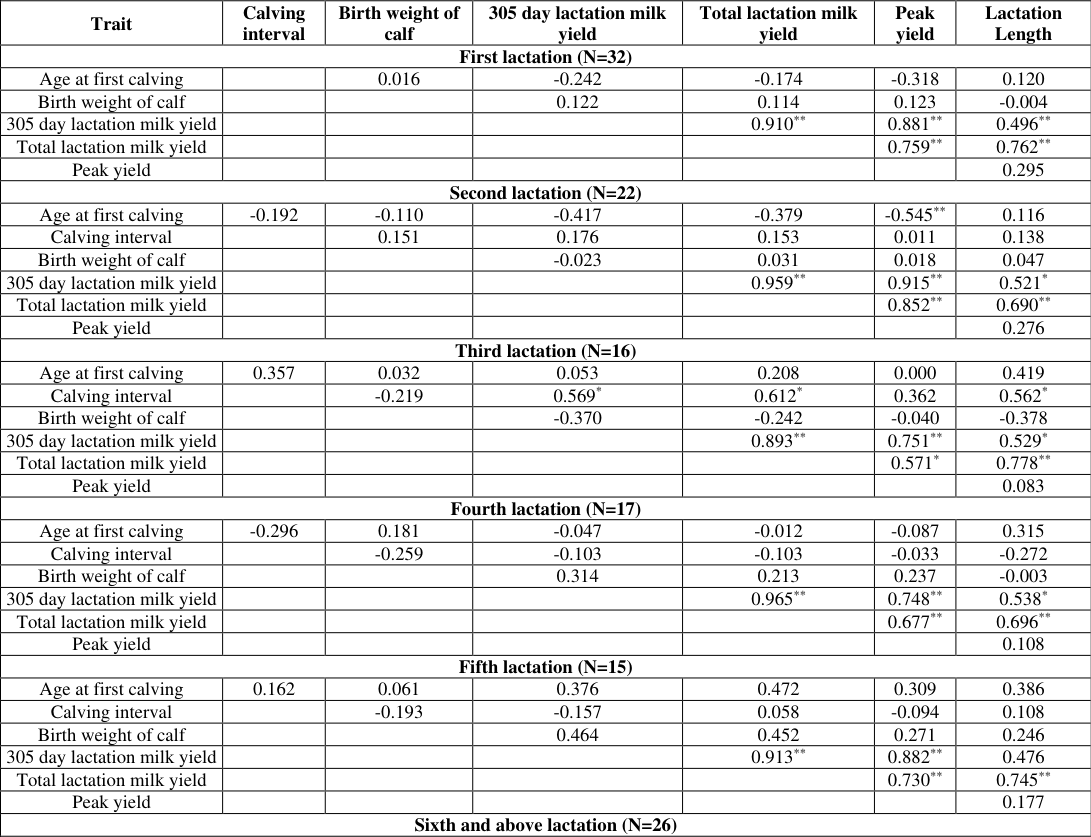 Table 2
Introduction
Among all the dual-purpose cattle breeds of India, the Ongole breed carries a special distinction of being our mute ambassadors to many developed and developing countries such as USA, Australia, Switzerland, Sri Lanka etc., and being the first Indian cattle breed to get worldwide recognition. Most of the countries imported the breed to exploit its traits such as rapid growth rate, capacity to thrive on dry fodder, medium milk yield, heat tolerance, disease resistance and draughtability through crossbreeding (NBAGR, 2006) [1] . At present, the breed is being improved genetically for milk production through progeny testing programme in its native state of Andhra Pradesh. The efficiency and profitability of milk production systems depend mostly on the production and reproduction traits of dairy cattle. The genetic parameters especially the phenotypic correlations of important production traits are of great help in designing of animal breeding programmes. The knowledge of correlation among different traits is necessary for choosing the method of selection to be employed for the cattle. Most of the previous studies reported a negative or unfavourable correlation between production traits such as the standard lactation milk yield and reproduction traits such as age at first calving (Lobo et al., 2000 [2] ; Ojango and Pollott, 2001 [3] ; Makgahlela et al., 2007 [4] ; Canaza-Cayo et al., 2018 [5] ) in different breeds of cattle. The present study was aimed at knowing the type of phenotypic correlation present among the production and reproduction traits in Ongole Cattle.
Materials and Methods
The present study was carried out using the data obtained from the Livestock Research Station, Mahanandi, Andhra Pradesh. Around 250 Ongole cattle of various categories such as calves, cows and heifers were maintained on the farm. Milk was extracted from the cows twice a day in the morning and evening after initial calf suckling for letdown of milk. Milk consumption by calf was not taken into account while presenting the results regarding milk yield. The reproduction traits such as age at first calving and calving interval were calculated using the history records present in the farm. The production traits that were studied included birth weight of calf, 305 day milk yield, total lactation milk yield, peak yield and lactation length. With the exception of birth weight of calf which was collected from the records, all other production traits were calculated from the daily milk records available in the farm. The formula of phenotypic correlation coefficient (r P ) which indicate association between two traits (X and Y) was: All the data were analysed through SPSS software as per the standard procedures.
Results and Discussion
The values of mean, standard deviation, standard error, minimum and maximum for the production and reproduction traits were presented in Table 1. The phenotypic correlation coefficients of the production and reproduction traits were depicted in Table 2. [6] , Kumar et al. (2016) [7] and Reddy et al. (2021) [8] in the Ongole cattle. The present study revealed that the age at first calving was moderately negatively correlated with 305 day lactation milk yield and total lactation milk yield during first and second lactations, and significantly (P < 0.01) negatively correlated with peak yield during second lactation. These findings are in agreement with that of Ojango and Pollott (2001) [3] , Ayalew et al. (2017) [9] , Canaza-Cayo et al. (2018) [5] , Girimal et al. (2020) [10] and Kusaka et al. (2021) [11] . Tamboli et al. (2022) [12] reported that the age at first calving had a negative relation with peak yield and but, positive relation with lactation milk yield. The age at first calving was moderately positively correlated with lactation length which coincided with that of Thombre et al. (2015) [13] . However, Abbas (2007) [14] and Ayalew et al. (2017) [9] reported a non-significant negative correlation between the traits which might be due to breed differences and environmental variation. The moderate positive association found between the age at first calving and calving interval during third and fifth lactations was similar to the reports of Brzáková et al. (2019) [15] and Atashi et al. (2021) [16] . The moderate negative association found between the age at first calving and calving interval during second, fourth, sixth and above lactations was similar to the report of Canaza-Cayo et al. (2018) [5] .
| Trait | Calving interval | Birth weight of calf | 305 day lactation milk yield | Total lactation milk yield | Peak yield | Lactation Length |
|---|---|---|---|---|---|---|
| First lactation (N=32) | ||||||
| Age at first calving | 0.016 | -0.242 | -0.174 | -0.318 | 0.120 | |
| Birth weight of calf | 0.122 | 0.114 | 0.123 | -0.004 | ||
| 305 day lactation milk yield | 0.910** | 0.881** | 0.496** | |||
| Total lactation milk yield | 0.759** | 0.762** | ||||
| Peak yield | 0.295 | |||||
| Second lactation (N=22) | ||||||
| Age at first calving | -0.192 | -0.110 | -0.417 | -0.379 | -0.545** | 0.116 |
| Calving interval | 0.151 | 0.176 | 0.153 | 0.011 | 0.138 | |
| Birth weight of calf | -0.023 | 0.031 | 0.018 | 0.047 | ||
| 305 day lactation milk yield | 0.959** | 0.915** | 0.521* | |||
| Total lactation milk yield | 0.852** | 0.690** | ||||
| Peak yield | 0.276 | |||||
| Third lactation (N=16) | ||||||
| Age at first calving | 0.357 | 0.032 | 0.053 | 0.208 | 0.000 | 0.419 |
| Calving interval | -0.219 | 0.569* | 0.612* | 0.362 | 0.562* | |
| Birth weight of calf | -0.370 | -0.242 | -0.040 | -0.378 | ||
| 305 day lactation milk yield | 0.893** | 0.751** | 0.529* | |||
| Total lactation milk yield | 0.571* | 0.778** | ||||
| Peak yield | 0.083 | |||||
| Fourth lactation (N=17) | ||||||
| Age at first calving | -0.296 | 0.181 | -0.047 | -0.012 | -0.087 | 0.315 |
| Calving interval | -0.259 | -0.103 | -0.103 | -0.033 | -0.272 | |
| Birth weight of calf | 0.314 | 0.213 | 0.237 | -0.003 | ||
| 305 day lactation milk yield | 0.965** | 0.748** | 0.538* | |||
| Total lactation milk yield | 0.677** | 0.696** | ||||
| Peak yield | 0.108 | |||||
| Fifth lactation (N=15) | ||||||
| Age at first calving | 0.162 | 0.061 | 0.376 | 0.472 | 0.309 | 0.386 |
| Calving interval | -0.193 | -0.157 | 0.058 | -0.094 | 0.108 | |
| Birth weight of calf | 0.464 | 0.452 | 0.271 | 0.246 | ||
| 305 day lactation milk yield | 0.913** | 0.882** | 0.476 | |||
| Total lactation milk yield | 0.730** | 0.745** | ||||
| Peak yield | 0.177 | |||||
| Sixth and above lactation (N=26) |
Table text extracted from the original PDF; superscript letters are shown inline. The original table image is below.
View original table image
| Trait | Mean | SD | SE | Min. | Max. |
|---|---|---|---|---|---|
| Age at first calving (yrs) | 4.948 | 0.836 | 0.074 | 3.112 | 7.411 |
| Calving interval (yrs) | 1.571 | 0.442 | 0.045 | 0.877 | 2.792 |
| Birth weight of calf (kg) | 27.875 | 2.635 | 0.233 | 21.000 | 35.000 |
| 305 day lactation milk yield (kg) | 750.972 | 239.201 | 21.143 | 277.450 | 1511.450 |
| Total lactation milk yield (kg) | 850.280 | 333.136 | 29.445 | 277.450 | 1933.950 |
| Peak yield (kg) | 4.170 | 1.097 | 0.097 | 1.900 | 7.500 |
| Lactation length (days) | 330.188 | 82.084 | 7.255 | 170.000 | 508.000 |
Table text extracted from the original PDF; superscript letters are shown inline. The original table image is below.
View original table image
Calving interval
The average calving interval in the Ongole cattle was found to be 1.571±0.045 years which was similar to the findings of Vinoo et al. (2005) [6] , Singh et al. (2008) [17] , Kumar et al. (2016) [7] and Reddy et al. (2021) [8] in Ongole cattle. It was found to have mild negative association with the birth weight of calf from third lactation onwards.
Production traits 3.2.1 Birth weight of calf
The mean birth weight of Ongole calf was 27.875±0.233 kg. Kumar et al. (2016) [7] reported similar value in Ongole cattle. The birth weight of calf was found to be negatively associated with the age at first calving during second lactation and with calving interval from third lactation onwards. It was similar to the findings of Dangi et al. (2021) [18] . However, Atashi et al. (2021) [16] found out that the calf birth weight was increased with increase in age at first calving.
305 day lactation milk yield
The mean standard lactation milk yield obtained in the present study was 750.972±21.143 kgs which was similar to the findings of Vinoo et al. (2005) [6] and Kumar et al. (2016) [7] in Ongole cows. It was positively correlated significantly (p< 0.01) with total lactation milk yield, and peak yield and lactation length. These findings were in agreement with those of Ahmad et al. (2001) [19] , Abbas (2007) [14] and Ayalew et al.
(2017) [9] . The present study revealed moderate antagonism between 305 day lactation milk yield and age at first calving during first and second lactations which was supported by Abbas (2007) [14] . However, there was positive association between the two traits from fifth lactation onwards.
Total lactation milk yield
The mean total lactation milk yield of Ongole cows was 850.280±29.445 kgs which was higher than findings of Vinoo et al. (2005) [6] and Singh et al. (2008) [17] , and lower than that of Reddy et al. (2021) [8] . The disagreements were might be due to variation in the level of genetic improvement at different points of time. The total lactation milk yield has significant (p< 0.01) positive relation with 305 day lactation milk yield, peak yield and lactation length. Ahmad et al. (2001) [19] , Abbas (2007) [14] and Ayalew et al. (2017) [9] found the similar results.
Peak yield
The mean value of the peak yield was 4.170±0.097 kg. Singh et al. (2008) [17] and Reddy et al. (2021) [8] reported almost similar values of peak yield. There was significant (P < 0.01) positive association of the peak yield with 305 day lactation milk yield and total lactation milk yield. These findings were in agreement with those of Reddy et al. (2021) [8] .
Lactation length
The present study revealed that the lactation length of Ongole cattle was 330.188±7.255 days. Lower values were reported by Vinoo et al. (2005) [6] , Singh et al. (2008) [17] , Kumar et al. (2016) [7] and Reddy et al. (2021) [8] in Ongole cattle. The discrepancy is probably due to presence of many outliers in the data of present study which is evident from the maximum value of lactation length in Table 1. It was found through the present study that the lactation length had moderate positive relation with age at first calving, and significant (p<0.01) positive correlation with 305 day lactation milk yield and total lactation milk yield. The results coincided with the findings of Abbas (2007) [14] , Ayalew et al. (2017) [9] and Reddy et al. (2021) [8] .
Conclusions
From the results of the present study, it can be concluded that the phenotypic correlation between the age at first calving and milk yield traits such 305 day lactation milk yield and peak yield changes from negative to positive with increase of lactation number, and there is a general trend of positive relation among the milk production traits in all the lactations. In addition to the phenotypic correlations, genetic correlations have to be studied to know the effect of environment since P= G + E.
Acknowledgments
The research facilities provided by Sri Venkateswara Veterinary University, Tirupati, Andhra Pradesh are acknowledged.
References
17 in the original paper- Lobo RNB, Madalena FE, Vieira AR. Average estimates of genetic parameters for beef and dairy cattle in tropical regions. Animal breeding abstracts. 2000;68(6):433-462.
- Ojango JMK, Pollott GE. Genetics of milk yield and fertility traits in Holstein-Friesian cattle on large-scale Kenyan farms. Journal of Animal Science. 2001;79(7):1742-1750.
- Makgahlela ML, Banga CB, Norris D, Dzama K, Ng'ambi JW. Genetic correlations between female fertility and production traits in South African Holstein cattle. South African Journal of Animal Science. 2007;37(3):180-188.
- Canaza-Cayo AW, Lopes PS, Cobuci JA, Martins MF, Silva MVGBD. Genetic parameters of milk production and reproduction traits of Girolando cattle in Brazil. Italian Journal of Animal Science. 2018;17(1): 2230.
- Vinoo R, Rao GN, Gupta BR, Rao KB. Genetic study on productive and reproductive traits of Ongole cattle. The Indian Journal of Animal Sciences. 2005;75(4): 438-441.
- Kumar A, Singh U, Singh R, Vinoo R. Genetic studies on production and reproduction traits of Ongole cattle at organized farms. Indian Journal of Animal Sciences. 2016; 86 (7): 826-830.
- Ayalew W, Aliy M, Negussie E. Estimation of genetic parameters of the productive and reproductive traits in Ethiopian Holstein using multi-trait models. AsianAustralasian journal of animal sciences. 2017;30(11):1550-1556.
- Girimal, DG, Kumar D, Shahi BN, Ghosh AK, Kumar S. Genetic evaluation of Sahiwal and crossbred cattle for some economic traits. Pantnagar Journal of Research. 2020;18(2):153-57.
- Kusaka H, Yamazaki T, Sakaguchi M. Association of the age and bodyweight at first calving with the reproductive and productive performance in one herd of Holstein dairy heifers in Japan. Veterinary Record Open. 2022;9:e44.
- Tamboli P, Bharadwaj A, Chaurasiya A, Bangar YC, Jerome A. Association between age at first calving, first lactation traits and lifetime productivity in Murrah buffaloes. Animal Bioscience. 2022;35(8):1151-1161.
- Thombre BM, Bhutkar SS, Mane ST. Genetic studies on components of production and reproduction traits in Holstein Friesian X Deoni (Holdeo) crossbred cattle. Bioinfolet-A Quarterly Journal of Life Sciences. 2015;12(2A):349-352.
- Abbas, S. Effect of calving season, parity and age at first calving on performance traits and phenotypic correlations between these traits in Holstein Friesian cows. Journal of Animal and Poultry Production. 2007;32(10):8181-8190.
- Brzáková M, Zavadilová L, Přibyl J, Pešek, P, Kašná, E, Kranjčevičová A. Estimation of genetic parameters for female fertility traits in the Czech Holstein population. Czech Journal of Animal Science. 2019;64(5):199-206.
- Atashi H, Asaadi A, Hostens M. Association between age at first calving and lactation performance, lactation curve, calving interval, calf birth weight, and dystocia in Holstein dairy cows. PLoS One. 2021;16(1):e0244825.
- Singh U, Kumar A, Beniwal BK, Vinoo R. Estimates of genetic parameters for economic traits in Ongole cattle. Indian Veterinary Journal. 2008;85(2):167-169.
- Dangi M, Singh CV, Barwal RS, Shahi BN. Estimation of Genetic Parameters of First Lactation and Life Time Traits Using Sire Model and Animal Model in Crossbred Cattle. Journal of Animal Research. 2021;11(6):10891095.
- Ahmad M, Van der Werf JHJ, Javed K. Genetic and phenotypic correlations for some economic traits in dairy cattle. Pakistan Veterinary Journal. 2001;21:81-86.