
Research article · 2024 · Full text
International Journal of Research in AgronomyComparative impact of organic and inorganic fertilizers on the growth parameters of mustard (Brassica juncea L.) var.M-27
Volume 7(1) · Pages 411–413 · DOI: 10.33545/2618060x.2024.v7.i1f.248 ↗
Research areasNitrogen and Sulfur Effects on BrassicaPhosphorus and nutrient management
Abstract
Author-writtenA field experiment was conducted at Borum Village, Itanagar, Arunachal Pradesh to investigate comparative impact of organic and inorganic fertilizer on the growth attributes of Mustard (Brassica juncea L.) during Rabi season 2021-22. The field experiment was laid out under randomized block design (RBD) with 7 treatments in three replications using organic and inorganic fertilizers in combination. The mustard variety M-27 was sown on 9th January, 2022 and harvested on 15th April, 2022 since the Mustard variety M-27 used in the experiment is an early maturity variety. Among the treatments, the maximum plant height and number of leaves per plant are 57.84 cm and 11.70 were obtained on 90 DAS with the application of 100% VC + 0% NPK. Meanwhile, the lowest plant height and number of leaves per plant are 38.20 cm and 6.92 on 90 Das were observed under control treatment. From the present investigation it is found that all the growth characters such as plant height (cm) and number of leaves per plant recorded at 30 days interval from sowing upto 90 days significantly influence by the application of 100% vermicompost (T2). From the present investigation it can be concluded that the higher growth was recorded with the application of 100% vermicompost (T2).
Summary
Source-checkedPlain-language reading of the full paper, prepared with AI and checked against the text. Each point links to the authors' own words.
Why it matters
- Mustard (Brassica juncea L.) is an annual herbaceous plant valued for its seeds, which are used as a spice. View evidence ↗
- Mustard seeds contain 37-49% oil, which is utilized in various applications including food preparation, medicine, and industrial uses. View evidence ↗
- Fertilizers are categorized as organic, derived from plant or animal materials, or inorganic, which are industrial products resulting from chemical or biological engineering. View evidence ↗
The question
- The study aimed to compare how organic and inorganic fertilizers impact the growth attributes of Mustard (Brassica juncea L.) during the 2021-22 Rabi season. View evidence ↗
What they did
- The researchers used a randomized block design (RBD) featuring seven different fertilizer treatments, each replicated three times. View evidence ↗
- The seven treatments consisted of a control (0%), 100% organic, 100% inorganic, and five combinations of organic to inorganic fertilizer (75:25%, 65:35%, 50:50%, and 25:75%). View evidence ↗
- Mustard variety M-27 was planted on January 9, 2022, and harvested on April 15, 2022. View evidence ↗
- Growth was measured by recording plant height and the number of leaves per plant at 30, 60, and 90 days after sowing (DAS). View evidence ↗
What they found
- The maximum number of leaves per plant at 30, 60, and 90 DAS (7.07, 11.73, and 11.70, respectively) occurred with the 100% vermicompost treatment (T2). View evidence ↗
- The authors attribute the success of vermicompost to its ability to provide macro and micro nutrients, growth regulators, and improve soil water retention and microbial activity. View evidence ↗
What it means
- The authors concluded that organic fertilizer led to better growth development in terms of plant height and leaf number for the M-27 mustard variety compared to inorganic fertilizer. View evidence ↗
- The authors recommend using vermicompost to enhance the growth and development of mustard crops. View evidence ↗
- The authors note that the long-term use of inorganic fertilizers may cause soil damage. View evidence ↗
Visual summary
1 visualsIllustrations explain the paper; they do not show study data.
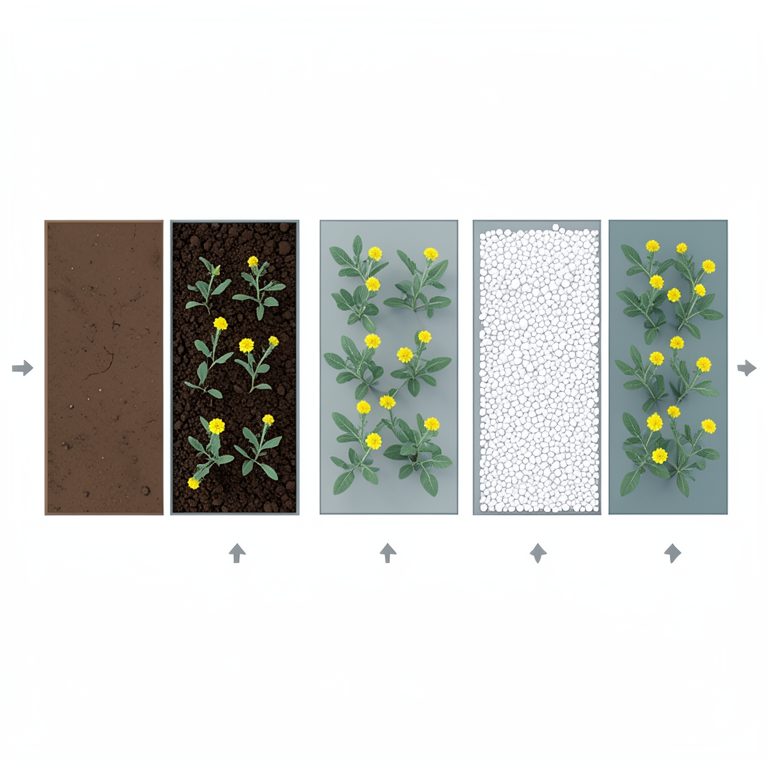
Experimental Treatment Layout
AI-generated conceptual illustration (Mustard plants (Brassica juncea L.) in field plots). It explains the idea and does not show study data.
View source evidence ↗Figures & tables
From the original paper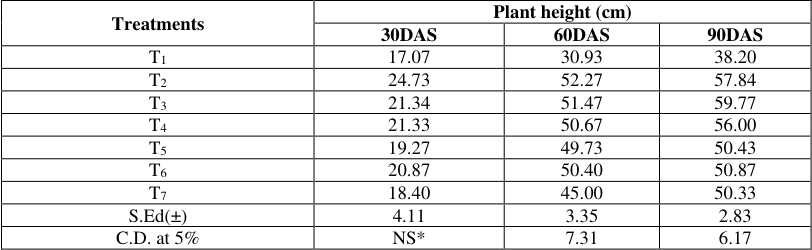 Table 1
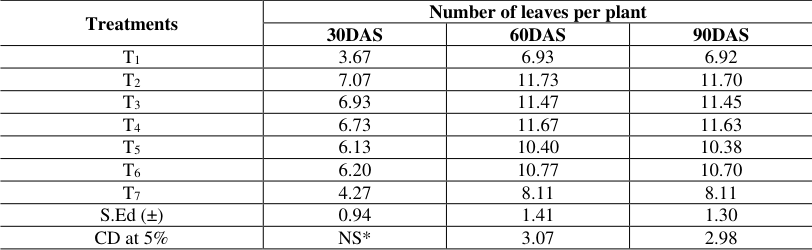 Table 2
Introduction
Mustard (Brassica juncea L.) is herbaceous annual plants in the family Brassicaceae, with chromosome no.18 grown for their seeds which are as a spice. The yellow/ white mustard is indigenous to Southern Europe, whereas brown mustard is from china introduced to Northern India. Mustard plants are thin herbaceous herbs with yellow flowers. The leaves of the plant are toothed, lobed and occasionally have the largest terminal lobes. It contains antioxidants and other beneficial plant compounds through to help protect our body against damage and disease. Mustard seeds content 37-49% of oil and these oil are sued as condemned in the preparation of pickles, curries, vegetables, hair oils, medicines and manufacture of glasses. The oil cake is used as a feed and manure. The leaves of young plant are used as green vegetable and stem and leaves are a good source of green fodder for cattle. In the tanning industry, mustard oil is used for softening leather. (Brassica juncea L.) is valued for its intense flavours and healing properties. This plant is cultivated mainly as an oil crop. It is a good bee plant (Kumar, 2018) [4] . All over the world, mustard is used for its appetizing flavour and preservative value and seeds are used largely for tempering food. Mustard is explored for its biodiesel potential (Mandal and Sinha, 2004) [5] . Organic fertilizer are fertilizers which are mostly or entirely consist of organic material derived from plant or animal which have gone through engineering processes and inorganic fertilizers are the fertilizers as a results of chemical, physical fertilizer or biological engineering processes and are industrial products or fertilizer manufacturing plants (Anggaraini et al., 2021) [1] .
Materials and Methods
The field experiment was carried out in Borum Village, Itanagar, Arunachal Pradesh during rabi season of the year 2022. The climatic condition of Borum is sub tropical. The rainy season actually started from may and it extended up to September and retreats from October onwards. The experiment was conducted in randomized block design (RBD) with 7 treatments in three replications. The organic and inorganic fertilizer were applied as 0%(control), 100% organic, 100% inorganic, 75:25%, 65:35%, 50:50%, 25:75%, respectively in three replications. All the Vermicompost and NPK were incorporated into the soil during final land preparation. Recommended doses of fertilizer used for mustard var. M-27 is 80:40:40 NPK Kg/ha. Five seeds of mustard var.M-27 were sown per hole at a depth of 3cm in the row, plant to plant distance was 15 cm and row to row distance was 45 cm. The mustard var.M-27 seeds were covered with pulverized soil just after sowing and gently pressed with hand. Five representative plants were selected at random from each unit plot to avoid border effect and tagged in the field. Plant height was measured from ground leaf to the tip of the longest leaf of the plant. The plant height and number of leaves per plant were recorded at 30, 60, 90 DAS and means were calculated. [2] . Application of organic manure exhibits a significant influence on number of leaves per plant of mustard var.M-27 crop at 30, 60 and 90 DAS. At 30, 60 and 90 DAS, the maximum number of leaves per plant with (7.07, 11.73 and 11.70) were found with the application of 100% VC+ 0% NPK in treatment (T 2 ) and the minimum recorded in control treatments T 1 with the value of (3.67, 6.9 and 6.92). It reduces after the 90 DAS. This shows that the application of different fertilizer has different effect on different growing time of mustard var.M-27. The treatment T 2 (100% organic) resulted in highest number of leaves per plant over all other treatments whereas control treatment (T 1 ) result lowest among all other treatments. It decreased after 90 DAS, treatment (T 2 ) had the highest yield rate after 30 DAS. The 100% application of vermicompost adds plant nutrient (macro and micro) and growth regulators, it also increase soil water retention, microbial population, causing more mineralization and consequently more release of available nutrients and treatment T 1 (control) had the lowest number of leaves per plant as there is no application of fertilizer in control plot and because of lack of nutrient control treatment (T 1 ) had the lowest number of leaves per plant. This shows that application of vermicompost has different effect on different growing time of the plant. This result is in agreement with (Kansotia, 2015) [3] .
Results and Discussion
Results and Discussion
Conclusion
Mustard M-27 variety which was grown under organic fertilizer showed the higher growth development plant height and number of leaves per plant than that of inorganic fertilizer. Application of treatment (T 2 ) which was 100% vermicompost had the highest plant height (24.73, 52.27 and 77.84) and number of leaves (6.27, 11.73 and 11.70). The highest plant height and number of leaves recorded in treatment T 2 and lowest in treatment T 1. According to the experiment, we recommend to use organic fertilizer (vermicompost) to increase crop growth and development of mustard as the production is high compared to all other treatments in which the control resulted in lowest growth parameters. Meanwhile, the control treatment (T 1 ) should be avoided in order to achieve high yield though continues use of inorganic fertilizer may cause damages to the soil in the long run but proper soil reclamation procedure should be implemented to avoid in the degradation of soil and its quality and we encourage and promote organic farming for better productivity and sustaining the soil quality.
Acknowledgement
AcknowledgementThe authors express their gratitude to research advisor for his guidance and encouragement and co-members, who were part of the study and have provided theirs valuable inputs. All the friends are dully acknowledged for their role in establishing the experimental trail plots. The support obtained from the Himalayan University, Arunachal Pradesh, is also thankfully acknowledged.
Figures and tables from the paper
| Treatments | Plant height (cm) | — | — |
|---|---|---|---|
| 30DAS | 60DAS | 90DAS | |
| T1 | 17.07 | 30.93 | 38.20 |
| T2 | 24.73 | 52.27 | 57.84 |
| T3 | 21.34 | 51.47 | 59.77 |
| T4 | 21.33 | 50.67 | 56.00 |
| T5 | 19.27 | 49.73 | 50.43 |
| T6 | 20.87 | 50.40 | 50.87 |
| T7 | 18.40 | 45.00 | 50.33 |
| S.Ed(±) | 4.11 | 3.35 | 2.83 |
| C.D. at 5% | NS* | 7.31 | 6.17 |
Table text extracted from the original PDF; superscript letters are shown inline. The original table image is below.
View original table image
| Treatments | Number of leaves per plant | — | — |
|---|---|---|---|
| 30DAS | 60DAS | 90DAS | |
| T1 | 3.67 | 6.93 | 6.92 |
| T2 | 7.07 | 11.73 | 11.70 |
| T3 | 6.93 | 11.47 | 11.45 |
| T4 | 6.73 | 11.67 | 11.63 |
| T5 | 6.13 | 10.40 | 10.38 |
| T6 | 6.20 | 10.77 | 10.70 |
| T7 | 4.27 | 8.11 | 8.11 |
| S.Ed (±) | 0.94 | 1.41 | 1.30 |
| CD at 5% | NS* | 3.07 | 2.98 |
Table text extracted from the original PDF; superscript letters are shown inline. The original table image is below.
View original table image
References
5 in the original paper- Anggraini WD, Prihantini NN. The effect of organic and inorganic fertilizer on Mustard (Brassica juncea L.) growth in Bahway Village, Balik Bukit district, West lampung regency. Journal of Physics Conference Series. 2021;1796(1):012004.
- Beenish O, Ahmad D, Ashaq H. Organic Manure and Biofertilizer: Effect on the Growth and Yield of Indian Mustard (Brassica juncea L.) Varieties. Current Journal of Applied Science and Technology. 2018, 1-7.
- Kansotia BM. Effect of Vermicompost and Inorganic fertilizer on Indian Mustard (Brassica juncea L.). Asian Journal of Soil Science. 2015;8(1):136-139.
- Kumar AK. Effect of Organic Management practicesa on growth, Yield attribute and grain yield in mustard (Brassica juncea L.). International journal of current Microbiology and applied science, 2018.
- Mandal, Sinha AC. Nutrient Management Effect on light interception, Photosynthesis, Growth, Dry matter production and yield of Indian Mustard (Brassica juncea L.). Journal of Agronomy and crop science. 2004;55(4):278-291.