
Research article · 2024 · Full text
International Journal of Research in AgronomyOODS of survival of Marwari sheep lamb in arid region of India
Volume 7(1S) · Pages 105–107 · DOI: 10.33545/2618060x.2024.v7.i1sb.245 ↗
Research areasLivestock Management and Performance ImprovementAgricultural Economics and Practices
Abstract
Author-writtenAn animal's health and welfare are enhanced by optimal young stock rearing, which also makes the herd more sustainable. Producers require knowledge into their kid's rearing outcomes, ideally based on key indications, in order to assess the rearing process. While mortality is thought to be a valuable metric for evaluating the general well-being and health of animals, less is known about its occurrence and the factors that affect it in the dairy industry. How and when producers record mortality after birth may present additional challenges to calculating the risks of kid mortality. The current study's findings indicate that by taking action to regulate environmental and animal-related factors, mortality losses may be reduced. Since the maximum birthweight has not yet been attained, there is still room to increase birthweight by improved nutrition for the mother, which will lower the infant death rate. The highest observed mortality rates were attributed to respiratory diseases (MTR-I=1.77%, MTR-II=7.29%), then blood diseases (MTR-I=0.85%, MTR-II=3.52%), other group diseases (MTR-I=0.41%, MTR-II=1.69%), digestive system diseases (MTR-I=0.85%, MTR-II=3.52%), and tetanus (MTR-I=0.32%, MTR-II=1.30%). Another way to reduce mortality would be to determine the dam's threshold weight at kidding in relation to child mortality. External validation can be carried out on separate datasets of Marwari sheep from different regions to ensure the model's generalizability.
Summary
Source-checkedPlain-language reading of the full paper, prepared with AI and checked against the text. Each point links to the authors' own words.
Why it matters
- Optimal rearing of young stock is essential for improving animal health and welfare, which in turn increases the sustainability of the herd. View evidence ↗
- Mortality is a key metric for assessing animal health, but there is limited knowledge regarding its occurrence and contributing factors within the dairy industry. View evidence ↗
The question
- The study aims to identify how regulating environmental and animal-related factors can reduce mortality losses in Marwari sheep lambs. View evidence ↗
What they did
- The research analyzed mortality percentages and economic damage in Marwari sheep lambs born between 2005 and 2014. View evidence ↗
- Lambs were categorized into age groups, specifically sucklings (birth to 3 months) and weaning (3 to 6 months). View evidence ↗
- Post-mortem examinations were conducted to validate and document the causes of death in the lambs. View evidence ↗
- Mortality data was analyzed based on the sex of the lamb, the year of the disease, and the season of birth. View evidence ↗
What they found
- The overall mortality rate for the studied group of Marwari sheep was 3.73%. View evidence ↗
- Respiratory diseases caused the highest mortality rates, with MTR-I at 1.77% and MTR-II at 7.29%. View evidence ↗
- Other significant causes of mortality included blood diseases (MTR-I=0.85%, MTR-II=3.52%), digestive system diseases (MTR-I=0.85%, MTR-II=3.52%), other group diseases (MTR-I=0.41%, MTR-II=1.69%), and tetanus (MTR-I=0.32%, MTR-II=1.30%). View evidence ↗
- There was a significant difference between male and female lambs in the total number of sick animals at MTR-1 and MTR-2. View evidence ↗
- In the respiratory system category, male lambs had a higher mortality rate (MTR-I=2.01%, MTR-II=7.86%) compared to female lambs (MTR-I=1.53%, MTR-II=6.65%). View evidence ↗
What it means
- To minimize economic losses, the authors recommend prompt disease treatment and regular deworming, particularly for respiratory, digestive, blood, and eye diseases. View evidence ↗
- The authors suggest that improving maternal nutrition to increase birthweight could further reduce the infant death rate. View evidence ↗
- The authors note that external validation using datasets from different regions is needed to ensure the generalizability of their findings. View evidence ↗
Visual summary
2 visualsIllustrations explain the paper; charts are replotted from the paper's own table values.
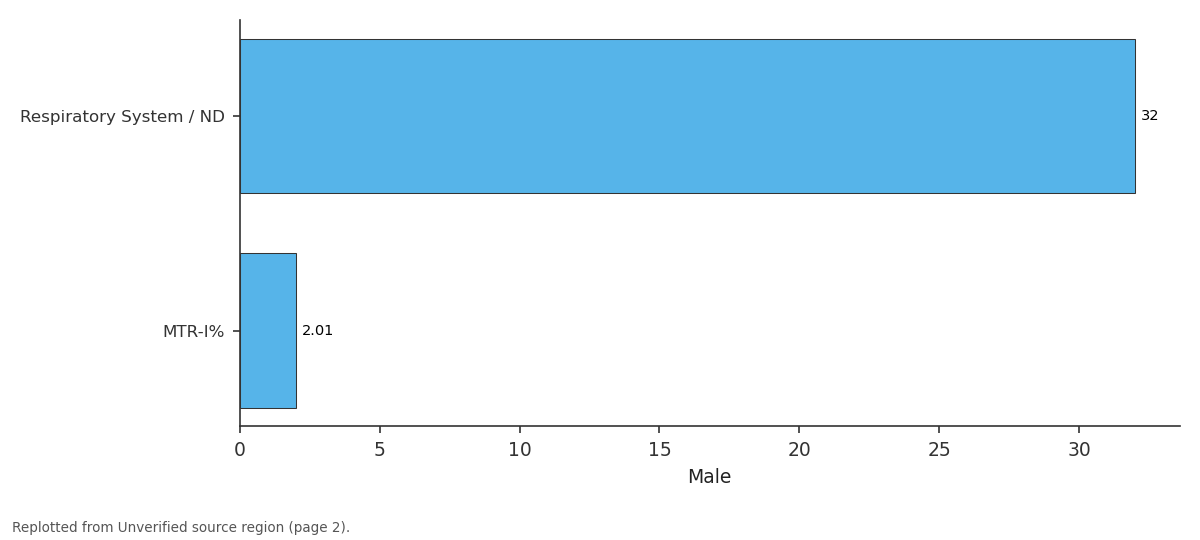
Male: Respiratory System / ND vs MTR-I%
Replotted from a table (page 2) of the original paper. Every bar is the paper's own table value.
View source evidence ↗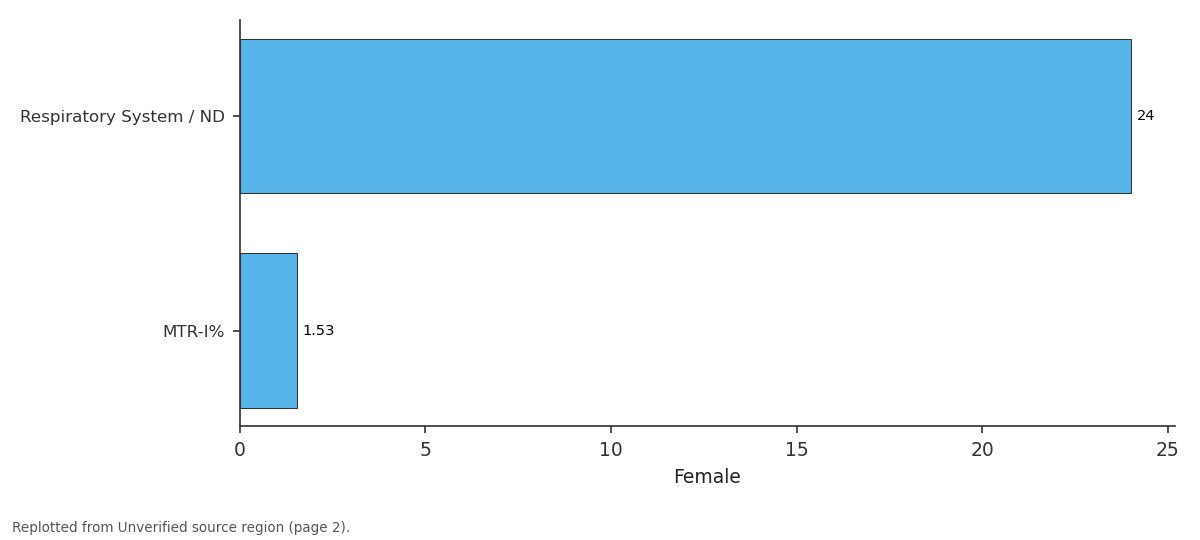
Female: Respiratory System / ND vs MTR-I%
Replotted from a table (page 2) of the original paper. Every bar is the paper's own table value.
View source evidence ↗Figures & tables
From the original paper Table 1
 Table 2
Introduction
Dairy farming is intrinsically tied to raising kids, as gestation is required not only to initiate breastfeeding but also to replenish the herd and enhance her pedigree. Since goat and sheep are seasonal breeders, farmers must deal with a brief period of time during which kidding and raising of newly born young stock take centre stage in farm operations. Because it is common in Dutch dairy goat husbandry to strive for longer breastfeeding, only a small portion of the herd typically gives birth, with the majority of babies delivered between January and May (Dijkstra et al., 2023) [1] . Rates of death and the variables influencing them the mortality rates resulting from distinct diseases were computed independently. The death rates of Marwari sheep were shown to be influenced by several factors, including sex, the year of the disease, and the season of birth. The proportion of dead lambs to all lambs available and the percentage of dead lambs for a specific disease to all sick lambs were used to calculate the mortality rate in the current study. Sharma (2006) [9] found that the total mortality rates for Marwari sheep were 3.58 percent for sucklings, 3.32 percent for weaners, 2.37 percent for hoggets, and 14.37 percent for adults. Many studies examining the mortality have found that pre-weaning animals typically experience a higher rate of mortality than adults (Chouhan et al., 2019; Sharma et al., 2007; Kumar et al., 2010) [2,3,4] . Additionally, mortality during the weaning period may account for as much as 37% of the total mortality (Chouhan et al., 2019; Thiruvenkadan and Karunanithi, 2007) [2,5] .
Materials and Methods
Materials and Methods
Source of data
The Central Sheep and Wool Research Institute's Arid Region campus in Bikaner, together with the project "Improvement of Marwari sheep for carpet wool production through selection" are the sources of the data used in this study.
Illustration of data
This investigation offers a summary of Marwari sheep statistics on mortality percentage and economic damage at various age groups of lambs from 2005 to 2014 (year of birth). Birth to 03 (suckling), 03 to 06 (weaning) were the various age categories.
Mortality rate
The lambs, both alive and dead, were sorted into age groups: 0-3. The post-mortem results were used to document and validate the potential cause of the lambs' deaths.
Body weight
Within twenty-four hours of lambing, the birth weights of both healthy and sick lambs were noted. Before the lambs had access to food or water, their weight was measured at three months of age (weaning), then again at six, nine, and twelve months of age in the morning. We used a dial platform balance with a 50 kg capacity that was accurate to within 0.05 kg up until weaning, and a 100 kg capacity that was accurate to within 0.10 kg after weaning.
Classification of data
The mortality rate data was categorised by birth season, disease sire year, and sex. The rates of illness and death by sire were also computed. The weather, feeding, housing, and differential management of males and females data were not collected at the farm, so they were excluded from the analysis.
Sex of lamb
For every condition under examination, the mortality rates for male and female lambs in the age categories of 0-3, 3-6, 6-12, and over twelve months were computed independently.
Season of birth
To investigate how variations in temperature, humidity, rainfall, and other meteorological factors affect mortality rates, the year was split into two seasons based on the month that lambs were born. [7] study. According to Mauna (1994) [6] , the average post-weaning mortality was 6% and 10%, respectively, while the pre-weaning mortality was higher in lambs than in goats. According to Segura et al. (1996) [8] , the blackbelly and Pelibuey sheep breeds have lamb mortality rates till weaning of 23.8 and 15.1%, respectively.
The highest observed mortality rates were attributed to respiratory diseases (MTR-I=1.77%, MTR-II=7.29%), then blood diseases (MTR-I=0.85%, MTR-II=3.52%), other group diseases (MTR-I=0.41%, MTR-II=1.69%), digestive system diseases (MTR-I=0.85%, MTR-II=3.52%), and tetanus (MTR-I=0.32%, MTR-II=1.30%). Total number of sick in term of male and female was significantly different at MTR-1 and MTR-2.
Sheep are susceptible to a variety of illnesses, such as parasite infections, gastrointestinal problems, and respiratory infections. The frequency of these illnesses in a given area, the success of preventative efforts, and the promptness and quality of veterinary care can all have an impact on the death rate.
Conclusion
The economic losses resulting from the morbidity and mortality of diseases of the respiratory system (pneumonia), the digestive system (I) (diarrhoea), the eye (conjunctivitis), the digestive system (II), the blood, and pyrexia were greater; therefore, regular deworming and prompt disease treatment were necessary to minimise losses. Conjunctivitis and foot rot were similarly associated with higher morbidity rates in the hogget and adult age groups, thus caution should be used while treating these conditions.
Declarations of Competing Interest:
The authors declare that they have no conflicts of interest associated with this publication.
Figures and tables from the paper
| S. No. | Season | Months of year |
|---|---|---|
| 1. | First | January to June |
| 2. | Second | July to December |
Table text extracted from the original PDF; superscript letters are shown inline. The original table image is below.
View original table image
| Classes | No. of animals | — | Blood | — | — | — | Digestive system | — | — | Reptile bite | — |
|---|---|---|---|---|---|---|---|---|---|---|---|
| TNA | TSA | ND | MTR-I% | MTR-II% | ND | MTR-I% | MTR-II% | ND | MTR-I% | MTR-II% | |
| Total | 3164 | 768 | 27 | 0.85 | 3.52 | 12 | 0.38 | 1.56 | 0 | 0.00 | 0.00 |
| Sex | χ2 | 0.84 | 0.41 | 0.00 | 0.04 | ||||||
| Male | 1594 | 407 | 16 | 1.00 | 3.93 | 6 | 0.38 | 1.47 | 0 | 0.00 | 0.00 |
| Female | 1570 | 361 | 11 | 0.70 | 3.05 | 6 | 0.38 | 1.66 | 0 | 0.00 | 0.00 |
Table text extracted from the original PDF; superscript letters are shown inline. The original table image is below.
View original table image
References
8 in the original paper- Dijkstra E, Vellema P, Brom RVD, Berends IS. Kid mortality indicators based on census data in dairy goat herds in the Netherlands. Small Ruminant Research. 2023;226:107042. https://doi.org/10.1016/j.smallrumres.2023.107042.
- Chauhan IS, Misra SS, Kumar A, Gowane GR. Survival analysis of mortality in pre-weaning kids of Sirohi goat. Animal. 2019;13(12):2896-2902. DOI: 10.1017/S1751731119001617.
- Sharma SK, Nagda RK, Kumar U, Khadda BS. Mortality pattern in Sirohi goats under field conditions. Indian Journal of Small Ruminants. 2007;13:210-212.
- Kumar U, Sharma SK, Nagda RK, Rajawat BS. Replacement index and mortality pattern of Sirohi goats under field condition. Indian Journal of Small Ruminants. 2010;16:274-276.
- Thiruvenkadan AK, Karunanithi K. Mortality and replacement rate of Tellicherry and its crossbred goats in Tamil Nadu. Indian Journal of Animal Sciences. 2007;77:590-594.
- Mauna PN. Performance of sheep and goats in smallholder farms in Eastern Highlands province of Papua New Guinea. Harvest (Port Moresby). 1994;16(1-2):10-11.
- Mukasa ME, LahlouKassi A, Anindo D, Regea JEO, Tembely S, Tibboa M, et al. Between and within breed variation in lamb survival and the risk factors associated with major causes of mortality in indigenous Horro and Menz sheep in Ethiopia. Small Ruminant Research. 2000;37(1-2):1-12.
- Segura JC, Sarmiento L, Rojas O. Productivity of Pelibuey and Blackbelly ewes in Mexico under extensive management. Small Ruminant Research. 1996;21(1):57-62.