
Research article · 2024 · Full text
International Journal of Agriculture Extension and Social DevelopmentWomen entrepreneur and problems- a micro level assessment
Volume 7(1) · Pages 657–660 · DOI: 10.33545/26180723.2024.v7.i1i.274 ↗
Research areasLivestock Management and Performance ImprovementEntrepreneurship Studies and InfluencesIndian Economic and Social Development
Abstract
Author-writtenWomen as entrepreneur are seen in various sector of enterprise like agriculture, textile, food packaging, food processing, crafting, livestock rearing etc. But woman as entrepreneur face many challenges in terms of balancing between family and career, socio-cultural barriers, dearth of financial assistance, lack of technical knowledge, marketing and entrepreneurial skills, lack of self – confidence and many more. Present study was carried out in Dhemaji district of Assam by adopting snowball samplings techniques to understand challenges of women entrepreneurs. Out of total 80 entrepreneurs 36 entrepreneur run their enterprises with official registration either in DIC, Gaon panchayt or office of the block level and 44 entrepreneurs who doesn't registered their enterprise. Study revealed that at the time of initial establishment major challenge faced both the categories of entrepreneurs was financial problem. Study also revealed that there is a significant difference between challenges faced by the registered and non-registered entrepreneurs in running their enterprises in the study area.
Summary
Source-checkedPlain-language reading of the full paper, prepared with AI and checked against the text. Each point links to the authors' own words.
Why it matters
- Women entrepreneurs operate across diverse sectors, including agriculture, textiles, food processing, and livestock rearing. View evidence ↗
- Women entrepreneurs face significant hurdles, such as socio-cultural barriers, financial shortages, and the struggle to balance family and career. View evidence ↗
- Unlike male entrepreneurs, women often encounter specific societal obstacles including male domination and religious or family restrictions. View evidence ↗
The question
- The study aims to understand the specific challenges women entrepreneurs experience while growing their businesses. View evidence ↗
What they did
- The research was conducted in the Dhemaji district of Assam, specifically within the randomly selected Murkong Selek Tribal and Sissiborgaon development blocks. View evidence ↗
- Using snowball sampling, the study recruited 80 women entrepreneurs, consisting of 36 registered and 44 non-registered business owners. View evidence ↗
- Primary data was gathered from the participants using an interview schedule. View evidence ↗
- A t-test was employed to analyze the differences in challenges faced by registered versus non-registered entrepreneurs. View evidence ↗
What they found
- During the initial establishment phase, financial problems were the primary challenge for both registered (38.9%) and non-registered (36.4%) entrepreneurs. View evidence ↗
- Poor infrastructure was cited as a major initial challenge by 13.9% of registered and 13.6% of non-registered entrepreneurs. View evidence ↗
- In the current operational stage, increased competition is the leading challenge, reported by 47.3% of registered and 43.2% of non-registered entrepreneurs. View evidence ↗
- Balancing family responsibilities and business roles was a major current challenge for 8.3% of registered and 4.5% of non-registered entrepreneurs. View evidence ↗
- Financial problems are less prevalent during the operational stage (8.3% registered, 4.5% non-registered) compared to the initial establishment phase. View evidence ↗
What it means
- The authors conclude that societal attitudes and mindsets must change to eliminate the obstacles hindering women entrepreneurs. View evidence ↗
- The authors recommend supporting women in realizing their strengths to help them succeed in entrepreneurship. View evidence ↗
Figures & tables
From the original paper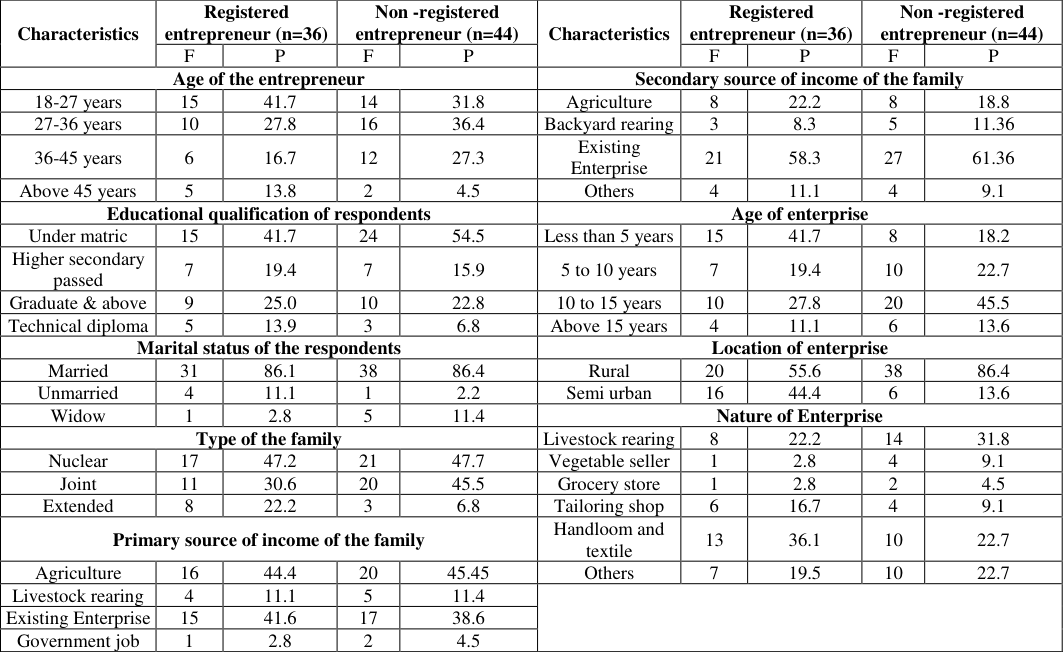 Table 1
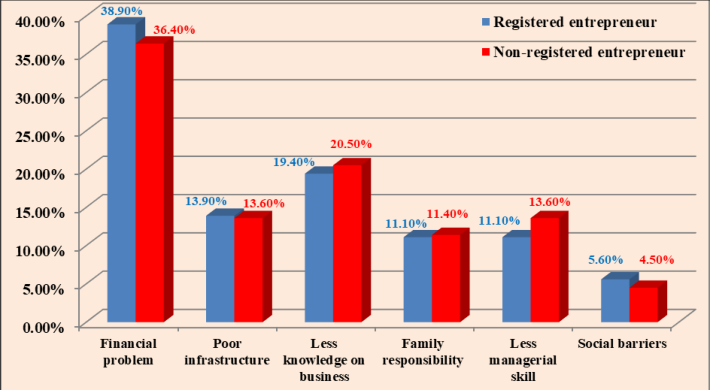 Figure 1
 Table 2
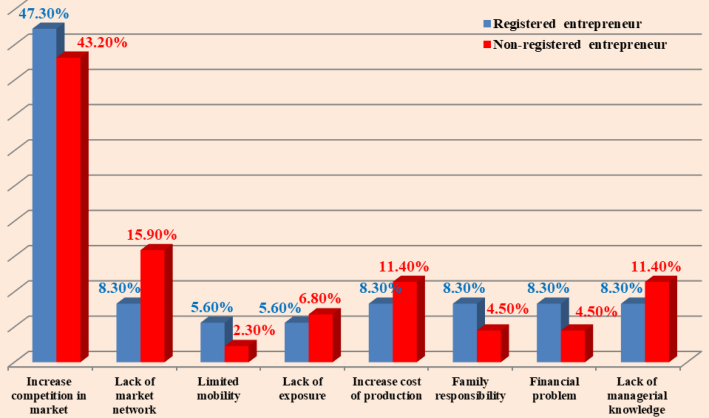 Figure 2
Introduction
An entrepreneur is a person having courage with specific skill, ability, knowledge, awareness and self-confidence, who bears the risk of operating a business in the face of uncertainty about the future conditions. Entrepreneurs are innovators, who can think differently to establish a products or services in a new form of earning. Singh and Belwal (2008) revealed entrepreneur as person who is initiate by new idea, personal goals and interest to establish and run a business entity by bringing together financial capital, people, equipment and other facilities. Women constitute half of the country's population and have a great contribution in economic development of the nation. Over the last few decades there has been a steady change taking place in terms of their involvement in various economic activities including entrepreneurship for growth of the nation. Women entrepreneurs can be defined as a women or group of women, who initiate, organise and run a business enterprise, have the quality of innovation, initiation, organise and can bear a risk in all types of challenges in the business. According to the recent reports and studies, due to increasing number of women as an entrepreneurs has changed the demographic characteristics of business and economic growth of the country. Womenowned businesses enterprises are playing more active role in society and the economic development of the nation. But Women being an entrepreneur have to face many challenges sometimes more than a man. They are expected to take orders rather than give it. Role conflict between home maker and carrier, Poor funding prospects, restriction in mobility, Lack of risk bearing capacity, Limited of exposure and networking, Lack of managerial knowledge etc are common challenges documented in different literature face by women entrepreneur in India. Apart from women entrepreneur in many societies face challenges in terms of male domination, family restriction, religion restriction etc which does not come as hinder for male entrepreneur. Like other parts of country in Assam also women are now seen in various sector of enterprise like agriculture, textile, food packaging, food processing, crafting, livestock rearing etc. Present study is designed to understand the challenges experienced by women entrepreneurs in growth of their enterprises.
Materials and Methods
The study was carried out in Dhemaji district of Assam, Out of total five numbers of development blocks, two blocks namely Murkong Selek Tribal Development Block and Sissiborgaon Development Block were selected randomly. Snowball sampling technique was adopted to locate the women entrepreneurs. A total of 80 women entrepreneur comprised the total sample of the study. Out of that 36 entrepreneurs were registered entrepreneur and 44 were non-registered entrepreneurs. The primary information of respondents was collected with the help of an interview schedule. Registered entrepreneurs are those who have registered their enterprise in the government sectors like DIC, NRLM etc to get benefits of govt. scheme, credit facilities, etc. non-registered entrepreneurs does not have such registration in government sectors. The interview www.extensionjournal.com schedule was prepared keeping in mind the objectives of the study. Prior to data collection, purpose of the interview was explained properly to the women entrepreneurs (respondent). The consent and cooperation of the respondent were sought for and an interaction (interview) was carried out as per the convenient time of the respondents. The collected data were analysed by using appropriate statistical techniques.
Results and Discussions
Before analysing challenges they face, it was found important to understand few basic information about selected entrepreneurs and their enterprises. Few basic information about entrepreneur and their enterprises are revealed in Table 1. The highest number of selected registered respondents (i.e. 41.7 per cent) were in the age group of 18-27 years followed by 27-36 years age group (27.8 per cent), Among non-registered entrepreneur highest percentage of respondents (i.e. 36.4 per cent) are in the category of 27-36 years of age group followed by 31.8 per cent in the age group of 18-27 years. In both the categories respondents above 45 years are found lowest. Regarding educational qualifications, all the entrepreneurs were found to be literate. Highest percentage of entrepreneur in both the categories were found to be under matric among registered (i.e. 41.7 per cent) and 54.5 per cent among non-registered entrepreneurs. 13.9 per cent of respondents among registered entrepreneurs completed a technical diploma while only 6.8 per cent among nonregistered completed a technical course like ITI, polytechnic etc. Majority of respondents were found married in both the categories of registered and non-registered entrepreneurs, i.e. 86.1 per cent and 86.4 per cent respectively followed by 11.1 per cent of respondents in registered entrepreneurs are unmarried while 2.2 per cent of respondents in nonregistered entrepreneurs are unmarried. Majority of respondents were belonged to the category of nuclear family in both registered and non-registered entrepreneurs, respondents household having 2 to 4 members in the family. Existing enterprise as primary source of income was found among 41.6 per cent registered entrepreneurs and 38.6 per cent non-registered entrepreneurs. Secondary sources of income are referred as additional earning sources of the family apart from primary source of income. It was revealed that all the selected respondent households were engaged in one or the other activity as secondary source of income.
| Characteristics | Registered entrepreneur (n=36) | — | Non -registered entrepreneur (n=44) | — | Characteristics | Registered entrepreneur (n=36) | — | Non -registered entrepreneur (n=44) | — |
|---|---|---|---|---|---|---|---|---|---|
| F | P | F | P | F | P | F | P | ||
| Age of the entrepreneur | Secondary source of income of the family | ||||||||
| 18-27 years | 15 | 41.7 | 14 | 31.8 | Agriculture | 8 | 22.2 | 8 | 18.8 |
| 27-36 years | 10 | 27.8 | 16 | 36.4 | Backyard rearing | 3 | 8.3 | 5 | 11.36 |
| 36-45 years | 6 | 16.7 | 12 | 27.3 | Existing Enterprise | 21 | 58.3 | 27 | 61.36 |
| Above 45 years | 5 | 13.8 | 2 | 4.5 | Others | 4 | 11.1 | 4 | 9.1 |
| Educational qualification of respondents | Age of enterprise | ||||||||
| Under matric | 15 | 41.7 | 24 | 54.5 | Less than 5 years | 15 | 41.7 | 8 | 18.2 |
| Higher secondary passed | 7 | 19.4 | 7 | 15.9 | 5 to 10 years | 7 | 19.4 | 10 | 22.7 |
| Graduate & above | 9 | 25.0 | 10 | 22.8 | 10 to 15 years | 10 | 27.8 | 20 | 45.5 |
| Technical diploma | 5 | 13.9 | 3 | 6.8 | Above 15 years | 4 | 11.1 | 6 | 13.6 |
| Marital status of the respondents | Location of enterprise | ||||||||
| Married | 31 | 86.1 | 38 | 86.4 | Rural | 20 | 55.6 | 38 | 86.4 |
| Unmarried | 4 | 11.1 | 1 | 2.2 | Semi urban | 16 | 44.4 | 6 | 13.6 |
| Widow | 1 | 2.8 | 5 | 11.4 | Nature of Enterprise | ||||
| Type of the family | Livestock rearing | 8 | 22.2 | 14 | 31.8 | ||||
| Nuclear | 17 | 47.2 | 21 | 47.7 | Vegetable seller | 1 | 2.8 | 4 | 9.1 |
| Joint | 11 | 30.6 | 20 | 45.5 | Grocery store | 1 | 2.8 | 2 | 4.5 |
| Extended | 8 | 22.2 | 3 | 6.8 | Tailoring shop | 6 | 16.7 | 4 | 9.1 |
| Primary source of income of the family | Handloom and textile | 13 | 36.1 | 10 | 22.7 | ||||
| Agriculture | 16 | 44.4 | 20 | 45.45 | Others | 7 | 19.5 | 10 | 22.7 |
| Livestock rearing | 4 | 11.1 | 5 | 11.4 | |||||
| Existing Enterprise | 15 | 41.6 | 17 | 38.6 | |||||
| Government job | 1 | 2.8 | 2 | 4.5 |
Table text extracted from the original PDF; superscript letters are shown inline. The original table image is below.
View original table image
Table 1 shows existing enterprise as secondary source of income among 58.3 per cent of registered entrepreneurs and 61.38 per cent non-registered entrepreneurs. Findings shows in all the households of selected entrepreneurs have both primary and secondary source of income. Age of enterprise helps us to understand how old an enterprise is, it was found that 41.7 per cent registered enterprises were less than five years old i.e. 3 to 4 years old, followed by 27.8 per cent which were of 10 to 15 years old. www.extensionjournal.com Among non-registered entrepreneurs, majority of enterprises (45.5 per cent) were 10 to 15 years old and only 13.6 per cent enterprise were found to be more than 15 years. It was also revealed that 55.6 per cent enterprises of registered entrepreneurs were located in rural areas followed by 44.4 per cent enterprise located in semi urban areas. Similarly, 86.4 per cent enterprises of non-registered entrepreneurs were located in rural areas, followed by 13.6 per cent enterprise in semi urban area. No enterprises were found to be located in urban areas.
Nature of an enterprise indicates product or services offers to the customer. From the Table it was found that different product or services offered to the customer by selected entrepreneur in study area. Enterprise with handloom and textile product among selected registered entrepreneur found highest i.e. 36.1 per cent followed by livestock rearing and tailoring shop (22.2 and 16.7 per cent respectively) livestock farming includes piggery, poultry farming and cattle rearing in study area. Among non registered entrepreneurs livestock rearing was found highest i.e. 31.8 per cent followed by handloom and textile (22.7 per cent). In the category of others includes cosmetic shop, tea stall, beauty parlour, small tea grower etc.
Challenges faced by women entrepreneurs
Challenges are the situations that need physical and mental effort to overcome. In the study area women entrepreneur faced multiple challenges. In following findings only major challenges were presented.
Challenges during initial stage of establishment
Fig. 1 shows in the study area major challenges faced by the entrepreneurs during establishment of their enterprises was financial problem (i.e. 38.9 per cent registered and 36.4 per cent non-registered reported respectively) and small percentage of entrepreneur i.e. 5.6 per cent registered and 4.5 per cent non-registered reported social barriers in terms of restricted mobility, religious restriction as major challenge. Reddy et al. (2015) [3] in a study revealed that women entrepreneurs faced major challenges such as availing financial support and marketing network during initial establishment of business. Poor infrastructure as major challenges in initial stage were reported by 13.9 per cent registered entrepreneur and 13.6 per cent non-registered entrepreneur. Poor infrastructure indicated physical facilities for starting their enterprises.
Respondents reported that initially they started their enterprises in adjacent part of their houses which create problem in attracting customer as a result they face financial constraints. Other challenges like less knowledge in terms of technical knowledge, market linkages, legal procedure of registration etc. was also reported as major challenge during initial period of establishment in study area in a study revealed that women entrepreneur faced challenges in accessing fund and lack of knowledge on business in the initial establishment of business.
Major Challenges face by women entrepreneur to run their enterprises Fig. 2 revealed major challenges face by women entrepreneur in running their enterprises at present age are different than the challenges they faced in initial period. Increase competition was reported as major challenge by 47.3 per cent and 43.2 per cent respondents both the category respectively. Similar study Reddy et al. (2015) [3] , revealed that in the operational stage women entrepreneurs faced challenges such as stiff competition, social barriers, lack of self confidence and family burden. Managing duel role and fulfilling family responsibilities as major challenge reported by 8.3 per cent registered entrepreneur and 4.5 per cent non-registered entrepreneur. Other challenges like cost of production, Lack of proper exposure, Lack of marketing network, managerial knowledge are also reported as major challenge face by women entrepreur in study area. Financial problem as major challenges was reported by 8.3 per cent registered entrepreneur and only 4.5 per cent non-registered entrepreneur which is very less compared to initial establishment of their enterprises. This is mainly because of availability of micro finance institutions and their services in support of expansion of enterprise. Mauchi (2014) [2] also revealed women entrepreneurs face numbers of problem in financial support, networking challenges, low level of education and managerial skills and problems in balancing family responsibilities and business in a study conducted in Mashonaland Central Province. www.extensionjournal.com
Difference in challenges
To analysis challenges face by women entrepreneur in study area between registered and non-registered entrepreneur ttest was conducted Table 2 shows that the P value of probability value is found to be 0.008 which is less than 0.05 i.e. at 5 per cent level of significance. Hence, inference can be drawn that there is a significance difference between the business challenges faced at present stage by registered and non-registered selected entrepreneurs in study area.
| Characteristics | Type of enterprise | N | Mean | S.D | t | P value |
|---|---|---|---|---|---|---|
| Challenges faced at present stage | Registered entrepreneurs | 36 | 1.9722 | 0.69636 | 2.702 | 0.008 |
| Non-registered entrepreneurs | 44 | 2.4773 | 0.92733 |
Table text extracted from the original PDF; superscript letters are shown inline. The original table image is below.
View original table image
Conclusion
Entrepreneurs are the people who have the skills and initiative, which is necessary to take good new ideas to market and make the right decisions to make the idea profitable. Entrepreneur perceives a need and then brings together manpower, material and capital required to meet that need. Women were really tried hard to come out of household workload and trying to shape their imagination, talent and creativity into line of business. But in this road they face many challenges like increase competition in market, increase cost of production, lack of marketing network, family responsibility, limited mobility, financial problem and lack of managerial skill in terms of running and up scaling of their enterprises etc. but the quantum of challenges varies with registered and non-registered entrepreneur. With these challenges women entrepreneurs are trying to open the door of new jobs and success for themselves and others also. Therefore effort needs to eliminate obstacles for women entrepreneurs by changing attitudes and mindsets of people in society There are ample opportunities for women to be an entrepreneur, supporting them in realizing their strengths, can help them to shine in the field of enterprise.
References
4 in the original paper- Mamum, Al Md, Abdul Md J, Rebeka S. Problems and Opportunities of Women Entrepreneurship in Char Areas of Bangladesh. South Asian Journal of Social Studies and Economics. 2021;10(2):27-38.
- Mauchi NF, Mutengezanwa M, Damiyano D. Challenges faced by women entrepreneurs: A case study of Mashonaland Central Province. International Journal of Development and Sustainability. 2014;3(3):466-480.
- Reddy KB, Reddy KP, Panda S. Women entrepreneurs in India: An empirical analysis of motivations, success factors and problems. EDII Eleventh Biennial Conference. 2015;112:1076-1093.
- Vinesh. Role of Women Entrepreneurship in India. Global Journal of Finance and Management. 2014;6(5):473-480.