
Research article · 2024 · Full text
International Journal of Veterinary Sciences and Animal HusbandryWound healing in native poultry birds
Volume 9(1) · Pages 940–942 · DOI: 10.22271/veterinary.2024.v9.i1m.1027 ↗
Research areasBiochemical and Structural CharacterizationEssential Oils and Antimicrobial ActivityAntimicrobial Peptides and Activities
Abstract
Author-writtenIn developing countries, the cutaneous wounds can impose considerable economic burdens on farmers. If the wound is left untreated may lead to secondary bacterial infection and maggot infestation. Sometimes the wounds can result in life-threatening septicaemia. Hence effective therapies are required to handle the wound in order to prevent its potential complications. There are many natural phototherapeutic agents which have medicinal properties and promote tissue healing. The anti-microbial activity of Sarala resin, anti-inflammatory property of Tailaparna leaves and tissue regeneration ability of Devadaru bark, promote wound healing. Numerous studies have demonstrated the ability of Oxytetetracycline (OTC) and Gentian violet to heal wounds. In this study, Group 1 and Group 2 birds with wounds were applied topically with a spray 1 combination of Sarala resin, Tailaparna leaves and Devadaru bark and spray 2 which included OTC+ Gentian violet. The results have shown spray 1 healed wound significantly more quickly and effectively than spray 2. To our knowledge, no research has compared spray 1 (Sarala resin, Tailaparna leaves, and Devadaru bark) with spray 2 (Gentian violet and OTC). Additional in-depth research in this area will facilitate the application of medicinal plants for the treatment of cutaneous wounds in animals.
Summary
Source-checkedPlain-language reading of the full paper, prepared with AI and checked against the text. Each point links to the authors' own words.
Why it matters
- Cutaneous wounds in poultry can cause significant economic losses for farmers in developing countries. View evidence ↗
- Untreated wounds in birds are dangerous because they can lead to maggot infestation, secondary bacterial infections, or fatal septicaemia. View evidence ↗
- Certain natural agents, specifically Sarala resin (antimicrobial), Tailaparna leaves (anti-inflammatory), and Devadaru bark (tissue regeneration), are known to promote healing. View evidence ↗
The question
- The study aimed to compare the effectiveness of a natural plant-based spray (Sarala resin, Tailaparna leaves, and Devadaru bark) against a conventional spray containing Oxytetracycline (OTC) and Gentian violet. View evidence ↗
What they did
- Three types of wounds were surgically induced in the birds: deep wounds on the back, skin wounds on the lateral neck, and comb wounds via comb removal. View evidence ↗
- Wounds were sutured, with sutures removed on day 7; observations continued until day 15, and photography was conducted on days 0, 3, and 7. View evidence ↗
- The assigned treatment sprays were applied to the wounds twice daily throughout the study period. View evidence ↗
What they found
- Observations indicated that healing in Group 1 was faster than in Group 2 specifically between days 5 and 7. View evidence ↗
- By day 12, Group 1 birds showed faster clearance of wound scabs and encrustations than Group 2 birds. View evidence ↗
- Birds in Group 2 exhibited more pronounced scratching of their wounds compared to those in Group 1. View evidence ↗
What it means
- The authors conclude that the natural combination of Sarala resin, Tailaparna leaves, and Devadaru bark is effective for treating deep, skin, and comb wounds. View evidence ↗
- The natural spray is considered clinically beneficial and cost-effective. View evidence ↗
- The authors state that more detailed clinical studies are required to further validate these findings. View evidence ↗
Visual summary
2 visualsIllustrations explain the paper; charts are replotted from the paper's own table values.
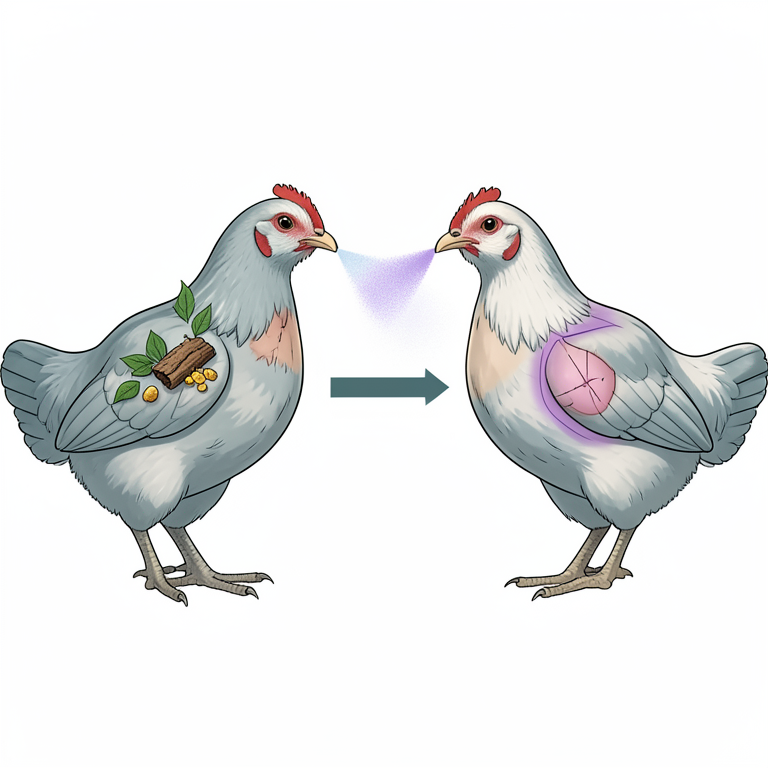
Comparison of Treatment Groups
AI-generated conceptual illustration (native poultry birds). It explains the idea and does not show study data.
View source evidence ↗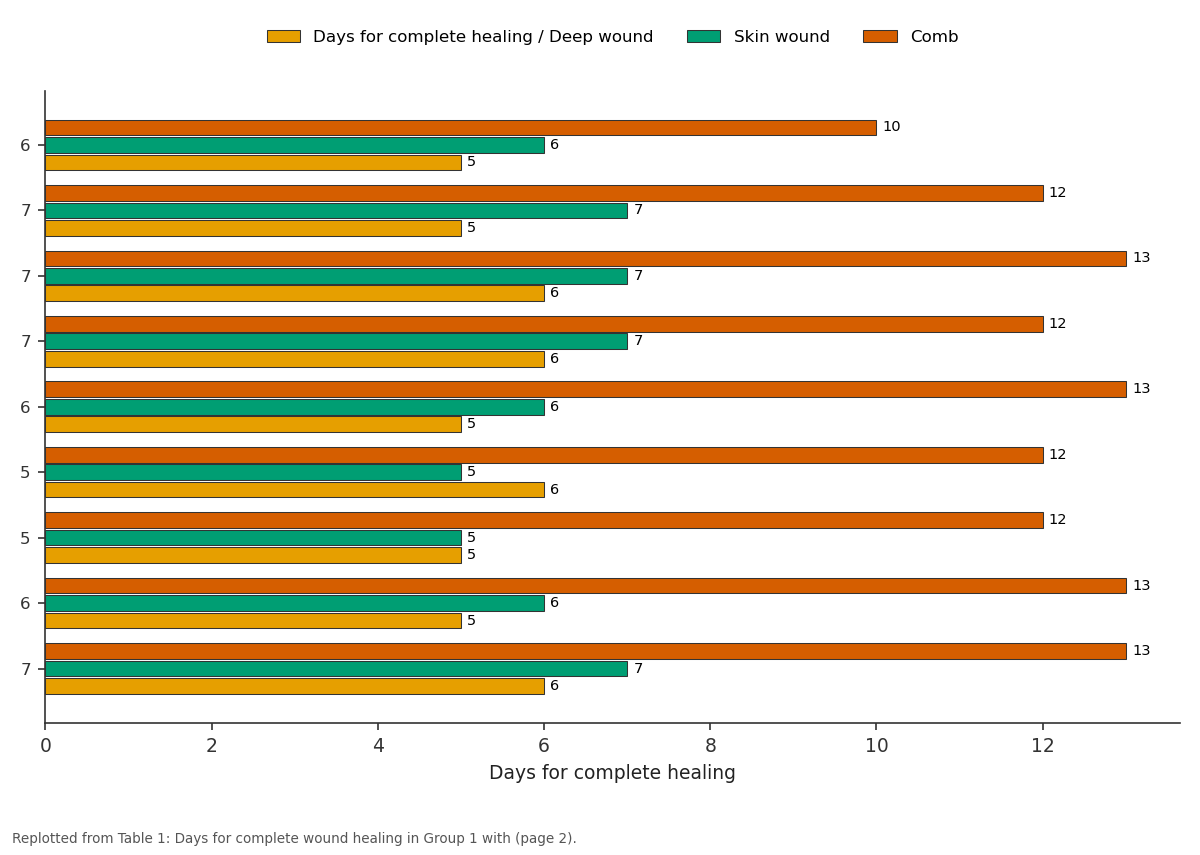
Days for complete healing / Deep wound and Skin wound and more: 6 vs 7 vs 7 vs 7 vs 6
Replotted from Table 1 (page 2) of the original paper. Every bar is the paper's own table value.
View source evidence ↗Figures & tables
From the original paper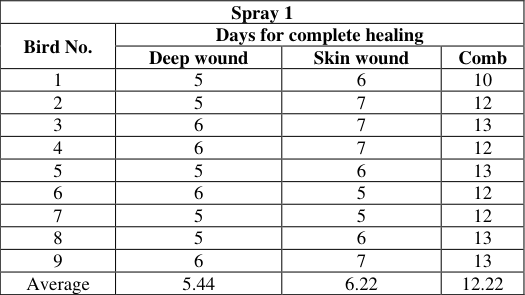 Table 1
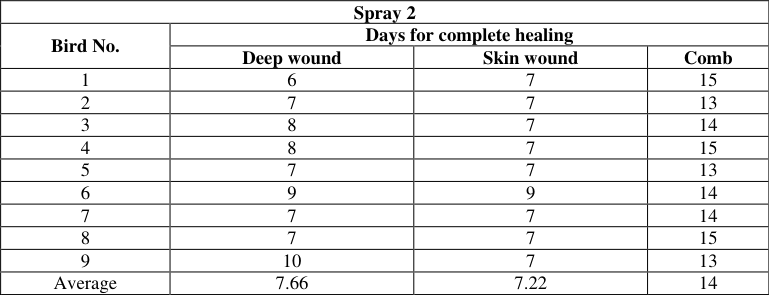 Table 2
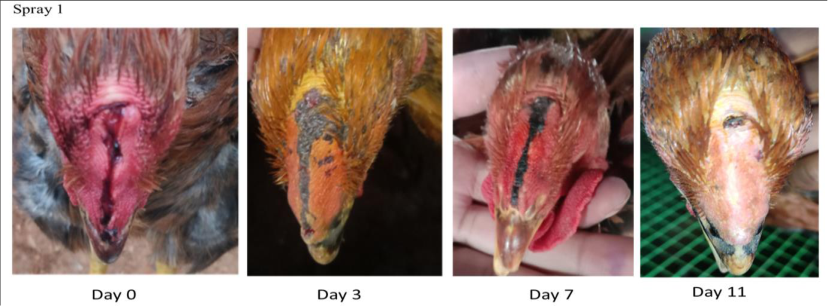 Figure 1
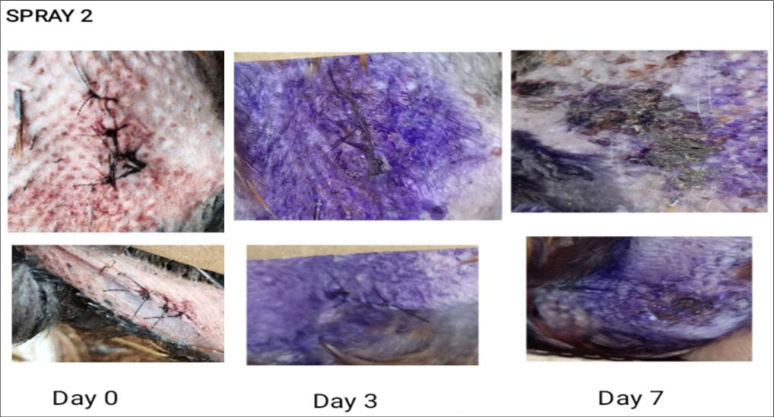 Figure 4
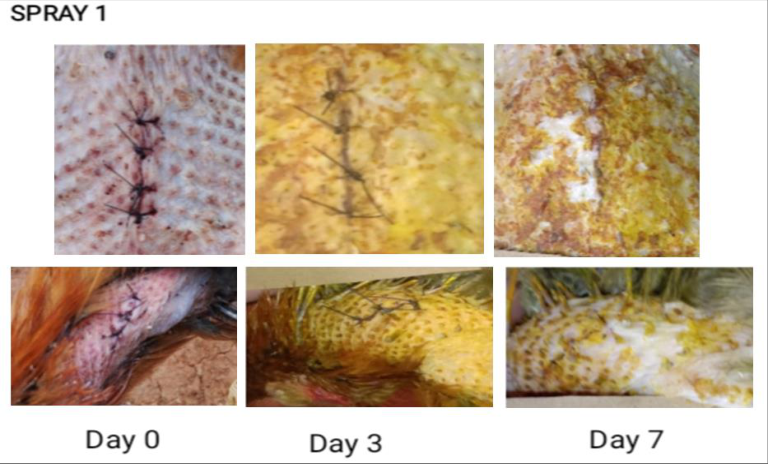 Figure 3
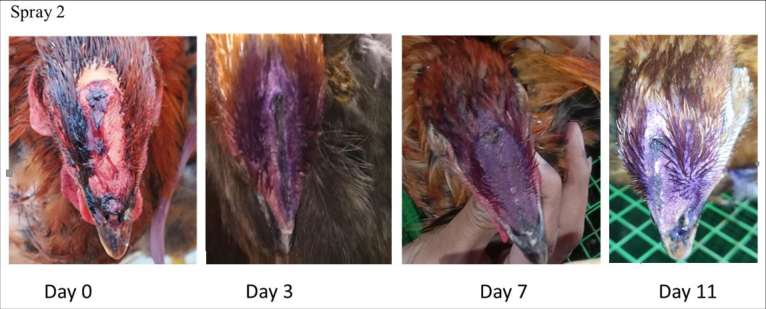 Figure 2
Introduction
A wound is defined as a disruption of the skin, mucous membrane or tissue surface, which is caused by physical, chemical or biological factors (Basha et al., 2020) [2] . These wounds can manifest suddenly involving skin tearing, cutting or puncturing or even development of bruises due to blunt force trauma. In developing countries, wounds can impose considerable economic burdens on farmers due to inadequate hygiene practices. In some cases, these wounds may lead to secondary bacterial infections. Even a minor, unnoticed wound left untreated for several days can escalate into a severe microbial infection in birds. Moreover, this condition may progress to septicaemia or infestation by maggots. These scenarios present significant issues for animal owners and result in substantial financial losses for farmers. Most wounds generally heal on their own, necessitating only simple care to protect them from external elements. Nevertheless, in instances where wounds do not heal as expected, a more proactive approach to treatment that fosters the healing process becomes necessary. The wound care products include topical antibiotics, wound irrigants, and wound antiseptics, various types of bandages, and products that aid in reducing the appearance of scars. Over-thecounter products available for minor burns and cuts include skin protectants, skin protectants with antiseptics, and local anesthetics. Polysporin, Neosporin, Bacitracin, Mupirocin Oxytetracycline (OTC) and Metronidazole are over-the-counter antibiotic ointments that are useful for minor skin injuries. Antibiotics such as Clindamycin, Sulphamethoxazole-Trimethoprim, Cefazolin, Imipenem etc. play a crucial role in halting bacterial growth and addressing infections caused by bacteria. Interestingly, phytotherapeutic agents have been widely employed in the context of healing cutaneous wounds. These include Aloe vera, Mimosa, Grape vine, Echinacea, Chamomile, Ginseng, Green tea, Jojoba, Tea tree oil, Rosemary, Lemon, Soybean, Comfrey, Papaya, Oat, Garlic, Ginkgo, Olive oil and Ocimum (Derakhshanfar, A and Moayedi, J. 2019) [4] . Sarala resin has antimicrobial property. It cleanses the wound and promotes wound healing. Tailaparna leaves contain antioxidants and may help to reduce inflammation and promotes wound healing. Devadaru bark have cleansing property and facilitates wound healing also promotes tissue regeneration. Gentian violet is an over-the-counter medication designed to treat fungal infections of the skin such as ringworm and athlete's foot. It is available in the form of topical solution specifically intended for skin application. Additionally, variety of over-the-counter products is available for the treatment of minor wounds and burns.
Materials and Methods
Eighteen native healthy poultry birds weighing around 2.3 to 2.5 kgs are taken in the study. Each study group includes nine birds. Group 1 and Group 2 birds with wounds were smeared with a spray 1 combination of Sarala resin, Tailaparna leaves and Devadaru bark and spray 2 which included OTC+ Gentian Violet. For study purpose wounds were made over back of the birds, skin wound was made surgically over lateral neck skin region; comb wound was made by surgically removing comb of all the birds. All the wounds were sutured using synthetic sutures. All the procedures were carried under anaesthesia and strict aseptic conditions with minimal pain. The sutures were removed on day 7 and the observation was continued till day 15. The photography of the wounds were taken on day 0, day 3, day 7 for deep wounds, skin wounds and comb wounds. However, the observations and photography were continued for comb wounds up to period of 11 days. The treatment sprays were applied twice daily through the period.
Results
The eighteen birds with induced wounds were classified into Group 1 applied with spray 1 and Group 2 with OTC+ Gentian Violet Spray application on the wound. The clinical examination of wounds included observations for swelling, serous oozing, healing rate and any other self-induced scratching by birds. General body condition and activity level were also considered. The period of observations was from the day of beginning of application of spray to day 11. The deep wound over dorsal body surface of birds started to show healing by third day in both the groups. However, the routine observations showed, relatively slower healing rate in Group 2 than Group 1. In Group 1, the healing was faster during 5 to 7 days than Group 2. The same could be evidenced as shown in the photography on day 7 in Group 1 than Group 2. The wound over comb took longer time for healing in both groups. However, in Group 1 much of the wound scabs, encrustations over wounds are cleared faster by day 12 than Group 2. The days for complete healing in both the Group 1 and Group 2 are shown in the table 1 & 2 respectively. The Spray used for Group 1, showed good wound healing activity with sustained fly repellent activity with anti-itching property. The scratching of the wounds by birds was more pronounced in Group 2 than Group 1. The application of Group 1 spray was found to be easy and the wound areas were clearly evident. However, the spray of Group 2 was staining the wound areas and thereby wound healing could not be observed easily. Over all, the spray 1 combination of Sarala resin, Tailaparna leaves and Devadaru bark was found to be effective over deep, skin and comb wound lesions over different body surfaces. Clinically, the spray found to be very beneficial without many expenses. However, further elaborated clinical study is needed for the same.
| Spray 1 | — | — | — |
|---|---|---|---|
| Bird No. | Days for complete healing | ||
| Deep wound | Skin wound | Comb | |
| 1 | 5 | 6 | 10 |
| 2 | 5 | 7 | 12 |
| 3 | 6 | 7 | 13 |
| 4 | 6 | 7 | 12 |
| 5 | 5 | 6 | 13 |
| 6 | 6 | 5 | 12 |
| 7 | 5 | 5 | 12 |
| 8 | 5 | 6 | 13 |
| 9 | 6 | 7 | 13 |
| Average | 5.44 | 6.22 | 12.22 |
Table text extracted from the original PDF; superscript letters are shown inline. The original table image is below.
View original table image
Discussion
Wound healing commonly means repairing of the skin. Normally, they heal by themselves. However, microbial contamination of wound is the major complication for wound healing. When the skin is damaged, microorganisms can quickly invade the underlying tissues and cause infections that are potentially life-threatening. As a result, effective therapies are required to handle such pathological disorders. Sarala resin, found in the Himalayan region, furnishes an oleo-resin which is used as insecticides, disinfectants and liver disorders. They are reported to have wound healing, cytotoxic, antibacterial, antifungal and spasmolytic actions. The plant also shows beneficial effects in the treatment of cough, ulceration and genito-urinary disorders. Many studies showed the wound healing property of Sarala resin in many human and animal species (Shuaib et al., 2013) [16] . [18,3,8,10] . Tailaparna commonly known as Eucalyptus is a fastgrowing evergreen tree. Several bioactivities, including fungicidal and antibacterial properties, have been noted for Eucalyptus essential oils and widely used in medicine (El-Sakhawy et al., 2023) [6] . [21,9,1,6] . Devadaru widely known as Cedrus deodara, the common cedar is an important plant belonging to the family pinaceae. C. deodara has been proven to have great pharmacological potential with a great utility and usage medicinal plant (Gupta et al., 2011) [7] . Its oil has been reported to possess antiinflammatory and anti-microbial activities. [5,15,11,17,13,12,20] . Gentian violet derived from coal tar has antibacterial, antifungal, antiviral, antiparasitic, anti-angiogenic, antitumor, and wound healing properties. Gentian violet is a low cost and well-tolerated topical agent with the potential for widespread applications in dermatology (Pona et al., 2020) [14] . OTC acts as topical antibiotic. Combination of Gentian Violet with OTC plays good role in wound healing. Many studies have shown the wound healing property of both Gentian violet and OTC.
In our study we could find wound healing was much faster in spray 1 than spray 2. According to our knowledge no studies have shown comparison of spray 1 (Sarala resin, Tailaparna leaves and Devadaru bark) and spray 2 (Gentian violet and OTC). Further elaborative studies in this field will help in use of medicinal plants in cutaneous wound healing.
Conclusion
Untreated wounds run the risk of developing secondary bacterial infections and pest infestations. Sometimes the wounds might cause septicemia, which can be fatal. Naturally occurring phytotherapeutic substances like Sarala resin, Tailaparna leaves and Devadaru bark possess medical qualities and aid in the healing of tissue. Wound healing is aided by the antimicrobial activity of Sarala resin, the antiinflammatory qualities of Tailaparna leaves, and the capacity for tissue regeneration of Devadaru bark. These plant derived substances work efficiently in wound repair and also in control of microbial infections.
Figures and tables from the paper
| Spray 2 | — | — | — |
|---|---|---|---|
| Bird No. | Days for complete healing | ||
| Deep wound | Skin wound | Comb | |
| 1 | 6 | 7 | 15 |
| 2 | 7 | 7 | 13 |
| 3 | 8 | 7 | 14 |
| 4 | 8 | 7 | 15 |
| 5 | 7 | 7 | 13 |
| 6 | 9 | 9 | 14 |
| 7 | 7 | 7 | 14 |
| 8 | 7 | 7 | 15 |
| 9 | 10 | 7 | 13 |
| Average | 7.66 | 7.22 | 14 |
Table text extracted from the original PDF; superscript letters are shown inline. The original table image is below.
View original table image
References
20 in the original paper- Alam P, Shakeel F, Anwer MK, Foudah AI, Alqarni MH. Wound healing study of eucalyptus essential oil containing nanoemulsion in rat model. Journal of Oleo Science. 2018;67(8):957-968.
- Basha SI, Ghosh S, Vinothkumar K, Ramesh B, Mohan KM, Sukumar E. Fumaric acid incorporated Agar-agar hybrid hydrogel: A multifunctional avenue to tackle wound healing. Materials Science and Engineering: C. 2020;111:110743.
- Chaudhary AK, Singh V, Ahmad S, Mazumder A. Wound Healing, Antimicrobial and Antioxidant potentials of Cedrus Deodara Loud and Pinus Roxburghii Sarg. Indian Drugs. 2022;59(9).
- Derakhshanfar A, Moayedi J, Derakhshanfar G, Fard AP. The role of Iranian medicinal plants in experimental surgical skin wound healing: An integrative review. Iranian Journal of Basic Medical Sciences. 2019;22(6):590.
- Dikshit A, Dixit SN. Cedrus oil -a promising anti-fungal agent. Indian Perfumer. 1982;26:216-227.
- El-Sakhawy MA, Soliman GA, El-Sheikh HH, Ganaie MA. Anticandidal effect of Eucalyptus oil and three isolated compounds on cutaneous wound healing in rats. European Review for Medical & Pharmacological Sciences. 2023;27(1).
- Gupta S, Walia A, Malan R. Phytochemistry and pharmacology of Cedrus deodera: an overview. International Journal of Pharmaceutical sciences and Research. 2011;2(8):2010.
- Heinrich M, Jiang H, Scotti F, Booker A, Walt H, Weckerle C, Maake C. Medicinal plants from the Himalayan region for potential novel antimicrobial and anti-inflammatory skin treatments. Journal of Pharmacy and Pharmacology. 2021;73(7):956-967.
- Kadhim EF, Amer H. Laser Doppler Evaluation to the Effect of Local Application of Eucalyptus Oil on Wound Healing: Histological Study on Male Rats. International Journal of Medical Research & Health Sciences. 2018;7(12):114-120.
- Khateeb AM, Khandi SA, Kumar P, Bhadwal MS, Jeelani R. Ethno-veterinary practices used for the treatment of animal diseases in Doda district, Jammu & Kashmir; 2015.
- Kunwar RM, Uprety Y, Burlakoti C, Chowdhary CL, Bussmann RW. Indigenous use and ethnopharmacology of medicinal plants in far-west Nepal; 2009.
- Maan AS, Sandhu BS, Chauhan RS, Rathore PS. Pharmacognostic Standardization of Cedrus deodara stem Bark. Journal of Current Pharma Research. 2012;2(4):645.
- Nadeem F, Khalid T, Jilani MI, Rahman S. A review on ethnobotanical, phytochemical and pharmacological potentials of Cedrus deodara. International Journal of Chemical and Biochemical Sciences. 2019;15:28-34.
- Pona A, Quan EY, Cline A, Feldman SR. Review of the use of gentian violet in dermatology practice. Dermatology Online Journal. 2020;26(5).
- Semchenko K. Substantiation of the composition of antibacterial soap with a complex of essential oils; 2023.
- Shuaib M, Ali M, Ahamad J, Naquvi KJ, Ahmad MI. Pharmacognosy of Pinus roxburghii: A review. Journal of Pharmacognosy and Phytochemistry. 2013;2(1):262268.
- Singh H, Saklani A, Lal B. Ethnobotanical observations on some gymnosperms of Garhwal Himalaya, Uttar Pradesh, India. Economic Botany. 1990;44(3):349-354.
- Kumari N, Singh N, Singh B. 2017. Phytoconstituent S and Pharmacological Activity of Pinus Roxburghii Sarg.: A Review. International Journal of Pharmaceutics and Drug Analysis. 2015;5(7):241-249.
- Ullah TS, Firdous SS, Shier WT, Hussain J, Shaheen H, Usman M, et al. Diversity and ethnomycological importance of mushrooms from Western Himalayas, Kashmir. Journal of Ethnobiology and Ethnomedicine. 2022;18(1):1-20.
- Velmurugan C, Geetha C, Shajahan SK, Vijayakumar S, Kumar PL. Wound healing potential of leaves of Eucalyptus citriodora Lin rats. World Journal of Pharmaceutical Sciences. 2014, 62-71.