
Research article · 2024 · Full text
International Journal of Veterinary Sciences and Animal HusbandryEffect of supplementation of Arjuna bark powder (Terminalia arjuna) as herbal feed additive on carcass characteristics of broiler chicks in arid region of Rajasthan
Volume 9(1) · Pages 961–963 · DOI: 10.22271/veterinary.2024.v9.i1m.1032 ↗
Research areasPhytochemicals and Medicinal PlantsAgricultural Economics and PracticesBotanical Research and Chemistry
Abstract
Author-writtenAim of this experiment was to investigate the use of Arjuna Bark Powder (Terminalia arjuna) in broiler feed as a feed additive on carcass characteristics of broilers in arid region of Rajasthan. Total 150 one day old broiler chicks (Cobb-430) were used in experiment. The broiler chicks were divided into five dietary treatments groups (T1-T5) and each treatment group was also divided into three replicates (R1-R3). The T1 group was fed on basal diet without feed additive and kept as control. Whereas treatment groups (T2-T5) were supplemented with graded levels of Arjuna Bark Powder (Terminalia arjuna) in the basal broiler starter and finisher ration, respectively. The T2, T3, T4 and T5 group were supplemented with Arjuna Bark Powder @ 0.50%, 0.75%, 1% and 1.25% in the basal broiler starter and finisher ration, respectively. A feeding trial was conducted for duration of 42 days after this broiler were slaughtered to assess the alteration in carcass characteristics of Arjuna supplemented groups than control group. The findings revealed that the supplementation of Arjuna Bark Powder at graded levels improves the carcass characteristics of broilers i.e., improved dressing, eviscerated weight per cent, giblet yield and weight per cent of organs (liver, heart and gizzard). However, it did not bring any significant effect on carcass characteristics of broiler.
Summary
Source-checkedPlain-language reading of the full paper, prepared with AI and checked against the text. Each point links to the authors' own words.
Why it matters
- Poultry production is a key livestock activity in India because it can drive fast economic growth with relatively low investment. View evidence ↗
- Feed is the most significant economic factor in the broiler industry, representing 70-75% of total production costs. View evidence ↗
The question
- The study aimed to evaluate how adding Arjuna Bark Powder (Terminalia arjuna) to broiler feed affects the carcass characteristics of chickens in the arid region of Rajasthan. View evidence ↗
What they did
- The experiment used 150 one-day-old Cobb-430 broiler chicks, divided into five groups of 30 birds each. View evidence ↗
- The control group (T1) received a basal diet, while treatment groups (T2-T5) received Arjuna Bark Powder at graded levels of 0.5%, 0.75%, 1%, and 1.25%. View evidence ↗
- Broilers were slaughtered after 6 weeks to measure dressed weight, eviscerated weight, and the weight of giblets and specific organs. View evidence ↗
What they found
- The overall mean dressing yield ranged from 73.67% to 76.33%, and the eviscerated yield ranged from 64.48% to 65.47%. View evidence ↗
- There was no statistically significant difference in dressing yield or eviscerated yield between the control group and the Arjuna-supplemented groups. View evidence ↗
- The mean weights as a percentage of live weight were 1.81-1.93% for liver, 0.57-0.59% for heart, 1.60-1.71% for gizzard, and 3.98-4.22% for giblets. View evidence ↗
- Supplementing the diet with Arjuna Bark Powder had no significant effect (p>0.05) on the weight of the giblets or specific internal organs. View evidence ↗
- The organ weights remained within normal ranges, suggesting that the Arjuna Bark Powder additive did not cause adverse effects on internal organs. View evidence ↗
What it means
- The authors conclude that supplementing broiler feed with Arjuna Bark Powder up to 1.25% is safe and potentially viable for meat production. View evidence ↗
- The authors recommend replicating the experiment with a larger number of broilers before making a final recommendation for industry-wide use. View evidence ↗
Visual summary
2 visualsIllustrations explain the paper; charts are replotted from the paper's own table values.
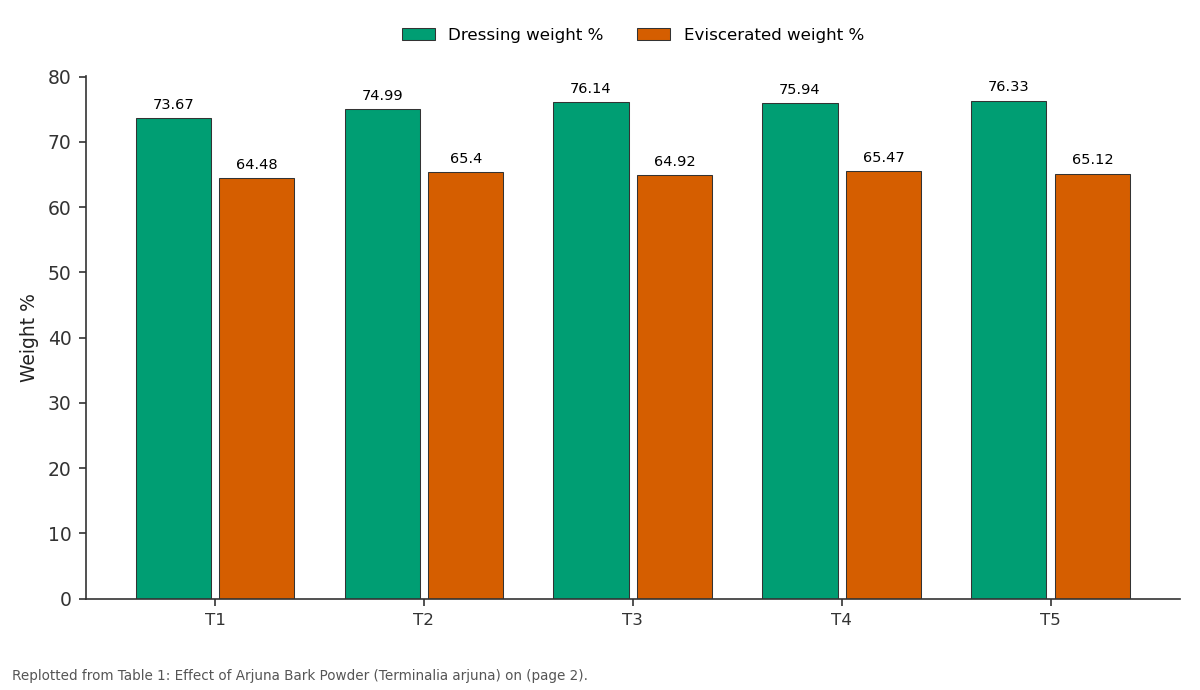
Dressing weight % and Eviscerated weight %: T1 vs T2 vs T3 vs T4 vs T5
Replotted from Table 1 (page 2) of the original paper. Every bar is the paper's own table value.
View source evidence ↗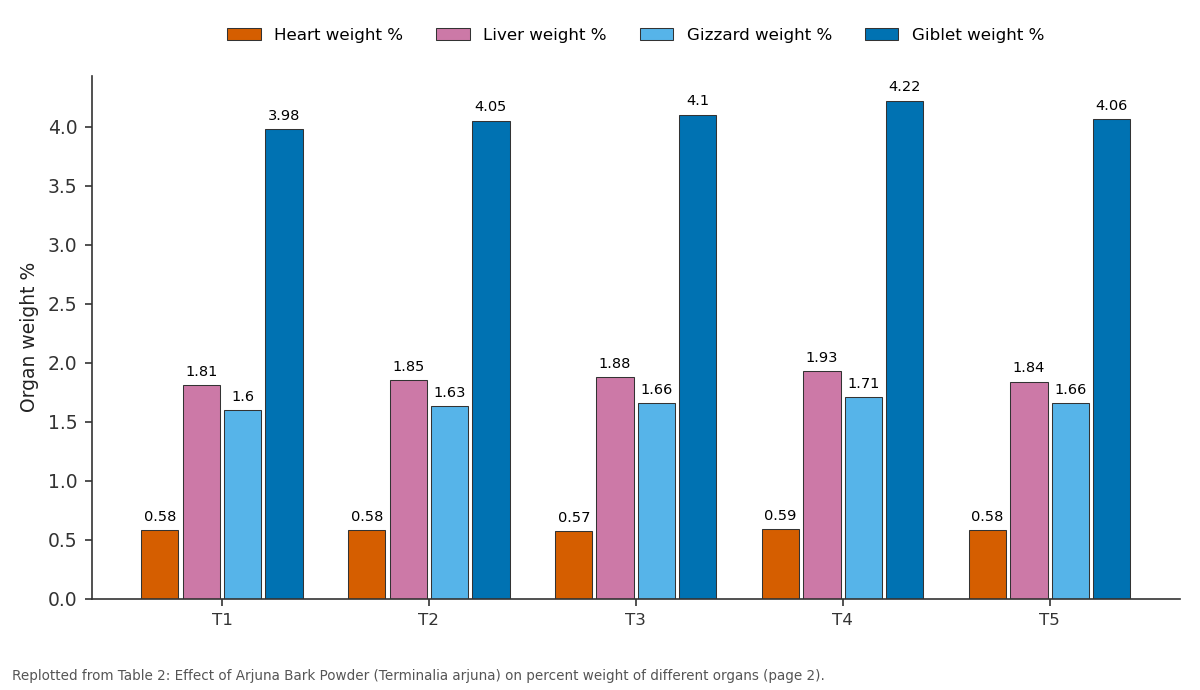
Heart weight % and Liver weight % and more: T1 vs T2 vs T3 vs T4 vs T5
Replotted from Table 2 (page 2) of the original paper. Every bar is the paper's own table value.
View source evidence ↗Figures & tables
From the original paper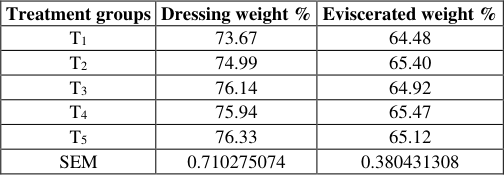 Table 1
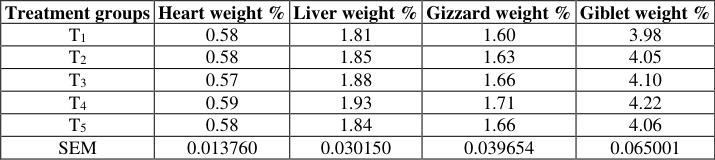 Table 2
Introduction
Poultry rearing is a traditional practice in India and among the Indian livestock-based vocations, poultry production occupies a pivotal position due to its enormous potential to bring about rapid economic growth with low investment and currently it is recognised as a dawn sector with a CAGR (Compound Annual Growth Rate) of egg production is 6.77% (Anonymous, 2023) [3] and 7.52% in egg and broiler production (Anonymous, 2019) [2] . Poultry meat remains the foremost driver of the growth in total meat production in India and it contribute comparatively more protein than other edible animal product like milk, pork, mutton, and beef while considering per unit of human consumption, and are predicted to be the highest consumed animal protein items by 2025 (Pica-Ciamarra and Otte, 2010, Henuk, 2018) [12, 7] . The main axis of economics of poultry industry is based on the feed. Feed plays pivotal role in poultry industry's economics and it accounts for 70-75% of total production costs in the broiler industry, so the efficiency with which poultry convert feed to meat is critical to the industry's economics Prajapat et al. (2020) [13] . Various exertions have been made over time to lessen production costs by letting down feed costs. The feed additives are termed as "growth promoters" and are often called non-nutrient feed additives (Singh and Panda, 1992) [15] . The foremost motive of adding feed additives is to enhance performance of broiler chickens by augmenting growth rate, ameliorate FCR, body growth, resistance against diseases, and lower mortality in poultry birds. An ideal feed additive should be readily biodegradable, free from environmental hazards, non-toxic, involved with transferable drug resistance, and improves performance effectively and economically. Presently, there are many restrictions on the use of various AGPs (antibiotic growth promoters) and other chemical and synthetic medicinal products in the poultry diet, since they were seriously criticized by consumers due to their harmful effects like bacterial resistance and possible transmission of antibiotic, any other chemical/synthetic feed additive's residue into the human food chain. These serious concerns have been the greatest worry of poultry production (Panda, 2008; Daramola, 2019) [10,5] . To overcome from health hazard of AGPs, the use of alternative feed additives is emphasized by various producers and consumers. Herbs and plant extracts are searched to be incorporated in poultry feed as alternative feed additive (Alloui et al., 2013) [1] . Hence, use of herbs like Arjuna Bark Powder has advantage because they are safe, economical, effective and easily available. However, the information on the role of Arjuna on broiler performance in arid region is limited. So, present study was taken up to evaluate the efficacy of different levels of Arjuna Bark Powder in improving the carcass characteristics in broiler chicken.
Materials and Methods
A total of 150 experimental day old, unsexed, apparently healthy broiler chicks (Cobb-430) were individually weighed and randomly divided into five treatment groups i.e., T 1 , T 2 , T 3 , T 4 and T 5 , with 30 chicks in each group. Each group of 30 chicks was again subdivided into three sub groups having 10 chicks in each replicate (R 1 -R 3 ). Arjuna bark Powder (Terminalia arjuna) was supplemented at a graded level. The control group were fed only on basal diet without any supplementation and other treatment groups were supplemented with 0.5%, 0.75%, 1%, and 1.25% of Arjuna Bark Powder in the experimental broiler starter and finisher ration, respectively. For evaluation of carcass characteristics viz., dressed weight percentage, eviscerated weight percentage, giblet and organ weight percentage broilers were sacrificed at the end of 6 th week from each replicate. The birds were weighed immediately before slaughtering. Dressed weight was calculated as:
The dressed birds were eviscerated by giving a median cut in the abdomen and removing the crop, gullet, trachea and viscera. The lungs were scrapped off. Heart, liver, pancreas, spleen and gizzard were separated from gastrointestinal tract. The giblets (heart, liver and gizzard) were cleaned and retained along with the carcass to record eviscerated weight and expressed as percentage of pre-slaughter weight. From the sacrificed birds, giblet (heart, liver and gizzard) was separated carefully and weighed with the help of electronic balance to observe the effect of different dietary treatments on growth and development of certain organs.
Results and Discussion
The findings of dressing yield (%) and eviscerated yield (%) has been presented in Table 1 and revealed that the carcass yield was higher in Arjuna supplemented groups than the control group indicating positive effect of Arjuna Bark Powder in broilers. The overall mean values of dressing yield (%) and eviscerated yield (%) were recorded to be 73.67 to 76.33 and 64.48 to 65.47 respectively. Upon comparison of means, the mean values of dressing yield (%) and eviscerated yield (%) did not vary significantly among various treatment groups. The results obtained in present study regarding dressing yield (%) and eviscerated yield (%) are in accordance with findings of Biswas and Wakita (2001) [4] , Mehala and Moorthy (2008) [9] , Depar et al. (2021) [6] and Pasaribu et al. (2021) [11] . [8] , Weerasingha and Atapattu (2012) [16] Shohe et al. (2019) [14]
| Treatment groups | Dressing weight % | Eviscerated weight % |
|---|---|---|
| T1 | 73.67 | 64.48 |
| T2 | 74.99 | 65.40 |
| T3 | 76.14 | 64.92 |
| T4 | 75.94 | 65.47 |
| T5 | 76.33 | 65.12 |
| SEM | 0.710275074 | 0.380431308 |
Table text extracted from the original PDF; superscript letters are shown inline. The original table image is below.
View original table image
Conclusion
This experiment was conducted to determine the optimum level of supplementation of Arjuna Bark Powder in the diet of broilers and its effect on the carcass characteristics of broilers in arid region of Rajasthan. The mean values of dressing yield (%) and eviscerated yield (%) did not vary significantly among various treatment groups. Even though, there is numerical increase in dressing yield (%) and eviscerated yield (%) of phytogenic feed additive supplemented groups as compared to control, at the same time the giblet and certain organ weight per cent were within normal weight range indicating no adverse effect on the internal organs upon inclusion of phytogenic feed additive in broilers diet and somewhat some improved dressing yield (%) and eviscerated yield (%) found in phytogenic feed additive supplemented groups. So, it could be concluded that supplementation of Arjuna Bark Powder at graded level up to 1.25% is quite safer and could be a viable proposition for lucrative broiler farming for meat production. Though the results are concrete and indicative but replication of feeding experiments with large number of broilers are recommended before reaching to final recommendation for incorporation of Arjuna Bark Powder in the broiler feed for wellbeing of broiler industry.
Figures and tables from the paper
| Treatment groups | Heart weight % | Liver weight % | Gizzard weight % | Giblet weight % |
|---|---|---|---|---|
| T1 | 0.58 | 1.81 | 1.60 | 3.98 |
| T2 | 0.58 | 1.85 | 1.63 | 4.05 |
| T3 | 0.57 | 1.88 | 1.66 | 4.10 |
| T4 | 0.59 | 1.93 | 1.71 | 4.22 |
| T5 | 0.58 | 1.84 | 1.66 | 4.06 |
| SEM | 0.013760 | 0.030150 | 0.039654 | 0.065001 |
Table text extracted from the original PDF; superscript letters are shown inline. The original table image is below.
View original table image
References
14 in the original paper- Alloui MN, Szczurek W, Swiatkiewicz S. The Usefulness of Prebiotics and Probiotics in Modern Poultry Nutrition: A Review. Ann Anim Sci. 2013;13(1):17.
- Anonymous. Basic Animal husbandry statistic (2019): http://dadf.gov.in/sites/default/filess/BAHS%20%28Basi c%20Animal%20Husbandry%20Statistics-2019%29.pdf. Accessed July 26, 2021.
- Biswas AH, Wakita M. Effect of dietary Japanese green tea powder supplementation on feed utilization and carcass profiles in broilers. J Poultry Sci. 2001;38(1):5057.
- Daramola OT. Medicinal plants leaf meal supplementation in broiler chicken diet: effects on performance characteristics, serum metabolite and antioxidant status. Anim Res Int. 2019;16(2):3334-3342.
- Depar SA, Lighari IH, Rajput N, Rajput MN, Memon MA, Moryani AA, et al. To investigate the effect of Cassia fistula powder on the growth performance and health of broiler. Pure Appl Biol. 2021;10(4):945-955.
- Henuk YL. Global Poultry Production and Its Substantial Contribution to Nutrition, Food Security and Poverty Alleviation in Many Developing Countries. J Vet Sci Med Diagn. 2018;7.
- Issa KJ, Omar JA. Effect of Garlic Powder on Performance and Lipid Profile of Broilers. Open J Anim Sci. 2012;2(2):62-68.
- Mehala C, Moorthy M. Effect of Aloe vera and Curcuma longa (Turmeric) on carcass characteristics and biochemical parameters of broilers. Int J Poultry Sci. 2008;7(9):857-861.
- Panda AK. Growth Promoters in Poultry: Novel Concepts. IBDC Publishers, Lucknow, India; 2008.
- Pasaribu T, Sukirman M, Wibowo NR, Kostaman T. The influence of Phyllanthus niruri L. powder and Znbacitracin antibiotics on the relative weight of carcasses and intestines of broiler. In IOP Conference Series: Earth and Environmental Science. 2021;788(1):12-46.
- Pica-Ciamarra U, Otte J. Poultry, Food Security and Poverty in India: Looking beyond the Farm-gate. World's Poultry Sci J. 2010;66(2):309-320.
- Prajapat UK, Jain D, Sharma T, Dhuria RK, Bothra T, Nehra R, et al. Effect of Supplementation of Tulsi (Ocimum Sanctum) And Fenugreek (Trigonella foenumgraceum L.) on Liveability and Economics of Heat Stressed Broilers in Arid Zone of Rajasthan. Vet Practitioner. 2020;21(1):149-151.
- Shohe A, Vidyarthi VK, Zuyie R. Performance of broiler chicken on diet supplemented with Turmeric powder (Curcuma longa). Livestock Res Int. 2019;7(2):77-82.
- Weerasingha AS, Atapattu NSBM, Mapalana K. Effects of Fenugreek (Trigonella foenum-graecum L.) Seed Powder on Growth Performance, Visceral Organ Weight, Serum Cholesterol Levels and the Nitrogen Retention of Broiler Chicken. Trop Agric Res. 2013;24(3):289-295.