
Research article · 2024 · Full text
International Journal of Advanced Biochemistry ResearchHost preference of various aphid species on winter vegetables
Volume 8(1S) · Pages 875–879 · DOI: 10.33545/26174693.2024.v8.i1sl.465 ↗
Research areasDengue and Mosquito Control ResearchAgricultural pest management studiesAgricultural Research and Practices
Abstract
Author-writtenAphids, a significant emerging pest worldwide, have a broad impact on various hosts. This study aims to assess the specific host preferences of three aphid species: Pea Aphid (Acyrthosiphon pisum Harris), Mustard Aphid (Lipaphis erysimi Kat.), and Cabbage Aphid (Brevicoryne brassicae Linn.) on three different winter vegetables i.e. Cabbage, Garden pea, and Broadleaf Mustard. This research was conducted in the net house of AKS University, FAST campus, Satna, the research employed a two factorial CRD with three replications from January 2023 to February 2023. The statistical analysis revealed highly significant results for both aphid species and crop species, as well as their interaction, in terms of live aphid count. The interaction results indicated distinct host preferences, with Pea Aphid exclusively favoring legume crops (Garden pea). Cabbage Aphid and Mustard Aphid demonstrated preferences for Cabbage and Broadleaf Mustard, respectively. In Broadleaf mustard, the initial population count of Cabbage Aphid was higher, but over the time (34 days post-inoculation), Mustard Aphid increased at a faster rate, becoming statistically similar to Cabbage Aphid. Throughout the study period, the population of Mustard Aphid was consistently higher in cabbage. This comprehensive understanding of host preferences contributes to the enhancement of effective pest management programs against aphids.
Summary
Source-checkedPlain-language reading of the full paper, prepared with AI and checked against the text. Each point links to the authors' own words.
Why it matters
- Aphids are globally significant sap-sucking pests that cause direct damage via feeding and indirect damage by transmitting viruses and excreting honeydew. View evidence ↗
- The Mustard aphid (L. erysimi) can cause severe agricultural losses, including yield reductions between 35.4% and 96%, seed weight loss of 30.9%, and oil loss of 2.75%. View evidence ↗
- There is a noted lack of research regarding the specific host ranges and preferences of different aphid species, despite its importance for pest management. View evidence ↗
The question
- The study aimed to investigate the host preferences and assess the host-based infestation of various aphid species on major winter vegetables. View evidence ↗
What they did
- The researchers tested three aphid species (Pea, Mustard, and Cabbage aphids) on three winter vegetables: Cabbage, Garden pea, and Broadleaf Mustard. View evidence ↗
- The experiment used a two-factorial Complete Randomized Design (CRD) with three replications, conducted in a net house at AKS University from January to February 2023. View evidence ↗
- Two individual aphids were inoculated per plant, and 2 mm mesh insect netting was used to keep the aphid species confined to their assigned plants. View evidence ↗
- Live aphid population counts were recorded every seven days following inoculation and analyzed using MS-Excel. View evidence ↗
What they found
- The Cabbage Aphid (B. brassicae) reached its highest mean population of 2966.76 on Broadleaf Mustard (BLM) by day 34, which was statistically similar to the Mustard Aphid's population on the same host. View evidence ↗
- On Broadleaf Mustard, Cabbage Aphids were initially more numerous, but Mustard Aphids grew faster over 34 days to reach a similar population level. View evidence ↗
- The authors note that glucosinolate (GSL) levels are higher in Mustard (61.76 μmol·g−1 dry weight) than in Cabbage (8.84 μmol·g−1 dry weight), while Garden pea is GSL-free. View evidence ↗
What it means
- The authors conclude that Pea aphids are limited to leguminous crops, as they infested garden pea most severely and rejected the other tested crops. View evidence ↗
- The authors conclude that while both Cabbage and Mustard aphids prefer cruciferous crops, the Mustard aphid is more devastating because it attacks both cabbage and mustard. View evidence ↗
Visual summary
1 visualsIllustrations explain the paper; they do not show study data.
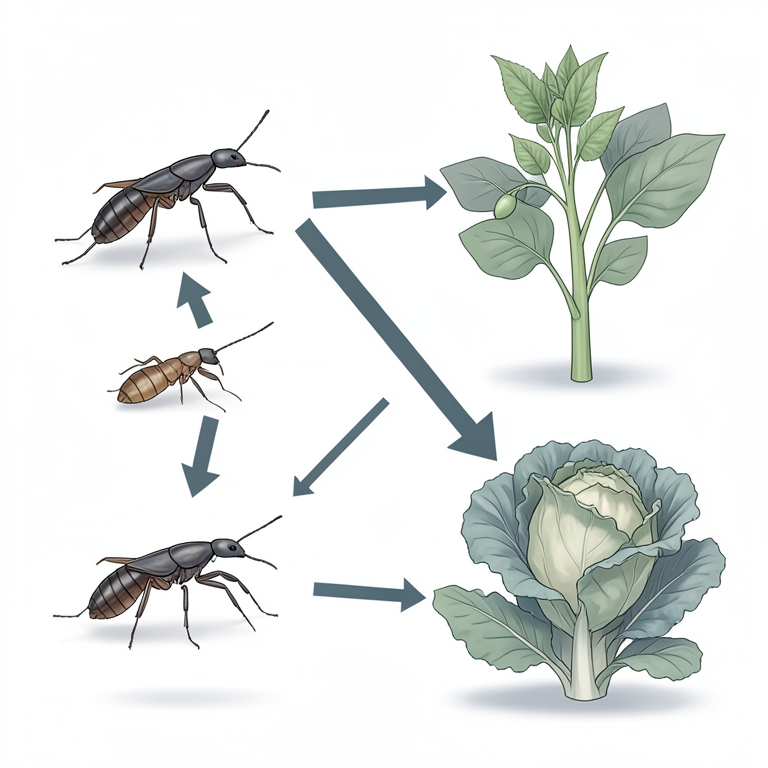
Aphid-Host Preference Matrix
AI-generated conceptual illustration (Aphids (Brevicoryne brassicae, Lipaphis erysimi, Acyrthosiphon pisum) and winter vegetables (Brassica juncea, Brassica o). It explains the idea and does not show study data.
View source evidence ↗Figures & tables
From the original paper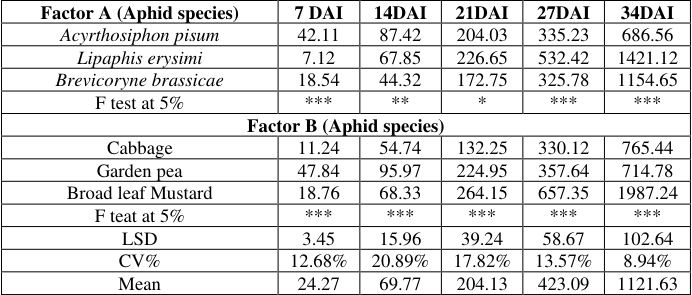 Table 1
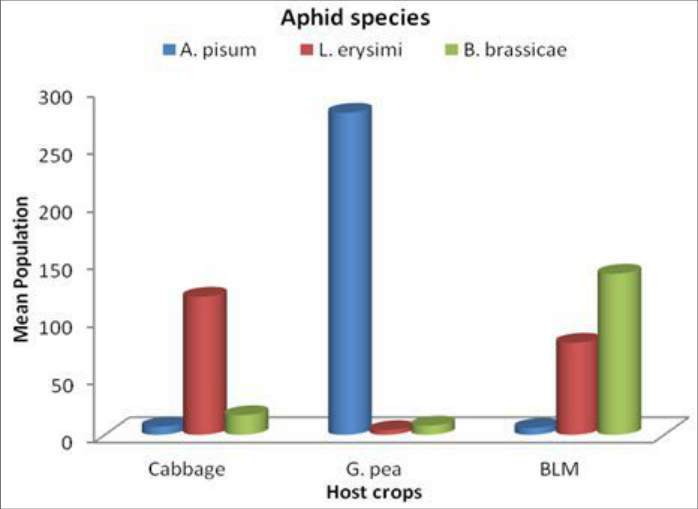 Figure 1
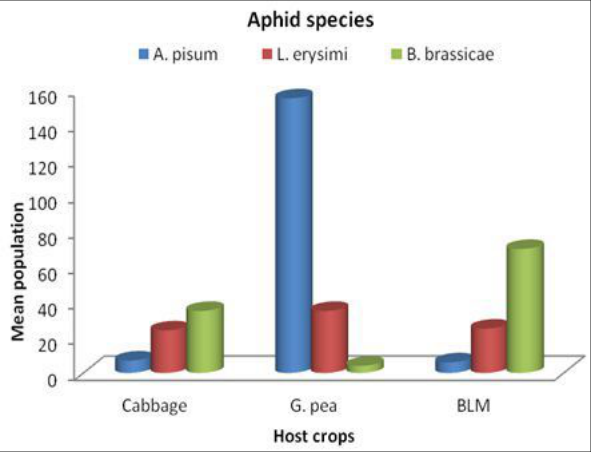 Figure 2
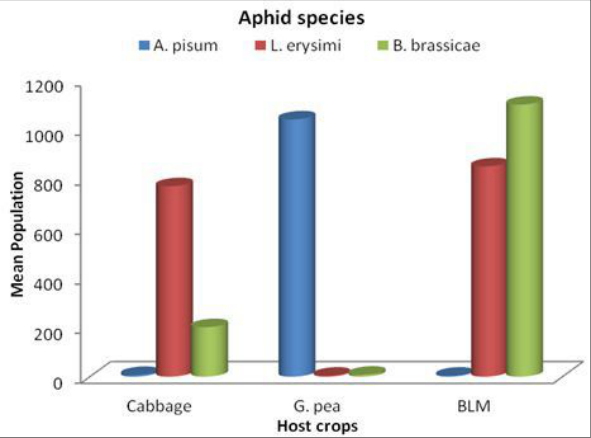 Figure 3
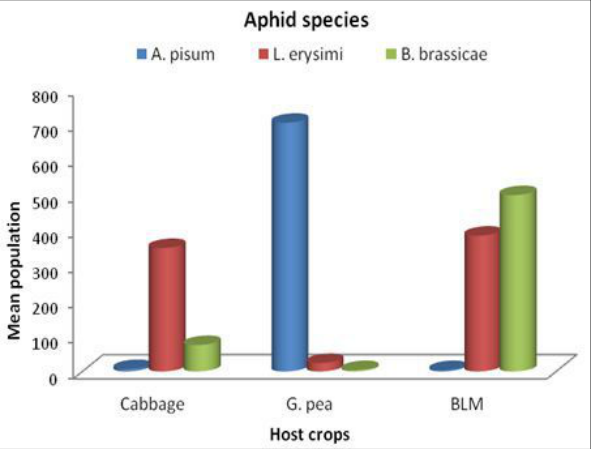 Figure 4
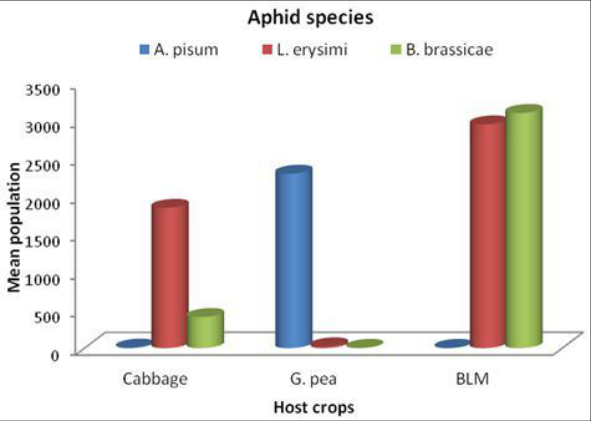 Figure 5
Introduction
Aphids, which are sap sucking pests, are increasingly recognized as a significant global pest (Vennila, 2008) [13] . These pests can directly damage host plants through feeding and indirectly through the transmission of viruses and honeydew excretion (Opfer and McGrath, 2013) [9] . The continuous feeding of aphids leads to symptoms such as yellowing, wilting, and stunting of plants. The Pea Aphid (Acyrthosiphon pisum), found worldwide, infesting crops such as faba bean (Vicia faba L.), lupin (Lupinus albus L.), alfalfa (Medicago sativa L.), lentil (Lens culinaris Medik.), chickpea (Cicer arietinum L.), and pea (Pisum sativum L.) (Fernández et al., 2019) [2] . Its broad host range, complex life cycle, including both sexual and parthenogenetic reproduction (Schmidtberg and Vilcinskas, 2016) [11] , and its flexibility in adapting to different environmental conditions (Srinivasan et al., 2014) [12] makes it difficult to control this pest. Cabbage aphid Brevicoryne brassicae is distinguishable by the presence of very short cornicles and the waxy coating in its body. Cabbage aphid poses a significant challenge in the production of cauliflower, broccoli, and cabbage. This aphid species is confined to plants in the Brassicaceae family, which include both cultivated and wild cruciferous crops (Gabrys et al., 1997) [6] . The Mustard aphid (Lipaphis erysimi), distributed in tropical and subtropical regions globally, is acknowledged as a serious pest affecting mustard, cabbage, cauliflower, turnip, rai, toria, brocoli, and more (Atwal, 1976) [1] . L. erysimi is associated with substantial yield losses, seed weight reduction, and oil loss ranging from 35.4% to 96%, 30.9%, and 2.75%, respectively (Singh and Premchand, 2015) [10] . Aphids, particularly in herbaceous crops like vegetables, pose significant challenges to the productivity of cruciferous vegetables worldwide. Each aphid species exhibits a distinct host range for feeding and reproduction, contributing to varying levels of infestation (Capinera, 2001) [4] . Despite the importance of understanding host preferences, there is a lack of research addressing the specific host range and preferences of different aphid species.
This experiment was conducted to investigate the host preferences of various aphid species on major winter vegetables and to assess the host-based infestation of these aphid species.
Materials and Methods
The experiment was conducted in net house of Faculty of Agriculture Science and Technology, AKS University, Satna (M.P.) Which is located at 24 o 34' North in longitude from 80 o 49' east at an altitude of 324m above sea level using a two-factorial Complete Randomized Design (CRD). Three common winter vegetables viz. Cabbage (Brassica oleracea L.), Broad Leaf mustard (BLM) (Brassica juncea L) and Garden pea (Pisum sativum L.) are treated as one factor and three common aphid species viz. Cabbage Aphid (Brevicoryne brassicae Linn.), Mustard Aphid (Lipaphis erysimi Kat.) and Pea Aphid (Acyrthosiphon pisum Harris) as next with three replications. Observations were taken on every seven days from the day of inoculation and obtained observations were analyzed with the help of MS-Excel.
Pure Culture Preparation
A laboratory reared a pure culture of aphid species were collected from farmer fields in the Satna district. The rearing process followed to Johnson's method (Huges and Woolcock, 1965) [8] with two individuals of each species placed in a petri dish lined with sterilized tissue paper to maintain the required moisture level at an average laboratory temperature of 28 ˚C. These aphids were provided with fresh leaves of the host crop daily for nourishment. Only new emerged progeny were retained, and the parental line was consistently discarded through multiple cycles to maintain the purity of the stock culture of aphid species.
Plantation of Crop (Host)
Crops were cultivated inside the poly house with 20 cm spacing. Seeds were obtained from a local agriculture shop. Varieties of crops were Arkel, Kala sona and Pusa Mukta for Garden pea, BLM and Cabbage, respectively. Cabbage was transplanted 30 days after nursery establishment, while the other two crops were directly seeded.
Inoculation of Stock Culture
In the experiment, each plant species was inoculated with aphids from the pure culture, after 30 days of transplanting for transplanted crops and 30 days after sowing in case of directly seeded crops. Two individual aphids were inoculated on each plant, and the confinement of aphid species to their respective plants was ensured using insect netting with a mesh size of 2 mm.
Result and discussion:
All Aphid species showed the significant result with mean population count. Acyrthosiphon pisum was found to grow rapidly as compare to L. erysimi and B. brassicae in the initial phase (Seven days after inoculation) whereas, BLM was affected more in the last date of the count. Similarly, it was found that crop species also significantly effective in the mean population count of live aphids. Garden pea harbor maximum population count at Seven days of inoculation followed by BLM and Cabbage. Then, the population count was rapidly increased in BLM from 21 DAI till final days followed by Cabbage and Garden pea which were statically similar. The interaction result of both factors (reveled in Table-1) signifies the host preference. The date wise performance of different aphids on the different host is interpreted as.
Seven days after Inoculation
Seven days after inoculation, A. pisum was found to be dominant in garden pea than any other interaction. In Cabbage, B. brassicae grow predominantly high which was significantly different from mustard aphid and pea aphid. Whereas, in Broadleaf mustard, B. brassicae was dominant over L. erysimi and A. pisum. The host garden pea was less preferred by B. brassicae and L. erysimi.
Fourteen days after Inoculation
After 14 days of inoculation, Growth of A. pisum in garden pea was quite high in comparison to other aphids. This aphid showed poor interaction with two other crops. In cabbage, L. erysimi population showed significant result followed by B. brassicae and A. pisum. and, In case of BLM, B. brassicae population was found greater than that of L. erysim and A. pisum. During this stage, the aphid A. pisum inoculated at cabbage and BLM were totally dead.
Twenty-one days after Inoculation
In Twenty-one days of inoculation, Growth of A. pisum in garden pea was outstanding but its growth and preference on both crops (cabbage and BLM) was totally neglected. And both the crucifers also resist the growth of A. pisum due to which inoculated A. pisum on that host were totally dead. Here, in cabbage, L. erysimi showed significant result followed by B. brassicae. And, In BLM, B. brassicae population was significantly higher than the L. eryisimi.
Twenty-seven days after Inoculation
Twenty-seven days after inoculation, the growth of B. brassicae in BLM was highest than any other interaction, which was statically similar with A. pisum in garden pea. The growth rate of L. erysimi was following B. brassicae in BLM. In the case of cabbage, the population of L. erysimi was significantly higher than that of B. brassicae. Here, both crops resist the growth of A. pisum which was only concentrated in garden pea.
Thirty four days after Inoculation
During 34 days of inoculation, Mean population of B. brassicae in BLM was found to be highest which was significantly similar with L. eryisimi. Similarly, In the case of cabbage, the population of L. eryisimi was significantly higher than that of B. brassicae. Here, the host cabbage and BLM was totally rejected by A. pisum which prefers only the host garden pea. And the host garden pea was also totally rejected by both the aphid i.e. B. brassicae and L. erysimi. The growth of given aphids is predominantly guided by the content of the allelochemicals known as Glucosinolates on these plant species (Francis et al., 2001) [5] . Glucosinolates (GLS), a group of thioglucoside compounds which may function as feeding deterrents or toxins for some herbivorous insects, most pests of Brassicaceae species, in particular aphids, are attracted and stimulated to feed and oviposit by allyl isothiocyanate or its GLS precursor, sinigrin (Huang and Renwick, 1994) [7] . While assessing the Glucosinolates levels in shoots of different Brassica crops higher level of GSL were found to be in leaf Mustard (61.76 μmol•g -1 dry weight) than in Cabbage (8.84 μmol•g -1 dry weight) (Bhandari et al., 2015) [3] . They also observed Garden pea, Pisum sativum L. as GLS free. In this research, the higher preference of L. erysimi towards Cabbage is guided by the lower concentration of Glucosinolates present in BLM which was demonstrated also by Franchis et al., 2001 [5] . Similarly, the preference of GLS Free Pisum sativum was limited to A. pisum only.
As the host garden pea is free from GLM, it was not preferred by L. erysimi and B. brassicae which is supported Wensler, 1962 [14] , where he found the non-host plants, Vicia faba and Pisum sativum was accepted by the cabbage aphid after excised plant parts had been treated with a 2% GLM solution. In case of BLM, this research count B. brassica higher in the initial stage of the host but in maturity level, the L erysimi seems to increase which may be due to the fact that glucosinolate label decrease with the maturity of the host shown in (Table 2).
Conclusion
The statistical analysis showed highly significant outcomes for both factors aphid species and crop species along with their interaction, in terms of live aphid count. Initially, Aphid A. pisum was found highest count during the early stage of plant development, succeeded by B. brassica and L. erysimi. However, after 21 DAI, L. erysimi became more predominant. Similarly, the crop species also demonstrated highly significant results in mean population count. Garden pea was found to harbor more aphids in the early days, while BLM had a greater impact in later days, followed by cabbage and garden pea.
The interaction result which signifies the host preference suggested that among three different species of aphids used for the study, Pea aphids show their host preference towards the leguminous crops among the crops used in the study. Pea aphids infest the garden pea most severely than other crops. This gives the idea that Pea aphids are limited to the legume crops only. Other two species of aphid viz. Cabbage aphid and Mustard aphid both showed a greater affinity towards the cruciferous crops i.e. Cabbage and BLM. These two aphids both infest cruciferous to a greater extent, but among these two aphids, Mustard aphid is more devastating as these aphids attack in both cabbage and mustard crops.
Acknowledgement
AcknowledgementThe authors greatly acknowledge the Department of Entomology, Faculty of Agriculture Science & Technology, AKS University, Satna for their constant support throughout the study period.
Figures and tables from the paper
| Factor A (Aphid species) | 7 DAI | 14DAI | 21DAI | 27DAI | 34DAI |
|---|---|---|---|---|---|
| Acyrthosiphon pisum | 42.11 | 87.42 | 204.03 | 335.23 | 686.56 |
| Lipaphis erysimi | 7.12 | 67.85 | 226.65 | 532.42 | 1421.12 |
| Brevicoryne brassicae | 18.54 | 44.32 | 172.75 | 325.78 | 1154.65 |
| F test at 5% | *** | ** | * | *** | *** |
| Factor B (Aphid species) | |||||
| Cabbage | 11.24 | 54.74 | 132.25 | 330.12 | 765.44 |
| Garden pea | 47.84 | 95.97 | 224.95 | 357.64 | 714.78 |
| Broad leaf Mustard | 18.76 | 68.33 | 264.15 | 657.35 | 1987.24 |
| F teat at 5% | *** | *** | *** | *** | *** |
| LSD | 3.45 | 15.96 | 39.24 | 58.67 | 102.64 |
| CV% | 12.68% | 20.89% | 17.82% | 13.57% | 8.94% |
| Mean | 24.27 | 69.77 | 204.13 | 423.09 | 1121.63 |
Table text extracted from the original PDF; superscript letters are shown inline. The original table image is below.
View original table image
References
10 in the original paper- Aznar-Fernández T, Cimmino A, Masi M, Rubiales D, Evidente A. Antifeedant activity of long-chain alcohols, and fungal and plant metabolites against pea aphid (Acyrthosiphon pisum) as a potential biocontrol strategy. Natural product research. 2019;33(17):24712479.
- Bhandari SR, Jo JS, Lee JG. Comparison of glucosinolates profiles in different tissues of nine Brassica crops. Molecules. 2015;20:15827-15841.
- Francis F, Lognay G, Wathelet JP, Haubruge E. Effects of allelochemicals from first (Brassicaceae) and second (Myzuspersicae & Brevicorynebrassicae) trophic levels on Adaliabipunctata. Journal of Chemical Ecology. 2001;27:243-256.
- Gabrys BJ, Gadomski HJ, Klukowski Z, Pickett JA, Sobota GT, Wadhams LJ, et al. Sex pheromone of cabbage aphid, Brevicoryne brassicae: identification and field trapping of male aphids and parasitoids. Journal of Chemical Ecology. 1997;23:1881-1890.
- Huang X, Renwick JAA. Relative activities of glucosinolates as oviposition stimulants for Pierisrapae and P. napioleracea. J Chem. Ecol. 1994;20:10251032.
- Hughes RD, Woolcock LT. A modification of Johnson's method of rearing aphids, for ecological studies. New Zealand Journal of Agriculture Research. 1965;8(3):728-736.
- Singh P, Premchand K. Yield loss due to mustard aphid, Lipaphis erysimi (Kalt.) in Eastern Bihar Plateau. Journal of Applied Zoological Research. 2015;6:97100.
- Srinivasan DG, Abdelhady A, Stern DL. Gene expression analysis of parthenogenetic embryonic development of the pea aphid, Acyrthosiphon pisum, suggests that aphid parthenogenesis evolved from meiotic oogenesis. PLoS One. 2014;9(12):e115099.
- Vennila S. Pest management for cotton ecosystems or ecosystem management for cotton production. Curr. Sci. 2008;94(11):1351-1352.
- Wensler RJD. Mode of host selection by an aphid. Nature. 1962;195:830-831.