
Research article · 2024 · Full text
International Journal of Agriculture Extension and Social DevelopmentKnowledge, Attitude and Practices (KAP) of Asha workers with regard to nutrition education
Volume 7(1) · Pages 549–554 · DOI: 10.33545/26180723.2024.v7.i1g.266 ↗
Research areasChild Nutrition and Water Access
Abstract
Author-writtenNutrition is one of the important aspects that deal with good health and well-being of people. Nutrition education helps resolve nutrition problems by imparting nutrition education and bringing desirable changes in Knowledge, Attitude and Practices (KAP). The existing study was conducted to know the knowledge, attitude, and practices of ASHA Workers regarding Nutrition education for pregnant women and lactating mothers. A sample size of Forty-five respondents from three mandals of the Guntur district was selected and data were collected using pre-tested questionnaires. The random sampling procedure was used for the selection of the respondents. The results of the study found that ASHA Workers had a low to medium level of knowledge, poor attitudes, and poor practices during baseline tests after implementing an intervention program for the ASHA Workers for a period of one month a significant improvement in the Knowledge, Attitude, and Practices was observed during Endline test (t=10.5; t=10.3). The above findings can be used to plan digital material on nutrition education interventions that aim at bringing change in the behavior of the respondents i.e., KAP and it can be used as ready reckoners during sudden epidemics.
Summary
Source-checkedPlain-language reading of the full paper, prepared with AI and checked against the text. Each point links to the authors' own words.
Why it matters
- Nutrition education is essential for a healthy life, as it encourages the voluntary adoption of eating habits and behaviors that improve overall well-being. View evidence ↗
- Accredited Social Health Activists (ASHA) serve as the primary frontline workers responsible for delivering science-based nutrition information at the village level. View evidence ↗
- The goal of nutrition education is to solve nutritional problems by improving the knowledge, attitudes, and practices (KAP) of the target population. View evidence ↗
The question
- The study aimed to evaluate the existing knowledge, attitudes, and practices of ASHA workers regarding nutrition education specifically for lactating mothers and pregnant women. View evidence ↗
What they did
- The research was conducted in the Guntur district of Andhra Pradesh, using a sample of 45 ASHA workers selected from three purposively chosen mandals. View evidence ↗
- The study employed an experimental design featuring a one-month nutrition education intervention program, with assessments conducted at baseline and endline. View evidence ↗
What they found
- At the start of the study, ASHA workers demonstrated poor attitudes and practices, and their knowledge levels ranged from low to medium. View evidence ↗
- During the baseline test, 62.22% of ASHA workers lacked knowledge on eight out of 18 specific nutrition education statements. View evidence ↗
- Baseline results showed that 73.33% of ASHA workers had poor practices across twelve out of twenty evaluated statements. View evidence ↗
- Following the intervention, over 90% of respondents showed good knowledge on seven out of 18 statements during the endline test. View evidence ↗
- The endline test revealed that over 85% of ASHA workers demonstrated good practices on seventeen out of twenty statements. View evidence ↗
- The mean KAP score for ASHA workers increased significantly from 22.87 at baseline to 43.24 at the endline test. View evidence ↗
- A paired t-test confirmed a statistically significant improvement in KAP scores (t=10.34) at a 5% significance level. View evidence ↗
What it means
- The authors conclude that a one-month intervention program effectively improves the knowledge, attitudes, and practices of ASHA workers regarding nutrition. View evidence ↗
- The authors recommend using these findings to develop digital nutrition education materials to drive behavioral change and serve as quick-reference guides during epidemics. View evidence ↗
Visual summary
1 visualsIllustrations explain the paper; charts are replotted from the paper's own table values.
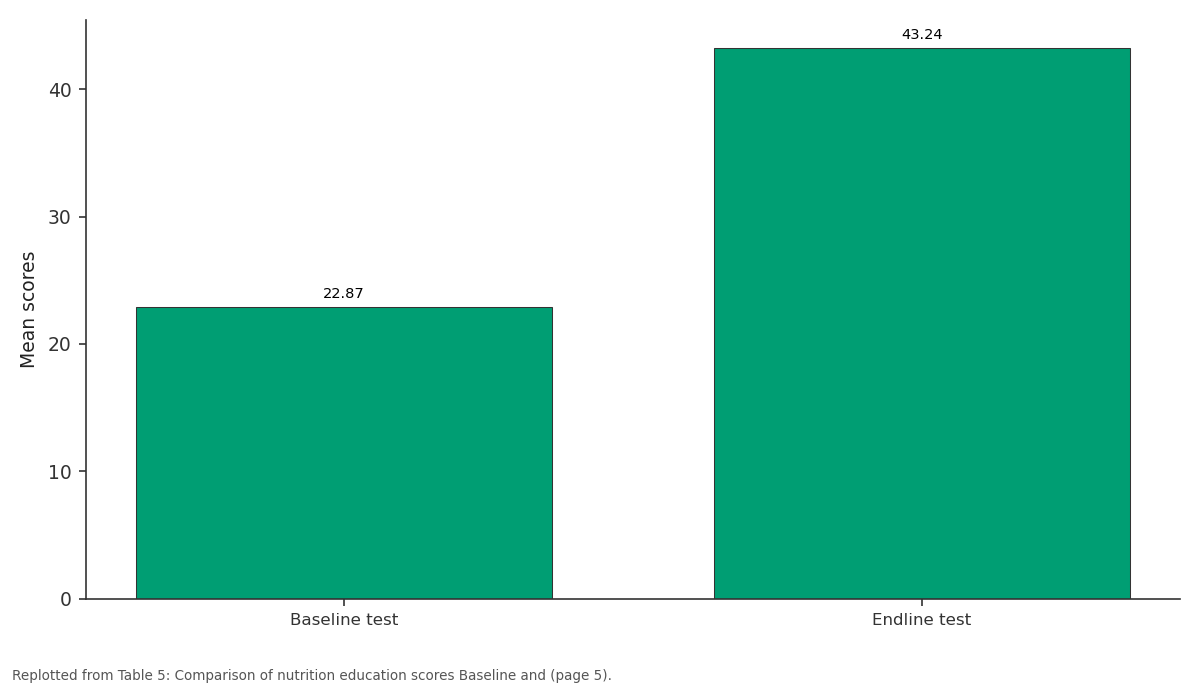
Mean scores: Baseline test vs Endline test
Replotted from Table 5 (page 5) of the original paper. Every bar is the paper's own table value.
View source evidence ↗Figures & tables
From the original paper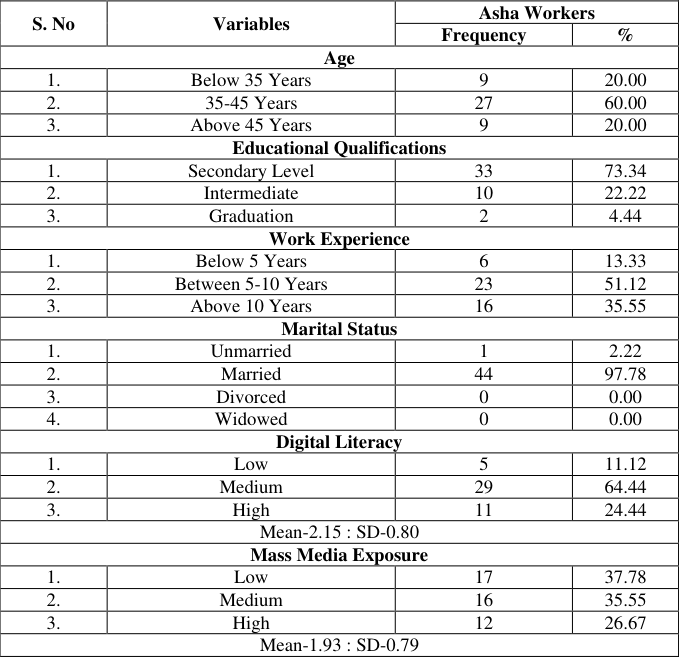 Table 1
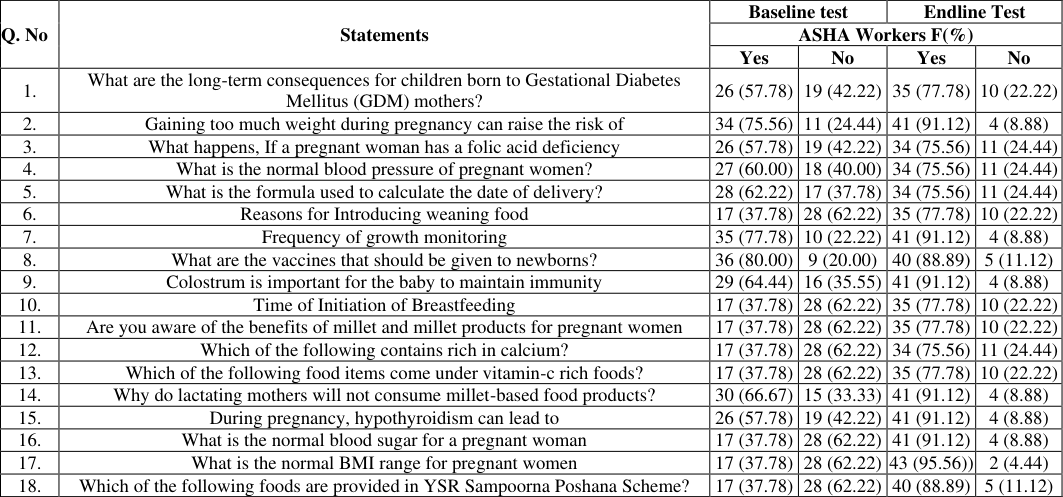 Table 2
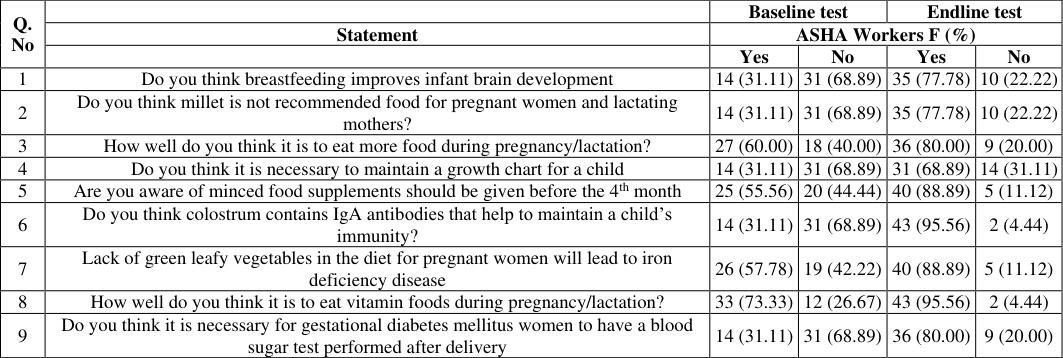 Table 3
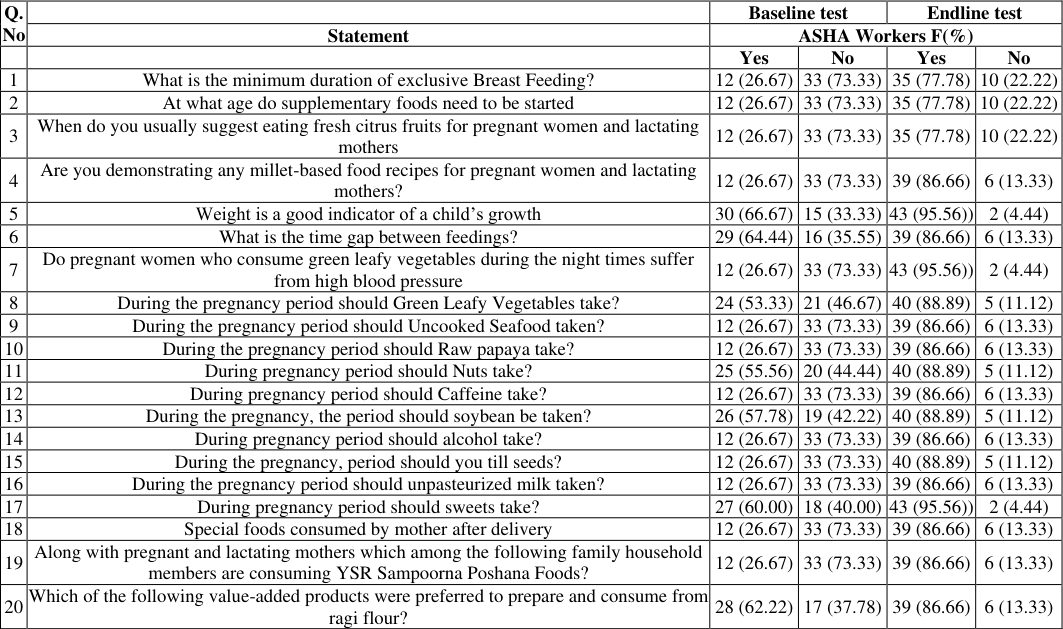 Table 4
 Table 5
Introduction
Nutritional status is one of the key indicators of the health of a pregnant and lactating mother. Nutrition is a discipline directly connected with many other areas associated with human existence like agriculture, economics, medicine, food technology, engineering, biological sciences, sociology, anthropology, etc. Nutrition education is a critical aspect of better and healthy life and is defined as "a set of learning experiences designed to facilitate the voluntary adoption of eating and other nutrition-related behaviors favorable health and well-being" (Swaminathan. M, 1997) [5] which is interchangeably called social marketing, behavior change communication, community nutrition, and health promotion. Nutrition education should be practical and easily adaptable by inculcating food habits with available local food resources. Nutrition education should become a part of the community as it is very critical in determining the health status of the community. Nutrition education aims to resolve the nutritional difficulties among people through imparting knowledge and bringing desirable change in knowledge, practices, and attitude. Nutrition education is one of the services that come under Health departments which are implemented by ASHA at the village level. They are the frontline disseminators of science-based facts related to nutrition. Hence, they need to be provided with the right information from the right perspective with the right methodology to transfer the message understandably to the ultimate users. Nutrition education intervention is described as consciously planned actions aimed at improving a nutrition-related behavior or component of health status for an individual, a target group, or the entire community. ASHAs is a trained female community health workers recruited under National Health Mission (NHM). They mobilize the people for participation towards increased utilization and accountability of the existing health services. The responsibilities of ASHA workers include a survey of health & related events, community sensitization on government programs, counseling, community mobilization, health planning, and immunization. The outcomes of the research will be considered while framing the appropriate education intervention suitable for the frontline disseminators in the Indian health delivery system.
Materials and Methods
The present study was conducted in three purposively selected mandals of the Guntur district of Andhra Pradesh. Fifteen ASHA Workers from each Mandal thus made a sample of Forty-five (45) respondents from three mandals were selected. An experimental research design was adopted to study the Knowledge, Attitude, and Practices (KAP) of ASHA Workers regarding nutrition education. A structured questionnaire developed and used for the study consisting of 47 multiple choice questions was developed in the closure of the KAP with a score of 1 and 0 for the right and wrong answers, respectively. Thus, the maximum and minimum overall scores could be 47 and 1 for each respondent. The data were analyzed using frequency, percentages, Mean scores, and tests.
Results and Discussions
The profile of ASHA Workers includes Age, Education, Experience, Marital Status, Digital Literacy, and Mass media exposure. The results were depicted in the Table .1 Majority of the respondents belong to the 35-45 years age group, this might be due to the time of recruitment of the post. The other reason might be that people in middle age between 35 to 45 years are more likely to acquire new information and possess responsibility to share the information and discharge their duties effectively, especially in educating lactating and pregnant mothers compared to young and old age people. The above results are in line with Khoisnam et al. (2022) [4] . Majority of the ASHAs had completed secondary level school (73.34%) and had interacted with the investigator and expressed their knowledge, attitude, and practices. The reason might be minimum eligibility qualification for ASHAs was revised from primary level to secondary level of education which made them viruses possess a higher level of education. Results depicted that majority (51.12%) of ASHA Workers the 5-10 years of experience. The reason might be due to the year of initiation of the project and scheme where the posts of ASHAs were created under NHM in the year 2005. The above results are in line with Catherine et al. (2018) [2] and Bhagia et al. (2020) [1] . Results revealed that a great portion of the respondents ASHAs (97.78%) were married and the reason might be that, married local women will be given preference in recruitment of these local posts which will be selected by the community constituted with local members. The above results are in line with Usha et al. (2016) [7] and Catherine et al. (2018) [2] . Results reported that more than half of the respondents of ASHA workers (64.44%) fell under medium digital literacy. The reason might be due to the respondents are having medium to high digital literacy among ASHA Workers might be due to their regular usage of Tabs/Androids to report, interact, and intimation to their superiors and peers.
The government had provided every extension functionary with digital gadgets as part of e-Governance in India which was made mandatory to share the daily reports with images and videos as evidence. It was apparent nearly one-third (37.78%) of ASHA's had low exposure to media. This might be due to their level of education and the experience was also low.
KAP of ASHA workers Baseline test
The response of ASHA workers to the knowledge questionnaire on nutrition education is presented in Table 2. Over more than 70 per cent of the respondents have good www.extensionjournal.com knowledge (answering right) on each of three statements out of 18. These are statement 2 had 75.56 per cent; statement 7 had 77.78 per cent and Statement 8 had 80.00 per cent. On the other side, more than 60 per cent of the ASHA Workers lacks knowledge of nutrition education (answering wrong) on eight statements out of 18. Of these statements 6, and 10, 11, 12, 13, 16, 17 & 18 all had an equal percentage (62.22%). The reason might be due to lack of knowledge on nutrition education and the probable reason might be due to their low level of education and various other factors like their age, the effectiveness of training, lack of continuing education, years of experience, motivation by supervisors, lack of incentives, etc. This view of them suggests that Anganwadi teachers know about the government schemes like YSR sampoorna poshana and poshan tracker because they are bringing awareness on these schemes among the people who are eligible for this scheme especially pregnant women and lactating mothers and they are aware of the benefits of millets not for the product development and lacks knowledge on vaccines for new-borns and pregnant women, pregnancy risks, etc. While ASHA Workers know about pregnancy risks, growth monitoring frequencies, and also vaccines for pregnant and newborns, and lack knowledge on some of the aspects that they won't deal with their people.
| Q. No | Statements | Baseline test | — | Endline Test | — |
|---|---|---|---|---|---|
| ASHA Workers F(%) | |||||
| Yes | No | Yes | No | ||
| 1. | What are the long-term consequences for children born to Gestational Diabetes Mellitus (GDM) mothers? | 26 (57.78) | 19 (42.22) | 35 (77.78) | 10 (22.22) |
| 2. | Gaining too much weight during pregnancy can raise the risk of | 34 (75.56) | 11 (24.44) | 41 (91.12) | 4 (8.88) |
| 3. | What happens, If a pregnant woman has a folic acid deficiency | 26 (57.78) | 19 (42.22) | 34 (75.56) | 11 (24.44) |
| 4. | What is the normal blood pressure of pregnant women? | 27 (60.00) | 18 (40.00) | 34 (75.56) | 11 (24.44) |
| 5. | What is the formula used to calculate the date of delivery? | 28 (62.22) | 17 (37.78) | 34 (75.56) | 11 (24.44) |
| 6. | Reasons for Introducing weaning food | 17 (37.78) | 28 (62.22) | 35 (77.78) | 10 (22.22) |
| 7. | Frequency of growth monitoring | 35 (77.78) | 10 (22.22) | 41 (91.12) | 4 (8.88) |
| 8. | What are the vaccines that should be given to newborns? | 36 (80.00) | 9 (20.00) | 40 (88.89) | 5 (11.12) |
| 9. | Colostrum is important for the baby to maintain immunity | 29 (64.44) | 16 (35.55) | 41 (91.12) | 4 (8.88) |
| 10. | Time of Initiation of Breastfeeding | 17 (37.78) | 28 (62.22) | 35 (77.78) | 10 (22.22) |
| 11. | Are you aware of the benefits of millet and millet products for pregnant women | 17 (37.78) | 28 (62.22) | 35 (77.78) | 10 (22.22) |
| 12. | Which of the following contains rich in calcium? | 17 (37.78) | 28 (62.22) | 34 (75.56) | 11 (24.44) |
| 13. | Which of the following food items come under vitamin-c rich foods? | 17 (37.78) | 28 (62.22) | 35 (77.78) | 10 (22.22) |
| 14. | Why do lactating mothers will not consume millet-based food products? | 30 (66.67) | 15 (33.33) | 41 (91.12) | 4 (8.88) |
| 15. | During pregnancy, hypothyroidism can lead to | 26 (57.78) | 19 (42.22) | 41 (91.12) | 4 (8.88) |
| 16. | What is the normal blood sugar for a pregnant woman | 17 (37.78) | 28 (62.22) | 41 (91.12) | 4 (8.88) |
| 17. | What is the normal BMI range for pregnant women | 17 (37.78) | 28 (62.22) | 43 (95.56)) | 2 (4.44) |
| 18. | Which of the following foods are provided in YSR Sampoorna Poshana Scheme? | 17 (37.78) | 28 (62.22) | 40 (88.89) | 5 (11.12) |
Table text extracted from the original PDF; superscript letters are shown inline. The original table image is below.
View original table image
Endline test
The response of ASHA Workers to the Attitude questionnaire on nutrition education is presented in Table 3. Over more than 80 per cent of the respondents have a positive attitude (Answering right) on each of six statements out of 9. These statements are 3, 5, 6, 7, 8 & 9. On the other side, more than 20 per cent of the ASHA Workers have a negative attitude (Answering wrong) related to nutrition education on five statements out of 9. These statements are 1, 2, 3, 4 & 9. Paired t-test was done to assess the significant difference between Baseline and Endline test scores. In ASHA Workers, a significant difference between the Baseline and Endline tests a t-critical value of 2.021 at a 5% level of significance and a t-statistical value is 10.34*. Hence there is a significant improvement in Knowledge, Attitude, and Practices (KAP) among the respondents in the areas of nutrition education. The findings of Taksande et al. (2020) [6] also suggest that intervention has a positive impact on the Nutritional Knowledge, Attitude, and Practices of ASHA Workers.
| Q. No | — | Baseline test | — | Endline test | — |
|---|---|---|---|---|---|
| Statement | ASHA Workers F (%) | ||||
| Yes | No | Yes | No | ||
| 1 | Do you think breastfeeding improves infant brain development | 14 (31.11) | 31 (68.89) | 35 (77.78) | 10 (22.22) |
| 2 | Do you think millet is not recommended food for pregnant women and lactating mothers? | 14 (31.11) | 31 (68.89) | 35 (77.78) | 10 (22.22) |
| 3 | How well do you think it is to eat more food during pregnancy/lactation? | 27 (60.00) | 18 (40.00) | 36 (80.00) | 9 (20.00) |
| 4 | Do you think it is necessary to maintain a growth chart for a child | 14 (31.11) | 31 (68.89) | 31 (68.89) | 14 (31.11) |
| 5 | Are you aware of minced food supplements should be given before the 4th month | 25 (55.56) | 20 (44.44) | 40 (88.89) | 5 (11.12) |
| 6 | Do you think colostrum contains IgA antibodies that help to maintain a child’s immunity? | 14 (31.11) | 31 (68.89) | 43 (95.56) | 2 (4.44) |
| 7 | Lack of green leafy vegetables in the diet for pregnant women will lead to iron deficiency disease | 26 (57.78) | 19 (42.22) | 40 (88.89) | 5 (11.12) |
| 8 | How well do you think it is to eat vitamin foods during pregnancy/lactation? | 33 (73.33) | 12 (26.67) | 43 (95.56) | 2 (4.44) |
| 9 | Do you think it is necessary for gestational diabetes mellitus women to have a blood sugar test performed after delivery | 14 (31.11) | 31 (68.89) | 36 (80.00) | 9 (20.00) |
Table text extracted from the original PDF; superscript letters are shown inline. The original table image is below.
View original table image
Conclusion
Nutrition education is an important element aimed at improving the knowledge of different aspects of nutrition. Nutritional Knowledge, Attitude, and Practices (KAP) levels of ASHA Workers indicate that before the Endline test, they had low to medium levels of knowledge, poor attitudes, and poor practices. After implanting one month of an intervention program ASHA Workers improved their Knowledge, Attitude, and Practices during the Endline test. A significant difference was found in the Baseline and endline test intervention scores in the areas of nutrition.
Figures and tables from the paper
| S. No | Variables | Asha Workers | — |
|---|---|---|---|
| Frequency | % | ||
| Age | |||
| 1. | Below 35 Years | 9 | 20.00 |
| 2. | 35-45 Years | 27 | 60.00 |
| 3. | Above 45 Years | 9 | 20.00 |
| Educational Qualifications | |||
| 1. | Secondary Level | 33 | 73.34 |
| 2. | Intermediate | 10 | 22.22 |
| 3. | Graduation | 2 | 4.44 |
| Work Experience | |||
| 1. | Below 5 Years | 6 | 13.33 |
| 2. | Between 5-10 Years | 23 | 51.12 |
| 3. | Above 10 Years | 16 | 35.55 |
| Marital Status | |||
| 1. | Unmarried | 1 | 2.22 |
| 2. | Married | 44 | 97.78 |
| 3. | Divorced | 0 | 0.00 |
| 4. | Widowed | 0 | 0.00 |
| Digital Literacy | |||
| 1. | Low | 5 | 11.12 |
| 2. | Medium | 29 | 64.44 |
| 3. | High | 11 | 24.44 |
| Mean-2.15 : SD-0.80 | |||
| Mass Media Exposure | |||
| 1. | Low | 17 | 37.78 |
| 2. | Medium | 16 | 35.55 |
| 3. | High | 12 | 26.67 |
| Mean-1.93 : SD-0.79 |
Table text extracted from the original PDF; superscript letters are shown inline. The original table image is below.
View original table image
| Q. No | — | Baseline test | — | Endline test | — |
|---|---|---|---|---|---|
| Statement | ASHA Workers F(%) | ||||
| Yes | No | Yes | No | ||
| 1 | What is the minimum duration of exclusive Breast Feeding? | 12 (26.67) | 33 (73.33) | 35 (77.78) | 10 (22.22) |
| 2 | At what age do supplementary foods need to be started | 12 (26.67) | 33 (73.33) | 35 (77.78) | 10 (22.22) |
| 3 | When do you usually suggest eating fresh citrus fruits for pregnant women and lactating mothers | 12 (26.67) | 33 (73.33) | 35 (77.78) | 10 (22.22) |
| 4 | Are you demonstrating any millet-based food recipes for pregnant women and lactating mothers? | 12 (26.67) | 33 (73.33) | 39 (86.66) | 6 (13.33) |
| 5 | Weight is a good indicator of a child’s growth | 30 (66.67) | 15 (33.33) | 43 (95.56)) | 2 (4.44) |
| 6 | What is the time gap between feedings? | 29 (64.44) | 16 (35.55) | 39 (86.66) | 6 (13.33) |
| 7 | Do pregnant women who consume green leafy vegetables during the night times suffer from high blood pressure | 12 (26.67) | 33 (73.33) | 43 (95.56)) | 2 (4.44) |
| 8 | During the pregnancy period should Green Leafy Vegetables take? | 24 (53.33) | 21 (46.67) | 40 (88.89) | 5 (11.12) |
| 9 | During the pregnancy period should Uncooked Seafood taken? | 12 (26.67) | 33 (73.33) | 39 (86.66) | 6 (13.33) |
| 10 | During the pregnancy period should Raw papaya take? | 12 (26.67) | 33 (73.33) | 39 (86.66) | 6 (13.33) |
| 11 | During pregnancy period should Nuts take? | 25 (55.56) | 20 (44.44) | 40 (88.89) | 5 (11.12) |
| 12 | During pregnancy period should Caffeine take? | 12 (26.67) | 33 (73.33) | 39 (86.66) | 6 (13.33) |
| 13 | During the pregnancy, the period should soybean be taken? | 26 (57.78) | 19 (42.22) | 40 (88.89) | 5 (11.12) |
| 14 | During pregnancy period should alcohol take? | 12 (26.67) | 33 (73.33) | 39 (86.66) | 6 (13.33) |
| 15 | During the pregnancy, period should you till seeds? | 12 (26.67) | 33 (73.33) | 40 (88.89) | 5 (11.12) |
| 16 | During the pregnancy period should unpasteurized milk taken? | 12 (26.67) | 33 (73.33) | 39 (86.66) | 6 (13.33) |
| 17 | During pregnancy period should sweets take? | 27 (60.00) | 18 (40.00) | 43 (95.56)) | 2 (4.44) |
| 18 | Special foods consumed by mother after delivery | 12 (26.67) | 33 (73.33) | 39 (86.66) | 6 (13.33) |
| 19 | Along with pregnant and lactating mothers which among the following family household members are consuming YSR Sampoorna Poshana Foods? | 12 (26.67) | 33 (73.33) | 39 (86.66) | 6 (13.33) |
| 20 | Which of the following value-added products were preferred to prepare and consume from ragi flour? | 28 (62.22) | 17 (37.78) | 39 (86.66) | 6 (13.33) |
Table text extracted from the original PDF; superscript letters are shown inline. The original table image is below.
View original table image
| — | Variables | Mean scores | t-value |
|---|---|---|---|
| ASHA Workers | Baseline test | 22.87 | 10.34* |
| Endline test | 43.24 |
Table text extracted from the original PDF; superscript letters are shown inline. The original table image is below.
View original table image
References
4 in the original paper- Bhagia P, Menon I, Singh RP, Gupta R, Goyal J, Das D. Effectiveness of various health education methods amongst primary healthcare workers of western Uttar Pradesh, Delhi (National Capital Region), India: A promotive intervention study. J Fam. Med. Prim. Care. 2020;9:3555-3564.
- Department of Health, Medical and Family Welfare, Andhra Pradesh; c2022. ASHA Program. Retrieved from http://hmfw.ap.gov.in/asha-program.aspx on 1105-2022.
- Khoisnam DD, Reddy LV, Sinha PM, Goutham BS, Saha S. The utilization of dental health care services by accredited social health activists and Anganwadi workers in Lucknow district: A cross-sectional study. J Indian Assoc Public Health Dent. 2022;168(21):23195932.
- Taksande V, Nilesh B, Karishama C, Nitish D, Shubham D. To assess the effectiveness of planned teaching on knowledge regarding epilepsy in children among the Anganwadi workers. Int. J Nurs. Educ. 2020;12(4).
Cited by 2
From OpenAlex, OpenCitations and reference lists read by Scinovex
- Assessment of Knowledge, Attitude, and Practices (KAP) of Anganwadi Teachers and Asha Workers with Regard to Nutrition Education Intervention ↗
M Vasanthi, M.S. Chaitanya Kumari, B. Vijayabhindana, K. Padmaja, Jyothula Tripura Lakshmi · European Journal of Nutrition & Food Safety · 2024
Nutrition is one of the important aspects that deals with good health and wellbeing of people. Nutrition education helps to resolve the nutrition problems by imparting nutrition education and bring desirable changes in terms of Knowledge, Attitude and Practices (KAP). The existing study was conducted to know the knowledge, attitude, and practices of AWW and ASHA’s with regard to nutrition…
❝ 1PDF - Awareness & knowledge of frontline workers on infant & young child feeding (IYCF) practices: A qualitative study from Palghar-Maharashtra, India ↗
Suchitra Vishwambhar Surve, Shraddha Kyatam, Bhavya MK, Shahina Begum, Ragini Nitin Kulkarni · The Indian Journal of Medical Research · 2025
Background & objectives Appropriate infant and young child feeding (IYCF) practices are crucial for growth and development during the first two years of life. Despite national initiatives, suboptimal IYCF practices prevail in tribal regions, contributing to undernutrition among under- five children. This necessitates need of specific targeted interventions through involvement of front line workers considering their role in community engagement.…
❝ 0PDF