
Research article · 2024 · Full text
International Journal of Agriculture Extension and Social DevelopmentNDRI's dairy business school model through the lens of aspiring dairypreneurs
Volume 7(1) · Pages 603–607 · DOI: 10.33545/26180723.2024.v7.i1h.262 ↗
Research areasLivestock Management and Performance ImprovementEntrepreneurship Studies and Influences
Abstract
Author-writtenIndia is the leading milk producer in the world with sustained growth. The dairy sector involves more than 30 million small producers owning 1 – 2 animals forming an essential part of the rural economy and serving as an important source of employment and income. The dairy sector offers profitable business opportunities to farmers who are aspiring to become dairy preneurs in the era of entrepreneurship. Dairy Business School can help dairy farmers to start entrepreneurial ventures through capacity building. The Dairy Business School model is a school for dairy farmers to develop their capabilities and entrepreneurial skills. It was organized at Expert Institute i.e., NDRI, Karnal for aspiring dairy preneurs with an aim to develop their capabilities, entrepreneurial and management skills in dairy. The Dairy Business School was conducted by selecting the farmers from 6 peripheral districts of Expert Institute comprising 180 farmers. From 180, 30 were selected as participants for school based on Entrepreneurial Behaviour Index developed for the study. After completion of the Dairy Business School, the attitude of the emerging dairy preneurs was measured using a developed scale for the study. Around 67.86 per cent of farmer participants had favourable attitude towards the Dairy Business School model followed by more favourable (25.00%) and less favourable (7.14%) attitude. The independent variables of participant dairy preneurs like Annual Income, Group Orientation, Motivational Factors, Market Intelligence, Mass media exposure and Information seeking behaviour were positively correlated with attitude towards DBS.
Summary
Source-checkedPlain-language reading of the full paper, prepared with AI and checked against the text. Each point links to the authors' own words.
Why it matters
- India is the world's largest milk producer, with the dairy sector supporting approximately 8.4 million small and marginal farmers, 71% of whom are women. View evidence ↗
- Developing the dairy sector is critical for rural welfare as it creates employment for landless laborers and small farmers, helps alleviate poverty, and stabilizes income. View evidence ↗
- Dairy farmers can stabilize their income by transitioning into entrepreneurs through activities such as organic milk production, animal trading, and processing. View evidence ↗
The question
- The study aimed to evaluate the attitudes of participants in the Dairy Business School (DBS) regarding its effectiveness in helping them achieve dairy entrepreneurship. View evidence ↗
What they did
- The researchers used multi-stage sampling to select 180 dairy farmers (under age 50 with more than two animals) from two villages in each of six districts surrounding the NDRI institute. View evidence ↗
- Out of the initial 180 farmers, 30 were selected to participate in the Dairy Business School based on a specific Entrepreneurial Behaviour Index. View evidence ↗
- A 45-statement Likert-type scale was used to measure the attitudes of 28 eligible farmer participants across six dimensions, including curriculum and infrastructure. View evidence ↗
What they found
- The majority of participants (67.86%) had a favourable attitude toward the DBS model, while 25% were more favourable and 7.14% were less favourable. View evidence ↗
- Participants rated the motivation to start a business and the receipt of certificates as the highest aspects of the general information dimension, both with a mean score of 5.00. View evidence ↗
- Field exposure visits and visits to successful entrepreneurs were highly valued, both receiving the top mean score of 5.00 in their dimension. View evidence ↗
- The lowest rated aspect of the curriculum was the balance between theory and practical classes, which received a mean score of 3.00. View evidence ↗
- Positive attitudes toward the DBS were significantly correlated with higher annual income, group orientation, motivational factors, market intelligence, mass media exposure, and information-seeking behavior. View evidence ↗
- Age was found to be negatively and significantly correlated with the attitude toward the DBS, suggesting younger farmers had more positive attitudes. View evidence ↗
- The selected independent variables explained approximately 76.20% of the variance in the participants' attitudes toward the DBS model. View evidence ↗
What it means
- The authors recommend adopting the DBS model to build entrepreneurial capabilities, particularly for small and marginal farmers. View evidence ↗
- The study found that participants were interested in expanding the DBS model into a diploma course to further strengthen their skills. View evidence ↗
Visual summary
3 visualsIllustrations explain the paper; charts are replotted from the paper's own table values.
Factors Influencing DBS Attitude
AI-generated conceptual illustration (Indian dairy farmers and cattle). It explains the idea and does not show study data.
View source evidence ↗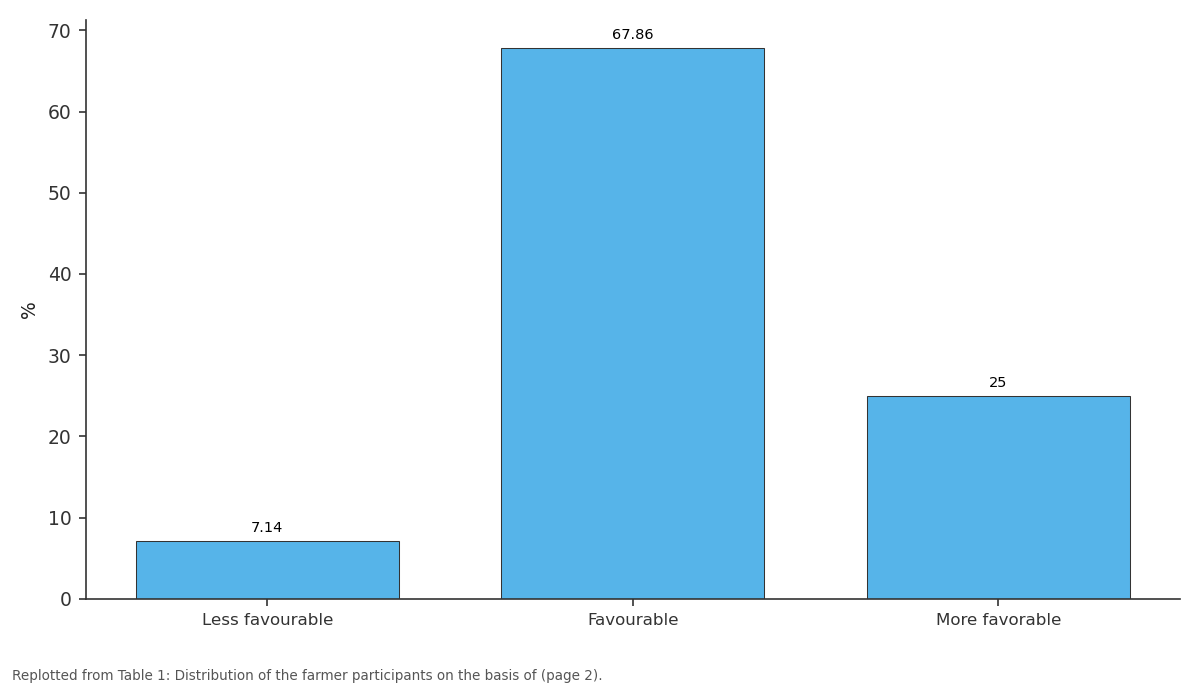
%: Less favourable vs Favourable vs More favorable
Replotted from Table 1 (page 2) of the original paper. Every bar is the paper's own table value.
View source evidence ↗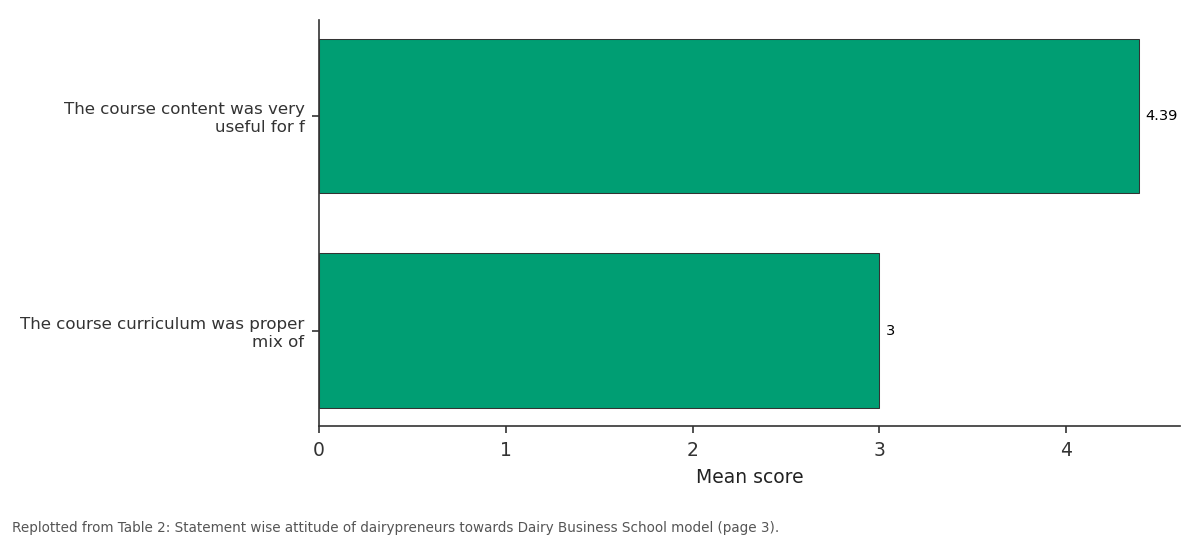
Mean score: The course content was... vs The course curriculum...
Replotted from Table 2 (page 3) of the original paper. Every bar is the paper's own table value.
View source evidence ↗Figures & tables
From the original paper Table 1
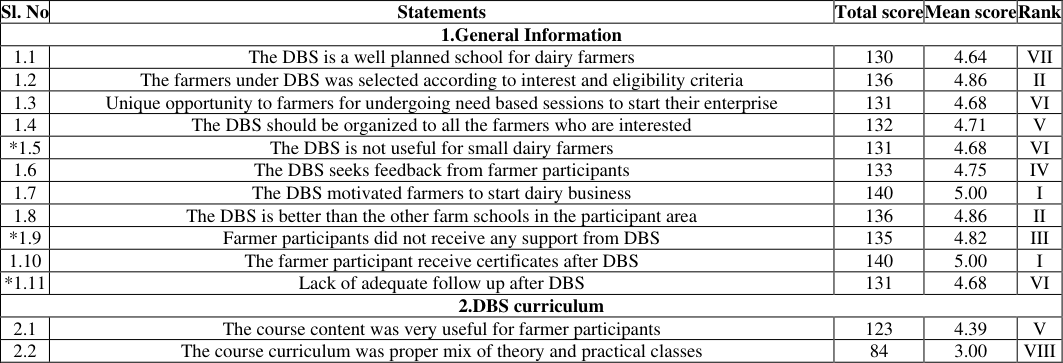 Table 2
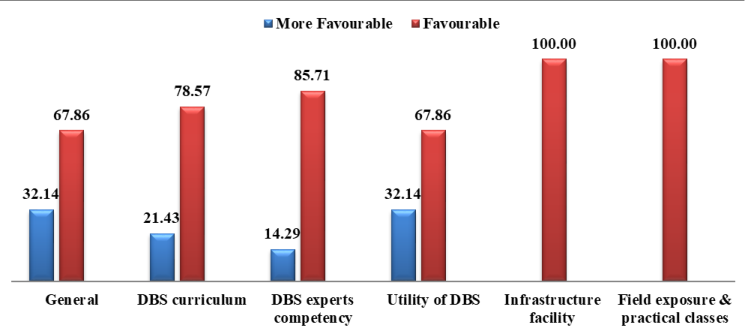 Figure 1
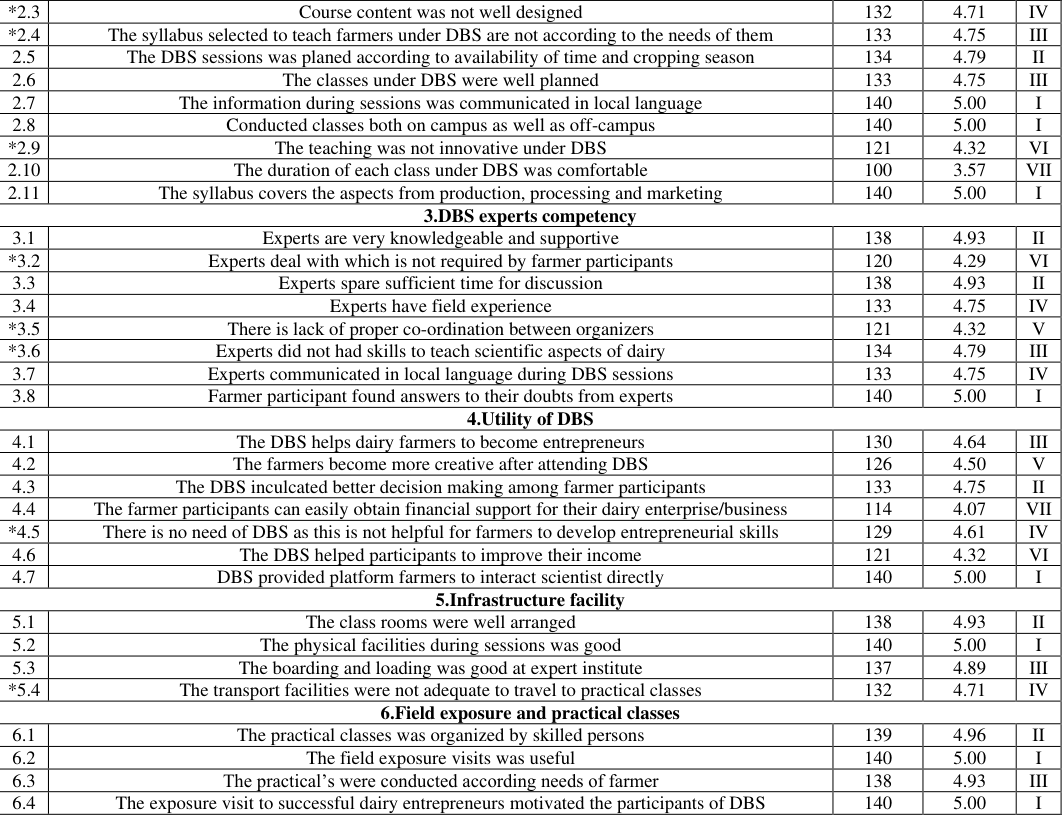 Table 3
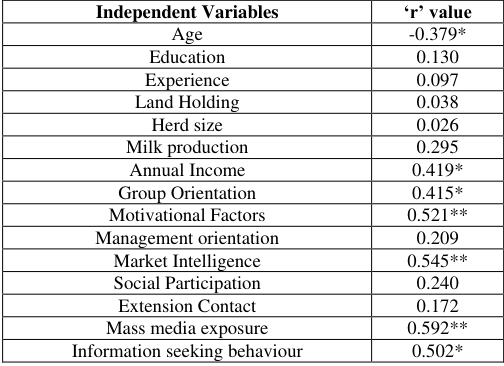 Table 3
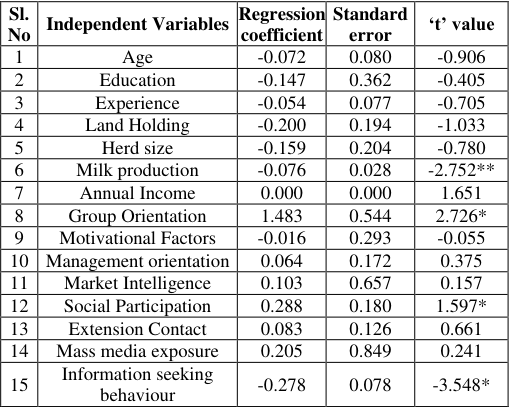 Table 4
Introduction
India has world's largest dairy herd contributing 23 per cent of global milk production. Around 8.4 million small and marginal dairy farmers' directly and indirectly depend on dairy sector for their livelihood, out of which 71 percent are women (Agriculture Skill Council of India report, 2019) [1] . As more than 30 million small producers in India, each raising one or two cows/buffaloes is dependent on milk production. Development in the dairy sector makes multifarious contribution to overall welfare of India's rural population in terms of generating more employment opportunities, especially for the marginal and small farmers and landless laborers, alleviating poverty and stabilizing farm income. However, despite large livestock population and good growth in dairy sector, poorer livestock producers are left behind. The government along with various institutes and extension approaches has taken many initiatives to improve the livelihood of the dairy farmers. Over the years, regular milk sale has helped farmers to move from subsistence to market-based income. Further, improving capabilities of farmers in financing and improved milk marketing along with dairy development policies have potential to reduce the cost of milk production to improve their livelihood (Torsten et al, 2003) [6] . In the era of entrepreneurship, dairy farmers have huge potential to build their own enterprises to stabilize their incomes. The farmers can explore the areas like improving productivity of milch animals, fodder sale, organic milk production, animal trading, processing and marketing of milk and milk products to start their business. Thus, to empower and educate the farmers to take up dairy entrepreneurship, Dairy Business School (DBS) has been taken up by National Dairy Research Institute (NDRI), Karnal. DBS aims to implant entrepreneurial behaviour among farmers. DBS involves capacity building of farmers with respect to dairy production, processing and marketing aspects and linking to them to the value chains (Gayathri et al, 2022) [3] . The dairy farmers who were interested to become dairy preneurs were selected as participants based Entrepreneurial Behaviour Index developed for the study. The school was organized to DBS participant farmers in 2021 at NDRI. The study was conducted to know the attitude of DBS participants towards Dairy Business School towards achieving their aim of dairy entrepreneurship.
Methodology
The study was conducted at ICAR-National Dairy Research Institute, Karnal which being an Expert Institute to organize Dairy Business School (DBS). A multi stage sampling was followed to select the respondents for the study. The adjoining districts of Expert Institute i.e., Karnal, Panipat, Kurukshetra, Yamuna Nagar, Jind and Kaithal were selected for study. From each district, two villages were randomly selected and 15 dairy farmers from each village was selected on the criteria's like having more than two milch animals, interested in dairy business and age less than 50 years which constitute sample size of 180. From the 180 farmers, 30 were selected for Dairy Business School model based on Entrepreneurial Behaviour Index developed for the study. These selected farmers who wanted to become dairy preneurs actively participated in Dairy Business School among which 28 farmers were eligible for certificates. An attitude scale was constructed to measure the attitude of Dairy Business School among the farmer participants by following Likert type summated rating scale. After item collection and editing of the items on six major dimensions (General aspects of DBS; DBS curriculum; Experts competency; Utility of DBS; Infrastructure facility; and field exposure and practical classes), relevancy test of items was done with help of 63 experts from dairy science, social scientists and Ph.D. research scholars of extension and economics. Pretesting of the attitude scale was done using a small sample size of fifteen from non-sampling region. The final scale consisting of 45 statements was administered to the 28 farmer participants of Dairy Business School for the data collection on five-point continuums viz., strongly agree (SA), Agree (A), natural (N), disagree (DA), and strongly disagree (SDA) with a score of 5, 4, 3, 2 and 1 respectively for positive statements and opposite scoring pattern for negative statements. Further analysis was done using the total attitude score of participants for categorization and calculated Mean score and ranking.
Results and Discussions Level of attitude towards Dairy Business School model
The results given in Table 1 reveals that majority of the farmer participants (67.86%) had favourable attitude towards Dairy Business School model whereas 25.00 per cent had more favourable attitude and 7.14 per cent had less favourable attitude towards Dairy Business School model. The probable reasons for favourable attitude towards model may be Dairy Business School was organized according to the needs and interest of the participants who wanted to become dairypreneurs. The curriculum of DBS has sessions organized for the participants in areas of dairy production, processing and marketing to develop their capabilities, entrepreneurial and decision-making skills through capacity building programmes. The participants directly interacted with experts of NDRI under different division, financial institutions and successful dairy preneurs to gather ideas and motivation to start their ventures in dairy. The results are in line with study of Alok Kumar Sahoo et al., 2021 [2] that most of the farmers had favorable attitude towards IARI-Post Office Linkage Extension Model.
Attitude of farmer participants towards Dairy Business School model under different dimensions
The attitude towards DBS model was measured using developed scale consisting of 6 dimensions and 45 statements from 28 emerging dairypreneurs who participated in Dairy Business School at NDRI as shown in Table 2. The statement under "General Information" dimension viz., 'The DBS motivated farmers to start dairy business' and 'The farmer participant receives certificates after DBS' were ranked first with mean score of 5.00. The results are in line with Joanna Chilemba and Catherine Ragasa (2018) [5] who found that farmers were very satisfied and received certificates for FBS attendance. Whereas the statement 'The DBS is a well planned school for dairy farmers' was ranked last with mean score of 4.64. The statements 'The information during sessions was communicated in local language', 'Conducted classes both on campus as well as off-campus' and 'The syllabus covers the aspects from dairy production, processing and marketing' was ranked first with mean score of 5.00 and the statement 'The course curriculum was proper mix of theory and practical classes' was ranked last with mean score of 3.00 under "DBS curriculum" dimension. Under "DBS experts competency", the statement 'Farmer participant found answers to their doubts from experts' was ranked first whereas the statement with mean score of 4.29 i.e., 'Experts deal with which is not required by farmer participants' ranked last. The statement 'DBS provided platform farmers to interact scientist directly' was ranked first with mean score of 5.00 and the statement 'The farmer participants can easily obtain financial support for their dairy enterprise/business' was ranked last with 4.07 mean score under "Utility of DBS" dimension. The statement under "Infrastructure facility dimension viz., 'The physical facilities during sessions was good' under was ranked first with mean score of 5.00. Whereas statement 'The transport facilities were not adequate to travel to practical classes' was ranked last with 4.71 mean score. The statements 'The field exposure visits was useful' and 'The exposure visit to successful dairy entrepreneurs motivated the participants of DBS' were ranked first with mean score of 5.00 under "Field exposure and practical classes" dimension. Further analysis of the statements shows that cent per cent farmer participants had favourable attitude towards "Infrastructure facility" and "Field exposure and practical classes" (Fig. 1). [4] , who reported that most of the trained farmers had favourable attitude towards training methodology followed by KVK, Shahdol. Around 85.71 per cent of participants had favourable attitude towards DBS experts competency but 14.29 per cent had highly favourable attitude. Experts in the area of dairy production and processing are one of the main pillars of NDRI's DBS model. Experts having wide experience, strong subject knowledge and skills were involved in empowering and mentoring the farmer participants to take up dairy entrepreneurial activities resulted towards positive attitude of DBS. With respect to utility of DBS, than half (67.86) of the participants were favourable and 32. 14 per cent of participants were highly favorable. Dairy Business School has helped the participant farmers to improve their decision-making skills by developing their knowledge base and expanding their experiences through exposure visits to the successful dairy entrepreneurs and farms around Karnal. The participant farmers discussed their business ideas with Experts of NDRI, financial institutions and others to start their dairy enterprises.
| Sl. No | Statements | Total score | Mean score | Rank |
|---|---|---|---|---|
| 1.General Information | ||||
| 1.1 | The DBS is a well planned school for dairy farmers | 130 | 4.64 | VII |
| 1.2 | The farmers under DBS was selected according to interest and eligibility criteria | 136 | 4.86 | II |
| 1.3 | Unique opportunity to farmers for undergoing need based sessions to start their enterprise | 131 | 4.68 | VI |
| 1.4 | The DBS should be organized to all the farmers who are interested | 132 | 4.71 | V |
| *1.5 | The DBS is not useful for small dairy farmers | 131 | 4.68 | VI |
| 1.6 | The DBS seeks feedback from farmer participants | 133 | 4.75 | IV |
| 1.7 | The DBS motivated farmers to start dairy business | 140 | 5.00 | I |
| 1.8 | The DBS is better than the other farm schools in the participant area | 136 | 4.86 | II |
| *1.9 | Farmer participants did not receive any support from DBS | 135 | 4.82 | III |
| 1.10 | The farmer participant receive certificates after DBS | 140 | 5.00 | I |
| *1.11 | Lack of adequate follow up after DBS | 131 | 4.68 | VI |
| 2.DBS curriculum | ||||
| 2.1 | The course content was very useful for farmer participants | 123 | 4.39 | V |
| 2.2 | The course curriculum was proper mix of theory and practical classes | 84 | 3.00 | VIII |
Table text extracted from the original PDF; superscript letters are shown inline. The original table image is below.
View original table image
Association between attitude of dairypreneurs towards DBS model and selected independent variables
An examination of the findings in Table 3 shows that Annual Income, Group Orientation, Motivational Factors, Market Intelligence, Mass media exposure and Information seeking behaviour were positively and statistically significantly correlated with attitude of DBS participant farmers. Age was negatively and statistically significantly correlated with attitude of DBS participant farmers. From association, it could be in inferred that DBS participant farmers who were young had positive attitude compared to older generation reason being younger generation were more interested to take risk and to explore business options in dairy entrepreneurship to earn better livelihood. This findings with consistent with findings of Sayak et al., (2023) [7] who found that the estimated annual income, social participation and economic motivation were found significant and positively associated with attitude of the farmers of IARI-VO adopted village. Furthermore to identify set of independent variables contributing maximum attitude towards DBS model, the stepwise multiple liner regression was carried. As result, out of fifteen variables, four variables were identified as most contributing factors towards attitude of DBS model. The data in table 4 reveals that milk production, group orientation, social participation and information seeking behaviour had significant contribution to the attitude. The R 2 value is 0.762 which indicates that about 76.20 per cent of variance in attitude towards DBS model could be explained by the selected independent variable for the study.
| Sl. No | Independent Variables | Regression coefficient | Standard error | ‘t’ value |
|---|---|---|---|---|
| 1 | Age | -0.072 | 0.080 | -0.906 |
| 2 | Education | -0.147 | 0.362 | -0.405 |
| 3 | Experience | -0.054 | 0.077 | -0.705 |
| 4 | Land Holding | -0.200 | 0.194 | -1.033 |
| 5 | Herd size | -0.159 | 0.204 | -0.780 |
| 6 | Milk production | -0.076 | 0.028 | -2.752** |
| 7 | Annual Income | 0.000 | 0.000 | 1.651 |
| 8 | Group Orientation | 1.483 | 0.544 | 2.726* |
| 9 | Motivational Factors | -0.016 | 0.293 | -0.055 |
| 10 | Management orientation | 0.064 | 0.172 | 0.375 |
| 11 | Market Intelligence | 0.103 | 0.657 | 0.157 |
| 12 | Social Participation | 0.288 | 0.180 | 1.597* |
| 13 | Extension Contact | 0.083 | 0.126 | 0.661 |
| 14 | Mass media exposure | 0.205 | 0.849 | 0.241 |
| 15 | Information seeking behaviour | -0.278 | 0.078 | -3.548* |
Table text extracted from the original PDF; superscript letters are shown inline. The original table image is below.
View original table image
| Independent Variables | ‘r’ value |
|---|---|
| Age | -0.379* |
| Education | 0.130 |
| Experience | 0.097 |
| Land Holding | 0.038 |
| Herd size | 0.026 |
| Milk production | 0.295 |
| Annual Income | 0.419* |
| Group Orientation | 0.415* |
| Motivational Factors | 0.521** |
| Management orientation | 0.209 |
| Market Intelligence | 0.545** |
| Social Participation | 0.240 |
| Extension Contact | 0.172 |
| Mass media exposure | 0.592** |
| Information seeking behaviour | 0.502* |
Table text extracted from the original PDF; superscript letters are shown inline. The original table image is below.
View original table image
| *2.3 | Course content was not well designed | 132 | 4.71 | IV |
|---|---|---|---|---|
| *2.4 | The syllabus selected to teach farmers under DBS are not according to the needs of them | 133 | 4.75 | III |
| 2.5 | The DBS sessions was planed according to availability of time and cropping season | 134 | 4.79 | II |
| 2.6 | The classes under DBS were well planned | 133 | 4.75 | III |
| 2.7 | The information during sessions was communicated in local language | 140 | 5.00 | I |
| 2.8 | Conducted classes both on campus as well as off-campus | 140 | 5.00 | I |
| *2.9 | The teaching was not innovative under DBS | 121 | 4.32 | VI |
| 2.10 | The duration of each class under DBS was comfortable | 100 | 3.57 | VII |
| 2.11 | The syllabus covers the aspects from production, processing and marketing | 140 | 5.00 | I |
| 3.DBS experts competency | ||||
| 3.1 | Experts are very knowledgeable and supportive | 138 | 4.93 | II |
| *3.2 | Experts deal with which is not required by farmer participants | 120 | 4.29 | VI |
| 3.3 | Experts spare sufficient time for discussion | 138 | 4.93 | II |
| 3.4 | Experts have field experience | 133 | 4.75 | IV |
| *3.5 | There is lack of proper co-ordination between organizers | 121 | 4.32 | V |
| *3.6 | Experts did not had skills to teach scientific aspects of dairy | 134 | 4.79 | III |
| 3.7 | Experts communicated in local language during DBS sessions | 133 | 4.75 | IV |
| 3.8 | Farmer participant found answers to their doubts from experts | 140 | 5.00 | I |
| 4.Utility of DBS | ||||
| 4.1 | The DBS helps dairy farmers to become entrepreneurs | 130 | 4.64 | III |
| 4.2 | The farmers become more creative after attending DBS | 126 | 4.50 | V |
| 4.3 | The DBS inculcated better decision making among farmer participants | 133 | 4.75 | II |
| 4.4 | The farmer participants can easily obtain financial support for their dairy enterprise/business | 114 | 4.07 | VII |
| *4.5 | There is no need of DBS as this is not helpful for farmers to develop entrepreneurial skills | 129 | 4.61 | IV |
| 4.6 | The DBS helped participants to improve their income | 121 | 4.32 | VI |
| 4.7 | DBS provided platform farmers to interact scientist directly | 140 | 5.00 | I |
| 5.Infrastructure facility | ||||
| 5.1 | The class rooms were well arranged | 138 | 4.93 | II |
| 5.2 | The physical facilities during sessions was good | 140 | 5.00 | I |
| 5.3 | The boarding and loading was good at expert institute | 137 | 4.89 | III |
| *5.4 | The transport facilities were not adequate to travel to practical classes | 132 | 4.71 | IV |
| 6.Field exposure and practical classes | ||||
| 6.1 | The practical classes was organized by skilled persons | 139 | 4.96 | II |
| 6.2 | The field exposure visits was useful | 140 | 5.00 | I |
| 6.3 | The practical’s were conducted according needs of farmer | 138 | 4.93 | III |
| 6.4 | The exposure visit to successful dairy entrepreneurs motivated the participants of DBS | 140 | 5.00 | I |
Table text extracted from the original PDF; superscript letters are shown inline. The original table image is below.
View original table image
Conclusion
The study concluded that majority of farmer participants had favourable attitude towards Dairy Business School model of NDRI. It is recommended to adopt DBS model to develop the capabilities of farmers to take up entrepreneurship, especially to small and marginal farmers. Dairy being the most engaged enterprise in the rural areas will have huge impact on income levels of the farmers through dairy entrepreneurship. The study revealed that the farmer participants were further interested to take up DBS model of NDRI as diploma course to strengthen their entrepreneurial skills and dairy enterprises. Annual Income, Group Orientation, Motivational Factors, Market Intelligence, Mass media exposure and Information seeking behaviour of the farmer respondents were positively and statistically significant with attitude towards DBS model.
References
4 in the original paper- Sahoo AK, Burman RR, Lenin V, Sajesh VK, Sarkar S. Attitude of Stakeholders towards IARI-Post Office Linkage Extension Model. Indian J Ext Educ. 2021;57(2):73-77.
- Gayathri GN, Gopal Sankhala. Dairy Business School: A way to build entrepreneurship-a success story. Agric Food E-newsletter. 2022;4(11):171-173.
- Sahare K, Gupta AK, Singh S, Tiwari BK, Dharmendra. Attitude of the trained farmers towards the trainings conducted by Krishi Vigyan Kendras of Shahdol division (M.P.), India. Plant Arch. 2017;17(1):99-102.
- Saha S, Sharma N, Burman RR, Sinha PK, Joshi P, Ramasubramanian V. Analysing Attitude of the Farmers Towards IARI Pusa Extension Approaches. Indian Res J Ext Edu. 2023;23(1):23-29.