
Research article · 2024 · Full text
International Journal of Agriculture Extension and Social DevelopmentEmpowering farmers: Vital role of agriculture extension workers in preserving traditional wisdom, navigating the PPVFR Act, 2001
Volume 7(1) · Pages 593–596 · DOI: 10.33545/26180723.2024.v7.i1h.260 ↗
Research areasAgriculture, Land Use, Rural DevelopmentAgricultural Innovations and PracticesAgricultural Systems and Practices
Abstract
Author-writtenThe collaborative efforts of extension workers and scientists in preserving traditional crop varieties is crucial for safeguarding India's agricultural heritage and promoting sustainable farming practices with a focus on the Protection of Plant Varieties and Farmers' Rights (PPVFR) Act of 2001. The multifaceted responsibilities of extension workers include raising awareness, documenting local varieties, advocating for farmers' rights under the PPVFR Act, and facilitating knowledge exchange among farmers. Their pivotal role extends to promoting sustainable agricultural practices, establishing seed banks, and fostering community-based initiatives. This review underscores the need for cultural sensitivity, ethical considerations, and effective collaboration to ensure the success of conservation efforts. Through these actions, extension workers empower farmers to navigate the complexities of intellectual property rights, contribute to biodiversity conservation and sustain traditional farming practices for future generations and also for food and nutritional security of the country.
Summary
Source-checkedPlain-language reading of the full paper, prepared with AI and checked against the text. Each point links to the authors' own words.
Why it matters
- Intellectual Property Rights (IPR) are essential in India to protect agricultural innovations and provide incentives for creators to share their ideas. View evidence ↗
- India is a global agricultural hub and a center of origin for 30,000 to 50,000 crop varieties, making the preservation of its biodiversity critical. View evidence ↗
- Collaboration between scientists and extension workers is necessary to protect India's agricultural heritage and ensure sustainable farming. View evidence ↗
The question
- The paper examines how extension workers can empower farmers to navigate intellectual property rights and preserve traditional crop varieties. View evidence ↗
What they did
- The registration process for farmers' varieties requires a triplicate application (Form 1) with seed samples submitted to the PPVFR Authority in New Delhi. View evidence ↗
What they found
- The PPVFR Act recognizes farmers as breeders, granting them the same rights and responsibilities as professional breeders. View evidence ↗
- Farmers retain the right to save, share, and sell their farm produce, including protected seeds, provided the seeds sold are unbranded. View evidence ↗
- Farmers who conserve genetic resources of landraces and wild relatives can receive annual Plant Genome Saviour awards. View evidence ↗
- Since 2007, the PPVFR Authority has received approximately 19,000 applications and granted legal protection to 6,122 varieties. View evidence ↗
- Of the 6,122 registered varieties, 2,927 are farmers' varieties, with rice being the most dominant crop (2,817 certificates). View evidence ↗
- Despite current registrations, it is estimated that over 25,000 crop varieties in India still require legal protection. View evidence ↗
- A major barrier to the implementation of the PPVFR Act is the lack of awareness among farmers regarding their legal rights. View evidence ↗
- Small and marginal farmers are particularly vulnerable as they often lack the necessary resources and knowledge to use the PPVFR system. View evidence ↗
- Extension workers act as guardians of farmers' varieties by providing education, documenting local crops, and facilitating seed banks. View evidence ↗
What it means
- The authors conclude that extension workers can significantly maintain genetic diversity and India's agricultural heritage through education, documentation, and policy advocacy. View evidence ↗
Visual summary
1 visualsIllustrations explain the paper; they do not show study data.
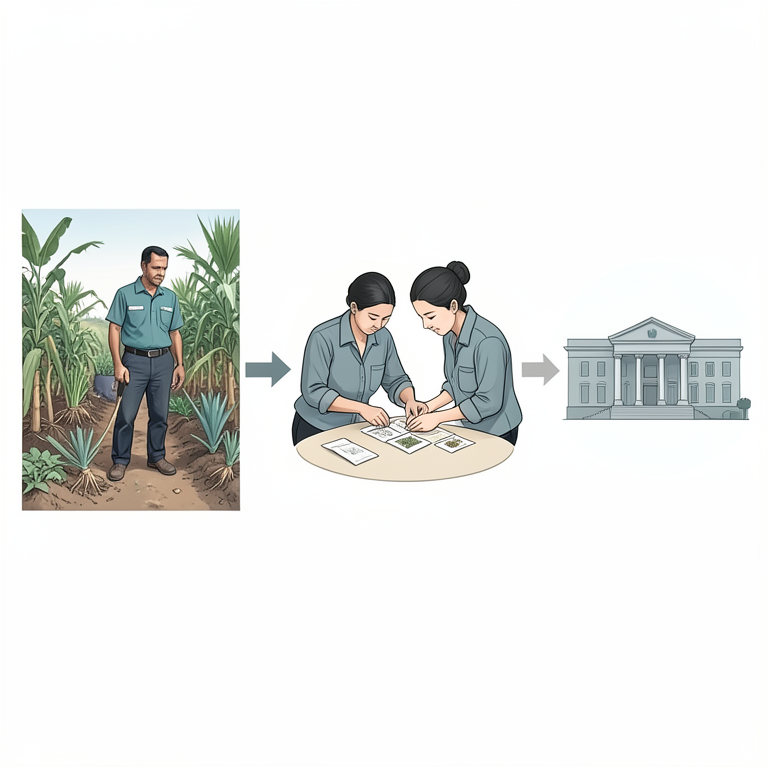
Study overview
AI-generated conceptual illustration (Indian farmers and agricultural extension workers with traditional seed varieties). It explains the idea and does not show study data.
View source evidence ↗Introduction
Intellectual Property Rights (IPR) in India play a pivotal role in safeguarding the innovations and creations of individuals and entities in the field of agriculture. These legal protections are essential for fostering innovation, nurturing creativity, and providing inventors and creators with the incentives they need to develop and share their ideas. In India, the landscape of IPR is governed by a variety of Acts, ranging from the Indian Copyright Act, 1957, to the Protection of Plant Varieties and Farmers' Rights Act, 2001 (PPVFRA), which is the latest addition to this regulatory framework. The World Trade Organization (WTO), established in 1995, holds a significant influence on the global trade dynamics among nations. At the heart of its trade-related agreements lies the Agreement on Trade-Related Aspects of Intellectual Property Rights (TRIPS), which sets out minimum standards for the protection of intellectual property rights. These encompass patents, copyrights, trademarks, and even plant varieties. India, being one of the founding members of the WTO, is inherently bound by the TRIPS agreement. India has taken a distinct approach in complying with the TRIPS Agreement. Article 27(3)(b) of the TRIPS Agreement requires member countries to ensure protection for plant varieties either through patents or via an effective sui generis (unique) system, such as a Plant Variety Protection (PVP) system. Section 3(j) of the Indian Patent Act explicitly excludes plants from patentability. Instead, India has opted for a sui generis system, which stands out for its innovative addition of farmers' rights. This distinctive approach is primarily embodied in the Protection of Plant Varieties and Farmers' Rights (PPV&FR) Act, 2001 [5] .
Farmers' Rights as per PPVFR Act, 2001
A farmer means any person a. cultivates crops by cultivating the land himself; or b. cultivates crops by directly supervising the cultivation or land through any other person; or c. conserves and preserves, severally or jointly, with any person any wild species or traditional varieties or adds value to such wild species or traditional varieties through selection and identification of their useful properties.
"Farmers' variety" is a variety whicha. has been traditionally cultivated (in cultivation prior to introduction of varieties from modern plant breeding interventions) and/or evolved by selection(s) made in existing traditional variety population by the farmers in their fields; or b. is a wild relative or land race or a variety about which the farmers possess the common (traditional) knowledge.
Type of varieties considered for registration under farmers' category
The Act recognizes the importance of traditional varieties and landraces that have been cultivated and developed by farmers over time. These varieties may have evolved www.extensionjournal.com naturally in the field or may be wild relatives of crops. Farmers who possess common knowledge about these varieties have rights over them. In cases where entire communities or villages maintain these varieties, the rights belong to the entire community (FAQ, 2021) [4] . Overall, the PPV&FR Act, 2001 [5] , aims to strike a delicate balance between the interests of plant breeders and preservation of traditional farming practices. It fosters the development of new plant varieties while safeguarding farmers' ability to continue their customary agricultural methods and access improved plant varieties without unnecessary restrictions. This approach is vital for promoting sustainable agriculture and conserving the invaluable knowledge of traditional farming practices (FAQ, 2021) [4] .
Rights conferred to farmers under the Act 4.1 Farmers as a breeder [Section 39(1)(iii)]:
A farmer who has bred or developed a new variety shall be entitled for registration in the like manner as a breeder of a variety under the Act.
Farmers' Right on seed:
Farmers are entitled to save, use, sow, re-sow, exchange, share or sell their farm produce including seeds of a variety protected under the Act just as they were entitled to do before the Act came into effect. However, farmers are entitled to sell unbranded seeds of a variety protected under this Act.
Access to seed [Section 39
(1) (iv)]: Farmers are granted the essential right to obtain seeds of registered varieties at a fair and profitable cost. In cases where this condition is not fulfilled, the breeder's exclusive rights over the variety can be temporarily suspended, as specified in the provisions governing compulsory licensing. Under these circumstances, the breeder is required to grant a license for the production, distribution, and sale of the variety to a competent legal entity.
Farmers' Right to compensation [Section 39(2)]:
A registered crop variety is made available for sale with its agronomic performance when cultivated under the suggested optimal conditions. Farmers can purchase these seeds with the assurance that they have been thoroughly evaluated and documented. If, however, the variety does not deliver the anticipated results when cultivated according to the recommended guidelines, farmers have the option to seek compensation from the breeder, with the involvement of the PPV&FR Authority.
Farmer protection from innocent infringement [Section 42]:
In case of infringement of any registered variety, a farmer, upon demonstrating in a court of law that they were unaware of the existence of any rights as stipulated in the PPV&FR Act at the time of an infringement, will not be subject to charges.
Farmers Right for Benefit sharing [Section 26]:
If the breeder of a registered variety disregards the substantial contributions made by a village or local community to the development of a variety, they may be eligible to seek benefit sharing. The breeder's obligation to contribute is contingent upon factors such as the extent and nature of genetic material usage from the claimant, the commercial viability of the variety, and its market demand. The breeder is required to deposit the specified amount into the Gene Fund. In the event of non-compliance within a three-month timeframe, the Registrar will refer the matter to the District Magistrate. The deposited amount will then be disbursed to the claimant from the Gene Fund.
Registration of farmers' varieties [Section 39 (1) (iii)]:
Under the PPV&FR Act, the registration of existing farmers' varieties is permissible if they meet the criteria of distinctiveness, uniformity, stability and denomination, without requiring novelty. This provision grants farmers a unique and time-limited opportunity, starting from the point when a crop species is incorporated into the crop portfolio governed by the PPV&FR Act for potential registration. Once registered, these varieties are entitled to all the rights associated with Plant Breeders' Rights.
Exemption from registration fees [Section 44]:
Farmers are exempted from payment of any fees in respect of any proceedings before the Registrar or Authority or High Court and they are also exempted from payment of any fee for inspection of any document or obtaining any decision or order or document under the Act or Rules.
Farmers' recognition and reward for contributing to conservation [Section 39(i)(iii) & Section 45(2)(C)]:
A Farmer who is engaged in conservation of Genetic Resources of Land Races and Wild relatives of economic plants and their improvement through selection and preservation and that the material so selected and preserved has been used as donors of genes in varieties registerable under PPV&FR Act, 2001 (Section 39(1)(iii) of the protection of plant varieties and farmers' Right Act, 2001) [5] . Such farmers are eligible for Plant Genome Saviour Reward/Recognition/Community awards conferred by PPVFR Authority annually. www.extensionjournal.com A farmer will be violating Farmer's Rights or infringing the Breeder's Rights on a variety if a. He sells seed in branded form (packs, labels). b. He adopts any practice that can be described as processing. c. The product is beyond what is described as "farm produce", or produced on contract on behalf of any agency. d. multiplies seedlings, propagules under protected cultivation systems, nurseries, etc., for selling. e. He claims rights of 39(2) on "illegitimately obtained unbranded/unauthenticated seed". f. He sells the seed with variety denomination using 39
(1)(iv) from his farm produce if the seed is not true to type. g. There can be no claims on compensation by any farmers under 39(2) who procure seed from a farmer who used his 39(1) iv to sell.
Process of registration of farmers' varieties
To register plant varieties, applicants must complete Form number 1, providing essential details such as the applicant's name and address, variety classification, the recipient's name and address for application-related correspondence, and general information about the variety (T.K. Nagarathna, 2023) [3] . The application should be signed by the applicant and endorsed by either the Chairperson or Secretary of the respective Panchayat, Biodiversity Management Committee or Director of Research at the State Agricultural University, or any other authorized person specified in Form number 1.
The completed application, in triplicate, along with the required quantity of seeds, must be submitted to the Registrar of the PPVFR Authority in New Delhi (www.plantauthority.gov.in). It's worth noting that there is also an option for the registration of perennial plants, involving on-site field testing. The Protection of Plant Varieties and Farmers' Rights (PPVFR) Act, 2001 [5] is an important piece of legislation in India aimed at protecting the rights of both plant breeders and farmers. However, like any law, it has faced various issues and challenges in its implementation. Some of these issues and challenges include: 1. Lack of Awareness: One of the primary challenges is the lack of awareness among farmers about their rights under the PPVFR Act. Many farmers are unaware of the provisions of the Act and how they can benefit from it.
Biopiracy and Intellectual Property Rights (IPR):
There have been concerns about the potential for biopiracy, where indigenous plant varieties are patented by corporations without adequate compensation to local farmers and communities. Striking a balance between protecting plant breeders' rights and ensuring farmers' rights is a challenge. 3. Small and Marginal Farmers: Small and marginal farmers often lack the resources and knowledge to participate effectively in the PPVFR system. The Act may not provide adequate protection and benefits to these vulnerable groups. 4. Benefit-Sharing Mechanisms: Implementing effective benefit-sharing mechanisms, where farmers receive a fair share of the benefits from the commercialization of protected plant varieties, has been a challenge. 5. Enforcement: Ensuring effective enforcement of the Act and protecting farmers' rights can be difficult, particularly in rural and remote areas where regulatory authorities may have limited presence and capacity. 6. Seed Monopoly: Some critics argue that the PPVFR Act may inadvertently contribute to the consolidation of seed companies and limit the availability of traditional and locally adapted seed varieties. 7. Bureaucratic Processes: The registration and certification processes for plant varieties can be cumbersome and time-consuming, making it difficult for farmers, especially small-scale ones, to navigate the system. 8. Conflict Resolution: Disputes between plant breeders and farmers over rights and benefits can be challenging to resolve in a fair and timely manner. 9. Traditional Knowledge Protection: Safeguarding the traditional knowledge of farmers and indigenous communities in relation to plant varieties is an ongoing challenge, as this knowledge may not always fit neatly into the legal framework of the Act. 10. Resource Constraints: Government agencies responsible for implementing the PPVFR Act may face resource constraints, which can hinder effective monitoring and enforcement.
Current status of registration of plant varieties in India
The current data indicates that, the Authority has received around 19,000 applications from farmers, private industry, and the public sector since it commenced accepting registration applications in 2007. Among these applications, legal protection has been awarded to 6,122 varieties, beginning with the issuance of the first certificate in 2009 for the pearl millet variety JKBH-26 (595) in the Extant (Notified) category and the first farmers' variety was in rice, Tilak Chandan in 2009. This recent data on the number of certificates granted for various categories of crop varieties, such as Extant (Notified), Extant (VCK), new, EDVs (Essentially Derived Varieties), and farmers' varieties, highlights that a significant number of certificates have been granted for cereals, particularly rice, followed by wheat, sorghum, and barley. The data regarding certificates issued in various categories reveals that 1548 certificates for Extant (Notified) varieties, 653 for Extant (VCK) varieties, 980 for new varieties, 14 for EDVs (Essentially Derived Varieties), and 2927 for farmers' varieties. Further examination of crop groupspecific data, as presented in Table 1, highlights that the majority of certificates have been issued for cereals, with rice being the most prominent, followed by wheat, sorghum, and barley. Among the 6122 registered varieties, farmers' varieties stand out with 2927 certificates, primarily dominated by rice, which accounts for 2817 of these certificates.
India's biodiversity
India is home to a diverse range of crop species, including landraces, wild relatives, and traditional varieties to over 18,000 plant species, including 160 crops and 325 wild www.extensionjournal.com relatives. Indigenous tribes utilize around 1,500 wild edible plants, comprising 145 roots/tubers, 521 leafy vegetables, 101 buds/flowers, 647 fruits, and 118 seeds/nuts. The country boasts nearly 9,500 plant species for ethnobotanical use, with 7,500 for ethno-medicinal purposes and 3,900 being multipurpose/edible, showcasing India's diverse contributions to agriculture and traditional medicine (NAAS 1998.). [2] India, recognized as the centre of origin for 30,000-50,000 varieties including rice, pigeon-pea, mango, turmeric, ginger, sugarcane, and gooseberries, holds the seventh position in global agriculture contribution. As one of the 17 mega diverse countries, India possesses about 8% of global biodiversity, featuring approximately 45,000 plant species distributed across 16 agro-climatic zones (Anon. 2006) [1] . So far, PPVFR Authority has received only 19,000 applications for registration under different crop categories. Still there are more than 25,000 crop varieties to be legally protected in India. India's agricultural landscape is a treasure trove of biodiversity, hosting a vast array of crop varieties crucial for food security and ecological balance. To ensure the preservation and protection of this rich biodiversity for future generations, the collaborative efforts of agricultural extension workers and scientists are pivotal. Agricultural extension workers serve as key guardians of farmers' varieties, actively contributing to the preservation of the nation's agricultural legacy. Their collaborative efforts ensure the sustainability of traditional crop varieties, securing a resilient future for Indian agriculture. Here are some ways in which they can contribute to this important task: 1. Extension workers can help assess the impact of their interventions and make necessary adjustments to their strategies.
Conclusion
The efforts of agriculture extension workers in India can have a profound impact on the preservation of farmers' varieties and the overall sustainability of agriculture in the country. Through a combination of awareness building, education, documentation, sustainable practices, collaboration, and policy advocacy, they can contribute significantly to maintaining genetic diversity and upholding the rich agricultural heritage of India.
References
0 in the original paperCited by 1
From OpenAlex, OpenCitations and reference lists read by Scinovex
- Analisis Keberlanjutan Usahatani Andaliman di Kabupaten Toba ↗
Abdoni Sitorus, Abdul Rauf, Lindawati Lindawati · MIMBAR AGRIBISNIS Jurnal Pemikiran Masyarakat Ilmiah Berwawasan Agribisnis · 2025
Andaliman as a typical biodiversity of North Sumatra that grows wild in the Toba and Tapanuli lake areas and is widely found in Toba Regency. Toba Regency is the largest producer of andaliman in North Sumatra with a planting area of 274 Ha and a production of 110.17 tons per year. Andaliman plants experience price fluctuations throughout the year ranging…
❝ 0PDF