
Research article · 2024 · Full text
International Journal of Agriculture Extension and Social DevelopmentKAP study of mothers on complementary feeding practices residing at Gandhinagar city
Volume 7(1) · Pages 451–453 · DOI: 10.33545/26180723.2024.v7.i1f.254 ↗
Research areasChild Nutrition and Water AccessFood Security and Health in Diverse Populations
Abstract
Author-writtenPresent study was conducted with aim of “KAP study of mother’s on complementary feeding practices residing at Gandhinagar city” Present study was conducted with descriptive and survey method. For data collection, a pre-structured an ideal questionnaire was used. Total 100 6-23 months child's were randomly selected from four areas of Gandhinagar city of Gandhinagar district of Gujarat state. Suitable statistical analysis was applied. The result of the present study concluded that overall, KAP study of mother’s on complementary feeding practices of mother’s at age of 6-23 months of child was not good. Anthropometric measurement was not normal and majority of selected 6-23 months of child age had lower measurement than the standards. Only 50% or half of selected population had overall good appearance.
Summary
Source-checkedPlain-language reading of the full paper, prepared with AI and checked against the text. Each point links to the authors' own words.
Why it matters
- Complementary feeding typically occurs between 6 and 23 months of age and is essential for a child's physical and cognitive development. View evidence ↗
- By 6 months, breast milk alone no longer provides sufficient energy and nutrients, making complementary foods necessary. View evidence ↗
- Children are at high risk of undernutrition during this period if complementary foods are of poor quality or administered incorrectly. View evidence ↗
The question
- The study aimed to evaluate the knowledge, attitudes, and practices (KAP) of mothers regarding complementary feeding in Gandhinagar city. View evidence ↗
What they did
- The research was conducted in four purposely selected areas within the city of Gandhinagar, Gujarat. View evidence ↗
- A sample of 100 children aged 6-23 months was randomly selected for the study. View evidence ↗
- Data were gathered through personal interviews with parents using a pre-structured interview schedule. View evidence ↗
- The researchers used the percentage method to analyze the data and test significance. View evidence ↗
What they found
- A majority (81%) of the mothers breastfed their children within one hour of birth. View evidence ↗
- Mother's milk was the first feed for 83% of the children in the study. View evidence ↗
- All (100%) of the mothers had a Mamta card, and all children had received their vaccinations regularly. View evidence ↗
- Regarding complementary foods, 41% of children received both mother's and animal milk, while 38% received animal milk. View evidence ↗
- Most children (72%) were fed 7-8 times per day. View evidence ↗
- The most common food group combination (84%) consisted of fruits, cereals, pulses, milk/milk products, and jaggery. View evidence ↗
- The most frequent quantity of food given at one time was 1 bowl (39%). View evidence ↗
- The majority of the children (87%) were not sick during the study period. View evidence ↗
What it means
- The authors concluded that the overall knowledge, attitudes, and practices of mothers regarding complementary feeding for children aged 6-23 months were not good. View evidence ↗
- The authors noted that anthropometric measurements were generally below standard, with only 50% of the children having a good overall appearance. View evidence ↗
Visual summary
2 visualsIllustrations explain the paper; charts are replotted from the paper's own table values.
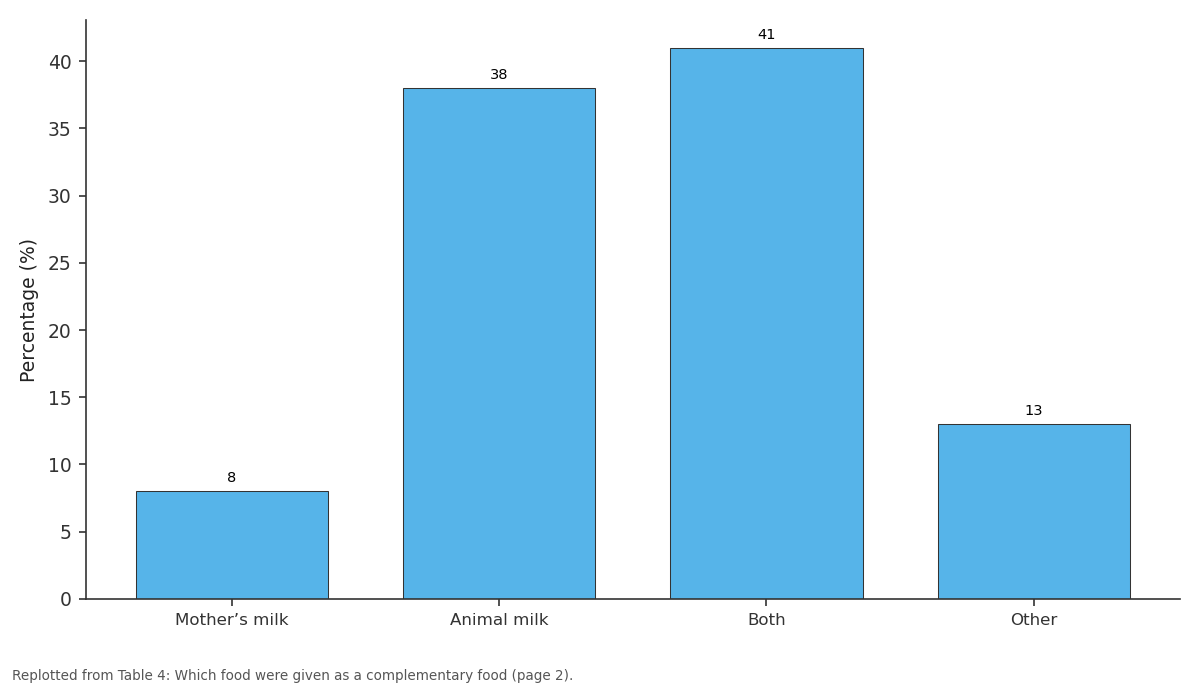
Percentage (%): Mother’s milk vs Animal milk vs Both vs Other
Replotted from Table 4 (page 2) of the original paper. Every bar is the paper's own table value.
View source evidence ↗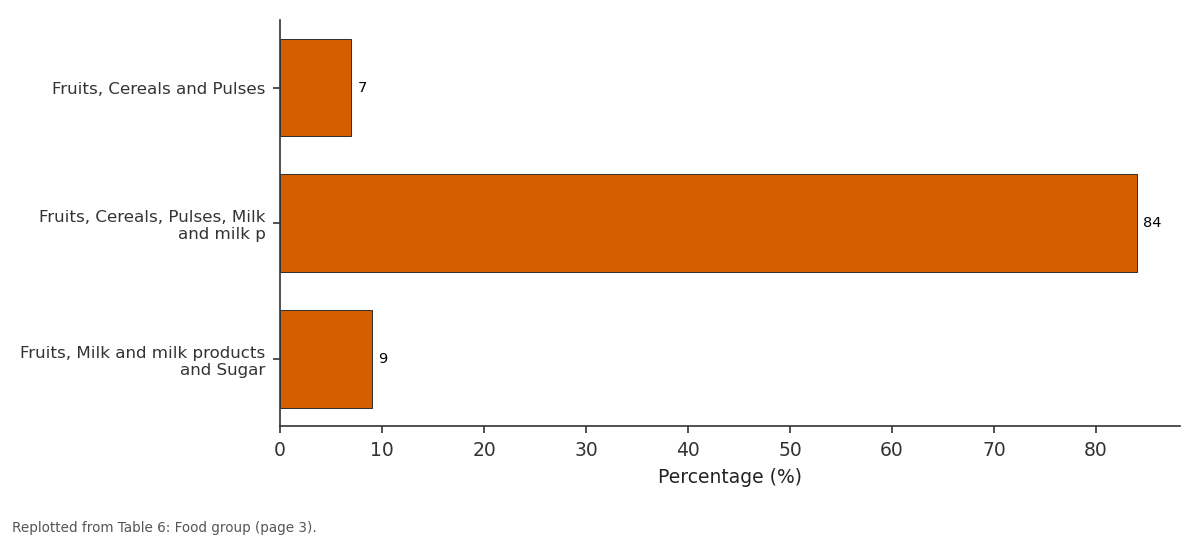
Percentage (%): Fruits, Cereals and... vs Fruits, Cereals... vs Fruits, Milk and milk...
Replotted from Table 6 (page 3) of the original paper. Every bar is the paper's own table value.
View source evidence ↗Figures & tables
From the original paper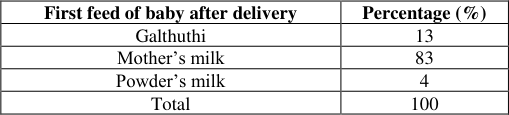 Table 2
 Table 3
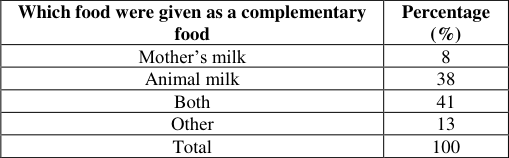 Table 4
 Table 1
 Table 6
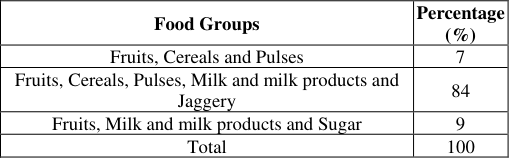 Table 6
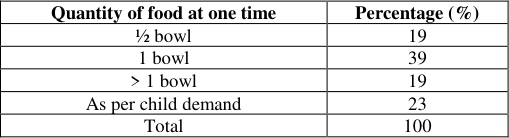 Table 7
 Table 8
Introduction
Complementary feeding, when foods are introduced to complement a milk-based diet, generally occurs between 6 and 23 months of age. It is a critical period for both physical and cognitive development. During this period, the growth rate of the brain is one of the fastest during the life span and, consequently, the timing, dose, and duration of exposure to specific nutrients can result in both positive and negative effects. Complementary feeding is more than ensuring an adequate intake of nutrients; it also is about avoiding excess intakes of calories, salt, sugars, and unhealthy fats. Therefore, in addition to what a child is fed, attention to how a child is fed is also important. In this review, 12 topics relevant for updating global guidance on complementary feeding were identified: age of introduction of complementary foods; continued breastfeeding; responsive feeding; safe preparation and storage of complementary foods; food textures, flavors, and acceptance; energy and meal and snack frequency; fats, protein, and carbohydrates; dietary diversity; milks other than breast milk; fluid needs; unhealthy foods and beverages; and use of vitamin and mineral supplements or supplementary foods. Foods used in complementary feeding are Combination of cereals and pulses (Khichdi, Dal-rice, etc.), locally available staple foods such as idli, dosa, dhokla, ragi, chapatti, roti, paratha with oil/ghee, and some amount of sugar. Mashed banana, other pulpy fruits (e.g., mango, papaya), sweet potato, and potato, Milk-based cereal preparations Sprouts, pulses, legumes, groundnuts, almonds, cashewnuts, raisins (Note: Any nut should be well grinded and mixed with food as solid pieces may cause choking in young children). During the period of complementary feeding, children are at high risk of Undernutrition Complementary foods are often of inadequate nutritional quality, or they are given too early or too late, in too small amounts, or not frequently enough. Premature cessation or low frequency of breastfeeding also contributes to insufficient nutrient and energy intake in infants beyond 6 months of age. Around the age of 6 months, an infant's need for energy and nutrients starts to exceed what is provided by breast milk, and complementary foods are necessary to meet those needs. An infant of this age is also developmentally ready for other foods. If complementary foods are not introduced around the age of 6 months, or if they are given inappropriately, an infant's growth may falter. Guiding principles for appropriate complementary feeding are:
▪ Continue frequent, on-demand breast feeding until 2 years of age or beyond; ▪ Practice responsive feeding (for example, feed infants directly and assist older children. Feed slowly and patiently, encourage them to eat but do not force them, talk to the child and maintain eye contact); ▪ Practice good hygiene and proper food handling; ▪ start at 6 months with small amounts of food and increase gradually as the child gets older; ▪ Gradually increase food consistency and variety;
Importance of complementary feeding
▪ Good nutrition in the first two years of life is crucial.
Therefore, to grow and stay healthy, young children www.extensionjournal.com need a variety of nutritious foods such as meat, fish, pulses, grains, eggs, fruits and vegetables, as well as breast milk.
▪ Foods such as mashed vegetables and copped meat, eggs or fish should be added to the child's diet as often as possible.
▪ Starting at six months of age, feed babies freshly prepared energy and nutrient rich complementary foods, while continuing to breastfeed the baby up to two years of age and longer.
▪ A child's stomach is smaller than an adult's, so a child cannot eat as much at one meal. However, children's energy and body-building needs are great. It is important that children eat frequently to provide for all their needs.
▪ Complementary feeding ensures healthy growth and development of children through the variety of nutritious food introduced in addition to breast milk.
▪ Good nutrition, care and hygiene, especially in the first two years of life, are necessary to prevent children from becoming too short for their age (stunted). Objectives 1. To Study KAP of mothers feeding on complementary practices residing at area of Gandhinagar City.
Methodology
The present study was conducted in the city area of Gandhinagar district, Gujarat state. Four areas selected purposely for conducting the study. The main purpose of selecting the Gandhinagar district is that it has been identified as a less awareness of nutrition. During the period of investigation, lists of 6-23 months old child attaining Anganwadi were prepared from each selected area with the help of a data sheet obtained from Anganwadi of Gandhinagar taluka. Then, a sample of 100 child was drawn by following a proportionate random sampling technique.
To collect the information in person, the per-structured interview schedule was used. The data were collected through personal interviews of the respondent's parents. The respondents were interviewed either at their residence or at their Anganwadi center. Then, the data were classified, tabulated, processed and analyzed to obtain the result. For the present study, Percentage method was applied for the testing significance. Table 4 depicts the data related to complementary food. In the present study, 8% selected 6-23 months child had a Mother's milk as a complementary food. 38% selected 6-23 months child had a Animal milk as a complementary food. 41% selected 6-23 months child had a both as a complementary food. 13% selected 6-23 months child had a other food as a complementary food. Thus, it can be concluded that majority i.e. 41% selected 6-23 months child had a both milk as a complementary food, But most off complementary food from animal milk i.e. 38% selected 6-23 months child. Table 8 depicts the data regarding sickness of child and place of treatment. 13% selected 6-23 months child were sicked and their treatment given at PHC center. 87% selected 6-23 months child were no sicked. Thus, it can be concluded that majority i.e. 87% selected 6-23 months child were no sicked.
| Sickness of child | Treatment of place | Percentage (%) |
|---|---|---|
| Yes | PHC center | 13 |
| No | - | 87 |
| Total | - | 100 |
Table text extracted from the original PDF; superscript letters are shown inline. The original table image is below.
View original table image
| Which food were given as a complementary food | Percentage (%) |
|---|---|
| Mother’s milk | 8 |
| Animal milk | 38 |
| Both | 41 |
| Other | 13 |
| Total | 100 |
Table text extracted from the original PDF; superscript letters are shown inline. The original table image is below.
View original table image
Results and Discussions
Results and Discussions
Conclusion
Inappropriate complementary feeding practices like early or late initiation of complementary feeding, feeding the child less quantity or poor-quality diet is the root cause of child malnutrition. From above results, the present study concluded that overall, KAP study of mother's on complementary feeding practices of mother's at age of 6-23 months of child was not good. Anthropometric measurement was not normal and majority of selected 6-23 months of child age had lower measurement than the standards. Only 50% or half of selected population had overall good appearance.
Figures and tables from the paper
| First feed of baby after delivery | Percentage (%) |
|---|---|
| Galthuthi | 13 |
| Mother’s milk | 83 |
| Powder’s milk | 4 |
| Total | 100 |
Table text extracted from the original PDF; superscript letters are shown inline. The original table image is below.
View original table image
| Had Mamta card/ Child taken all Vaccination | Percentage (%) |
|---|---|
| Yes | 100 |
| No | 00 |
| Total | 100 |
Table text extracted from the original PDF; superscript letters are shown inline. The original table image is below.
View original table image
| Time of first received breast milk | Percentage (%) |
|---|---|
| Within one hour | 81 |
| After one hour | 19 |
| Total | 100 |
Table text extracted from the original PDF; superscript letters are shown inline. The original table image is below.
View original table image
| Frequency of feeding | Percentage (%) |
|---|---|
| 7-8 times a day | 72 |
| As per child demand | 28 |
| Total | 100 |
Table text extracted from the original PDF; superscript letters are shown inline. The original table image is below.
View original table image
| Food Groups | Percentage (%) |
|---|---|
| Fruits, Cereals and Pulses | 7 |
| Fruits, Cereals, Pulses, Milk and milk products and Jaggery | 84 |
| Fruits, Milk and milk products and Sugar | 9 |
| Total | 100 |
Table text extracted from the original PDF; superscript letters are shown inline. The original table image is below.
View original table image
| Quantity of food at one time | Percentage (%) |
|---|---|
| ½ bowl | 19 |
| 1 bowl | 39 |
| > 1 bowl | 19 |
| As per child demand | 23 |
| Total | 100 |
Table text extracted from the original PDF; superscript letters are shown inline. The original table image is below.
View original table image
References
1 in the original paper- Infantand Young Child Feeding Guidelines, 2016 - Indian Pediatricians://www.indianpediatrics.net/aug2016/703. pdf