
Research article · 2024 · Full text
International Journal of Advanced Biochemistry ResearchNon-genetic factors affecting pre and post-weaning average daily gain in Sirohi goat under field condition
Volume 8(1S) · Pages 835–838 · DOI: 10.33545/26174693.2024.v8.i1sk.453 ↗
Research areasLivestock Management and Performance ImprovementGenetic and phenotypic traits in livestock
Abstract
Author-writtenThe objective of this study was to evaluate the effect of some non-genetic factors on average daily weight gain in Sirohi kids during preweaning and post weaning age. Total 3714 data were collected from the records maintained under All India Coordinated Research Project (AICRP) on goat improvement at Livestock research station, Vallabhnagar, Udaipur (Rajasthan). Year of birth and sex of kid had highly significant (p<0.01) effect on average daily gain (ADG) in pre weaning (0-3 months) and post-weaning stages (3-6, 6-9, 9-12 and 3-12 months). Season had non-significant (p>0.05) effect on ADG in preweaning stage and highly significant (p<0.01) effect on ADG in all post weaning stages. Type of birth had non-significant (p>0.05) effect on ADG in preweaning stage whereas significant (p>0.05) in post-weaning stages except 6-9 months of age. Parity of dam had highly significant effect on ADG in preweaning stage.
Summary
Source-checkedPlain-language reading of the full paper, prepared with AI and checked against the text. Each point links to the authors' own words.
Why it matters
- Goats are a critical source of income for poor populations and contribute significantly to rural economies. View evidence ↗
- The Sirohi goat is a key dual-purpose breed in Rajasthan, valued for its growth, production, adaptability, and disease resistance. View evidence ↗
- Average Daily Gain (ADG) is a vital metric for optimizing breeding plans and feeding strategies by measuring daily weight gain across growth stages. View evidence ↗
The question
- The study aimed to evaluate how various non-genetic factors influence the average daily gain of Sirohi kids during pre-weaning and post-weaning periods. View evidence ↗
What they did
- Data were collected for 3,714 Sirohi goats from the AICRP records at the Livestock research station in Vallabhnagar, Udaipur, Rajasthan. View evidence ↗
- The study utilized data collected over a five-year period from 2016 to 2021. View evidence ↗
- Weights were recorded at birth and at 3, 6, 9, and 12 months, with weaning occurring at 3 months of age. View evidence ↗
- ADG (g/day) was calculated for pre-weaning (0-3 months) and post-weaning (3-6, 6-9, 9-12, and 3-12 months) by dividing the weight gain by the number of days in the trial. View evidence ↗
What they found
- The overall mean ADG was 105.06±0.53g (0-3 months), 47.02±0.48g (3-6 months), 43.30±0.52g (6-9 months), 42.20±0.78g (9-12 months), and 133.51±1.08g (3-12 months). View evidence ↗
- Year of birth and the sex of the kid had a highly significant effect (p<0.01) on ADG across all pre-weaning and post-weaning stages. View evidence ↗
- Male kids achieved significantly higher ADG (p<0.01) than female kids during both the pre-weaning and all post-weaning stages. View evidence ↗
- Season of birth did not affect pre-weaning ADG but had a highly significant effect (p<0.01) on all post-weaning ADG stages. View evidence ↗
- Type of kidding had no significant effect on pre-weaning ADG, but it significantly affected post-weaning ADG at 3-6, 9-12, and 3-12 months. View evidence ↗
- The parity of the dam had a highly significant effect on the ADG of kids during the pre-weaning stage. View evidence ↗
What it means
- The lack of seasonal effect on pre-weaning ADG suggests that the Sirohi breed possesses sufficient milk production and strong mothering abilities to support kid growth. View evidence ↗
- The authors recommend establishing proper guidelines for optimizing rearing practices to mitigate the impact of non-genetic factors on ADG. View evidence ↗
Visual summary
1 visualsIllustrations explain the paper; they do not show study data.
Non-Genetic Factors Influencing ADG
AI-generated conceptual illustration (Sirohi goat kids). It explains the idea and does not show study data.
View source evidence ↗Figures & tables
From the original paper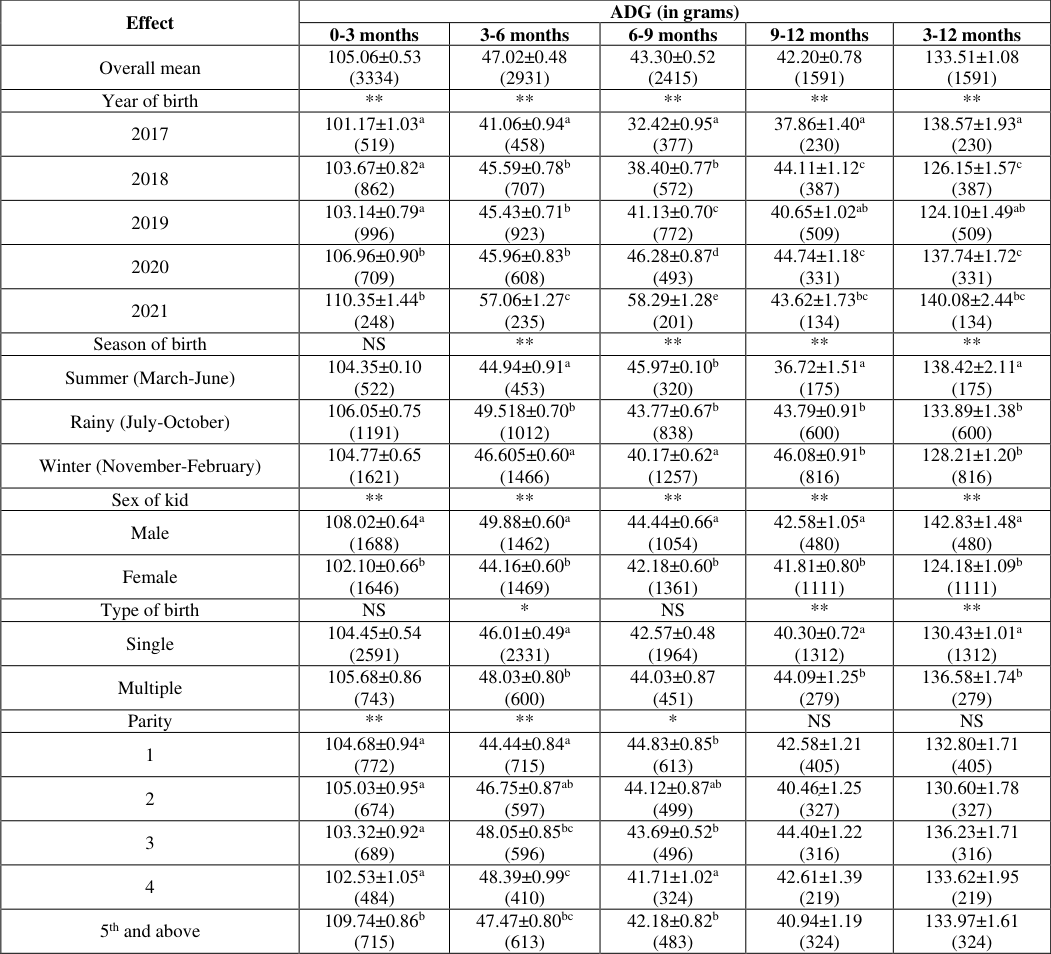 Table 1
Introduction
The goat is a major source of income for the impoverished segments of society and makes a significant contribution to the rural economy. With 148.88 million goats (27.80% of the nation's total livestock), India has the second-largest goat population in the world. The Rajasthan ranks 1 st in goat population with 20.84 million (20 th Livestock Census, 2019) [1] . Sirohi is a predominant dual-purpose breed of Rajasthan and proved an excellent goat breed with respect to disease resistance, adaptability, Growth and production performance. Farmer prefers to rear these goats because of their shining body colour, beautiful look, good performance in field condition, ability to survive on scarce vegetation and utility as a good source of income through milk and meat. Chevon is the most preferred and widely consumed meat in the India. In addition to being a good source of dietary protein for human beings, chevon has a lower total fat, saturated fatty acid and cholesterol content as compare to other meat, which makes it a healthy product (Mazhangara et al. 2019) [7] Goat contribute 14.47% to the total meat production of the country (BAHS 2023). Social taboos surrounding beef and pork consumption in India intensify pressure on small ruminants and poultry, emphasizing the urgency to enhance goat productivity for meat production (Dige et al. 2021) [3] . Therefore, it is imperative to raise goat productivity for meat production in order to fulfill the growing demand and support small, marginal farmers. Furthermore, the growth efficiency is an important economic trait that has an impact on the goat's market weight. Average Daily Gain (ADG) can be defined as the average amount of weight a market animal will gain each day during different growth stages and is an important trait that help us in optimizing feeding strategies and breeding plans. Effect of non-genetic factors should always be corrected for any given trait for precise estimate of genetic parameter and breeding value and thereby for choosing of efficient selection programme.
Materials and Methods
Materials and Methods
Data collection
The data records regarding to 3714 animals of Sirohi breed including details of body weight at different age, year of birth, season of birth, sex of kid, type of birth and parity of dam were collected from records maintained under All India Coordinated Research Project (AICRP) on goat improvement at Livestock research station, Vallabhnagar, Udaipur (Rajasthan). Data were collected over a period of five years from 2016 to 2021. Season was divided into three category I summer (March-June), II rainy (July-October) and III winter (November-February). Body weight of animals were collected at birth, 3 months, 6 months, 9 months and 12 months of age. The kids were weaned at 3 month of age. Average daily gain was calculated during preweaning stage (0-3 months of age) and post weaning stages (3-6, 6-9, 9-12 and 3-12 months of age) by using the following formula.
Average daily Gain (g/day) = [final weight (g)-initial weight (g)] /no. of days of growth trial
Statistical analysis
To study the effect of various non-genetic factors (year of birth, season of birth, sex, type of birth and parity of dam) on average daily gain at preweaning and post weaning stages were estimated through least square mean and maximum likelihood method designed by Harvey (1990). The effect of different non-genetic factors on average daily gain was calculated from the following statistical general linear model:
Where: Y ijklmn = Average daily gain of n th kid born in i th year in the j th season of k th sex in l th type of birth in m th parity of dam μ = Overall Population mean A i = Effect of i th year of birth B j = Effect of j th season of birth C k = Effect of k th sex of the kid D l = Effect of l th type of birth E m = Effect of m th parity of dam e ijklmn = Residual error, NID (0, σ 2 ) Duncan's Multiple Range Test as modified by Kramer (1956) [6] was used to make pair wise comparison among the least squares means.
Results and Discussion
Overall least-squares means were 105.06±0.53g, 47.02±0.48g, 43.30±0.52g, 42.20±0.78g and 133.51±1.08g for preweaning age (0-3 months) and post weaning age (3-6, 6-9, 9-12 and 3-12 months), respectively. Similar findings were observed by Gautam et al. (2018) [4] in Sirohi breed. Lower value of ADG in preweaning stage was reported by Singh et al. (2021) [11] in Barbari kids. Some other studies (Patel and Pandey [9] , 2013 in Mehsana breed; Thiruvenkadan et al. 2009 [14] in Tellicherry breed) also reported the lower value of ADG in pre and post weaning stages.
Effect of year of birth
Year of birth had highly significant (p<0.01) effect on preweaning and all post weaning ADG. Similar difference in year of birth for pre weaning and post weaning ADG was observed in barbari breed (Singh et al. 2021) [11] . Difference in ADG in various years might be due to difference in climatic conditions and change in managemental practices over the years and also might be attributed by difference in vegetation.
Season of birth
Pre weaning ADG in the given study was not influenced by season of birth whereas post weaning ADG at 3-6, 6-9, 9-12 and 3-12 months were significantly (p<0.01) affected. Present findings on daily weight gains in post-weaning stage are contrary to the results reported by Singh et al. (2021) [11] in Barbari breed. significant effect of season on both preweaning and post weaning stages were reported by Gautam et al. (2018) [4] and Thiruvenkadan et al. (2009) [14] . In present study differences in ADG at post weaning stages might be due to scarce availability of feed and fodder to the growing kids at any particular season. Since pre weaning ADG is not significantly affected by season which might be due to the fact that the kids are under the dam's care and particularly Sirohi is known for producing sufficient quantity of milk to feed their kids.
Sex of the kid
Male kids significantly (p<0.01) achieved better ADG then females in both pre weaning and post weaning ADG at 3-6, 6-9, 9-12 and 3-12 months. This difference among the two sexes might be due to hormonal, differences. Testosterone in male kids promote muscle development and lean tissue growth leading to faster growth rate. The comparison of weight gains in male and female kids revealed that males attained significantly higher growth at both the pre-weaning as well as the post-weaning periods than female kids (Patel and Pandey 2011) [9] . Similar findings were also reported by Rao et al. (2007) [10] , Yadav et al. (2008) [15] , Singh et al. (2008) [15] , Singh et al. (2007) [13] , Thiruvenkadan et al. (2009) [14] and Gautam et al. (2018) [4] in different breeds of goats.
Type of kidding
In the present study, the type of kidding showed nonsignificant (p>0.05) effect on pre-weaning average daily gain (ADG). This lack of significance could be attributed to the possibility that individual care was provided to each kid within the farmer's herd. However, when considering postweaning ADG, a significant effect of the type of kidding was observed at 3-6, 9-12, and 3-12 months. ADG at 6-9 months remained unaffected by the type of kidding. Higher weight gain in twin kids during post weaning period as compared to kids born as single was reported by Patel and Pandey (2013) [9] and Nugroho et al. (2023) [8] . In contrary to study, Single born kids were reported significantly heavier than those born as multiple and maintained their superiority for body weight up to 12 months of age Singh et al. (2021) [21] .
Parity of dam
The parity of does exerts a high significant (p<0.01) influence on both pre-weaning (3-6 months) and postweaning ADG during the 3-6 and 9-12 months of age. Significant effects on preweaning ADG was also observed by Singh et al. (2007) [13] and Thiruvenkadan et al. (2009) [14] . Multiparous does tend to achieve higher body weights at later parities. This can be advantageous for providing better nourishment to the developing kids, as it is associated with increased milk production and overall maternal care. The increased body weight of multiparous does at later parities contributes to their ability to support the nutritional needs of the offspring. In contrast, primiparous does may undergo stress and a learning curve during their initial kidding experiences, potentially impacting the growth rates of their offspring.
Conclusion
Average Daily Gain is a valuable metric that serves as an indicator of overall herd health, nutritional adequacy, and economic efficiency in goat farming. Regular monitoring and interpretation of ADG data enable farmers to make informed decisions to optimize productivity and profitability in their goat operations. The findings of this study underlined the effect of non-genetic factor on preweaning (0-3 months of age) and postweaning (3-6, 6-9, 9-12and 3-12 months of age) ADG. Year and sex of kid had highly significant (p<0.01) effect on ADG in both pre and post weaning stages. Non-significant (p>0.05) effect of season on ADG in preweaning stage indicate that Sirohi breed has good mothering ability and sufficient milk production required for better growth rate of kids. To mitigate effect of nongenetic factors on ADG proper guidelines for optimizing rearing practices are required.
Acknowledgement
AcknowledgementThe authors acknowledge the support of staffs of AICRP on Goat Improvement, livestock Research Station, Vallabhnagar (Udaipur) for providing the facilities as well as information for this study.
Figures and tables from the paper
References
12 in the original paper- Dige MS, Rout PK, Singh MK, Dass G, Kaushik R, Gowane GR. Estimation of co (variance) components and genetic parameters for growth and feed efficiency traits in Jamunapari goat. Small Ruminant Research. 2021;196:106317.
- Gautam L, Nagda RK, Nehra KS, Singh MK. Studies on average daily gains of Sirohi goats in the breeding tract. Indian Journal of Small Ruminants (The). 2018;24(2):243-247.
- Kramer CY. Extension of multiple range tests to group means with unequal numbers of replications. Biometrics. 1956;12:307-310.
- Mazhangara IR, Chivandi E, Mupangwa JF, Muchenje V. The potential of goat meat in the red meat industry. Sustainability. 2019;11(13):3671.
- Nugroho T, Widyas N, Widi TSM, Prastowo S. Factors Affecting Post-Weaning Growth of Boer and Boer Cross Goats in a Closed Breeding Farm Population. Journal Sain Peternakan Indonesia, 2023, 18(4).
- Patel AC, Pandey DP. Growth, production and reproduction performance of Mehsana goat. Journal of Livestock Science. 2013;4:17-21.
- Rao P, Singh MK, Rai B, Roy R. Performance of Ganjam goat under field conditions. Indian Journal of Animal Sciences. 2007;77:184-186.
- Singh MK, Singh SK, Dige MS, Kumar A. Genetic and non-genetic factors affecting first parity growth, reproductive and lactation traits in Barbari goats under semi-intensive management in semi-arid region of India. The Indian Journal of Animal Sciences, 2021. 91(2).
- Singh MK, Rai B, Singh NP. Environmental and genetic effects on growth traits in Jamunapari kids, Indian Journal of Animal Sciences. 2009;79:582-586.
- Singh MK, Rai B, Tiwari HA, Singh NP. Nongenetic sources of variation affecting average daily gains in Jamunapari kids. Indian Journal of Small Ruminants. 2007;13:144-150.
- Thiruvenkadan AK, Murugan M, Karunanithi K, Muralidharan J, Chinnamani K. Genetic and nongenetic factors affecting body weight in Tellicherry goats. South African Journal of Animal Science. 2009;39(sup-1):107-111.
- Yadav JS, Yadav MC, Khan BU. Non-genetic factors affecting growth of Kutchi goats, Indian Journal of Animal Sciences. 2008;78:1288-1290.