
Research article · 2024 · Full text
International Journal of Veterinary Sciences and Animal HusbandryPet dog managemental practices followed by pet dog owners of Kakinada city in Andhra Pradesh
Volume 9(1S) · Pages 268–271 · DOI: 10.22271/veterinary.2024.v9.i1sd.976 ↗
Research areasHuman-Animal Interaction StudiesRabies epidemiology and controlAnimal Virus Infections Studies
Abstract
Author-writtenAn empirical study was conducted to identify the level of awareness and practices followed by pet dog owners in Kakinada city, Andhra Pradesh. The study design involved the systemic personal interview of randomly selected 127 dog owners using a well-structured interview schedule through a simple random sampling method. The study revealed that Dog owners mainly provide homemade and commercial (74.01%) food, 4.72% exclusively use commercial foods and none of them were aware of the chocolate toxicity. The majority of them (86.61%) give both vegetarian and non vegetarian foods to their pets 2-3 times a day. Pet owners in this area prefer male (59.05%) dogs over females. People in this area have a preference for the rearing Labrador Retrievers. About 85.83% pet owners were aware of heat detection, and 82.68% were aware of the appropriate period for breeding. The results revealed that, 38.58% of the owners neutered their dogs. Among the respondents who owned breeding dogs, cent percent preferred natural method of breeding by taking female dogs to male dog’s place. Majority (74.02%) of the owners took their dogs for pregnancy diagnosis and preferred both physical examination by the veterinarian and as well as ultrasound scanning (55.91%) for pregnancy diagnosis. The majority (62.99%) of the owners weaned puppies at less than 4 weeks of age. Most dog breeders (87.4%) in Kakinada housed their dogs at home without any separate housing provisions, only 12.6% kept their dogs in Kennels. The present study reveals that 84.25% of dog owners engage in deworming and vaccination with the advice of nearby Veterinarians. The majority of the dog owners (87.19%) own only one dog as a pet, and most (64.57%) of them maintain records of vaccination and disease treatment. Most of the dog owners (73.23%) do not groom hair and trim nails of their pets despite spending more than 3hrs with their pets (77.17%). Awareness of the importance of grooming and nail trimming is lacking. Approximately, 43.31% of owners in the study area take their dogs for exercise for one hour daily, both in the morning and evening. Pet dog insurance was not known to all the respondents. Therefore, there is urgent need to enhance the knowledge of the dog owners regarding scientific breeding practices of pet dogs by effective dissemination of the information based on the needs of the dog owners.
Summary
Source-checkedPlain-language reading of the full paper, prepared with AI and checked against the text. Each point links to the authors' own words.
Why it matters
- Dogs are widely kept as companions and have become integral members of families in India. View evidence ↗
- The pet dog population in India is growing, increasing from 19.41 million in 2018 to an expected 31.41 million by 2023. View evidence ↗
- There is a lack of available information regarding the awareness of scientific dog rearing and the challenges faced by pet owners. View evidence ↗
The question
- The study aims to identify the feeding, breeding, and health management practices used by pet dog owners in Kakinada city, Andhra Pradesh. View evidence ↗
What they did
- The researchers used a simple random sampling method to select 127 pet dog owners for the study. View evidence ↗
- Data collection was performed via personal interviews using a pretested, well-structured interview schedule. View evidence ↗
- The study took place in Kakinada city, targeting pet owners who visited government veterinary dispensaries and polyclinics. View evidence ↗
What they found
- Most dog owners (74.01%) use a combination of homemade and commercial food, while only 4.72% use commercial food exclusively. View evidence ↗
- None of the surveyed dog owners were aware of chocolate toxicity. View evidence ↗
- Approximately 38.58% of the dog owners in the study neutered their pets. View evidence ↗
- The majority of dog breeders (87.4%) house their dogs inside the home without separate provisions, with only 12.6% using kennels. View evidence ↗
- Despite 77.17% of owners spending over 3 hours with their pets, 73.23% do not perform grooming or nail trimming due to a lack of awareness. View evidence ↗
- None of the respondents were aware of or used insurance for their pet dogs. View evidence ↗
What it means
- The authors conclude there is an urgent need to educate pet owners on how to formulate balanced diets for their dogs. View evidence ↗
- The authors recommend providing need-based training to enhance owners' knowledge of scientific breeding and rearing management. View evidence ↗
Visual summary
3 visualsIllustrations explain the paper; charts are replotted from the paper's own table values.
Overview of Pet Management Practices
AI-generated conceptual illustration (domestic pet dogs). It explains the idea and does not show study data.
View source evidence ↗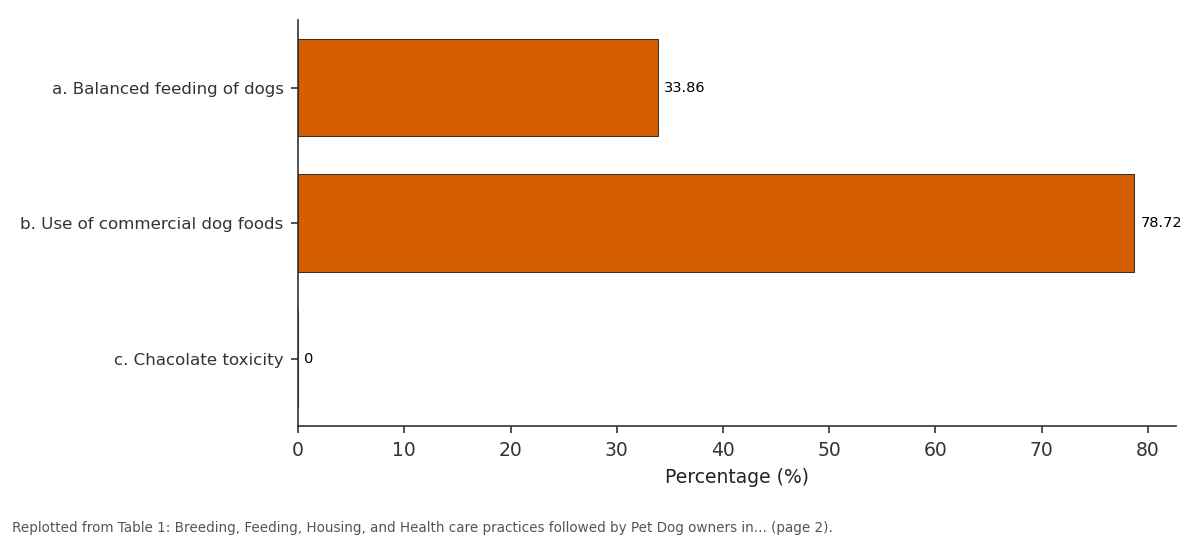
%: a. Balanced feeding of... vs b. Use of commercial... vs c. Chacolate toxicity
Replotted from Table 1 (page 2) of the original paper. Every bar is the paper's own table value.
View source evidence ↗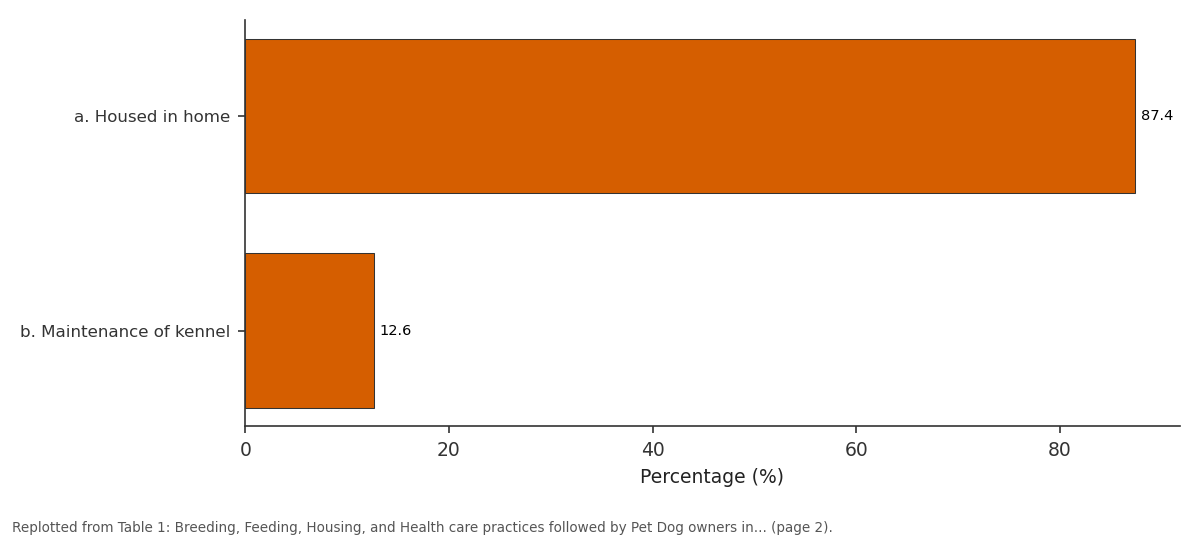
%: a. Housed in home vs b. Maintenance of kennel
Replotted from Table 1 (page 2) of the original paper. Every bar is the paper's own table value.
View source evidence ↗Figures & tables
From the original paper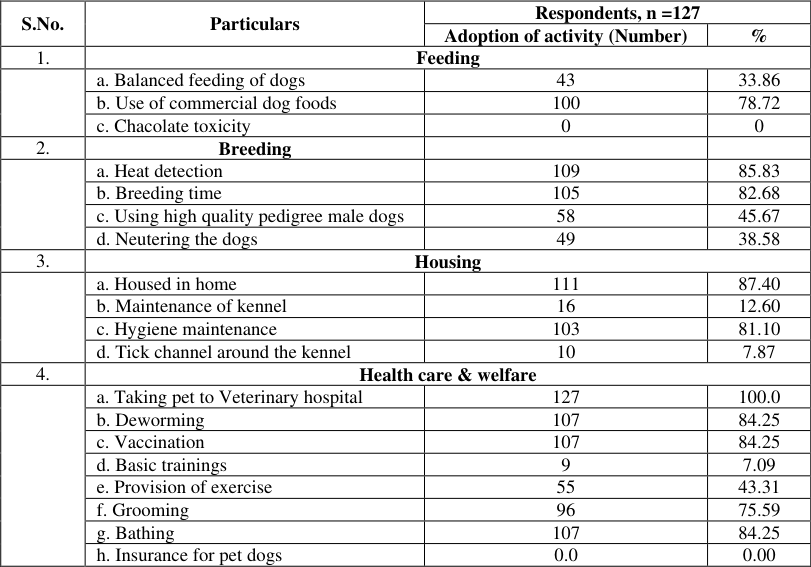 Table 1
Introduction
India, as a developing country, is adopting western life style leading to an increase in nuclear families. Dogs, the first animals domesticated by humans are eventually kept as perfect companions and have become an integral part of the families. There is growing interest in pets among the Indian population, as they contribute to lively atmosphere and provide companionship during walks. Moreover, pets have a positive impact on the emotional and physical health of their owners. The changing socio-cultural values have shifted attitudes towards companion animal ownership. India's pet dog population has risen from 19.41 million in 2018 to 21.42 million in 2019 with an expected increase to 31.41 million in 2023 (Statista, 2022) [14] . Despite the large population of dogs, there is limited information available on pet lovers' awareness of scientific dog rearing and the challenges they face. This study aims to identify the feeding, breeding and health management practices adopted by pet dog owners in Kakinada city, Andhra Pradesh. The goal is to understand the constraints faced by pet lovers in breeding management, helping dog breeders to plan future strategies. A pretested interview schedule was prepared covering scientific pet dog feeding, breeding and housing, cleanliness practices, vaccinations, deworming and other welfare aspects. Besides this, some managemental, health care and welfare aspects were also made part of this survey proforma. During survey, the data on number and gender of pets reared, time spent with pets, record keeping and constraints faced in pet management was collected.
Materials and Methods
The study was conducted in Kakinada city by interacting with pet owners visiting Government Veterinary Polyclinics and Veterinary Dispensaries. A total of 127 pet dog owners were selected using a simple random sampling method. Data was collected through the personal interviews using a wellstructured pretested interview schedule. The collected data were analysed as per the procedures established by Snedecor and Cochran (1994) [10] .
Results and Discussion
The study revealed that the majority of dog owners in Kakinada city belong to middle age group (81.10%), primarily keeping pets for safety (74.80%) and as a hobby (18.11%). Only seven percent of the pet owners rear pets as a companion in old age. These results align with Sawaimul et al. (2009) [12] in Maharashtra. In the present study 93% of respondents stated that they acquired pups below six months for rearing. The results regarding awareness of breeding, feeding, housing, and health care practices are presented in Table 1. In the present study, most of the dog breeders did not prepare special food for their dogs. Only a few of the commercial dog breeders providing exclusively branded dog food. Approximately 29.13% of the population offers homemade food along with milk and milk products, while 4.72% exclusively offer commercial feed. Additionally, 74.01% dog owners provide both homemade and commercial dog foods, correlated with the findings of Singh et al. (2022) [8] in central Punjab and Seneviratne et al. (2016) [13] in Colombo, Sri Lanka. They reported that 42% of pet dogs in Sri Lanka were fed with homemade food only, and 40% of dogs were fed a mixture of both commercial and homemade food. None of them were not aware of the chocolate toxicity. The increased popularity of homemade food may be attributed to its easy availability, and affordability. Only a meager percentage of the pet owners feed their dogs solely commercial food due to higher costs and limited availability of commercial dog foods. Majority of them (86.61%) give both vegetarian and nonvegetarian foods to their pets 2-3 times a day. These findings are consistent with Hadge et al., (2009) [2] , Sawaimul et al. (2009) [12] and Selvakkumar (2020) [6] . Further, only 33.86% of pet owners only know about balanced feeding of dogs. There was wide variation in the dietary composition of the homemade diets, which comprised of varied combinations of rice, vegetables, milk, meat and eggs.
| S.No. | Particulars | Respondents, n =127 | — |
|---|---|---|---|
| Adoption of activity (Number) | % | ||
| 1. | Feeding | ||
| a. Balanced feeding of dogs | 43 | 33.86 | |
| b. Use of commercial dog foods | 100 | 78.72 | |
| c. Chacolate toxicity | 0 | 0 | |
| 2. | Breeding | ||
| a. Heat detection | 109 | 85.83 | |
| b. Breeding time | 105 | 82.68 | |
| c. Using high quality pedigree male dogs | 58 | 45.67 | |
| d. Neutering the dogs | 49 | 38.58 | |
| 3. | Housing | ||
| a. Housed in home | 111 | 87.40 | |
| b. Maintenance of kennel | 16 | 12.60 | |
| c. Hygiene maintenance | 103 | 81.10 | |
| d. Tick channel around the kennel | 10 | 7.87 | |
| 4. | Health care & welfare | ||
| a. Taking pet to Veterinary hospital | 127 | 100.0 | |
| b. Deworming | 107 | 84.25 | |
| c. Vaccination | 107 | 84.25 | |
| d. Basic trainings | 9 | 7.09 | |
| e. Provision of exercise | 55 | 43.31 | |
| f. Grooming | 96 | 75.59 | |
| g. Bathing | 107 | 84.25 | |
| h. Insurance for pet dogs | 0.0 | 0.00 |
Table text extracted from the original PDF; superscript letters are shown inline. The original table image is below.
View original table image
Age, Sex and Breed Preferences
The results of the current investigation showed that 13% dogs reared are of less than one year of age, 84% are between 1-4 years of age and 3% are above 4 years of age. Among 127 dog owners, 75 (59.05%) possess male breeding dogs and 52 (40.94%) have female breeding dogs. The pet owners in this area prefer male dogs over female for ease of management, which is in accordance with the findings of Singh et al. (2020) [7] . This is also in close agreement with Hadge et al., (2009) [2] , who reported that majority of pet owners in Akola city of Vidarbha region preferred young male dogs. However, these findings are in contrast with the findings of Patra et al. (2021) [4] , who reported that the pet owners prefer females over male dogs. Among the dog breeds reared, the majority are large (65.35%), followed by small (30.7%) and medium (3.95%) sized breeds. Commonly reared large breeds include Labrador, German shepherd, medium breeds include Bulldog and non-descript breeds, and small breeds include Pomeranian, Shih Tzu, Pug, Dachshund etc. The analysis of data reveals that people in Kakinada city have a preference for the rearing Labrador Retrievers, which are large breed dogs with friendly nature. This aligns with Sonawane (2018) [11] who noted a similar preference in people in Mumbai city, Maharashtra.
Breeding
The present study revealed that 38.58% of the owners neutered their dogs to avoid developing undesirable behaviours, such as aggression and fighting, while 61.42% kept their dogs intact for breeding to get economic returns from the sale of puppies. The findings are in accordance with Hsu et al. (2003) [3] but in contrast with the results of Rohlf et al. (2010) [5] . Among the respondents who owned female breeding dogs, 85.83% have awareness of heat symptoms, 82.68 percent were aware of breeding time, and about 45.67% were aware of using high quality pedigreed dogs. Cent percent preferred the natural method of breeding by taking female dogs to the male dog's place, primarily due to the availability of pedigreed male dogs for natural service and to provide an advantageous environment for the male dog, the performer. Further, female dogs were bred for three times (85.82%) which is in agreement with the findings of Slater et al. (2008) [9] . In the present study, majority (93.7%) of the respondents did not notice any breeding problems in their dogs, while only 6.3% noticed breeding problems due to unawares of the diseases or conditions affecting their dogs. Therefore, there is an urgent need to enhance the knowledge of the dog owners regarding scientific breeding practices through effective information dissemination tailored to their needs. Among respondents with female dogs, majority (74.02%) took their dogs for pregnancy diagnosis to confirm the pregnancy, to know approximate number of puppies, to detect any abnormalities in puppies and to confirm the date of parturition for timely preparations. The study revealed that the majority (55.91%) of respondents preferred both physical examination by a veterinarian and ultrasound scanning as the reliable source for accurate diagnosis and confirmation of pregnancy. The study also showed that, the majority (62.99%) of owner's weaned puppies at less than 4 weeks age, followed by 4 to 6 weeks (31.50%) and 6 to 8 weeks (5.51%).
Housing
Most dog breeders (87.4%) in Kakinada housed their dogs at home without any separate housing provisions. Only 12.6% kept their dogs in Kennels. [12] , Selvakkumar (2020) [6] . The present investigation contradicts the findings of Hadge et al. (2009) [2] , who reported that about half of dog owners in the Vidarbha region in Maharashtra kept their pets in separate house. As a greater number of dog owners keep their pets inside their homes, it is essential to create awareness among pet parents about zoonotic diseases and preventive measures.
Vaccination and Deworming
The present study reveals that 84.25% of dog owners engage in deworming and vaccination with the advice of nearby Veterinarians. Similar findings were observed by Sawaimul et al. (2009) [12] and Hadge et al (2009) [2] . The survey reveals that the dog breeders have adequate knowledge of the importance of deworming, with more than half (83.46%) of pet lovers having 2-5yrs experience in pet rearing. The majority of the dog owners (87.19%) owned only one dog as a pet, and most (64.57%) of them maintain records of vaccination and disease treatment details of their pets. This is in accordance with the findings of Athilakshmy et al. (2020) [1] . Furthermore, most of the dog owners (73.23%) do not groom hair and trim nails of their pets. Despite spending more than 3hrs with their pets (77.17%), awareness of the importance of grooming and nail trimming is lacking. This is in line with the findings of Athilakshmy et al. (2020) [1] . Approximately, 43.31% of owners in the study area take their dogs for exercise for one hour daily, both in the morning and evening. Pet dog insurance was not known to all the respondents.
Conclusion
The dog owners in Kakinada city are providing homemade food to their pets. Therefore, the proportion of non-vegetarian ingredients such as meat, bones, eggs and meat by products should be elevated in their diets as these can supply high quality proteins and other essential nutrients to the pets. Currently, no scientific feeding schedule was followed. Thus, there is an urgent need to educate pet owners about the formulation of balanced diets for their dogs. Among the respondents who owned breeding dogs, all the pet owners preferred natural method of breeding, by taking female dogs to male dog's place, and did not notice any breeding problems in their dogs. Consequently, there is urgent need to enhance the knowledge of dog owners regarding scientific breeding management by providing need-based training on scientific rearing of dogs. A deep understanding of pet management adopted by pet owners will assist public health experts in creating awareness of zoonotic diseases and their control among general public. No one is aware of insurance coverage for dogs. This necessitates proper assistance from the intellectuals in the form of capacity building programs for pet owners and efforts to remove constraints in pet management. The use of more interactive Information and Communication Technologies (ICT) tools for pet owners is the need of the hour.
References
15 in the original paper- Athilakshmy P, Kumaravel P, Vimalrajkumar N. General Dog Management Practices Followed and Constraints Faced by Pet Owners in Chennai-An Empirical Study. Int. J Curr. Microbiol. App. Sci. 2020;9(10):674682.
- Hadge MR, Kuralkar P, Nuzhat S, Raja AA. Dog Rearing Practices in Akola City of Vidarbha Region. Indian Journal of Animal Research. 2009;43(3):226-227.
- Hsu Y, Severinghaus LL, Serpell JA. Dog Keeping in Taiwan: Its contribution to the problem of free-roaming dogs. J Appl. Anim. Welf. Sci. 2003;6(1):1-23.
- Patra M, Singh U, Jisna K, Rajin T, De U, Saxena A. Narayanan Krishnaswamy & kumar, H. Socio-economic factors related to rearing female dogs in India: Relation to the development of CEH-Pyometra. The Indian Journal of Animal Reproduction. 2021;42(1):17-21.
- Rohlf VI, Toukhsati SA, Grahame J, Coleman A, Bennett PC. Dog obesity: can dog caregivers (owners) feed and exercise intentions and behaviours be predicted from attitudes. Journal of Applied Animal Welfare Science. 2010;13(3):213-236.
- Selvakkumar R. Rearing Practices Adopted for Rajapalayam Dog Breed in its Native Tract. Intas Polivet. 2020;21(1):161-163.
- Singh O, Singh U, Mavi G, Grewal RS, Sethi APS. Appraisal of Feeding Practices for Pet Dogs in Districts of Central Punjab. International Journal of Livestock Research. 2020;10(10):80-85.
- Singh O, Singh U, Sethi APS, Mavi G, Malav OP. Proximates Composition, Physiochemical Properties of Dogs Food and Nutritional Practices Adopted by Dog Owners in Central Punjab. Journal of Animal Research. 2022;12(1):123-130.
- Slater MR, Di Nardo A, Pediconi O, Villa PD, Candeloro L, Alessandrini B, et al. Cat and dog ownership and management patterns in Central Italy Preventive veterinary medicine. 2008;85(3-4):267-294.
- Snedecor GW, Cochran WG. Statistical Methods, 6th Ed. Oxford and IBH Publishing Co., New Delhi, 1994.
- Sonawane SR. Preference for Dog breed in Mumbai city of Maharashtra. International Journal of Fauna and Biological Studies. 2018;5(2):181-182.
- Sawaimul AD, Ghule SS, Ali SZ, Kuralkar SV, Sahare MG, Patil LV, et al. Status of dog owners in Amravati Region of Maharashtra. Veterinary World. 2009;2(3):108.
- Seneviratne M, Subasinghe DWD, Watson PJ. A survey of pet feeding practices of dog owners visiting a veterinary practice in Colombo, Sri Lanka. Veterinary Medicine and Science. 2016;2(2):106-116.
- Statista. Statistics Research Department, 2022. https://www.statista.com/.
- Vijayakumar P, Xavier F, Anil L. Housing Management Practices of Pet Dogs in Central Kerala. Indian Journal of Animal Research. 2006;40(1):73-75.