
Research article · 2024 · Full text
International Journal of Agriculture Extension and Social DevelopmentAssessment of Krishi Vigyan Kendra's training programme in upgrading farmers' understanding in Madhya Pradesh
Volume 7(1) · Pages 16–19 · DOI: 10.33545/26180723.2024.v7.i1a.252 ↗
Research areasAgricultural Economics and PracticesLivestock Management and Performance ImprovementAgricultural Systems and Practices
Abstract
Author-writtenThe Farmers seek training to enhance their abilities and knowledge. Training is to enhance employees' job performance and conduct. Different kinds of training can help enhance the agricultural community's economic status. The present study was done in Madhya Pradesh's Barwani districts. The total number of participants for the research was 240 farmers. The results of this study demonstrates that the majority of the 50.00 percent respondents have increased their medium level understanding of agricultural technology through the program and activities of Krishi Vigyan Kendra. The coefficient of collaboration of age, caste, and family size showed no significant link with improved understanding as a result of KVK-organized activities/programmes. Farmers' feedback indicate that the majority.
Summary
Source-checkedPlain-language reading of the full paper, prepared with AI and checked against the text. Each point links to the authors' own words.
Why it matters
- Transferring technology via training and extension is considered the most critical factor for increasing agricultural productivity. View evidence ↗
- Krishi Vigyan Kendra (KVK) serves as a science-based organization that provides vocational training to rural youth, farm women, and farmers. View evidence ↗
- KVK training covers agriculture and other income-generating industries, which has the potential to quadruple the income of rural communities. View evidence ↗
The question
- The research sought to explore how the socio-personal traits of farmers relate to their level of knowledge about agricultural technology. View evidence ↗
What they did
- The research was conducted in the Barwani districts of the West Nimar area in Madhya Pradesh. View evidence ↗
- Primary data was gathered through individual interviews using a pretested interview schedule. View evidence ↗
What they found
- Half of the 240 farmers (50.00%) achieved a medium level of overall knowledge increase, while 33.33% reached a high level and 16.67% a low level. View evidence ↗
- Regarding weed control, the majority of respondents (60.00%) demonstrated a medium level of knowledge. View evidence ↗
- For sowing time and method, the majority of respondents (52.50%) achieved a high level of knowledge. View evidence ↗
- Age, caste, and family size showed no significant correlation with the increase in knowledge resulting from KVK programs. View evidence ↗
- Eleven variables, including education, land holding size, and innovativeness, showed a positive relationship with knowledge gain at the 0.01% probability level. View evidence ↗
- The top-ranked feedback from farmers (73.33%) was the need to increase KVK outreach to remote and village levels. View evidence ↗
- The second most requested improvement (62.50%) was the use of simple terminology and local language during classes. View evidence ↗
What it means
- The authors conclude that KVK programs successfully increased the understanding of agricultural technology to a medium level for the majority (50.00%) of respondents. View evidence ↗
Visual summary
2 visualsIllustrations explain the paper; charts are replotted from the paper's own table values.
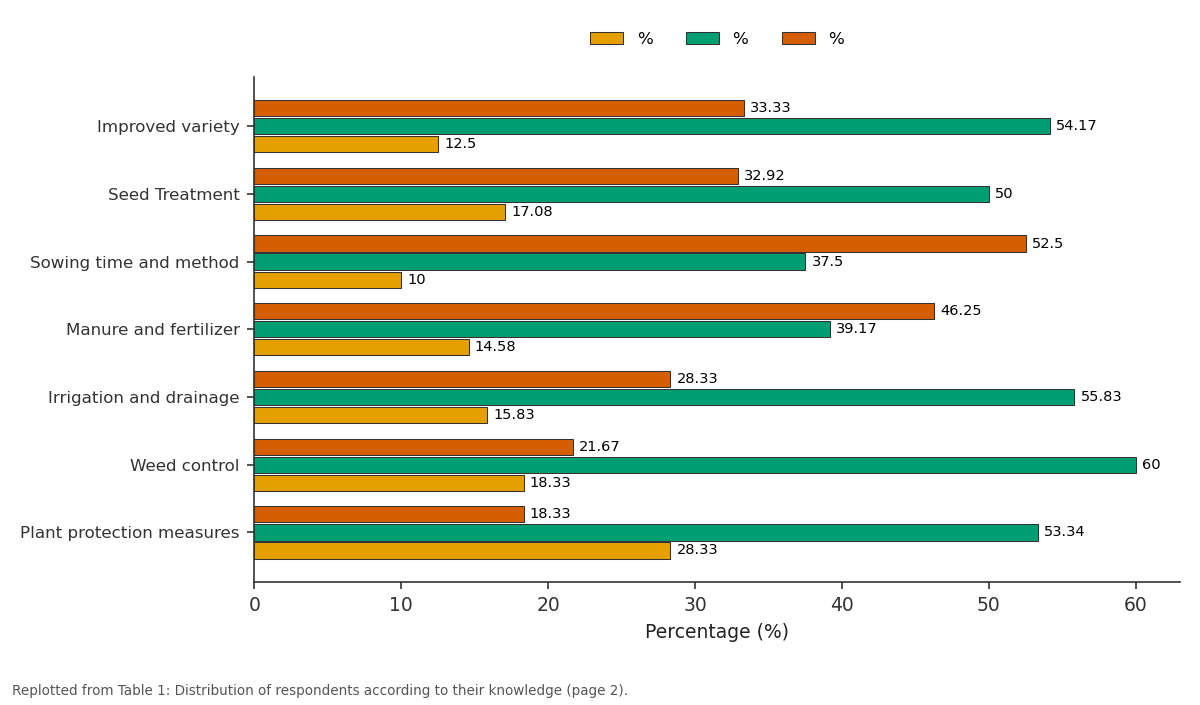
% and % and more: Improved variety vs Seed Treatment vs Sowing time and method vs Manure and fertilizer vs Irrigation and drainage
Replotted from Table 1 (page 2) of the original paper. Every bar is the paper's own table value.
View source evidence ↗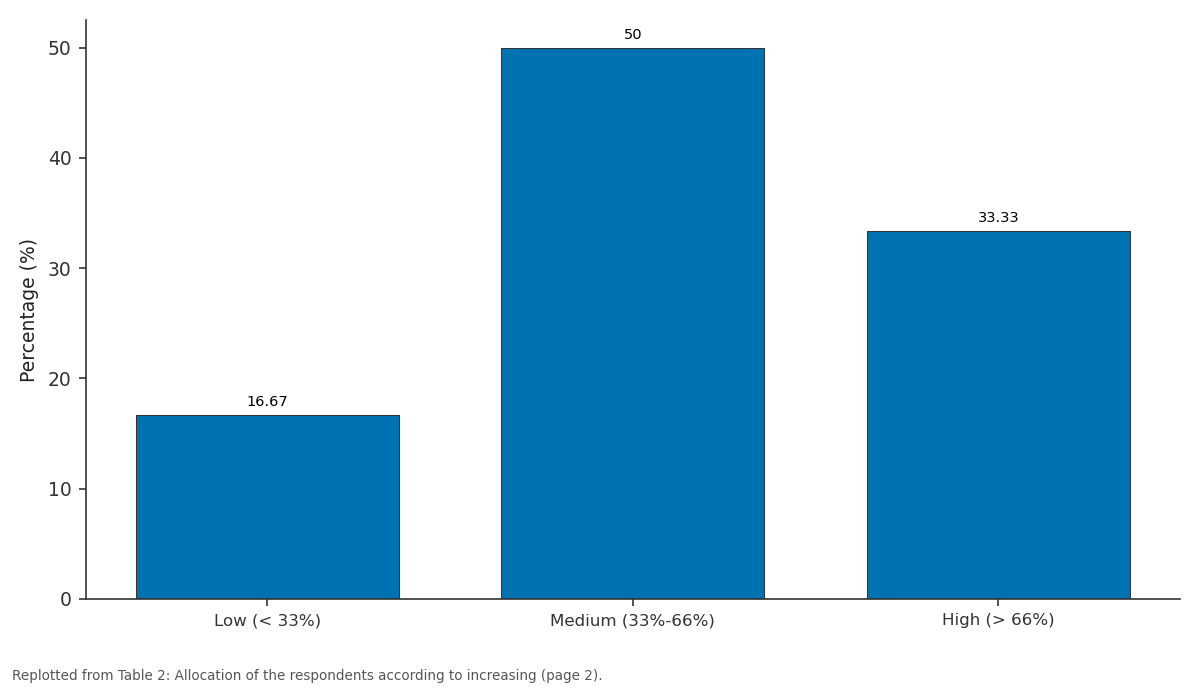
Percentage: Low (< 33%) vs Medium (33%-66%) vs High (> 66%)
Replotted from Table 2 (page 2) of the original paper. Every bar is the paper's own table value.
View source evidence ↗Figures & tables
From the original paper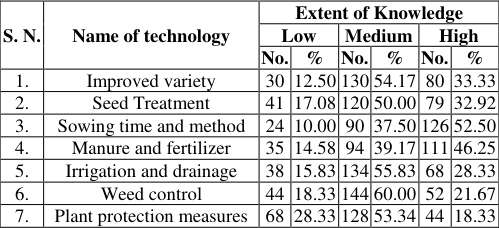 Table 1
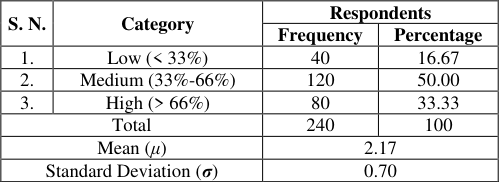 Table 2
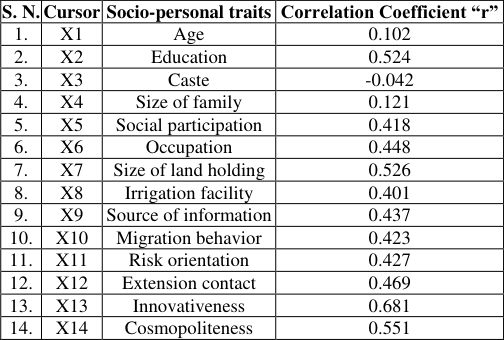 Table 3
 Table 4
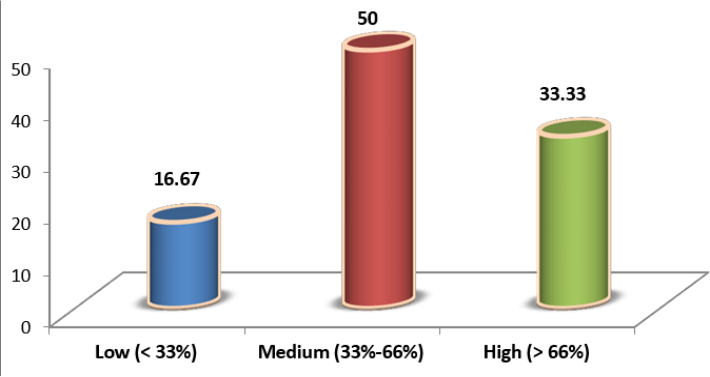 Figure 1
Introduction
Growth in agriculture has nothing to do with the use of science and technology in the field. As a result, the amount to which farmers adopt new technology determines the rise in agricultural productivity as well as its social and economic advantages. Technology transfer through training, demonstration, and extension operations has been identified as the most essential crucial component in enhancing productivity in agriculture. Krishi Vigyan Kendra (KVK) is an innovative science -based organization providing vocational training to farmers, farm women, and rural youths, as well as in-service training for extension workers. It also executes on-farm research to enhance technology and performs frontline demonstrations. One of their main goals is to train farmers through the Farm Science Center or Krishi Vigyan Kendra. Krishi Vigyan Kendra delivers longterm vocational and skill-oriented training. The concept of training is an essential part of human resource development. It compacts with teaching and practicing a skill to a specific level through education and practice. Effective training is one in which training is imparted involving various methods and methods. Appropriate ways to conduct technical know-how are mostly interactive lectures and demonstration groups, discussion role-plays, etc. In such a situation, trainees get a good opportunity to discuss adequately for clarification. Apart from this the ideal location, appropriate material as per the requirement, proper design, and right timing are other considerations to carry out the training programs effectively. Therefore, in this study, an attempt has been made to study the impact of training on farmers through Krishi Vigyan Kendra training. Most of the programmes are interlinked with the demonstration and trail that are conducted to extend the solution to location-specific problems and to improve production. Similarly, some aimed at increasing the net income and proper management of natural resources by reducing the cost of production. The some programmes are aimed at diversifying agriculture based on market demand for available local resources.
Training is an essential and continuous requirement for the continued development of the agricultural sector. Krishi Vigyan Kendra emphasizes vocational training as one of its most significant initiatives. PRA addresses the designated emphasize village's needs and concerns. This is why needbased training courses for extension workers and practicing farmers are created, as well as there are systematic chances for rural youth and participants to get the essential understanding and skills throughout the training. The KVK not only provides training in agriculture and related businesses, but also in other income-generating industries that may quadruple rural communities' income. Training methods can be formal, informal, or a hybrid of both. The training program should be conducted as a plan. The present study was carried out with the following objectives. 1. To study the impact of KVK in terms of gain in knowledge of agriculture technology and allied www.extensionjournal.com activities of farmers. 2. To explore the relationship between socio-personal traits of the farmers with their level of knowledge about agricultural technology and allied activities of farmers. 3. To record the opinion of the farmers as feedback for effective conducting of different activities.
Materials and Methods
The study was done in Madhya Pradesh's West Nimar area, particularly the Barwani districts. The Barwani district comprises seven blocks. Among the seven blocks of the Barwani district, Barwani, Sendhwa, Pati, and Rajpur were purposefully chosen for the study since these areas had the highest number of farmers participating in different KVK activities, followed by the other blocks. A list of villages where Krishi Vigyan Kendra performed different activities/programmes was established and three villages from each selected block were chosen at random for the study. Krishak Mitra, AFO, and RAEO collaborated to develop a village-by-village farmer list. From this list, twenty farmers were selected at random from each the village to produce a sample size of 240 farmers. The primary data was collected from the respondents by using a pretested interview schedule. The respondents were interviewed individually by the investigator. 1 assesses and summarizes the increase in farmers' knowledge of agricultural technology and related activities.
Results and Discussion
In the case of enhanced variety, the majority of respondents (54.17) had a medium level of knowledge, followed by 33.33 and 12.50 percent who had a high and low degree of knowledge of agricultural technology, respectively. In terms of land preparation, the majority of respondents (51.67%) had a medium level of knowledge, followed by 35.83 percent with a high level of knowledge and just 12.50 percent with a poor degree of understanding of agricultural technology. While in terms of sowing time and method, the majority of respondents (52.50%) had a high level of knowledge, 37.50% had a medium level of knowledge, and 10% had a poor level of understanding of agricultural technology. In terms of manure and fertilizer, the majority of respondents (46.25%) had high level knowledge, followed by 39.17% who had medium level knowledge, and 14.58% who had low level knowledge of agricultural production technology.
In terms of irrigation and drainage, the majority of respondents (55.33%) had medium level knowledge, 28.33% had high level knowledge, and just 15.83% had low level understanding of agricultural technology. In terms of weed management, the majority of respondents (60.00%) had a medium level of expertise, 21.67 percent had a high level of knowledge, and 18.33 percent had a poor level of understanding of agricultural technology. In terms of plant protection measures, 53.34% of respondents had a medium level of knowledge, 28.33% had a poor level of knowledge, and just 18.33% had a high level of knowledge of agricultural technology. The findings are consistent with those of Deshmukh et al. (2021) [7] and Christopher et al. (2020) [8] . According to the data in table 2, the majority of the 240 farmers (50.00%) increased their overall knowledge of agricultural technology to a medium level, followed by 33.33 percent who increased their overall knowledge to a high level, and only 16.67 percent who increased their overall knowledge to a low level. Similar findings were reported by Badodiya et al. (2021) [1] , Khare et al. (1996) [5] , and Medhi et al. (2017) [6] . www.extensionjournal.com
| S. N. | Category | Respondents | — |
|---|---|---|---|
| Frequency | Percentage | ||
| 1. | Low (< 33%) | 40 | 16.67 |
| 2. | Medium (33%-66%) | 120 | 50.00 |
| 3. | High (> 66%) | 80 | 33.33 |
| Total | 240 | 100 | |
| Mean (μ) | 2.17 | ||
| Standard Deviation (σ) | 0.70 |
Table text extracted from the original PDF; superscript letters are shown inline. The original table image is below.
View original table image
Relationship between socio-personal traits of the farmers with their level of knowledge about agricultural technology and allied activities of farmers
The zero order correlation coefficient of selected sociopersonnel traits was determined with knowledge of farmers and presented in table 3. The zero order correlation coefficient of each of the variables with their dependent variable annual income increased due to training programme organized by KVK has been furnished. The coefficient of correlation of age, caste and family size were showed no significant relationship with knowledge increase due to activities/programme organized by KVK. This findings are in line with the findings of Badodiya et al.
| S. N. | Cursor | Socio-personal traits | Correlation Coefficient “r” |
|---|---|---|---|
| 1. | X1 | Age | 0.102 |
| 2. | X2 | Education | 0.524 |
| 3. | X3 | Caste | -0.042 |
| 4. | X4 | Size of family | 0.121 |
| 5. | X5 | Social participation | 0.418 |
| 6. | X6 | Occupation | 0.448 |
| 7. | X7 | Size of land holding | 0.526 |
| 8. | X8 | Irrigation facility | 0.401 |
| 9. | X9 | Source of information | 0.437 |
| 10. | X10 | Migration behavior | 0.423 |
| 11. | X11 | Risk orientation | 0.427 |
| 12. | X12 | Extension contact | 0.469 |
| 13. | X13 | Innovativeness | 0.681 |
| 14. | X14 | Cosmopoliteness | 0.551 |
Table text extracted from the original PDF; superscript letters are shown inline. The original table image is below.
View original table image
(2021) [1] , Bihare et al. (2022) [3] , Dixit & Singh (2005) [4] , Yadav et al. (2012) [9] and Medhi et al. (2017) [6] .
Opinion of the farmers as feedback for effective conducting of different activities
During the research, farmers provided several ideas and submissions to help develop more effective training programmes. These findings were described as viable techniques for an effective training program.
According to the farmer responses, the majority (73.33 percent) suggested that KVK outreach be increased for remote and village levels, which was ranked first, followed by the use of local language and simple terminology during theory and practical classes, which was said by 62.50 percent of the respondents and ranked second.
According to the data presented in Table 4, 59.17 percent of respondents believe that literature should be prepared in the local language, which is based on the principle of extension education of "seeing by believing." The majority, 50.83 percent, believe that result and method demonstrations should be conducted during training because "learning by doing" is the best principle of extension education and was ranked fourth. Graphical and pictographic models should be employed to improve training effectiveness, according to 42.50 percent of respondents. Training should be structured depending on need and time, as proposed by 31.67 percent of respondents and rated seventh. Table 4 shows that the majority of 33.33 percent of the respondents advocated that Infrastructural facilities should be developed because inputs are the foundation of any enterprise and it's got seventh ranked. [1] .
| S. N. | Feedback | Freq. | % | Rank |
|---|---|---|---|---|
| 1. | Local language and simple terminology should be used during training | 150 | 62.50 | II |
| 2. | Outreach of KVK should be increased for remote as well as villages level | 176 | 73.33 | I |
| 3. | Literature should be prepared in local language | 142 | 59.17 | III |
| 4. | Result and Method demonstration should be conducted during training | 122 | 50.83 | V |
| 5. | Graphical and pictographic model should be used for making training more effective | 102 | 42.50 | VI |
Table text extracted from the original PDF; superscript letters are shown inline. The original table image is below.
View original table image
Conclusion
This study reveals that the majority of the 50.00 percent respondents have increased their medium level understanding of agricultural technology owing to the program and activities of Krishi Vigyan Kendra. The coefficient of correlation for age, caste, and family size indicated no significant link with knowledge improvement as a result of KVK-organized activities/programmes. According to the farmer responses, the majority (73.33 percent) suggested that KVK outreach be increased for remote and village levels, which was ranked first, followed by the use of local language and simple terminology during theory and practical classes, which was said by 62.50 percent of the respondents and ranked second.
Figures and tables from the paper
| S. N. | Name of technology | Extent of Knowledge | — | — | — | — | — |
|---|---|---|---|---|---|---|---|
| Low | Medium | High | |||||
| No. | % | No. | % | No. | % | ||
| 1. | Improved variety | 30 | 12.50 | 130 | 54.17 | 80 | 33.33 |
| 2. | Seed Treatment | 41 | 17.08 | 120 | 50.00 | 79 | 32.92 |
| 3. | Sowing time and method | 24 | 10.00 | 90 | 37.50 | 126 | 52.50 |
| 4. | Manure and fertilizer | 35 | 14.58 | 94 | 39.17 | 111 | 46.25 |
| 5. | Irrigation and drainage | 38 | 15.83 | 134 | 55.83 | 68 | 28.33 |
| 6. | Weed control | 44 | 18.33 | 144 | 60.00 | 52 | 21.67 |
| 7. | Plant protection measures | 68 | 28.33 | 128 | 53.34 | 44 | 18.33 |
Table text extracted from the original PDF; superscript letters are shown inline. The original table image is below.
View original table image
References
9 in the original paper- Badodiya SK, Jain R, Singh SRK, Kulmi GS. Impact Assessment of Krishi Vigyan Kendra's Interventions on Adoption of Drip Irrigation among the Farmers of Barwani District, Madhya Pradesh. Technofame-A Journal of Multidisciplinary Advance Research. 2021;10(2):114-119.
- Badodiya SK, Jain DK, Maratha P, Gour CL, Sikarwar RS. Efficacy of training programs as perceived by the tribal farmers with regards to organic farming practices in West Nimar Region Barwani of Madhya Pradesh. SKUAST Journal of Research. 2021;23(1):83-86.
- Bihare G, Swarnkar VK, Badodiya SK. Efficacy of training programmes among the tribal farmers provided by Krishi Vigyan Kendra's of West Nimar Region Madhya Pradesh. J Krishi Vigyan. 2022;11(1):158-161.
- Dixit H, Singh S. Impact assessment of farm women training programmes with reference to Sidhi district (M.P.). Madhya J Extn. Edu. 2005;8:87-90.
- Khare YR, Dubey MK, Khare NK. Utility and effectiveness of training on Mushroom (Oyster) production technology -A study. Bhartiya Krishi Anusandhan Patrika. 1996;11(2):121-128.
- Medhi S, Singha AK, Singh R, Singh RJ. Effectiveness of training programmes of Krishi Vigyan Kendra (KVK) towards socio-economic development of farmers in Meghalaya. Economic Affairs. 2017;62(4):677-682.
- Deshmukh SK, Tamilselvi G, Deshmukh TS. Impact of KVK training on knowledge and adoption levels of soybean growers in Maharashtra State. International Journal of Agriculture Sciences. 2021;13(2):1064410646.
- Christopher K, Kumar M, Pathak A, Khusboo N. Impact of Krishi Vigyan Kendra (KVK) Training Program on Knowledge Behaviour of Maize Growers in Bettiah Block of West Champaran District of Bihar, India. Int. J Curr Microbiol. App Sci. 2020;9(2):24312434.
- Yadav SK, Sharma ML, Singh DP. Impact of Krishi Vigyan Kendra on Knowledge and Adoption of Rice Production Technology by the Farmers. Research J Science and Tech. 2012;4(4):158-161.