
Research article · 2024 · Full text
International Journal of Advanced Biochemistry ResearchPhysico-chemical properties of Paneer prepared from cow milk blended with buffalo colostrum
Volume 8(1) · Pages 490–494 · DOI: 10.33545/26174693.2024.v8.i1g.423 ↗
Research areasFood Science and Nutritional StudiesAgricultural Economics and Practices
Abstract
Author-writtenIn the present investigation the attempt was made to study the Physico-chemical properties of Paneer prepared from cow milk blended with buffalo colostrum. The Paneer was prepared by considering treatment combination of cow milk and buffalo colostrum as 95%, 90% and 85% of cow milk and 5%, 10% and 15% of buffalo colostrum in treatments T2, T3 and T4 whereas treatment T1 was taken as control. The Physico-chemical properties (pH, acidity, fat, protein, ash, moisture and total solid) for the Paneer prepared from cow milk blended with buffalo colostrum were analyzed. The treatment T1, T2, T3 and T4 contained score for acidity 0.30, 0.37, 0.46 and 0.54 percent, pH 6.87, 6.68, 6.51 and 6.42 percent, fat 23.76, 24.38, 24.98 and 25.10 percent, protein 16.99, 17.13, 17.24 and 18.03 percent, moisture 55.61, 54.62, 53.97 and 52.65 percent, total solid 44.64, 44.78, 45.06 and 46.18 percent, ash 0.84, 1.66, 1.54 and 1.58 percent, respectively. On the basis of result it was revealed that as the concentration of buffalo colostrum in Paneer increased there was increase in acidity, protein, fat, ash, total solid, while pH and moisture percentage decreased.
Summary
Source-checkedPlain-language reading of the full paper, prepared with AI and checked against the text. Each point links to the authors' own words.
Why it matters
- Colostrum is a nutrient-dense substance containing essential fatty acids, proteins, vitamins, minerals, and immunological compounds. View evidence ↗
- Beyond immune support, colostrum is noted for its ability to support musculoskeletal growth and repair. View evidence ↗
- Paneer is defined by regulatory rules as a product made from cow or buffalo milk (or a blend) precipitated using citric acid, lactic acid, or sour milk. View evidence ↗
The question
- The study aimed to analyze how blending buffalo colostrum into cow milk affects the physico-chemical properties of the resulting Paneer. View evidence ↗
What they did
- The researchers used four treatments: a control (T1) and three blends (T2, T3, T4) containing 5%, 10%, and 15% buffalo colostrum respectively. View evidence ↗
- Paneer was produced by heating cow milk (3.5% fat, 8.5% SNF) to 90°C, cooling to 78°C, adding colostrum, and then adding 1% citric acid at 76°C. View evidence ↗
- The study measured pH, titrable acidity, fat, protein, moisture, total solids, and ash using standardized analytical methods. View evidence ↗
- Statistical analysis of the data was performed using a Completely Randomized Design (CRD). View evidence ↗
What they found
- Titrable acidity increased with higher colostrum levels, rising from 0.30% in T1 to 0.54% in T4. View evidence ↗
- Fat content increased as more colostrum was added, moving from 23.76% in T1 to 25.10% in T4. View evidence ↗
- Protein content increased with colostrum addition, with the lowest value in T1 (16.99%) and the highest in T4 (18.03%). View evidence ↗
- Moisture content decreased as colostrum levels rose, falling from 55.61% in T1 to 52.65% in T4. View evidence ↗
- Ash content increased significantly in all colostrum blends (T2: 1.66%, T3: 1.54%, T4: 1.58%) compared to the control (T1: 0.84%). View evidence ↗
- Total solids increased as colostrum concentration increased, rising from 44.64% in T1 to 46.18% in T4. View evidence ↗
What it means
- The authors conclude that buffalo colostrum is a suitable ingredient for creating Paneer with enhanced nutritional and medicinal properties. View evidence ↗
Visual summary
3 visualsIllustrations explain the paper; charts are replotted from the paper's own table values.
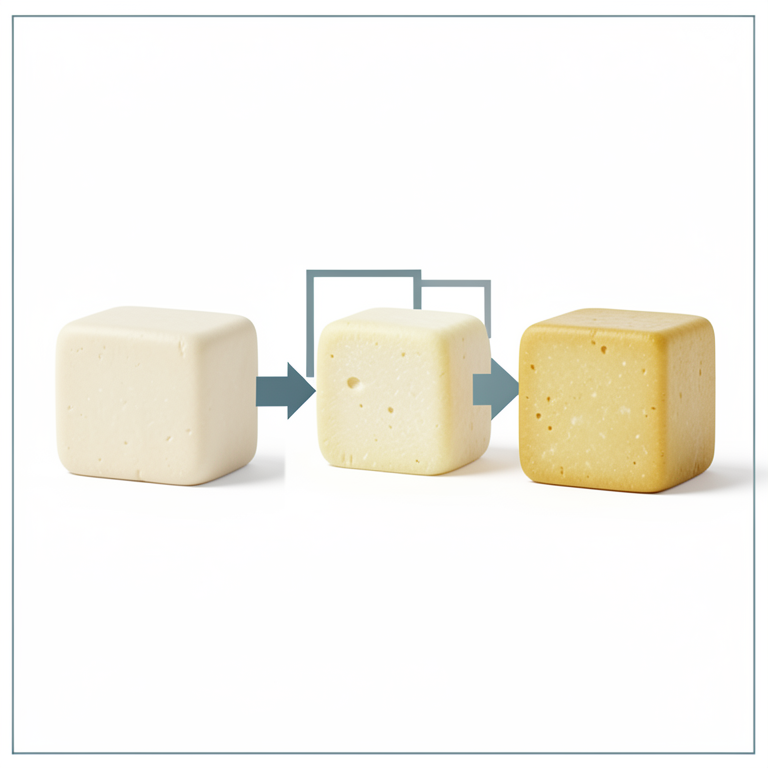
Effect of Colostrum Concentration on Paneer Properties
AI-generated conceptual illustration (Paneer cheese cubes made from cow milk and buffalo colostrum). It explains the idea and does not show study data.
View source evidence ↗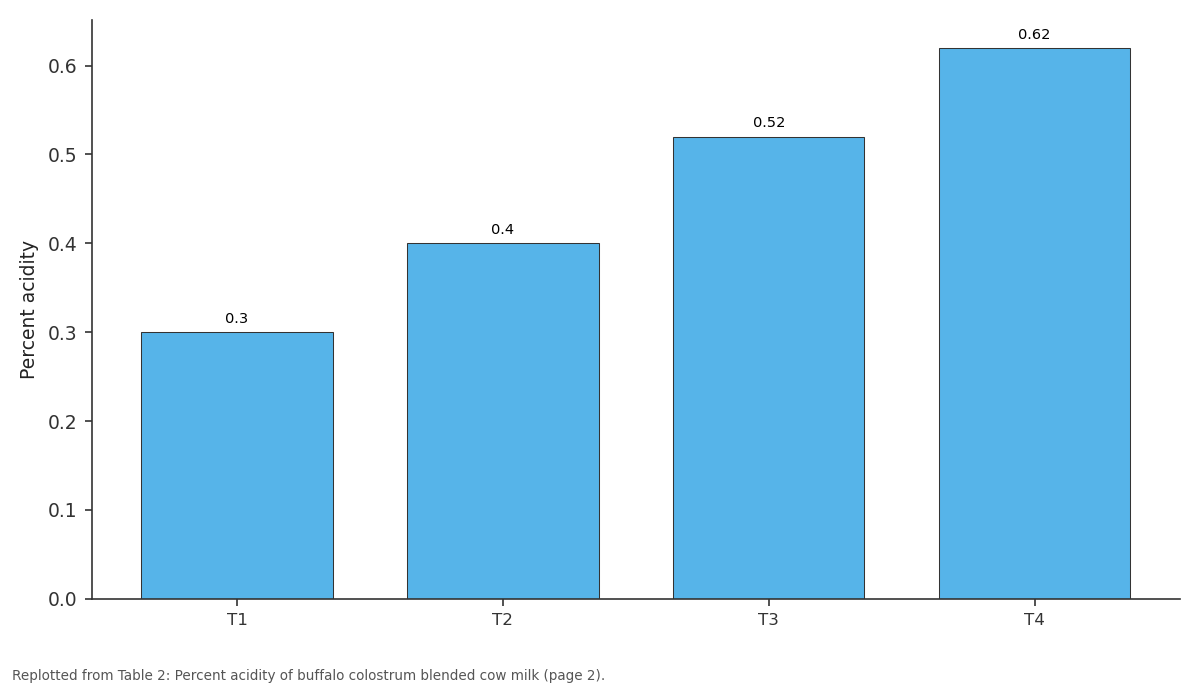
R4: T1 vs T2 vs T3 vs T4
Replotted from Table 2 (page 2) of the original paper. Every bar is the paper's own table value.
View source evidence ↗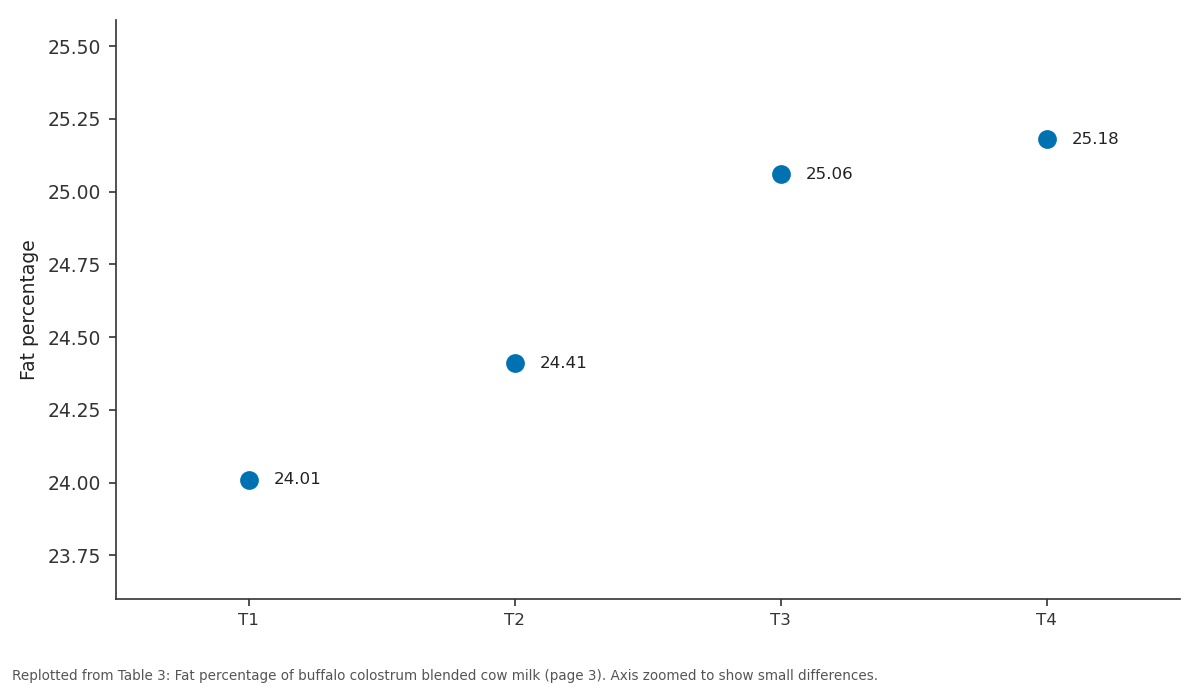
R4: T1 vs T2 vs T3 vs T4
Replotted from Table 3 (page 3) of the original paper. Every bar is the paper's own table value.
View source evidence ↗Figures & tables
From the original paper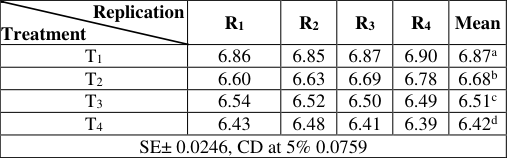 Table 1
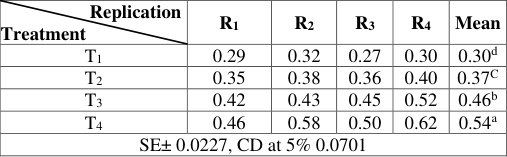 Table 2
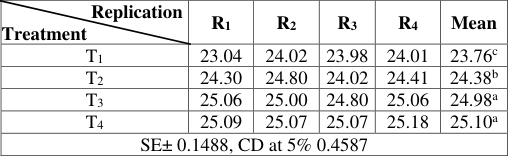 Table 3
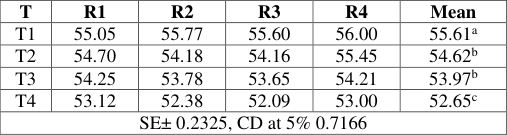 Table 5
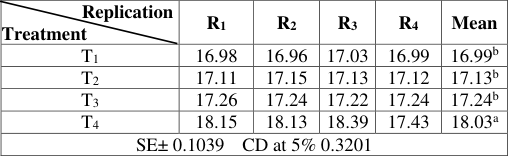 Table 4
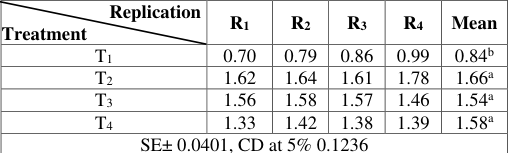 Table 6
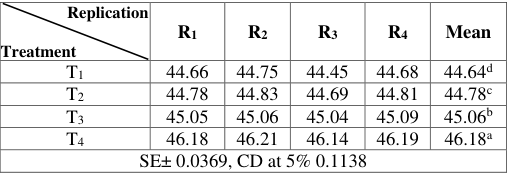 Table 7
Introduction
India is leading as a global milk producer. India's fluid milk production in market year 2023 is 207 million metric tons, up to 2 percent from the earlier revised MY 2022 estimates of 202.5 MMT and milk consumption in MY 2023 at 86.5 MMT up somewhat compared to the MY 2022 consumption of 85 MMT. (Anonymous 2022-23) [5] . According to Prevention of Food Adulteration Rules (PFA 2010) [14] , Paneer means the product obtained from cow or buffalo milk or a combination thereof by precipitation with sour milk, lactic acid or citric acid. It shall not contain more than 70 percent moisture and the milk fat content shall not be less than 50% of the dry matter. Colostrum contains major nutrients (fatty acids, proteins, carbohydrates, vitamins (A, B6, B12, C etc.), minerals (Ca, Na, Mg, P, CI, K etc.), immunological compounds (immunoglobulines -lgG and IgM, hormones and enzymes. Besides providing immune support colostrum has remarkable musculoskeletal repair and growth capabilities. In addition, it seems that colostrum is the only natural source of four major growth factors namely transforming growth factors alpha (TGF-a) and beta (TGF-B), and insulin-like growth factors 1 (IGF-1) and 2 (IGF-2). Colostrum in addition is also a protecting agent against various disease (Coroian et al. 2013) [1] . The present investigation was carried out to study the physicochemical properties of Paneer prepared from cow milk blended with buffalo colostrum.
Materials and Methods
Materials and Methods
Cow milk and Buffalo colostrum:
The fresh Cow milk was purchased from local market of Latur city, having 3.5 percent fat and 8.5 percent SNF. The Buffalo colostrum was purchased from farmer of Sonvati village of Latur.
Equipment and accessories
The equipment includes stainless steel vessels of requisite capacity, knives, mixture, milkometer (fat, lactose, solid not fat and protein of milk), standard weight balance, thermometer, gas shegadi, muslin cloth, Paneer press machine, etc used for the preparation of Paneer. All the equipment was properly cleaned and washed with the detergent solution before using and all the precautionary measures were considered during the conduction of trials to avoid contamination.
Preparation of Paneer from cow milk blended with buffalo colostrum
The cow milk with 3.5 percent fat and 8.5 percent SNF was heated to 90°C and cooled up to temperature 78°C. After cooling buffalo colostrum was added than citric acid was added @ 1 percent at 76°C with stiring. After complete coagulation the stirring was stopped and allow the curd to sink to the bottom. The whey was then drained through a stainless steel container. The curd was collected and filled in stainless steel Paneer hoop. The hoop used was of circular blocks with holes on its side to facilitate the expulsion of whey. Paneer was pressed 10-15 minutes@ 3 kg/sq em. The pressed block of curd was removed from the hoop, cut into pieces and immersed in chilled water (4 °C) for 2 to 3 hours. The chilled Paneer was then removed from water to drain out and packed in polythene bag and finally was stored in refrigerator (5 °C).
Treatment combinations
The Paneer was prepared from cow milk blended with buffalo colostrum as per the following treatments. [13] .
Results and Discussion
Results and Discussion
Physico-chemical analysis of Paneer
The requisite Paneer samples prepared from cow milk blended with buffalo colostrum were subjected for the proximate analysis of physico-chemical properties such as pH, acidity, fat, protein, moisture, ash and total solids.
pH of Paneer prepared from buffalo milk blended with cow colostrum
The pH of Paneer refers to the level of acidity or alkalinity in the cheese. The pH content in the finished product prepared under different treatments combinations had been determined in table no. 1. From Table no. 1 it was revealed that the average scores for pH of developed Paneer was continuously decreased. The highest value of pH was shown by treatment T 1 i.e. 6.87. and the lowest had shown by treatment T 4 i.e. 6.42. The pH of the Paneer declined as the amount of buffalo colostrum in Paneer increased and average scores for pH declined from 6.87 to 6.68, 6.51 and 6.42. The reduced values in pH of all treatments of developed Paneer was due to increase in its acidity due to addition of buffalo colostrum. The results of the Paneer generated were similar to those found in the following research investigations. Anamika (2013) [4] observed that with increase in bovine colostrum level, there was significant decrease (p>0.05) in pH of bovine colostrum supplemented ice cream. The pH values of R 1 and R 2 were found to be 6.52 and 6.48 respectively. Saleh et al. (2019) [15] stated that the pH values of all the produced ice cream with buffalo colostrum took an opposite trend to that of the acidity and decreased compared to control from (6.49) to (6.41) for T 1 , (6.38) T 2 , (6.34) T 3 and (6.32) T 4 respectively.
Percent acidity percentage of buffalo colostrum blended cow milk Paneer
The data on acidity content in buffalo colostrum blended cow milk Paneer is presented in Table no. 2. It was observed that the average acidity (percent) of Paneer prepared under each treatment was increased as buffalo colostrum quantity increased. The overall acid content of a food is indicated by its titrable acidity. From Table 2, indicates that the mean average scores for acidity of Paneer were 0.30, 0.37, 0.46 and 0.54 percent for treatment T 1 , T 2 , T 3 and T 4 , respectively. It was observed that buffalo colostrum increased the acidity of the developed product. The highest value for acidity had shown by treatment T 4 (0.54) and lowest value for acidity had shown by treatment T 1 (0.30). All the treatment shown significant differed between each other. The results of the Paneer generated were similar to those found in the following research investigations. Neupane (2018) [11] showed that the results on acidity percent in control and experimental Paneer using cow milk and soymilk sample of various treatments. It was discovered that the soy Paneer was found to be slightly acidic than control sample from 0.507±0.0l to 0.41±0.005. Saleh et al. (2019) [15] showed that the acidity of ice cream without colostrum compared to ice cream with buffalo colostrum had slightly higher acidity than control as 0.24, 0.28, 0.31, 0.36 respectively.
| Replication Treatment | R1 | R2 | R3 | R4 | Mean |
|---|---|---|---|---|---|
| T1 | 0.29 | 0.32 | 0.27 | 0.30 | 0.30d |
| T2 | 0.35 | 0.38 | 0.36 | 0.40 | 0.37C |
| T3 | 0.42 | 0.43 | 0.45 | 0.52 | 0.46b |
| T4 | 0.46 | 0.58 | 0.50 | 0.62 | 0.54a |
| SE± 0.0227, CD at 5% 0.0701 |
Table text extracted from the original PDF; superscript letters are shown inline. The original table image is below.
View original table image
Fat percentage of buffalo colostrum blended cow milk Paneer
Gerber's fat determination device was used to determine the fat content of the created product. The average ratings for fat produced Paneer are shown in Table no. 3. From Table no. 3 it was concluded that the mean fat percentage score of the manufactured Paneer continued to rose from treatment T 1 (23.76), T 2 (24.38), T 3 (24.98) to T 4 (25.10) concerning the percentage of buffalo colostrum. The treatments T 3 as (24.98) and T 4 as (25.10) at par with each other but significantly different from treatment T 1 as (23.76) and T 2 as (24.38). According to the current study, the fat percentage of Paneer rose as the amount of buffalo colostrum in Paneer increased. The results of the Paneer generated were comparable to those found in the following research investigations. Nivedita and Prajakta. (2015) [12] studied on fat values of experimental resepies like kalakand, palak Paneer, chocolate split, and vegetable pizza prepared using bovine colostrum and found to be higher than control recipies from 4.48 to 23.64, 9.77 to 10.82, 24.09 to 25.29 and 5.78 to 9.92. Alshymaa et al. (2022) [2] studied on functional stirred yoghurt fortified with buffalo colostrum and found increasing values of fat when compared with control 6.52 to 6.75.
Protein percentage of buffalo colostrum blended cow milk Paneer
Protein in milk refers to essential macronutrient found in milk and dairy products. The protein percentage of the developed product was determined using Kjeldahl's distillation flask method. The recorded protein values under different treatment combinations are presented. in Table No From Table no. 4, the protein percentage in buffalo colostrum added cow milk Paneer rose as the amount of buffalo colostrum percent increased. The mean average protein score of buffalo colostrum blended cow milk Paneer was (16.99), (17.13), and (17.24) for treatments T 1 , T 2 and T 3 , respectively. Were significantly different from treatment T 4 . T 4 had the highest percentage of protein whereas T 1 had the lowest protein percentage. The protein increased in each treatment was due to the higher protein in buffalo colostrum. The results of the Paneer generated were comparable to those found in the following research investigations. Nivedita and Prajakta. (2015) [12] revealed protein values of experimental resepies like Kalakand, Palak Paneer, chocolate split, and vegetable pizza prepared using bovine colostrum was found to be two or three folds higher than control recipies from 3.22 to57. 15 [15] recorded the protein content average values of ice cream were the lowest (p< 0.01) in the control compared with treatments T 1 , T 2 , T 3 and T 4 . However, the protein content gradually increased in all treatments with an increase in the added percentage of buffalo's colostrum. The measured average values were 4.90, 4.95, 5.10, 5.18 and 5.37 percent for control, T 1 , T 2 , T 3 and T 4 , respectively.
Moisture percentage of buffalo colostrum blended cow milk Paneer
The moisture of Paneer refers to the amount of water content present in Paneer. The moisture content of the produced Paneer was determined by placing the sample in a hot air oven. The recorded moisture values of the developed product are presented. in Table No.5. From the above Table no.5, it is clear that the moisture content of the control (T 1 ) Paneer was 55.61 percent. As the proportion of buffalo colostrum increased the moisture percent of developed Paneer decreased. The decreasing trends of moisture started from T 2 to T 4 because of increase in level of buffalo colostrum. The treatments T 1 , T 2 , T 3 and T 4 were differed significantly over each other. The decline in moisture was due to the fact that colostrum had high total solid as compared to normal milk. The results of the Paneer generated were comparable to those found in the following research investigations. Amrita and Dabur (2015) [3] studied on moisture content of cow and buffalo colostrum Paneer and found higher value of moisture was seen in control Paneer as 53.00±1.66 and decreased in milk: buffalo colostrum Paneer as 51.00±1.00 for buffalo colostrum Paneer. Simon et al. (2022) [ 16] prepared fresh cheese using the colostrum surplus and reported that the fresh colostrum based cheese contained 67.98±1.16 percent moisture.
Ash percentage of buffalo colostrum blended cow milk Paneer
The ash content in developed Paneer as influenced by different proportions of buffalo colostrum blended in cow milk has been presented in Table no. 6. Table no. 6, revealed that the mean ash score of buffalo colostrum blended cow milk Paneer with treatments T 2 , T 3 and T 4 had a score of (1.66), (1.54) and (1.58) respectively. These treatment values were at par with each other but significantly different than T 1 . Which had a score of (0.84). From the above treatment score, it was clear that ash percent of developed Paneer rose with the amount of buffalo colostrum was added in Paneer. Treatment T 4 with a score of 1.58 which was the highest ash percentage score of all of the treatments. This might be due to high content of mineral as compared to milk and their binding ability to milk components. The values recorded in ash content in the present investigation were comparable with below mentioned research. Saleh et al. (2019) [15] revealed the increase of ash contents in treatments T 1 , T 2 , T 3 and T 4 as (0.90), (1.07), (1.08) and (1.09) of ice cream contained buffalo colostrum compared to the control sample scoring (0.88) percent ash. Alshymaa et al. (2022) [2] estimated the ash percentage of stirred yoghurt fortified with buffalo colostrum which increased from control 0.78 to 0.95 with the addition of buffalo colostrum.
Total solid percentage of buffalo colostrum blended cow milk Paneer:
The data obtained in respect of total solids content of the finished product are presented in Table . no. 7. From the Table no 7, it was revealed that the control (T 1 ) has total solids content as 44.64 percent and other treatments i.e. T 2 (44.78), T 3 (45.06) and T 4 (46.18) percent. It was observed that the total solid content increased with increased in level of buffalo colostrum from T 1 to T 4 . A total solid of product is the counter part of the moisture content parameter of the product and hence moisture content directly influenced the total solid percent, decreased in moisture content of the product increased the total solid content. The results of the Paneer generated were comparable to those found in the following research investigations. Bhandekar et al. (2018) [6] studied that the total solid content of Paneer marketed in Nagpur city was 45.51, 48.08, 47.44, and 47.21 percent of various samples. Saleh et al. (2019) [15] reported that Total solids (TS) content was significantly affected by adding buffalo's colostrum. The recorded value in ice cream (36.29 percent) was significantly higher (p< 0.01) in treatment T 4 compared to the control, T 1 , T 2 and T 3 (34.20, 35.56, 35.90 and 36.12 percent respectively.
Conclusion
From present investigation it can be concluded that the buffalo colostrum can be very well utilized for preparation of medicinal and nutritional Paneer. All the physico-chemical properties i.e., pH, acidity, fat, protein, ash, moisture and total solid these values were found to be significantly differed over control and between each other. There was increased in acidity, protein, fat, ash, total solid, whereas, decrease in pH and moisture percentage of Paneer.
Figures and tables from the paper
| Replication Treatment | R1 | R2 | R3 | R4 | Mean |
|---|---|---|---|---|---|
| T1 | 6.86 | 6.85 | 6.87 | 6.90 | 6.87a |
| T2 | 6.60 | 6.63 | 6.69 | 6.78 | 6.68b |
| T3 | 6.54 | 6.52 | 6.50 | 6.49 | 6.51c |
| T4 | 6.43 | 6.48 | 6.41 | 6.39 | 6.42d |
| SE± 0.0246, CD at 5% 0.0759 |
Table text extracted from the original PDF; superscript letters are shown inline. The original table image is below.
View original table image
| Replication Treatment | R1 | R2 | R3 | R4 | Mean |
|---|---|---|---|---|---|
| T1 | 23.04 | 24.02 | 23.98 | 24.01 | 23.76c |
| T2 | 24.30 | 24.80 | 24.02 | 24.41 | 24.38b |
| T3 | 25.06 | 25.00 | 24.80 | 25.06 | 24.98a |
| T4 | 25.09 | 25.07 | 25.07 | 25.18 | 25.10a |
| SE± 0.1488, CD at 5% 0.4587 |
Table text extracted from the original PDF; superscript letters are shown inline. The original table image is below.
View original table image
| T | R1 | R2 | R3 | R4 | Mean |
|---|---|---|---|---|---|
| T1 | 55.05 | 55.77 | 55.60 | 56.00 | 55.61a |
| T2 | 54.70 | 54.18 | 54.16 | 55.45 | 54.62b |
| T3 | 54.25 | 53.78 | 53.65 | 54.21 | 53.97b |
| T4 | 53.12 | 52.38 | 52.09 | 53.00 | 52.65c |
| SE± 0.2325, CD at 5% 0.7166 |
Table text extracted from the original PDF; superscript letters are shown inline. The original table image is below.
View original table image
| Replication Treatment | R1 | R2 | R3 | R4 | Mean |
|---|---|---|---|---|---|
| T1 | 16.98 | 16.96 | 17.03 | 16.99 | 16.99b |
| T2 | 17.11 | 17.15 | 17.13 | 17.12 | 17.13b |
| T3 | 17.26 | 17.24 | 17.22 | 17.24 | 17.24b |
| T4 | 18.15 | 18.13 | 18.39 | 17.43 | 18.03a |
| SE± 0.1039 CD at 5% 0.3201 |
Table text extracted from the original PDF; superscript letters are shown inline. The original table image is below.
View original table image
| Replication Treatment | R1 | R2 | R3 | R4 | Mean |
|---|---|---|---|---|---|
| T1 | 0.70 | 0.79 | 0.86 | 0.99 | 0.84b |
| T2 | 1.62 | 1.64 | 1.61 | 1.78 | 1.66a |
| T3 | 1.56 | 1.58 | 1.57 | 1.46 | 1.54a |
| T4 | 1.33 | 1.42 | 1.38 | 1.39 | 1.58a |
| SE± 0.0401, CD at 5% 0.1236 |
Table text extracted from the original PDF; superscript letters are shown inline. The original table image is below.
View original table image
| Replication Treatment | R1 | R2 | R3 | R4 | Mean |
|---|---|---|---|---|---|
| T1 | 44.66 | 44.75 | 44.45 | 44.68 | 44.64d |
| T2 | 44.78 | 44.83 | 44.69 | 44.81 | 44.78c |
| T3 | 45.05 | 45.06 | 45.04 | 45.09 | 45.06b |
| T4 | 46.18 | 46.21 | 46.14 | 46.19 | 46.18a |
| SE± 0.0369, CD at 5% 0.1138 |
Table text extracted from the original PDF; superscript letters are shown inline. The original table image is below.
View original table image
References
16 in the original paper- AOAC. Official Methods of Analysis. 11th ed. Washington, D.C.: Association of Official Analytical Chemists; 1965.
- Alshymaa A. Karam-Allah, Eman M. Abo-Zaid, Mahmoud M.M. Refay, Hamdy A. Shaanan, A.S. Abdella, A.M. Hassanin & M.A. EL Waseif. Functional stirred Yoghurt fortified with buffalo, bovine, mix colostrum and lactoferrin: Effect of lactoferrin on pathogenic bacteria and amino acids of buffalo, bovine colostrum, and lactoferrin. Egypt J Chem. 2022;65(7):583-594.
- Amrita, P., & Dabur, R.S. Effect of different concentrations of coagulant, pressing time, and dipping time on the quality of buffalo colostrum Paneer. Asian J Dairy Food Res. 2015;34(1):23-27.
- Anamika, D. Physico-chemical properties of colostrumsupplemented dahi and ice cream. Thesis, Dairy Chemistry, NDRl, Karnal-132001; 2013.
- Anonymous. Annual Report 2022-23. Department of Animal Husbandry & Dairying, Ministry of Fisheries, Animal Husbandry & Dairying, Government of India; 2022-2023.
- Bhandekar, V., Atkare, V., Kadu, K., & Meshram, A. Physico-chemical quality of Paneer sold in Nagpur City. Int J Chem Stud. 2018;6(4):2517-2519.
- Coroian, A., Erler, S., Matea, C.T., Miresan, V., Raducu, C., Bele, C., & Coroian, C.O. Seasonal changes of buffalo colostrum: Physicochemical parameters, fatty acids, and cholesterol variation. Chem Cent J. 2013;7(40):1-9.
- IS.1224 (Part-II). Determination of fat by Gerber method. Indian Standard Institute. New Delhi, India: Manak Bhavan; 1977.
- IS.1479 (Part-I). Method of test for Dairy Industry. Indian Standard Institution. New Delhi, India: Manak Bhavan; 1960.
- IS.SP. (Part-XI). Method of test for dairy industry. Indian Standard Institution. New Delhi, India: Manak Bhavan; 1981.
- Neupane, S. Effect of fat content and heating temperature of milk on the sensory quality and yield of Paneer. M.Tech. Thesis, Tribhuvan University, Nepal; 2018.
- Nivedita, D.D. & Prajakta, J.N. Development & sensory characteristics of value-added products using bovine colostrum. Int J Res Biosci Agric Technol. 2015;ISSN 2347-517.
- Panse, V.G. & Sukhatme, P.V. Statistical analysis for agricultural workers. 2nd ed. New Delhi: ICAR; 1985.
- Prevention of Food Adulteration Rules, 1954 (amended up to 2009). New Delhi: Universal Law Publishing Company Pvt Ltd; 2010. p. 165-166.
- Saleh, A.E., Moussa, M.A.M., Hassabo, M.R. & Ewis, A.M. Manufacturing Functional Stirred Yoghurt Supported by Colostrum. J Prod Dev. 2019;24(4):945963.
- Simon, R., Gennari, A., Kuhn, D., Rama, G.R., & Souza, C.F.V. Making a fresh cheese using the colostrum surplus of dairy farms: An alternative aiming to minimize the waste of this raw material. Braz J Food Technol. 2022;ISSN 1981-6723.