
Research article · 2024 · Full text
International Journal of Advanced Biochemistry ResearchEvaluating the influence of chemical insecticides and biopesticides on Helicoverpa armigera in chickpea fields
Volume 8(1S) · Pages 743–746 · DOI: 10.33545/26174693.2024.v8.i1sj.418 ↗
Research areasAgricultural pest management studiesInsect Resistance and GeneticsGenetic and Environmental Crop Studies
Abstract
Author-writtenIn the conducted field trials at G.H.R.U. School of Agriculture Sciences, Saikheda (M.P.), an investigation was carried out to assess the impact of chemical insecticides in conjunction with biopesticides on the gram pod borer, Helicoverpa armigera, in chickpea crops. The experimental design followed a Randomized Block Design (RBD) with eight treatment modules, including a control. The treatments consisted of Emamectin Benzoate 5 g, Indoxacarb 14.5 SC, Flubendiamide 480 SC, Cypermethrin 25 EC, Quinalphos 25 EC, NSKE Neem seed kernel extract, and Bt (Bacillus thuringiensis). Two spray schedules were implemented on the gram pod borer, and post-application of all sprays, Flubendiamide 480 SC demonstrated high efficacy in controlling the population, with only 0.88 larvae/mrl. Consequently, Flubendiamide emerged as the most effective treatment among all modules. Other treatments also exhibited significant control over the gram pod borer, with Emamectin Benzoate 5 g (1.07 larvae/mrl), Indoxacarb 14.5 SC (1.11 larvae/mrl), Cypermethrin 25 EC (1.21 larvae/mrl), Quinalphos 25 EC (1.38 larvae/mrl), Bt (Bacillus thuringiensis) (1.60 larvae per meter row), and NSKE Neem seed kernel extract (1.67 larvae/mrl). Regarding grain yield, Flubendiamide 480 SC demonstrated its effectiveness by achieving the highest yield among all modules, i.e., 14-15 qt/ha.
Summary
Source-checkedPlain-language reading of the full paper, prepared with AI and checked against the text. Each point links to the authors' own words.
Why it matters
- Chickpea is a globally important legume crop valued for its versatility and nutritional content. View evidence ↗
- The gram pod borer (Helicoverpa armigera) is a major threat to chickpea, causing average pod damage of 30-40%, which can escalate to 80-90% in favorable conditions. View evidence ↗
- There is an increasing interest in biopesticides as sustainable alternatives to synthetic insecticides to reduce environmental impact. View evidence ↗
The question
- The study aimed to evaluate how various chemical insecticides and biopesticides affect the population of the gram pod borer in chickpea fields. View evidence ↗
What they did
- The experiment used a Randomized Block Design (RBD) with 24 plots of chickpea cultivar JG-11, featuring 8 treatments and 3 replications during the 2022-23 season in Saikheda, India. View evidence ↗
- The tested treatments included chemical insecticides (Emamectin Benzoate, Indoxacarb, Flubendiamide, Cypermethrin, and Quinalphos) and biopesticides (Neem seed kernel extract and Bacillus thuringiensis). View evidence ↗
What they found
- Three days after the first spray, Flubendiamide was the most effective (0.60 larvae/mrl), while Neem seed kernel extract was the least effective treatment (1.53 larvae/mrl) compared to the control (2.47 larvae/mrl). View evidence ↗
- Seven days after the second spray, Flubendiamide remained the most effective treatment with 0.47 larvae/mrl, compared to the untreated control at 1.80 larvae/mrl. View evidence ↗
- Fourteen days after the second spray, Flubendiamide showed the lowest larval population (0.40 larvae/mrl), while Bacillus thuringiensis was the least effective treatment (1.07 larvae/mrl), and the control had 1.47 larvae/mrl. View evidence ↗
- Across all spray treatments, Flubendiamide 480 SC was the most effective (0.88 larvae/mrl), followed by Emamectin Benzoate (1.07), Indoxacarb (1.11), Cypermethrin (1.21), Quinalphos (1.38), and Bt (1.60), with NSKE being the least effective (1.67 larvae/mrl). View evidence ↗
- Flubendiamide produced the highest grain yield at 15.77 qt/ha, followed by Emamectin Benzoate (14.88 qt/ha) and Indoxacarb (14.73 qt/ha), while the untreated plot had the lowest yield at 7.54 qt/ha. View evidence ↗
What it means
- The authors conclude that integrating Flubendiamide 480 SC, Emamectin Benzoate 5 SG, and Indoxacarb 14.5 SC into an integrated pest management program is a promising strategy for controlling the gram pod borer. View evidence ↗
- The authors state that further research is needed to understand the long-term environmental and pest population effects of these insecticides. View evidence ↗
- The authors suggest future studies should focus on optimizing spray schedules, specifically initiating sprays only when the Economic Threshold Level (ETL) is reached. View evidence ↗
Visual summary
1 visualsIllustrations explain the paper; they do not show study data.
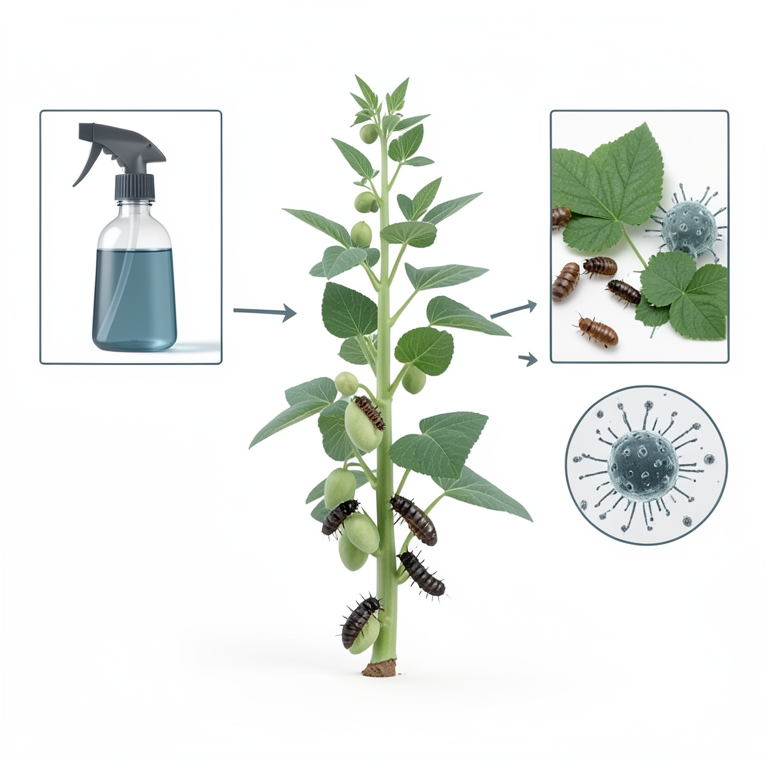
Treatment Comparison Framework
AI-generated conceptual illustration (Chickpea plants and Helicoverpa armigera larvae). It explains the idea and does not show study data.
View source evidence ↗Figures & tables
From the original paper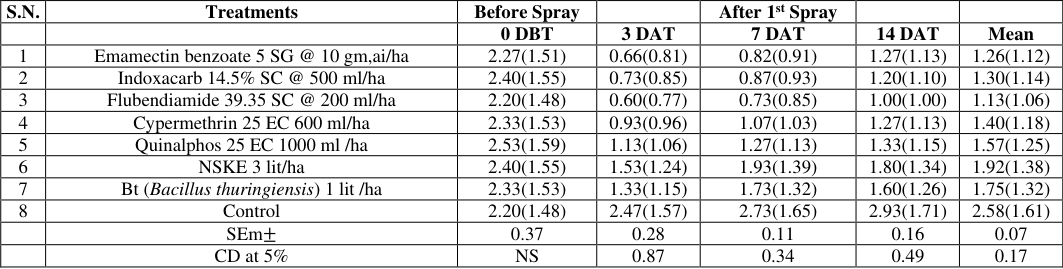 Table 1
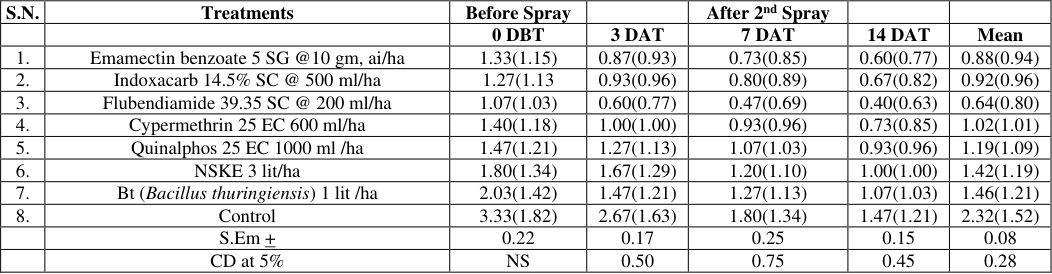 Table 2
Introduction
Chickpea, recognized globally for its nutritional richness and versatility, stands as a crucial legume crop with a history of cultivation dating back millennia. India, boasting a prominent position in global chickpea production, sees significant contributions from states like Madhya Pradesh, Uttar Pradesh, Rajasthan, and Maharashtra. However, the productivity of chickpea faces various challenges in India, categorized as biotic and abiotic factors, including weeds, pests, and insects. Among the insect pests, Helicoverpa armigera (Hubner), commonly known as the gram pod borer, emerges as a significant threat to chickpea crops. Studies by Rahman et al. (1982) [11] identify eleven distinct insect pests affecting chickpea, with Helicoverpa armigera being recognized as the most significant and damaging. This pod borer inflicts a substantial 30-40% loss in pod damage on average, reaching severe levels of 80-90% under favorable environmental conditions. The life cycle of Helicoverpa armigera involves feeding on various parts of chickpea plants, including leaflets, buds, flowers, and pods, creating circular openings in the pods as they mature (Mandal and Roy, 2012) [9] . To address these challenges, the conventional approach involves the use of multiple synthetic insecticides for pest control. However, recognizing the environmental impact and the need for sustainable practices, there is a growing interest in exploring biopesticides as an alternative. Biopesticides offer a promising solution to reduce dependence on hazardous chemicals, maintain productivity, and minimize ecological impacts, aligning with the goal of fostering sustainable pest management practices (Jadhav et al., 2010) [8] .
Materials and Methods
The research conducted at the trial field of G.H.R.U. School of Agricultural Sciences in Saikheda, Chhindwara (M.P.) during the 2022-23 season, an experimental design (RBD) was employed with 3 replications and 8 treatments. The experiment consisted of a total of 24 plots, where the chickpea cultivar JG-11 was sown in the first week of November, with a spacing of 30cm between rows and 10cm between plants within each row. Weekly observations were conducted in each plot to measure the population of gram pod borer per meter row length (mrl). Larval counts were recorded 24 hours before treatment and again after three, seven, and fourteen days following the first and second spray, respectively. These observations were carried out on a one-meter row length from selected five plants of each plot. The collected data on larval population before and after treatment were utilized to calculate the mean and effectiveness of the chemicals on the H. armigera larval population. Additionally, grain yield data were recorded for further analysis. The methodology was designed to assess the impact of the experimental treatments on the targeted pest while considering the overall yield outcome.
Grain Yield (qt/ha) = Grain yield(Kg per plot) ×10000(m2) Plot size (m2)×100
Grain yield calculated at harvesting. It recorded as kg/plot further converted into qtl/ha.
Preparation of insecticidal spray solution
The insecticidal spray solution of desired concentration as per treatment was freshly prepared every time at the site of experiment just before start of spraying operations. The spray solution of desired concentration was prepared by adoption of following formula. (Singh et al., 2011) [12] . V= 𝐶 ×𝐴
𝑎.𝑖 %
Where, V = Volume of a formulated pesticide required C= Concentration required A = Volume of total solution to be prepared % a.i. = given percentage strength of a formulated pesticide.
Results and Discussion 1 st Spray Pre-treatment Assessment
Initial data were gathered from the research field 24 hours prior to the first spray application. The prevalence of Helicoverpa armigera ranged from 2.20 to 2.53 larvae/meter row length. There were no statistically significant variations in larval populations observed among the different treatment plots.
Post-treatment Evaluation
On the 3rd day after the initial spray, the effectiveness of various treatments in controlling gram pod borer was assessed (as detailed in Table 1). Flubendiamide demonstrated the highest efficacy, yielding a larval population of 0.60 larvae/meter row length. It was followed by Emamectin Benzoate (0.66 larvae/meter row), Indoxacarb (0.73 larvae/meter row length), Cypermethrin (0.93 larvae/meter row length), and Quinalphos (1.13 larvae/meter row length). Bt (Bacillus thuringiensis) also exhibited effectiveness with a larval population of 1.33 larvae/meter row length, while Neem seed kernel extract treatment (1.53 larvae/meter row length) proved significantly less efficacious compared to other modules or treatments, with the untreated control at 2.47 larvae/meter row length. By the 7th day after the first spray, Flubendiamide remained the most effective treatment (0.73 larvae/meter row length), followed by Emamectin Benzoate (0.82 larvae/meter row), Indoxacarb (0.87 larvae/meter row length), Cypermethrin (1.07 larvae/meter row length), and Quinalphos (1.27 larvae/meter row length). Bt (Bacillus thuringiensis) also demonstrated effectiveness (1.73 larvae/meter row length), while Neem seed kernel extract treatment (1.93 larvae/meter row length) was less effective than other treatments, including the untreated control (2.73 larvae/meter row length). On the 14th day after the first spray, Flubendiamide continued to exhibit the highest effectiveness (1.00 larvae/meter row length), followed by Emamectin Benzoate (1.27 larvae/meter row), Indoxacarb (1.20 larvae/meter row length), Cypermethrin (1.27 larvae/meter row length), Quinalphos (1.33 larvae/meter row length), and Bt (Bacillus thuringiensis) (1.60 larvae/meter row length). Meanwhile, Neem seed kernel extract treatment showed slightly lower effectiveness (1.80 larvae/meter row length), with the untreated control at 2.93 larvae/meter row length. In conclusion, all chemical modules or treatments demonstrated significant effectiveness in managing the larval incidence of gram pod borer, with Flubendiamide being the most potent treatment throughout the observation period. However, Neem seed kernel extract treatment consistently exhibited relatively lower effectiveness compared to other treatments after the first spray. The initial data collection for the agricultural research was conducted 24 hours prior to the first application of spray. During this phase, the recorded incidence of Helicoverpa armigera ranged from 1.07 to 3.33 larvae per meter of row length. No statistically significant variations in larval populations were observed among the different treatment plots.
| S.N. | Treatments | Before Spray | — | After 1st Spray | — | — |
|---|---|---|---|---|---|---|
| 0 DBT | 3 DAT | 7 DAT | 14 DAT | Mean | ||
| 1 | Emamectin benzoate 5 SG @ 10 gm,ai/ha | 2.27(1.51) | 0.66(0.81) | 0.82(0.91) | 1.27(1.13) | 1.26(1.12) |
| 2 | Indoxacarb 14.5% SC @ 500 ml/ha | 2.40(1.55) | 0.73(0.85) | 0.87(0.93) | 1.20(1.10) | 1.30(1.14) |
| 3 | Flubendiamide 39.35 SC @ 200 ml/ha | 2.20(1.48) | 0.60(0.77) | 0.73(0.85) | 1.00(1.00) | 1.13(1.06) |
| 4 | Cypermethrin 25 EC 600 ml/ha | 2.33(1.53) | 0.93(0.96) | 1.07(1.03) | 1.27(1.13) | 1.40(1.18) |
| 5 | Quinalphos 25 EC 1000 ml /ha | 2.53(1.59) | 1.13(1.06) | 1.27(1.13) | 1.33(1.15) | 1.57(1.25) |
| 6 | NSKE 3 lit/ha | 2.40(1.55) | 1.53(1.24) | 1.93(1.39) | 1.80(1.34) | 1.92(1.38) |
| 7 | Bt (Bacillus thuringiensis) 1 lit /ha | 2.33(1.53) | 1.33(1.15) | 1.73(1.32) | 1.60(1.26) | 1.75(1.32) |
| 8 | Control | 2.20(1.48) | 2.47(1.57) | 2.73(1.65) | 2.93(1.71) | 2.58(1.61) |
| SEm± | 0.37 | 0.28 | 0.11 | 0.16 | 0.07 | |
| CD at 5% | NS | 0.87 | 0.34 | 0.49 | 0.17 |
Table text extracted from the original PDF; superscript letters are shown inline. The original table image is below.
View original table image
Post-treatment Observation
Subsequent to the second spray application (refer to Table 2), observations made three days later highlighted the efficacy in controlling or minimizing the incidence of gram pod borer. The order of effectiveness was as follows: Flubendiamide (0.60 larvae/meter row length), Emamectin Benzoate (0.87 larvae/meter row length), Indoxacarb (0.93 larvae/meter row length), Cypermethrin (1.00 larvae/meter row length), Quinalphos (1.27 larvae/meter row length), Bt (Bacillus thuringiensis) (1.47 larvae/meter row length), and Neem seed kernel extract (1.67 larvae/meter row length) displayed comparatively lower effective. 7th DAS (Days After Second Spray): Seven days after the second spray application, Flubendiamide maintained its status as the most effective treatment (0.47 larvae/meter row length), followed by Emamectin Benzoate (0.73 larvae/meter row length), Indoxacarb (0.80 larvae/meter row length), Cypermethrin (0.93 larvae/meter row length), Quinalphos (1.07 larvae/meter row length), Neem seed kernel extract (1.20 larvae/meter row length), with Bt (Bacillus thuringiensis) showing comparatively reduced effectiveness (1.27 larvae/meter row length) with untreated control 1.80 larvae/mrl. 14th DAS: Fourteen days after the second spray, the effectiveness sequence remained consistent: Flubendiamide (0.40 larvae/meter row length), Emamectin Benzoate (0.60 larvae/meter row length), Indoxacarb (0.67 larvae/meter row length), Cypermethrin (0.73 larvae/meter row length), Quinalphos (0.93 larvae/meter row length), Neem seed kernel extract (1.00 larvae/meter row length), and Bt (Bacillus thuringiensis) exhibited relatively lower effectiveness (1.07 larvae/meter row length) with untreated control 1.47 larvae /mrl. In conclusion, all chemical treatments demonstrated significant efficacy in managing the larval incidence of gram pod borer, with Flubendiamide consistently exhibiting the highest potency throughout the observation period. Conversely, Bt (Bacillus thuringiensis) treatment consistently displayed relatively lower effectiveness compared to other treatments comparatively in second spray.
| S.N. | Treatments | Before Spray | — | After 2nd Spray | — | — |
|---|---|---|---|---|---|---|
| 0 DBT | 3 DAT | 7 DAT | 14 DAT | Mean | ||
| 1. | Emamectin benzoate 5 SG @10 gm, ai/ha | 1.33(1.15) | 0.87(0.93) | 0.73(0.85) | 0.60(0.77) | 0.88(0.94) |
| 2. | Indoxacarb 14.5% SC @ 500 ml/ha | 1.27(1.13 | 0.93(0.96) | 0.80(0.89) | 0.67(0.82) | 0.92(0.96) |
| 3. | Flubendiamide 39.35 SC @ 200 ml/ha | 1.07(1.03) | 0.60(0.77) | 0.47(0.69) | 0.40(0.63) | 0.64(0.80) |
| 4. | Cypermethrin 25 EC 600 ml/ha | 1.40(1.18) | 1.00(1.00) | 0.93(0.96) | 0.73(0.85) | 1.02(1.01) |
| 5. | Quinalphos 25 EC 1000 ml /ha | 1.47(1.21) | 1.27(1.13) | 1.07(1.03) | 0.93(0.96) | 1.19(1.09) |
| 6. | NSKE 3 lit/ha | 1.80(1.34) | 1.67(1.29) | 1.20(1.10) | 1.00(1.00) | 1.42(1.19) |
| 7. | Bt (Bacillus thuringiensis) 1 lit /ha | 2.03(1.42) | 1.47(1.21) | 1.27(1.13) | 1.07(1.03) | 1.46(1.21) |
| 8. | Control | 3.33(1.82) | 2.67(1.63) | 1.80(1.34) | 1.47(1.21) | 2.32(1.52) |
| S.Em + | 0.22 | 0.17 | 0.25 | 0.15 | 0.08 | |
| CD at 5% | NS | 0.50 | 0.75 | 0.45 | 0.28 |
Table text extracted from the original PDF; superscript letters are shown inline. The original table image is below.
View original table image
Comprehensive Analysis of Spray Treatments
A comprehensive analysis of spray treatments or combined mean of larval population results reveals the efficacy of various modules in effectively managing the incidence of Helicoverpa armigera, excluding the plot without control (2.45 larvae/meter row length). Collectively, Flubendiamide 480 SC emerges as a high-potential chemical, demonstrating superior effectiveness in controlling the population of gram pod borer, with only 0.88 larvae/mrl. Consequently, Flubendiamide takes the lead over other treatments. The remaining treatments also exhibit significant control on gram pod borer, with Emamectin Benzoate 5 SG recording 1.07 larvae/meter row length, Indoxacarb 14.5 SC with 1.11 larvae/mrl, Cypermethrin 25 EC with 1.21 larvae/mrl, Quinalphos 25 EC with 1.38 larvae/mrl, Bt (Bacillus thuringiensis) 1lit/ha with 1.60 larvae/mrl, and NSKE with the least effectiveness at 1.67 larvae/mrl. Comparisons with previous studies conducted by Deshmukh et al. (2010) [4] indicate similarities in findings, highlighting the effectiveness of Flubendiamide at 0.007% and Indoxacarb at 0.0075% in reducing the incidence of gram pod borer. Similar results are reported by Babar et al. (2012a) [3] , showcasing significant reductions in larvae occurrence with various insecticides. Additional studies by Ameta and Kumar (2008) [1] reveal that applying Flubendiamide at 60 g a.i./ha (125 ml/ha) three times led to a substantial decline in H. armigera larvae on chili plants, resulting in increased yield. Similarly, for chickpea crops, Gowda et al. (2007) [7] found that Indoxacarb at 25 g a.i./ha and Emamectin Benzoate also demonstrated the highest efficiency in controlling the gram pod borer. In contrast, Dhawan et al. (2006) [6] discovered that on cotton crops, Flubendiamide at 50 g a.i./ha outperformed Indoxacarb at 75 g a.i./ha in managing H. armigera in chickpea. These collective findings provide valuable insights into effective insecticides for controlling the gram pod borer in various crops, suggesting that Flubendiamide, Emamectin Benzoate, and Indoxacarb demonstrate promising results, contingent on the specific crop and application methods. Further research is encouraged to explore their long-term effects on pest populations and the environment, aiming to develop sustainable pest management strategies for agricultural practices.
Grain yield
Observation recorded on grain yield (kg/ha) at harvest showed significantly outcome of various treatments in increasing the chickpea yield. Among the various treatments, flubendiamide 15.77 qt/ha(1.42 kg/plot) was found to be most effective followed by Emamectin Benzoate 14.88 qt/ha (1.346 [3] , Dhaka et al. (2015) [5] and Deshmukh et al. (2010 b) [4] observed an increased Benifit: Cost B:C ratio in the treatment involving Flubendiamide. They also documented that these flubendiamide treatments yielded the highest crop output, with a production of 1850 kg/ha, followed closely by indoxacarb at 0.0075% concentration, resulting in 1805 kg/ha of chickpea. Dhawan reported that applying 60 g a.i./ha of flubendiamide led to 19.11-21.50 q/ha for seed cotton which was highest cotton yield.
Conclusion
In the assessment of seven distinct treatments applied to address gram pod borer infestation in chickpea crops, Flubendiamide emerged as the most efficacious and promising chemical for controlling Helicoverpa armigera. Following closely in effectiveness were Emamectin Benzoate and Indoxacarb. Analyzing grain yield across all treatments revealed that Flubendiamide exhibited the highest potential for yield enhancement, trailed by Emamectin Benzoate and Indoxacarb, which demonstrated comparable outcomes. Cypermethrin, Quinalphos, B.t. (Bacillus thuringiensis) and notably Neem Seed Kernel Extract (NSKE) constituted the treatments with varying degrees of efficacy, with NSKE yielding the least. A thorough examination of the current research underscores the inference that the integration of insecticides, specifically Flubendiamide 480 SC, Emamectin Benzoate 5 SG, and Indoxacarb 14.5 SC, into a meticulously designed integrated pest management program holds substantial promise for effectively combating Helicoverpa armigera (Hubner). Significantly, the efficiency of these insecticides is noteworthy, attributed to their remarkably low recommended field doses.
Suggestion for further study
Propose of study focusing on optimizing insecticidal spray schedules for crop protection. Initiate the first spray only when pest incidence reaches the Economic Threshold Level (ETL). Investigate the communication and behavior patterns of insect pests to enhance understanding of their life cycles and movement. For early-matured crop varieties, evaluate the effectiveness of a two-spray schedule in suppressing pest populations. In the case of chickpeas, identify two critical susceptible stages for gram pod borer infestation-flowering and pod-filling. Implement the first spray upon ETL initiation and the second 15 to 18 days thereafter, providing a strategic approach to manage pests at their early stages and Analyze how the timing of insecticidal sprays affects crop yield, considering factors like pest suppression, plant health, and overall productivity.
Acknowledgement
AcknowledgementThe authors express their heartfelt gratitude to the Head of the Department of Entomology and the esteemed Adviser at G.H.R.U School of Agriculture Sciences in Saikheda (M.P.) for their unwavering support and the provision of essential facilities. Their invaluable contributions were pivotal in ensuring the successful execution of this research endeavor.
References
11 in the original paper- Ameta OP, Kumar A. Efficacy of flubendiamide against Helicoverpa armigera (Hubner) and Spodoptera litura (Fab.) in chilli. Pestology. 2008;17(5):26-29.
- Babar KS, Bharpoda TM, Shah KD, Jhala RC. Bioefficacy of newer molecules of insecticides against chickpea pod borer, Helicoverpa armigera (Hub.). An International e-Journal. 2012;1(2):134-147.
- Deshmukh SG, Sureja BV, Jethva DM, Chatar VP. Field efficacy of different insecticides against Helicoverpa armigera (Hubner) infesting chickpea. Legume Research. 2010;33(4):269-273.
- Dhaka SS, Rai MK, Yadav A. Efficacy of novel insecticides against pod borer, Helicoverpa armigera (Hub.) in chickpea. Indian Journal of Entomology. 2015;77(4):339-344.
- Dhawan AK, Singh K, Singh R, Kumar T. Field evaluation of flubendiamide (480 SC) against bollworm complex on upland cotton. J Cotton Res Development. 2006;20(2):232-235.
- Gowda SDK, Patil BV, Suhas Y. Performance of different sprayers against gram pod borer, Helicoverpa armigera (Hub.) on chickpea. Karnataka Journal of Agricultural Science. 2007;20(2):261-264.
- Jadhav SN, Konda CR, Hanumanaikar RH, Kamanna BC. Eco-friendly integrated pest management strategies against Helicoverpa armigera (Hubner) on chickpea. Karnataka J Agric Sci. 2010;23(1):103-105.
- Mandal SK, Roy SP. Impact of environmental factor(s) on certain pulse crops of north-eastern Bihar (India) with reference to resource management. The Ecoscan. 2012;1:35-40.
- Rahman UA, Saeed MQ, Noora J, Musharaf A, Muhammad T. Efficacy of some new insecticides against gram pod borer Helicoverpa armigera (Hub.) in Peshawar. Sarhad Journal of Agriculture. 2006;22(2):293-295.
- Singh K, Raju SVS, Singh DK. Population succession of tomato fruit borer Helicoverpa armigera on tomato. Agroecosystem in eastern region of U.P. Vegetable Sciences. 2011;38(2):152-155.
- Verma S, Gupta S. Chickpea, a potential source of protein. Legume Research. 2016;39(3):361-366.