
Research article · 2024 · Full text
International Journal of Veterinary Sciences and Animal HusbandryGenetic improvements in sheep
Volume 9(1) · Pages 791–795 · DOI: 10.22271/veterinary.2024.v9.i1k.1003 ↗
Research areasGenetic and phenotypic traits in livestockAnimal Genetics and Reproduction
Abstract
Author-writtenA sheep belongs to the Animalia kingdom, Chordata division, Mammalia class, artiodactyl order, and Bovidae family. It was first domesticated between 11000 – 9000 BC in Southwest Asia. A sheep is a ruminant animal. It is an essential part of the livestock species due to its ability to utilize and convert forages and materials that are unfit for human consumption into end products such as meat and milk, which are essential dietary proteins for humans. (Elshazly & Youngs, 2019). According to the FAO database (Food, 2018), the world population of sheep is 1,173 million heads with 30% of the population in Africa. (Mazinani & Rude, 2020). It is important for the provision of these products and uses; Wool, Meat, Skin and hides, Use in landscape management, science, and in medicine, dairy- production of milk and milk products such as cheese.
Summary
Source-checkedPlain-language reading of the full paper, prepared with AI and checked against the text. Each point links to the authors' own words.
Why it matters
- Sheep are vital livestock because they convert forage and materials humans cannot eat into essential dietary proteins like meat and milk. View evidence ↗
- The global sheep population is estimated at 1,173 million heads, with Africa hosting 30% of these animals. View evidence ↗
- Beyond food, sheep provide wool, skins, and hides, and are used in medicine, science, and landscape management. View evidence ↗
What they did
- Modern breeding involves defining specific objectives and maintaining detailed pedigree and performance records. View evidence ↗
- Genetic progress is implemented in flocks using either natural mating systems or artificial insemination. View evidence ↗
- Genomic selection is preferred over phenotypic or pedigree methods because it allows for selection at an early age and for traits that are hard to measure. View evidence ↗
What they found
- Wool growth and weight gain traits have high heritability, whereas reproduction and milk production traits have low heritability. View evidence ↗
- Embryo transfer and artificial insemination result in superior offspring when compared to conventional breeding methods. View evidence ↗
- In the establishment of breeding goals, milk production is considered the most profitable enterprise. View evidence ↗
- Sperm sexing is used to increase the number of females in a herd, as they are considered more economically valuable due to their reproductive and productive traits. View evidence ↗
- Genetic improvements in welfare, fertility, and feed efficiency can help reduce methane (CH4) and nitrous oxide (N2O) emissions, which are projected to rise in developing nations by 2030. View evidence ↗
- Developing genetic resistance to parasites is identified as one of the most unexplored areas of sheep genetic improvement. View evidence ↗
What it means
- The author concludes that to address modern challenges, there must be an emphasis on animal recording systems and the use of genomic information in breeding objectives. View evidence ↗
- A significant limitation in developing sectors is the lack of comprehensive animal recording, particularly for fertility traits compared to growth traits. View evidence ↗
Visual summary
1 visualsIllustrations explain the paper; they do not show study data.
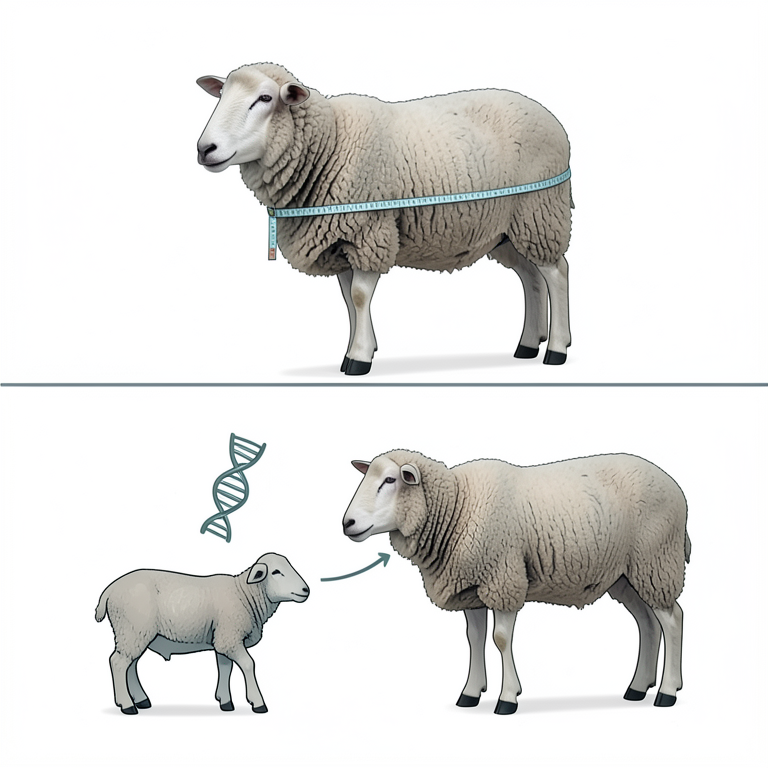
Selection Methods Comparison
AI-generated conceptual illustration (domestic sheep (Ovis aries)). It explains the idea and does not show study data.
View source evidence ↗Introduction
The modern breeding method for sheep was coined in the 18 th century. The herein included, defining breeding objectives, and animal recording (Pedigree recording and also performance recording). This breed could be classified according to the primary economic use of the animal. Triple purpose use, are used for meat, wool, and milk. Examples of such breeds include local Awassi sheep in the Middle East. Dual-purpose breeds such as the New Zealand Romney sheep are important for wool and milk production. Morphological traits can also be used in the classification of sheep. They include the presence of horns (Dorset sheep and poll Dorset sheep), the color (Blackhead and white breed), the wool growth criteria, tail length, and fatty tissue accumulation at the posterior region. (Gootwine, 2020) [11] .
Genetic advancements
Genetic improvements are long-lasting and permanent as they influence the functioning and performance of the animal for its lifetime. Performance of the animal fitness traits which include reproduction, survivability and fertility traits can be affected and passed from one generation to another. (Welsman, n.d.) In doing genetic advancements several issues ought to be addressed; ▪ Reproduction ▪ Animal health issues such as diseases ▪ Breeding goals among other issues
Current state for genetic improvements sheep
Modern breeding programs were put in place in the 1960s. Genetic advancements and progress have been transferred to the flocks through artificial insemination and also by natural mating systems. Milk production has been deemed the most profitable enterprise when setting up the breeding goals for these flocks. The current breeding programs regarding the quantitative approaches have also had the same goals as the traditional approaches i.e. milk production (Carta et al., 2009) [5] Secondly, the recent evolution can also be attributed to prevailing farming systems, climate change (climate-smart agriculture approaches), production chains as well as consumer interests. Genetic technologies are changing sheep production across the globe. The technologies that accelerate the level of production will be the frontiers of advancement in the 21 st century. These technologies increase production efficiency, enhance the environmental adaptability of the sheep and also re-invigorate the sheep industry. (Sejian et al., 2021) [27] According to Gootwine (2020) [11] , the genetic potential on the improvement of the sheep has not been fully exploited, he goes further to state that with continued genetic improvements, a new breeding goal might be defined. Given the overwhelming similarities and differences, the current breeding programs for dairy sheep, the ability to utilize the new technologies, and the molecular knowledge in the breeding practices will consequently be breed-dependent in the coming years. (Barillet, 2007) [2] . Animal breeding is a vital tool that facilitates the selection of the best animals to the next generation. According to T. Pabiou, the breeding goal of any farmer is always to produce at low cost and ensure that the best characteristics are passed to the next generation. Through these rapid gains can be made and genomics selection could greatly enhance the productivity of a specific breed Artificial insemination as well as embryo transfer have been proven to produce superior offspring compared to the conventional means of breeding. It is therefore important to expose these off springs to better nutrition as well as more productive environments to enable them to properly express their genetic potential for better and improved production. (Elshazly & Youngs, 2019) [8] .
Genetic evaluation and selection in sheep
Breeding work and genetic improvements are based on selecting superior animals with exquisite traits as the parents of the next generation. A sheep may be chosen due to its excellent genetic makeup and also environmental adaptability traits. Traits may have a high heritability (h 2 ) ability while others may have low heritability traits. Traits such as wool growth characteristics and also weight gaining characteristics have high heritability ability compared to traits such as reproduction or milk products which have low heritability (Gootwine, 2020) [11] . The advantage of genomic selection over pedigree/phenotypic selection is that selection can be done on the early stages of life and selection can be done for traits that are difficult to measure. Progeny testing is used in the selection of dairy sheep. Breeding values for traits such as milk production is obtained by comparing the performances of groups of half-daughters. The males are used in progeny performance evaluation as the males can produce more progeny than the females in a lifetime. (Djaout et al., 2019) [7] .
Genetic improvement of carcass composition in sheep
Carcass composition is considered a very important trait in sheep. A lamb with good carcass properties is considered to be of high quality and usually fetches the highest market prices. (Nsoso et al., 2000) [23] . Examples of meat quality traits are the color of the meat, moisture percentages, taste assessment of the meat, and fat content of the meat among many other traits (Karamichou et al., 2006) [15] . The carcass traits can be passed from one generation to another and they have the potential to be improved through marker-assisted selection and genomic selection.
Genetic improvement of reproductive efficiency in sheep
The management systems optimization of the reproduction capacity as well as synchronization of the genetic potentials with the local environment is the key to improving the reproduction efficiency in sheep. In the bid to enhance and provide more opportunities for the well-being of the offspring, the ovulation rates should be one on one with the available feeds and management practices deployed. (Notter, 2012) [22] .
Challenges when evaluating reproductive traits ▪ Low heritability ▪ It is a complex trait as multiple traits influence it
Animal biotechnologies that contribute to genetic improvements in sheep
Convection methods of genetic improvement are slow, difficult, and inefficient (Limera et al., 2017) [16] .
Embryo transfer and multiple ovulation
Embryo transfer has been acknowledged for its ability to shape genetic improvements in sheep. Despite being expensive, it is an essential tool in breed improvement. (Smith, 1988) [28] . It increases selection intensity while decreasing generation intervals. Embryo transfer begins when a donor cow is stimulated to superovulate. After the process of superovulating, the eggs are fertilized and implanted into a recipient female we refer to as a surrogate female. Embryo transfer was first used on sheep. Its success greatly contributed to the cloning of dolly the Sheep, the first animal to be ever cloned. (Ishwar & Memon, 1996) [14] . It was later concluded that this technology is based on synchronization of the estrus, the use of super ovulating drugs which causes a sheep to do multiple ovulation within a cycle among many other factors.
Gene cloning
Sheep was the first animal ever to be cloned. According to (Ryder, 2002) [26] , cloning not only creates potential conservation opportunities but also preserves genetic diversity and variations Cloning can be a possible advantageous future tool when properly executed, rebreeding the best clones and crossing them can be a very effective tool. Continuous genetic improvement and variations can be maintained by continuously selecting these clones, testing and selecting their progeny
Estrus synchronization
It is an important tool in animal breeding as it brings the sheep to heat or servicing at almost or at the same time. It is an important tool of genetic improvement that lead to uniform meat and milk production in the herd. It saves the farmer time and personnel by having all the sheep in the farm calve at the same time. It is done by injection of the prostaglandin hormone. This hormone decreases the production of the progesterone hormone leading to the development of follicles and consequently a new cycle of ovulation. (Habeeb & Anne Kutzler, 2021) [12] Artificial insemination This is a combination of estrus synchronization to help in ovulation and artificial means of servicing a sheep. It is a rapid method of genetic progress and transfer. It is achieved by the use of frozen semen from several selected sires. This biotechnology is advantageous as there is maximum use of highly productive sires in upgrading the genetic composition of a herd. Cryopreservation facilitates the storage and transport of semen (Bancheva et al., n.d.) The breed of the sheep, the breeding season, the frequency of use of this technology, the effectiveness of the personnel, how well the semen was stored, and also the body condition of the sheep will influence the success of the procedure.
Somatic cell nuclear transfer
This is a method of genetic cloning that involves the cloning of an egg (Oocyte) and a body (Somatic) to create an embryo. It has been successfully used in sheep genetic improvement either in the production of genetically modified sheep, or drug production for the sheep among other applications. (Czernik et al., 2019) [6] . The success levels of this technology as remained to be low for ages. The embryo developed has abnormal gene expression
In vitro fertilization
In using In vitro fertilization for genetic improvement is done in several steps, it starts with the retrieval of the oocytes (egg) which are fertilized in an In vitro way, they are then cultured for 57 days as the blastocyst develops, they are later transferred to a recipient cow where calf development and production occurs. This works hand in hand with superovulation and embryo transfer in sheep. (Mondal et al., 2019) [21] .
Sperm sexing
This method involves separating X or Y chromosomes bearing spermatozoa from semen samples (Yata, 2021) [29] . This biotechnology is important in raising a desired sex animal. It is important in sheep, as this separation leads to the raising of the female herd which is believed to be of more economic gains than the males due to their productive and reproductive traits. It is also important in the conservation of the endangered breeds of sheep.
Breeding sheep for genetic improvements
The design of any breeding program has to start with the definition of breeding objectives. The breeding objective will be influenced by the production system, the market structure, the breed structure as well as the economic situation. Some of the targeted traits in breeding programs for sheep include growth performances, reproductive traits, wool quality traits, and meat and wool production (Haile et al., 2019) Inbreeding and outbreeding are some mechanisms of breeding sheep. In breeding is the breeding of related animals, this should be avoided and controlled due to the negative impacts associated with it such as, the expression of deleterious alleles, although it can be used to fix a desirable type and also uniformity. Outbreeding is the breeding of unrelated animals. In sheep, we have to crossbreed and upgrade as means of outbreeding. Cross-breeding is the breeding of animals of different breeds. Upgrading involves 2 breeds of sheep, a superior breed and an inferior breed. Out-breeding covers the effects of recessive lethal alleles (Rather et al., n.d.)
Opportunities for genetic improvement of sheep
Improving fertility, feed conversion efficiency, and sheep welfare will help in reducing the CH4 and N2O emissions that are expected to have risen in developing countries by 2030. Incorporation with some of the biotechnologies that focus on reducing methane production makes the genetic improvements have an environmental conservation aspect in it. (FAO, 2017) [9] . Parasites are a threat to sheep production around the world due to the losses they cause. Their effects include; reduced growth, losses in weight, they reduce expression of fitness traits, and reproductive traits. This may bring inaccuracy in the measurement of traits in the sheep. These parasites are building resistance against some of the drugs that have been used against them. It is important to note that these drugs are expensive for most farmers to afford. Breeding sheep for genetic resistance against parasites as well as effective management strategies remains one of the most unexplored areas in genetically improving the sheep. (Mavrot et al., 2015) [15] The emerging farmers are an important link in the dissemination of genetic resources and materials from the suppliers to small-scale farmers, in this way the genetic improvements could have a positive impact. (Yonas, 2020) [30] . Breeding for feed efficiency and low methane emission using rumen microbiome in sheep. Microbiome composition has been associated with traits such as milk production. (Mizrahi et al., 2021) [20] According to (Peter et al., 2018) [24] , genetically improving sheep will lead to the expansion of the systems of production for sheep. The presence of large rangelands and the incorporation of modern technologies will encourage the integrated nature of the production systems in different agroecological zones
Drawbacks/challenges in genetic improvement of sheep
Animal recording is limited in developing sectors. The number of traits recorded for fertility traits is less compared to the phenotypes for growth. Technical advice and support in animal recording should be provided for all traits not just the traits of economic importance. (Berglund, 2008) [3] . With climate change affecting almost all aspects of livestock production, the breeding of superior sheep will become mandatory. Climate change brings effects such as heat stress due to high temperatures to the sheep, it creates a favorable environment for the pathogens and the parasites to thrive. Dairy breeds in sheep are the most affected. Excessive temperature may interfere with the wool quality as well as the fiber quality. Heat tolerance is a field that should be greatly researched and genetic improvements focused on it. (Bogale & Erena, 2022) [4] . Genetic tools and technologies have been restricted to use commercially despite their being available. Their use requires the social economic factors to be addressed by the national strategy. This means that the genetic potential has not been fully exploited. (Ferré et al., 2020) [10] . To meet the 21 st -century problems, breeding objectives in sheep as well as the animal recording systems should be emphasized, and the application for genomic information in genetic improvements is of great potential. (Marshall et al., 2019) [17] .
Conclusion
The emphasis on economically significant features, such as reproductive efficiency and carcass composition, draws attention to the strategic factors involved in breeding programs which are a crucial technique that enables earlystage selection and solves the problems associated with hardto-measure features in the introduction of genomic selection. Opportunities for improvement, such as breeding for feed efficiency and low methane emissions, showcase the potential for genetic advancements to contribute not only to economic gains but also to environmental conservation. However, amidst the promising advancements, challenges such as limited animal recording, climate change-induced stressors, and the underutilization of available genetic tools ought to be addressed. Addressing these challenges is crucial for fully exploiting the genetic potential of sheep and meeting the demands of the 21st century.
References
24 in the original paper- Barillet F. Genetic improvement for dairy production in sheep and goats. Small Ruminant Research. 2007;70(1):60-75. https://doi.org/10.1016/j.smallrumres.2007.01.004
- Berglund B. Genetic improvement of dairy cow reproductive performance. Reproduction in Domestic Animals. 2008;43(s2):89-95. https://doi.org/10.1111/j.1439-0531.2008.01147.
- Bogale GA, Erena ZB. Drought vulnerability and impacts of climate change on livestock production and productivity in different agro-ecological zones of Ethiopia. Journal of Applied Animal Research. 2022;50(1):471-489. https://doi.org/10.1080/09712119.2022.2103563
- Carta A, Casu S, Salaris S. Current state of genetic improvement in dairy sheep. Journal of Dairy Science. 2009;92(12):5814-5833. https://doi.org/10.3168/jds.2009-2479
- Czernik M, Anzalone DA, Palazzese L, Oikawa M, Loi P. Somatic cell nuclear transfer: Failures, successes and the challenges ahead. International Journal of Developmental Biology. 2019;63(3-4-5):Article 3-4-5. https://doi.org/10.1387/ijdb.180324mc
- Djaout A, Afri-Bouzebda F, Bouzebda Z, Belkhiri Y. Progeny-test and factors of variation in dairy sheep selection in the local population (in Setif region). Options Méditerranéennes. Série A, Séminaires Méditerranéens. 2019;(123):225-228.
- Elshazly AG, Youngs CR. Feasibility of utilizing advanced reproductive technologies for sheep breeding in Egypt. Part 1. Genetic and nutritional resources. Egyptian Journal of Sheep and Goats Sciences. 2019;14(1):39-52. https://doi.org/10.21608/ejsgs.2019.33235
- FAO. The future of food and agriculture: Trends and challenges. Food and Agriculture Organization of the United Nations. 2017.
- Ferré LB, Kjelland ME, Strøbech LB, Hyttel P, Mermillod P, Ross PJ. Recent advances in bovine in vitro embryo production: Reproductive biotechnology history and methods. Animal. 2020;14(5):991-1004. https://doi.org/10.1017/S1751731119002775
- Gootwine E. Genetics and breeding of sheep and goats. In: Animal Agriculture. Elsevier; 2020. p. 183-198. https://doi.org/10.1016/B978-0-12-817052-6.00010-0
- Habeeb HMH, Anne Kutzler M. Estrus synchronization in the sheep and goat. Veterinary Clinics of North America: Food Animal Practice. 2021;37(1):125-137. https://doi.org/10.1016/j.cvfa.2020.10.007
- Haile A, Gizaw S, Getachew T, Mueller JP, Amer P, Rekik M, Rischkowsky B. Community-based breeding programmes are a viable solution for Ethiopian small ruminant genetic improvement but require public and private investments. Journal of Animal Breeding and Genetics. 2019;136(5):319-328. https://doi.org/10.1111/jbg.12401
- Ishwar AK, Memon MA. Embryo transfer in sheep and goats: A review. Small Ruminant Research. 1996;19(1):35-43. https://doi.org/10.1016/09214488(95)00735-0
- Karamichou E, Richardson RI, Nute GR, McLean KA, Bishop SC. Genetic analyses of carcass composition, as assessed by X-ray computer tomography, and meat quality traits in Scottish Blackface sheep. Animal Science. 2006;82(2):151-162.
- Limera C, Sabbadini S, Sweet JB, Mezzetti B. New biotechnological tools for the genetic improvement of major woody fruit species. Frontiers in Plant Science. 2017;8:1418. https://doi.org/10.3389/fpls.2017.01418
- Marshall K, Gibson JP, Mwai O, Mwacharo JM, Haile A, Getachew T, Mrode R, Kemp SJ. Livestock genomics for developing countries -African examples in practice. Frontiers in Genetics. 2019;10. https://www.frontiersin.org/articles/10.3389/fgene.2019.0 0297
- Mavrot F, Hertzberg H, Torgerson P. Effect of gastrointestinal nematode infection on sheep performance: A systematic review and meta-analysis. Parasites&Vectors. 2015;8:557. https://doi.org/10.1186/s13071-015-1164-z
- Mazinani M, Rude B. Population, world production and quality of sheep and goat products. American Journal of Animal and Veterinary Sciences. 2020;15:291-299. https://doi.org/10.3844/ajavsp.2020.291.299
- Mizrahi I, Wallace RJ, Moraïs S. The rumen microbiome: Balancing food security and environmental impacts. Nature Reviews Microbiology. 2021;19(9):Article 9. https://doi.org/10.1038/s41579-021-00543-6
- Mondal S, Mor A, Reddy IJ, Nandi S, Gupta PSP, Mishra A. In vitro embryo production in sheep. Methods in Molecular Biology (Clifton, N.J.). 2019;2006:131-140. https://doi.org/10.1007/978-1-4939-9566-0_9
- Notter DR. Genetic improvement of reproductive efficiency of sheep and goats. Animal Reproduction Science. 2012;130(3):147-151. https://doi.org/10.1016/j.anireprosci.2012.01.008
- Nsoso SJ, Young M, Beatson P. A review of carcass conformation in sheep: Assessment, genetic control and development. Small Ruminant Research. 2000;35:89-96. https://doi.org/10.1016/S0921-4488(99)00095-4
- Peter C, Lee SH, Egbu C, Manjula P, Lee JH. Review on challenges, opportunities and genetic improvement of sheep and goat productivity in Ethiopia. Journal of Animal Breeding and Genomics. 2018. https://doi.org/10.12972/jabng.20180015
- Ryder OA. Cloning advances and challenges for conservation. Trends in Biotechnology. 2002;20(6):231232. https://doi.org/10.1016/S0167-7799(02)01954-6
Cited by 3
From OpenAlex, OpenCitations and reference lists read by Scinovex
- Mining and identification of solitary long terminal repeat (Solo-LTR) presence polymorphisms in the sheep genomes ↗
Ahmed A. Saleh, Naisu Yang, Fengxu Wang, Amr M. A. Rashad, Ali Shoaib Moawad, Cai Chen et al. · Genome · 2025
The analysis of 51 sheep genomes led to the identification of 3624 high-confidence Solitary Long Terminal Repeats (Solo-LTRs), remnants of Long Terminal Repeat retrotransposons (LTR-RTns). These elements, comprising 3308 absence-type and 316 presence-type sites, are integrated into functional regions of the genome, where they can influence gene structures and regulation. Approximately 4.39% of protein-coding genes and 0.54% of long noncoding…
❝ 1PDF - In vivo prediction of carcass and meat quality in lambs using multi-site bioelectrical impedance combined with body morphometrics ↗
Xuewen Han, Xudong Liu, Jinlin Chen, Yu Vincent Fu, Cuiyu Lai, Xiaofan Yang et al. · Journal of Animal Science · 2025
Accurate live prediction of carcass and meat quality traits is essential for enhancing product consistency and production efficiency in the lamb industry. Traditional assessments rely on postmortem measurements, which require animal slaughter and thus cannot be used for repeated measurements or on-farm decision making. In this study, we developed a modified bioelectrical impedance analysis (BIA) system incorporating multi-site needle electrodes…
❝ 0PDF - INDUSTRIAL CROSSBREEDING AS EFFICIENT SHEEP FARMING PRODUCTION ↗
Volodymyr Pokhyl, O. M. Pokhyl, Liudmyla Mykolaichuk, Dmytro Taran · The Scientific and Technical Bulletin of the Institute of Animal Science NAAS of Ukraine · 2024
The article examines the materials of industrial crossbreeding in sheep farming using ewes of the Dnipropetrovsk inbred type of the Prydniprovska meat breed (DT Pm) and breeding rams of the Merinolandschaf breed (Ml) and its effect on the quantitative and qualitative indicators of meat productivity. The level of productivity of breeding rams indicates their compliance with the meat type. Their…
❝ 0PDF