
Research article · 2024 · Full text
International Journal of Advanced Biochemistry ResearchAntifungal activity of raw honey collected from Apis dorsata Fabricius Honeybee
Volume 8(1) · Pages 352–354 · DOI: 10.33545/26174693.2024.v8.i1e.378 ↗
Research areasInsect and Pesticide ResearchBee Products Chemical AnalysisInsect and Arachnid Ecology and Behavior
Abstract
Author-writtenThe ingredients of honey have been reported to exert antioxidant, antimicrobial, anti-inflammatory, anti-proliferative, anticancer, and anti-metastatic effects. The present investigation aimed to study the antifungal activity of raw honey of three honeybee species collected from the Kumaon region of Uttarakhand. Honey samples were collected and assayed against Fusarium oxysporum fungal species by Kirby–Bauer disk diffusion technique. Among all the honey samples. Apis dorsata honey was effective against the Fusarium oxysporum. The inhibition zone clearly showed that honey obtained from raw Apis dorsata had the highest antifungal activity, while honey samples from other species showed no antifungal activity.
Summary
Source-checkedPlain-language reading of the full paper, prepared with AI and checked against the text. Each point links to the authors' own words.
Why it matters
- Honey contains ingredients that are reported to have various therapeutic effects, including antimicrobial and antioxidant properties. View evidence ↗
- There is a growing need for new antifungal agents because some current drugs suffer from resistance, side effects, or lack of efficacy. View evidence ↗
- Honey is considered a potential organic alternative for treating pathogens. View evidence ↗
The question
- The study aimed to evaluate the antifungal activity of raw honey from three different honeybee species collected in the Kumaon region of Uttarakhand. View evidence ↗
What they did
- Raw honey samples from three bee species, Apis mellifera, Apis cerana, and Apis dorsata, were tested, with each sample replicated three times. View evidence ↗
- A 5 mm diameter fungal disc was placed in PDA medium, and honey samples were inoculated at the periphery and incubated for 5–6 days at 25 ± 2 °C. View evidence ↗
- Distilled water was used as a control in place of honey inoculation. View evidence ↗
What they found
- Of the three species tested, only Apis dorsata honey showed effectiveness against Fusarium oxysporum. View evidence ↗
- The inhibition zones indicated that raw Apis dorsata honey had the highest antifungal activity, whereas honey from the other species showed no activity. View evidence ↗
- Apis dorsata honey successfully stopped the growth of Fusarium oxysporum mycelia, while Apis mellifera and Apis cerana honeys did not prevent mycelial growth. View evidence ↗
What it means
- The authors conclude that raw Apis dorsata honey has antifungal potential, highlighting its significance for use in healthcare and alternative medicine. View evidence ↗
- The authors suggest that this honey could serve as an organic alternative to traditional fungicides and drugs for treating certain diseases. View evidence ↗
Visual summary
1 visualsIllustrations explain the paper; they do not show study data.
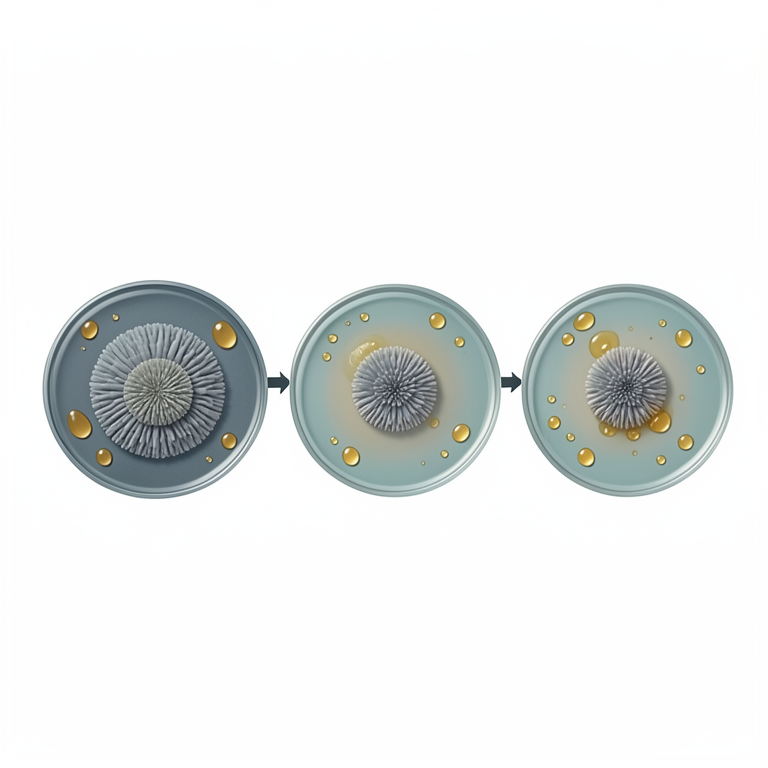
Experimental Setup for Antifungal Testing
AI-generated conceptual illustration (Apis dorsata honey and fungal colonies in Petri dishes). It explains the idea and does not show study data.
View source evidence ↗Figures & tables
From the original paper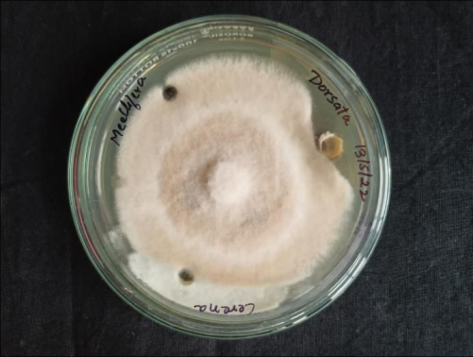 Figure 1
Introduction
The definition of honey is "a sweet, viscous natural fluid substance made by honeybees from blossom nectar, which the bees gather, process, and store in structures resembling hexagons of wax called honeycombs (Codex Alimentarius 2001) [1] . According to scientific data, honey has significant biochemical therapeutic potential and can treat a variety of illnesses. Molan, (1996) [2] . Numerous research demonstrated honey's greater activity compared to several well-known antibiotics (Al-Waili and Saloam 1999) [3] . The antibacterial properties of honey were found to be potent against both pathogenic and non-pathogenic microorganisms. Molan, (1996) [2] . According to his past studies, honey possesses antibacterial qualities and can expedite the healing process of human ailments. Therefore, honey can eradicate all surgical site germs and manage wound infections following surgery that are brought on by different types of bacteria. Strong antibacterial qualities found in honey can be used safely and affordably (Fessenden R.E, 2008) [4] . Various studies have reported the antimicrobial activity of honey (Agbaje et al., 2006) [5] . Aflatoxin B1 and B2 levels are lowered and Aspergillus flavus growth is inhibited by honey. It has been observed that the inherent qualities of honey exert bacteriostatic effects on the growth and survival of bacteria (Iurlina, MO & Fritz R, 2005; Mekky, 2007) [6,7] . Its antifungal action has been observed against the yeast Candida albicans and most species of Aspergillus baumannii as well as Penicillium chrysogenum and all the common dermatophytes (Willix et al., 1992; Brady et al., 1997) [8,9] . In addition, the antifungal effect of honey from different regions has been shown in different studies, on different strains such as Aspergillus spp., Alterneria spp., Fusarium spp., Microsporum spp., Penicillium spp., Rhizopus spp. or Candida spp. (Ceyhan, 2001& Ahmad, 2017) [10,11] . In recent years, there has been an increasing search for new antifungal compounds due to the lack of efficacy, side effects and or resistance associated with some of the existing drugs. Therefore, honey could be one of the best alternative organic antimicrobial agents to treat pathogens (Barker and Rogers 2006; Ali et al., 2010) [18,19] .
Materials and Methods
To evaluate the antifungal potential of honey, samples were taken from three different kinds of honeybees: Apis mellifera (raw), Apis cerana (raw), and Apis dorsata (raw) and each sample were replicated three time, The Kirby-Bauer diffusion technique was used to test the antagonistic potential against phytopathogenic fungi viz, Fusarium oxysporum for which PDA medium plates were prepared. The actively grown fungal disc (5 mm diameter) was placed centrally in a PDA medium plate then raw honey samples were inoculated well towards the periphery of the Petri plate and incubated for 5-6 days at 25 ± 2 °C. The control plates were maintained by adding distilled water instead of honey inoculation. Appearance of zone of inhibition in fungal growth can be seen in Figure -1.
Results and Discussion
The pathogenic Fusarium oxysporum fungi, which are known to cause head blight (FHB) in several crops, including canary seed, wheat, barley, oats, rye, corn, triticale, and some forage grasses, were tested for their antifungal properties against all three honey samples (Alisaac and Mahlein, 2023) [12] . The only honey found to be able to stop Fusarium oxysporum's mycelia from growing was Apis dorsata honey. The antifungal property of the honey from Apis mellifera and Apis cerana was not reported since it allowed Fusarium oxysporum to grow mycelia past their inhibitory effects. Numerous studies have found that honey has a range of bioactive ingredients that prevent phytopathogens from growing in crops when they are in the mycelial stage. These include phenolic substances like flavonoids and phenolic acids, as well as other polyphenols, methylglyoxal (MGO), and the inherent acidity of honey. Hydrogen peroxide is created by the enzyme glucose oxidase. Furthermore, honey's defenses against microbes are strengthened by bee-derived peptides and proteins, such as bee defensin-1. The combined activity of these several chemicals highlights the efficacy of honey as a natural antifungal agent (Molan, 1992). The current investigation supports the results of Moussa et al., (2011) [13] who looked at the antifungal qualities of four Algerian honeys made from different botanical sources against Rhodotorula sp. and Candida albicans. The findings of their experiment confirmed the antifungal activity of all honey samples against C. albicans and Rhodotorula sp. by showing that all honey samples suppressed the mycelial growth in both fungi. Cavanagh et al., (1970) [14] found that a 100% (v/v) concentration of honey had a complete fungicidal effect on C. albicans, while a 50% concentration was necessary to bring about the same action in the species of C. stellatoidea, C. reukaufii, and C. tropicalis. A similar kind of activity was shown by the Apis dorsata honey. Our findings were also in agreement with Molan's review of the antimicrobial activity of honey. Anand et al., (2019) [15] also studied the antifungal activity of mono-foral Agastache honey and commercially available honeys were tested against dermatophytes (T. mentagrophytes and T. rubrum) and C. albicans (ATCC 10231 and a clinical isolate), Agastache honey was more effective as compared to the other commercial at 40% concentration against dermatophytes similarly raw Apis dorsata honey was more effective as antifungal agent. Groot et al., (2021) [16] also revealed that medical-grade honey effective against the fungus Candida auris. However, different results were obtained by Bhalchandra et al., (2022) [17] where zone of inhibition clearly showed that honey obtained from Apis florea and Apis cerana indica had highest antifungal activity, while a honey sample of Apis dorsata showed minimum antifungal activity.
Figures and tables from the paper
References
17 in the original paper- Alimentarius C. Draft revised standard for standard for honey (at step 10 of the Codex procedure). Alinorm. 2001;1(25):19-26.
- Molan PC, Peter O. Honey for treatment of infections. Bee Informed. 1996;3(2):6-7.
- Al-Waili NS, Saloom KY. Effects of topical honey on post-operative wound infections due to gram-positive and gram-negative bacteria following cesarean sections and hysterectomies. Eur J Med Res. 1999 Mar 1;4(3):126-30.
- Agbaje EO, Ogunsanya T, Aiwerioba OI. Conventional use of honey as antibacterial agent. Ann Afr. Med. 2006;5(2):78-81.
- Iurlina MO, Fritz R. Characterization of microorganisms in Argentinean honeys from different sources. Int. J Food Microbiol. 2005 Dec 15;105(3):297-304.
- Mekky TM. Effect of crude honey on stability of aflatoxins and growth of Aspergillus flavus. New Egypt J Microbiol. 2007 Dec 6;17:182-90.
- Willix DJ, Molan PC, Harfoot CG. A comparison of the sensitivity of wound-infecting species of bacteria to the antibacterial activity of manuka honey and other honey. J Appl Bacteriol. 1992 Nov;73(5):388-94.
- Brady NF, Molan PC, Harfoot CG. The sensitivity of dermatophytes to the antimicrobial activity of manuka honey and other honey. Pharmacy Pharmacol Commun. 1996 Oct;2(10):471-3.
- Ceyhan N, Ugur AY. Investigation of in vitro antimicrobial activity of honey. Riv. Biol. 2001 May 1;94(2):363-71.
- Ahmad K, Khali AT, Somayya R, Khan FN, Shah AR, Ovais M, Shinwari ZK. Potential antifungal activity of different honey brands from Pakistan: a quest for natural remedy. Afr J Tradit Complement Altern Med. 2017;14(5):18-23.
- Alisaac E, Mahlein AK. Fusarium head blight on wheat: Biology, modern detection and diagnosis and integrated disease management. Toxins. 2023 Mar 3;15(3):192.
- Moussa A, Saad A, Djebli ND, Meslem A, Benhalima AE. Antifungal activity of four honeys of different types from Algeria against pathogenic yeast: Candida albicans and Rhodotorula sp. Int J Microbiol Res. 2011;2(3):276-9.
- Cavanagh D, Beazley J, Ostapowicz F. Radical operation for carcinoma of the vulva. J Obstet Gynaecol Br Commonw. 1970;77(11):1037-40.
- Anand S, Deighton M, Livanos G, Pang EC, Mantri N. Agastache honey has superior antifungal activity in comparison with important commercial honeys. Sci Rep. 2019 Dec 3;9(1):18197.
- de Groot T, Janssen T, Faro D, Cremers NA, Chowdhary A, Meis JF. Antifungal activity of a medical-grade honey formulation against Candida auris. J Fungi. 2021 Jan 13;7(1):50.
- Ali I, Khan FG, Suri KA, Gupta BD, Satti NK, Dutt P, et al. In vitro antifungal activity of hydroxychavicol isolated from Piper betle L. Ann Clin. Microbiol Antimicrob. 2010 Dec;9:1-9.
- Barker KS, Rogers PD. Recent insights into the mechanisms of antifungal resistance. Curr. Infect Dis Rep. 2006 Nov;8(6):449-56.