
Research article · 2024 · Full text
International Journal of Agriculture Extension and Social DevelopmentErgonomics in libraries: A review
Volume 7(1) · Pages 354–359 · DOI: 10.33545/26180723.2024.v7.i1e.251 ↗
Research areasErgonomics and Musculoskeletal DisordersSafety Warnings and SignageErgonomics and Human Factors
Abstract
Author-writtenThough the term Ergonomics was coined in the nineteenth century, Library ergonomics is comparatively newly emerged concept from it. This paper tried to take a review of Ergonomics in the context of the libraries from different aspects like, arrangement of equipment in the library, proper bending, lifting processes which are as per the rules of ergonomics, newly introduced computer work stations and care to be taken thereof eyes, wrist joint, shoulder joint, fingers and the necessity of training of library staff for awareness of Library ergonomics.
Summary
Source-checkedPlain-language reading of the full paper, prepared with AI and checked against the text. Each point links to the authors' own words.
Why it matters
- Ergonomics is the study of organizing workplaces and systems to fit the users to improve productivity. View evidence ↗
- Library ergonomics specifically applies these principles to both the staff and the users of a library. View evidence ↗
- The need for ergonomic standards in libraries is driven by rising instances of workplace injuries, techno-stress, and musculoskeletal disorders among staff. View evidence ↗
The question
- The paper aims to review library ergonomics across several areas, including equipment arrangement, lifting processes, computer workstation safety, and the need for staff training. View evidence ↗
What they did
- The authors conducted a literature review to examine various aspects of ergonomics within the library environment. View evidence ↗
What they found
- Eyestrain is identified as the most frequent complaint among those using computers. View evidence ↗
- A five-year program at Colorado State University Libraries found that repetitive motion sickness can be prevented through job design, workplace planning, and employee training. View evidence ↗
- An ergonomics program at the East Baton Rouge Parish Main Library resulted in a statistically significant improvement in librarians' awareness of ergonomic principles. View evidence ↗
- Between 1991 and 1994, approximately 1,400 office staff members at the Library of Congress received ergonomic training. View evidence ↗
- Physical injuries are substantially related to age, exercise, and work experience, but not to gender, workplace conditions, library equipment, or working hours. View evidence ↗
- The ideal environmental conditions for a library are a temperature of 20-22 degrees centigrade and humidity between 50-55%. View evidence ↗
- Implementing ergonomics programs can lower organizational costs by reducing absenteeism, staff turnover, and workers' compensation claims. View evidence ↗
What it means
- The authors conclude that library ergonomics reduces techno-stress, musculoskeletal disorders, and workplace injuries for staff while increasing user satisfaction. View evidence ↗
- The review highlights a specific need for the implementation of ergonomics training programs or courses for library staff. View evidence ↗
Visual summary
1 visualsIllustrations explain the paper; they do not show study data.
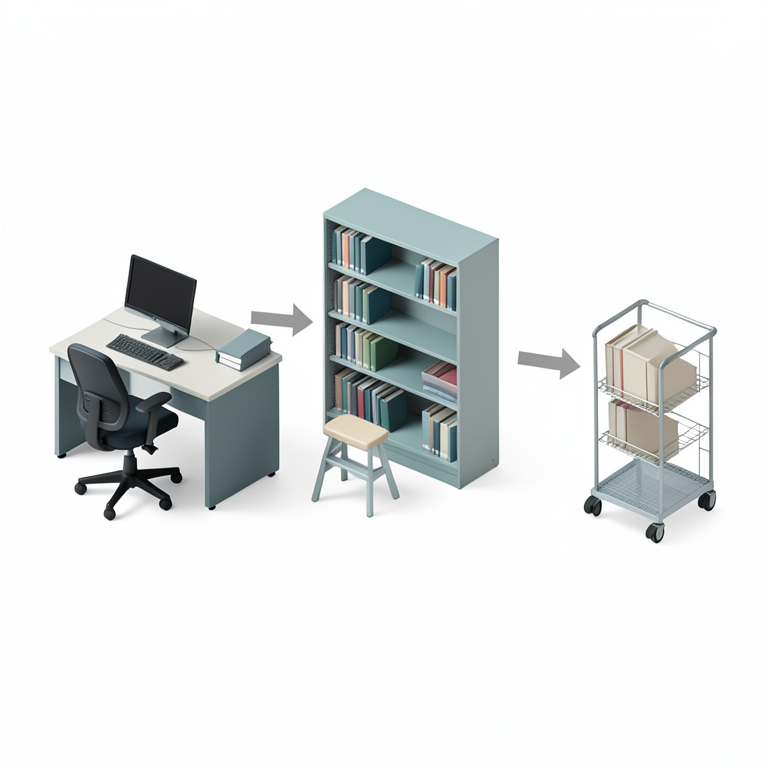
Study overview
AI-generated conceptual illustration (library workstations and shelving units). It explains the idea and does not show study data.
View source evidence ↗Introduction
Ergonomics is the investigation of people's productivity in the workplace, the practice of creating or organizing workplaces, items, and systems to fit the users of them. Library Ergonomics is the study of implementation of ergonomics with respect to the library personnel and the library users. Library ergonomics involves traditional library work, seating arrangement of library staff and users, reading room chairs, lighting, library furniture design and arrangement, along with modern automated library work. Library ergonomics will help to boost a healthy, happy work culture in a library environment to increase library service productivity and reader / user satisfaction.
Ergonomics -Natural rules of work
For many workers whose illnesses are brought on by the harmful properties of the substance they handle, an Italian physician named Bernardino Ramazzini wrote in 1713's De Morbis Artificum. He further added, I now want to focus on other workers who gradually develop certain morbid affections due to various factors, such as specific limb postures or strange body movements required for their jobs. These are the types of workers that stand or sit all day, stoop or are doubled over ride or run, or move their bodies in various ways. The term "Ergonomics" was originally used in a Polish newspaper in the nineteenth century by a Polish educator named Wojceich Jastrzebowski. The name "Ergonomics" is derived from the Greek words "ERGOS" (Labour) and "Nomos" (natural rules). The laws of work are ergonomics [15] . In addition to screens and keyboards, productivity is another aspect of ergonomics [5] . Ergonomics is the study of matching a task to a worker's abilities. Ergonomics is analyzing biological and engineering data and applying that information to design workplace improvements that reduce work-related injuries [7] .
Ergonomics is mostly a matter of common sense, despite differences. You don't have to be an expert to see that sitting at a computer all day or lifting a lot can have an impact on your body, and you should take precautions to avoid injury and discomfort [8] . A variety of academic disciplines are studied in ergonomics. The biological sciences of physiology, anatomy, and medicine offer knowledge regarding the composition, physical properties, and restrictions of the human body. The study of physiological and psychological problems focuses on how the brain and nerve system influence behavior. The goal of experimental psychology is to know the basic mechanisms by which a person uses his body to comprehend, pick up on, and remember how to manage his motor functions. Physics and engineering help us to comprehend the tools and surroundings in which a person works. An ergonomist integrates the data from different fields of study to gain a better understanding of a worker's safety, effectiveness, and consistency of performance, making the task at hand simpler to learn and also working [24] . The occupational ergonomics, occupational safety and health administration defines ergonomics as the study of the interaction between humans and machines, as well as the elements that influence that relationship [17] .
Library Ergonomics
Why is ergonomics gaining popularity again? Why relating the Ergonomics in Libraries? Increased cases of Musculoskeletal Disorders, Workplace injuries and Technostress among the library staff, are the main reasons for need of implementing ergonomics standards in libraries.
Musculoskeletal Disorders and Techno-stress
Musculoskeletal disorders (MSDs), are the injuries to the body's nerves, muscles, tendons, and supporting systems. www.extensionjournal.com Repeating the same activity throughout the workday, working in an inconvenient position, swiftly moving the hand and wrist, or repeatedly lifting objects are the most common causes of these injuries. Because library work sometimes involves one or a mixture of these factors, injuries do occur, injuries that may have been avoided. Recognizing and resolving ergonomic issues will help to reduce workplace injuries [7] . According to the National Institute of Occupational Health and Safety, eyestrain is the most common complaint among computer users, eye strain can result in a variety of issues, including excessive fatigue, lost productivity days, and workplace blunders, incorrectly set video display terminals, excessive illumination, primary and secondary glare, and improper or non-existent eye care can all cause eyestrain [3] . Along with the successful and exciting high-tech revolution in libraries, a variety of physical, psychological, and social issues have arisen among library employees and consumers, Techno-stress in libraries viz., anxieties, frustrations, and misunderstandings that prevent people from using computers effectively is observed in modern libraries and poorly constructed workstations, insufficient training, and management's bad planning and implementation may all contribute to techno-stress among library employees. False expectations and a lack of comprehension of the system are common among library users, owing in part to insufficient training. Fear, nervousness, and overall apprehension about new technology can affect both employees and users [6] . A study with the objective to investigate the health issues faced by library professionals who work with computers at the University of Kerala's Kariavattom Campus and reported that many of them are experiencing health issues such as Cumulative Trauma Disorders and Musculoskeletal disorders, loss of concentration, irritability, and dizziness due to emotional fatigue, muscle pain, and other issues as a result of prolonged computer use and an unfavorable working environment [22] .
Library Ergonomics: A must for a modern as well as traditional library set up
Library Staff performs different types work like -Motions that are repeated: e.g., data entry operations, such as cataloguing and sensitizing or desensitizing library materials with a hand-held bar-code scanner; Uncomfortable Posture: e.g., Over-the-shoulder work, such as re-shelving books or typing on keyboards that are at an inconvenient height; Motionless posture over an extended period of time: e.g., Holding a phone in the same position for an extended amount of time, or putting bulky books against a scanner; Motions/actions causing exertion: Book carts being pushed, or in the receiving area, lifting boxes, actions creating Stress caused by continuous contact: At computer workstations, there is a lot of contact stress on the forearms or firmly gripping a pen or pencil; Other common actions causing stress / producing low output: Poor sitting causing back pain. Insufficient illumination in the library causes eyestrain [15] . There is little information on how ergonomics might be applied to health sciences libraries. The hazards of the library environment can be revealed and the risks can be reduced or eliminated by ergonomics research [9] . Library Managers can use a range of strategies to help employees and customers cope with technological stress [6] . As online public access catalogues become more common, catalogue librarians may become more reliant on the use of VDTs (Visual Display Terminals), raising concerns about potential physiological effects, increased availability of ergonomic furniture, and increased interest in identifying work that can be done away from the computer terminal. Although catalogers spend more time at VDTs than they did before, offline cataloguing and editing, as well as a variety of processes related to the maintenance of manual files, are not uncommon, and that ergonomic furniture, other than pneumatically adjustable chairs, is not widely available [28] . To fit the machine or environment to the needs of the operator or worker is one of ergonomics' primary goals. A worker is connected to the machine in a closed loop by doing this. Ergonomics is a collection of ideas that helps designers optimize how people interact with tools, systems, working conditions, and settings while also taking into account the operators' safety, physical and mental capabilities, and potential for productivity. Therefore, the library managers should also remember that ergonomics is important for library users as well as staff [24] . Ergonomic modifications needn't be expensive, and a comfortable, safe and healthy workforce will repay your investment several times over [5] . While technology has improved productivity in the workplace, many offices are seeing an increase in workers' compensation claims and employee absenteeism owing to physical therapy, surgery and recovery, and doctor's appointments. A smooth workflow has become afflicted by the diseases such as cumulative trauma disorders and repeated stress injuries [30] . New technologies are altering the nature of information services and the manner in which they are offered. Many librarians' everyday work has been altered by computers and technological technologies, resulting in new issues such as stress, exhaustion, and cumulative trauma illnesses [31] . To reduce patron eye strain, libraries should be constructed with adequate illumination [3] . Working in a library includes a lot of handling of books and cartons, as well as computer workstations and other office and maintenance tasks [18] . With the rise in musculoskeletal injuries, ergonomics, the study of how people interact with our physical surroundings, has become more important in libraries [11] . All service-oriented institutions, particularly libraries, where circulation, reference, and technical services are fully automated and rely on computers for information access and retrieval via patron files and online public access catalogues, are significant in that human interaction with computers predominates [26] . Workers in libraries are at risk because they frequently use a keyboard or mouse for more than four hours a day for technical services and reference, they work with the back, neck, or wrists bent or twisted for more than two hours a day (shelvers, photocopier operators, book repairers) or they lift 50 pounds or more than ten times a day (shelvers, photocopier operators, book repairers) [7] . Electronic technology advances and computer use becomes more prevalent, computer operators are suffering from a variety of work-related hand, wrist, and arm problems. The phenomena has heightened public awareness of ergonomics and the study of how people interact with their physical surroundings [25] . If the library personnel had any ergonomic symptoms, they should know about it [1] . The majority of the staff who got ergonomic programme training at Library of www.extensionjournal.com Congress, USA were able to prevent injuries before they happened or respond properly to any ergonomic workplace incident [8] . There is a substantial relationship between age, work experience, exercise and physical injuries, but not between gender, working hours, library equipment, or workplace conditions and physical injuries [19] . The use of computers in libraries has expanded dramatically in recent decades, posing a number of health risks viz., Demographic Information and Ergonomics & Stress [27] . A small percentage of employees of University of Kerala, who suffered from ergonomic diseases, see a doctor on a regular basis, and the rest do not seek effective treatment for their health problems [22] . Ergonomics research was being examined, along with Ergonomics for young computer users; Preventing injury; Internet sites to learn about ergonomics in the library; Chat rooms dedicated to ergonomics; Contact information for the resources mentioned [4] . Libraries provide users with learning, study, and research environments. The question of compatibility for users' physical, anatomical, and psychosocial demands is critical for libraries [21] . Running a library has long included repeated duties that put workers' arms, hands, backs, and necks at risk of harm. The development of new media has expanded the selection and inventory of the modern library, which has in turn increased the job's repetitiveness even though technology advancements have helped lessen many of the risk factors that contribute to it. While books still make up a large portion of a library's collection, additional media has been added to the collection that is available for checkout, including videos, CDs, and DVDs. From the time when books were catalogued on index cards hidden beneath the book's front cover, most modern libraries have changed dramatically. In order to drastically save handling during checkout, books and media are now given barcodes that may be quickly read with fixed or handheld scanners. Scanners have considerably decreased handling during check-in and check-out, but books and media still need to be organised, moved, and stored [32] .
Points to consider while implementing Ergonomics in Libraries
A six steps Ergonomics programme that can be used in a library step by step, was designed with the steps viz., Develop a statement of responsibility, Compile a packet of information, Ergonomically evaluate each employee, Use ergonomically correct equipment, Provide continuous training and Reevaluate the program regularly. The Colorado State University (CSU) Libraries embarked this ergonomics programme for five-years giving results as repetitive motion sickness can be prevented by adequate workplace planning and job design, as well as effective employee training and education and recognizing that the best way to treat repetitive stress injuries is to avoid them [30] . When it comes to ergonomics, there are three crucial factors to consider: Education, training, and product. Employees' well-being can be improved through education by explaining why it is vital to sit appropriately, change position frequently, adjust furniture and equipment, and demonstrate and reinforce excellent sitting posture. Teaching the "How and Why" of furniture adjustments, developing a routine of healthy work breaks, and acquiring furniture and equipment which helps in lowering certain health issues, boost productivity and create a more pleasant working atmosphere [15] . Library Ergonomics training programme must address employee safety and health issues in the library [26] . The components of an efficient ergonomics programme are viz., Evaluation -an ergonomics consultant's or the library's management and staff's thorough assessment of the workplace, Staff Training, Record Keeping / Analysis, Action -As soon as you can, address any circumstances that have led to injury, Re-evaluation -Check the records occasionally to see if the programme has had any effect on the quantity and seriousness of ergonomic occurrences [7] . A training and awareness programme should be set up to raise understanding of ergonomics and its standards [23] . An Ergonomics program was implemented at East Baton Rouge Parish Main Library, USA to assess changes in self-reported musculoskeletal problems, computer workstation arrangement, and other relevant activities and giving the results as librarians' awareness of ergonomics principles has improved statistically significantly; "break/rest every 2 hours," "hand/wrist positions," "handle more than 50 lbs," and "bend or twist at the waist to handle goods." As the existence and severity of musculoskeletal problems and felt control over the work environment, did not show statistically significant changes, but there was a trend toward positive improvement. The training program's goal was that of supporting librarians in improving job ergonomics and reducing musculoskeletal discomfort i.e., an integrated participatory approach to reducing librarian ergonomic injuries [33] . Between 1991 and 1994, about 1400 office staff in two divisions of the Library of Congress, USA received ergonomic training. A coordinating committee was formed which drafted a written plan that covered health and risk factor surveillance, interventions, and training. Materials-handling devices, furniture, floor mats, lighting, glare screens, chairs, copy holders, CPU stands, monitor pedestals, and shelves were among the interventions [18] . Every company should have an ergonomics programme in place to reduce workplace injuries and pain [8] . Libraries spend a lot of time preparing the hardware and software implementations of electronic information services, but they often overlook the human factors. When developing or redesigning facilities for electronic resources and services, ergonomic considerations must be taken into account. By paying attention to basic ergonomic considerations when constructing workstations and work places, libraries can avoid some of the frequent problems that arise in the digital workplace. Many of the major occupational difficulties linked with computers can be avoided by using proper monitor placement, lighting, workstation setup, and seating. In the electronic workplace, staff training will help to lessen the possibility of ergonomic issues [31] . An Annotated bibliography of books, book chapters, journals, journal articles, and internet resources dealing mostly with library ergonomic difficulties and concerns was created that can be used by researchers, administrators, librarians, library staff, subject specialists, ergonomic consultants, physical therapists, and anybody else interested in library ergonomics to identify and locate useful information resources, a list of useful ergonomics goods, www.extensionjournal.com along with their prices, sellers, and availability [25] . Ergonomics norms and recommendations should be used while building computer workstations in libraries. Ergonomic "Postural Dimensions Equipment" should be available to improve job productivity [23] . Compact shelving can conserve space while also allowing for future growth. Furthermore, compact shelving is placed in accordance with ergonomic norms, which are typically disregarded by traditional fixed shelves. Compact shelves would relieve users of physical strain. The amount of reading and other spaces can be expanded thanks to the space saved by using compact shelving. In every region, the amount of light should be increased. To boost illumination, light can be turned down to lower levels over reading desks. Noise can be reduced by utilizing sound-absorbing wallpaper and rugs, as well as placing curtains on windows. More fans can be installed to reach the desired temperature and relative humidity. Pedestal fans provide airflow at the floor level, lowering humidity. If at all possible, air conditioners should be provided. To safeguard the library from fire-related dangers and losses, each library should have fire extinguishers on hand and train personnel on how to use them. Every library should have an emergency exit door that is unobstructed by furniture or other objects [10] . Library manager or Ergonomic consultant should look at how people use their workspaces and how often they selfassess their physical discomforts in order to develop an interventional ergonomic health education programme [27] . Libraries provide ergonomics equipment and accessories, but whether libraries offer ergonomics training sessions, whether ergonomics training and activities are focused on technical services departments, and whether ergonomics concerns have had an impact on job descriptions or office design were collected, also suggested some intriguing approaches for tackling ergonomics difficulties [29] . The joint participation of users and designers in project development is important [12] . Do not use pinch grips, to teach staff to hold books using a two-handed power grip rather than a pinch-grip through ongoing training; by employing the stronger muscles in both hands, the twohanded power grip equally distributes the weight of the book between them [2] . In today's society, both library staff and patrons rely on technology to be productive, but we frequently hear about users suffering from back, neck, and/or shoulder problems, as well as pain in their hands, arms, and fingers (musculoskeletal diseases or MSDs). The study also showed that it's unclear how many users know how to set up a workstation that supports good health and posture, which is especially important at public libraries because they provide free access to their resources to all members of the community. Public libraries value accessibility and that librarians have received complaints from patrons regarding MSD pain, but that certain libraries are better suited than others to satisfy patrons' and staff members' ergonomic demands by having ergonomic arrangements. But, a variety of obstacles prohibit public libraries from providing more ergonomic resources at their locations. Participants expressed a desire in overcoming these obstacles and offering additional help to both staff and clients [21] . There is need of taking user expectations into account in libraries regardless of the type of library or concepts used [32] .
Minimize repetitive bending, lifting, and twisting, as much as possible; when a book is processed through the library at both check-in and check-out, to keep track of how many times it is handled and how many times a staff member must bend to find methods to cut that amount in half; to encourage proper movement patterns; when placing or removing books from carts or shelves, instruct staff to crouch or kneel while maintaining a straight back; to tell children how important it is to hold the books near to their bodies; to encourage staff to push instead of pull carts; employees should push while maintaining straight wrists by standing at one end of the trolley; never overfill shopping carts; to avoid exerting additional hard effort, it is preferable to make an additional trip and last but not least, training of the library staff and users will help to implement Ergonomics in the library context [2] . Library furniture design should be in relation to the human body. E.g., Chairs -many chairs are designed for specific purposes like Visual Display Terminals, Issue desk or library users. All should ideally be comfortable to use for long or short periods of time & following a set guidelines of seat characteristics, adjustable height chairs, fixed height chairs, reclining seats; Desks -special purpose desks for online catalogues, CD-ROM workstations; Foot Rests -Relaxing relieving pressure on the legs; Shelving -design & layout should be central to eases of accessibility to the reading material and convenient height of shelving; adequate natural & artificial lighting; noise -high noise levels cause fatigue, headaches, stress problems, high BP, ulcers and tinnitus, a ringing in the ear; sick building syndrome. It is the phenomenon where hermetically sealed buildings of glass and concrete with inadequate ventilation & air conditioning can lead to infection being passed quickly from person to person within this closed environment, Heating: The ideal temperature of a library is 20-22 degrees centigrade and humidity 50-55% for flooring -good sound insulation properties, protecting the library from external sources & sound but also deadening the sound of footsteps & noise from machines; Space in libraries -Rearrange space so that it works better for people & people work better with it; Signposting-provision of professional, clear, attractive & accurate guiding or signposting; Issues desks -open, clear of obstruction & at a height convenient for wheelchair user, flow of traffic & amount of use must also be considered; Colour of libraries should be inviting & attractive; Photocopiers -There can be health hazards in using photocopiers, the creation of ozone gases from the high voltages present can cause headaches, chest pains & fatigue & the toner can cause skin irritation, irritation to the cornea of the eye [24] .
Advantages of ergonomics for the library environment
In an automated environment, such as a library, ergonomics can be extremely beneficial to both the workers and the service quality. Implementation of Ergonomics can boost employee satisfaction, efficiency, and production [6] . If ergonomics is not implemented in older building then it must be incorporated while designing new library building otherwise the quality of service will deteriorate and decline [13] . Careful consideration of ergonomics factors can make employees healthy and more able in their work [16] . An Ergonomics programme which was implemented at the www.extensionjournal.com Library of Congress, USA to reduce the risk of musculoskeletal illnesses also helped to improve worker comfort and productivity [18] . Ergonomics improves the worker's physical comfort while also lowering the risk of damage. Ergonomics can help a company to save money. By implementing an ergonomics program, an organisation can reduce costs related to issues such as workers' compensation, staff turnover, and absenteeism. Work can also be made more efficient by workplace designs that create fewer errors [7] . The ergonomic education to the Librarians, paraprofessionals, administrative personnel, and secretaries or other measures in place help to promote a healthy and productive workforce [1] . Organizations that take a systematic approach to ergonomics, utilising a basic checklist to establish ergonomically sound surroundings, perform better than those that rely exclusively on employees' and managers' common sense [8] . The ultimate goal of implementing Ergonomics in the library is lowering musculoskeletal problems [33] . Ergonomics (spatial comfort and environmental workplace elements) and job satisfaction have a positive association. For higher job satisfaction of the library personnel in Nigerian Universities, it was proposed that ergonomic measures be adopted and used in the design of spatial comfort and environmental workplace aspects in libraries [14] . Improvements in equipment and space can boost satisfaction. In order to meet user needs, boost productivity in research and learning activities, and provide a healthy and safe environment in library units, attention should be made to the notion of ergonomics in library units [20] . By considering fundamental ergonomic concerns when building workstations and work places, libraries can avoid some of the typical issues that arise in the digital workplace. Many of the typical workplace issues related to computers can be avoided with proper monitor positioning, lighting, workstation configuration, and seating. Effective book handling can lead to less lost time and a lower chance of accident [32] .
Conclusion
The present review is an endeavor to understand the implementation of Ergonomics in the libraries. The literature indicates that in the 18th century the studies on laws for work or relation between man and machine, and material were being started, and further in the 19th century the term 'Ergonomics' was being coined. The review noticed that since last three-four decades, few libraries are trying to implement ergonomics because of increased number of cases of musculoskeletal disorders and technostress among library staff and library users. The review finds need of ergonomics training program / course too, for the library staff. Ergonomics are the laws to be followed in the work environment. Library staff training, change in work procedures, change in the arrangements of equipment are the factors to consider while implementing ergonomics in the library environment. Library Ergonomics will help in reducing workplace injuries, musculoskeletal disorders and techno-stress among the library staff and increased library users' satisfaction.
References
26 in the original paper- Adeyemi AO. Case study of ergonomics awareness among library staff of two universities in SouthWestern Nigeria. IFE PsychologIA: An International Journal. 2009;17(1):243-253.
- Anon. Library Ergonomics. Accessed June 24, 2022. 2020. https://www.safeatworkca.com/safety-articles/libraryergonomics
- Atencio R. Eyestrain: The number one complaint of computer users. Accessed June 17, 2022. 1996. https://go.gale.com/ps/i.do?id=GALE%7CA18696032 &sid=googleScholar&v=2.1&it=r&linkaccess=abs&iss n=10417915&p=HRCA&sw=w&userGroupName=ano n%7Eaa85409
- Balas J. Making libraries comfortable. Computers in libraries. 1997;17(8):49-50.
- Boss RW. Ergonomics for libraries. Library Technology Reports. 2001;37(6):1-66.
- Boss RW. Ergonomics Basics. Library Technology Reports. 2009;45(6):25-32.
- Bube JL. The ergonomics/human factors approach to health sciences libraries. Bulletin of the Medical Library Association. 1985;73(3):254.
- Chandra AM, Ghosh S, Barman S, Chakravarti DP. Ergonomic issues in Academic Libraries in Kolkata, West Bengal: A pilot study. Library Philosophy and Practice. 2009;279:1-8.
- Ferrer N, Villarouco V. Casting an ergonomic eye on university libraries. Work. 2012;41(1):3809-3815.
- Ikonne CN. Influence of workstation and work posture ergonomics on job satisfaction of librarians in the federal and state university libraries in Southern Nigeria. IOSR Journal of Humanities and Social Science. 2014;19(9):78-84.
- Labajo EM. Occupational ergonomics in the library workplace. University of the Visayas -Journal of Research. 2017;11(1):53-60.
- Mansfield JA, Armstrong TJ. Library of Congress workplace ergonomics program. American Industrial Hygiene Association Journal. 1997;58(2):138-144.
- Mirhoseini Z, Gholizadeh N. Investigating the physical injuries of the workplace among librarians of governmental universities of Isfahan based on Ergonomic principles. Journal of Knowledge Studies. 2011;3(11):117-133.
- Narkhede SP, Sarode RD. Importance of Ergonomics in Academic Libraries. Journal of Library and Information www.extensionjournal.com Science. 2018;5(2):16-21.
- O'Connor E. Ergonomics in the Library: Surveying the presence and necessity of ergonomics in Connecticut public libraries to offset musculoskeletal disorders. Ph.D. Thesis, Southern Connecticut State University. 2022.
- Pillai CR, Jayalatha KT. Ergonomics and library professionals-a case study of the University of Kerala. SRELS Journal of Information Management. 2016;53(3):221-227.
- Prabhu M, Sornam SA. Computer workstation ergonomic issues in self-financing engineering college libraries in Coimbatore: A pilot study. International Journal of Library Science and Research. 2016;6(6):6976.
- Rooney J. Ergonomics in academic libraries. Library management. 1994;15(1):26-35.
- Sheauyueh JC. Library ergonomics in literature: A selected annotated bibliography. Collection building. 2001;20(4):165-176.
- Sheauyueh JC, Chang C, Chiang B. Planning and implementing a library ergonomics program: Case study at queen's college library, the City University of New York. The Electronic Library. 2001;19(5):327341.
- Sornam SA. Ergonomics and techno stress among library professionals of engineering colleges of Anna University. Singapore Journal of Library & Information Management. 2011;40:89-102.
- Steinhagen EN, Mueller CJ. Ergonomics and the catalogue librarian. Technical Services Quarterly. 1992;9(4):29-42.
- Summer SC. Ergonomics programs and activities in research libraries. Library Resources & Technical Services. 2011;40(1):84-92.
- Switzer TR. Ergonomics: An ounce of prevention. College & Research Libraries News. 1995;56(5):314318.
- Thibodeau PL, Melamut SJ. Ergonomics in the electronic library. Bulletin of the Medical Library Association. 1995;83(3):322.
- Uşma G, Gürsoy RAÖ. A Comparative Analysis on Ergonomics of University Libraries: A Case Study. Online Journal of Art and Design. 2022;10(3):245-262.
Cited by 1
From OpenAlex, OpenCitations and reference lists read by Scinovex
- An Analytical Study Regarding the Application of ‘Ergonomics’ in the Library of the St. Paul’s Cathedral Mission College, Kolkata ↗
Tridib Chattopadhyay · Quest-The Journal of UGC-HRDC Nainital · 2024
St. Paul’s Cathedral Mission College is a general degree college that contains the traditional heritage of Kolkata city and has completed its 159-year journey on 1st January 2024. The unique collection of the Church Missionary Society (CMS) is the principal characteristic feature of the college library. The marvellous furniture of the library is an added attraction of the college, and…
❝ 0