
Research article · 2019 · Full text
International Journal of Agriculture and Food ScienceRemote automated controlled irrigation systems and the principles of their functioning in the conditions of Azerbaijan
Volume 1(3) · Pages 05–09 · DOI: 10.33545/2664844x.2019.v1.i3a.11 ↗
Research areasAgricultural Development and PoliciesDigitalization and Economic Development in Agriculture
Abstract
Author-writtenThis article examines the current state of soil and water resources, farmland t.ch.i Azerbaijan Republic, the problem of progressive water and wind soil degradation, the need for the organization of agriculture, taking into account the introduction of automated control systems for irrigation using water saving technology and hardware equipment in it, the study of the characteristics a nd analysis of experience implementing measures to stabilize ecological and drainage system of agriculture in conditions of insufficient moisture areas in the country, as well as basic aspects of development of environmental reclamation approach balanced, rational use of a particular system of crop rotation and crop taking into account the requirements of economic development and environmental management.
Summary
Source-checkedPlain-language reading of the full paper, prepared with AI and checked against the text. Each point links to the authors' own words.
Why it matters
- Azerbaijan faces significant challenges regarding the state of its soil and water resources, specifically progressive wind and water soil degradation. View evidence ↗
- Implementing environmental-friendly agricultural crops can improve the ecological status of irrigated land while reducing water use and increasing crop yields. View evidence ↗
The question
- The research aims to develop new technical solutions and introduce automated low-intensity irrigation systems to support agriculture. View evidence ↗
What they did
- The system was tested on orchard soils in the Guba-Khachmas zone on the Shahdag foothills, at an altitude of 600 meters and a terrain slope of 0.02. View evidence ↗
- The researchers developed an automated control system for low-intensity irrigation based on a self-oscillating micro-oxidizer. View evidence ↗
- The system uses sensors to record wind speed, air temperature, and air humidity as analog signals every 30 minutes. View evidence ↗
- Water intake and pumping are monitored via sensors measuring water turbidity, water level in sedimentation chambers, and water pressure, all read in 30-minute cycles. View evidence ↗
- Soil conditions are monitored per field using sensors for soil moisture, water evaporation from the surface, and soil temperature, recorded every 30 minutes. View evidence ↗
- The system utilizes the World Wide Web for data exchange regarding the operation of the irrigation system. View evidence ↗
What they found
- The system's measurement formula allows parameter values to be accepted as actual with a probability of 0.8. View evidence ↗
- Critical system components, including gate valve positions, power switch positions, and alarms, are monitored using discrete signals read in 1-second cycles. View evidence ↗
Visual summary
1 visualsIllustrations explain the paper; they do not show study data.
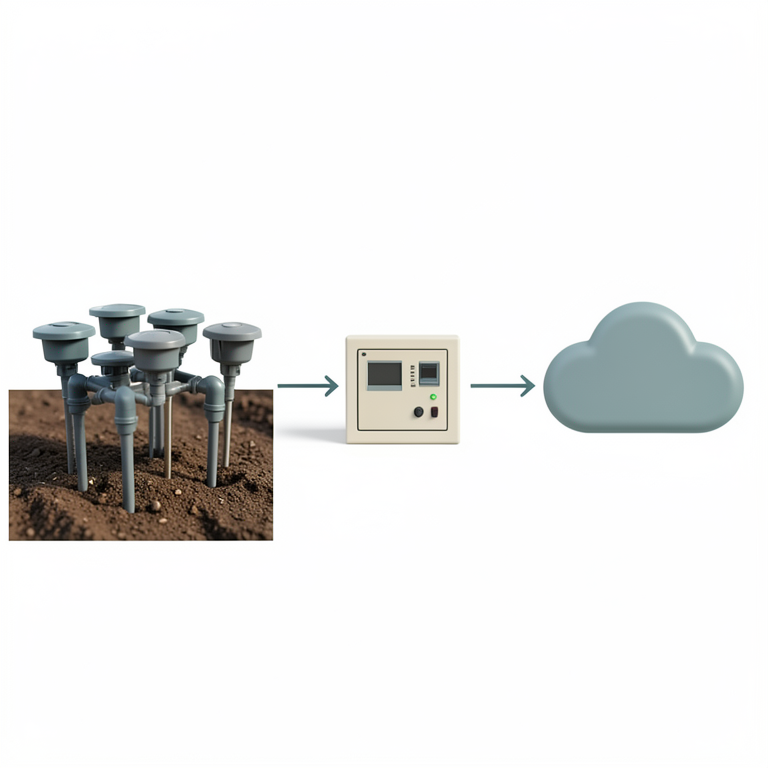
Automated Irrigation Monitoring Architecture
AI-generated conceptual illustration (Agricultural field in Azerbaijan with an automated irrigation system). It explains the idea and does not show study data.
View source evidence ↗Figures & tables
From the original paper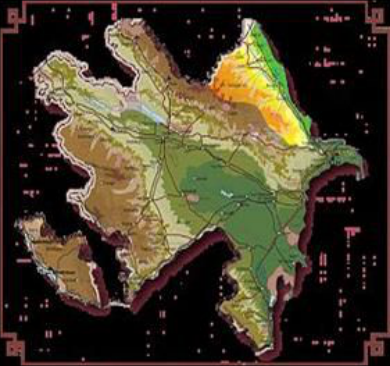 Figure 1
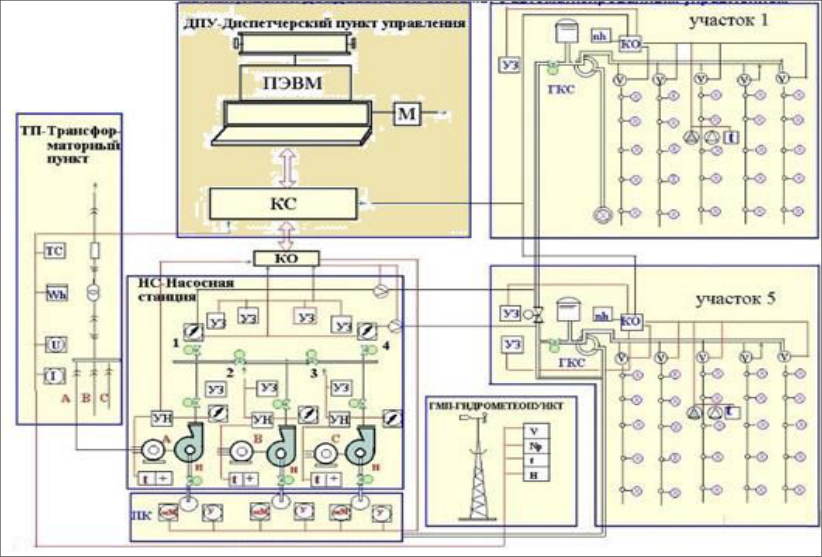 Figure 2
Introduction
The main directions of the economic and social development of the republic are the intensification of agricultural production. Irrigation is a powerful means of intensifying agricultural production in the conditions of its specialization. In areas of insufficient moisture (especially characteristic of mountainous areas), irrigation is one of the decisive factors in the cultivation of high and stable crop yields. Purpose of the research: To this end, it is necessary to develop new technical solutions and introduce automated low-intensity irrigation systems for agricultural crops that meet the requirements of the environment and protect their habitat, which allows improving the ecological status of irrigated land, reducing water consumption per unit and increasing yields crops on the irrigated field.
Methods of research and discussion
Irrigated soils in Azerbaijan cover 1,45 thousand hectares. It is believed that the use of automation also applies to factors directly affecting the entrainment of crop yields and increasing the productivity of each hectare of arable land and agricultural land with minimal outlays of labor and resources. Automated irrigation increases the efficiency of all the intensification factors: chemicalization, complex mechanization, renewal grade, intensive technology, etc. It allows creating large zones of guaranteed crop production.
Objects of research
The object of the study is to study and create methods of correct regulation of water consumption and plant nutrition by irrigation, depending on the weather conditions. To this end, we have developed and implemented in the design of systems for automated control of low-intensity irrigation systems based on a self-oscillating micro-oxidizer successfully passed the resource test, tested on selected soils under the orchard, in the Guba-Khachmas zone on the Shahdag foothills located above the sea level at 600 meters with a slope of the terrain of 0.02. (See Principal scheme of a pulse sprinkler system of self-oscillating action with automated control Fig. 2) The computer uses the exchange programs to count the data from the RAM of the coprocessor, recodes them and writes them to the operational database, from which it displays them in real time to display on the mimics, and after linearization and averaging, the data for their program codes are written to the storage bases, the cat structures They are listed in the information support, and this forms the Bank of Data of the ASMO task complex [1,3] . Information flows of the automated low-intensity irrigation system (ASMO). Before recording to the Data Bank, the flow of measurement data is analyzed according to predetermined algorithms and, when analyzing results having deviations from the settings specified in the regulations, is recorded in the operational control database (OBU) by the technological process.
International Journal of Agriculture and Food Science
The operational base of program management, but according to the cycle specified in the regulations, is counted by the control module in the technological directions and in the presence of deviations in the data records forms direction of the control signal to the required executive body. Organization of data collection and transmission via Internet.3.1. Terms of data exchange: 3.1.1. Data exchange on the operation of the irrigation system is carried out through the World Wide Web. For this, it is necessary to connect the modem through a computer to the telephone network and obtain the right to access the Internet from the provider. This condition extends to each subscriber. If these conditions are met, the "Center's computer can connect to computers in the irrigation areas of the regions of Azerbaijan and other countries." 3.1.2. The site of the irrigation system is being organized, visitors of which will see: the latest data on the state of the system, interactive pages created using PHP technology, and the real-time exchange of data and messages. 3.1.3.
With the help of Skype 3, users can talk over the phone and when using cameras to see each other, and with streaming video programs to review the state of the site. When instrumental parameter measurements, it is necessary to take into account the available scatter of the measured values.
The number of readings repeated by the formula determines the value of the parameter, which can be taken as the actual value with a probability of 0.8:
General description of the problem
The initial moisture reserves of W0 in the active soil layer are determined by the formula: DWHB = W (tau) -W (HB), (2) where: h (a) -active soil layer, m (it is assumed that the active soil layer is divided into layers 0,20-0,30 m) γ-average for the layer soil density, t / m3 record in the code of the program -gamma_srbt -soilness of the soil in the field section in% to the mass dry record in the code of the soil program at the considered moment -( (eta_ tau). With the automated determination of the initial moisture reserves in the soil, it is assumed that the value of βτ (Вета_tau) is determined by the humidity meter installed in the balance area of the field according to n0.8 (TP) measurements (entry in program code n_0.8 Ex).
Measured the parameter values are automatically written to the Data Par. dbf Data Bank file by the N_code of the element to which the parameter belongs (see the special section "Information Support") [3,4] .
To specify the calculation conditions, the values of the required conditionally variable variables are recorded in the task for solving the problems (see ZADANIE_3 in the information support). By determining the value of the initial (initial) soil moisture, the moisture reserve deficit and the necessary irrigation rates are programmatically determined. The results of the task solution are recorded in the output document DOC_3 and are displayed as a chart.4.2. Description of the algorithm in accordance with the task of determining the soil moisture and moisture reserves in the field of irrigation (see the information section "REST_3).4.2.1 Finding values from the database (from the Information Support section):
-the parameter values are automatically read from the Data Par file. DBF on the N code of the element to which the parameter belongs;
The value of the N_ code of the element is read from the ELEM file. dbf at the key:
Form the key for searching N_code (see statement to the operator):
1. From the SL_ SYST. DBF file, select the system to which the element parameter belongs. 2. From the SL_ SSYST. DBF file select the subsystem from the file + SL _ Modyle. DBF-module.
solution of the complex problems of the operational determination of agro-meliorative parameters.
Figures and tables from the paper
References
8 in the original paper- BH Aliev, Aliev ZH. Zoning of territory of the Republic of Azerbaijan on selected advanced irrigation techniques. /Monograph, Publishing house "Ziya".Baku, 2001, 297.
- BH Aliev, Aliev ZH. Irrigated agriculture in the mountain and foothill regions of Azerbaijan. // Monograph Publishing House "Nurlan Zia EPG Ltd" Baku, 2003, 330.
- Aliev BH, Aliev ZH. and others Techniques and technology few intensive irrigations in condition of the mountain region Azerbaijan. // Publishers "Elm", Baku, 1999, 220.
- Aliev ZH. The premises about the most important problem of the agriculture in the provision of water resources mountain and foothill regions Azerbaijan, // J. AAS, # 1-3, Baku, 2007, 179-182.
- Aliev Z.H. In the mountains and foothill region of Azerbaijan. // The works SRI "Erosions and Irrigations", Baku, 1999, 125-129
- Guseynov NM Ways to improve the efficiency of irrigation, improved technologies and methods for irrigation of agricultural crops in Azerbaijan. // Report on the degree of competition C.C. D. on the basis of works, Baku, 1969,.214230.
- Mezhdunarodny Center C / X Research in the Dry the Dry Areas (ICARDA) Irrigation regime and monitoring equipment. / / Edited U. Umarova and A Karimov, Taraz: IC "AQUA", 2002, 128.
- VF Nosenko Irrigation in the mountains. // Publishing House "Kolos" Moscow 1981, 143.