
Research article · 2020 · Full text
International Journal of Agriculture and Food ScienceDeterminants to the decision and extent of participation by cassava processors in waste management programmed in Anambra State, Nigeria
Volume 2(1) · Pages 61–65 · DOI: 10.33545/2664844x.2020.v2.i1a.80 ↗
Research areasCassava research and cyanideFood Security and Health in Diverse PopulationsMunicipal Solid Waste Management
Abstract
Author-writtenThe study was to determine factors influencing the decision to participation and intensity of cassava processors in cassava waste management programmer. Heckman two stage model was employed to address the objective. Multi-staged random selection procedures were used to obtain one hundred and twenty respondents for the study. Structured questionnaire was employed to elicit data from the sampled population for detailed study. The results of the cassava processors’ decision to participate in the programmer was positively and significantly influenced by the educational Level, processing experience, extension services, membership of processing and access to credit. Furthermore, the extent of participation in the programmer was significantly and positively influenced processing experience and educational level, while age of household head and gender negatively influenced the respondents’ level of participation. The need for policy options to enhance the farmers’ access to educational programmer, extension services and access to credit were recommended.
Summary
Source-checkedPlain-language reading of the full paper, prepared with AI and checked against the text. Each point links to the authors' own words.
Why it matters
- Agricultural waste from cassava is a dominant form of solid waste in sub-Saharan Africa. View evidence ↗
- Improper disposal of cassava waste can lead to severe environmental and health issues, including climate change, water eutrophication, and the spread of diseases. View evidence ↗
- Many cassava processors lack the financial resources and technology needed to properly dispose of waste or convert it into income-generating products. View evidence ↗
The question
- The study aimed to identify the factors that influence whether cassava processors decide to participate in waste management programs and the extent (intensity) of that participation. View evidence ↗
What they did
- Data was collected using structured questionnaires and informal oral interviews. View evidence ↗
- A Heckman two-stage model was used for analysis, employing a probity model to evaluate the decision to participate and OLS regression to evaluate the level of participation. View evidence ↗
What they found
- Higher educational levels significantly increased the likelihood of participating in waste management programs, with each additional year of education increasing the probability of participation by 1%. View evidence ↗
- Access to extension services positively influenced the decision to participate, increasing the likelihood by 1%. View evidence ↗
- Access to credit from formal or informal sources increased the probability of participating in the program by 0.0071%. View evidence ↗
- The intensity of participation decreased as the age of the household head increased, with a decline of 0.0236% for every additional year of age. View evidence ↗
- Processing experience positively impacted the extent of participation, where each additional year of experience increased the level of participation by 0.4665%. View evidence ↗
- Increases in off-processing income were associated with a 0.4183% increase in the extent of participation in waste management. View evidence ↗
What it means
- The authors recommend that the government and private sectors provide educational programs, such as adult education and workshops, to processors. View evidence ↗
- The authors suggest that the government should facilitate access to subsidized credit from commercial and microfinance banks for processors. View evidence ↗
Visual summary
3 visualsIllustrations explain the paper; charts are replotted from the paper's own table values.
Determinants of Waste Management Participation
AI-generated conceptual illustration (Cassava processing waste in a rural Nigerian setting). It explains the idea and does not show study data.
View source evidence ↗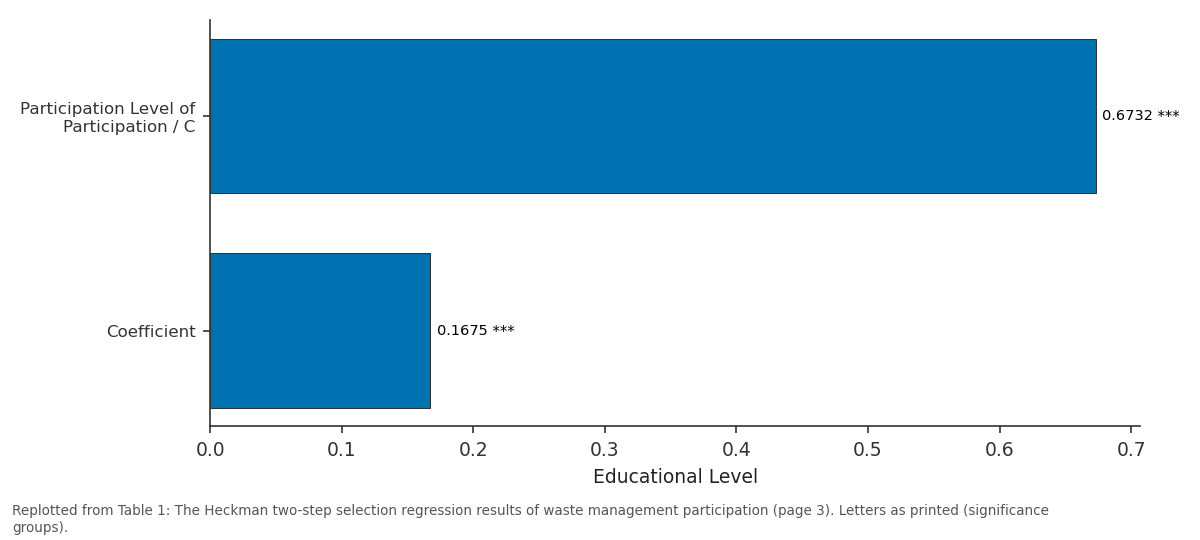
Educational Level: Participation Level of... vs Coefficient
Replotted from Table 1 (page 3) of the original paper. Every bar is the paper's own table value.
View source evidence ↗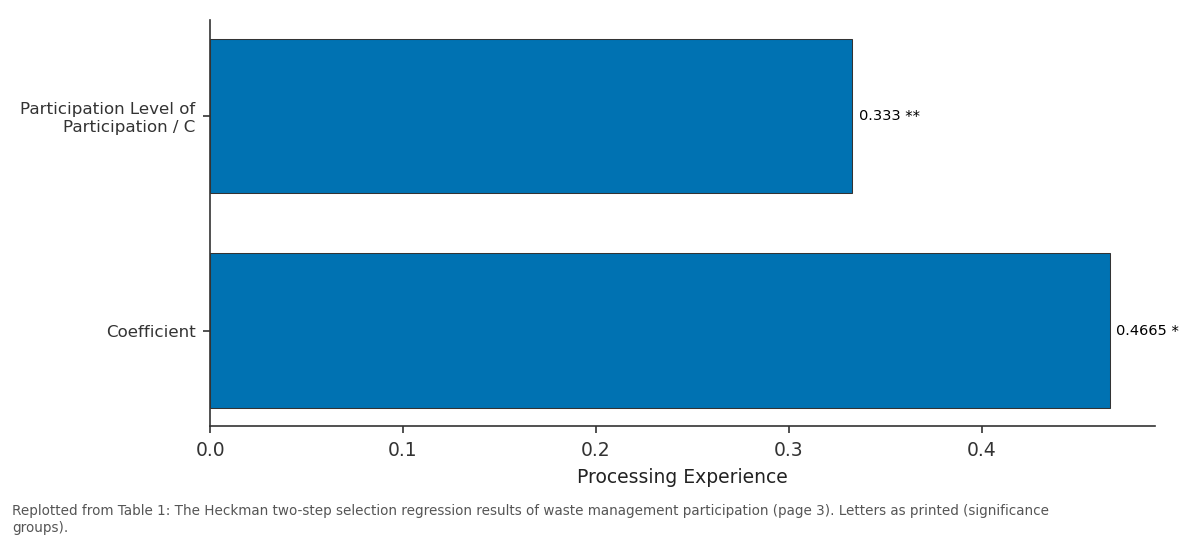
Processing Experience: Participation Level of... vs Coefficient
Replotted from Table 1 (page 3) of the original paper. Every bar is the paper's own table value.
View source evidence ↗Figures & tables
From the original paper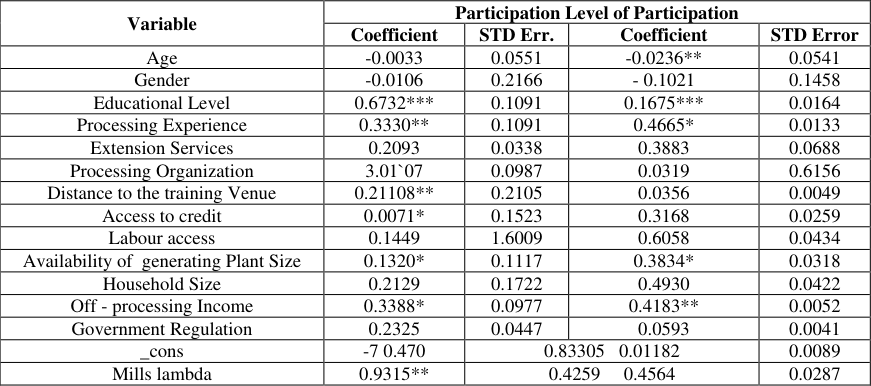 Table 1
Introduction
In most urban and rural areas in sub Saharan Africa, solid waste management palaver has been a recurring decimal and the improper handling has resulted in significant environmental degradation (Olukanni and Olatunji, 2014) [10] . Among several solid wastes generated in the region, agricultural waste in form of cassava wastes stand supereminence (Sackey and Bani, 2007) [13] . Cassava is a starchy staple food crop which has the ability to resist drought and diseases, with Nigeria being the highest producer in the world with output of 34 metric tons in 2016 (Ume, et al; 2016). In Nigeria, cassava is mostly produced and processed by small-scale farmers at the family or village level into Gari, FUFU, starch, chips, tapioca, flour etc., with lots of wastes such as peelings, pulp (fibrous by-products from crushing and sieving), starch residues after starch settling, effluent (waste water) and gases (generated from the machines used in grinding and from fire wood used in toasting) being produced (Oparaku, Ofomata and Okorigwe, 2013) [9] . These wastes in many rural and sub-urban areas are a times feed to livestock but in excessive situation, the processors dispose the wastes either by burning, allow to rot, dumping or unplanned landfilling with regardless to the environmental consequences (Olukanni and Olatunji, 2014) [10] . The havocs associated with such reckless wastes disposals, include climate change, increase in vermin populations, eutrophication of waterways, flooding due to garbage blocking drain, diseases related to improper waste disposal, breeding of flies and mosquitos and foul odour (Adebayo, Anyanwu and Osiyale, 2003 [1] , Sackey and Bani, 2007) [13] . The poor resource nature of the processors has complicated the above scenario, as the large proportion of them cannot afford to pay for disposal of the wastes and as well do not possess the necessary technologies and facilities in generating funds (income) from the wastes through producing products such as organic acid, flavor and aroma compounds, methane and hydrogen gas, enzymes, ethanol, lactic acid, bio surfactant, polyhydroxyalkanoate, essential oils, xanthan gum, and fertilizer (Oparaku, et al; 2013) [9] . In effect, processors in study area are equipped with technologies for efficient waste management to curtail maximally the environmental and human health effects by Anambra State Ministry of Environment, an off shoot of Nesrea. (an arm of Federal Environmental Protection Agencies), Women in Agriculture (WIA) (Women extension arm of Agricultural Development Programmed, ADP) and nongovernmental Organization (NGO) through seminars and workshops. Such technologies, include use of discharging pit, use of personal protection equipment (PPE) while operating the processing machines and toasting of gari, controlled land filling of wastes, controlled burning of wastes, composting of cassava solid wastes and treatment of waste water and slurry (Aerobic and anaerobic lagoons), fermentation of cassava peels (Oyegbami, Oboh and Omueti, 2010). Therefore, it becomes imperative to reveal the determinants factors to the decision to participate and the extent by the processors, as there is dearth of information in the subject matter in the study area, despite the programmers important to environmental sustainability. This study would serve as among other source of research information for scholars for further studies in related subjects, provision of useful information for extension agents to disseminate to processors and in making decisions and policies on wastes management by Environmental protection policy makers and planners.
Materials and Methods
The Study Area Anambra State of Nigeria is located between latitude 5038 'N and 6 0 47 'E of Equator and longitude 6 0 36 'N and 7021 'E of Greenwich Meridian. Anambra State has population figure of 4.184 million people (National Population Commission, (NPC), 2006) [8] . The state has annual rainfall range of 1600 mm -1700 mm, which is distributed from February to December. The state has mean temperature of 27 o C all through the year, but highest from February to April (NRCRI, 2006). The inhabitants are producers and processors of major food crop such as cassava, yam, cocoyam, maize, rice, sweet potato, vegetables and fruits.
Sampling Size and Sampling Technique
Multi-stage sampling techniques were used to select agricultural zones, Local Governments Areas (LGAs), towns and respondents. In the 1 st stage, three out of four agricultural zones of the state were purposively selected because of their intensity of cassava processing in those areas. The selected zones were Onitsha, Ihiala, and Awka. The second stage involved the random selection of two Local Governments Areas (LGAs) out of five from each zone. This brought to a total of six LGAs. In the third stage, two towns were randomly selected from each Local Governments Areas (LGA). This brought to a total of twelve towns. Finally, ten cassava processors were randomly selected from each of the towns from the lists of farmers compiled by the extension agents of the Anambra State Agricultural Development Programmed (ADP). This brought to a total of one hundred and twenty processors for detailed study.
Method of Data Collection
The information for the study was derived from primary and secondary sources. The primary data were obtained through the use of structured questionnaire and informal or oral interview of respondents. The secondary sources was derived from review of related literatures, text books, conferences papers, seminar, journals, published and unpublished thesis, workshop, the internets, and government publications.
Data Analysis
Heckman two stage model was used to ascertain factors influencing cassava processors' decision to participate and intensity in waste management programmer by EPA.
Econometric Analysis
The Heckman model is a statistical technique to correct bias from non-randomly selected samples or otherwise incidentally truncated dependent variables, a prevalent matter in quantitative social science when using observable data. Theoretically, this is achieved by explicitly modelling the individual sampling probability of each observation (the so-called selection equation) together with the conditional expectation of the dependent variable. The resulting likelihood is mathematically comparable to the Tobit model for censored dependent variables (Heckman, 1979) [6] . Heckman also developed a two-step control function method to evaluate this model, which reduced the computing problem of having to estimate both equations jointly, although at the cost of inefficiency (Frederick, 1983) [4] . Heckman discussed bias from using nonrandom selected samples to estimate behavioral relationships as a specification error. He suggests a two-stage estimation method to correct the bias. The correction employs a control function idea and is easy to implement. Haeckman's correction involves a normality assumption, provides a test for sample selection bias and formula for bias corrected model (Greene, 2000) [5] . Here, Heckman's two stage model to categorize factors that affect participation in cassava waste management programmer. The Heckman model is useful in dealing with line regression models when the equation involves never ending variable. However, we tend to are usually interested by cases where the result equation involves a divided variable. In effect, we would have a probity choice equation and a probity outcome equation (Frederick, 1983) [4] . Generally, Tobit model has the problem of assumption. It assumes the same set of parameters and variables are too used to decide both the probability of participation and the level of participation. Due to this assumption, the same variables in the same way introduce consistency bias in the model. Hence, Heckman two stage was employed in this study to minimize this problems. The model comprised of two steps; firstly, choice condition was evaluated by utilizing probity model and also, a result condition was evaluated by using Ordinary Least Square (OLS) regression. A probity model predicts the likelihood of whether the individual participates in the waste management programmer or not is:
Where is an indicator variable equal to unity for farmers participating in waste disposal management, market, 𝜑 is the standard cumulative distribution function, wi is factors affecting decision to participate in waste management 𝛼 is the vector of coefficient to be estimated and 𝘀𝑖 is normally distributed disturbance term with mean zero and variance 𝛿2.Thevariable 𝑍𝑖 takes the estimation of 1, if farm household I participate in waste management programmer and zero otherwise.
…………………….…………. (4)
Where is the idle dimension of utility the cassava processors get from programmer participation, ~N(0,1) and, zi* ……………………… (5)
………..……………… (6)
Heckman models incorporate exclusion restriction to compute an adjustment factor Inverse Mills Ratio (IMR) which included in the second-stage estimation in OLS part of this model. The IMR is figured as.
………………………………… (7)
Where is the normal probability function? The second equation is given by: …….... (8) Where E is the desire administrator, Y is the (continuous) extent of waste management method used, x is a vector of autonomous factors influencing the number of waste management method employed and β is the vector of the comparing coefficients to be estimated. In this way, Yi can be explained as follows: The model would thus be evaluated as follows; in the first step of deciding whether to participate in cassava waste management programmer. This can be indicated as:
.....… (10) Where, 1 denoted participation and 0 non-participation, β0 is a constant β1…..n are parameters to be estimate, dx is vector of explanatory variables. In the second step OLS were estimated to test the effect of hypothesized factors on the level of participation measured by the methods of waste management employed. The model is specified as; ….. (11) Where Y denotes the number of methods waste management employed, = is a constant, …..n are parameters to be estimated, are vector of explanatory variables.
Results and Discussion
Results and Discussion
Determinants of cassava processors' Participation in wastes management
The results of the two stage Heckman model for the participation decision and level of participation revealed that the coefficient of Mills ratio (Lamda) was significant at the probability 1.0 % (Table 1). Moreover, the models goodness of fit and likelihood function were significant at Walda chi2 (14) = 97.77 (0.0000) ***, z = 2.09, rho = 0.87604, sigma = 1.0060408. The finding assures the appropriateness of the two stage Heckman model to avoid sample selection bias that could have been experienced as a result of presence of some unobservable processor characteristics determining processors' chances to participate in the programmer thus influencing the level of participation if probity model was employed for the investigation (). Numerous factors were posited to effect cassava processors' decision to participate in cassava waste management in Anambra State, Nigeria (Table 1). Also, as expected the variables of educational Level, processing experience, extension services, membership of processing and access to credit had positive influence on cassava processors' decision to participate in cassava waste management, while the coefficient of age of the processors was negative. The coefficient of education level of the household head was found to positively influenced cassava processors' decision to participate in wastes management by EPA at 1 % significance level. The processors with higher educational status are as expected to participate more keenly in the programmed activity, as they have more aware about emerging environment and human vulnerabilities that could emanate from ailing management of the processing wastes (Sackey and Sani, 2007). As the number of years spent in formal education by processors increases by a year, the possibility of participation in programmer activity increases by 1 %. This result concurred with the finding of Osmani and Elias, (2015) [12] who opined that education aids in one's ability to receive, decode and understand information relevant to making participation decisions. As hypothesized, household heads' access to Environmental Protection Agency (EPA) extension services had direct association with processor's chances to partake in the cassava waste management training programmer by EPA. This specifies that access to extension services enhances the likelihood of processors in partaking in the programmer by 1 %. Oparaku; et al. (2013) [9] finding was synonymous with the finding. The higher the number of extension contact, the greater the processors' tendency to participate in the programmer, as the processors shall be equipped with information as relates to the consequences of pollution resulting from their processing activities by the change agent. As well, at 10 % level of significance, access to credit facilities positively influenced the decision to participate in the programmer. Sackey and Bani, (2007) [13] also reported a direct relationship between participation and access to credit among farmers. Access to credit could suggest that the processors will be able to take advantage of the new funds to increase their scope of operations in management of wastes through procuring necessary facilities. This specifies that access to credit from formal or informal sectors or both has the capacity of increasing the prospect of engaging in the programed by 0.0071 %. In addition, increase in awareness of the havocs of environment pollution control prompted by being a member of processing organization could explain the positive relationship between decision to participate in the programmer and membership of the organization. Similar finding was also reported by David, (1993) [3] , who posited that that increase in the level of awareness possibly can also explains the fact that participation increased through interaction or cross fertilization of member. As well, persuasion of members to attend such training by the organization could prompt the processors' decision to partake in the programmer (David, 1993) [3] . Additionally as expected, the coefficient of age of processing household was negative, implying that with advancing in age of the processors, more the likelihood of the reduced decision to partake in the programmer. This could be explained by diminishing in aged processors' risk bearing ability, innovativeness, mental capacity to cope with daily processing challenges and his ability to do manual jobs associated with processing (Omilani, Abass, Okoruwa, 2015) [11] .
| Variable | Participation Level of Participation | — | — | — |
|---|---|---|---|---|
| Coefficient | STD Err. | Coefficient | STD Error | |
| Age | -0.0033 | 0.0551 | -0.0236** | 0.0541 |
| Gender | -0.0106 | 0.2166 | - 0.1021 | 0.1458 |
| Educational Level | 0.6732*** | 0.1091 | 0.1675*** | 0.0164 |
| Processing Experience | 0.3330** | 0.1091 | 0.4665* | 0.0133 |
| Extension Services | 0.2093 | 0.0338 | 0.3883 | 0.0688 |
| Processing Organization | 3.01`07 | 0.0987 | 0.0319 | 0.6156 |
| Distance to the training Venue | 0.21108** | 0.2105 | 0.0356 | 0.0049 |
| Access to credit | 0.0071* | 0.1523 | 0.3168 | 0.0259 |
| Labour access | 0.1449 | 1.6009 | 0.6058 | 0.0434 |
| Availability of generating Plant Size | 0.1320* | 0.1117 | 0.3834* | 0.0318 |
| Household Size | 0.2129 | 0.1722 | 0.4930 | 0.0422 |
| Off - processing Income | 0.3388* | 0.0977 | 0.4183** | 0.0052 |
| Government Regulation | 0.2325 | 0.0447 | 0.0593 | 0.0041 |
| cons _ | -7 0.470 | 0.83305 0.01182 | 0.0089 | |
| Mills lambda | 0.9315** | 0.4259 0.4564 | 0.0287 |
Table text extracted from the original PDF; superscript letters are shown inline. The original table image is below.
View original table image
Determinants of extent of participation in cassava waste management by processors
The second stage of the analysis shows that educational Level, processing experience and off-processing come had positive influence, while the age of the household was negative. Age of the household head had indirect relationship with the level of participation in the programmer at 95 % confidence level. Keeping other explanatory variables at their mean level, as the age of household heads increases by one year, the level of participation in the programmer declines by -0.0236 %. The reason could be deduced by the fact that aged households are conservative and risk averse and are not enthusiastic to endeavor into innovative they are not familiar with (Ume, et al; 2016). Additionally, Olukanni, Adeleke, Aremu, (2016) opined that elderly household heads are very feeble to engage into some of the management practices of cassava processing wastes which are usually strenuous. As the findings of Omilani, et al, (2015) [11] corresponded to above assertion. They pointed that elder processors could be more experienced and endowed with wherewithal hence they may have either experienced or observed the gains of joining in the programmer. As well, the number of years of processing experience of processor was positively related and statistically significant with the level of participation in the programmer. This indicates that, ceteris paribus, an increase in processor's year of experience by one year will increase the level of participation or him or her by 0.4665 %. Experienced processors are expected to be familiar with EPA extension agents which could likely to facilitate their level in participation in the waste management programmer. In addition, many years of processing is an indication of the practical knowledge the processor (s) had acquired to overwhelmed definite integral waste management in cassava processing (Olukanni, et al. 2016). This result contradicted the finding of Osmani and Elias, (2015) [12] , who reported that experienced processors could not be eager to embarrass improved innovation, likely resulting to poor participation. Furthermore, the positive and statistical significant of the coefficient of educational level of household heads with participation in the programmer as shown in Table 1 is in conformity to a priori expectation but did not concur to the finding. This implies as the number of years spent in schooling by the household head increases by a year, the greater the probability of increase in the intensity of participation in waste management by 01675 %. Education as opined by Dary and Kuunibe, (2012) impacts into individuals with the environmental management skill and knowledge that will spur individuals to participate in the programmer. However, the finding of Omilani, et al; 2015) [11] did not coincide to the affirmation. They opined that most educated people have preference for 'white collar jobs' than cassava p finding of processing vocation. Additionally, the coefficient of off-processing income was positively signed to the dependent variable. This symbolizes that any increase in money accruing from participation in offprocessing income, will increase the extent of participation in the programmer by 0.4183 %. Off-processing income as reported by David, (1993) [3] aids in providing flows of cash income that can be used to purchase processing inputs and hire labour in management of cassava processing wastes.
Conclusion and Recommendations
The results of the decision to participate in the programmer was positively and significantly influenced by educational Level, processing experience, extension services, membership of processing, access to credit and household size. Furthermore, the extent of participation in the programmer was significantly and positively influenced by processing experience, off processing income and level of education, while age of household head and gender negatively influenced the respondents' level participation in the programmer. Based on the finding the following policy interventions were recommended. First, the need to expose processors to educational programmers such as adult education, workshops and seminars by government through the appropriate agencies and organizer private sectors. Second, processors are advised to form cooperatives for ease of access to processing inputs at subsidized prices and as well government subsides. Third, extension services of the programmer should be enhanced by motivation of the agents through payment of incentives. Fourth, government should enhance processors' access to credits form microfinance banks and commercial banks at subsidized rates. Fifth, there is need to develop rural areas with industries and equipped with basic amenities to enhance processors access to varied sources of off-processing activities.
References
9 in the original paper- Adebayo K, Anyanwu AC, Osiyale AO. Perception of Environmental Issues by Cassava Processors in Ogun State, Nigeria -Implications for Environmental Extension Education. J. Ext. Syst. 2003;19:103-112.
- Dary SK, Kuunibe N. Participation in rural non-farm economic activities in Ghana. American International Journal of Contemporary Research. 2012;2(8):154-161.
- Heckman J. Sample Selection Bias as a Specification Error. Econometrical. 1979;47(1):153-161.
- Ndolo PJ, Mcharo T, Carey EE, Gichuki ST, Ndinya C, Malinga J. Participatory on-farm selection of sweet potato varieties in Western Kenya. African Crop Science. 2001;1:41-48.
- Oparaku NF, Ofomatah AC, Okoroigwe EC. Bio digestion of cassava peels blended with pig dung for methane generation. Afr. J. Biotechnology. 2013;12:5956-5961.
- Olukanni DO, Olatunji TO. Cassava waste management and biogas generation potential in selected Local Government Areas in Ogun State, Nigeria Recycling Article. 2014;5:12-2.
- Omilani O, Abass A, Okoruwa VO. Willingness to pay for value-added solid waste management system among cassava processors in Nigeria; c2015. Available online: www.tropentag.de/2015/proceedings/node515.html (accessed on 22 May 2018).
- Osmani AG, Elias H. Market participation decision of smallholder farmers and its determinants in Bangladesh. Economics of Agriculture. 2015;3:62.
- Sackey IS, Bani RJ. Survey of waste management practices in cassava processing to Gari in selected districts of Ghana. J. Food Agric. Environ. 2007;5:325-328.