
Research article · 2024 · Full text
International Journal of Advanced Biochemistry ResearchStudy of lower productivity in the suckling and weaner age group of Marwari sheep due to mortality (Weight losses)
Volume 8(1S) · Pages 139–142 · DOI: 10.33545/26174693.2024.v8.i1sc.357 ↗
Research areasLivestock Management and Performance Improvement
Abstract
Author-writtenThe assessment of financial damages resulting from disease in Marwari sheep in arid zones had been examined by the utilisation of data (relating to Marwari, 3164) obtained from CSWRI, ARC, Bikaner over a period of eight years (2004). Morbidity from the disorders mentioned was the subject of the study. The age groups under study were birth to three (suckling age) and three to six (weaning age). Here, the diseases listed at the Central Sheep and Wool Research Institute in Bikaner are categorised according to systemic diseases. It's important to note that mortality rates can be influenced by various factors, including nutrition, housing conditions, disease control, and the overall health management of the flock. Therefore, implementing effective management practices and investing in the health and well-being of the animals can help mitigate economic losses.
Summary
Source-checkedPlain-language reading of the full paper, prepared with AI and checked against the text. Each point links to the authors' own words.
Why it matters
- Sheep mortality is influenced by a variety of factors, including bacterial infections, worm infestations, poor nutrition, climate, and management practices. View evidence ↗
- Mortality in sheep leads to economic losses through decreased productivity and the direct impact of parasite infestations and nutritional deficiencies. View evidence ↗
- Overall production is further reduced by indirect effects on feed intake and efficiency, which impact reproductive efficiency and live weight gain. View evidence ↗
The question
- The study aimed to assess the financial damages caused by disease in Marwari sheep within arid zones using data from the CSWRI, ARC, Bikaner. View evidence ↗
What they did
- Weight measurements were taken using dial platform balances with accuracies of 0.05 kg (up to weaning) and 0.10 kg (after weaning). View evidence ↗
- Economic losses were calculated based on a CSWRI average live weight cost of Rs. 130 per kilogram. View evidence ↗
What they found
- In the suckling group, 118 deaths resulted in a mean weight loss of 3.00±0.022 kg per lamb, totaling a 354.00 kg loss and an economic loss of Rs. 46,020.00. View evidence ↗
- Within the suckling group, male lambs (71 deaths) had higher weight losses (218.68 kg; Rs. 28,428.40) compared to female lambs (47 deaths; 137.24 kg; Rs. 17,841.20). View evidence ↗
- In the suckling group, the major birth season saw higher total weight losses (265.72 kg for 91 lambs) than the minor season (81.00 kg for 27 lambs). View evidence ↗
- In the weaning group, 27 deaths led to a least-squares mean weight loss of 15.59±0.170 kg per lamb, totaling 420.82 kg and an economic loss of Rs. 54,706.86. View evidence ↗
- In the weaning group, males (15 deaths) experienced greater weight and economic losses (246.30 kg; Rs. 32,019.00) than females (12 deaths; 176.86 kg; Rs. 22,991.23). View evidence ↗
- For the weaning group, the main birth season resulted in higher total weight losses (284.05 kg for 19 lambs) compared to the minor season (124.48 kg for 8 lambs). View evidence ↗
What it means
- The authors conclude that the sex of the lamb significantly influences morbidity, suggesting that males are more disease-resistant and robust than females. View evidence ↗
Visual summary
1 visualsIllustrations explain the paper; they do not show study data.
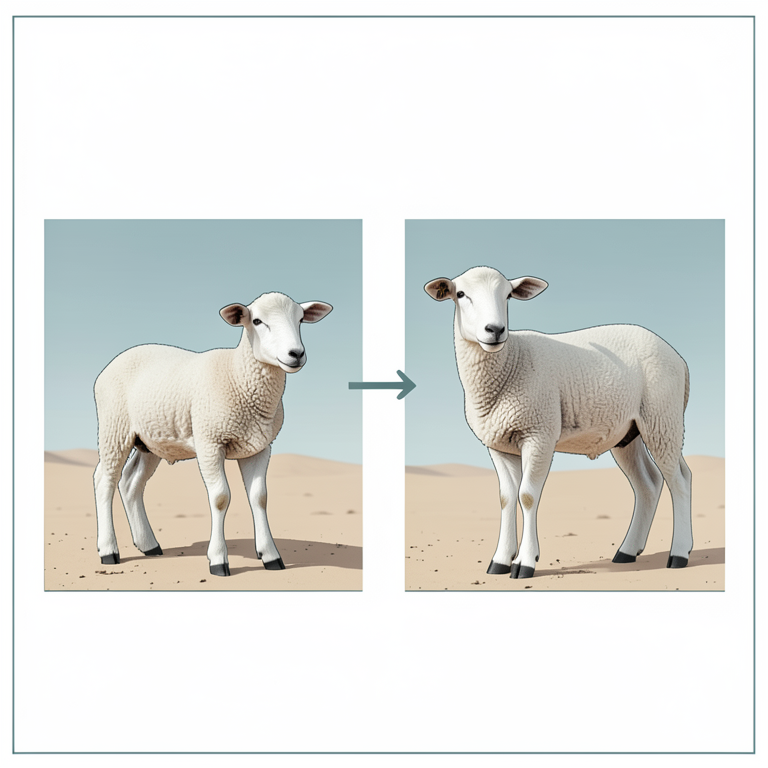
Study Framework
AI-generated conceptual illustration (Marwari sheep lambs). It explains the idea and does not show study data.
View source evidence ↗Figures & tables
From the original paper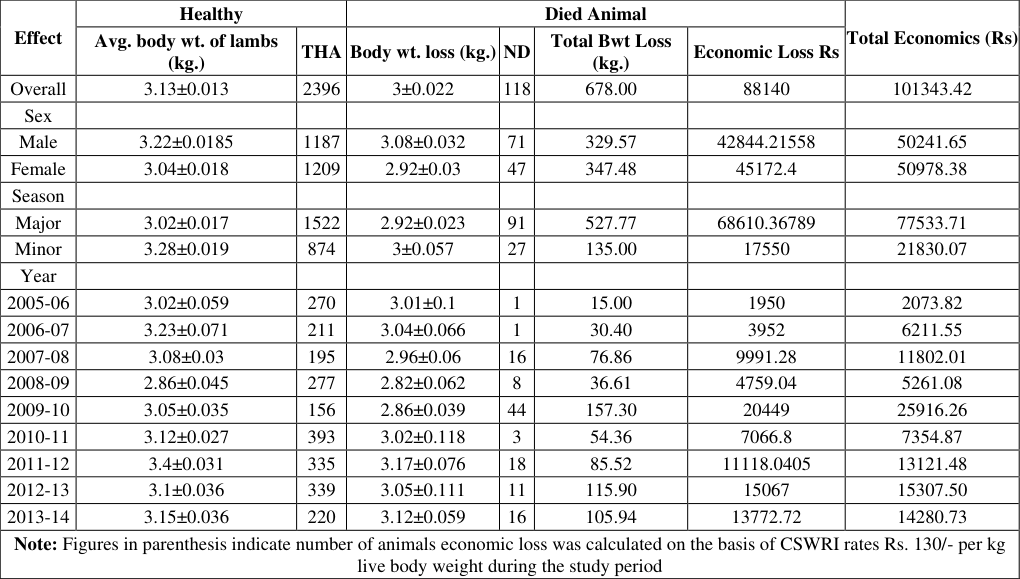 Table 1
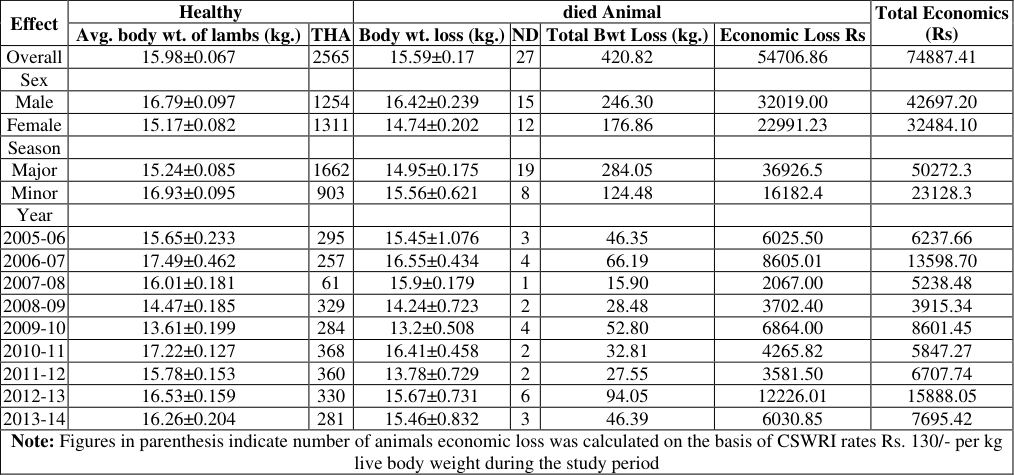 Table 2
Introduction
A number of variables, including bacterial infections, worm infestations, malnourishment, adverse the climate, and management practices, have been studied in relation to sheep mortality. thorough investigation on non-genetic variables affecting sheep mortality rates. There are vaccines for the viral infections that affect ovine, such as rinderpest, FMD, and sheep pox, which can shield small ruminants from harm. Two more viral diseases that result in a decrease in sheep production are blue tongue and PPR. In addition to hunger, other common issues that cause output losses include enterotoxemia, Johne's illness, and worm infestation. Along with decreased output, mortality also results in economic damage from parasite infestation and nutritional inadequacies. The indirect influence on feed intake and efficiency reduces overall production by influencing live weight gain and reproductive efficiency. The yield of wool is decreased by uncontrolled infections with virulent foot rot. It is likely that the estimate of 8% loss of yearly wool weight by Marshall et al. (1991) [2] was the greatest available estimate of the effect of foot rot on average annual wool production in an infected flock.
Market Prices:
The current market prices for sheep and sheep products, as this can influence the economic impact.
Preventive Measures Cost:
The cost of implementing preventive measures to reduce mortality rates, such as vaccination programs or improved management practices.
According to Kanaujia et al. (1985) [1] , Beetal and its crosses (females older than 12 months) had a lower survivorship percentage (71.69%), indicating a higher death rate (28.31%) in adult females.
Materials and Methods
Materials and Methods
Source of data
The Central Sheep and Wool Research Institute's Arid Region campus in Bikaner, together with the project "Improvement of Marwari sheep for carpet wool production through selection" are the sources of the data used in this study.
Illustration of data
This investigation offers a summary of Marwari sheep statistics on mortality percentage and economic damage at various age groups of lambs from 2005 to 2014 (year of birth). Birth to 03 (suckling), 03 to 06 (weaning) were the various age categories.
Mortality rate
The lambs, both alive and dead, were sorted into age groups: 0-3, 3-6, 6-12, and above twelve months. The post-mortem results were used to document and validate the potential cause of the lambs' deaths.
Body weight
Within twenty-four hours of lambing, the birth weights of both healthy and sick lambs were noted. Before the lambs had access to food or water, their weight was measured at three months of age (weaning), then again at six, nine, and twelve months of age in the morning. We used a dial platform balance with a 50 kg capacity that was accurate to within 0.05 kg up until weaning, and a 100 kg capacity that was accurate to within 0.10 kg after weaning.
Classification of data
The mortality rate data was categorised by birth season, disease sire year, and sex. The rates of illness and death by sire were also computed. The weather, feeding, housing, and differential management of males and females data were not collected at the farm, so they were excluded from the analysis.
Sex of lamb
For every condition under examination, the mortality rates for male and female lambs in the age categories of 0-3, 3-6, 6-12, and over twelve months were computed independently.
Season of birth
To investigate how variations in temperature, humidity, rainfall, and other meteorological factors affect mortality rates, the year was split into two seasons based on the month that lambs were born. For every age group, birth season, and disease year, the economic losses in body weight resulting from mortality were computed. For the duration of the studies, the CSWRI fee per kilogramme of live weight was Rs. 130/-per kg.
Suckling group (0-3 months of age)
The mean weight loss per lamb resulting from the 118 deaths was 3.00±0.022 kg. Rs. 46020.00 was the economic loss as a result of the 354.00 kg body weight drop (Table : 2). [4] , helminthic burden causes 20% of adult mortality and 30% of mortality in lambs. Sharma (2006) [5] found that the overall morbidity rates in the age groups of hogget, adult, weaner, and suckling Marwari sheep were, respectively, 8.53, 6.21, 15.38, and 34.79 percent. Barbosa, 2014 [6] According to research, septicemia (19.1%), enterotoxaemia (25.5%), coccidiosis (8.1%), colibacillosis (14.9%), and other diverse causes (31.9%) were the main risk factors linked to poor lamb survival. Lambs aged 0-14 and 31-45 days had greater mortality rates (36% and 55%, respectively), and the majority of them passed away without exhibiting any symptoms. With abortions and lamb deaths included, the average mortality rate was 13.05%, meaning that the 57 sheep farms lost a total of 116.706 euros annually.
Figures and tables from the paper
| Effect | Healthy | — | Died Animal | — | — | — | Total Economics (Rs) |
|---|---|---|---|---|---|---|---|
| Avg. body wt. of lambs (kg.) | THA | Body wt. loss (kg.) | ND | Total Bwt Loss (kg.) | Economic Loss Rs | ||
| Overall | 3.13±0.013 | 2396 | 3±0.022 | 118 | 678.00 | 88140 | 101343.42 |
| Sex | |||||||
| Male | 3.22±0.0185 | 1187 | 3.08±0.032 | 71 | 329.57 | 42844.21558 | 50241.65 |
| Female | 3.04±0.018 | 1209 | 2.92±0.03 | 47 | 347.48 | 45172.4 | 50978.38 |
| Season | |||||||
| Major | 3.02±0.017 | 1522 | 2.92±0.023 | 91 | 527.77 | 68610.36789 | 77533.71 |
| Minor | 3.28±0.019 | 874 | 3±0.057 | 27 | 135.00 | 17550 | 21830.07 |
| Year | |||||||
| 2005-06 | 3.02±0.059 | 270 | 3.01±0.1 | 1 | 15.00 | 1950 | 2073.82 |
| 2006-07 | 3.23±0.071 | 211 | 3.04±0.066 | 1 | 30.40 | 3952 | 6211.55 |
| 2007-08 | 3.08±0.03 | 195 | 2.96±0.06 | 16 | 76.86 | 9991.28 | 11802.01 |
| 2008-09 | 2.86±0.045 | 277 | 2.82±0.062 | 8 | 36.61 | 4759.04 | 5261.08 |
| 2009-10 | 3.05±0.035 | 156 | 2.86±0.039 | 44 | 157.30 | 20449 | 25916.26 |
| 2010-11 | 3.12±0.027 | 393 | 3.02±0.118 | 3 | 54.36 | 7066.8 | 7354.87 |
| 2011-12 | 3.4±0.031 | 335 | 3.17±0.076 | 18 | 85.52 | 11118.0405 | 13121.48 |
| 2012-13 | 3.1±0.036 | 339 | 3.05±0.111 | 11 | 115.90 | 15067 | 15307.50 |
| 2013-14 | 3.15±0.036 | 220 | 3.12±0.059 | 16 | 105.94 | 13772.72 | 14280.73 |
| Note: Figures in parenthesis indicate number of animals economic loss was calculated on the basis of CSWRI rates Rs. 130/- per kg live body weight during the study period |
Table text extracted from the original PDF; superscript letters are shown inline. The original table image is below.
View original table image
| Effect | Healthy | — | died Animal | — | — | — | Total Economics (Rs) |
|---|---|---|---|---|---|---|---|
| Avg. body wt. of lambs (kg.) | THA | Body wt. loss (kg.) | ND | Total Bwt Loss (kg.) | Economic Loss Rs | ||
| Overall | 15.98±0.067 | 2565 | 15.59±0.17 | 27 | 420.82 | 54706.86 | 74887.41 |
| Sex | |||||||
| Male | 16.79±0.097 | 1254 | 16.42±0.239 | 15 | 246.30 | 32019.00 | 42697.20 |
| Female | 15.17±0.082 | 1311 | 14.74±0.202 | 12 | 176.86 | 22991.23 | 32484.10 |
| Season | |||||||
| Major | 15.24±0.085 | 1662 | 14.95±0.175 | 19 | 284.05 | 36926.5 | 50272.3 |
| Minor | 16.93±0.095 | 903 | 15.56±0.621 | 8 | 124.48 | 16182.4 | 23128.3 |
| Year | |||||||
| 2005-06 | 15.65±0.233 | 295 | 15.45±1.076 | 3 | 46.35 | 6025.50 | 6237.66 |
| 2006-07 | 17.49±0.462 | 257 | 16.55±0.434 | 4 | 66.19 | 8605.01 | 13598.70 |
| 2007-08 | 16.01±0.181 | 61 | 15.9±0.179 | 1 | 15.90 | 2067.00 | 5238.48 |
| 2008-09 | 14.47±0.185 | 329 | 14.24±0.723 | 2 | 28.48 | 3702.40 | 3915.34 |
| 2009-10 | 13.61±0.199 | 284 | 13.2±0.508 | 4 | 52.80 | 6864.00 | 8601.45 |
| 2010-11 | 17.22±0.127 | 368 | 16.41±0.458 | 2 | 32.81 | 4265.82 | 5847.27 |
| 2011-12 | 15.78±0.153 | 360 | 13.78±0.729 | 2 | 27.55 | 3581.50 | 6707.74 |
| 2012-13 | 16.53±0.159 | 330 | 15.67±0.731 | 6 | 94.05 | 12226.01 | 15888.05 |
| 2013-14 | 16.26±0.204 | 281 | 15.46±0.832 | 3 | 46.39 | 6030.85 | 7695.42 |
| Note: Figures in parenthesis indicate number of animals economic loss was calculated on the basis of CSWRI rates Rs. 130/- per kg live body weight during the study period |
Table text extracted from the original PDF; superscript letters are shown inline. The original table image is below.
View original table image
References
4 in the original paper- Kanaujia AS, Vinayak AK, Pandre BL, Balain DS. Studies on survivability in Beetal and Black Bengal goats and their crosses. Indian J Anim Prod Manage. 1985;1(4):183-188.
- Marshall DJ, Walker RI, Cullis BR, Luff MF. The effect of foxtrot on body weight and wool growth of sheep. Aust Vet J. 1991;68:45.
- Kumar A, Vaid RK, Barua S, Rana R, Gupta VK, Vihan VS. An outbreak of pneumonic pasteurellosis in sheep: clinical behavior, meteorological variables, and management. Vet Practitioner. 2005;6(2):119-122.
- Biffaa D, Jobrea Y, Hassen C. Ovine helminthosis, a major health constraint to the productivity of sheep in Ethiopia. Anim Health Res Rev. 2006;7(1-2):107-118.