
Research article · 2024 · Full text
International Journal of Agriculture Extension and Social DevelopmentAnalysing IL8, IL10, IFNɑ and IFNγ levels in pregnancy and pathological conditions in Karan Fries
Volume 7(1) · Pages 328–332 · DOI: 10.33545/26180723.2024.v7.i1e.230 ↗
Research areasReproductive System and PregnancyReproductive Physiology in Livestock
Abstract
Author-writtenThe maternal immune system has immune tolerance to fetus so that it is not rejected. This immune tolerance involves cytokines produced by T cells. This study was conducted to monitor various pro- and anti-inflammatory cytokines in both pregnant cows as well as diseased cows. Cows suffering from clinical mastitis and endometritis were selected for the study. In pregnant cows, blood sample was collected on day 10, 18, 36 post artificial insemination. Plasma of both pregnant and diseased cows was isolated and IL8, IL10, IFNÉ‘, and IFNγ levels were estimated. IL10 levels were up regulated in pregnant animals. IL8 levels were higher in pregnant cows. IFNÉ‘ and IFNγ levels were higher both in pregnant and diseased cows.
Summary
Source-checkedPlain-language reading of the full paper, prepared with AI and checked against the text. Each point links to the authors' own words.
Why it matters
- Decreased fertility and conception rates in high-producing dairy cows lead to significant economic losses in the dairy industry. View evidence ↗
- The maternal immune system uses T cell-produced cytokines to maintain immune tolerance, preventing the fetus from being rejected. View evidence ↗
- Cytokines and chemokines are essential for regulating the immune response when the body encounters pathological antigens. View evidence ↗
The question
- The study aimed to monitor pro- and anti-inflammatory cytokines in both pregnant and diseased cows. View evidence ↗
What they did
- The research was conducted on Karan Fries (KF) cows from the Livestock Research Centre at the National Dairy Research Institute in Karnal. View evidence ↗
- Plasma levels of IL8, IL10, IFNα, and IFNγ were measured using ELISA kits from Bioassay technology laboratory. View evidence ↗
- Data were analyzed using one-way ANOVA in GraphPad Prism software and expressed as mean ± S.E.M. View evidence ↗
What they found
- Plasma IL8 levels were significantly higher (p≤ 0.05) in pregnant cows on days 10, 18, and 36 post-AI compared to non-cyclic heifers. View evidence ↗
- Cows with endometritis showed significantly higher (p≤ 0.05) IL8 levels compared to the control group. View evidence ↗
- IL10 levels significantly increased (p≤ 0.05) on days 18 and 36 post-AI compared to non-cyclic heifers, and were also significantly higher in cows with endometritis than in controls. View evidence ↗
- IFNα levels were significantly higher (p≤ 0.05) on days 10, 18, and 36 post-AI, as well as in cows with both endometritis and mastitis, compared to controls. View evidence ↗
- IFNγ levels were significantly higher (p≤ 0.05) on days 10, 18, and 36 post-AI, and in cows with endometritis and mastitis, compared to controls. View evidence ↗
What it means
- The authors concluded that both pregnancy and pathological conditions modulate cytokine responses. View evidence ↗
- The authors state that high levels of IL10 in pregnant animals are crucial for the establishment of pregnancy. View evidence ↗
Visual summary
3 visualsIllustrations explain the paper; charts are replotted from the paper's own table values.
Cytokine Modulation Overview
AI-generated conceptual illustration (Karan Fries cows). It explains the idea and does not show study data.
View source evidence ↗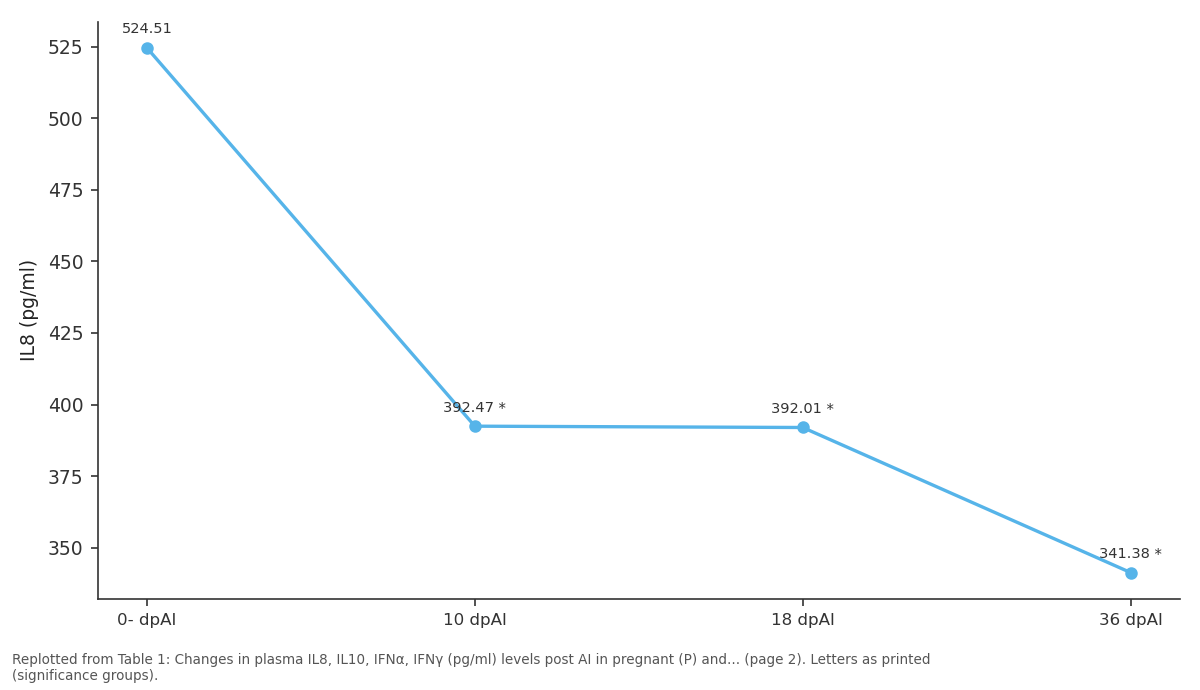
IL8: 0- dpAI vs 10 dpAI vs 18 dpAI vs 36 dpAI
Replotted from Table 1 (page 2) of the original paper. Every bar is the paper's own table value.
View source evidence ↗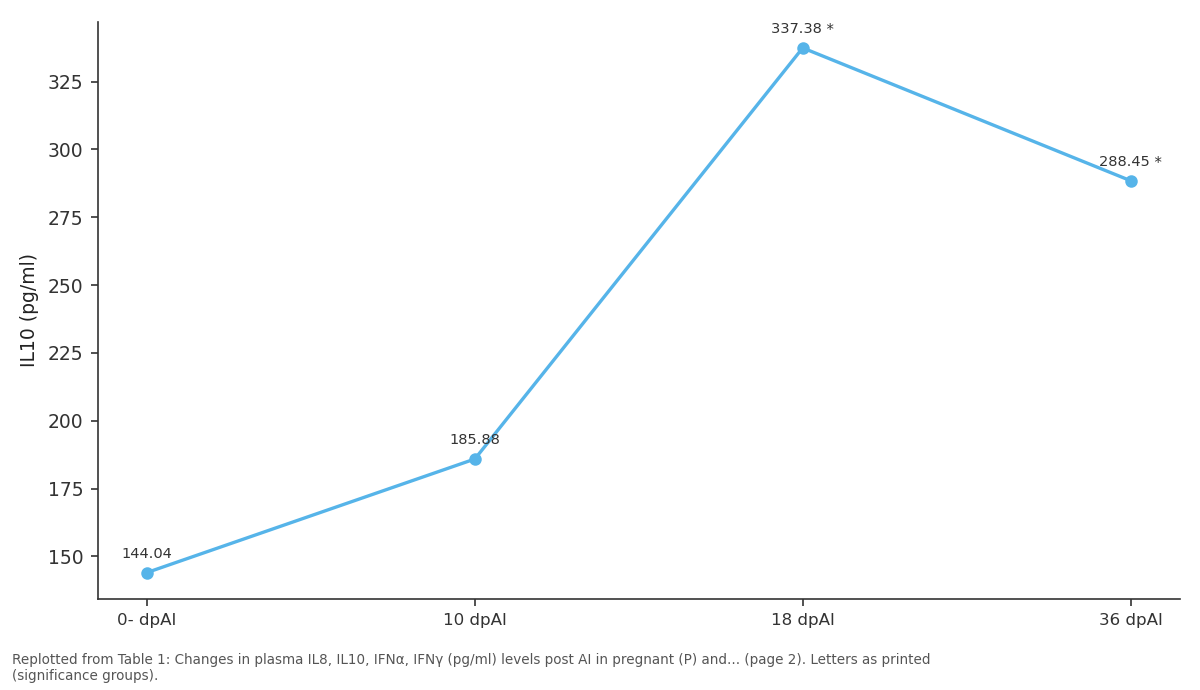
IL10: 0- dpAI vs 10 dpAI vs 18 dpAI vs 36 dpAI
Replotted from Table 1 (page 2) of the original paper. Every bar is the paper's own table value.
View source evidence ↗Figures & tables
From the original paper Table 1
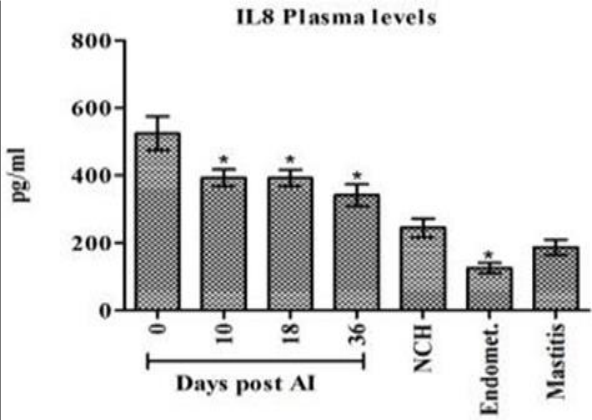 Figure 1
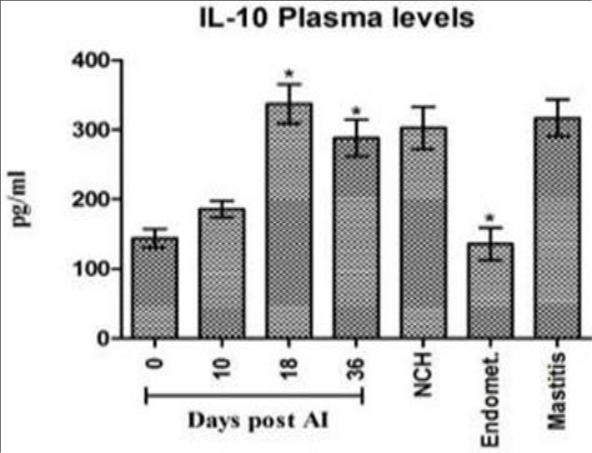 Figure 2
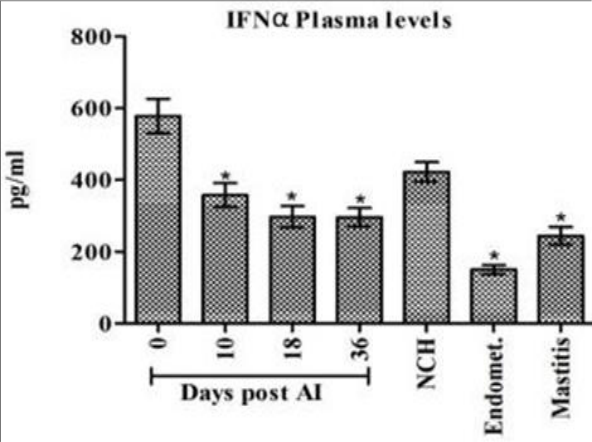 Figure 3
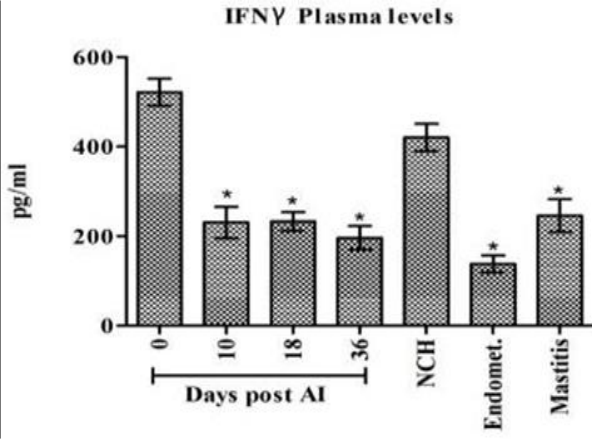 Figure 4
Introduction
During the past five decades milk production per cow has increased significantly because of improved management, nutrition, and genetic selection. In contrast there has been a decrease in fertility and conception rates of high producing dairy cows which are the major causes of economic loss to the dairy industry. Dairy industry is a profitable venture commercially and an important source of income for rural dairy farmers who are the economic backbone of the nation. The economic potential of dairy animals and profitability of dairying has been severely limited due to poor fertility of dairy bovines at commercial and grassroot level. To get maximum profit from the dairy sector, optimal reproductive efficiency is important; cattle must calve within a 12-14 month interval, but this is almost never achieved at field level due to various reproductive and post-partum complications. A study regarding the production and reproductive performances of crossbred Jersey cattle in Tamil Nadu reported 460.56±11.08 days (15-16 months) calving interval (Vijayakumar et al., 2019) [14] . In order to achieve optimal reproductive efficiency, identification of non-pregnant animals at an early date post insemination is important so that the animals can be re-bred or treated. Pregnancy is necessary for conservation of species which involves successful fertilization, establishment, and maintenance. First step of pregnancy is the adherence of the fertilized egg to the surface of the uterus (Implantation) where the dam tries to accommodate the alien fetus. During this time the conceptus secretes interferon tau (IFNt) which not only acts as a maternal recognition factor but also imparts local changes in the maternal uterus to provide a local environment friendly to subsequent conceptus development (Roberts et al., 2008) [10] . It maintains the corpus luteum (CL) during early pregnancy. Progesterone is antiproliferative and suppresses the production of pro-inflammatory cytokines. In addition to this, it also inhibits cytotoxic T cell activity (Shah et al., 2018) [11] . T cells play modulatory roles during pregnancy responsible for Th1/ Th2 shift. Based on the cytokine production they are divided into two categories Th1 and Th2. Th1 cells produce cytokines like Interferon-gamma (IFNγ), tumor necrosis factor-alpha (TNFα), Interferonalpha (IFNɑ) and Interleukin 10 (IL10) whereas Th2 cells produce IL4, IL5, IL10 and down regulate Th1 responses (Adkins et al., 2004) [1] . Cytokines are the proteins released by cells that have specific effects on the interactions and communications between cells. Cytokine is a general name, it includes lymphokines (Cytokines made by lymphocytes), monokine (Cytokines made by lymphocytes), interleukin (Cytokines made by one leukocyte and that acts on other leukocytes) and chemokine (Cytokines made with chemotactic activities). Cytokines act on the same cells that secrete them (Autocrine action), and on nearby cells (Paracrine action), or in some instances on distant cells (Endocrine action). Cytokines are produced in a cascade, as one cytokine stimulates its target cells to make other additional cytokines. These can act synergistically or antagonistically. Cytokines are made by many cell populations, but predominantly by helper T cells (Th cells) and macrophages. Cytokines can be pro-inflammatory or anti-inflammatory. Th cells are classified into Th1 and Th2. Th1 cells produce cytokines like IFNγ, IL1β, TNFα and Th2 produce IL4, IL5 and IL10 and downregulates Th1 cell responses. Th1 cytokines inhibit www.extensionjournal.com growth of trophoblast cells and play a critical role in allograft rejection (Burns et al., 2005) [4] whereas Th2 cells are responsible for immunological allograft tolerance (Lie et al., 1998) [18] . There are only a few studies on Th1/Th2 shift during pregnancy in domestic animals. Th1/Th2 cytokine pattern is not evident in ruminants (Waldvogel et al., 2000) [15] . Cytokines and chemokines play an important role in regulation of immune response against pathological antigens. Cytokines also stimulate acute phase protein production by the liver, which promotes phagocytosis. Cytokines also increase the amino acid pool of the body by causing mild proteolysis in muscles and resulting in amino acid release responsible for synthesis of various immunoprotective elements. The purpose of this study was to study the response of various cytokines in both pregnant and pathological conditions. Information obtained from this study may provide a better understanding of bovine reproductive immunology.
Material and methods
To evaluate the response of various cytokines during both pregnant and diseased conditions in Karan fries (KF) cows. These KF cows were selected from the Livestock Research Centre (LRC), National Dairy Research Institute (NDRI), Karnal.
Ethical permission
The experiment was approved by the Institutional Animal Ethics Committee (IAEC) of ICAR-National Dairy Research Institute (Application no 41-IAEC-18-32) constituted as per the article 13 of the CPCSEA rules, laid on by the Government of India (Reg. No. 1705/GO/AC/13/CPCSEA dated. 3/7/2013). All the ethical guidelines were followed throughout the experiment.
Processing of blood samples
Blood samples (9ml) from each animal were drawn aseptically from jugular vein in heparinized vacutainer tubes. The blood sampling was done on days 0, 10, 18, 36 days post artificial insemination (AI) (n=10). Animals having clinical mastitis and endometritis were selected. Clinical mastitis cows (n=5) were selected based on their somatic cell count (SCC) more than 5 lakh scc/ml and metritis cows (n=5) selected on the basis of vaginal mucus (white side test). The samples were immediately taken to the laboratory under refrigeration conditions and plasma was isolated.
Isolation of Plasma from whole blood
Freshly collected blood samples were centrifuged in 15 ml polypropylene Falcon tubes (Tarsons®) @ 2500 rpm for 30 minutes to separate the plasma which was stored in the storage vials at -20oC for the analysis. IL8, IL10, IFNα, IFNγ, were estimated via ELISA Kit (Catalog Number. CSB-E13052B, CSB-E0252Bo, CSB-E0205Bo, CSB-E0005Bo) supplied by Bioassay technology laboratory. The sensitivity of the assay was less than 3.08 ng/ml with a detection range of 5-1000 ng/ml. Inter-assay CV was 10% and intra-assay CV was 8%.
Statistical analyses
Statistical analyses were performed using the GraphPad Prism software. All the data were expressed as mean ± standard error of the mean (S.E.M.) and were analyzed by one-way analysis of variance (ANOVA).
Results
In our study, the plasma levels of IL8 (Fig. 1, Table 1) were significantly higher (p≤ 0.05) on day 10, 18, 36 days post AI in comparison to non-cyclic heifers. In endometritis cow IL8 levels were significantly more (p≤0.05) with respect to control. In mastitis animals, there was no change observed in comparison to control. There was no significant change observed in plasma IL10 levels on day 0 and 10 in comparison to the control. On day 18, 36, IL10 levels were significantly increased (p≤0.05) with respect to the noncyclic heifers. IL10 levels were significantly more (p≤0.05) in endometritis animals than in control. For mastitis animals, there was no change in IL10 level in comparison to control (Fig 2 ,Table 1). IFNα levels were also estimated. It was found on day 10, 18, 36 post-AI that IFNα levels were significantly more (p≤0.05) in comparison to control. In the case of endometritis and mastitis IFNα levels were significantly higher (p≤0.05) with respect to control (Fig 3, Table 1). On day 10, 18, 36 post AI, IFNγ levels were significantly higher (p≤0.05) with respect to control. In case of endometritis and mastitis IFNγ levels were significantly more (p≤0.05) than in control (Fig 4 ,Table 1).
| Plasma levels | — | — | — | — | — | — | — | — |
|---|---|---|---|---|---|---|---|---|
| IL8 | IL10 | IFNA | IFNG | |||||
| 0- dpAI | 524.51 | ±50.43 | 144.04 | ±13.54 | 577.66 | ±47.84 | 521.46 | ±30.26 |
| 10 dpAI | 392.47* | ±25.46 | 185.88 | ±11.89 | 357.85* | ±33.41 | 230.66 | ±35.23 |
| 18 dpAI | 392.01* | ±25.01 | 337.38* | ±28.15 | 297.80* | ±29.28 | 233.13 | ±20.65 |
| 36 dpAI | 341.38* | ±32.58 | 288.45* | ±26.59 | 296.48* | ±25.16 | 196.44 | ±26.56 |
| NCH | 244.69 | ±27.70 | 302.77 | ±30.18 | 422.47 | ±27.07 | 420.30 | ±30.85 |
| Endomet. | 124.91* | ±15.94 | 135.89* | ±23.20 | 150.01* | ±13.26 | 138.02 | ±18.93 |
| Mastitis | 187.03 | ±22.38 | 317.33 | ±26.35 | 244.50* | ±24.82 | 245.71 | ±37.16 |
Table text extracted from the original PDF; superscript letters are shown inline. The original table image is below.
View original table image
Discussion
The maintenance of pregnancy is supported by Th2 cytokines which predominates over Th1 cytokines. In early pregnancy, there is a change in the population of T helper cells, i.e., from T helper type 1 (Th1) to T helper type 2 (Th2) or humoral type immunity (Kelemen et al., 1998) [5] . Ott et al. (2014) [9] reported that during pregnancy this shift occurring in Th cell population toward Th2 is termed as the Th1-Th2 shift. This shift involves decreased expression of pro-inflammatory cytokines associated with inflammatory (Th1) immune responses and increases expression of antiinflammatory cytokines that suppress or regulate (Th2) immune responses. Anti-inflammatory cytokines block/ suppress this process. For the establishment of pregnancy, balance of pro-inflammatory and anti-inflammatory cytokines should be maintained. IL8 is produced by phagocytes when exposed to inflammatory stimuli and activates neutrophils inducing chemotaxis, exocytosis and the respiratory burst. In vivo, IL8 accumulates massive neutrophil at the site of injection (Baggiolini and Clark-Lewis, 1992) [3] . IL8 is produced in several tissues upon infection and inflammation and can be the main cause of local neutrophil accumulation (Alhussien et al., 2016) [2] . Luteal cell cultures treated with IFNt did not increase production of progesterone, however cell cultures treated with IL8 increase the progesterone production. IFNt stimulate neutrophils and IL8 which are associated with increased progesterone production (Shirasuna et al., 2015) [13] . In our study, the plasma levels of IL8 for pregnant (P) animals were significantly higher (p≤ 0.05) at day 10, 18, 36 post AI in comparison to non-cyclic heifers (Fig 4 .45, table 4.13). Manjari et al. (2016) [7] reported that significantly (p≤0.05) higher plasma IL8 levels were observed in NP cows on day 14, 16 and 18 post AI, but in the present study, endometritis cows IL8 levels were significantly more (p≤0.05) with respect to control. In mastitis animals no significant change was observed in comparison to control (Fig 1 ,table 1). Interleukin 10 (IL10) is a potent antiinflammatory cytokine that plays a vital role in preventing inflammatory and autoimmune pathologies. Major sources of IL10 are Th cells, monocytes, macrophages and dendritic cells. In the present study, for pregnant animals there was no significant change observed in plasma IL10 levels on day 0, 10 in comparison to control. Day 18, 36 IL10 levels were significantly higher (p≤0.05) with respect to non-cyclic heifers (Fig 4 .46, table 4.13). Shirasuna et al. (2012) [12] have also reported that IL10 gene expression was high on day 10 post AI in peripheral blood mononuclear cells (PBMCs) and in vitro supplementation of IFNt to PBMCs also stimulated IL10 expression in PBMCs. Oliveira et al. (2008) [8] also demonstrated an increase in the expression of IL10 gene in the endometrium of pregnant cows till day 13 post AI, after which the expression remained high only. In our study, IL10 levels were significantly more (p≤0.05) in endometritis animals than control. For mastitis animals there was no change in comparison to control IL10 level (Fig 2, Table 1). IFNα exhibits antiviral, antiproliferative and immunomodulatory actions. IFNα involves modulation of both adaptive and innate immune response, activating monocytes, antigen presenting cells, macrophages, natural killer cells (NK) cells, T cells and B cells. Within the PBMCs of the bovine viral diarrhea virus (BVDV) infected animals, there are distinct patterns of kinase mediated signal transduction activity with respect to activation of classic IFN-activated signaling pathways like JAK-STAT and induce expression of IFNα and IFNγ (Wyk et al., 2016) [16] . In our study, on day 10, 18, 36 post AI IFNα levels were significantly more (p≤0.05) in comparison to control. In case of endometritis and mastitis IFNα levels were significantly higher (p≤0.05) with respect to control (Fig 3 andtable 1). In our study, there was no change in IFNγ levels for pregnant animals on day 0 compared to control. On day 10, 18, 36 post AI IFNγ levels were significantly higher (p≤0.05) with respect to control. In case of endometritis, mastitis IFNγ levels were significantly increased (p≤0.05) than control (Fig 4 ,table 1). Yang et al., (2018) [17] reported expression levels of mRNA and protein of IFNγ were lower in pregnant cows.
Conclusions
It was concluded that pregnancy and pathological conditions both modulate the response of cytokines. IFNα and IFNγ www.extensionjournal.com levels were high in mastitic and endometriotic animals but they were also high in pregnant animals it might be due to any infection and it was not affected by it and there is no embryonic mortality. IL8 being an anti-inflammatory cytokine is significantly high in both pregnant and diseased cows. IL10 levels were high in pregnant animals and it is a very crucial anti-inflammatory cytokine for pregnancy establishment.
Acknowledgement
AcknowledgmentThe authors thank the Director of the Institute for providing all the facilities to carry out this research work.
References
18 in the original paper- Adkins B, Leclerc C, Marshall-Clarke S. Neonatal adaptive immunity comes of age. Nat Rev Immunol 2004;4:553-564.
- Alhussien M, Manjari P, Sheikh AA, Seman SM, Reddi S, Mohanty AK, et al. Immunological attributes of blood and milk neutrophils isolated from crossbred cows during different physiological conditions. Czech J Anim Sci. 2016;61:223-231.
- Baggiolini M, Clark-Lewis I. Interleukin-8, a chemotactic and inflammatory cytokine. FEBS Lett. 1992;307(1):97-101.
- Burns WR, Wang Y, Tang PC, Ranjbaran H, Iakimov A, Kim J, et al. Recruitment of CXCR3+ and CCR5+ T cells and production of interferon-gamma-inducible chemokines in rejecting human arteries. Am J Transplant. 2005;5:1226-1236.
- Kelemen K, Paldi A, Tinneberg H, Torok A, SzekeresBartho J. Early recognition of pregnancy by the maternal immune system. Am J Reprod Immunol. 1988;39:351-355.
- Li XC, Zand MS, Li Y, Zheng XX, Strom TB. On histocompatibility barriers, Th1 to Th2 immune deviation, and the nature of the allograft responses. J Immunol. 1998;161:2241-2247.
- Manjari P, Reddi S, Alhussien M, Mohammed S, De S, Mohanty AK, et al. Neutrophil gene dynamics and plasma cytokine levels in dairy cattle during periimplantation period. Vet Immunol Immunopathol. 2016;173:44-49.
- Oliveira LJ, Attia NM, Fahey AG, Browne J, Forde N, Roche JF, et al. Characterization of the profile of the bovine endometrium during the oestrous cycle and early pregnancy. PLoS One. 2008;8(10):e75571.
- Ott TL, Kamat MM, Vasudevan S, Townson DH, Pate JL. Maternal immune responses to conceptus signals during early pregnancy in ruminants. Anim Reprod. 2014;11:237-245.
- Roberts MR, Chen Y, Ezashi T, Walker AM. Interferons and the maternal conceptus dialog in mammals. Sem Cell Dev Biol. 2008;19:170-177.
- Shah N, Imami N. Progesterone modulation of Pregnancy-Related immune responses. Front Immunol. 2018;9:1293.
- Shirasuna K, Matsumoto H, Kobayashi E, Nitta A, Haneda S, Matsui M, et al. Upregulation of interferonstimulated genes and interleukin-10 in peripheral blood immune cells during early pregnancy in dairy cows. Malays J Reprod Health. 2012;58(1):84-90.
- Shirasuna K, Matsumoto H, Matsuyama S, Kimura K, Bollwein H, Miyamoto A. Possible role of interferon tau on the bovine corpus luteum and neutrophils during the early pregnancy. Reprod. 2015;150(3):217-225.
- Vijayakumar P, Singaravadivelan A, Silambarasan P, Ramachandran M, Churchil R. Production and reproduction performances of crossbred Jersey cows. Veterinary Research International. 2019;7(2):56-59.
- Waldvogel AS, Hediger-Weithaler BM, Eicher R, Zakher A, Zarlenga DS, Gasbarre LC, et al. Interferongamma and interleukin-4 mRNA expression by peripheral blood mononuclear cells from pregnant and non-pregnant cattle seropositive for bovine viral diarrhea virus. Vet Immunol Immunopathol. 2000;77:201-212.
- Wyk BV, Snider M, Scruten E. Induction of functional interferon alpha and gamma responses during acute infection of cattle with non-cytopathic bovine viral diarrhea virus. Vety Microbiol. 2016;195:104-114.
- Yang L, Yongxiang W, Li S. Differential expression of interferon gamma, IL-4 and IL-10 in peripheral blood mononuclear cells during early pregnancy of bovine. Reprod Biol. 2018;18(3):312-315.
- Lie RT, Rasmussen S, Brunborg H, Gjessing HK, LieNielsen E, Irgens LM. Fetal and maternal contributions to risk of pre-eclampsia: Population based study. BMJ. 1998 May 2;316(7141):1343.