
Research article · 2024 · Full text
International Journal of Agriculture Extension and Social DevelopmentImpact assessment of CROPSAP scheme on cotton growers: A probit analysis
Volume 7(1) · Pages 540–542 · DOI: 10.33545/26180723.2024.v7.i1g.237 ↗
Research areasAgricultural Innovations and PracticesAgricultural Economics and Practices
Abstract
Author-writtenThe CROPSAP scheme was started in year 2009-10 in the Maharashtra state with aim provide to farmer for advisory of pest surveillance of cotton crops. The State Agriculture Department Maharashtra is the CROPSAP “crop pest surveillance and advisory project” Cotton (Gossypium spp.) the ‘white gold’ and ‘king of fiber’. Cotton is one of the most important commercial crops cultivated in India. In year 2022-2023, an investigation in Parbhani district. The research identified that the Economic Impact of CROPSAP scheme beneficiary and non-beneficiary cotton growers in Parbhani district of Maharashtra state. Having analyzed the findings on the information collected for findings of the Economic impact of cotton growers The adoption of the CROPSAP scheme show the positive impact on beneficiary cotton grower. This finding are estimated by Probit Regression Model.
Summary
Source-checkedPlain-language reading of the full paper, prepared with AI and checked against the text. Each point links to the authors' own words.
Why it matters
- Cotton is a critical commercial fiber and cash crop for the Indian economy. View evidence ↗
- The Crop Pest Surveillance and Advisory Project (CROPSAP) was launched in Maharashtra in 2009-10 to provide farmers with pest surveillance advisories for cotton. View evidence ↗
- The CROPSAP project utilizes specialized software for GIS-based pest mapping, data interpretation, and the dissemination of advisories. View evidence ↗
The question
- The study aimed to identify the economic impact of the CROPSAP scheme by comparing beneficiary and non-beneficiary cotton growers in the Parbhani district of Maharashtra. View evidence ↗
What they did
- The researchers selected five tahsils in Parbhani district, choosing four villages per tahsil and four adopters and four non-adopters per village. View evidence ↗
- The total sample size consisted of 160 cotton growers, split equally between 80 CROPSAP adopters and 80 non-adopters. View evidence ↗
- A probit regression model was used to analyze the impact of the scheme on the growers. View evidence ↗
- The analysis measured several variables, including sowing time, spacing, plant population, CROPSAP-recommended plant protection practices, insecticide/pesticide use, and yield. View evidence ↗
What they found
- The adoption of the CROPSAP scheme had a positive impact on beneficiary cotton growers. View evidence ↗
- Cotton area (X1) was found to be a significant factor at the 1 percent level in the probit model. View evidence ↗
- Plant protection practices (X5), sowing time (X2), and yield (X7) were significant factors at the 10 percent level. View evidence ↗
- The results indicate that following the recommended sowing time and plant protection practices of CROPSAP helps increase both cotton yield and the area under cultivation. View evidence ↗
What it means
- The authors concluded that the CROPSAP scheme leads to higher yields and greater monetary benefits for adopters compared to non-adopters. View evidence ↗
- The authors recommend that government agencies, research institutes, and NGOs increase awareness of the CROPSAP scheme to improve economic stability for farmers. View evidence ↗
Figures & tables
From the original paper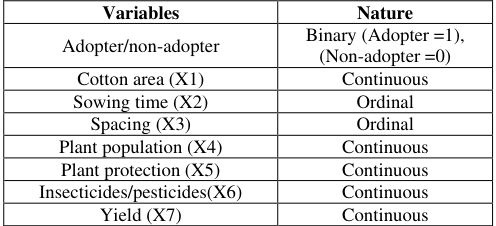 Table 1
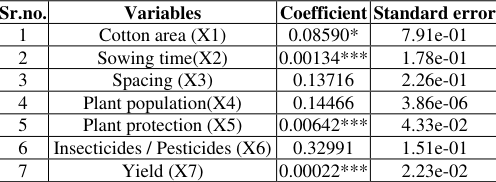 Table 2
Introduction
The CROPSAP scheme was started in year 2009-10 in the Maharashtra state with aim provide to farmer for advisory of pest surveillance of cotton crops. The State Agriculture Department Maharashtra is the CROPSAP "crop pest surveillance and advisory project" implementation authority with the funding through RKVY of Central Government till 2012 followed by Government of Maharashtra from 2013 till date. Nearly 44000 villages across 348 talukas of 34 districts from 8 division of Maharashtra are being covered under this programme by Nand Sagar et al., (2022) [10] . We may have clear picture of the nature and working of CROPSAP by knowing. Project modality: Software was developed and implemented for data feeding, interpretation, report generation, GIS based pest mapping and advisory dissemination by Ahire and Kharde, (2013) [1] , mote and sonanse (2012) [9] . Cotton (Gossypium spp.) the 'white gold' and 'king of fiber', (Reddy et al, 2011) [23] . 'Queen of fibers' is multipurpose crop grown in various agro-climatic conditions (Munjunath et al., (2013) [18] . Cotton is one of the most important commercial crops cultivated in India and accounts for around 25% of the total global cotton production. It plays a major role in sustaining the livelihood of an estimated 6 million cotton farmers and 40-50 million. producing countries are namely China, India, U.S.A., Pakistan, Brazil, Uzbekistan, Australia, Turkey, Turkmenistan and Syria, which totally account for 93.2 million bales of cotton production. India got 1st place in the world in cotton acreage with 120.69 lakh ha under cotton cultivation i.e. around 36 percent of the world area of 333 lakh ha around 67 percent of India's cotton is grown on irrigated area. In terms of productivity, India is on 38th rank with yield of 510 kg/ha. Gujrat is the largest producer of cotton in India. cotton is one of the most important fiber crops and cash crops in India. the top ten cotton producing state of India are as follows: Gujrat, Maharashtra, Telangana, Andhra Pradesh, Madhya Pradesh, Karnataka, Haryana, Rajasthan, Panjab, Odisha by Ministry of Textiles (COCPC, 2021). Maharashtra has the highest area and production of cotton in the country. It has 3.953 million hectares area under cotton crop with production of 1.21 million metric tons in the year 2021-2022. The productivity of cotton is 336 kg/ha seed cotton yield (national average 568 kg/ha). The major cotton growing districts are namely, Aurangabad, Jalana, Beed, Parbhani, Nanded, Hingoli, Latur, in Marathwada region (10 per cernt) while Akola, Amaravati, Buldhana, Chandrapur, Dhule, Jalgaon, Nagpur, Wardha, and Yavatamal, in Vidarbha region (25 percent) by Shrey and Kamble (2014) [13] . The Parbhani district 1.99 lakh ha production 3.98 lakh bale and productivity 339 kg lint /ha (Anonymous, 2020) [2] . In this said study to access the impact of CROPSAP scheme by cotton growers very few researches was available on this topic of research. www.extensionjournal.com
Methodology
In Parbhani district 5 tahsil was selected Parbhani, Jintur, Manavat, Pathari, Gangakhed. and each tahsil 4 village was selected and each village 4 adopter and 4 non-adopter cotton growers was selected in each village the same categories was used by Kaviraju et al., (2018) [21] total sample size of CROPSAP adopter was 80 and non-adopter was 80. Total number of cotton growers was 160 were selected for present study. The same methodology was used by the collection of data Jyothsna priyadarshabi et al., (2022) [8] , Nand Sagar et al., (2022) [10] , Shrey and Kamble (2014) [16] Venkatachalam et al., (2013) [25] . The impact of said collected to study scheme was studied by using probit regression model.
Probit Regression Model
The probit regression model is fitted to access the impact of CROPSAP scheme on beneficiary and non-beneficiary cotton growers. Probit model is a way to perform regression for binary outcome variable with two possibilities like adopters and non-adopters of cotton growers. this model was used by P. Sadashivappa (2012) [12] , Cappellari and Jenkins (2003) [4] , Fikiru et, al., (2017) [6] . The probit regression equation explained above takes the following form, Where, Y = Dependent variable X = Independent variable μi = Error term β = Coefficient of regression Yield (X7) 0.00022*** 2.23e-02 Note: *** significant at 1 percent, ** significant at 5 percent, * significant at 10 percent
Results and Discussion
Results and Discussion
Impact of CROPSAP scheme on cotton growers
The findings of the present study is depicted in table 1. Estimate the Impact of CROPSAP scheme on cotton growers to analyzed by a probit regression model. where some factors viz. X1, X2, X3, X4, X5, X6 are used to describe Sowing time, Spacing, Plant population, Plant protection Practices recommended by CROPSAP scheme, Insecticides and Pesticides and Yield this variable can be used to analyze the impact respectively. This factor are responsible for increasing the attitudes of farmers towards adoption of CROPSAP scheme. The adoption of the CROPSAP scheme show the positive impact on beneficiary cotton grower from the table 2 where X1 (Cotton area), X2 (Sowing time), X5 (Plant protection by CROPSAP sche me) and X7 (Yield) were highly significant effect of CROPSAP scheme on beneficiary cotton grower. X5 (plant protection practices by CROPSAP scheme) X2 (Sowing time) and X7 (Yield) significant at 10 percent and X1 (Cotton area) significant at 1 percent. similar findings have been reported by Tejpara et al., (2018) [24] . The result indicate that the sowing time, plant protection practices recommended by 'Crop pest surveillance and advisory project (CROPSAP)'scheme helps to increasing the level of yield and it helps to increase in area of cotton cultivation.
| Sr.no. | Variables | Coefficient | Standard error |
|---|---|---|---|
| 1 | Cotton area (X1) | 0.08590* | 7.91e-01 |
| 2 | Sowing time(X2) | 0.00134*** | 1.78e-01 |
| 3 | Spacing (X3) | 0.13716 | 2.26e-01 |
| 4 | Plant population(X4) | 0.14466 | 3.86e-06 |
| 5 | Plant protection (X5) | 0.00642*** | 4.33e-02 |
| 6 | Insecticides / Pesticides (X6) | 0.32991 | 1.51e-01 |
| 7 | Yield (X7) | 0.00022*** | 2.23e-02 |
Table text extracted from the original PDF; superscript letters are shown inline. The original table image is below.
View original table image
Conclusion
The said study was concluded that the CROPSAP scheme is responsible to get higher yield along with more monetary benefits to adopter rather than non-adopter. it is also noted that proper utilization of package practices under CROPSAP would be assured to enhance the attitude of cotton growers towards adoption of the prescribed scheme.
Policy Implication
The Government agencies, Research institutes NGOs, etc. has to take appropriate actions to emphasize awareness of CROPSAP scheme among villages to get more economic stability to farmers.
References
22 in the original paper- Ahire A, Kharde V. Innovative advisory through CROPSAP. Indian Research Journal of Extension Education. 2013;13(2):108-112.
- Choudhary B, Gaur K. Socio-economic and farm-level impact of Bt cotton in India: 2002 to 2010. The International Service for the Acquisition of Agribiotech Applications. New Delhi; c2011.
- Cappellari L, Jenkins SP. Multivariate probit regression using simulated maximum likelihood. Stata J. 2003;3(3):278-294.
- Fikiru Temesgen et al. Application of multivariate probit on determinants of sesame farmers' market outlet choices in Gimbi District, Ethiopia. African Journal of www.extensionjournal.com Agricultural Research. 2017;12(38):2830-2835.
- Gurdeep Singh, Pritpal Singh, Sodhi R, Ranvir Singh, Kulwant Singh. Impact of Cotton Development Programme on Adoption of Recommended Bt-Cotton Cultivation Practices. Indian Journal of Extension Education. 2022;58(2):149-152.
- Jyothsna, Priyadarshini, Sinha DK, Ahmed N, Singh KM. Economic Analysis of Cotton Production in Bhadradri Kothagudem District of Telangana. Biological Forum -An International Journal. 2022;14(1):1751-1756.
- Mote, Sonanse. Evaluation of CROPSAP for Soybean Crop in Nasik district. Journal of Agriculture Research Technology. 2012;38(1):102-106.
- Nand Sagar, Jakkawad, Deshmukh. Constraints Faced by Beneficiary Farmers in Crop Pest Surveillance and Advisory Project and Suggestions To Overcome The Constraints. The Pharma Innovation Journal. 2022;11(12):4177-4179.
- Kiresur, Manjunath Ichangi. Socio-Economic Impact of Cotton -A Case Study of Karnataka. Agricultural Economic Research Review. 2011;24:67-81.
- Khan, Akhtar. Cost-Benefit Analysis of Cotton Production and Processing by Stakeholder: the case of Multan and Bahawalpur region. African Journal of Scientific Research. 2011;13:131-141.
- Kamble, Navadkar, Yadav. Impact Assessment of Adopted Cotton Production Technology and Constraints in Marathwada Region of Maharashtra State. Gujarat Journal Extension Education. 2017;Special Issue on National Seminar.
- Kathpalia, Jatesh, Chander, Kumari, Vinod. Impact of Bt. Cotton and Non-Bt./DesiCotton Growing on SocioEconomic Status of Farmers in Bhiwani District. Indian Journal of Health and Well-being. 2018;9(6):869-871.
- Khuda Baksh. Economic and Environmental Impacts of Bt: Evidence from Pakistan. SANDEE working research paper, WP 79-13, Khathmandu, Nepal. 2013.
- Kamble, Navadkar, Yadav. Impact Assessment of Adopted Cotton Production Technology and Constraints in Marathwada Region of Maharashtra State. Gujarat Journal of Extension Education. 2017;Special Issue on National Seminar, April, 2017.
- Murthy C, Kerur BP, Kulkarni V. Impact of Minimum Support Price Scheme for Cotton and Maize in North Karnataka. International Journal of Agricultural. 2015;8(2):153-161.
- Manjunath, Dhananjaya Swamy, Jamkhandi BR, Nadoni NN. Resource Use Efficiency of Bt Cotton and Non-Bt Cotton in Haveri District of Karnataka. International Journal of Agricultural and Food Technology. 2013;4(3):253-258.
- More, Shende. Resource Productivity and Resource Use Efficiency in Cotton Production Investigation. The Pharma Innovation Journal. 2021;10(6):124-126.
- Mote, Sananse. Evaluation of CROPSAP for Soybean Crops in Nasik district. Journal of Agriculture Research Technology. 2012;38(1):102-106.
- Kaviraju, Dinesh Kumar, Nahar Singh, Sanjay Kumar. A Comparative Study on Socio-Economic Impact of Bt cotton and Non-Bt cotton Farm Households in Warangal District of Telangana State, India. International Journal of Current Microbiology and Applied Sciences. 2018;7(5):1561-1567.
- Prakash Sadashivappa. The Socio-Economic Impacts of Bt Cotton Adoption in India: Evidence From Panel Data. Agril. Bio.Forum. 2015;18(2):193-208.
- Reddy, Tirapamma, Gurava Reddy K. Socio-Economic Impact of Bt Cotton in Andhra Pradesh, India: A Comparative Study. International Journal of Plant, Animal and Environmental Sciences. 2011;1(1):22314490.
- Venkatachalam, Hansra MJ, Chandre, Gowda, Ramasubramaniam. Studied An Analysis of SocioEconomic Impact of Bt Cotton Cultivation in India. Indian Journal of Extension Education. 2013;49(3):2427.
Cited by 2
From OpenAlex, OpenCitations and reference lists read by Scinovex
- Advancing Agricultural Sustainability through Cow-Based Organic Liquid Fertilizers: A Systematic Review ↗
Sneha Kagale, A. V. Narayan · Compost Science & Utilization · 2025
Organic fertilizers are gaining increasing attention due to their potential to enhance agricultural yields and promote sustainability in farming. This highlights the importance of understanding the characteristics of cow-based liquid fertilizers, particularly their impact on soil fertility and chemistry, while also exploring modern, environmentally friendly methods for reusing livestock waste to enhance farm profitability. However, there is a lack of…
❝ 1 - Impact assessment of BBF technology adoption in soybean production using probit regression
Rivaldy Aditya, Chavan RV, Kamble SH, Shelke RD, Pawar AA · International Journal of Research in Agronomy · 2025
This study assesses the impact of the Broad Bed and Furrow (BBF) system on soybean farming in Latur, Maharashtra. Originally developed by ICRISAT for vertisols and tested for eight years in Medak, the BBF method proved effective in improving drainage, reducing soil erosion, and enhancing yields, which led to its widespread adoption across Marathwada’s rainfed regions with strong support from Vasantrao Naik Marathwada Krishi Vidyapeeth (VNMKV), Parbhani. Soybean, often referred to as a