
Research article · 2024 · Full text
International Journal of Veterinary Sciences and Animal HusbandryPostpartum reproductive health monitoring via hormonal and uterine involution investigations in Mehsana buffalo
Volume 9(1) · Pages 307–310 · DOI: 10.22271/veterinary.2024.v9.i1e.912 ↗
Research areasGenetic and phenotypic traits in livestockReproductive Physiology in LivestockEffects of Environmental Stressors on Livestock
Abstract
Author-writtenThis study was undertaken on 26 Mehsana buffaloes maintained at Livestock Research Station, S.D.A.U., Sardarkrushinagar, Gujarat (India). These buffaloes were monitored for their post-partum reproductive performance through per-rectal examination and pregnancy was confirmed at day 60 after natural service. Buffaloes were grouped retrospectively on the basis of fertile estrus in to, Group I (Buffaloes conceiving before 90 days) and Group II (Buffaloes conceiving after 90 days). Blood samples were collected on the day of calving, 10th, 20th and 30th day postpartum. The mean plasma progesterone (ng/ml) ranged between 0.18±0.01 to 0.31±0.02 in Group I and 0.24±0.01 to 0.48±0.02 in Group II with significantly (p
Summary
Source-checkedPlain-language reading of the full paper, prepared with AI and checked against the text. Each point links to the authors' own words.
Why it matters
- Buffaloes are vital to India's agricultural economy, serving as primary sources of milk and meat in tropical and sub-tropical regions. View evidence ↗
- Uterine infections after calving can harm reproductive performance by increasing the time between calving and first service and lowering conception rates. View evidence ↗
- Thyroid hormone activity is essential for maintaining productivity in domestic animals and serves as an indicator of their nutritional and metabolic health. View evidence ↗
The question
- The study aimed to investigate the hormonal profiles of progesterone, tri-iodothyronine (T3), and thyroxine (T4), as well as gross uterine involution in Mehsana buffaloes during the postpartum period. View evidence ↗
What they did
- The research was conducted using 26 Mehsana buffaloes at the Livestock Research Station, S.D.A.U., in Gujarat, India. View evidence ↗
- Blood samples were collected from the external jugular vein on the day of calving and on the 10th, 20th, and 30th days postpartum. View evidence ↗
- Plasma levels of progesterone, T3, and T4 were measured using commercially available ELISA kits. View evidence ↗
- Gross uterine involution was monitored via per-rectal examination, with completion defined as the return of the uterus and cervix to their normal size, tone, and location. View evidence ↗
- Animals were retrospectively divided into Group I (conceived before 90 days postpartum) and Group II (conceived after 90 days postpartum). View evidence ↗
What they found
- Group I buffaloes had significantly lower mean plasma progesterone levels (0.18±0.01 to 0.31±0.02 ng/ml) compared to Group II (0.24±0.01 to 0.48±0.02 ng/ml). View evidence ↗
- On day 20 postpartum, Group I buffaloes showed significantly higher levels of T3 (1.23±0.55 to 2.30±0.68 ng/ml) and T4 (42.67±3.64 to 57.92±4.43 nmol/L) than Group II (T3: 1.02±0.15 to 1.74±0.15 ng/ml; T4: 40.48±2.40 to 44.07±2.69 nmol/L). View evidence ↗
- Gross uterine involution occurred at 28.20±1.10 days for Group I and 29.80±0.20 days for Group II, with no significant difference between the two groups. View evidence ↗
- There was a significant reducing trend in cervical diameter from the 15th to the 30th day postpartum within both groups. View evidence ↗
- Both gravid and non-gravid uterine horn diameters showed a significant reducing trend from the 15th to the 30th day postpartum. View evidence ↗
What it means
- The authors concluded that Group I buffaloes had significantly lower progesterone levels than Group II throughout the postpartum period. View evidence ↗
- The authors concluded that the overall mean for gross uterine involution was 29.00±1.30 days across both groups, characterized by a significant reduction in the diameter of the uterine horn and cervix. View evidence ↗
Visual summary
1 visualsIllustrations explain the paper; they do not show study data.
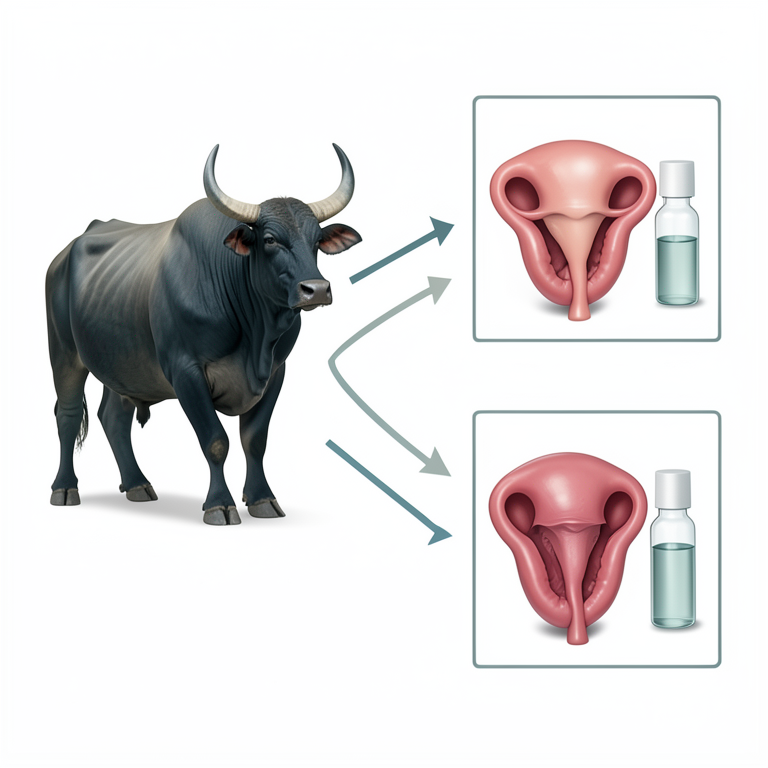
Study Grouping Logic
AI-generated conceptual illustration (Mehsana buffaloes). It explains the idea and does not show study data.
View source evidence ↗Figures & tables
From the original paper Table 1
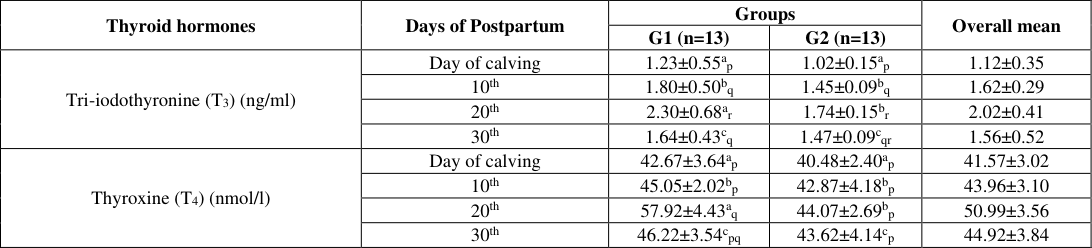 Table 2
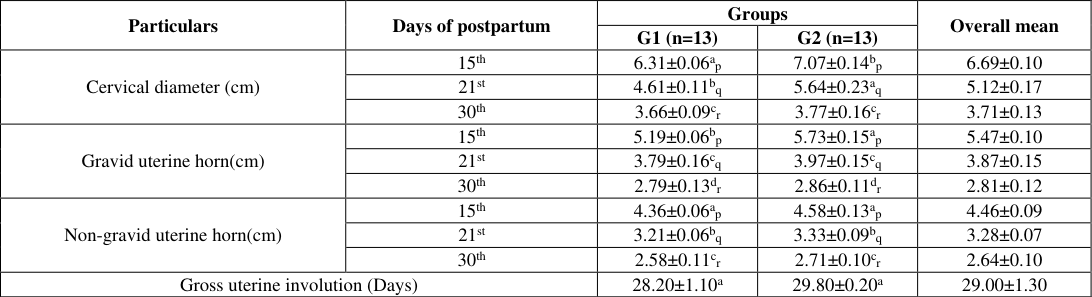 Table 3
Introduction
The Buffaloes are used as a source of milk and meat largely in tropical and sub-tropical countries and occupy an important place in the agricultural economy of India. Reproductive performance of dairy cows after the voluntary wait period is highly related to the health status of the uterus after calving (Ferguson et al., 2000) [5] . Postpartum uterine infection has a negative effect on reproductive performance as it increases the calving to first service interval and decreases the conception rate (Fourichon et al., 2000) [6] . The changes in blood constituents can reflect the physiological condition as well as nutritional and health status of cows. Appropriate thyroid gland function and activity of thyroid hormones (TH) are considered crucial to sustain the productive performance in domestic animals and circulating TH can be considered as indicators of the metabolic and nutritional status of the animals (Todini et al., 2007) [18] . Following parturition, Involution of the uterus to its normal nonpregnant size and physiological function is a normal phenomenon in mammals. Several investigators have studied the phenomenon of uterine involution in post-partum buffaloes. Some investigators reported shorter periods (< 35 days) required for completion of involutiona and others reported longer periods (> 40 days) in the buffaloes (Nakhashi, 2006; Basem et al., 2017; Vala et al., 2018) [12,2,19] . From economical point of view these changes should occur earlier after calving, because of any delay in the completion of uterine involution, reestablishment of ovarian and estrous activities decreases the reproductive efficiency of animal by prolonging subsequent calving interval. Therefore, keeping these facts in view, the study on hormonal profile of Tri-iodothyronine (T 3 ), Thyroxine (T 4 ), Progesterone (P4) and gross uterine involution during postpartum period in Mehsana buffaloes conducted.
Materials and Methods
Livestock Research Station, SDAU. Sardarkrushinagar is located in north Gujarat. The average minimum and maximum ambient temperature and relative humidity of the zone ranged from 17.95 °C and 32.25 °C and 48.5% and 73% respectively, during the period of study. All the buffaloes were maintained in well ventilated hygienic sheds and were fed green fodder, hay and compounded concentrate, as per standard feeding schedule followed on the farm. These buffaloes had free access to drinking water. Every Mehsana buffalo was vaccinated according to schedule and had frequent deworming treatments with broad spectrum anthelminthic medications before and after the monsoon. A total of 26 advanced pregnant Mehsana buffaloes irrespective of parity and body weight with a history of normal calving were selected for the study. Blood samples were collected from all the buffaloes on the day of calving, 10 th , 20 th and 30 th day postpartum by puncturing external jugular vein in heparinized vials, centrifuged at 3000 rpm for 10 minutes. The plasma samples were stored at -20 °C till analyzed for hormonal assay. The progesterone in blood plasma was estimated by using commercially available enzyme linked immune-sorbent assay (ELISA) kits manufactured by DBC diagnostics Biochem Canada Inc, Canada. The Triiodothyronine (T3) and Thyroxine (T 4 ) in blood plasma was estimated by using commercially available enzyme linked immune-sorbent assay (ELISA) kits manufactured by Labor Diagnostics Nord GmbH & Co. KG, Germany. The progress of gross uterine involution was felt through per-rectal examination. Uterus and cervix were considered completely involuted when they returned to their normal size, tone and location in pelvic cavity. Measurements were taken by using palm and a centimeter scale following transrectal palpation of the reproductive tract and the findings were recorded as diameter of cervix (cm), gravid horn (cm) and non-gravid horn (cm). Buffaloes were grouped retrospectively on the basis of first fertile estrous as Buffaloes which conceived before 90 days post-partum (Group-I) Buffaloes which conceived after 90 days post-partum (Group-II). The data obtained from research work were analyzed statistically using't-test' as per standard statistical procedure. (Snedecor and Cochran., 1994) [16] .
Hormonal Profile Progesterone
The mean plasma progesterone (ng/ml) level ranged between 0.18±0.01 to 0.31±0.02 in Group I and 0.24±0.01 to 0.48±0.02 in Group II. The level was found to be significantly (p<0.05) lower at 20 th day postpartum within the groups as compared to that of the other days except with a nonsignificant difference between 20 th day and on day of calving in group I buffaloes. It indicated that the plasma P4 concentration remained low (less than 1 ng/ml) up to day 30 th post-partum in both the group. Similarly a very low or negligible level of progesterone have been reported during postpartum period in buffaloes (Patil et al. (2013) [13] . The statistical analysis showed significant (p<0.05) lower progesterone levels in Group I as compared to Group II at all the days of postpartum. These findings nearly agreed with the Dhami et al. (2012) [3] who reported that value of the control group buffaloes was non-significantly lower than that of the retained fetal membrane groups. Whereas, Dolatkhah et al. (2013) [4] reported that the P4 concentration had no significant differences between healthy and endometritic postpartum dairy cows. Lower P4 levels observed in the group I may be due to earlier post-partum period (up to 30 th day) of the study which gets the support of Kalasariya et al. (2017) [9] in buffaloes.
Tri-iodothyronine (T3)
The mean plasma tri-iodothyronine (ng/ml) level ranged between 1.23±0.55 to 2.30±0.68 in Group I and 1.02±0.15 to 1.74±0.15 in Group II with an increasing trend from day of calving to 20 th day postpartum. These findings are in agreement with the reports of Stojic et al. (2001) [17] in Murrah buffaloe. The T 3 levels were significantly (p<0.05) lower at day 20 th in Group II as compared to Group I buffaloes which is in agreement with the lower concentrations of T 3 in non-conceiving as compared conceiving buffaloes (Ghuman et al., 2011) [7] , lower reproductive performance with decrease in T 3 in postpartum in lactating cows (Nahed Saleh et al., 2011) [11] . Variations in the T 3 levels have been attributed to food, environment and especially temperature influence, significant breed differences for thyroid status, Lower T 3 due to negative energy balance and due to high metabolic demands during peak milk production in buffaloes.
Thyroxine (T4)
The mean plasma thyroxine (nmol/L) level ranged between 42.67±3.64 to 57.92±4.43 in Group I and 40.48±2.40 to 44.07±2.69 in Group II with an increasing trend from day of calving to 20 th day postpartum. Similar to the present study, range of T 4 have been observed in dairy cows at parturition and five days after parturition (Kasagic et al., 2011) [10] . The T 4 levels were significantly (p<0.05) lower at day 20 in group II as compared to Group I buffaloes which is in accordance with, lower concentrations of T 4 in non-conceiving as compared conceiving buffaloes (Ghuman et al., 2011) [7] , lower reproductive performance with decrease in T 4 in postpartum lactating cows (Nahed Saleh et al., 2011) [11] and non-significant differences between cyclic and acyclic Sahiwal cow at 50 and 60 days postpartum (Sarfraj Ali et al., 2012) [14] . Variations in the T 4 levels have been attributed to food, environment and especially temperature influence, significant breed differences in thyroid status in cows, Lower T 4 due to negative energy balance and due to high metabolic demands during peak milk production in cows.
Gross Uterine Involution
Per-rectal Observations: Per-rectally, the reduction in diameter of uterine horn and cervix, location of genitalia and gradual increase in tonicity of genitalia was considered to know the gross uterine involution. On 15 th day postpartum, both the uterine horns and cervix were palpated. Out of 26 buffaloes of both the groups, the genitalia of 18 (69.23%) buffaloes were at pelvic floor within the pelvic cavity while eight (30.76%) buffaloes had uterine horns hanging at pelvic brim. However, these eight buffaloes regained intrapelvic position of genitalia on and before 21 th day postpartum. The increasing perceptibility in terms of tonicity, elasticity and curling of horns was observed from 15 th to 21 st day postpartum and it further continued to be better at 30 th day postpartum progressing towards that of the normal genitalia in both the groups. The mean gross uterine involution was found to be occurred non-significantly at 28.20±1.10 days in group-I and at 29.80±0.20 days in group-II buffaloes (Table 2). These findings are in close agreement with those of Khasatiya (2003) [20] in Surti buffaloes and Nakhashi (2006) [12] in Mehsana buffaloes. The overall mean gross uterine involution was found to occur at 29.00±1.30 days postpartum in the present study which is in close agreement with the findings in buffaloes (Amer et al. 2010) [1] . Variations in days of gross uterine involution observed by different workers could be attributed to the breed of animals, effect of suckling or nonsuckling, season of calving, nutritional status and endocrine balance.
| Thyroid hormones | Days of Postpartum | Groups | — | Overall mean |
|---|---|---|---|---|
| G1 (n=13) | G2 (n=13) | |||
| Tri-iodothyronine (T3) (ng/ml) | Day of calving | 1.23±0.55a p | 1.02±0.15a p | 1.12±0.35 |
| 10th | 1.80±0.50b q | 1.45±0.09b q | 1.62±0.29 | |
| 20th | 2.30±0.68a r | 1.74±0.15b r | 2.02±0.41 | |
| 30th | 1.64±0.43c q | 1.47±0.09c qr | 1.56±0.52 | |
| Thyroxine (T4) (nmol/l) | Day of calving | 42.67±3.64a p | 40.48±2.40a p | 41.57±3.02 |
| 10th | 45.05±2.02b p | 42.87±4.18b p | 43.96±3.10 | |
| 20th | 57.92±4.43a q | 44.07±2.69b p | 50.99±3.56 | |
| 30th | 46.22±3.54c pq | 43.62±4.14c p | 44.92±3.84 |
Table text extracted from the original PDF; superscript letters are shown inline. The original table image is below.
View original table image
Cervical Diameter
The cervical diameter (cm) was measured to be 6.31±0.06, 4.61±0.11 and 3.66±0.09 in Group I and 7.07±0.14, 5.64±0.23 and 3.77±0.16 in Group II buffaloes at days 15 th , 21 st and 30 th postpartum, respectively. The statistical analysis revealed a significant (p<0.05) reducing trend in the diameter of the cervix from 15 th to 30 th day postpartum within the groups which agreed well with the reports in buffaloes (Nakhashi, 2006) [12] and in cows (Jadhav, 2005) [8] .
Uterine Horn Diameter (Gravid and Non Gravid)
The gravid uterine horn diameter (cm) was measured to be 5.19±0.06, 3.79±0.16 and 2.79±0.13 in Group I and 5.73±0.15, 3.97±0.15 and 2.86±0.11 in group II buffaloes at days 15 th , 21 st and 30 th postpartum, respectively. The nongravid uterine horn diameter (cm) was measured to be 4.36±0.06, 3.21±0.06 and 2.58±0.11 in Group I and 4.58±0.13, 3.33±0.09 and 2.71±0.10 in Group II buffaloes on 15 th , 21 st and 30 th day postpartum, respectively. A significant (p<0.05) reducing trend in the diameter of the gravid and non-gravid uterine horn from 15 th to 30 day postpartum within the groups corroborates well with the reports in buffaloes (Nakhashi, 2006) [12] and in dairy cows Saut et al., (2011) [15] .
Conclusion
The study concluded that the statistical analysis showed significant (p<0.05) lower progesterone levels in Group I as compared to Group II at all the days of postpartum. Triiodothyronine (ng/ml) and Thyroxine (nmol/L) were lower in these buffaloes up to 30 days, with a significantly lower level at the 20 th day postpartum. It may be due to earlier postpartum period (up to 30 th day) of the study and the overall mean gross uterine involution was found to occur at 29.00±1.30 days postpartum in both groups, with a significant reducing trend in the diameter of the cervix and uterine horn.
Acknowledgement
AcknowledgementWe thank Livestock Research Station and college of veterinary science and animal husbandry SDAU, Sardarkrushinagar for providing necessary facilities for successful completion of research work.
Figures and tables from the paper
| Days of Postpartum | Groups | — | Overall mean |
|---|---|---|---|
| G1 (n=13) | G2 (n=13) | ||
| Day of calving | 0.20±0.01a p | 0.30±0.04b p | 0.25±0.02 |
| 10th | 0.31±0.02b q | 0.45±0.02a q | 0.37±0.02 |
| 20th | 0.18±0.01a p | 0.24±0.01b r | 0.21±0.01 |
| 30th | 0.29±0.02b q | 0.48±0.02a q | 0.38±0.01 |
Table text extracted from the original PDF; superscript letters are shown inline. The original table image is below.
View original table image
| Particulars | Days of postpartum | Groups | — | Overall mean |
|---|---|---|---|---|
| G1 (n=13) | G2 (n=13) | |||
| Cervical diameter (cm) | 15th | 6.31±0.06a p | 7.07±0.14b p | 6.69±0.10 |
| 21st | 4.61±0.11b q | 5.64±0.23a q | 5.12±0.17 | |
| 30th | 3.66±0.09c r | 3.77±0.16c r | 3.71±0.13 | |
| Gravid uterine horn(cm) | 15th | 5.19±0.06b p | 5.73±0.15a p | 5.47±0.10 |
| 21st | 3.79±0.16c q | 3.97±0.15c q | 3.87±0.15 | |
| 30th | 2.79±0.13d r | 2.86±0.11d r | 2.81±0.12 | |
| Non-gravid uterine horn(cm) | 15th | 4.36±0.06a p | 4.58±0.13a p | 4.46±0.09 |
| 21st | 3.21±0.06b q | 3.33±0.09b q | 3.28±0.07 | |
| 30th | 2.58±0.11c r | 2.71±0.10c r | 2.64±0.10 | |
| Gross uterine involution (Days) | 28.20±1.10a | 29.80±0.20a | 29.00±1.30 |
Table text extracted from the original PDF; superscript letters are shown inline. The original table image is below.
View original table image
References
14 in the original paper- Amer HA, Zeid ANZ, Barakat TM. Endometrial cytology and bacteriological isolates from buffaloes with retained fetal membranes and their effects on the reproductive efficiency. Journal of American Science. 2010;6(11):115121.
- BGad A, Kandiel MMM, El-Azab AI, Sosa GAM, Essawy SAA. Ultrasonographic Monitoring of Uterine Involution in Postpartum Buffalo Cows. Journal of Advanced Veterinary Research. 2017;7(4):93-99.
- Dolatkhah B, Mahdavi AH, Rahmani HR, Edriss MA, Khorvash M. Cytologic and histologic characteristics of endometritis in postpartum dairy cows. Annals of Biological Research. 2013;4(4):70-76.
- Ferguson JD, Galligan DT. Assessment of reproductive efficiency in dairy herds. Compend Contin Ed Prac Vet. 2000;22:S150-S158.
- Fourichon C, Seegers H, Malher X. Effect of disease on reproduction in the dairy cow: A meta-analysis. Theriogenology. 2000;53:1729-1759.
- Ghuman SP, Singh SJ, Honparkhe M, Ahuja CS, Dhami DS, Nazirand G, et al. Differential Fertility in Dairy Buffalo: Role of Thyroid and Blood Plasma Biochemical Milieu. Iranian Journal of Applied Animal Science. 2011;1(2):105-109.
- Kalasariya RM, Dhami AJ, Hadiya KK, Borkhatariya DN, Patel JA. Effect of peripartum nutritional management on plasma profile of steroid hormones, metabolites and postpartum fertility in buffaloes, Veterinary World. 2017;10(3):302-310.
- Kasagic D, Biljana R, Gvozdi D, Mirilovi M, Matarugi D. Endocrine and metabolic profile in holstein and red holstein heifers during peripartal period. Acta Veterinaria (Beograd). 2011;61:555-565.
- Saleh N, Mahmud E, Waded E. Interactions between insulin like growth factor 1, thyroid hormones and blood energy metabolites in cattle with postpartum inactive ovaries. Nature and Science. 2011;9(5):56-63.
- Saut JPE, Oliveira RSBR, Martins CFG, Moura ARF, Tsuruta SA, Nasciutti NR, et al. Clinical observations of postpartum uterine involution in crossbred dairy cows. Uberlândia. 2011;17(1):16-25.
- Stojic V, Gvozdic D, Kirovski D, Judith NA, Huszenicza GY, Samanc H, et al. Serum Thyronine and Triiodothyronine concentrations prior to and after delivery in primiparous Holstein cows. Acta Veterinaria (Beograd). 2001;51(1):3-8. (C.f.ABA. 69: 5795).
- Todini L, Malfatti A, Valbonesi A, Trabalza-Marinucci M, Debenedetti A. Plasma total T3 and T 4 concentrations in goats at different physiological stages, as affected by the energy intake. Small Ruminant Research. 2007;68:285-290.
- Vala KB, Kavani FS, Raval RJ, Tank PH. Evaluation of Uterine Involution by Rectal Palpation and Ultrasonography in Peripartum Nutritional Supplemented Jaffarabadi Buffaloes. Int. J Curr. Microbiol. App. Sci. 2018;7(6):1955-1963.
- Chaudhary JK, Khasatiya CT, Parmar SC, Patel RV, Patel MD. Serum progesterone and oestradiol-17β profile in norgestomet primed postpartum silent estrus surti buffaloes. Wayamba J Anim. Sci., Article. 2015(1427620266):1095-1103.