
Research article · 2024 · Full text
International Journal of Veterinary Sciences and Animal HusbandryCommon salt supplemented with mineral mixture provides rapid symptomatic relief in pica-affected camels
Volume 9(1) · Pages 395–398 · DOI: 10.22271/veterinary.2024.v9.i1f.894 ↗
Research areasTherapeutic Uses of Natural ElementsMyofascial pain diagnosis and treatment
Abstract
Author-writtenThe proposed study was carried out at an organized camel herd at NRCC, Bikaner. Initially, the incidence study was carried out among 44 camels. Based on clinical observation 21 camels were shown signs of pica. Among them 11.36% were shown osteophagia; 4.55% geophagia and 4.55% lithophagia; 9.09% coprophagia; 4.55% lignophagia and whereas 13.64% eat more than one objectionable object. After that 18 severely pica-affected camels were selected and divided into 3 groups to evaluate the responsiveness of treatment, mineral mixture (group A) and mineral mixture common salt (group B) with untreated control group (group C) camels. The silica content of fecal material and Mean bite per hour decreased significantly post-treatment in both treated groups (Group-A and B) compare to pre-treatment. Body weight was found to increase post-treatment in both treated groups (Group-A and Group-B) compare to pre-treatment. The results indicated that the mineral supplementation alone or in combination with common salt is beneficial for the treatment of pica. However additional salt supplementation was observed over mineral supplementation and found better results.
Summary
Source-checkedPlain-language reading of the full paper, prepared with AI and checked against the text. Each point links to the authors' own words.
Why it matters
- Pica is a condition characterized by an abnormal appetite where animals eat non-food, inanimate objects. View evidence ↗
- Pica can lead to serious health complications, including intestinal obstruction, perforation from sharp objects, and parasitic infections. View evidence ↗
- While not always fatal, pica causes economic losses for owners due to reduced animal productivity and inability to work. View evidence ↗
The question
- The study aimed to evaluate how pica-affected camels respond to treatment with a mineral mixture alone versus a combination of a mineral mixture and common salt. View evidence ↗
What they did
- The feeding trial involved 18 male camels divided into three groups of six animals each. View evidence ↗
- The presence of soil in feces was measured by analyzing acid insoluble ash (AIA) containing sand and silica after heating samples in a muffle furnace. View evidence ↗
- Researchers measured the frequency of pica behavior by recording the number of bites per hour of non-food items during eight-hour daytime observations. View evidence ↗
What they found
- In an initial incidence study of 44 male camels aged 2-4, 47.73% (21 camels) were found to be suffering from pica. View evidence ↗
- Among pica-affected camels, the most common behaviors were eating more than one object (13.64%) and osteophagia (11.36%), followed by coprophagia (9.09%), geophagia (4.55%), lithophagia (4.55%), and lignophagia (4.55%). View evidence ↗
- Group A showed an average 79% reduction in bites per hour of abnormal materials, decreasing from a mean of 21.67 to 4.5. View evidence ↗
- Group B showed an average 81% reduction in bites per hour of abnormal materials, decreasing from a mean of 22 to 4.17. View evidence ↗
- The untreated control group experienced a 12% increase in bites per hour of abnormal materials, rising from a mean of 14.83 to 16.58. View evidence ↗
What it means
- The authors conclude that while mineral supplementation is beneficial, adding common salt to the mineral mixture provides better results for treating pica in camels. View evidence ↗
Visual summary
2 visualsIllustrations explain the paper; charts are replotted from the paper's own table values.
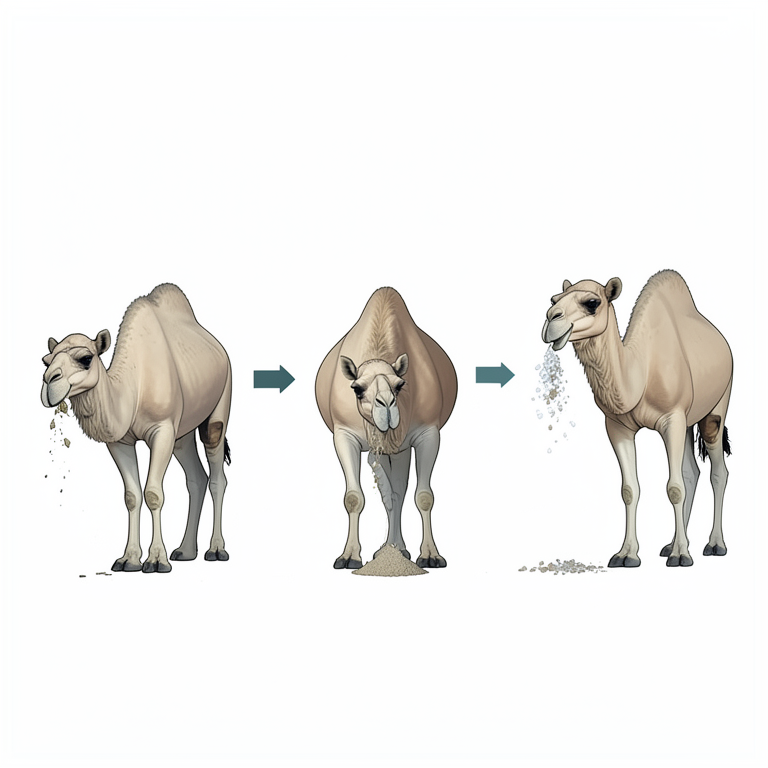
Treatment Group Comparison
AI-generated conceptual illustration (Dromedary camels). It explains the idea and does not show study data.
View source evidence ↗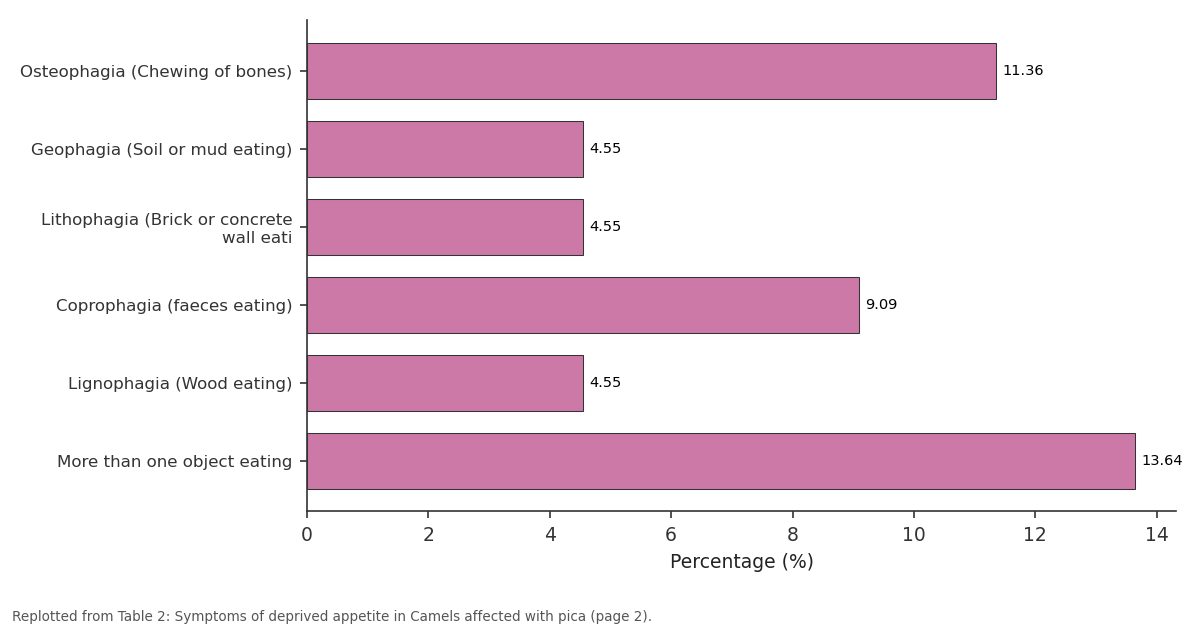
Percentage (%): Osteophagia (Chewing of... vs Geophagia (Soil or mud... vs Lithophagia (Brick or... vs Coprophagia (faeces... vs Lignophagia (Wood...
Replotted from Table 2 (page 2) of the original paper. Every bar is the paper's own table value.
View source evidence ↗Figures & tables
From the original paper Table 1
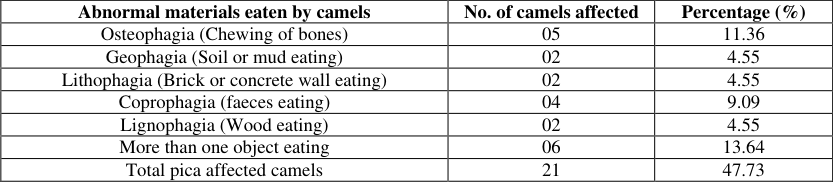 Table 2
 Table 3
 Table 4
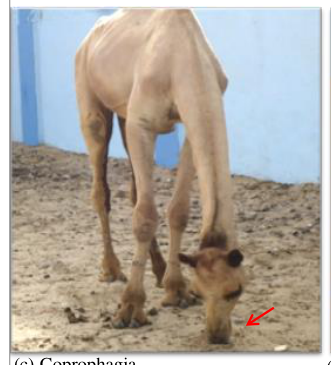 Figure 1
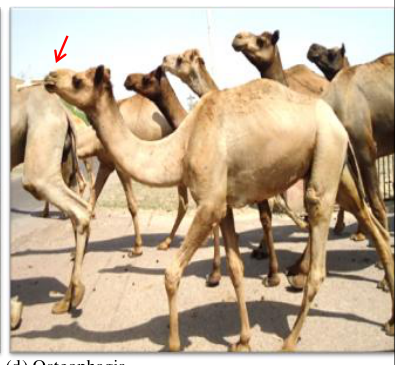 Figure 1
 Table 5
Introduction
Camel is the most suitable mammal for use in extreme climatic conditions [1,2] . The people most closely associated with the camel in Rajasthan belong to the Raika community and in Gujarat are Maldars. These camel keepers have developed their own ways to treat diseases in camels, based on beliefs, traditional knowledge, skills, methods, and practices. Camel farming is mainly both the organized (Tola keepers) and unorganized (One to few animal keepers) farmers do not follow any scientific feeding plan and only the available feeds are being offered to the camels. Pica is a depraved or abnormal appetite. It is usually associated with animals that chew/eat inanimate objects which are usually not considered feedstuffs. This behavior can be classified according to the types of material involved are the chewing of bones (Osteophagia), eating of stones (Lithophagia), eating of soil or sand (Geophagia), chewing and eating of wood (Lignophagia), hair (Trichophagia), paper (Papyrophagia), glass (Hyalophagia), faeces (Coprophagia), metal (Metallophagia), urine (Urophagia). Pica has potential side effects that most commonly affect the intestine and bowel. Complications can include constipation, cramping, pain, obstruction, perforation from sharp objects like rocks or gravel, contamination, and infection from soil-dwelling parasites, diarrhea, and colic [3][4][5] . Survey work on ethno-veterinary practices revealed that farmers provide common salts to camels if they develop symptoms of pica. Moreover, camel herders of Gujarat state revealed that Kharai camels living near sea do not develop symptoms of pica, whereas Kachhi camels living in the desert develop symptoms of pica. Local farmers knowledge explains, this is due to the high salt intake of Kharai camels either by browsing on salty bushes (Halophytes) growing near the sea and also due to intake of salty sea water. According to camel pastoralists salt is required to have better health and fertility of camels [6] . Though these ailments are not always fatal but indirectly economical losses are incurred due to reduced production. The inability to work or death of the animal results in severe monetary loss, which shatters the socio-economic status of camel owner. Since the incidence of pica in camels is increasing year by year and there do not appear to be satisfactory therapeutic and or preventive approaches, resulting in loss of productivity. Recently an incidence of pica as high as 51.66 percent has been recorded in camels [7,8] .
Materials and Methods
Recording of all the 18 camels was further carried out to know the bites per hour for eating non-food items. Each animal was observed for eight hours during day time, in the camel corrals. Animals number, age, sex, breed, approximate body weight, and abnormal behaviour of all these camels were recorded while taking these observations. A detailed history of previous illness, feeding practice management and physical examination for associated signs and symptoms of rough hair coat, anaemia, weakness etc. was recorded for every pica-affected camel. In the Feeding trial experiment, all the selected 18 male camels were divided into three groups comprising six animals in each group. In this trial six animals of group-A were fed with a specially designed mineral mixture daily at the rate of 30 gram per animal per day mixed with fodder for two months, six animals of group-B were fed mineral mixture 30 grams + 20 gram common salt per animal per day mixed with fodder for two months, whereas six animals of group-C were fed with same basal fodder for two months. Faecal qualitative examination was conducted to record the gastrointestinal parasitic infections in camel population on the basis of the presence/absence of eggs/cysts/oocysts in the faeces by using centrifugal floatation and sedimentation techniques [9] . Soil pass out in faeces was examined by ash in the inorganic residue left after ignition of a faecal sample in the muffle furnace at 550-600 °C for 2-3 hours. The residue left after dissolving the inorganic portion of total ash represented acid insoluble ash (AIA), the majority containing sand and silica [10] .
Results and Discussion
Incidence of pica with clinical symptoms in the particular age group camels Observations of the total 44 male camels in the age group of 2-4 revealed that a total of 21 (47.73%) camels were suffering from pica. Common clinical symptoms observed were osteophagia (11.36%) followed by geophagia (4.55%), lithophagia (4.55%), coprophagia (9.09%) lignophagia (4.55%) and more than one object (13.64%) in the camels (Table . 1), depending upon the availability of the particular objects in the vicinity of the animals. In the present study, the health status of the camels was recorded in a particular herd. Number of cases with poor health status was higher in the pica affected camels compared to camels not revealing symptoms of pica. General weakness was observed by thinness of the hump. Other observed symptoms were roughness of the hair coat, anaemia and emaciation. Common symptoms of weakness, roughness of the hair coat and emaciation in camels affected in pica has also been reported by Gautam and Bansal (1972) [11] , Kachhawaha et al. (2013) [12] and Koted (2019) [8] . Parsani et al. (2008) mentioned pica a clinical sign in parasitic diseases [13] . The camel with heavy helminth infection shows anorexia, loss of body weight, loss of body condition, rough hair coat, anaemia, oedematous swellings of lower body parts and pica. We also observed symptoms of deprived appetite in Camels affected with pica (Table 2 and Figure 1). Geophagia 'mitti khana' in camel affected with pica has been reported by Gautam and Bansal (1972) [11] , Sharma and Satija (1974) [14] , Sahmat (2008) [15] and Koted (2019) [7] . Osteophagia in camels has also been observed by Schwartz and Dioli (1992) [16] , Shamat (2008) [15] and Koted (2019) [7] in case of pica.
| Abnormal materials eaten by camels | No. of camels affected | Percentage (%) |
|---|---|---|
| Osteophagia (Chewing of bones) | 05 | 11.36 |
| Geophagia (Soil or mud eating) | 02 | 4.55 |
| Lithophagia (Brick or concrete wall eating) | 02 | 4.55 |
| Coprophagia (faeces eating) | 04 | 9.09 |
| Lignophagia (Wood eating) | 02 | 4.55 |
| More than one object eating | 06 | 13.64 |
| Total pica affected camels | 21 | 47.73 |
Table text extracted from the original PDF; superscript letters are shown inline. The original table image is below.
View original table image
Coprophagia and Lithophagia in camels has been reported by Koted (2019) [7] . Oesophageal obstruction in camels due to nonfeed items has been reported by Ramadan and Abdin-Bey (1990) [17] . Additionally, on faecal examination of the 21 pica affected camels revealed that none of the camel was affected with heavy parasitic load. Whereas parasitic infestations were recorded in four camels, these were identified as Trichuris (2), Nematodirus (1) and Strongyle (1) by eggs morphology. Since no heavy parasitic infestation was recorded, therefore no special deworming was under taken.
Efficacy of treatment for pica in camels
There was reduction in bite per hour for eating non-food items in the treated groups-A (79%) and B (81%). Significant difference was recorded with the mineral mixture supplementation and salt supplementation before and after the treatment trail in the present study (Table 3). Non supplementations lead to increase in bite per hour for nonfood items. For achieving 100 per cent efficacy with mineral mixture supplementation either period of supplementation may be prolonged or the daily dose of supplementation may be increased. The pica affected camels were feeding with specially designed mineral mixture at the rate of 50 gm per day per animal for two months was found satisfactory improving in terms of relieving the camels from symptoms of pica. In feeding treatment trail experiment, significant decrease in mean bite per hour recorded in both treated group A and B on day 60 compared to day 0 of the treatment (Table 4). There was increase in the body weight of all the three study groups including the control group. This increase was marginal higher in the treated groups compared to control group (Table 5). Previously, Koted (2019) also reported that feeding specially designed mineral mixture at the rate of 50 gm per day per animal for two months was found satisfactory in improving in terms of relieving the camels from symptoms of pica [7] .
| Groups | No. of camels eating abnormal things | — | 0th day (Pre-treatment) | — | 60th day (Post-treatment) | — |
|---|---|---|---|---|---|---|
| Before treatment | After 60 days of treatment | Mean Bite/ hour | Range | Mean bite/hour | Range | |
| Treated group - A | 6 | Average 79 per cent reduction in bite/hour to abnormal materials in all the 6/6 camels. | 21.67a±2.40 | 32 - 12 | 4.5b±0.88 | 8 - 0 |
| Treated group -B | 6 | Average 81 per cent reduction in bite/hour to abnormal materials in all the 6/6 camels | 22a±3.28 | 23 - 17 | 4.17b±2.86 | 8 - 0 |
| Untreated control group - C | 6 | Average 12 per cent increase in bite/hour to abnormal materials in all the 6/6 camels | 14.83±2.93 | 17 - 6 | 16.58±1.44 | 22 - 9 |
Table text extracted from the original PDF; superscript letters are shown inline. The original table image is below.
View original table image
| Parameter | Group- A (Mineral mixture feeding) | — | Group- B (Mineral Mixture + Salt feeding) | — | Group C (Untreated controls) | — |
|---|---|---|---|---|---|---|
| 0 day | 60 day | 0 day | 60 day | 0 day | 60 day | |
| Silica content (%) | 7.37a±1.86 | 2.15bB±0.39 | 8.20a±1.17 | 1.45bB±0.34 | 6.80±0.55 | 6.50A±1.03 |
| Range | 3 -14 | 1 - 3 | 5 - 13 | 1 - 3 | 3 - 8 | 3 - 11 |
| Total Ash content (%) | 10.54a±1.76 | 6.31bB±0.62 | 11.46a±1.21 | 6.23bB±0.83 | 10.2±0.63 | 10.41A±0.99 |
| Range | 6 -17 | 4 - 8 | 8 -16 | 4 -10 | 5 -13 | 7-14 |
Table text extracted from the original PDF; superscript letters are shown inline. The original table image is below.
View original table image
Conclusion
Common clinical symptoms in pica affected camels observed were osteophagia followed by geophagia, lithophagia, coprophagia and lignophagia. Associated signs in pica affected camels commonly observed were general weakness, thinness of the hump, roughness of the hair coat, anaemia and emaciation. The silica content of faecal material and Mean bite per hours were decreased significantly post treatment in both treated groups (Group-A and B) compare to pretreatment. Body weight was found increase post treatment in both treated groups (Group-A and Group-B) compare to pretreatment. Based on clinical signs and symptoms effect of additional salt supplementation with mineral supplementation in the pica affected camels was found better.
Acknowledgement
AcknowledgementsA part of this study belongs to MVSc thesis work of MK Dhaka.
Figures and tables from the paper
| Symptoms | No of pica affected camels (n=21) | Percentage (%) | No of pica healthy camels (n=23) | Percentage (%) |
|---|---|---|---|---|
| Weakness | 11 | 52.38 | 4 | 17.39 |
| Rough hair coat | 03 | 14.29 | 01 | 4.34 |
| Anaemia | 02 | 9.52 | 0 | 0 |
| Emaciation | 02 | 9.52 | 01 | 4.34 |
| Note:-n= number of study animals. |
Table text extracted from the original PDF; superscript letters are shown inline. The original table image is below.
View original table image
References
8 in the original paper- Bertone J, Traub-Dargatz J, Wrigley R, Bennett D, Williams R. Diarrhea associated with sand in the gastrointestinal tract of horses. J Am Vet Med Assoc. 1988;193:1409-1412.
- Husted L, Andersen M, Borggaard O, Houe H, Olsen S. Risk factors for faecal sand excretion in Icelandic horses. Equine Vet J. 2005;37:351-355.
- Firyal S. Pica (Depraved appetite; allotrophagia) in domestic animals and man. Pak Vet J. 2007;27:208.
- Soulsby E. Helminths. Arthropods and Protozoa of domesticated animals. 1982, 291.
- Gautam P, Bansal S. Save your camel from pica-'Mini Khana'. Indian Farming. 1972, 21.
- Kachhawah S, Chand K, Jangid B. Health problems and their management in camel herds of southern Rajasthan. J Camel Pract Res. 2013;20:113-120.
- Parsani H, Singh V, Momin R. Common parasitic diseases of camel. Vet World. 2008;1:317-318.
- Ramadan R, Abdin-Bey M. Obstruction of the oesophagus in camels. Indian Vet J. 1990;67:363-364.