
Research article · 2024 · Full text
International Journal of Agriculture Extension and Social DevelopmentStudy on Use of Social Networking Sites by Students in Selected Engineering Colleges in Tiruchirappalli
Volume 7(1) · Pages 278–282 · DOI: 10.33545/26180723.2024.v7.i1d.223 ↗
Research areasMobile Learning in EducationImpact of Technology on AdolescentsICT in Developing Communities
Abstract
Author-writtenThe present paper investigates the Use of Social Networking sites by students selected Engineering Colleges in Tiruchirappalli. Professional course of Engineering has Four Years during the periods and Interest in engineering careers in different fields of Engineering for today needs in the society. The Majority of the academician is using the social networks for Academic, Entertainment, sharing for information and communication. The analyzes has describes the Frequency of Access Social Networking Sites, Types of the Social Networking Sites, Time spent, Preference Place, Opinions, Purposes and Satisfaction level. The majority of the respondents are among the five institutions the mostly using the Indira Ganesan College of Engineering (21.99%), Male respondents are in the top most level (61.70%) followed by Female (38.30%), The types of the Social Networking Sites wise using the majority in Face book (27.66%), the Frequency is “Daily (37.59%), types of the Social Networking Sites are using Face book (27.66%) and Time spent on social networking sites of the respondents are more Less than 1 hour (45.39%) of the Engineering Students
Summary
Source-checkedPlain-language reading of the full paper, prepared with AI and checked against the text. Each point links to the authors' own words.
Why it matters
- The growth of SNS provides libraries with opportunities to offer innovative online services to an increasing number of users. View evidence ↗
The question
- The study aimed to investigate how students in selected engineering colleges in Tiruchirappalli use social networking sites. View evidence ↗
What they did
- The researchers distributed questionnaires to students across five selected engineering colleges in the Tiruchirappalli area, with a total of 200 questionnaires distributed. View evidence ↗
- The survey achieved a response rate of 70.50%, with 141 students responding to the questionnaires. View evidence ↗
- Data analysis was performed using Microsoft Excel to calculate percentages and conduct ANOVA tests. View evidence ↗
What they found
- Among the 141 respondents, males represented the majority at 61.70%, while females accounted for 38.30%. View evidence ↗
- The most common frequency of SNS usage was daily (37.59%), followed by twice a day (32.62%). View evidence ↗
- Facebook was the most used social networking site (27.66%), followed closely by Twitter (26.95%) and WhatsApp (23.40%). View evidence ↗
- The largest group of students spent less than 1 hour on social networking sites (45.39%). View evidence ↗
- A vast majority of respondents (91.49%) believe in using social networking sites for academic work. View evidence ↗
- The primary purpose for using SNS was academic work (35%), followed by communication (21%). View evidence ↗
- For academic activities, electronic mail was the most used tool (38.30%), followed by WhatsApp (30.50%). View evidence ↗
- Regarding academic use, 43.26% of respondents reported being highly satisfied, and 27.66% were satisfied. View evidence ↗
What it means
- The authors recommend implementing Information and Communication Technology to advance and improve learning activities in higher education. View evidence ↗
Visual summary
3 visualsIllustrations explain the paper; charts are replotted from the paper's own table values.

Purposes of SNS Usage
AI-generated conceptual illustration (Engineering students using smartphones and laptops). It explains the idea and does not show study data.
View source evidence ↗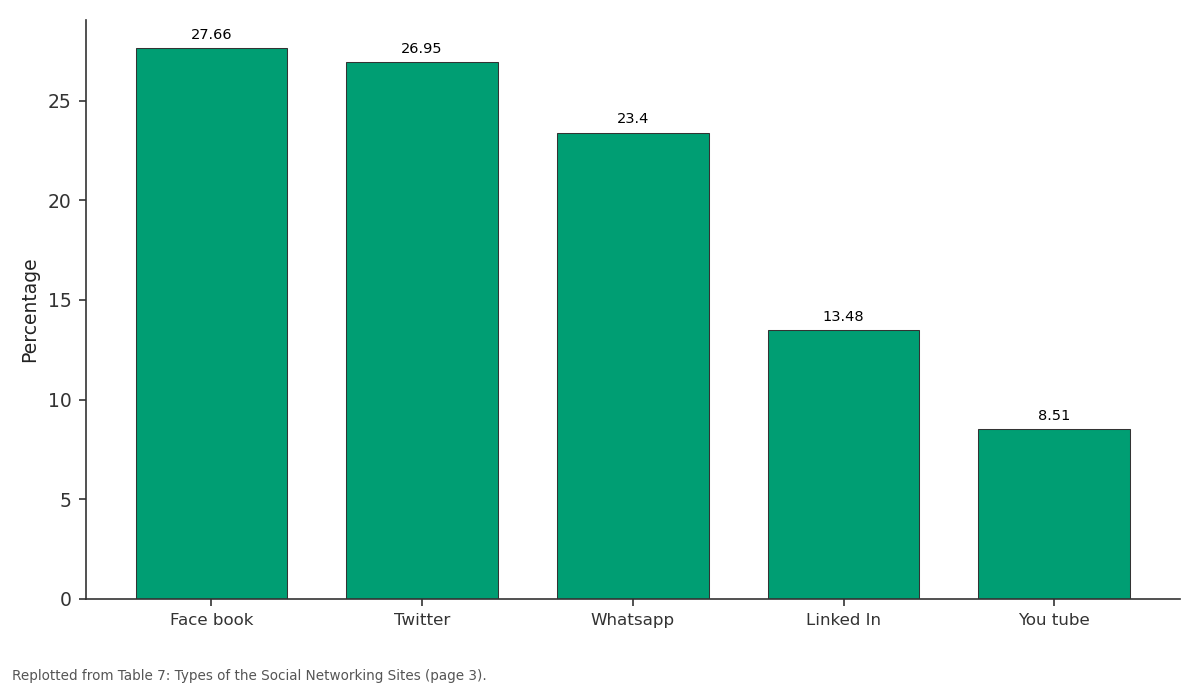
Percentage: Face book vs Twitter vs Whatsapp vs Linked In vs You tube
Replotted from Table 7 (page 3) of the original paper. Every bar is the paper's own table value.
View source evidence ↗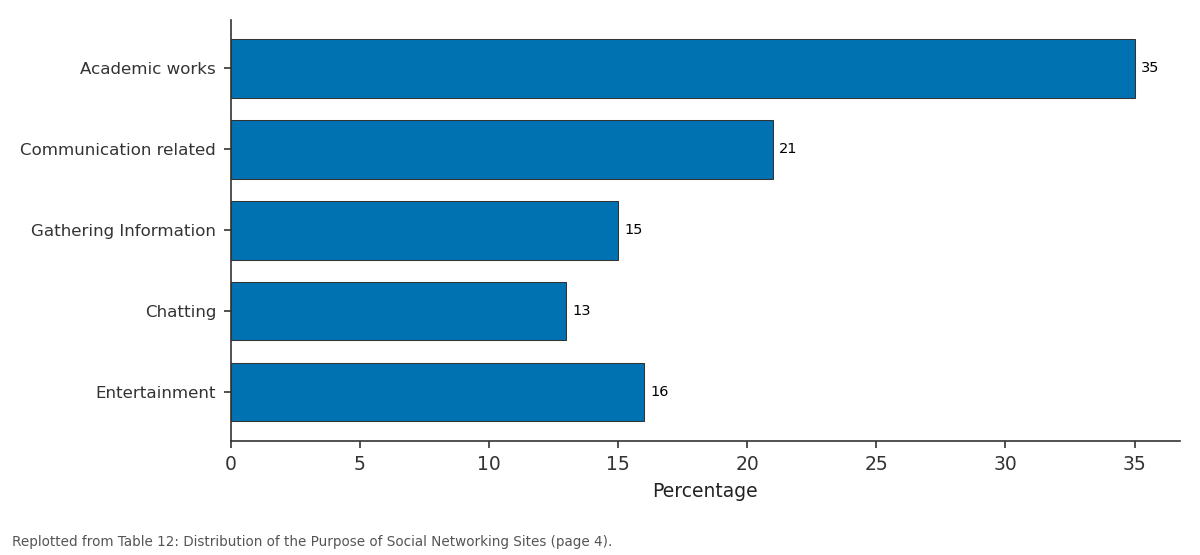
Percentage: Academic works vs Communication related vs Gathering Information vs Chatting vs Entertainment
Replotted from Table 12 (page 4) of the original paper. Every bar is the paper's own table value.
View source evidence ↗Figures & tables
From the original paper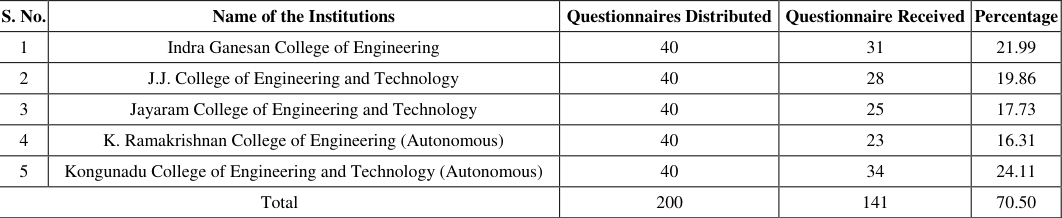 Table 1
 Table 2
 Table 3
 Table 4
 Table 5
 Table 7
 Table 8
 Table 9
 Table 10
 Table 11
 Table 12
 Table 13
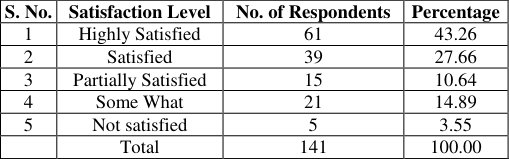 Table 14
Introduction
Currently, Social Networking Sites (SNS), also known as social networking software, have become very significant to the twenty-first century, and is projected to be "the future of online activity" (Stone; Brad). Projections of the future use of the Web indicate that most of Web users or prospective users will be engaged in social networking and belong to and use a social networking site. This means that libraries have the opportunity to utilize SNS in the online world in order to provide new and innovative online services for a growing online population. Social network sites (SNs) have been defined in a traditional sense as "web-based services that allow individuals to (1) construct a public or semipublic profile within a bounded system, (2) articulate a list of other users with whom they share a connection, and (3) view and traverse their list of connections and those made by others within the system" (Boyd & Ellison, 2007) [1] . Hailu and Wu (2021) [2] wrote an article "The Use of Academic Social Networking Sites in Scholarly Communication: Scoping Review." The study focused a geographic variation in what motivates academics to use ASNs to using the Scholar discovery and sharing are the literature. The analyses has a four main themes namely such as a motivation and uses, impact assessment, features and services, and scholarly big data. The analyses have an academics a better understanding and their weaknesses, and identifies gaps in the literature that are worth addressing in future investigations. The future study suggest an extend of existing theoretical framework and epistemological approaches to better predict and clarify the socio-technical dimensions of ASNs use in scholarly communication. Nilashi et al. (2019) [4] carried out a study "The impact of social networking sites on students' social wellbeing and academic performance." Analyzes for using the Malaysian University studying students usage of social networking sites to identify the influential factors and propose a new model based on several research hypotheses. To evaluate the hypotheses and verify the proposed model, a survey is conducted on the female students. The study focuses use Decision Making Trial and Evaluation Laboratory and statistical technique can find the casual relationships among the factors, their effect size and their importance levels. The results of the study revealed that there is positive relationship between social presence, students' social wellbeing and their academic performance. Napoleon, Egedegbe. (2013) [3] evaluate a study on "The Effect of Social Networking Sites on Students' Academic Performance in Girne American University, North Cyprus." SNS has offer people new and varied ways to communicate via the internet, whether through their mobile phone. Many social media sites are such as a MySpace, Face book, Skype etc. Usage has a simply create profile and contacts to friends and many persons to easy to communicate with your classmate, discuss class assignment and even submit project www.extensionjournal.com to your lecturer, watch videos, make comment on your friend page etc. Savitha and Geetha (2016) [5] explains an "Awareness and Use of Social Networking Sites by Engineering Students at New Horizon College of Engineering." The study to find out the frequency of use of social networking sites, time spent on using SNSs and purpose of using these sites for communication with friends and for entertainment instead of academic purposes. Har Singh and Anil Kumar (2013) [8] noted on "Use of social networking Sites (SNSs) by the research Scholars of Punjab University, Chandigarh: A Study' explored to study the activities and purposes for using SNSs by the scholars of Punjab University, Chandigarh. The findings of their study shows that majority of the respondents were found to be aware and making use of such applications in their research work. With this background, the following objectives were framed.
Methodology
The Questionnaires was well structured for using the students-based interview schedule the data about the using the social networking sites and using the gender, Frequency of Access, Frequency of Usage of Social Networking, Time spent. Preference place, purpose and satisfaction level of the engineering student's usage. The questionnaire was distributed to 200 questionnaires in engineering college studied students for selected engineering colleges surrounding area of Tiruchirappalli only. There are many Engineering colleges are available and selected five engineering colleges only in the area of the study. 141 questionnaires were responded in the survey and overall response rate is 70.50%. The statistical tools applied to the study for using the Microsoft Excel to calculate the percentage and ANOVA Test, Table including the study.
Analysis of Data
After collecting the data from the respondents, the data was analyzed accordingly to the objectives stated.
Distribution of questionnaire wise Respondents
Distribution of questionnaire wise Respondents
Gender wise Frequency of Access Social Networking Sites
Table 3 depicts the Gender wise Frequency of Access Social Networking Sites. Gender of Male, the majority of the respondents are frequency of access "Daily", 33(37.93%) followed by "Twice a day", 21 (24.14%), Weekly, 13 (14.94%), Monthly, 11 (12.64%) and rarely, 9 (10.34%). Gender of Female, the majority of the respondents are frequency of access "Daily", 21 (38.89%) followed by "Twice a day", 16 (29.63%), Weekly, 9 (16.67%), Monthly, 5 (9.26%) and rarely, 3 (5.56%). www.extensionjournal.com The one way ANOVA models are applied for the Table 4. The computer value 1.81 which is greater than its tabulated value 5.98 at 5 percent level of non-significance. Hence, the variations in using Gender wise statistically identified the Frequency of Access Social Networking Sites.
| Source of Variation | Sum of Squares | Degrees of Freedom | Mean of Squares | F-value |
|---|---|---|---|---|
| Between Groups | 55.125 | 1 | 55.125 | 1.819807 |
| Within Groups | 181.75 | 6 | 30.29167 | |
| Total | 236.875 | 7 |
Table text extracted from the original PDF; superscript letters are shown inline. The original table image is below.
View original table image
| S. No. | Frequency of Access | Male | — | Female | — |
|---|---|---|---|---|---|
| No. of Respondents | Percentage | No. of Respondents | Percentage | ||
| 1 | Daily | 33 | 37.93 | 21 | 38.89 |
| 2 | Twice a day | 21 | 24.14 | 16 | 29.63 |
| 3 | Weekly | 13 | 14.94 | 9 | 16.67 |
| 4 | Monthly | 11 | 12.64 | 5 | 9.26 |
| 5 | Rarely | 9 | 10.34 | 3 | 5.56 |
| Total | 87 | 61.70 | 54 | 38.30 |
Table text extracted from the original PDF; superscript letters are shown inline. The original table image is below.
View original table image
Frequency of Using Social Networking
Table 5 shows the Frequency of using Social Networking. The majority of the respondents are using "Daily", 53(37.59%) followed by Twice a day, 46(32.62%), Weekly, 21(14.89%), Monthly, 12(8.59%) and rarely, 9(6.38%).
| S. No. | Frequency of Usage of Social Networking | No. of Respondents | Percentage |
|---|---|---|---|
| 1 | Daily | 53 | 37.59 |
| 2 | Twice a day | 46 | 32.62 |
| 3 | Weekly | 21 | 14.89 |
| 4 | Monthly | 12 | 8.51 |
| 5 | Rarely | 9 | 6.38 |
| Total | 141 | 100.00 |
Table text extracted from the original PDF; superscript letters are shown inline. The original table image is below.
View original table image
Distribution of the Purpose of Social Networking Sites
Table 12 shows the distribution of the Purpose of Social Networking Sites. The majority of the respondents are using an "Academic works", 49 (35%), followed by communication related, 30(21%), Gathering Information, 22 (15%), Chatting, 18 (13%) and entertainment, 22 (16%). ). The Gender wise distribution of Respondents use of social networking sites male members are using the top most level (61.70%) followed by Female (38.30%). The types of the Social Networking Sites wise using the majority of the respondents are using "Face book", 39 (27.66%), twitter, 38 (26.95and so on. The majority of the respondents are Frequency of using Social Networking are "Daily", 53 (37.59%) followed by Twice a day, 46 (32.62%) and subsequently orders. Types of the Social Networking Sites are using "Face book", 39 (27.66%) are the majority and followed by others. Time spent on social networking sites of the respondents are more "Less than 1 hour", 64 (45.39%) next to 1-2 Hours, 37 (26.24%). Opinion for using Academic Works of the majority of the respondents are "Yes", 129(91.49%) and "no", 12 (8.51%). The majority of the respondents are using the purpose of Social Networking Sites "Academic works", 49 (35%), followed by communication related, 30(21%), Gathering Information, 22(15%), Chatting, 18(13%) and entertainment, 22(16%). Social Networking Sites tools for use an academic activity, 54(38.30%) are more, next to Whatsapp, 43 (30.50%) and so on. The sharing to Library based services Social Networking Sites usage of Male respondents, an access online resource, and 41 (29.08%) followed by to search library resources, 34 (24.11%), and so on. Female respondents are using the library based Social Networking Sites an Access online resource, 12 (22.22%) followed by to search library resources, 19(35.19%) and so on. The majority of the respondents are satisfaction level of using the academic purpose "Highly Satisfied" 61 (43.26%) next to "Satisfied", 39 (27.66%), "Partially Satisfied", 15(10.64%), "Some What", 21 (14.89%) and "Not Satisfied", 5(3.55%).
| S. No | Purpose of Social Networking Sites | No. of Respondents | Percentage |
|---|---|---|---|
| 1 | Academic works | 49 | 35.00 |
| 2 | Communication related | 30 | 21.00 |
| 3 | Gathering Information | 22 | 15.00 |
| 4 | Chatting | 18 | 13.00 |
| 5 | Entertainment | 22 | 16.00 |
| Total | 141 | 100.00 |
Table text extracted from the original PDF; superscript letters are shown inline. The original table image is below.
View original table image
Conclusion
Every day using the social networking sites are increasing and more number of used in the society. The society has using the academic activity, Entertainment, Communication and others. The Engineering education has a professional development of students studying period has learning and applied the techniques for evaluation of any engineering fields to developing the up-to-date for using the social networking sites. The majority of the respondents are using the academic activity for communication and learning purposes. The study recommends adding implementation of Information and Communication Technology for advancement of learning activities improving in the higher learning educations.
Figures and tables from the paper
| S. No. | Name of the Institutions | Questionnaires Distributed | Questionnaire Received | Percentage |
|---|---|---|---|---|
| 1 | Indra Ganesan College of Engineering | 40 | 31 | 21.99 |
| 2 | J.J. College of Engineering and Technology | 40 | 28 | 19.86 |
| 3 | Jayaram College of Engineering and Technology | 40 | 25 | 17.73 |
| 4 | K. Ramakrishnan College of Engineering (Autonomous) | 40 | 23 | 16.31 |
| 5 | Kongunadu College of Engineering and Technology (Autonomous) | 40 | 34 | 24.11 |
| Total | 200 | 141 | 70.50 |
Table text extracted from the original PDF; superscript letters are shown inline. The original table image is below.
View original table image
| S. No. | Gender | No. of Respondents | Percentage |
|---|---|---|---|
| 1 | Male | 87 | 61.70 |
| 2 | Female | 54 | 38.30 |
| Total | 141 | 100.00 |
Table text extracted from the original PDF; superscript letters are shown inline. The original table image is below.
View original table image
| S. No. | Types of the Social Networking Sites | No. of Respondents | Percentage |
|---|---|---|---|
| 1 | Face book | 39 | 27.66 |
| 2 | 38 | 26.95 | |
| 3 | 33 | 23.40 | |
| 4 | Linked In | 19 | 13.48 |
| 5 | You tube | 12 | 8.51 |
| Total | 141 | 100.00 |
Table text extracted from the original PDF; superscript letters are shown inline. The original table image is below.
View original table image
| S. No. | Time spend | No. of Respondents | Percentage |
|---|---|---|---|
| 1 | Less than 1 hour | 64 | 45.39 |
| 2 | 1-2 hours | 37 | 26.24 |
| 3 | 2-3 hours | 23 | 16.31 |
| 4 | More than 3 Hours | 17 | 12.06 |
| Total | 141 | 100.00 |
Table text extracted from the original PDF; superscript letters are shown inline. The original table image is below.
View original table image
| S. No. | Preference place using SNS | No. of Respondents | Percentage |
|---|---|---|---|
| 1 | Mobile Phone | 71 | 50.71 |
| 2 | Library | 29 | 20.71 |
| 3 | At home | 21 | 15.00 |
| 4 | Net Café Centre | 19 | 13.58 |
| Total | 141 | 100.00 |
Table text extracted from the original PDF; superscript letters are shown inline. The original table image is below.
View original table image
| S. No | Opinion for using Academic Works | No. of Respondents | Percentage |
|---|---|---|---|
| 1 | Yes | 129 | 91.49 |
| 2 | No | 12 | 8.51 |
| Total | 141 | 100.00 |
Table text extracted from the original PDF; superscript letters are shown inline. The original table image is below.
View original table image
| S. No. | Library based Social Networking Sites usage | Male | — | Female | — |
|---|---|---|---|---|---|
| No. of Respondents | Percentage | No. of Respondents | Percentage | ||
| 1 | Access online resources | 41 | 29.08 | 12 | 22.22 |
| 2 | To search library resources | 34 | 24.11 | 19 | 35.19 |
| 3 | Resources update | 19 | 13.48 | 5 | 9.26 |
| 4 | Sharing update information | 29 | 20.57 | 11 | 20.37 |
| 5 | Content based Social Networking | 18 | 12.77 | 7 | 12.96 |
| Total | 141 | 61.70 | 54 | 38.30 |
Table text extracted from the original PDF; superscript letters are shown inline. The original table image is below.
View original table image
| S. No. | Social Networking Sites Tools use of Academic activity | No. of Respondents | Percentage |
|---|---|---|---|
| 1 | Electronic mail | 54 | 38.30 |
| 2 | Whats App | 43 | 30.50 |
| 3 | You tube | 22 | 15.60 |
| 4 | Blogs | 17 | 12.06 |
| 5 | Wiki | 5 | 3.55 |
| Total | 141 | 100.00 |
Table text extracted from the original PDF; superscript letters are shown inline. The original table image is below.
View original table image
| S. No. | Satisfaction Level | No. of Respondents | Percentage |
|---|---|---|---|
| 1 | Highly Satisfied | 61 | 43.26 |
| 2 | Satisfied | 39 | 27.66 |
| 3 | Partially Satisfied | 15 | 10.64 |
| 4 | Some What | 21 | 14.89 |
| 5 | Not satisfied | 5 | 3.55 |
| Total | 141 | 100.00 |
Table text extracted from the original PDF; superscript letters are shown inline. The original table image is below.
View original table image
References
3 in the original paper- Boyd DM, Ellison NB. Social network sites: Definition, history, and scholarship. Journal of Computer-Mediated Communication. 2007;13(1):210-230
- Hailu M, Wu J. The Use of Academic Social Networking Sites in Scholarly Communication: Scoping Review. Data and Information Management. 2021;5(2):277-298. https://doi.org/10.2478/dim-20200050.
- Napoleon, Egedegbe. The Effect of Social Networking Sites on Students' Academic Performance in Girne American University, North Cyprus; c2013. http://ydemokrat.blogspot.com/2013/05/the-effect-ofsocial-networking-sites.html