
Research article · 2024 · Full text
International Journal of Advanced Biochemistry ResearchComparative evaluation of drying techniques and desiccants for enhancing drying quality of rose cv. gladiator
Volume 8(1S) · Pages 358–363 · DOI: 10.33545/26174693.2024.v8.i1sf.337 ↗
Research areasPlant Physiology and Cultivation StudiesFlowering Plant Growth and CultivationPowdery Mildew Fungal Diseases
Abstract
Author-writtenThe floriculture industry is experiencing rapid global expansion, driven by the immense potential for both domestic consumption and export of flowers. Among the cut flowers traded internationally roses hold a prominent position in terms of production and consumption. To capitalize on this demand and enhance farmers' income value addition has become crucial. In line with this objective a factorial experiment was conducted in 2020 using a completely randomized design. The experiment aimed to investigate the effects of different drying methods and desiccants on the sensory/quality parameters of roses during the drying and storage phases. The results revealed significant variations in the quality of dried roses based on the chosen drying methods and desiccants. Shade drying emerged as the superior method exhibiting favourable quality parameters such as bright colour, well-maintained shape, smooth petal texture and reduced mechanical damage during the drying process. During storage, shade-dried roses with sea sand demonstrated attributes of vibrant colour, smooth petals and minimal mechanical damage. However, sun-dried roses with silica gel exhibited well-preserved shape and showed fewer instances of pest and disease issues. Taking into consideration all aspects and the results obtained shade drying with sea sand proved to be the most effective approach for achieving desirable quality parameters during both the drying and storage stages.
Summary
Source-checkedPlain-language reading of the full paper, prepared with AI and checked against the text. Each point links to the authors' own words.
Why it matters
- Roses are among the most produced and consumed cut flowers in international trade. View evidence ↗
- The storage capacity of cut roses remains limited even when optimal chemicals are used to improve shelf and vase life. View evidence ↗
- Dry flower technology is used to increase the longevity and year-round availability of flowers. View evidence ↗
The question
- The study aimed to evaluate how different drying methods and desiccants affect the quality and sensory parameters of roses during drying and storage. View evidence ↗
What they did
- The research was conducted in 2020 at Junagadh Agricultural University in Gujarat using rose cv. Gladiator. View evidence ↗
- The study used a Factorial Completely Randomized Design with 12 treatment combinations and 3 replications. View evidence ↗
- The treatments consisted of two drying methods (sun and shade) and six desiccants: no desiccant, red river sand, black river sand, sea sand, silica gel, and borax powder. View evidence ↗
- Quality parameters including color, shape, mechanical damage, and pest/disease incidence were measured at 30, 45, 60, and 90 days after storage. View evidence ↗
What they found
- Shade drying with sea sand produced the most desirable flower color during the drying process. View evidence ↗
- Sun drying combined with borax powder resulted in unacceptable flower color during drying. View evidence ↗
- The most desirable flower shape during drying was achieved using shade drying with sea sand. View evidence ↗
- During the storage phase, sun drying with silica gel resulted in a very acceptable flower shape. View evidence ↗
- Shade drying with either sea sand or borax powder resulted in the least mechanical damage during the drying process. View evidence ↗
- The smoothest petal texture was observed in roses treated with shade drying and either sea sand or borax powder. View evidence ↗
- Sun drying with silica gel or without any desiccant showed the lowest incidence of pests and diseases during storage. View evidence ↗
- The highest incidence of pests and diseases during storage occurred in roses treated with shade drying and borax powder. View evidence ↗
What it means
- The authors conclude that shade drying with sea sand is the superior method for maintaining the quality and sensory parameters of rose cv. Gladiator. View evidence ↗
Visual summary
1 visualsIllustrations explain the paper; they do not show study data.
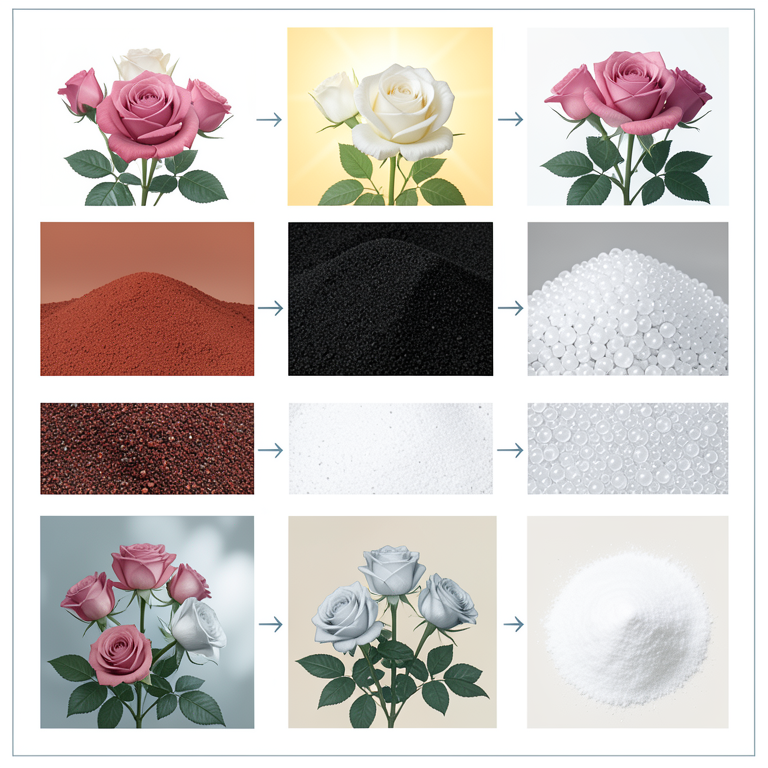
Experimental Treatment Matrix
AI-generated conceptual illustration (Rose cv. Gladiator flowers). It explains the idea and does not show study data.
View source evidence ↗Figures & tables
From the original paper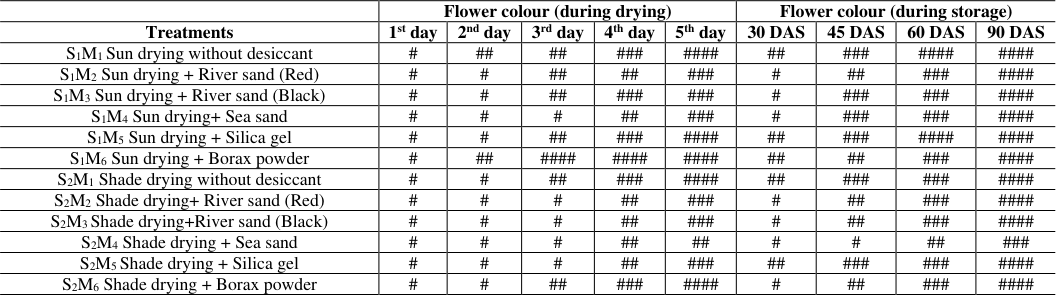 Table 1
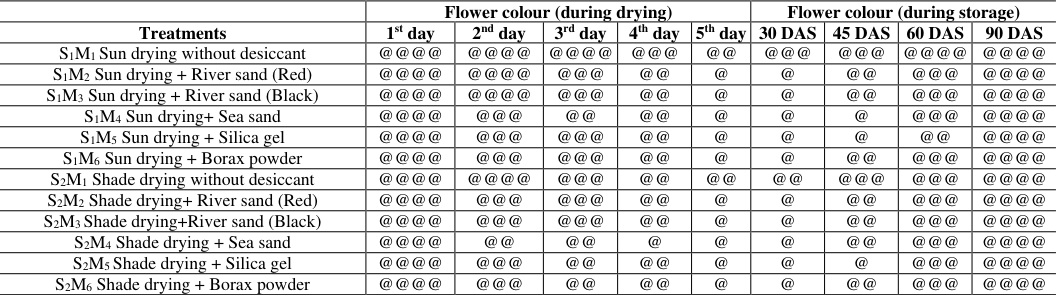 Table 2
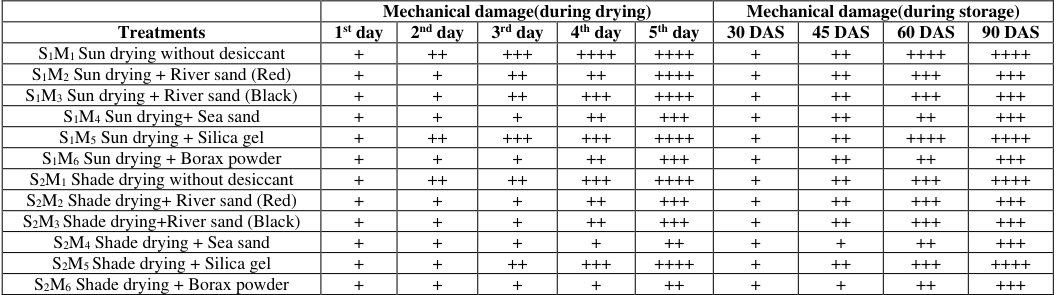 Table 3
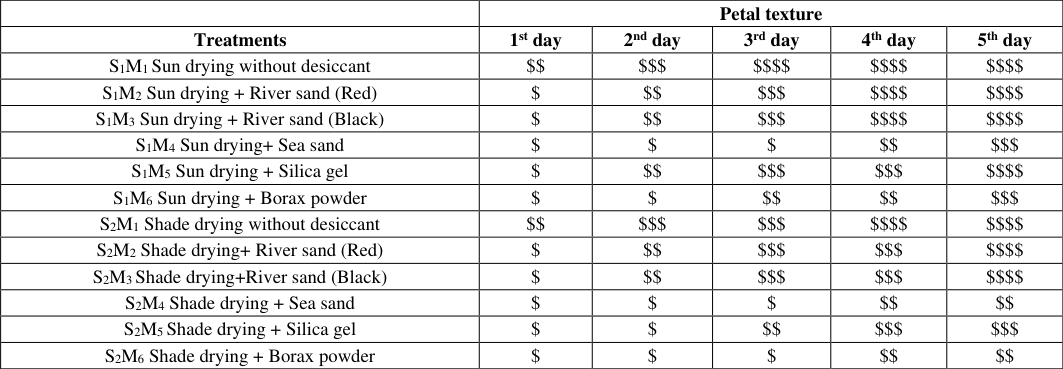 Table 4
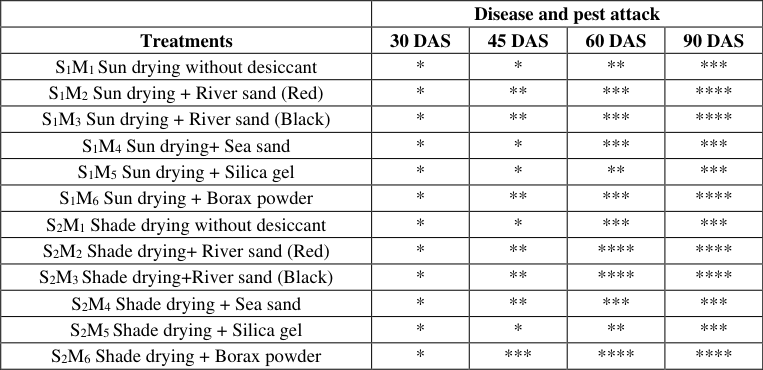 Table 5
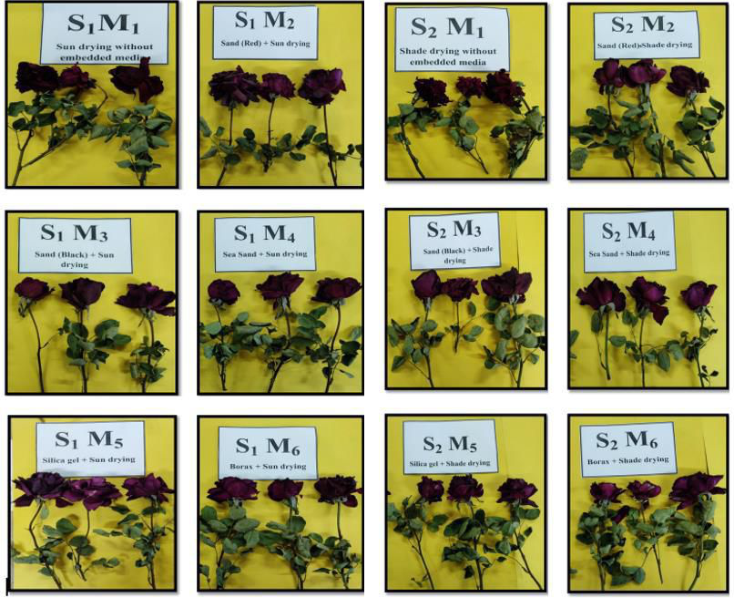 Figure 1
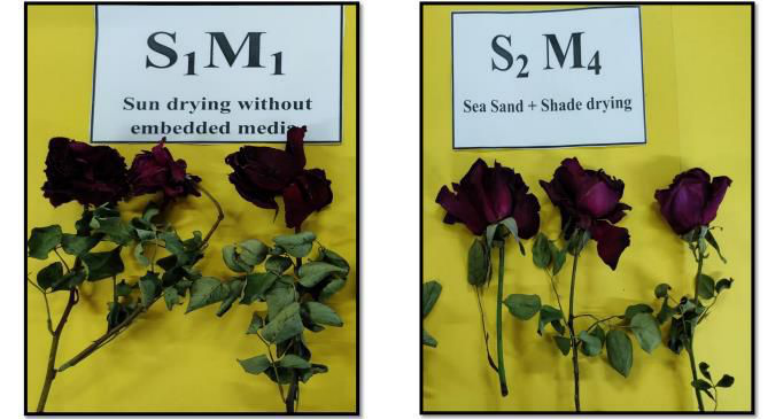 Figure 2
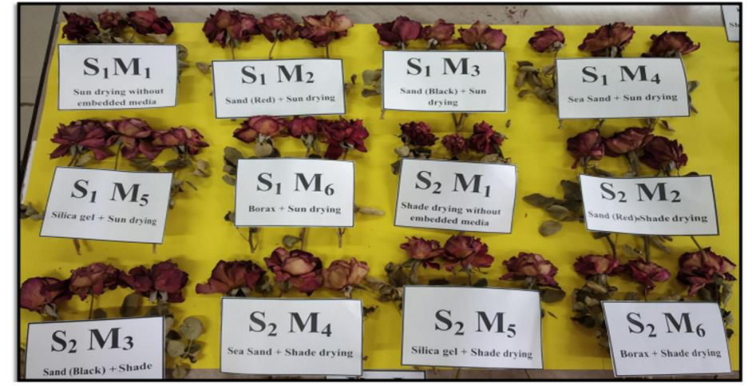 Figure 3
Introduction
The flourishing floriculture business calls for value addition to maximize the economic benefits of flowers. Among the highly produced and consumed cut flowers roses stand out as a prime choice in international trade. The rose is a popular and widely cultivated flower known for its beauty, fragrance and symbolic significance. It holds a prominent position in the floriculture industry and is highly sought after for various purposes including decoration, gifting and perfume production. Roses come in a wide range of colours, sizes, and petal shapes offering a diverse array of options for different preferences and occasions. With its global appeal, the rose continues to be a top-ranking cut flower in international trade both in terms of production and consumption. The versatility and market demand for roses make them a valuable asset for floriculture businesses and offer significant potential for value addition contributing to the growth and profitability of the industry. Despite the utilization of optimal chemicals to improve the shelf life and enhance the vase life of cut roses, their storage capacity remains limited. As a result, these flowers cannot be stored for extended periods of time. Besides, season of availability also causes serious problem regarding utilization (Dhatta et al., 2007) [2] . In order to increase the business potential and other ornamentals to the ultimate extent-alternative use and value addition are the choice of the day. For increasing the availability of flowers throughout the year in all the places as well as to increase the longevity of several flowers utilization of dry flower technology is one of the holistic approaches. Drying is a crucial process in the preservation of flowers as it enables their extended utilization for decorative purposes, fragrance production and other applications. However, improper drying methods can lead to significant quality degradation including loss of colour vibrancy, fragrance and overall aesthetic appeal. Therefore, it is essential to explore and assess different drying techniques and desiccants to identify the most effective approach for maintaining the drying quality of roses.
Materials and Methods
The purpose of this study was to investigate the impact of different drying methods and desiccants on the drying quality of rose cv. Gladiator during the year 2020 at Junagadh Agricultural University in Gujarat. The experiment was conducted using a Factorial Completely Randomized Design (FCRD) with 12 treatment combinations and 3 replications. Two drying methods, namely sun drying and shade drying were employed along with six desiccants: control (without desiccant), red river sand, black river sand, sea sand, silica gel and borax powder. To ensure uniformity, flowers were selected based on their size, shape, colour, and form. Only turgid flower that are of tight bud stage fresh flowers were chosen for the drying process. Upon arrival at the laboratory the flowers were sorted and any damaged, diseased or pest-infested flowers were removed. Stems of uniform size were selected and trimmed to the same length. Initial observations such as flower weight and diameter were recorded before embedding. The trays were filled with the required amount of desiccants filling them up to a height of 4-5 cm from the bottom. A wooden plank was used to level the surface of the desiccants. Each flower was then placed horizontally with its face downwards on the layer of desiccants. Carefully, desiccants were poured on top of the flowers ensuring they filled all gaps and crevices between the flowers without damaging their original petal shape. This method ensured that the entire flower was completely covered by the desiccants with an approximate depth of 2-3 cm above the flower. After embedding, the trays were placed according to the treatment combinations either under direct sunlight or in a shaded area for drying. Once the flowers were completely dried they were gently removed from the embedded desiccants to record necessary observations such as flower colour, shape, petal texture and mechanical damage. After five days of drying, the flowers were taken out from the desiccants and stored. During storage observation including colour, shape, mechanical damage and pest and disease incidence were recorded at 30, 45, 60 and 90 days after storage.
Results and Discussion
Figure 1, 2 and 3 debits the results obtained during drying and storage.
Flower colour during drying and storage
The results presented in Table 1 regarding the flower colour of rose clearly indicate that the most desirable colour was observed in (S 1 M 4 ) which corresponds to shade drying with sea sand. On the other hand, unacceptable flower colour was found in (S 1 M 6 ) representing sun drying with borax powder during the drying process. This can be attributed to the high temperature during sun drying which leads to a higher loss of carotenoids resulting in colour fading. When combined with borax powder this effect causes a bleaching effect on the flowers leading to dull and unacceptable flower colour. In contrast, flowers dried under shade with sea sand exhibited vibrant and acceptable colour demonstrating their superior quality. Similar observations regarding better colour retention through shade drying with sea sand were reported by Nataraja et al., (2004) [5] in annual statice, Meman (2006) [4] in miniature roses and gerbera and Khyati (2015) [3] in roses, gerbera, and gomphrena. Regarding storage (Table 1) it is evident that the flowers subjected to shade drying with sea sand (S 2 M 4 ) exhibited very acceptable colour during storage. Conversely, unacceptable flower colour was observed in (S 1 M 1 ) representing sun drying without desiccant and (S 1 M 5 ) representing sun drying with silica gel. This can be explained by the fact that the shadedried flowers with sea sand already showed acceptable and bright colour during the drying process which was maintained during storage for up to 45 days. However, in the treatment combinations of sun drying without desiccant and sun drying with silica gel the high temperature and increased degradation of carotenoid pigments led to the production of unacceptable flower colour. Red and dark pink rose flowers became even darker at 60 and 90 days after storage. Similar findings regarding better colour maintenance through shade drying with sea sand during storage were reported by Khyati (2015) [3] in roses, gerbera and gomphrena.
| — | Flower colour (during drying) | — | — | — | — | Flower colour (during storage) | — | — | — |
|---|---|---|---|---|---|---|---|---|---|
| Treatments | 1st day | 2nd day | 3rd day | 4th day | 5th day | 30 DAS | 45 DAS | 60 DAS | 90 DAS |
| S1M1 Sun drying without desiccant | # | ## | ## | ### | #### | ## | ### | #### | #### |
| S1M2 Sun drying + River sand (Red) | # | # | ## | ## | ### | # | ## | ### | #### |
| S1M3 Sun drying + River sand (Black) | # | # | ## | ### | ### | # | ### | ### | #### |
| S1M4 Sun drying+ Sea sand | # | # | # | ## | ### | # | ### | ### | #### |
| S1M5 Sun drying + Silica gel | # | # | ## | ### | #### | ## | ### | #### | #### |
| S1M6 Sun drying + Borax powder | # | ## | #### | #### | #### | ## | ## | ### | #### |
| S2M1 Shade drying without desiccant | # | # | ## | ### | #### | ## | ### | ### | #### |
| S2M2 Shade drying+ River sand (Red) | # | # | # | ## | ### | # | ## | ### | #### |
| S2M3 Shade drying+River sand (Black) | # | # | # | ## | ### | # | ## | ### | #### |
| S2M4 Shade drying + Sea sand | # | # | # | ## | ## | # | # | ## | ### |
| S2M5 Shade drying + Silica gel | # | # | # | ## | ### | ## | ### | ### | #### |
| S2M6 Shade drying + Borax powder | # | # | ## | ### | #### | # | ## | ### | #### |
Table text extracted from the original PDF; superscript letters are shown inline. The original table image is below.
View original table image
Flower shape during drying and storage
The results presented in Table 2 regarding the flower shape of rose clearly indicate that the most desirable shape was observed in (S 1 M 4 ) which corresponds to shade drying with sea sand. Conversely, unacceptable flower shape was found in (S 1 M 1 ) representing sun drying without a desiccant during the drying process. This can be attributed to the fact that shade-dried flowers experience less moisture loss and minimal cell shrinkage. When combined with sea sand which is smooth, heavy and easily flows into each layer of the flower the acceptable shape of the flowers is maintained during drying. In contrast, sun drying without desiccant leads to direct exposure of the flowers to high temperatures resulting in uneven cell shrinkage and no pressure from desiccants to hold the flowers in shape ultimately leading to distorted flower shape. Similar findings of well-maintained flower shape through shade drying with sea sand were reported by Meman (2006) [4] in miniature roses and gerbera. Regarding storage very acceptable flower shape was found in (S 1 M 5 ) representing sun drying with silica gel. Conversely, unacceptable flower shape was observed in (S 1 M 1 ) representing sun drying without a desiccant. This can be explained by the fact that flowers dried under the sun with silica gel experienced maximum moisture loss and attained a minimum moisture content during the drying process. Consequently, there were fewer chances of petal loosening during storage enabling them to maintain an acceptable shape for up to 45 days. Conversely, flowers dried under the sun and shade without a desiccant produced distorted flower shapes during storage. The direct exposure to high temperatures without any embedding desiccant resulted in petal brittleness causing the petals to separate from the flower after 45 days. These results are consistent with the findings of Chithira (2017) [1] in chrysanthemum var. Marigold.
| — | Flower colour (during drying) | — | — | — | — | Flower colour (during storage) | — | — | — |
|---|---|---|---|---|---|---|---|---|---|
| Treatments | 1st day | 2nd day | 3rd day | 4th day | 5th day | 30 DAS | 45 DAS | 60 DAS | 90 DAS |
| S1M1 Sun drying without desiccant | @@@@ | @@@@ | @@@@ | @@@ | @@ | @@@ | @@@ | @@@@ | @@@@ |
| S1M2 Sun drying + River sand (Red) | @@@@ | @@@@ | @@@ | @@ | @ | @ | @@ | @@@ | @@@@ |
| S1M3 Sun drying + River sand (Black) | @@@@ | @@@@ | @@@ | @@ | @ | @ | @@ | @@@ | @@@@ |
| S1M4 Sun drying+ Sea sand | @@@@ | @@@ | @@ | @@ | @ | @ | @ | @@@ | @@@@ |
| S1M5 Sun drying + Silica gel | @@@@ | @@@ | @@@ | @@ | @ | @ | @ | @@ | @@@@ |
| S1M6 Sun drying + Borax powder | @@@@ | @@@ | @@@ | @@ | @ | @ | @@ | @@@ | @@@@ |
| S2M1 Shade drying without desiccant | @@@@ | @@@@ | @@@ | @@ | @@ | @@ | @@@ | @@@ | @@@@ |
| S2M2 Shade drying+ River sand (Red) | @@@@ | @@@ | @@@ | @@ | @ | @ | @@ | @@@ | @@@@ |
| S2M3 Shade drying+River sand (Black) | @@@@ | @@@ | @@@ | @@ | @ | @ | @@ | @@@ | @@@@ |
| S2M4 Shade drying + Sea sand | @@@@ | @@ | @@ | @ | @ | @ | @@ | @@@ | @@@@ |
| S2M5 Shade drying + Silica gel | @@@@ | @@@ | @@ | @@ | @ | @ | @ | @@@ | @@@@ |
| S2M6 Shade drying + Borax powder | @@@@ | @@@ | @@ | @@ | @ | @ | @@ | @@@ | @@@@ |
Table text extracted from the original PDF; superscript letters are shown inline. The original table image is below.
View original table image
Where, # = Highly acceptable, ## = acceptable, ### = fairly acceptable, #### = not acceptable. @@@@ @@@@ @@@@ @@@ @@ @@@ @@@ @@@@ @@@@ S1M2 Sun drying + River sand (Red) @@@@ @@@@ @@@ @@ @ @ @@ @@@ @@@@ S1M3 Sun drying + River sand (Black) @@@@ @@@@ @@@ @@ @ @ @@ @@@ @@@@ S1M4 Sun drying+ Sea sand @@@@ @@@ @@ @@ @ @ @ @@@ @@@@ S1M5 Sun drying + Silica gel @@@@ @@@ @@@ @@ @ @ @ @@ @@@@ S1M6 Sun drying + Borax powder @@@@ @@@ @@@ @@ @ @ @@ @@@ @@@@ S2M1 Shade drying without desiccant @@@@ @@@@ @@@ @@ @@ @@ @@@ @@@ @@@@ S2M2 Shade drying+ River sand (Red) @@@@ @@@ @@@ @@ @ @ @@ @@@ @@@@ S2M3 Shade drying+River sand (Black) @@@@ @@@ @@@ @@ @ @ @@ @@@ @@@@ S2M4 Shade drying + Sea sand @@@@ @@ @@ @ @ @ @@ @@@ @@@@ S2M5 Shade drying + Silica gel @@@@ @@@ @@ @@ @ @ @ @@@ @@@@ S2M6 Shade drying + Borax powder @@@@ @@@ @@ @@ @ @ @@ @@@ @@@@ Where, @ = Highly acceptable, @@ = acceptable, @@@ = fairly acceptable, @@@@= not acceptable.
Mechanical damage during drying and storage
The results presented in Table 3 regarding the mechanical damage of rose reveal that less mechanical damage was observed in (S 2 M 4 ) which represents shade drying with sea sand and (S 2 M 6 ) which represents shade drying with borax. more mechanical damage was found in (S 1 M 1 ) corresponding to sun drying without a desiccant during the drying process. This can be attributed to the fact that drying flowers under the sun without a desiccant causes uneven cell shrinkage leading to petal breakage and increased mechanical damage. In contrast, flowers dried under shade with sea sand and borax powder experience uniform moisture loss and the smooth texture of these desiccants reduces the likelihood of damage. Similar findings of less mechanical damage through shade drying with sea sand were reported by Meman (2006) [4] in miniature roses and gerbera. Similarly, Meman (2006) [4] in miniature roses and gerbera and Khyati (2015) [3] in roses, gerbera and gomphrena observed less mechanical damage through shade drying with borax. Regarding storage (Table 3) shows that less mechanical damage was found in (S 2 M 4 ) representing shade drying with sea sand and (S 2 M 6 ) representing shade drying with borax powder. Conversely, more mechanical damage was observed in (S 1 M 1 ) corresponding to sun drying without a desiccant and (S 1 M 5 ) representing sun drying with silica gel. This is because in sun drying without a desiccant and sun drying with silica gel maximum moisture loss leads to brittleness of the petals resulting in petal breakage and increased mechanical damage after 60 days of storage. In contrast, flowers dried under shade with sea sand and borax also exhibited some mechanical damage but during the initial days of storage (up to 45 days) the damage was less severe. These findings of increased mechanical damage in sun drying with silica gel were reported by Khyati (2015) [3] in roses, gerbera and gomphrena. Where, + = no damage, ++ = 0-15% damage, +++ = 15-30% damage, ++++ = 30-50% damage.
| — | Mechanical damage(during drying) | — | — | — | — | Mechanical damage(during storage) | — | — | — |
|---|---|---|---|---|---|---|---|---|---|
| Treatments | 1st day | 2nd day | 3rd day | 4th day | 5th day | 30 DAS | 45 DAS | 60 DAS | 90 DAS |
| S1M1 Sun drying without desiccant | + | ++ | +++ | ++++ | ++++ | + | ++ | ++++ | ++++ |
| S1M2 Sun drying + River sand (Red) | + | + | ++ | ++ | ++++ | + | ++ | +++ | +++ |
| S1M3 Sun drying + River sand (Black) | + | + | ++ | +++ | ++++ | + | ++ | +++ | +++ |
| S1M4 Sun drying+ Sea sand | + | + | + | ++ | +++ | + | ++ | ++ | +++ |
| S1M5 Sun drying + Silica gel | + | ++ | +++ | +++ | ++++ | + | ++ | ++++ | ++++ |
| S1M6 Sun drying + Borax powder | + | + | + | ++ | +++ | + | ++ | ++ | +++ |
| S2M1 Shade drying without desiccant | + | ++ | ++ | +++ | ++++ | + | ++ | +++ | ++++ |
| S2M2 Shade drying+ River sand (Red) | + | + | + | ++ | +++ | + | ++ | +++ | +++ |
| S2M3 Shade drying+River sand (Black) | + | + | + | ++ | +++ | + | ++ | +++ | +++ |
| S2M4 Shade drying + Sea sand | + | + | + | + | ++ | + | + | ++ | +++ |
| S2M5 Shade drying + Silica gel | + | + | ++ | +++ | ++++ | + | ++ | +++ | ++++ |
| S2M6 Shade drying + Borax powder | + | + | + | + | ++ | + | + | ++ | +++ |
Table text extracted from the original PDF; superscript letters are shown inline. The original table image is below.
View original table image
Petal texture during drying
The results presented in Table 4 regarding the petal texture of roses demonstrate that very smooth petal texture was observed in (S 2 M 4 ) representing shade drying with sea sand and (S 2 M 6 ) representing shade drying with borax. Conversely, unacceptable flower shape was found in (S 1 M 1 ) corresponding to sun drying without a desiccant during the drying process. This can be attributed to the fact that shade drying allows for even drying without significant cell shrinkage. When combined with sea sand or borax powder which have smooth textures and cause minimal damage to the petal surface it results in the production of roses with smooth petal texture. On the other hand sun drying without a desiccant leads to uneven drying and more pronounced cell shrinkage resulting in rough-textured flowers. Similar findings of maintaining smooth petal texture through shade drying with sea sand were reported by Meman (2006) [4] in miniature roses and gerbera as well as Khyati (2015) [3] in roses, gerbera and gomphrena. Similar findings of maintaining smooth petal texture through shade drying with borax were also reported by Khyati (2015) [3] in roses, gerbera and gomphrena.
| — | Petal texture | — | — | — | — |
|---|---|---|---|---|---|
| Treatments | 1st day | 2nd day | 3rd day | 4th day | 5th day |
| S1M1 Sun drying without desiccant | $$ | $$$ | $$$$ | $$$$ | $$$$ |
| S1M2 Sun drying + River sand (Red) | $ | $$ | $$$ | $$$$ | $$$$ |
| S1M3 Sun drying + River sand (Black) | $ | $$ | $$$ | $$$$ | $$$$ |
| S1M4 Sun drying+ Sea sand | $ | $ | $ | $$ | $$$ |
| S1M5 Sun drying + Silica gel | $ | $$ | $$$ | $$$ | $$$$ |
| S1M6 Sun drying + Borax powder | $ | $ | $$ | $$ | $$$ |
| S2M1 Shade drying without desiccant | $$ | $$$ | $$$ | $$$$ | $$$$ |
| S2M2 Shade drying+ River sand (Red) | $ | $$ | $$$ | $$$ | $$$$ |
| S2M3 Shade drying+River sand (Black) | $ | $$ | $$$ | $$$ | $$$$ |
| S2M4 Shade drying + Sea sand | $ | $ | $ | $$ | $$ |
| S2M5 Shade drying + Silica gel | $ | $ | $$ | $$$ | $$$ |
| S2M6 Shade drying + Borax powder | $ | $ | $ | $$ | $$ |
Table text extracted from the original PDF; superscript letters are shown inline. The original table image is below.
View original table image
$$ Where, $ = Very Smooth, $$ = Smooth, $$$ = Rough, $$$$ = Very rough.
Disease and pest incidence during storage
The results (Table 5) revealed that there was less incidence of pests and diseases in (S 1 M 5 ) representing sun drying with silica gel, and (S 1 M 1 ) representing sun drying without a desiccant. Conversely, more pest and disease incidence was observed in (S 2 M 6 ) corresponding to shade drying with borax powder. This can be attributed to the fact that in treatment combinations of sun drying with silica gel and sun drying without a desiccant, there was maximum moisture loss and minimum moisture content. This unfavourable environment created fewer opportunities for fungal diseases and pest attacks resulting in lower incidence up to 60 days after storage (DAS). On the other hand in the treatment combination of shade drying with borax powder there was less moisture loss and higher moisture content compared to other treatments. This provided a favourable condition for the growth of fungi and increased pest infestation during 60 and 90 DAS. These findings are consistent with the results reported by Khyati (2015) [3] in roses, gerbera and gomphrena which also observed similar patterns of pest and disease incidence.
| — | Disease and pest attack | — | — | — |
|---|---|---|---|---|
| Treatments | 30 DAS | 45 DAS | 60 DAS | 90 DAS |
| S1M1 Sun drying without desiccant | * | * | ** | *** |
| S1M2 Sun drying + River sand (Red) | * | ** | *** | **** |
| S1M3 Sun drying + River sand (Black) | * | ** | *** | **** |
| S1M4 Sun drying+ Sea sand | * | * | *** | *** |
| S1M5 Sun drying + Silica gel | * | * | ** | *** |
| S1M6 Sun drying + Borax powder | * | ** | *** | **** |
| S2M1 Shade drying without desiccant | * | * | *** | *** |
| S2M2 Shade drying+ River sand (Red) | * | ** | **** | **** |
| S2M3 Shade drying+River sand (Black) | * | ** | **** | **** |
| S2M4 Shade drying + Sea sand | * | ** | *** | *** |
| S2M5 Shade drying + Silica gel | * | * | ** | *** |
| S2M6 Shade drying + Borax powder | * | *** | **** | **** |
Table text extracted from the original PDF; superscript letters are shown inline. The original table image is below.
View original table image
Conclusion
The study revealed that different drying methods and desiccants had a significant influence on the drying and storage quality of rose cv. Gladiator. Shade drying with sea sand demonstrated favourable outcomes in terms of very acceptable flower colour, flower shape and smooth textured flowers with minimal mechanical damage during drying. Additionally shade-dried flowers with borax powder also exhibited smooth textured flowers with reduced mechanical damage compared to other desiccants during the drying process. Furthermore, flowers dried under shade with sea sand exhibited highly acceptable flower colour and less mechanical damage during storage. On the other hand sun drying with silica gel as a desiccant resulted in highly acceptable flower shape and lower incidence of pest and disease compared to all other treatment combinations during storage. Considering results obtained it can be concluded that shade drying with desiccant sea sand was found superior with sensory or quality parameters in rose cv.
Acknowledgement
AcknowledgementsSenior author is thankful to the Junagadh Agricultural University, Gujarat for proving the all the facilities.
Figures and tables from the paper
References
2 in the original paper- Dhatta KK, Singh K, Kumar R. Studies on methods of dehydration of rose bud. J Ornam. Hort. 2007;10(4):264-267.
- Nataraj SK, Gangadharappa PM, Kulkarni SB, Reddy BS, Swamy GSK, Kumar RD. Standardization on drying techniques in annual Statice (Limonium sinuatum L.) cultivars. National Symposium on Recent Trends and Future Strategies in Ornamental Horticulture, Dec. 1-4, 2004, Indian Society of Ornamental Horticulture, New Delhi. Abstracts; c2004. p. 121.