
Research article · 2024 · Full text
International Journal of Research in AgronomyStudy of growth and yield attributes of Bajra Napier hybrids
Volume 7(1) · Pages 130–132 · DOI: 10.33545/2618060x.2024.v7.i1b.199 ↗
Research areasCrop Yield and Soil FertilityRice Cultivation and Yield ImprovementAgricultural Science and Fertilization
Abstract
Author-writtenA field experiment was conducted at Forage farm, S.K.N. College of Agriculture, Jobner (Rajasthan), during Kharif season, 2021 on loamy sand soil to study the Growth and Yield attributes of Bajra Napier hybrids. The experiment consisted four Bajra Napier hybrids (IGFRI-7, CO-5, KKM-1 and Supriya) and three plant spacings (60 cm × 60 cm, 75 cm × 60 cm and 100 cm × 60 cm). The total 12 treatment combinations were laid out in factorial randomized block design with three replications. The experimental results revealed that Bajra Napier hybrid CO-5 and hybrid Supriya recorded significantly higher plant height, number of tillers per plant, number of leaves per plant, green fodder yield, dry fodder yield.
Summary
Source-checkedPlain-language reading of the full paper, prepared with AI and checked against the text. Each point links to the authors' own words.
Why it matters
- The livestock industry in India and Rajasthan is hindered by a significant gap between the available supply and the actual requirement of quality fodder. View evidence ↗
- Feed costs account for 60-65% of milk production costs, but this could be lowered to 30-40% through the use of affordable, high-quality cultivated grasses. View evidence ↗
- Bajra Napier (BN) hybrids are high-biomass fodder grasses created by crossing Bajra and Napier grass to combine fast growth with a deep root system. View evidence ↗
The question
- The study aimed to evaluate the growth and yield characteristics of different Bajra Napier hybrids. View evidence ↗
What they did
- The researchers tested four hybrids (IGFRI-7, CO-5, KKM-1, and Supriya) across three different plant spacing configurations. View evidence ↗
- The study used a factorial randomized block design with 12 treatment combinations and three replications. View evidence ↗
- Plant height was measured using a meter scale at 90 and 120 days after planting (DAP). View evidence ↗
What they found
- Hybrid CO-5 achieved the highest plant height at both 90 DAP (137.7 cm) and 120 DAP (142.8 cm) compared to other hybrids. View evidence ↗
- Hybrid CO-5 produced significantly more tillers per plant at 90 DAP (32.04) and 120 DAP (43.40) than the other hybrids. View evidence ↗
- Hybrid CO-5 had the highest number of leaves per plant at 90 DAP (236.1) and 120 DAP (268.6). View evidence ↗
- Hybrid CO-5 yielded the most green fodder at 90 DAP (461.1 q/ha) and 120 DAP (568.7 q/ha). View evidence ↗
- Hybrid CO-5 also recorded the highest dry fodder yield at 90 DAP (118.5 q/ha) and 120 DAP (160.7 q/ha). View evidence ↗
- The 60 cm x 60 cm spacing (S1) resulted in the highest green fodder yield at 90 DAP (466.0 q/ha) and 120 DAP (568.8 q/ha). View evidence ↗
What it means
- The authors concluded that hybrids CO-5 and Supriya, when planted at a spacing of 60 cm x 60 cm, provide the best growth attributes and green fodder yield. View evidence ↗
Visual summary
3 visualsIllustrations explain the paper; charts are replotted from the paper's own table values.
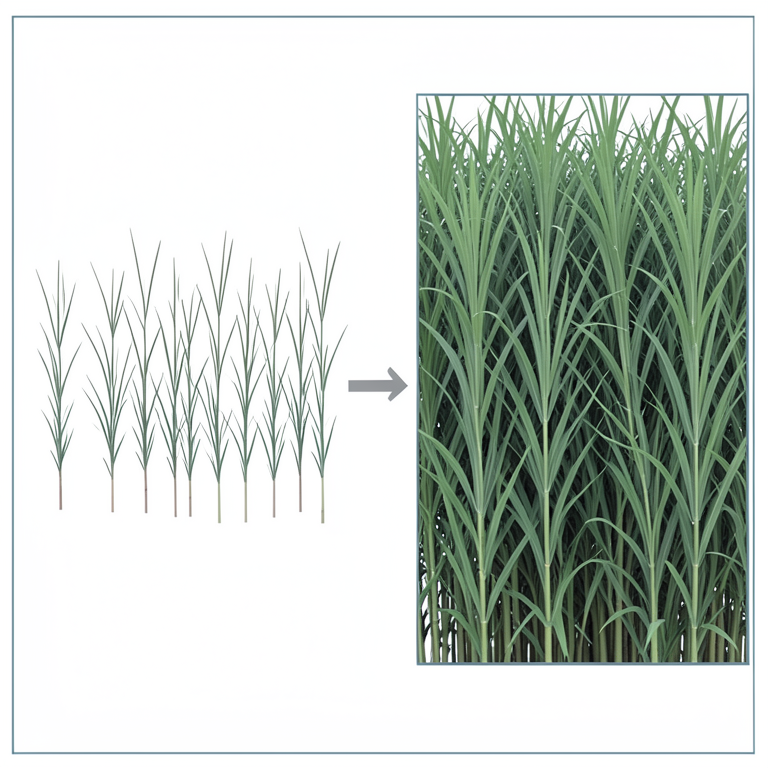
Optimal Hybrid and Spacing Combination
AI-generated conceptual illustration (Bajra Napier grass plants). It explains the idea and does not show study data.
View source evidence ↗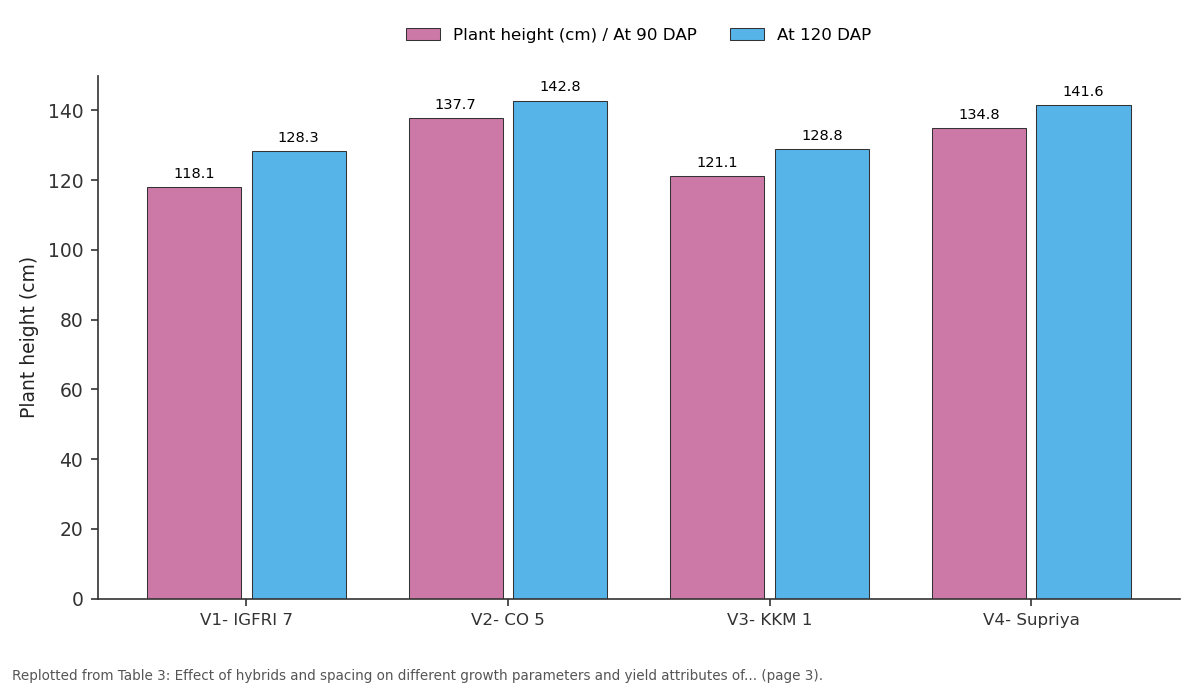
Plant height (cm) / At 90 DAP and At 120 DAP: V1- IGFRI 7 vs V2- CO 5 vs V3- KKM 1 vs V4- Supriya
Replotted from Table 3 (page 3) of the original paper. Every bar is the paper's own table value.
View source evidence ↗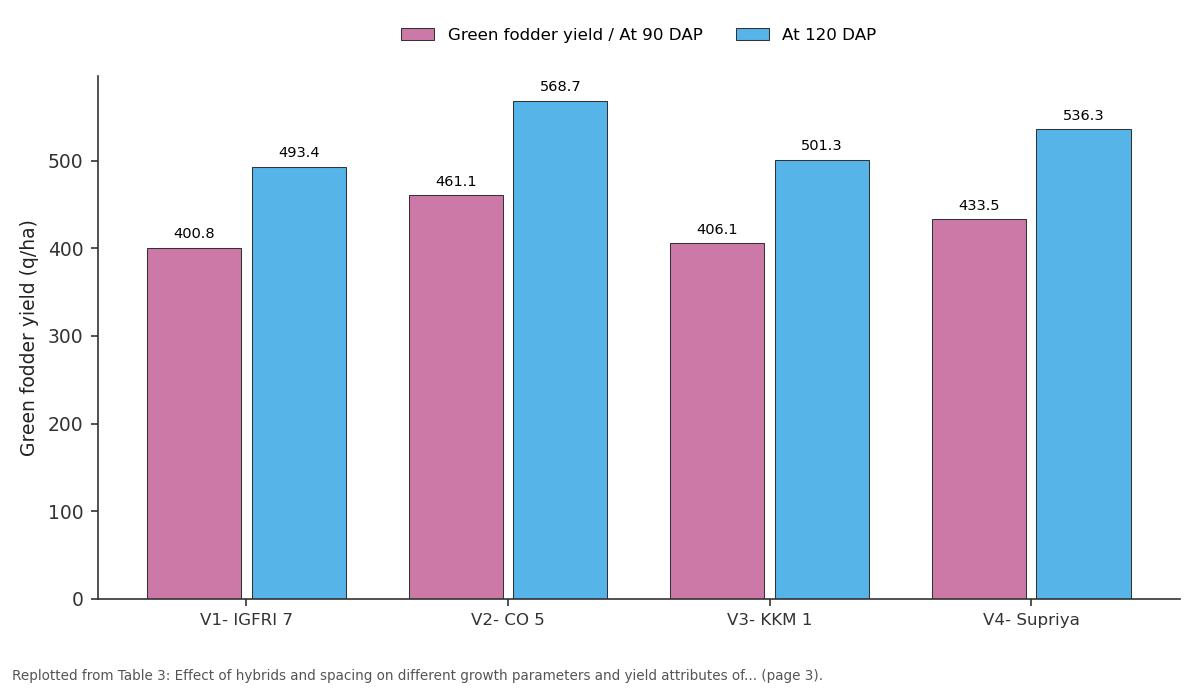
Green fodder yield / At 90 DAP and At 120 DAP: V1- IGFRI 7 vs V2- CO 5 vs V3- KKM 1 vs V4- Supriya
Replotted from Table 3 (page 3) of the original paper. Every bar is the paper's own table value.
View source evidence ↗Figures & tables
From the original paper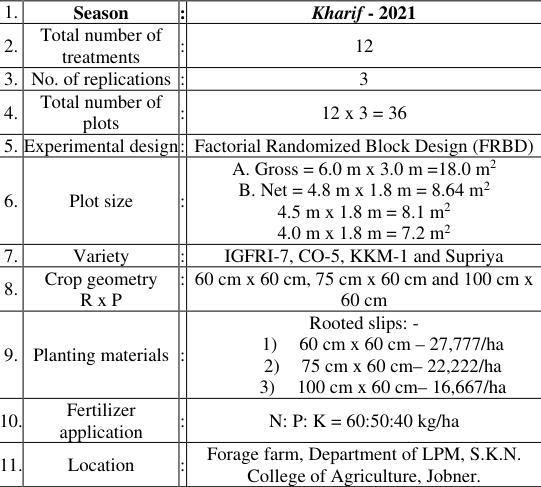 Table 1
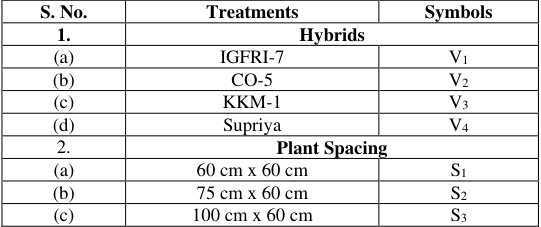 Table 2
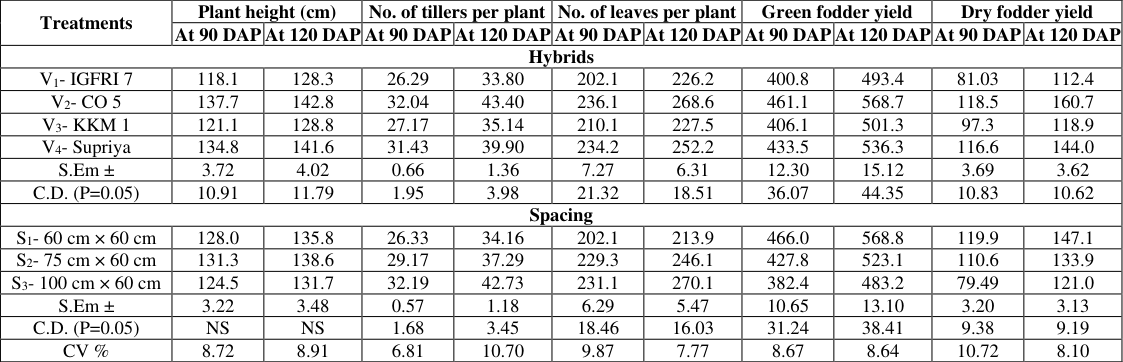 Table 3
Introduction
India supports over 20 per cent of the world's livestock population, with buffalo and cattle populations leading the way. The disparity between the availability and actual requirement of quality fodder in adequate amount remains the bottleneck for the productivity of livestock business in India and Rajasthan. It is critical that dairy animals should have access to green fodder throughout the year in order to optimise milk output. The most common fodder crops available in Rajasthan include bajra, sorghum, maize, oat, rye grass and berseem. However, these crops do not provide year-round green fodder, the way for cultivation of perennial and multicut forage crops like Bajra Napier hybrid grass. Bulks of the livestock are in holdings of small and marginal farmers having less than two hectares of land. In the case of small land holder, dairy feed is the most important constraint and farm animals are forced to feed on dry stalks and straw with low nutritive value during lean periods. Livestock sector contributes around 26 per cent in total agricultural income and 4.0 per cent in national GDP. Presently, livestock population in India is around 535.78 million heads and is expected to reach about 780.7 million by the year 2050 (Annual Report 2021-22, GOI). It is estimated that, feed alone constitute about 60-65 per cent of the total cost of milk production which can be reduced to 30-40 per cent by providing cheap and quality roughages such as natural and cultivated grasses (Thomas, 2008) [7] . Thus, the gap between the demand and supply of green fodder gets widened. Our country's fodder resources are insufficient to feed even half of the existing cow population, and the scarcity of green fodder is rampant. Scarcity of green fodder availability is mainly due to rapid urbanization and shrinkage in grazing lands, pressure of growing food grains, oilseeds and cash crops. BN Hybrid is a new fodder grass that has become popular among dairy farmers. It has very high biomass yielding grass developed by interspecific hybridization of Bajra (Pennisetum glaucum L.) and Napier grass (Pennisetum purpureum Schum.) combining high quality and faster growth of bajra with the deep root system and multicut habit of Napier grass. It can be found in subtropical areas of Asia, Africa, Southern Europe and North America. Being a triploid, it does not produce seeds. However, it produces large number of tillers and numerous leaves. It grows on a variety of soils and agro climatic conditions. Optimum plant population per unit of land area is essential for increased production.
The competition between plants and need for optimum plant population were described in detail by Donald (1963) [3] . Plants do not compete with one another as long as the amount of water, nutrients and light available exceeds the requirements of the plants. Keeping in view the above challenges, the present investigation was carried out.
Materials and Methods
The field experiment was conducted during Kharif-2021 at the Forage farm, S.K.N. College of Agriculture, Jobner, Rajasthan. Jobner is situated 45 km west of Jaipur at 26°05ʹ N latitude and 75°28ʹ E longitude and at an altitude of 427 metres above mean sea level. The region falls under Semi-Arid Eastern Plains Zone (IIIa) of Rajasthan. The climate of this region is typically semi-arid, characterized by extremes of temperature during both summers and winters. During summers, the temperature may go as high as 48 °C, while in winters, it may fall as low as -1.0 °C. Frost is not uncommon during winter. The average annual rainfall of this tract ranges between 400-500 mm, most of which is contributed by the S-W monsoon during July and August. There is hardly any rain during winter and summers. The maximum and minimum temperatures during the crop season ranged between 19.7 to 32.7 °C and 0.6 to 18.1 °C, respectively. A total of 19.37 mm rainfall was recorded during the cropping season. Observation recorded Plant height Five plants were selected randomly from each plot and tagged permanently. Height of these five plants was measured at 90 DAP and 120 DAP from the base of the plant to the tip of the top most leaf by meter scale and their mean was expressed as plant height (cm).
Number of tillers per plant
The number of tillers per plant were counted on five different plants that were chosen at random and the mean value of the five plants was calculated.
Number of leaves per plant
The green and fully opened leaves of the five tillers from representative bunch were counted at each cutting and average number of leaves per tiller was multiplied with total number of tillers per bunch and the mean value was worked out.
Green fodder yield
Green fodder yield from each plot was recorded immediately after each cutting interval. The produce from net plot was harvested and weighed. The total yield of all three cuts was expressed in q/ha.
Dry fodder yield
The fresh forage samples from each plot were taken. After recording the fresh weight, the samples were dried in hot air oven at temperature of 70 ±10 °C till the constant weight was attained. Dry matter content was worked out and then dry fodder yield was computed with the help of following formula.
Results and Discussion
A close perusal of data presented in Table 3. Indicated that significant variation was observed in plant height of different BN hybrids at 90 and 120 DAP. A significantly higher plant height was recorded in hybrid V2 (CO-5) at 90 DAP (137.7 cm) and 120 DAP (142.8 cm) over rest of BN hybrids. However, hybrid V4 (Supriya) was found at par to it at 90 and 120 DAP. Lower plant height was obtained by hybrid V1 (IGFRI-7) and V3 (KKM-1) at 90 and 120 DAP. Higher plant height was attained at 120 days after planting. This might be due to sufficient time available for growth of root system resulted in better nutrient supply in turn higher height at 120 DAP. During the initial stages (30 DAP), the grasses exhibited slow growth due to difficulty in establishment and atmospheric temperature (Vijayakumar et al. 2009) [9] . Spacing did not have any significant influence on plant height. Results of the studies conducted at TNAU, Coimbatore by Velayudham et al. (2011) [8] also revealed that spacing did not influence the plant height of BN hybrids. An interpretation of data presented in Table 3. Showed that significant variation was observed in number of tillers produced by different BN hybrids at 90 and 120 DAP. Significantly higher number of tillers was registered in hybrid V2 (CO-5) at 90 DAP (32.04) and 120 DAP (43.40) over rest of BN hybrids. However, hybrid V4 (Supriya) was found at par to it at different cuttings.
| Treatments | Plant height (cm) | — | No. of tillers per plant | — | No. of leaves per plant | — | Green fodder yield | — | Dry fodder yield | — |
|---|---|---|---|---|---|---|---|---|---|---|
| At 90 DAP | At 120 DAP | At 90 DAP | At 120 DAP | At 90 DAP | At 120 DAP | At 90 DAP | At 120 DAP | At 90 DAP | At 120 DAP | |
| Hybrids | ||||||||||
| V1- IGFRI 7 | 118.1 | 128.3 | 26.29 | 33.80 | 202.1 | 226.2 | 400.8 | 493.4 | 81.03 | 112.4 |
| V2- CO 5 | 137.7 | 142.8 | 32.04 | 43.40 | 236.1 | 268.6 | 461.1 | 568.7 | 118.5 | 160.7 |
| V3- KKM 1 | 121.1 | 128.8 | 27.17 | 35.14 | 210.1 | 227.5 | 406.1 | 501.3 | 97.3 | 118.9 |
| V4- Supriya | 134.8 | 141.6 | 31.43 | 39.90 | 234.2 | 252.2 | 433.5 | 536.3 | 116.6 | 144.0 |
| S.Em ± | 3.72 | 4.02 | 0.66 | 1.36 | 7.27 | 6.31 | 12.30 | 15.12 | 3.69 | 3.62 |
| C.D. (P=0.05) | 10.91 | 11.79 | 1.95 | 3.98 | 21.32 | 18.51 | 36.07 | 44.35 | 10.83 | 10.62 |
| Spacing | ||||||||||
| S1- 60 cm × 60 cm | 128.0 | 135.8 | 26.33 | 34.16 | 202.1 | 213.9 | 466.0 | 568.8 | 119.9 | 147.1 |
| S2- 75 cm × 60 cm | 131.3 | 138.6 | 29.17 | 37.29 | 229.3 | 246.1 | 427.8 | 523.1 | 110.6 | 133.9 |
| S3- 100 cm × 60 cm | 124.5 | 131.7 | 32.19 | 42.73 | 231.1 | 270.1 | 382.4 | 483.2 | 79.49 | 121.0 |
| S.Em ± | 3.22 | 3.48 | 0.57 | 1.18 | 6.29 | 5.47 | 10.65 | 13.10 | 3.20 | 3.13 |
| C.D. (P=0.05) | NS | NS | 1.68 | 3.45 | 18.46 | 16.03 | 31.24 | 38.41 | 9.38 | 9.19 |
| CV % | 8.72 | 8.91 | 6.81 | 10.70 | 9.87 | 7.77 | 8.67 | 8.64 | 10.72 | 8.10 |
Table text extracted from the original PDF; superscript letters are shown inline. The original table image is below.
View original table image
The lowest tillers were recorded by hybrid V1 (IGFRI-7) at 90 DAP (26.29) and 120 DAP (33.80).
In grasses the control of tillering is the attributed to physiological and genetic factors and their interaction with environmental factors (Assuero and Tognetti, 2010) [1] . Data (Table 3.) revealed that the number of tillers of BN hybrids was significantly influenced by different spacings at 90 and 120 DAP. A significantly higher number of tillers was obtained under spacings (S3) at 90 DAP (32.19) and 120 DAP (42.73) over the rest of spacing. According to Gardner et al. (1991) [4] , tillering is highly influenced by factors such as light, temperature, spacing, moisture and nitrogen supply. During the initial stages, the rate of tillering was less.
A perusal of data presented in Table 3. Revealed that significant variation was observed in number of leaves per plant of different BN hybrids at 90 and 120 DAP. A significantly higher number of leaves per plant was recorded in hybrid V2 (CO-5) at 90 DAP (236.1) and 120 DAP (268.6) over rest of BN hybrids. However, hybrid V4 (Supriya) was found at par to it at 90 and 120 DAP. The lowest number of leaves was recorded in hybrid V1 (IGFRI-7) at 90 and 120 DAP. The evaluation of data (Table 3.) reveals that the different BN hybrids registered significant variation in green fodder yield at 90 and 120 DAP. Significantly higher green fodder yield was registered in hybrid V2 (CO-5) at 90 DAP (461.1 q/ha) and 120 DAP (568.7 q/ha) over rest of BN hybrids. However, hybrid V4 (Supriya) was found at par to it at 90 and 120 DAP. Higher yield of CO-5 may be attributed to higher plant height, number of tillers per plant, length and width of leaves, leaf area index, leaf area ratio. It is generally accepted that the rate of fodder production is a functions of tiller production and leaf growth (Ryle, 1970; Barbara, 1985; Selvi and Subramanian, 1993) [5,2,6] . The data (Table 4.3) showed that the green fodder yield of BN hybrid was significantly influenced by different spacings at 90 and 120 DAP. Significantly higher green fodder yield was recorded under spacing S1 (60 cm × 60 cm) at 90 DAP (466.0 q/ha) and 120 DAP (568.8 q/ha) over the rest of spacings. However, green fodder yield in spacing S2 (75 cm × 60 cm) was found statistically at par with spacing S1 (60 cm × 60 cm) at 90 and 120 DAP. The experimental findings presented in Table 3. Indicated that different BN hybrids registered significant variation in dry fodder yield at 90 and 120 DAP. Significantly higher dry fodder yield was recorded in hybrid V2 (CO-5) at 90 DAP (118.5 q/ha) and 120 DAP (160.7 q/ha) over rest of BN hybrids. However, hybrid V4 (Supriya) was found at par to it at 90 and 120 DAP.
Conclusion
Keeping in view the objectives framed for undertaking the study and the results obtained after experimental period, it was concluded that hybrid CO-5 and Supriya planted at spacing of 60 cm × 60 cm recorded higher green fodder yield and growth attributes.
Figures and tables from the paper
| 1. | Season | : | Kharif - 2021 |
|---|---|---|---|
| 2. | Total number of treatments | : | 12 |
| 3. | No. of replications | : | 3 |
| 4. | Total number of plots | : | 12 x 3 = 36 |
| 5. | Experimental design | : | Factorial Randomized Block Design (FRBD) |
| 6. | Plot size | : | A. Gross = 6.0 m x 3.0 m =18.0 m2 B. Net = 4.8 m x 1.8 m = 8.64 m2 4.5 m x 1.8 m = 8.1 m2 4.0 m x 1.8 m = 7.2 m2 |
| 7. | Variety | : | IGFRI-7, CO-5, KKM-1 and Supriya |
| 8. | Crop geometry R x P | : | 60 cm x 60 cm, 75 cm x 60 cm and 100 cm x 60 cm |
| 9. | Planting materials | : | Rooted slips: - 1) 60 cm x 60 cm – 27,777/ha 2) 75 cm x 60 cm– 22,222/ha 3) 100 cm x 60 cm– 16,667/ha |
| 10. | Fertilizer application | : | N: P: K = 60:50:40 kg/ha |
| 11. | Location | : | Forage farm, Department of LPM, S.K.N. College of Agriculture, Jobner. |
Table text extracted from the original PDF; superscript letters are shown inline. The original table image is below.
View original table image
| S. No. | Treatments | Symbols |
|---|---|---|
| 1. | Hybrids | |
| (a) | IGFRI-7 | V1 |
| (b) | CO-5 | V2 |
| (c) | KKM-1 | V3 |
| (d) | Supriya | V4 |
| 2. | Plant Spacing | |
| (a) | 60 cm x 60 cm | S1 |
| (b) | 75 cm x 60 cm | S2 |
| (c) | 100 cm x 60 cm | S3 |
Table text extracted from the original PDF; superscript letters are shown inline. The original table image is below.
View original table image
References
6 in the original paper- Assuero SG, Tognetti JA. Tillering regulation by endogenous and environmental factors and its agricultural management. Am J Plant Sci Biotechnol. 2010;4(1):35-48.
- Barbara. Fodder yield components and their implementation in Deenanath grass (Pennisetum purpureum Trin.). JNKVV Res J. 1985;19:1-4.
- Donald CM. Competition among crop plants and pasture plants. Adv Agron. 1963;15:1-15.
- Selvi B, Subramanian S. Genetic study of Dheenanath grass (Pennisetum pedicellatum) for green fodder yield and its components. Madras Agric J. 1993;80(6):333-335.
- Velayudham K, Babu C, Iyanar K, Kalamani A. Impact of plant geometry and fertilizer levels on the bajra Napier hybrid grass. Indian J Agric Sci. 2011;81(6):575-577.
- Vijayakumar G, Babu C, Velayudham K, Raveendran TS. A high-yielding cumbu Napier hybrid grass CO (CN) 4. Madras Agric J. 2009;96(7-12):291-292.