
Research article · 2024 · Full text
International Journal of Research in AgronomyEvaluate the effect of different post emergence herbicides on growth and yield of rice (Oryza sativa L.)
Volume 7(1) · Pages 188–192 · DOI: 10.33545/2618060x.2024.v7.i1c.206 ↗
Research areasGABA and Rice ResearchCrop Yield and Soil FertilityRice Cultivation and Yield Improvement
Abstract
Author-writtenThe field experiment was conducted duringkharif, 2022 to evaluate the effect of different post emergence herbicides on growth and yield of rice (Oryza sativa L.) at Agronomy Farm, College of Agriculture, Dapoli, District Ratnagiri (M.S.).The experiment was laid out in a randomized block design with ten treatments which were replicated three times viz., (T1) Pyribenzoxim 3% + Penoxsulam 2% EC @ 500 ml ha-1, (T2) Pyribenzoxim 3% + Penoxsulam 2% EC @ 750 ml ha-1, (T3) Pyribenzoxim 3% + Penoxsulam 2% EC @ 1000 ml ha-1, (T4) Pyribenzoxim 3% + Penoxsulam 2% EC @ 1500 ml ha-1, (T5) Pyribenzoxim 5% EC @ 600 ml ha-1, (T6) Penoxsulam 2.67% OD @ 1000 ml ha-1, (T7) Bispyribac-Sodium 20% + Pyrazosulfuron Ethyl 15% WDG @ 100 g ha-1, (T8) Triafamone 20% +Ethoxysulfuron 10% WG @ 225 g ha-1, (T9) Hand weeding at 30 and 60 DAT and (T10) Weedy check (Untreated). The results of the experiment showed that the application of post emergence herbicide Pyribenzoxim 3% + Penoxsulam 2% EC @ 1500 ml ha-1 has positive effect on growth and yield of rice.Significantly higher values of growth attributes such as plant height (cm),number of tillers hill-1, dry matter accumulation hill-1 (g) were observed with treatment (T4) Pyribenzoxim 3% + Penoxsulam 2% EC @ 1500 ml ha-1 at 60, 90 and 120 DAT and at harvest stage as compared to other treatments whereas, least values were recorded with treatment (T10) Weedy check. Significantly higher grain yield (4050.55 kg ha-1) and straw yield (5524.62 kg ha-1) was observed with treatment (T4) Pyribenzoxim 3% + Penoxsulam 2% EC @ 1500 ml ha-1 and lower grain and straw yield was observed with treatment (T10) Weedy check.
Summary
Source-checkedPlain-language reading of the full paper, prepared with AI and checked against the text. Each point links to the authors' own words.
Why it matters
- Rice is a critical cereal crop that serves as a staple food for more than half of the world's population, particularly in developing regions. View evidence ↗
- Weed infestation is a major threat to transplanted rice, contributing to a global decline in production. View evidence ↗
- Competition from weeds can significantly reduce grain output, with potential losses reaching up to 32%. View evidence ↗
The question
- The study aimed to evaluate how different post-emergence herbicides affect the growth and yield of rice (Oryza sativa L.). View evidence ↗
What they did
- The field experiment was conducted during the kharif season of 2022 at the Agronomy Farm, College of Agriculture, Dapoli, District Ratnagiri (M.S.). View evidence ↗
- The study used a randomized block design consisting of ten different treatments, each replicated three times. View evidence ↗
- Treatments included various concentrations of Pyribenzoxim + Penoxsulam (T1-T4), Pyribenzoxim alone (T5), Penoxsulam alone (T6), Bispyribac-Sodium + Pyrazosulfuron Ethyl (T7), Triafamone + Ethoxysulfuron (T8), hand weeding (T9), and an untreated weedy check (T10). View evidence ↗
- The researchers measured growth attributes (plant height, number of tillers, and dry matter accumulation) and yield components (grain yield, straw yield, and harvest index). View evidence ↗
What they found
- Treatment T4 (Pyribenzoxim 3% + Penoxsulam 2% EC @ 1500 ml ha-1) produced significantly higher plant heights at 60 (51.66 cm), 90 (76.53 cm), 120 (97.58 cm) DAT, and at harvest (100.02 cm). View evidence ↗
- The number of tillers per hill was highest in treatment T4 at 60 DAT (12.20), 90 DAT (15.00), 120 DAT (13.60), and at harvest (13.33). View evidence ↗
- Treatment T4 achieved significantly higher dry matter accumulation per hill at 60 DAT (23.93 g), 90 DAT (47.18 g), 120 DAT (50.23 g), and at harvest (51.95 g). View evidence ↗
- The highest mean number of effective tillers per hill (9.13) was recorded with treatment T4. View evidence ↗
- Treatment T4 resulted in the highest grain yield (4050.55 kg ha-1), although T2, T3, and T9 (hand weeding) were statistically equivalent. View evidence ↗
- Treatment T4 produced a significantly higher straw yield of 5524.62 kg ha-1 compared to other treatments. View evidence ↗
- The highest biological yield (9575.17 kg ha-1) was observed in treatment T4, with T2, T3, and T9 showing statistically equivalent results. View evidence ↗
- The untreated weedy check (T10) consistently recorded the lowest values for growth attributes and the lowest grain yield (2568.85 kg ha-1). View evidence ↗
What it means
- The authors conclude that applying Pyribenzoxim 3% + Penoxsulam 2% EC at 1500 ml ha-1 as a post-emergence herbicide is effective for optimizing growth attributes and securing higher yields in transplanted rice. View evidence ↗
Visual summary
3 visualsIllustrations explain the paper; charts are replotted from the paper's own table values.
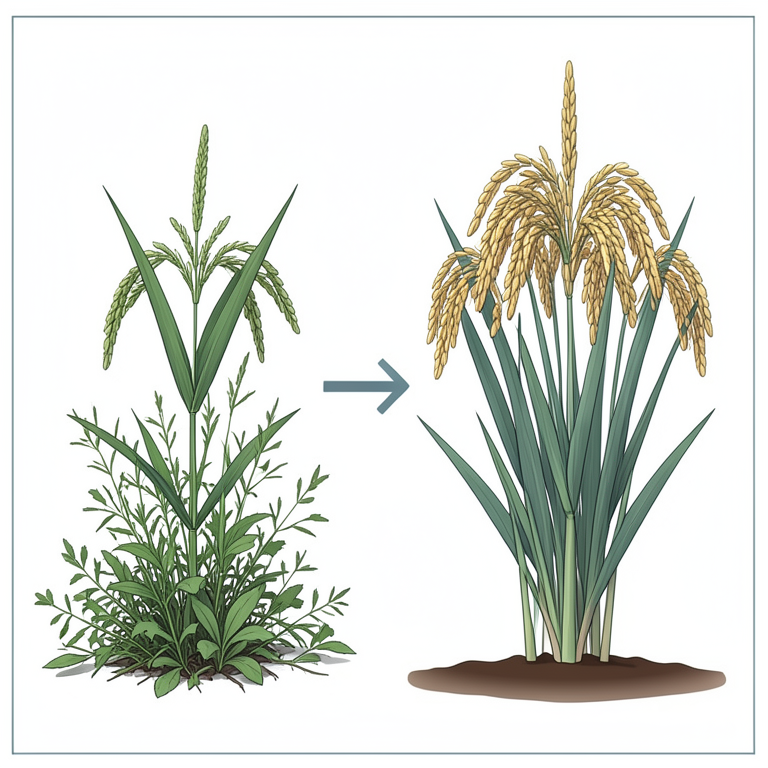
Effect of Herbicide on Rice Growth
AI-generated conceptual illustration (rice plants (Oryza sativa L.)). It explains the idea and does not show study data.
View source evidence ↗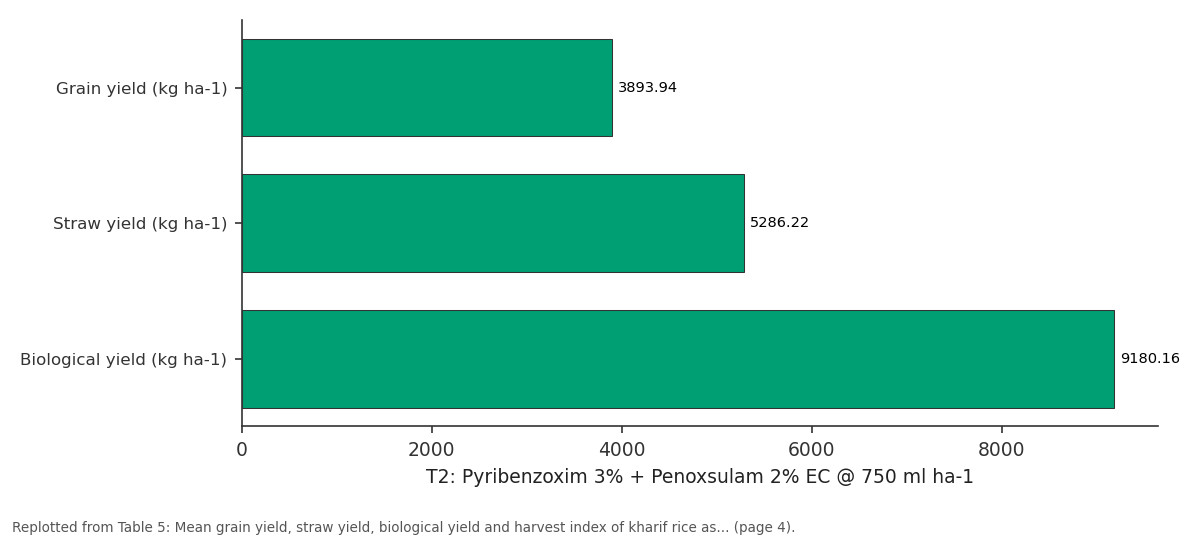
T2: Pyribenzoxim 3% + Penoxsulam 2% EC @ 750...: Grain yield (kg ha-1) vs Straw yield (kg ha-1) vs Biological yield (kg...
Replotted from Table 5 (page 4) of the original paper. Every bar is the paper's own table value.
View source evidence ↗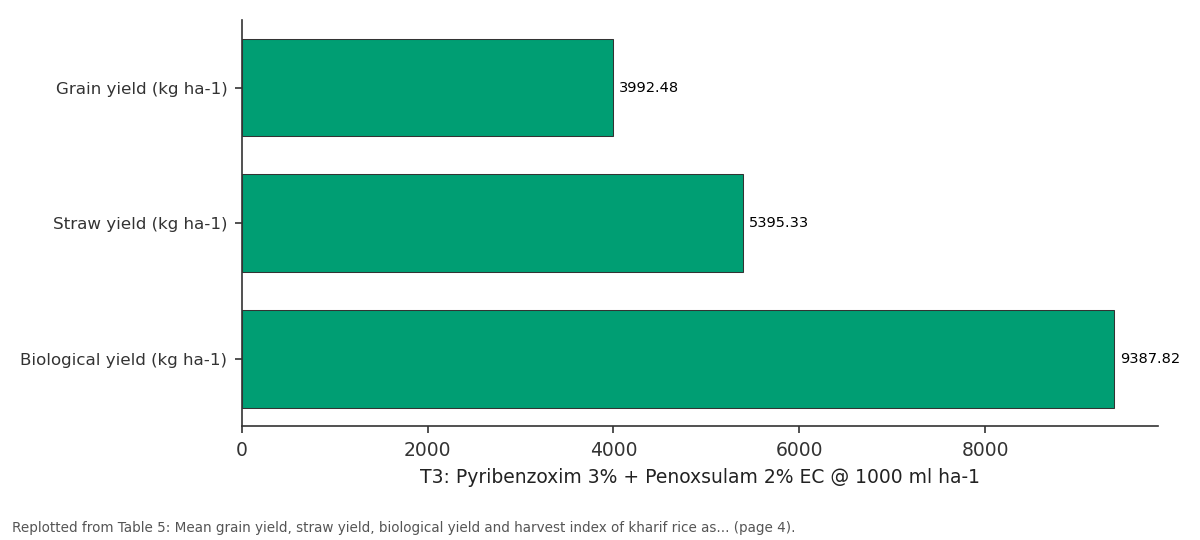
T3: Pyribenzoxim 3% + Penoxsulam 2% EC @...: Grain yield (kg ha-1) vs Straw yield (kg ha-1) vs Biological yield (kg...
Replotted from Table 5 (page 4) of the original paper. Every bar is the paper's own table value.
View source evidence ↗Figures & tables
From the original paper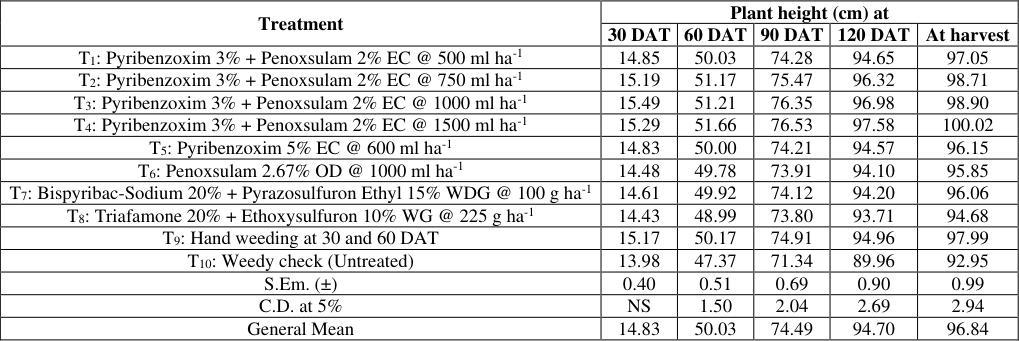 Table 1
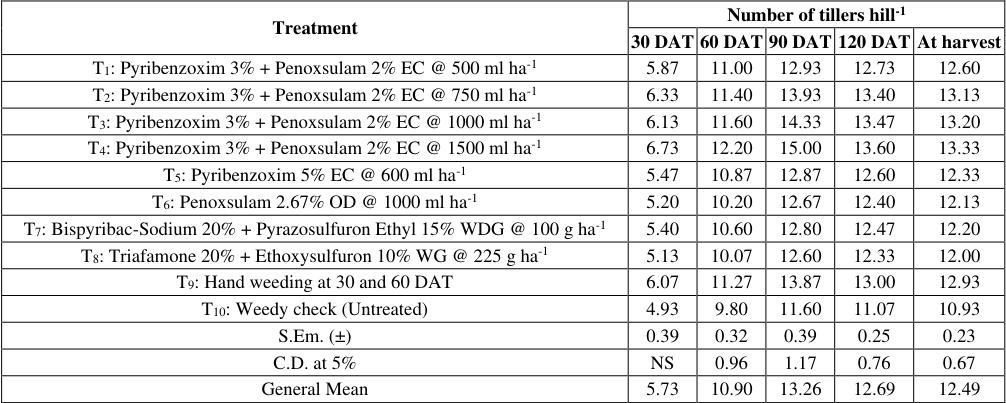 Table 2
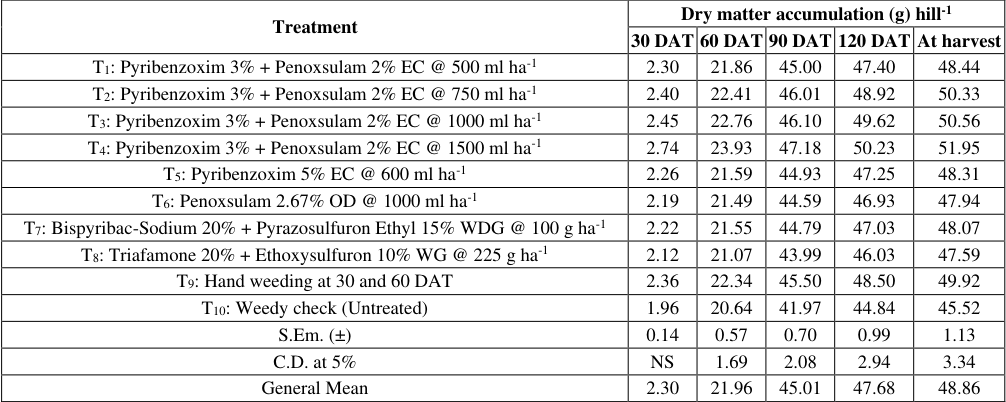 Table 3
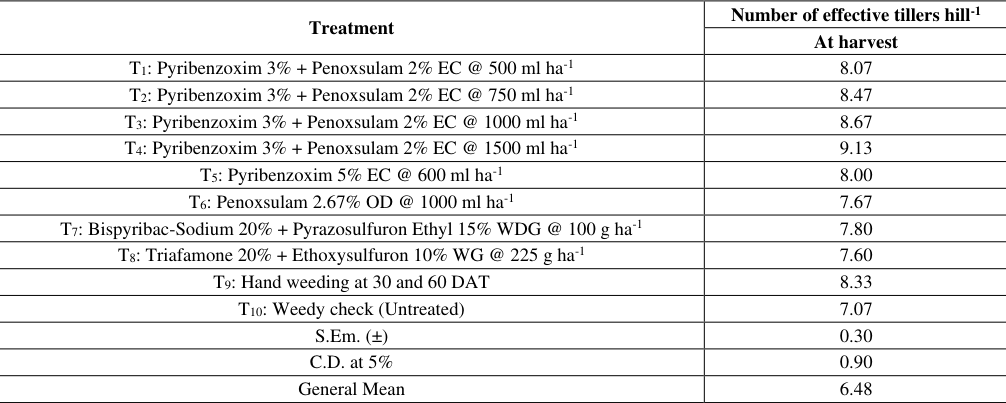 Table 4
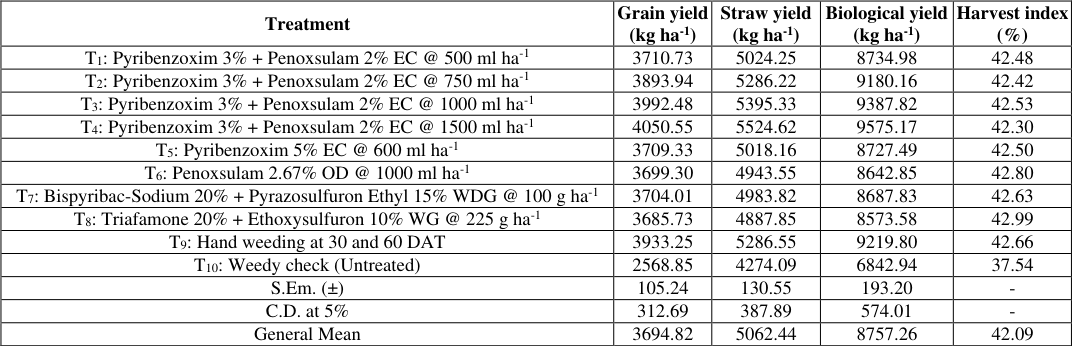 Table 5
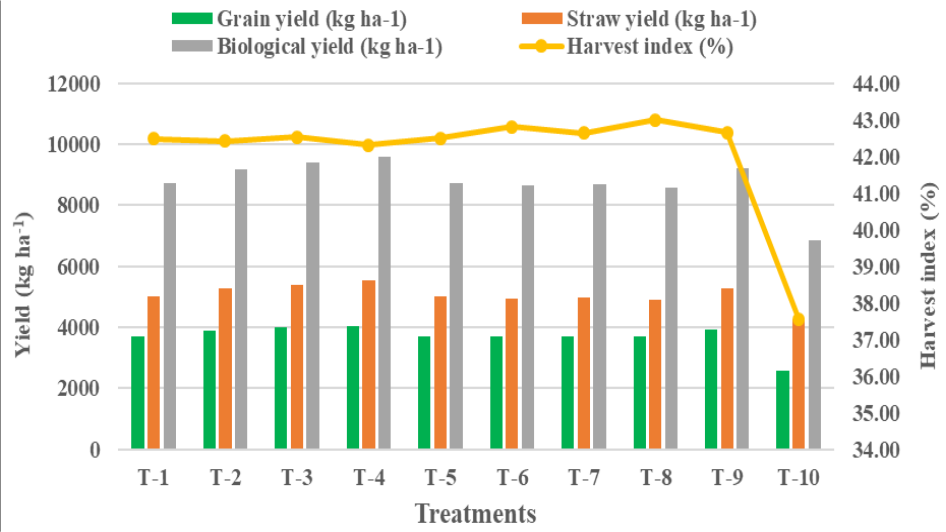 Figure 1
Introduction
Rice plays a crucial role as the primary cereal crop in the developing world, providing a staple diet for over half of the global population. As a semi-aquatic annual grass, it not only sustains livelihoods but also addresses hunger on a large scale. The Oryza genus comprises more than 24 recognized species, with Oryza sativa L. being the predominant variety in cultivated rice. Beyond sustenance, rice significantly impacts agriculture, the economy, and global ecology, surpassing other crops in its capacity to feed populations, generate employment, and contribute to ecological balance. Particularly in Asia, where approximately 70% of the impoverished population relies heavily on rice for both sustenance and income, rice cultivation plays a crucial role in shaping societal structures and economic dynamics. This intricate relationship underscores rice's pivotal role in addressing food security and supporting the well-being of communities, with India being a major contributor to global rice production. Globally, rice production faces a decline, primarily due to weed infestation, which presents a significant threat to transplanted rice. Weeds, known for their adaptability and rapid growth, can outcompete rice, resulting in reduced yields. Effective weed control is essential for successful transplanted rice cultivation, and control methods include manual, mechanical, or chemical approaches. Despite the effectiveness of manual weeding, farmers often opt for chemical weed control due to labor shortages and high costs. Herbicides are considered the most efficient, costeffective, and practical means of weed control. Weed competition can lead to substantial reductions in grain output, with potential decreases of up to 32% (Singh et al., 2007) [7] .
Establishing a weed-free environment within a month of transplanting is crucial for optimal crop growth, and postemergence herbicides like bispyribac-sodium and pyrazosulfuron-ethyl have proven highly effective in managing rapid weed growth.
Materials and Methods
The present investigation took place in the kharif season of 2022 at the Agronomy Farm, College of Agriculture, Dapoli, District Ratnagiri (M.S.). The experimental plot no. 51, is located in the subtropical region at 17°76'24" N latitude and 73°17'33" E longitude, with an elevation of approximately 157.8 meters above mean sea level. The experiment was laid out in a randomized block design with ten treatments which were replicated three times viz., (T 1 ) Pyribenzoxim 3% + Penoxsulam 2% EC @ 500 ml ha -1 , (T 2 ) Pyribenzoxim 3% + Penoxsulam 2% EC @ 750 ml ha -1 , (T 3 ) Pyribenzoxim 3% + Penoxsulam 2% EC @ 1000 ml ha -1 , (T 4 ) Pyribenzoxim 3% + Penoxsulam 2% EC @ 1500 ml ha -1 , (T 5 ) Pyribenzoxim 5% EC @ 600 ml ha -1 , (T 6 ) Penoxsulam 2.67% OD @ 1000 ml ha -1 , (T 7 ) Bispyribac-Sodium 20% + Pyrazosulfuron Ethyl 15% WDG @ 100 g ha -1 , (T 8 ) Triafamone 20% + Ethoxysulfuron 10% WG @ 225 g ha -1 , (T 9 ) Hand weeding at 30 and 60 DAT and (T 10 ) Weedy check (Untreated). Throughout the growth phase of the rice crop, it experienced a substantial rainfall of 3530.1 mm. The average daily sunshine duration was 4.00 hours. The soil in which the crop was cultivated had 11.18 g kg -1 of organic carbon, pH level of 6.14, and an electrical conductivity of 0.11 dS m -1 . The climatic conditions were highly favorable for the growth and development of the rice crop.
Result and Discussion
Result and Discussion
Table 1 presents data on the effect of various treatments on the plant height of rice plants. The results show that plant height increases with the progression of crop age, peaking at harvest. Across all treatments, the rate of height increase is relatively low during the early vegetative growth stage (up to 30 days after transplanting -DAT) but rises from 60 to 90 DAT. Subsequently, the rate remains low until crop maturity. Average plant heights were 14.83 cm, 50.03 cm, 74.49 cm, 94.70 cm, and 96.84 cm at 30, 60, 90, 120 DAT, and harvest, respectively. At 30 DAT, there is no significant difference in mean plant height among treatments. However, significant differences emerge at 60, 90, 120 DAT, and harvest based on the application of various post-emergence herbicides. Treatment T 4 (Pyribenzoxim 3% + Penoxsulam 2% EC @ 1500 ml ha -1 ) records significantly higher plant heights of 51.66 cm, 76.53 cm, 97.58 cm, and 100.02 cm at 60, 90, 120 DAT, and harvest, respectively. Treatments T 3 (Pyribenzoxim 3% + Penoxsulam 2% EC @ 1000 ml ha -1 ), T 2 (Pyribenzoxim 3% + Penoxsulam 2% EC @ 750 ml ha -1 ), and T 9 (Hand weeding at 30 and 60 DAT) were statistically at par to treatment T 4 .
| Treatment | Plant height (cm) at | — | — | — | — |
|---|---|---|---|---|---|
| 30 DAT | 60 DAT | 90 DAT | 120 DAT | At harvest | |
| T1: Pyribenzoxim 3% + Penoxsulam 2% EC @ 500 ml ha-1 | 14.85 | 50.03 | 74.28 | 94.65 | 97.05 |
| T2: Pyribenzoxim 3% + Penoxsulam 2% EC @ 750 ml ha-1 | 15.19 | 51.17 | 75.47 | 96.32 | 98.71 |
| T3: Pyribenzoxim 3% + Penoxsulam 2% EC @ 1000 ml ha-1 | 15.49 | 51.21 | 76.35 | 96.98 | 98.90 |
| T4: Pyribenzoxim 3% + Penoxsulam 2% EC @ 1500 ml ha-1 | 15.29 | 51.66 | 76.53 | 97.58 | 100.02 |
| T5: Pyribenzoxim 5% EC @ 600 ml ha-1 | 14.83 | 50.00 | 74.21 | 94.57 | 96.15 |
| T6: Penoxsulam 2.67% OD @ 1000 ml ha-1 | 14.48 | 49.78 | 73.91 | 94.10 | 95.85 |
| T7: Bispyribac-Sodium 20% + Pyrazosulfuron Ethyl 15% WDG @ 100 g ha-1 | 14.61 | 49.92 | 74.12 | 94.20 | 96.06 |
| T8: Triafamone 20% + Ethoxysulfuron 10% WG @ 225 g ha-1 | 14.43 | 48.99 | 73.80 | 93.71 | 94.68 |
| T9: Hand weeding at 30 and 60 DAT | 15.17 | 50.17 | 74.91 | 94.96 | 97.99 |
| T10: Weedy check (Untreated) | 13.98 | 47.37 | 71.34 | 89.96 | 92.95 |
| S.Em. (±) | 0.40 | 0.51 | 0.69 | 0.90 | 0.99 |
| C.D. at 5% | NS | 1.50 | 2.04 | 2.69 | 2.94 |
| General Mean | 14.83 | 50.03 | 74.49 | 94.70 | 96.84 |
Table text extracted from the original PDF; superscript letters are shown inline. The original table image is below.
View original table image
Number of tillers hill -1
Table 2 displays data regarding the number of tillers hill -1 under various treatments. Analysis of the data at 30 days after transplanting (DAT) did not reveal any statistically significant differences in the mean number of tillers hill -1 due to different treatments. However, at 60, 90, 120 DAT, and at harvest, the mean number of tillers hill -1 was significantly influenced by the application of different post-emergence herbicides.
| Treatment | Number of tillers hill-1 | — | — | — | — |
|---|---|---|---|---|---|
| 30 DAT | 60 DAT | 90 DAT | 120 DAT | At harvest | |
| T1: Pyribenzoxim 3% + Penoxsulam 2% EC @ 500 ml ha-1 | 5.87 | 11.00 | 12.93 | 12.73 | 12.60 |
| T2: Pyribenzoxim 3% + Penoxsulam 2% EC @ 750 ml ha-1 | 6.33 | 11.40 | 13.93 | 13.40 | 13.13 |
| T3: Pyribenzoxim 3% + Penoxsulam 2% EC @ 1000 ml ha-1 | 6.13 | 11.60 | 14.33 | 13.47 | 13.20 |
| T4: Pyribenzoxim 3% + Penoxsulam 2% EC @ 1500 ml ha-1 | 6.73 | 12.20 | 15.00 | 13.60 | 13.33 |
| T5: Pyribenzoxim 5% EC @ 600 ml ha-1 | 5.47 | 10.87 | 12.87 | 12.60 | 12.33 |
| T6: Penoxsulam 2.67% OD @ 1000 ml ha-1 | 5.20 | 10.20 | 12.67 | 12.40 | 12.13 |
| T7: Bispyribac-Sodium 20% + Pyrazosulfuron Ethyl 15% WDG @ 100 g ha-1 | 5.40 | 10.60 | 12.80 | 12.47 | 12.20 |
| T8: Triafamone 20% + Ethoxysulfuron 10% WG @ 225 g ha-1 | 5.13 | 10.07 | 12.60 | 12.33 | 12.00 |
| T9: Hand weeding at 30 and 60 DAT | 6.07 | 11.27 | 13.87 | 13.00 | 12.93 |
| T10: Weedy check (Untreated) | 4.93 | 9.80 | 11.60 | 11.07 | 10.93 |
| S.Em. (±) | 0.39 | 0.32 | 0.39 | 0.25 | 0.23 |
| C.D. at 5% | NS | 0.96 | 1.17 | 0.76 | 0.67 |
| General Mean | 5.73 | 10.90 | 13.26 | 12.69 | 12.49 |
Table text extracted from the original PDF; superscript letters are shown inline. The original table image is below.
View original table image
The results indicated that the number of tillers hill -1 was notably higher with treatment T 4 (Pyribenzoxim 3% + Penoxsulam 2% EC @ 1500 ml ha -1 ) compared to other treatments at 60 DAT (12.20), 90 DAT (15.00), 120 DAT (13.60), and at harvest (13.33). Treatment T 3 (Pyribenzoxim 3% + Penoxsulam 2% EC @ 1000 ml ha -1 ), T 2 (Pyribenzoxim 3% + Penoxsulam 2% EC @ 750 ml ha -1 ), and T 9 (Hand weeding at 30 and 60 DAT) were statistically at par to treatment T 4 .
Table 3 presents data on the periodic mean dry matter accumulation hill -1 of rice under different treatments. Generally, dry matter production hill -1 increased with the age of the crop, reaching its maximum at harvest. The mean dry matter accumulation hill -1 was 21.96 g, 45.01 g, 47.68 g, and 48.86 g at 60, 90, 120 days after transplanting (DAT), and at harvest, respectively. At 30 DAT, the dry matter accumulation hill -1 did not show significant differences among the various treatments. However, from 60 DAT to harvest, significant variations were observed between treatments. Treatment T 4 (Pyribenzoxim 3% + Penoxsulam 2% EC @ 1500 ml ha -1 ) recorded significantly higher dry matter accumulation hill -1 at 60 DAT (23.93 g), 90 DAT (47.18 g), 120 DAT (50.23 g), and at harvest (51.95 g). Treatments T 3 (Pyribenzoxim 3% + Penoxsulam 2% EC @ 1000 ml ha -1 ), T 2 (Pyribenzoxim 3% + Penoxsulam 2% EC @ 750 ml ha -1 ), and T 9 (Hand weeding at 30 and 60 DAT) were statistically at par with treatment T 4 at 60, 90, 120 DAT, and at harvest. Treatment T 10 (Weedy check -Untreated) recorded the lowest dry matter accumulation hill -1 at various growth stages.
| Treatment | Dry matter accumulation (g) hill-1 | — | — | — | — |
|---|---|---|---|---|---|
| 30 DAT | 60 DAT | 90 DAT | 120 DAT | At harvest | |
| T1: Pyribenzoxim 3% + Penoxsulam 2% EC @ 500 ml ha-1 | 2.30 | 21.86 | 45.00 | 47.40 | 48.44 |
| T2: Pyribenzoxim 3% + Penoxsulam 2% EC @ 750 ml ha-1 | 2.40 | 22.41 | 46.01 | 48.92 | 50.33 |
| T3: Pyribenzoxim 3% + Penoxsulam 2% EC @ 1000 ml ha-1 | 2.45 | 22.76 | 46.10 | 49.62 | 50.56 |
| T4: Pyribenzoxim 3% + Penoxsulam 2% EC @ 1500 ml ha-1 | 2.74 | 23.93 | 47.18 | 50.23 | 51.95 |
| T5: Pyribenzoxim 5% EC @ 600 ml ha-1 | 2.26 | 21.59 | 44.93 | 47.25 | 48.31 |
| T6: Penoxsulam 2.67% OD @ 1000 ml ha-1 | 2.19 | 21.49 | 44.59 | 46.93 | 47.94 |
| T7: Bispyribac-Sodium 20% + Pyrazosulfuron Ethyl 15% WDG @ 100 g ha-1 | 2.22 | 21.55 | 44.79 | 47.03 | 48.07 |
| T8: Triafamone 20% + Ethoxysulfuron 10% WG @ 225 g ha-1 | 2.12 | 21.07 | 43.99 | 46.03 | 47.59 |
| T9: Hand weeding at 30 and 60 DAT | 2.36 | 22.34 | 45.50 | 48.50 | 49.92 |
| T10: Weedy check (Untreated) | 1.96 | 20.64 | 41.97 | 44.84 | 45.52 |
| S.Em. (±) | 0.14 | 0.57 | 0.70 | 0.99 | 1.13 |
| C.D. at 5% | NS | 1.69 | 2.08 | 2.94 | 3.34 |
| General Mean | 2.30 | 21.96 | 45.01 | 47.68 | 48.86 |
Table text extracted from the original PDF; superscript letters are shown inline. The original table image is below.
View original table image
Number of effective tillers hill -1
Table 4 presents data on the number of effective tillers hill -1 of rice under different treatments. The mean number of effective tillers hill -1 was significantly influenced by the various treatments. The data clearly showed that the mean number of effective tillers hill -1 was significantly higher with treatment T 4 (Pyribenzoxim 3% + Penoxsulam 2% EC @ 1500 ml ha -1 ), recording 9.13 effective tillers hill -1 . Treatments T 3 (Pyribenzoxim 3% + Penoxsulam 2% EC @ 1000 ml ha -1 ), T 2 (Pyribenzoxim 3% + Penoxsulam 2% EC @ 750 ml ha -1 ), and T 9 (Hand weeding at 30 and 60 DAT) were followed by treatment T 4 .
| Treatment | Number of effective tillers hill-1 |
|---|---|
| At harvest | |
| T1: Pyribenzoxim 3% + Penoxsulam 2% EC @ 500 ml ha-1 | 8.07 |
| T2: Pyribenzoxim 3% + Penoxsulam 2% EC @ 750 ml ha-1 | 8.47 |
| T3: Pyribenzoxim 3% + Penoxsulam 2% EC @ 1000 ml ha-1 | 8.67 |
| T4: Pyribenzoxim 3% + Penoxsulam 2% EC @ 1500 ml ha-1 | 9.13 |
| T5: Pyribenzoxim 5% EC @ 600 ml ha-1 | 8.00 |
| T6: Penoxsulam 2.67% OD @ 1000 ml ha-1 | 7.67 |
| T7: Bispyribac-Sodium 20% + Pyrazosulfuron Ethyl 15% WDG @ 100 g ha-1 | 7.80 |
| T8: Triafamone 20% + Ethoxysulfuron 10% WG @ 225 g ha-1 | 7.60 |
| T9: Hand weeding at 30 and 60 DAT | 8.33 |
| T10: Weedy check (Untreated) | 7.07 |
| S.Em. (±) | 0.30 |
| C.D. at 5% | 0.90 |
| General Mean | 6.48 |
Table text extracted from the original PDF; superscript letters are shown inline. The original table image is below.
View original table image
Treatment Number of effective tillers hill -1
At harvest T1: Pyribenzoxim 3% + Penoxsulam 2% EC @ 500 ml ha -1 8.07 T2: Pyribenzoxim 3% + Penoxsulam 2% EC @ 750 ml ha -1 8.47 T3: Pyribenzoxim 3% + Penoxsulam 2% EC @ 1000 ml ha -1 8.67 T4: Pyribenzoxim 3% + Penoxsulam 2% EC @ 1500 ml ha -1 9.13 T5: Pyribenzoxim 5% EC @ 600 ml ha -1 8.00 T6: Penoxsulam 2.67% OD @ 1000 ml ha -1 7.67 T7: Bispyribac-Sodium 20% + Pyrazosulfuron Ethyl 15% WDG @ 100 g ha -1 7.80 T8: Triafamone 20% + Ethoxysulfuron 10% WG @ 225 g ha -
Effect on yield of rice
Table 5 demonstrated data on grain yield (kg ha -1 ), straw yield (kg ha -1 ), and harvest index (%) of the rice crop influenced by different post emergence herbicide treatments. The data indicates a significant increase in grain yield (kg ha -1 ) in treatment (T 4 ) Pyribenzoxim 3% + Penoxsulam 2% EC @ 1500 ml ha -1 , reaching 4050.55 kg ha -1 , surpassing all other treatments except for treatments (T 3 ) Pyribenzoxim 3% + Penoxsulam 2% EC @ 1000 ml ha -1 , (T 2 ) Pyribenzoxim 3% + Penoxsulam 2% EC @ 750 ml ha -1 , and (T 9 ) Hand weeding at 30 and 60 DAT, which were on par with T 4 . In contrast, treatment (T 10 ) Weedy check recorded the lowest grain yield 2568.85 kg ha -1 among all the treatments under study.
| Treatment | Grain yield (kg ha-1) | Straw yield (kg ha-1) | Biological yield (kg ha-1) | Harvest index (%) |
|---|---|---|---|---|
| T1: Pyribenzoxim 3% + Penoxsulam 2% EC @ 500 ml ha-1 | 3710.73 | 5024.25 | 8734.98 | 42.48 |
| T2: Pyribenzoxim 3% + Penoxsulam 2% EC @ 750 ml ha-1 | 3893.94 | 5286.22 | 9180.16 | 42.42 |
| T3: Pyribenzoxim 3% + Penoxsulam 2% EC @ 1000 ml ha-1 | 3992.48 | 5395.33 | 9387.82 | 42.53 |
| T4: Pyribenzoxim 3% + Penoxsulam 2% EC @ 1500 ml ha-1 | 4050.55 | 5524.62 | 9575.17 | 42.30 |
| T5: Pyribenzoxim 5% EC @ 600 ml ha-1 | 3709.33 | 5018.16 | 8727.49 | 42.50 |
| T6: Penoxsulam 2.67% OD @ 1000 ml ha-1 | 3699.30 | 4943.55 | 8642.85 | 42.80 |
| T7: Bispyribac-Sodium 20% + Pyrazosulfuron Ethyl 15% WDG @ 100 g ha-1 | 3704.01 | 4983.82 | 8687.83 | 42.63 |
| T8: Triafamone 20% + Ethoxysulfuron 10% WG @ 225 g ha-1 | 3685.73 | 4887.85 | 8573.58 | 42.99 |
| T9: Hand weeding at 30 and 60 DAT | 3933.25 | 5286.55 | 9219.80 | 42.66 |
| T10: Weedy check (Untreated) | 2568.85 | 4274.09 | 6842.94 | 37.54 |
| S.Em. (±) | 105.24 | 130.55 | 193.20 | - |
| C.D. at 5% | 312.69 | 387.89 | 574.01 | - |
| General Mean | 3694.82 | 5062.44 | 8757.26 | 42.09 |
Table text extracted from the original PDF; superscript letters are shown inline. The original table image is below.
View original table image
The data reveals a notable influence of different treatments on the straw yield (kg ha -1 ) of rice. Specifically, treatment (T 4 )
Pyribenzoxim 3% + Penoxsulam 2% EC @ 1500 ml ha -1 resulted in a significantly higher straw yield at 5524.62 kg ha -1 compared to other treatments. However, treatments (T 3 ) Pyribenzoxim 3% + Penoxsulam 2% EC @ 1000 ml ha -1 , (T 2 ) Pyribenzoxim 3% + Penoxsulam 2% EC @ 750 ml ha -1 , and (T 9 ) Hand weeding at 30 and 60 DAT were statistically equivalent to treatment T 4 . Conversely, treatment (T 10 ) Weedy check recorded the lowest straw yield 4274.09 kg ha -1 . The data demonstrates a significant impact of various treatments on the biological yield (kg ha -1 ) of rice. Specifically, treatment (T 4 ) Pyribenzoxim 3% + Penoxsulam 2% EC @ 1500 ml ha -1 resulted in a significantly higher biological yield at 9575.17 kg ha -1 compared to other treatments, except for T 3 , T 2 , and T 9 , which were statistically equivalent to T 4 . Treatment (T 10 ) Weedy check recorded the lowest biological yield 6842.94 kg ha -1 . [9] , Abraham and Menon (2015) [1] , Ganai et al. (2014) [2] , and Soni et al. (2020) [8] .
The data demonstrated in Table 5 shows the impact of various treatments on yield of rice. The significant rise in rice grain, straw, and biological yield can be directly attributed to a substantial improvement in overall yield. These improvements encompass various factors, including but not limited to an increased capacity for tillering, improved plant height, efficient development of panicles, enhanced photosynthetic efficiency, and more effective nutrient utilization. The notable increase in tillering capacity contributes directly to a higher number of productive tillers per plant, promoting enhanced panicle initiation and subsequent spikelet development, thereby increasing potential grain yield. Additionally, the improvement in plant height facilitates better light interception, optimizing the photosynthetic capacity of rice plants and subsequently contributing to increased biomass production. Furthermore, the combined impact of these enhanced growth characteristics significantly contributed to the biological yield improvement in rice highlighting the strength and productivity of the rice crop. Hence, the observed enhancements in grain, straw, and biological yield of rice can be attributed to the cumulative improvements in growth and yield attributes across the entire crop growth cycle. These findings align with those reported by Saranraj et al. (2018) [5] , Khaliq et al. (2012) [3] , Nazir et al.
(2020) [10] , and Sheeja et al. (2013) [6] .
Conclusion
Achieving optimal growth attributes such as plant height, number of tillers hill -1 , and dry matter accumulation hill -1 can be attained through the application of Pyribenzoxim 3% + Penoxsulam 2% EC @1500 ml hectare -1 . Utilizing this combination as a post-emergence herbicide in transplanted rice has proven to be effective in securing higher yields.
Figures and tables from the paper
References
9 in the original paper- Ganai MA, Hussain A, Bhat MA. Bio-efficacy of different herbicides in direct seeded rice (Oryza sativa) under temperate Kashmir valley conditions. Indian Journal of Agronomy. 2014;59(1):86-90.
- Khaliq A, Matloob A, Ahmad N, Rasul F, Awan IU. Post emergence chemical weed control in direct seeded fine rice. The Journal of Animal & Plant Sciences. 2012;22(4):11011106.
- Dimitrov D, Prodanova-Marinova N, Yoncheva T. Study of the effect of some herbicides on the volatile composition of red wines from Cabernet sauvignon. Int. J Agric. Food Sci. 2022;4(1):28-34. DOI: 10.33545/2664844X.2022.v4.i1a.62
- Saranraj T, Devasenapathy P, Subbalakshmi Lokanadhan. Penoxsulam influence on weed control and rice yield and its residual effect on microorganisms and succeeding greengram. Indian Journal of Weed Science. 2018;50(1):3741.
- Sheeja KR, Mathew R, Jose N, Leenakumary S. Evaluation of early post emergence and post emergence herbicides on weed control and productivity of direct seeded puddled rice in Kuttanad. Madras Agricultural Journal. 2013;100(79):737-742.
- Singh P, Singh P, Singh SS. Response of aromatic rice (Pusa Basmati 1) to establishment methods, fertility levels and weed management practices. Indian Journal of Weed Science. 2007;39(1/2):32-35.
- Soni R, Mondal T, Sondhia S, Sahu RP, Patel H. Efficacy of pyribenzoxim herbicide in dry direct-seeded rice. Indian Journal of Weed Science. 2020;52(3):227-231.
- Srinithan T, Arivukkarasu K, Sivasakthivelan P, Immanuel R. Evaluation of early post-emergence herbicide application on weed control, crop growth and nutrient uptake in transplanted rice (Oryza sativa). Plant Archives. 2020;21(1):2542-2544.
- Nazir A, Bhat MA, Bhat TA, Rashid Z, Mohi-ud-din R, Fayaz S, Wani SA. Crop establishment and weed management effect on weed parameters and rice yield under temperate zone of Kashmir. Indian Journal of Weed Science. 2020;52(3):217-221.