
Research article · 2024 · Full text
International Journal of Research in AgronomyResponse of rabi maize (Zea mays L.) to fertilizer application and organic liquid spray under South Gujarat condition
Volume 7(1) · Pages 144–148 · DOI: 10.33545/2618060x.2024.v7.i1b.202 ↗
Research areasCrop Yield and Soil Fertility
Abstract
Author-writtenA field experiment was carried out at College Farm, Navsari Agricultural University, Navsari on clayey soils during rabi season of 2017-18 to study the “Response of rabi maize (Zea mays L.) to fertilizer application and organic liquid spray under south Gujarat condition”. The experiment comprising of twelve treatment combinations and it is randomized three times. Recommended dose of fertilizer recorded significantly higher growth and yield attributes viz., plant height, dry matter accumulation/plant, number of leaves/plant, leaf area/plant, number of cobs/plant, number of grains/cob, cob length and girth, cob weight, test weight, shelling% as well as yields of rabi maize, but it remained at par with treatment 75% RDF. Application of 2% foliar spray of banana pseudo stem enrich sap recorded significantly higher growth as well and yield attributing characters and yields of rabi maize. Most of all the growth attributes, yield attributes and yields of maize recorded significantly higher under two sprays of organic liquid at 30 and 40 DAS over one spray of organic liquid at 30 DAS.
Summary
Source-checkedPlain-language reading of the full paper, prepared with AI and checked against the text. Each point links to the authors' own words.
Why it matters
- Maize is a globally critical food crop, ranking third in both production and area after rice and wheat. View evidence ↗
- Nitrogen is a primary element for crop growth and is often the most limiting nutrient in Indian soils. View evidence ↗
- Enriched banana pseudostem sap serves as an organic liquid rich in plant growth regulators and nutrients such as Iron (Fe) and Potassium (K). View evidence ↗
The question
- The study aimed to evaluate how rabi maize responds to different fertilizer applications and organic liquid sprays in the South Gujarat region. View evidence ↗
What they did
- The researchers used a randomized block design with a factorial concept and three replications. View evidence ↗
- The study tested twelve combinations of three fertilizer levels (100%, 75%, and 50% RDF), two organic liquid doses (1% and 2%), and two spray schedules (one spray at 40 DAS or two sprays at 30 and 40 DAS). View evidence ↗
- Maize variety 'GM-3' was planted on November 21, 2017, and harvested on March 14, 2018, using a seed rate of 25 kg/ha. View evidence ↗
- Data were analyzed using ANOVA and the F test, with conclusions drawn at a 5% probability level. View evidence ↗
What they found
- The 100% RDF treatment produced the highest plant height (up to 197.81 cm) and dry matter (up to 187.78 g/plant), though these results were statistically similar to the 75% RDF treatment. View evidence ↗
- A 2% organic liquid dose significantly outperformed a 1% dose, resulting in higher grain yield (4296 kg/ha) and straw yield (8436 kg/ha). View evidence ↗
- Applying two sprays of organic liquid (at 30 and 40 DAS) led to significantly higher grain yield (4380 kg/ha) compared to a single spray at 40 DAS. View evidence ↗
- The F1D2T2 treatment combination provided the highest net economic return at ₹ 85,205/ha. View evidence ↗
- The highest Benefit-Cost Ratio (BCR) of 3.38 was recorded for the F1D2T2 treatment combination. View evidence ↗
What it means
- The authors recommend using 75% RDF combined with a 2% organic liquid spray at 30 and 40 DAS for the most remunerative and sustainable production of GM-3 rabi maize in South Gujarat. View evidence ↗
Visual summary
3 visualsIllustrations explain the paper; charts are replotted from the paper's own table values.
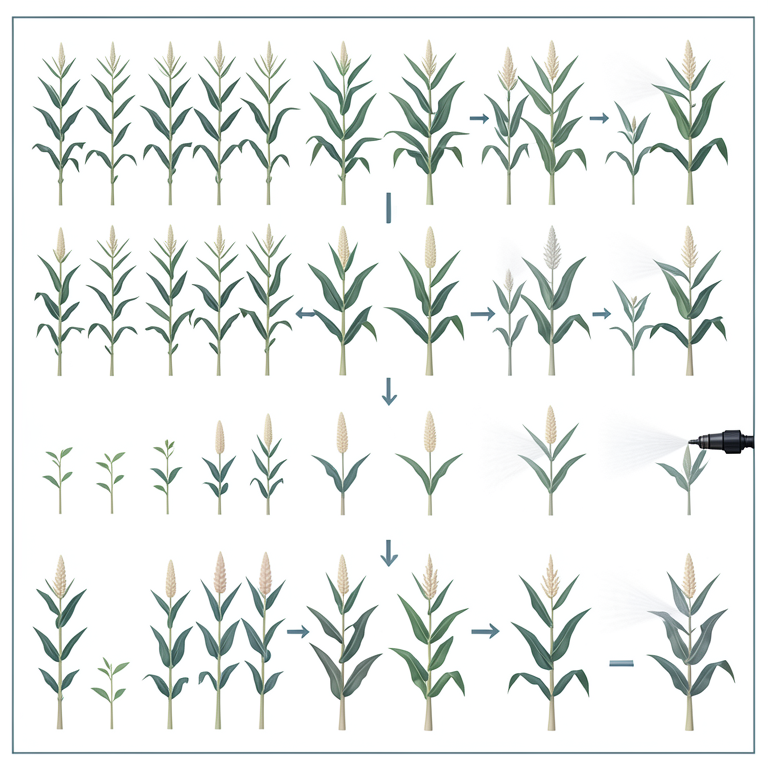
Experimental Treatment Matrix
AI-generated conceptual illustration (rabi maize (Zea mays L.) plants). It explains the idea and does not show study data.
View source evidence ↗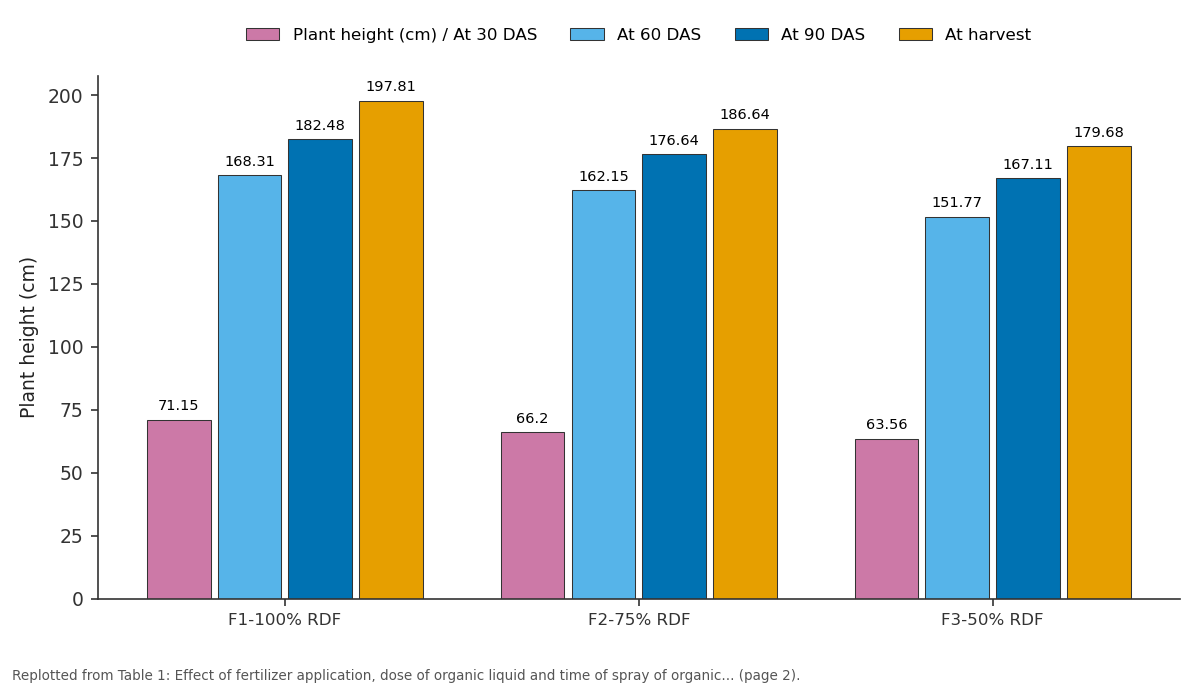
Plant height (cm) / At 30 DAS and At 60 DAS and more: F1-100% RDF vs F2-75% RDF vs F3-50% RDF
Replotted from Table 1 (page 2) of the original paper. Every bar is the paper's own table value.
View source evidence ↗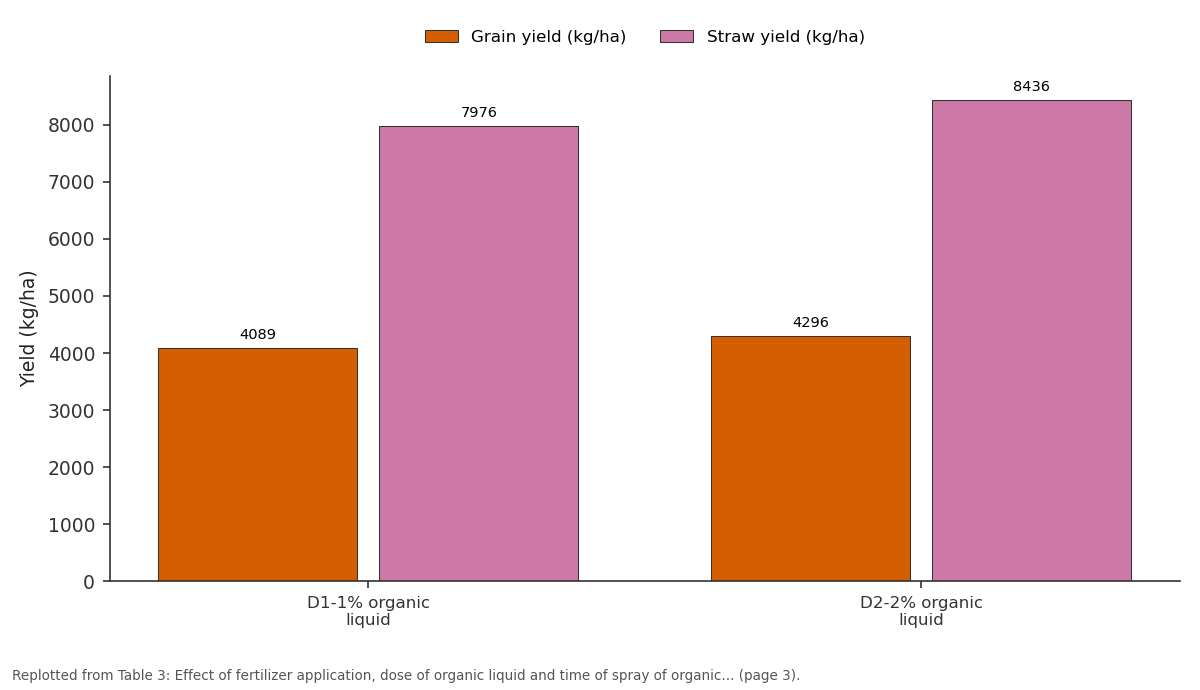
Grain yield (kg/ha) and Straw yield (kg/ha): D1-1% organic liquid vs D2-2% organic liquid
Replotted from Table 3 (page 3) of the original paper. Every bar is the paper's own table value.
View source evidence ↗Figures & tables
From the original paper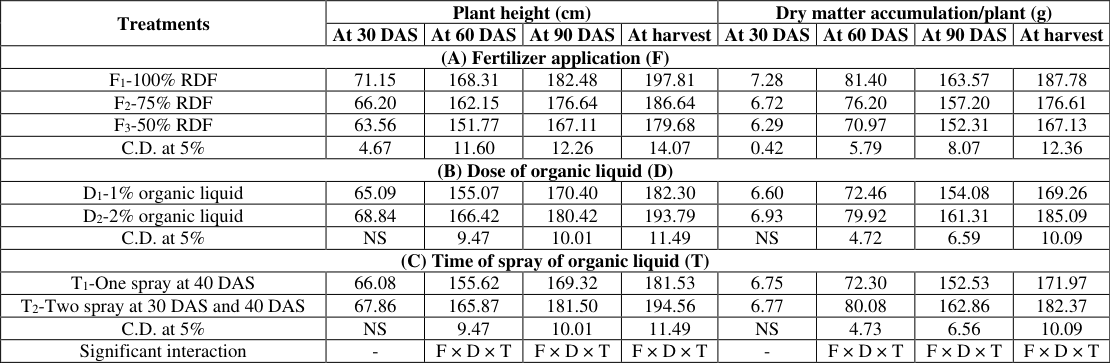 Table 1
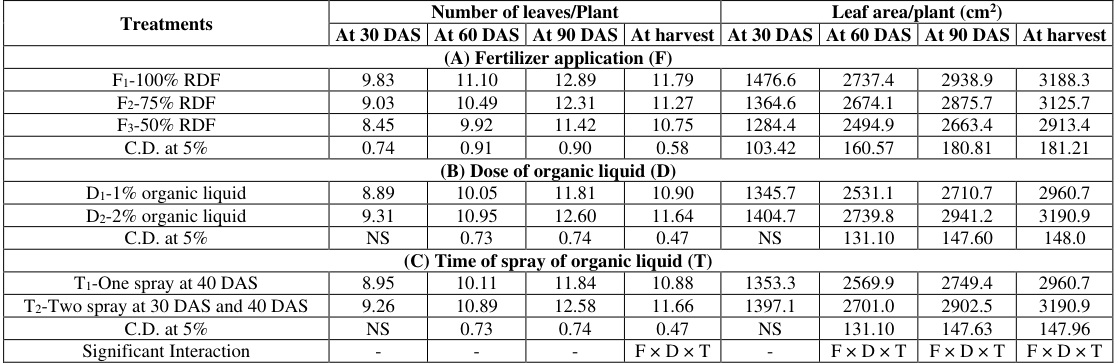 Table 2
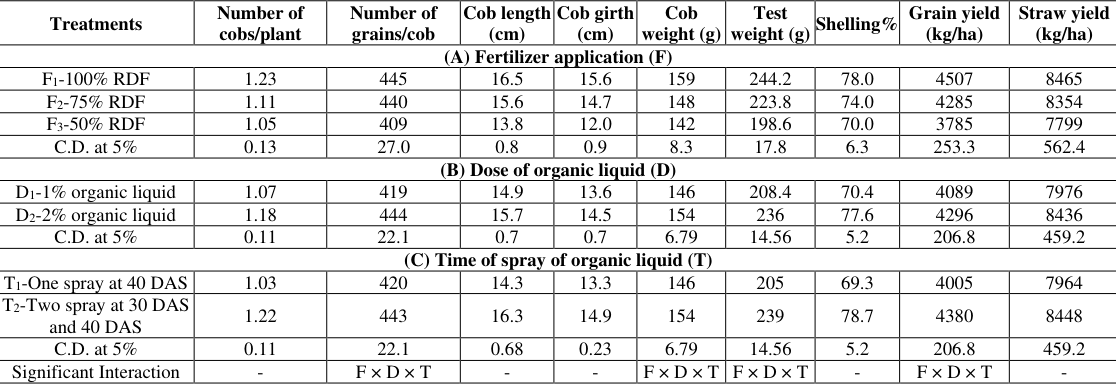 Table 3
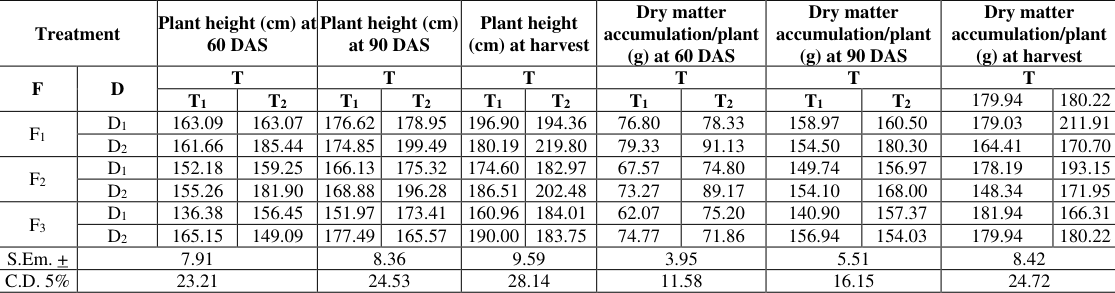 Table 4
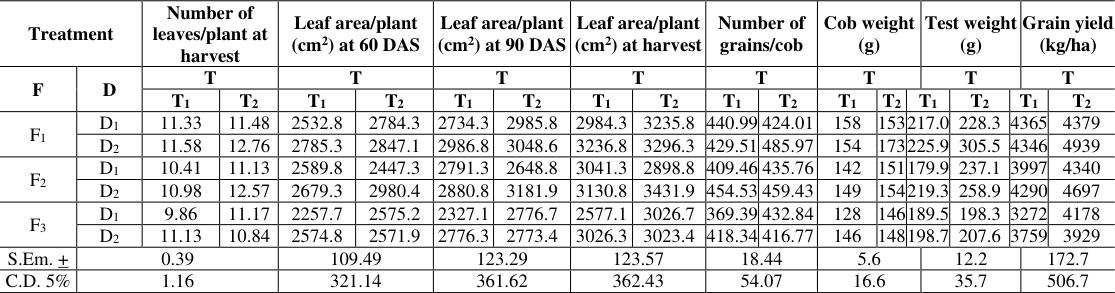 Table 5
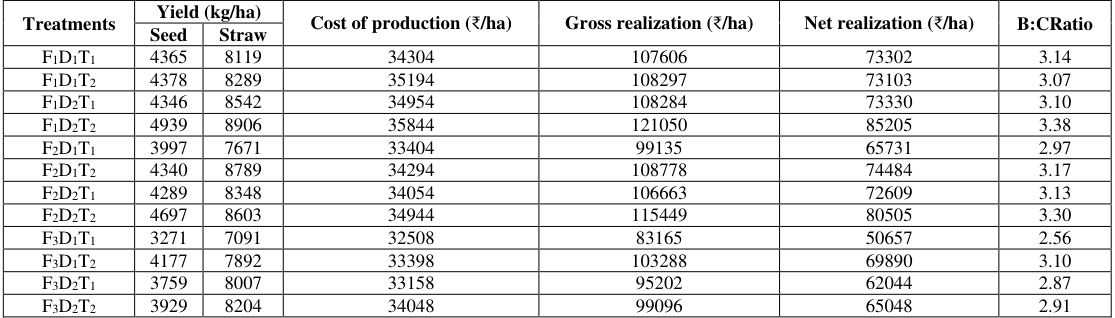 Table 6
Introduction
Maize (Zea mays L.) the "Queen of Cereals", popularly known as corn, is one of the most important cereals of the world, ranking third among the food crop, next to rice and wheat, both in respect of area and production. Nutrients applied in RDF are nitrogen and phosphorus from which Nitrogen is the key element in crop growth and is the most limiting nutrient in Indian soil. The paramount importance of nitrogen for increasing the yield has been widely accepted. Corn responds well to phosphatic fertilizers in almost all the soil types. It plays vital role in plant nutrition. Enriched banana pseudostem sap which is used for foliar spray in experiment as a organic liquid is a rich source of plant nutrient like K, Fe and plant growth regulators and it is obtained as a by-product during extraction of fiber from banana plant which is first time prepared by soil and water management research unit NAU, Navsari.
Material and Methods
A field experiment was conducted at the College Farm, Navsari Agricultural University, Navsari during rabi season of 2017-18. The soil of experimental field was clay in texture, low in organic carbon (0.44%) and available nitrogen (190.30 kg/ha), medium in available P 2 O 5 (32.15 kg/ha) and high in available K 2 O (364.23 kg/ha). The soil was found slightly alkaline (pH 7.8) in nature with normal electric conductivity of 0.145 dS/m. The experiment was laid out in randomized block design with factorial concept (FRBD) with three replications. Total twelve treatment combinations consisting of three levels of fertilizer viz., 100% RDF (120:60:00 N:P:K kg/ha), 75% RDF (90:45:00 N:P:K kg/ha) and 50% RDF (60:30:00 N:P:K kg/ha), two dose of organic liquid viz., 1% organic liquid (D 1 ) and 2% organic liquid (D 2 ) and various time of spray of organic liquid viz., one spray of organic liquid at 40 DAS (T 1 ) and two spray of organic liquid at 30 DAS and 40 DAS (T 2 ). Maize variety "GM-3" was sown on 21 November 2017 using seed rate 25 kg/ha with raw spacing 60 cm and plant spacing 20 cm and crop was harvested on 14 marches 2018.
The field observation on plant height, dry matter accumulation/plant, number of leaves/plant, leaf area/plant, number of cobs/plant, number of grains/cob, cob length, cob girth, cob weight, test weight, grain and straw yield was recorded. Five plants from each plot were randomly selected and observations like plant height, dry matter accumulation/plant, number of leaves/plant, leaf area/plant at 30, 60, 90 DAS and at harvest were recorded and averaged. The yields attributed were recorded at harvesting to assess the contribution of yield. The experimental data analyzed statistically by applying the technique of analysis of variance (ANOVA) prescribed for the design to test the significance of overall difference among treatments by the F test and conclusion were drawn at 5% probability level. Economics of treatments also worked out.
Result and Discussion
Result and Discussion
Fertilizer application
Successive levels of fertilizer significantly increased the growth attributes, yield and yield attributes. Significantly ), shelling% (78.00%) with higher grain yield (4507 kg/ha) and straw yield (8465 kg/ha) was recorded in treatment receiving 100% RDF, while the lowest in the 50% RDF but plant height, dry matter accumulation, number of leaves/plant, leaf area/plant, number of cobs/plant, grain yield, straw yield and shelling% remained at par with 75% RDF. The positive effect of nitrogen and phosphorus supplied through N and P fertilizers on growth could be as described to its effectiveness in providing a balanced nutritional both in rhizosphere and plant system. Nitrogen is considered to be a vitally important plant nutrient. It is an integral part of chlorophyll which is the primary absorber of light energy needed for photosynthesis. P is an important structural component of nucleic acid, protein, phospholipids and enzymes the overall improvement in crop growth and yield attributes as well as yield under the influence of nitrogen and phosphorus fertilization could possibly be better result of growth attributes, yield attributes and yield. The present investigation are in close conformity with the finding of Kumar et al. (2006) [5] , Mathukia et al. (2014) [7] Damor et al. (2017) [2] and Sadhukhan et al. (2018) [9] in maize crop.
Dose of organic liquid
Appraisal of data shows that significantly the highest plant height at 60, 90 DAS and at harvest (166.42 cm, 180.42 cm and 193.79 cm, respectively) dry matter accumulation at 60, 90 DAS and at harvest (79.92 g, 161.31 g and 185.09 g, respectively), number of leaves/plant at 60, 90 DAS and at harvest (10.95, 12.60 and 11.64, respectively) and leaf area/plant at 60, 90 DAS and at harvest (2739.8 cm 2 , 2942.2 cm 2 and 3190.9 cm 2 , respectively) Number of cobs/plant (1.18) and grains/cob (444), cob length (15.7 cm), cob girth (14.5 cm) Cob weight (154 g) and test weight (236 g), shelling% (77.60%) with higher grain yield (4296 kg/ha) and straw yield (8436 kg/ha) was recorded in 2% organic liquid over 1% organic liquid. Foliar application of organic liquid to plant in the adequate amount to fulfill the nutrients requirement of maize crop which increased nutrients uptake that lead to improvement in the growth attributes which effectively increased the yield parameters of maize crop. Singhal et al. (2015) [11] in cow pea and Barad et al. (2017) [1] in pearlmillet.
Time of spray of organic liquid
Data given in Table 1, 2 and 3 shows that significantly the highest plant height at 60, 90 DAS and at harvest (165.87 cm, 181.50 cm and 194.56 cm, respectively) dry matter accumulation at 60, 90 DAS and at harvest (80.08 g, 162.86 g and 182.37 g, respectively), number of leaves/plant at 60, 90 DAS and at harvest (10.89, 12.58 and 11.66, respectively) and leaf area/plant at 60, 90 DAS and at harvest (2701.0 cm 2 , 2902.5 cm 2 and 3190.9 cm 2 , respectively) Number of cobs/plant (1.22) and grains/cob (443), cob length 16.3 cm), cob girth (14.9 cm) Cob weight (154 g) and test weight (239 g), shelling% (78.70%) with higher grain yield (4380 kg/ha) and straw yield (8448 kg/ha) was recorded in two spray of organic liquid at 30 DAS and 40 DAS (T 2 ) over one spray of organic liquid at 40 DAS (T 1 ). The increase in growth attributes may be due to spray of organic liquid at most critical growth stages satisfied the nutrients requirement of maize crop which enhanced the photosynthetic activity of plant resulted in higher production of photosynthesis leads better growth of crop. Dekhane et al. (2017) [3] in wheat. Significantly higher cob weight of maize was recorded under treatment combination of F 1 D 2 T 2 and it remained at par with treatment combination of F 1 D 1 T 1 . Test weight (1000 seed weight) of rabi maize was noted significantly higher under treatment combination of F 1 D 2 T 2 . Grain yield (4939 kg/ha) of rabi maize was noted significantly higher under treatment combination of F 1 D 2 T 2 which remained statistically at par with treatment combination of F 2 D 2 T 2 over other treatment combinations. The increases in growth attributes like plant height, dry matter accumulation/plant, number of leaves/plant and leaf area/plant may be due to supply of essential plant nutrients at right time in right proportion through inorganic and organic forms of fertilizer by soil application as well as foliar application under these treatment combinations which resulted in higher production of photosynthates which utilizes by plant for development of sink of maize plant so better growth and yield parameters found under these treatment combinations which ultimately resulted in higher grain yield. These findings are in close vicinity with those reported by Loganathan and Wahab (2014) [6] in baby corn, Devi and Mani (2015) [4] in rice, Pal et al. (2015) [8] in sweet corn, Sahare (2015) [10] in rice crop and Dekhane et al. (2017) [3] in wheat.
| Treatments | Plant height (cm) | — | — | — | Dry matter accumulation/plant (g) | — | — | — |
|---|---|---|---|---|---|---|---|---|
| At 30 DAS | At 60 DAS | At 90 DAS | At harvest | At 30 DAS | At 60 DAS | At 90 DAS | At harvest | |
| (A) Fertilizer application (F) | ||||||||
| F1-100% RDF | 71.15 | 168.31 | 182.48 | 197.81 | 7.28 | 81.40 | 163.57 | 187.78 |
| F2-75% RDF | 66.20 | 162.15 | 176.64 | 186.64 | 6.72 | 76.20 | 157.20 | 176.61 |
| F3-50% RDF | 63.56 | 151.77 | 167.11 | 179.68 | 6.29 | 70.97 | 152.31 | 167.13 |
| C.D. at 5% | 4.67 | 11.60 | 12.26 | 14.07 | 0.42 | 5.79 | 8.07 | 12.36 |
| (B) Dose of organic liquid (D) | ||||||||
| D1-1% organic liquid | 65.09 | 155.07 | 170.40 | 182.30 | 6.60 | 72.46 | 154.08 | 169.26 |
| D2-2% organic liquid | 68.84 | 166.42 | 180.42 | 193.79 | 6.93 | 79.92 | 161.31 | 185.09 |
| C.D. at 5% | NS | 9.47 | 10.01 | 11.49 | NS | 4.72 | 6.59 | 10.09 |
| (C) Time of spray of organic liquid (T) | ||||||||
| T1-One spray at 40 DAS | 66.08 | 155.62 | 169.32 | 181.53 | 6.75 | 72.30 | 152.53 | 171.97 |
| T2-Two spray at 30 DAS and 40 DAS | 67.86 | 165.87 | 181.50 | 194.56 | 6.77 | 80.08 | 162.86 | 182.37 |
| C.D. at 5% | NS | 9.47 | 10.01 | 11.49 | NS | 4.73 | 6.56 | 10.09 |
| Significant interaction | - | F × D × T | F × D × T | F × D × T | - | F × D × T | F × D × T | F × D × T |
Table text extracted from the original PDF; superscript letters are shown inline. The original table image is below.
View original table image
Economics
Data presented in (2015) [8] in maize.
Conclusion
On the basis of results obtained in the present investigation, it can be concluded that rabi maize var. GM-3 should be fertilized with 75% RDF (90-45-00 NPK Kg/ha) along with foliar spray of 2% organic liquid (Enriched banana pseudostem sap) at 30 and 40 DAS under south Gujarat condition for obtaining more remunerative production with sustaining soil nutrients status.
Figures and tables from the paper
| Treatments | Number of leaves/Plant | — | — | — | Leaf area/plant (cm2) | — | — | — |
|---|---|---|---|---|---|---|---|---|
| At 30 DAS | At 60 DAS | At 90 DAS | At harvest | At 30 DAS | At 60 DAS | At 90 DAS | At harvest | |
| (A) Fertilizer application (F) | ||||||||
| F1-100% RDF | 9.83 | 11.10 | 12.89 | 11.79 | 1476.6 | 2737.4 | 2938.9 | 3188.3 |
| F2-75% RDF | 9.03 | 10.49 | 12.31 | 11.27 | 1364.6 | 2674.1 | 2875.7 | 3125.7 |
| F3-50% RDF | 8.45 | 9.92 | 11.42 | 10.75 | 1284.4 | 2494.9 | 2663.4 | 2913.4 |
| C.D. at 5% | 0.74 | 0.91 | 0.90 | 0.58 | 103.42 | 160.57 | 180.81 | 181.21 |
| (B) Dose of organic liquid (D) | ||||||||
| D1-1% organic liquid | 8.89 | 10.05 | 11.81 | 10.90 | 1345.7 | 2531.1 | 2710.7 | 2960.7 |
| D2-2% organic liquid | 9.31 | 10.95 | 12.60 | 11.64 | 1404.7 | 2739.8 | 2941.2 | 3190.9 |
| C.D. at 5% | NS | 0.73 | 0.74 | 0.47 | NS | 131.10 | 147.60 | 148.0 |
| (C) Time of spray of organic liquid (T) | ||||||||
| T1-One spray at 40 DAS | 8.95 | 10.11 | 11.84 | 10.88 | 1353.3 | 2569.9 | 2749.4 | 2960.7 |
| T2-Two spray at 30 DAS and 40 DAS | 9.26 | 10.89 | 12.58 | 11.66 | 1397.1 | 2701.0 | 2902.5 | 3190.9 |
| C.D. at 5% | NS | 0.73 | 0.74 | 0.47 | NS | 131.10 | 147.63 | 147.96 |
| Significant Interaction | - | - | - | F × D × T | - | F × D × T | F × D × T | F × D × T |
Table text extracted from the original PDF; superscript letters are shown inline. The original table image is below.
View original table image
| Treatments | Number of cobs/plant | Number of grains/cob | Cob length (cm) | Cob girth (cm) | Cob weight (g) | Test weight (g) | Shelling% | Grain yield (kg/ha) | Straw yield (kg/ha) |
|---|---|---|---|---|---|---|---|---|---|
| (A) Fertilizer application (F) | |||||||||
| F1-100% RDF | 1.23 | 445 | 16.5 | 15.6 | 159 | 244.2 | 78.0 | 4507 | 8465 |
| F2-75% RDF | 1.11 | 440 | 15.6 | 14.7 | 148 | 223.8 | 74.0 | 4285 | 8354 |
| F3-50% RDF | 1.05 | 409 | 13.8 | 12.0 | 142 | 198.6 | 70.0 | 3785 | 7799 |
| C.D. at 5% | 0.13 | 27.0 | 0.8 | 0.9 | 8.3 | 17.8 | 6.3 | 253.3 | 562.4 |
| (B) Dose of organic liquid (D) | |||||||||
| D1-1% organic liquid | 1.07 | 419 | 14.9 | 13.6 | 146 | 208.4 | 70.4 | 4089 | 7976 |
| D2-2% organic liquid | 1.18 | 444 | 15.7 | 14.5 | 154 | 236 | 77.6 | 4296 | 8436 |
| C.D. at 5% | 0.11 | 22.1 | 0.7 | 0.7 | 6.79 | 14.56 | 5.2 | 206.8 | 459.2 |
| (C) Time of spray of organic liquid (T) | |||||||||
| T1-One spray at 40 DAS | 1.03 | 420 | 14.3 | 13.3 | 146 | 205 | 69.3 | 4005 | 7964 |
| T2-Two spray at 30 DAS and 40 DAS | 1.22 | 443 | 16.3 | 14.9 | 154 | 239 | 78.7 | 4380 | 8448 |
| C.D. at 5% | 0.11 | 22.1 | 0.68 | 0.23 | 6.79 | 14.56 | 5.2 | 206.8 | 459.2 |
| Significant Interaction | - | F × D × T | - | - | F × D × T | F × D × T | - | F × D × T | - |
Table text extracted from the original PDF; superscript letters are shown inline. The original table image is below.
View original table image
| Treatment | — | Plant height (cm) at 60 DAS | — | Plant height (cm) at 90 DAS | — | Plant height (cm) at harvest | — | Dry matter accumulation/plant (g) at 60 DAS | — | Dry matter accumulation/plant (g) at 90 DAS | — | Dry matter accumulation/plant (g) at harvest | — |
|---|---|---|---|---|---|---|---|---|---|---|---|---|---|
| F | D | T | T | T | T | T | T | ||||||
| T1 | T2 | T1 | T2 | T1 | T2 | T1 | T2 | T1 | T2 | 179.94 | 180.22 | ||
| F1 | D1 | 163.09 | 163.07 | 176.62 | 178.95 | 196.90 | 194.36 | 76.80 | 78.33 | 158.97 | 160.50 | 179.03 | 211.91 |
| D2 | 161.66 | 185.44 | 174.85 | 199.49 | 180.19 | 219.80 | 79.33 | 91.13 | 154.50 | 180.30 | 164.41 | 170.70 | |
| F2 | D1 | 152.18 | 159.25 | 166.13 | 175.32 | 174.60 | 182.97 | 67.57 | 74.80 | 149.74 | 156.97 | 178.19 | 193.15 |
| D2 | 155.26 | 181.90 | 168.88 | 196.28 | 186.51 | 202.48 | 73.27 | 89.17 | 154.10 | 168.00 | 148.34 | 171.95 | |
| F3 | D1 | 136.38 | 156.45 | 151.97 | 173.41 | 160.96 | 184.01 | 62.07 | 75.20 | 140.90 | 157.37 | 181.94 | 166.31 |
| D2 | 165.15 | 149.09 | 177.49 | 165.57 | 190.00 | 183.75 | 74.77 | 71.86 | 156.94 | 154.03 | 179.94 | 180.22 | |
| S.Em. + | 7.91 | 8.36 | 9.59 | 3.95 | 5.51 | 8.42 | |||||||
| C.D. 5% | 23.21 | 24.53 | 28.14 | 11.58 | 16.15 | 24.72 |
Table text extracted from the original PDF; superscript letters are shown inline. The original table image is below.
View original table image
| Treatment | — | Number of leaves/plant at harvest | — | Leaf area/plant (cm2) at 60 DAS | — | Leaf area/plant (cm2) at 90 DAS | — | Leaf area/plant (cm2) at harvest | — | Number of grains/cob | — | Cob weight (g) | — | — | Test weight (g) | — | — | Grain yield (kg/ha) | — |
|---|---|---|---|---|---|---|---|---|---|---|---|---|---|---|---|---|---|---|---|
| F | D | T | T | T | T | T | T | T | T | ||||||||||
| T1 | T2 | T1 | T2 | T1 | T2 | T1 | T2 | T1 | T2 | T1 | T2 | T1 | T2 | T1 | T2 | ||||
| F1 | D1 | 11.33 | 11.48 | 2532.8 | 2784.3 | 2734.3 | 2985.8 | 2984.3 | 3235.8 | 440.99 | 424.01 | 158 | 153 | 217.0 | 228.3 | 4365 | 4379 | ||
| D2 | 11.58 | 12.76 | 2785.3 | 2847.1 | 2986.8 | 3048.6 | 3236.8 | 3296.3 | 429.51 | 485.97 | 154 | 173 | 225.9 | 305.5 | 4346 | 4939 | |||
| F2 | D1 | 10.41 | 11.13 | 2589.8 | 2447.3 | 2791.3 | 2648.8 | 3041.3 | 2898.8 | 409.46 | 435.76 | 142 | 151 | 179.9 | 237.1 | 3997 | 4340 | ||
| D2 | 10.98 | 12.57 | 2679.3 | 2980.4 | 2880.8 | 3181.9 | 3130.8 | 3431.9 | 454.53 | 459.43 | 149 | 154 | 219.3 | 258.9 | 4290 | 4697 | |||
| F3 | D1 | 9.86 | 11.17 | 2257.7 | 2575.2 | 2327.1 | 2776.7 | 2577.1 | 3026.7 | 369.39 | 432.84 | 128 | 146 | 189.5 | 198.3 | 3272 | 4178 | ||
| D2 | 11.13 | 10.84 | 2574.8 | 2571.9 | 2776.3 | 2773.4 | 3026.3 | 3023.4 | 418.34 | 416.77 | 146 | 148 | 198.7 | 207.6 | 3759 | 3929 | |||
| S.Em. + | 0.39 | 109.49 | 123.29 | 123.57 | 18.44 | 5.6 | 12.2 | 172.7 | |||||||||||
| C.D. 5% | 1.16 | 321.14 | 361.62 | 362.43 | 54.07 | 16.6 | 35.7 | 506.7 |
Table text extracted from the original PDF; superscript letters are shown inline. The original table image is below.
View original table image
| Treatments | Yield (kg/ha) | — | Cost of production (₹/ha) | Gross realization (₹/ha) | Net realization (₹/ha) | B:CRatio |
|---|---|---|---|---|---|---|
| Seed | Straw | |||||
| F1D1T1 | 4365 | 8119 | 34304 | 107606 | 73302 | 3.14 |
| F1D1T2 | 4378 | 8289 | 35194 | 108297 | 73103 | 3.07 |
| F1D2T1 | 4346 | 8542 | 34954 | 108284 | 73330 | 3.10 |
| F1D2T2 | 4939 | 8906 | 35844 | 121050 | 85205 | 3.38 |
| F2D1T1 | 3997 | 7671 | 33404 | 99135 | 65731 | 2.97 |
| F2D1T2 | 4340 | 8789 | 34294 | 108778 | 74484 | 3.17 |
| F2D2T1 | 4289 | 8348 | 34054 | 106663 | 72609 | 3.13 |
| F2D2T2 | 4697 | 8603 | 34944 | 115449 | 80505 | 3.30 |
| F3D1T1 | 3271 | 7091 | 32508 | 83165 | 50657 | 2.56 |
| F3D1T2 | 4177 | 7892 | 33398 | 103288 | 69890 | 3.10 |
| F3D2T1 | 3759 | 8007 | 33158 | 95202 | 62044 | 2.87 |
| F3D2T2 | 3929 | 8204 | 34048 | 99096 | 65048 | 2.91 |
Table text extracted from the original PDF; superscript letters are shown inline. The original table image is below.
View original table image
References
11 in the original paper- Barad HL, Patel CK, Patel DK, Sharma S, Joshi JR. Effect of organic manures and levels of inorganic fertilizers with and without banana sap on yield, quality and economics of summer pearlmillet (Pennisetum glaucum L.) under south Gujarat condition. International Journal of Science, Environment and Technology. 2017;6(4):2224-2231.
- Damor N, Patel GN, Patel NI, Patel CK, Vagela S. Response of rabi maize (Zea mays L.) to different dates of sowing and fertility levels. International Journal of Science, Environment and Technology. 2017;6(3):1905-1911.
- Dekhane SS, Mangave BD, Dumbre RB, Patel DJ. Effect of organic products on plant growth and yield of Wheat. International Journal of Horticulture, Agriculture and Food Science. 2017;1(4):2456-8635.
- Devi LN, Mani S. Effect of Seaweed Saps kappaphycus alvarezii and gracilaria on growth, yield and quality of rice. Indian Journal of Science and Technology. 2015;8(19):47610.
- Kumar A, Chillar RK, Gautam RC. Nutrient requirement of winter maize (Zea mays L.) based intercropping systems. Indian Journal of Agricultural Science. 2006;76(5):315-318.
- Loganathan V, Wahab K. Influence of Panchagavya foliar spray on the growth attributes and yield of baby corn (Zea mays L.) cv. COBC 1. Journal of Applied and Natural Science. 2014;6(2):397-401.
- Mathukia RK, Choudhary RP, Shivran A, Bhosale N. Response of rabi sweet corn to plant geometry and fertilizer. Current Biotica. 2014;7(4):294-298.
- Pal A, Dwivedi SK, Maurya PK, Kanwar P. Effect of seaweed saps on growth, yield, nutrient uptake and economic of maize (sweet corn). Journal of Applied and Natural Science. 2015;7(2):970-975.
- Sadhukhan R, Bohra JS, Choudhury S. Effect of fertility levels and cow urine foliar spray on growth and yield of wheat. International Journal of Current Microbiology and Applied Science. 2018;7(3):907-912.
- Sahare D. Impact of organic manures and liquid organic manures on growth, yield and quality of aerobic rice. The Ecoscan. 2015;9(1):563-567.
- Singhal V, Patel GG, Patel DH, Kumar U, Saini L. Effect of foliar application of water-soluble fertilizers on growth, yield and economics of vegetable cowpea production. The Ecoscan. 2015;7:79-83.