
Research article · 2024 · Full text
International Journal of Agriculture Extension and Social DevelopmentA study on entrepreneurial behaviour of self-help group members under National Rural Livelihood Mission (NRLM) in Lakhimpur Kheri District of Uttar Pradesh
Volume 7(1) · Pages 193–195 · DOI: 10.33545/26180723.2024.v7.i1c.208 ↗
Research areasInnovation and Socioeconomic DevelopmentMicrofinance and Financial Inclusion
Abstract
Author-writtenThe study was conducted during the year 2022-23 in Lakhimpur Kheri district of Uttar Pradesh state to measure the entrepreneurial behaviour of Self Help Group Members under National Rural Livelihood Mission. The three components of entrepreneurial behaviour were undertaken to evaluate the status of entrepreneurial behaviour such as, innovativeness, leadership ability and self-confidence. In Lakhimpur Kheri district, Nighasan and Pasgawan block was purposefully selected for the present study, since it is dominated with the maximum self-help group members were working under National Rural Livelihood Mission in areas. A sample of 100 Respondents was selected by using proportionate random sampling technique with personnel interview from two selected gram panchayat and 10 SHGs from each gram panchayat. Total 20 SHGs (each block total fifty respondents) were selected randomly. The results showed that majority of SHG members (57.00 percent) had a medium level of innovativeness, majority (55.00 percent) of SHG members had a medium level of leadership ability, large proportion (72.00 percent) of SHG members had a medium level of self-confidence and 64.00 percent of SHG members belonged to medium level of overall entrepreneurial behaviour. The study also revealed that variables i.e., age, caste, education, occupation, land holding and social participation was found highly significant and positively correlated with entrepreneurial behaviour of SHG members.
Summary
Source-checkedPlain-language reading of the full paper, prepared with AI and checked against the text. Each point links to the authors' own words.
Why it matters
- Entrepreneurship is considered a primary catalyst for development and a central force that drives economic activity. View evidence ↗
- Rural women make up approximately 50% of the total rural population and contribute significantly to national income and economic life. View evidence ↗
- The entrepreneurial behavior of women is a critical factor for the success of enterprises managed by women within self-help groups (SHGs). View evidence ↗
The question
- The study aimed to measure the entrepreneurial behavior of Self Help Group (SHG) members under the National Rural Livelihood Mission (NRLM) in the Lakhimpur Kheri district of Uttar Pradesh during 2022-23. View evidence ↗
What they did
- The Nighasan and Pasgawan blocks in Kheri District were purposively selected because they had the highest number of SHG members working under the NRLM. View evidence ↗
- A sample of 100 SHG members was selected using a proportionate random sampling technique, involving 10 SHGs from each of two selected gram panchayats. View evidence ↗
- Entrepreneurial behavior was evaluated based on three specific components: innovativeness, leadership ability, and self-confidence. View evidence ↗
- Data collection was performed via personal interviews using a pre-tested structured interview schedule. View evidence ↗
What they found
- Regarding innovativeness, 57.00% of SHG members showed a medium level, 31.00% a high level, and 12.00% a low level. View evidence ↗
- For leadership ability, 55.00% of members were at a medium level, 28.00% at a high level, and 17.00% at a low level. View evidence ↗
- Self-confidence levels were medium for 72.00% of members, high for 16.00%, and low for 12.00%. View evidence ↗
- Overall entrepreneurial behavior was medium for 64.00% of members, low for 21.00%, and high for 15.00%. View evidence ↗
- Age, caste, education, occupation, land holding, and social participation were all found to be highly significant and positively correlated with entrepreneurial behavior. View evidence ↗
- Extension contact showed a highly significant negative correlation with the entrepreneurial behavior of SHG members. View evidence ↗
What it means
- The authors conclude that the self-help group members in the studied area generally possess a medium level of entrepreneurial behavior. View evidence ↗
Visual summary
2 visualsIllustrations explain the paper; charts are replotted from the paper's own table values.
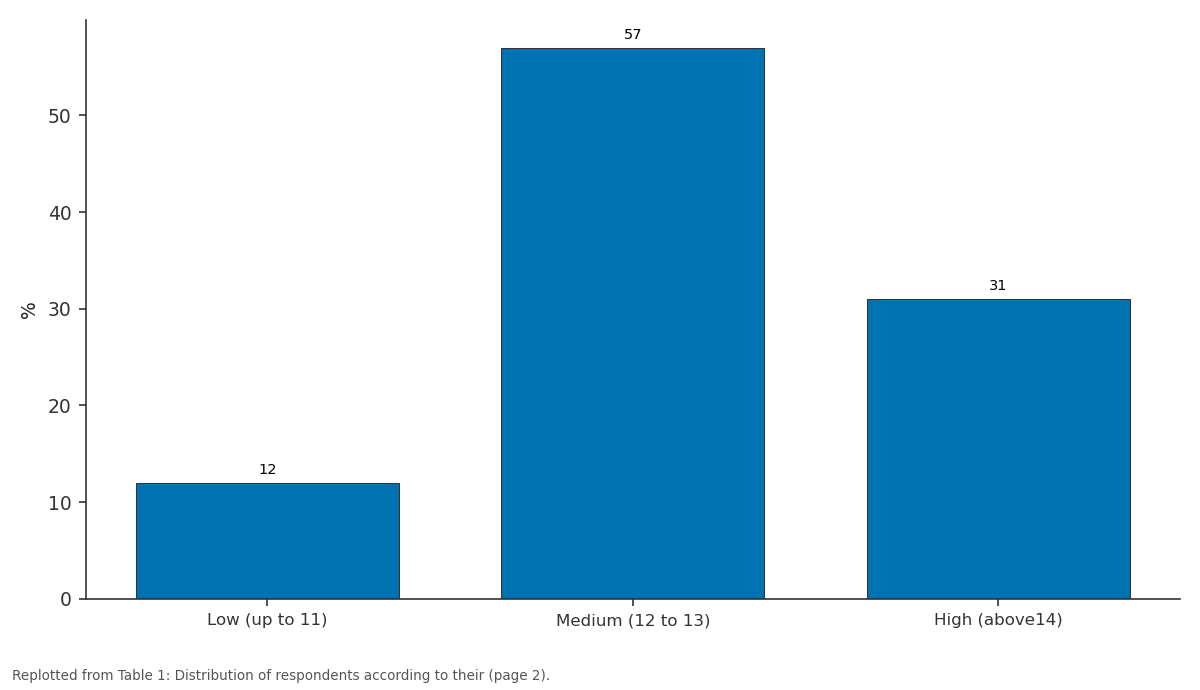
%: Low (up to 11) vs Medium (12 to 13) vs High (above14)
Replotted from Table 1 (page 2) of the original paper. Every bar is the paper's own table value.
View source evidence ↗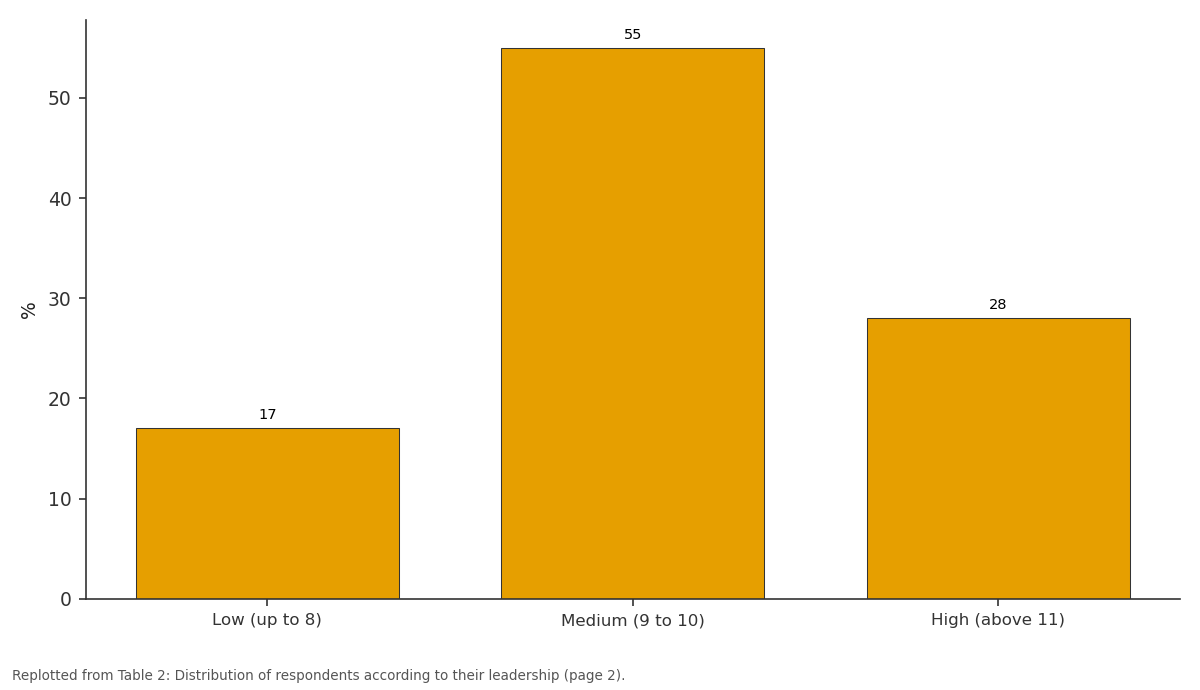
%: Low (up to 8) vs Medium (9 to 10) vs High (above 11)
Replotted from Table 2 (page 2) of the original paper. Every bar is the paper's own table value.
View source evidence ↗Figures & tables
From the original paper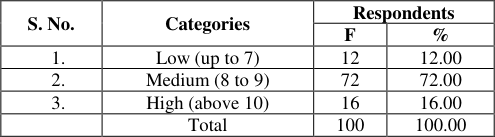 Table 3
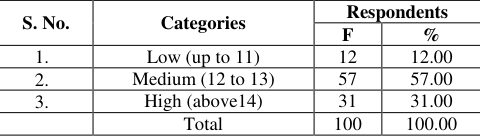 Table 1
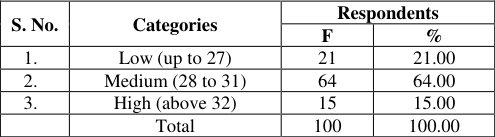 Table 4
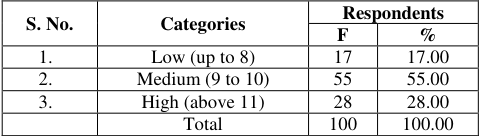 Table 2
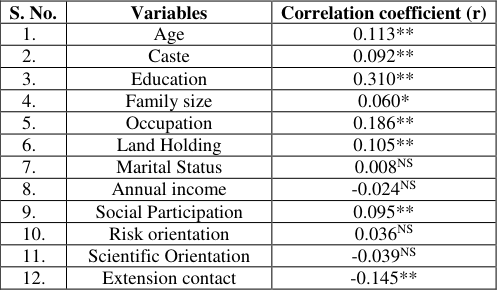 Table 5
Introduction
Entrepreneurial behaviour of SHG Members established under NRLM can be attributed as the change in knowledge, skills and attitude of entrepreneurs in the enterprise they have taken up (Bhati et al., 2014) [1] . Chatterjee (1992) [18] defined an entrepreneur as one who creates something new, undertakes risk, organizes production and handles the economic uncertainty. He termed entrepreneurship as the mission and entrepreneur as the missionary. Entrepreneurship is the central force driving economic activity and prime catalyst in development. Hence, it forms an essential component in the development (Kolgane et al., 2018) [7] . Women have vast entrepreneurial talents and that have transformed them from jobseekers to job givers. Initially women's activities in business were confined to making papad, pickles, jam, masala, squash, weaving embroidery, spinning and handicraft. Now their business has shifted towards non-traditional activities like engineering, and other technical fields. This is due to spread to technical education among women (Nirmala, 2004) [11] . Women entrepreneurship in economic development of any nation has been recognized for its significant contribution. The women folk can easily be considered as backbone of any nation and better half of the men in almost all spheres of community development, of which India is not an exception. Rural women, who constitute about 50 percent of total rural population, play an active role in all spheres of economic life and contribute richly towards national income (Jaiswal and Patel, 2012) [6] . Entrepreneurial behaviour of women is an important element for success of any enterprise undertaken by women in self-help groups (Kumar 2009) [8] . www.extensionjournal.com Kheri District, Nighasan and Pasgawan block was selected purposively based on highest number of self-help group members were working under National Rural Livelihood Mission in areas. The respondents were selected through proportionate random sampling technique from two selected gram panchayat and 10 SHGs from each gram panchayat. A Total 20 SHGs (each block total fifty respondents) were selected randomly. A total of 100 respondents who are members of SHGs were selected randomly. The data were collected with the help of pre-tested structured interview schedule by holding personal interview with self-help group members by the researcher. The three components of entrepreneurial behaviour were undertaken to evaluate the status of entrepreneurial behaviour such as, innovativeness, leadership ability and self-confidence. The component innovativeness were measured with the rating scale developed by Rao (1965) [21] and as followed by Shilpashree (2011) [19] were used with suiTable modifications. Leadership ability were measured with the three-point rating scale developed by Nanadapurkar (1980) and self-confidence were measured with the rating scale developed by Chaudhary (2006) [20] were used with suiTable modifications. Different statistical tools used were frequency, percentage, mean, standard deviation and Pearson's coefficient of correlation. Using mean and standard deviation for the variables (entrepreneurial behaviour and its components), the respondents were grouped into low, medium and high categories. 1, it can be described that majority (57.00 percent) of SHG members had a medium level of innovativeness; while 31.00 percent of members had a high level of innovativeness and 12.00 percent of members had a low level of innovativeness. As such most of the SHG members (57.00 percent) had a medium level of innovativeness the probable reason for this may be that most of members were educated and had medium to a high level of social participation. 2, it can be evident that majority (55.00 percent) of SHG members had a medium level of leadership ability; while 28.00 percent of members had a high level of leadership ability and 17.00 percent of members had a low level of leadership ability. The possible reason behind medium to the high level of leadership ability might be training and exposure of SHG members at various institutes under NRLM programme as well as their contact with various institutions. 3, it can be shown that large proportion (72.00 percent) of SHG members had a medium level of selfconfidence, while 16.00 percent of members had a high level of self-confidence and 12.00 percent members had a low level of self-confidence. The medium self-confidence level of SHG members maybe because of education, income and social participation of the members. It could be seen from Table 4. That 64.00 percent of SHG members belonged to medium level of entrepreneurial behaviour category followed by (21.00 percent) as low and (15.00 percent) high level of entrepreneurial behaviour. The majority of the SHG members were having a medium level of entrepreneurial behaviour. The middle age group and most of them where literate might be one of the reasons for this phenomenon. However, it is the reflection of all the major components of entrepreneurial behaviour. As the SHG members possess a medium level of innovativeness, leadership ability and self-confidence, which might have contributed to medium level of entrepreneurial behaviour.
| S. No. | Categories | Respondents | — |
|---|---|---|---|
| F | % | ||
| 1. | Low (up to 27) | 21 | 21.00 |
| 2. | Medium (28 to 31) | 64 | 64.00 |
| 3. | High (above 32) | 15 | 15.00 |
| Total | 100 | 100.00 |
Table text extracted from the original PDF; superscript letters are shown inline. The original table image is below.
View original table image
Results and Discussion
Results and Discussion
Innovativeness
Innovativeness
Leadership ability
Leadership ability
Self-confidence
Self-confidence
Overall entrepreneurial behaviour
Overall entrepreneurial behaviour
Relationship between entrepreneurial behaviour and personal and socio-economic variables
The Table 5. Focuses that out of twelve variables i.e., age, caste, education, occupation land holding and social participation was found highly significant and positively correlated with entrepreneurial behaviour of SHG members. Only single variable like family size were found significant www.extensionjournal.com and positive correlated with entrepreneurial behaviour of SHG members. Marital status and risk orientation were found non-significant and positive correlated with entrepreneurial behaviour of SHG members. Extension contact were found highly significant and negatively correlated with entrepreneurial behaviour of SHG members. The last two variables annual income and scientific orientation was found non-significant and negatively correlated with entrepreneurial behaviour of SHG members. Extension contact -0.145** *Significant at 0.05 % level NS-non-significant
| S. No. | Variables | Correlation coefficient (r) |
|---|---|---|
| 1. | Age | 0.113** |
| 2. | Caste | 0.092** |
| 3. | Education | 0.310** |
| 4. | Family size | 0.060* |
| 5. | Occupation | 0.186** |
| 6. | Land Holding | 0.105** |
| 7. | Marital Status | 0.008NS |
| 8. | Annual income | -0.024NS |
| 9. | Social Participation | 0.095** |
| 10. | Risk orientation | 0.036NS |
| 11. | Scientific Orientation | -0.039NS |
| 12. | Extension contact | -0.145** |
Table text extracted from the original PDF; superscript letters are shown inline. The original table image is below.
View original table image
Conclusion
According to the studies findings Majority (57.00 percent) of SHG members had a medium level of innovativeness and 55.00 percent of SHG members had a medium level of leadership ability, large proportion (72.00 percent) of SHG members had a medium level of self-confidence. The study also revealed that the majority of the SHG members (64.00 percent) were belonged to medium entrepreneurial behaviour category followed by (21.00 percent) as low and (15.00 percent) high level of entrepreneurial behaviour. This study indicates all self-help Group Members have medium level of entrepreneurial behaviour.
Figures and tables from the paper
| S. No. | Categories | Respondents | — |
|---|---|---|---|
| F | % | ||
| 1. | Low (up to 7) | 12 | 12.00 |
| 2. | Medium (8 to 9) | 72 | 72.00 |
| 3. | High (above 10) | 16 | 16.00 |
| Total | 100 | 100.00 |
Table text extracted from the original PDF; superscript letters are shown inline. The original table image is below.
View original table image
| S. No. | Categories | Respondents | — |
|---|---|---|---|
| F | % | ||
| 1. | Low (up to 11) | 12 | 12.00 |
| 2. | Medium (12 to 13) | 57 | 57.00 |
| 3. | High (above14) | 31 | 31.00 |
| Total | 100 | 100.00 |
Table text extracted from the original PDF; superscript letters are shown inline. The original table image is below.
View original table image
| S. No. | Categories | Respondents | — |
|---|---|---|---|
| F | % | ||
| 1. | Low (up to 8) | 17 | 17.00 |
| 2. | Medium (9 to 10) | 55 | 55.00 |
| 3. | High (above 11) | 28 | 28.00 |
| Total | 100 | 100.00 |
Table text extracted from the original PDF; superscript letters are shown inline. The original table image is below.
View original table image
References
20 in the original paper- Bhati NK, Upadhyay R, Upadhyay B. Entrepreneurial Behavior of Rural Women in Dairying. Indian Journal Extension Education. 2014;22(1):153-155.
- Bindu N, Shivalingaiah YN, Shwetha NV. Entrepreneurial Behaviour of Flower Growers in Tumkur District of Karnataka State. International Journal Current Microbiology and Allied Science. 2019;8(3):656-663.
- Boruah R, Borua S, Deka CR, Borah D. Entrepreneurial behaviour of tribal winter vegeTable growers in Jorhat District of Assam. Ind. Res. J Ext. Edu. 2015;15(1):6569.
- Chithra YD, Meti SK, Maraddi GN, Manjunatha BN. Entrepreneurial behaviour of pigeon pea seed growers: A Study in Raichur District of Karnataka, India. International Journal of Current Microbiology and Allied Sciences. 2018;7(3):1754-1762.
- Dhakad K, Wankhede A, Choudhary S, Verma DK. Study on entrepreneurial behaviour of sugarcane growers in Guna District (M.P.). International Journal of Advance Research, Ideas and Innovation in Technology. 2018;4(5):564-566.
- Jaiswal A, Patel MM. Entrepreneurial Behaviour of Rural Women. Indian Res. J Ext. Edu. 2012;12(1):5559.
- Kolgane BT, Suramwad SR, Dound RV. Study the entrepreneurial behaviour of pomegranate growing farmers in Solapur District of Maharashtra State. Journal of Pharmacognosy and Phytochemistry. 2018;SP1:2956-2958.
- Kumar RP. Study on group dynamics and entrepreneurial behaviour of women in self-help groups. Ph.D. Thesis, Submitted to University of Agricultural Sciences, Bangalore, India, 2009.
- Kumar V, Goyal TC. Entrepreneurial behaviour of dairy farmers in Udaipur district of Rajasthan. The Pharma Innovation Journal. 2021;10(10):28-32.
- Mariammal R, Seethalakshmi M. Entrepreneurial Behaviour of Dairy Farm Women in Dindigul District of Tamil Nadu. International Journal of Science, Environment and Technology. 2017;6(4):2539-2547.
- Nirmala BD. Women Entrepreneurs, Kanaklata Mahila Urban Co-operative bank, Kurukshetra, 2004;53(1):43.
- Pawar LD, Dubey MK, Bilaiya S. Entrepreneurial Behaviour of Potato Growers in Chhindwara District of Madhya Pradesh. International Journal of Agriculture Sciences. 2016;17(1):427-432.
- Sabale AN, Suradkar DD, Thombre BM. Entrepreneurial behaviour of farmers in Marathwada region. Agricultural Update. 2014;9(1):25-30.
- Sangma CA, Chauhan JK, Singh RJ, Das D. Entrepreneurial behaviour of Women Self-Help Group members in Meghalaya. Indian Journal of Hill Farming. 2019;32(1):63-67.
- Singh S, Mishra BP, Ojha PK, Kalia A, Shukla G, Gupta BK, et al. Entrepreneurial Behaviour and Constraint Analysis of SHG Members of National Rural Livelihood Mission (NRLM) in Banda District (U.P.). Journal of Extension Systems. 2021;37(2):7680.
- Thorat GN, Vahora SG, Trivedi MM. Management Efficiency of Poultry Owners. Guj. J Ext. Edu. 2016;27:18-20.
- Chatterjee S, Lubatkin MH, Schweiger DM, Weber Y. Cultural differences and shareholder value in related mergers: Linking equity and human capital. Strategic management journal. 1992 Jun;13(5):319-34.
- Chandrappa CP, Shilpashree CB, Karthik MR, Govindappa M, Sadananda TS. Antibacterial and Antioxidant Activities of Adiantum pedatum L. Journal of Phytology, 2011 Jan 19, 3(1).
- Chandran SP, Chaudhary M, Pasricha R, Ahmad A, Sastry M. Synthesis of gold nanotriangles and silver nanoparticles using Aloevera plant extract. Biotechnology progress. 2006;22(2):577-83.
- Rao CR. On discrete distributions arising out of methods of ascertainment. Sankhyā: The Indian Journal of Statistics, Series A. 1965 Dec 1:311-24.