
Research article · 2024 · Full text
International Journal of Advanced Biochemistry ResearchAnalysis of wind powered aerator on water quality in shrimp farming
Volume 8(1S) · Pages 98–100 · DOI: 10.33545/26174693.2024.v8.i1sb.293 ↗
Research areasWater Quality Monitoring TechnologiesSolar-Powered Water Purification MethodsAquaculture Nutrition and Growth
Abstract
Author-writtenAim: This paper presents the analysis of wind powered aerator on water quality in shrimp farming. Methodology: To study the effect of wind powered aeration on water quality parameters, three tanks of 12m x 4m x 1m each were selected. One tank was kept as a control (T1). In the second tank (T2) windmill operated aerator was installed. In third tank (T3) electric powered paddle wheel aerator (1hp) was installed and the aerator was run between 01.00 and 06.00 hours. The water quality parameters such as DO, Temperature and pH were recorded daily. Results: The highest value of DO obtained was 6.21 and 6.25 mg/l with wind powered aerator aqua tank and electric powered aerator tank respectively. The differences in temperature values of the three experimental tanks were not appreciable. The pH values of the experimental tanks were in the range of 7.8 to 8.7. Conclusion: The dissolved oxygen (DO), dawn DO values in the wind powered aerated tank were within the standard limit of shrimp production.
Summary
Source-checkedPlain-language reading of the full paper, prepared with AI and checked against the text. Each point links to the authors' own words.
Why it matters
- India is the world's leading producer and exporter of farmed shrimp. View evidence ↗
- Shrimp farmers face challenges operating electric aerators due to electricity costs and unreliable power grids. View evidence ↗
- Aeration is used to boost aquatic animal production when dissolved oxygen (DO) levels drop below 2 mg/l. View evidence ↗
The question
- The study aims to analyze how a wind-powered aerator affects water quality in shrimp farming. View evidence ↗
What they did
- Wild white shrimp (Penaus indcus) with an average weight of 2.1±0.12 g were stocked at a density of 10 shrimp per square meter. View evidence ↗
- Over a 45-day period, dissolved oxygen (DO), temperature, and pH were measured daily at five specific time intervals. View evidence ↗
What they found
- After day 26, the electric aerator (T3: 5.0–5.67 mg/l) maintained higher DO levels than the wind-powered aerator (T2: 4.5–5.25 mg/l). View evidence ↗
- At dawn, DO levels ranged from 2.75–4.5 mg/l in the control, 3.75 mg/l in the wind-powered tank, and 3.75–5.5 mg/l in the electric-powered tank. View evidence ↗
- Water temperatures remained similar across all tanks, ranging from approximately 24.96 °C to 29.90 °C. View evidence ↗
- Aeration had no significant effect on pH, which remained between 7.8 and 8.7 across all treatments. View evidence ↗
What it means
- The authors conclude that wind power is a viable alternative for pond aeration in coastal areas to reduce electricity consumption. View evidence ↗
- The wind-powered aerator maintained DO and dawn DO levels within the standard limits required for shrimp production. View evidence ↗
Figures & tables
From the original paper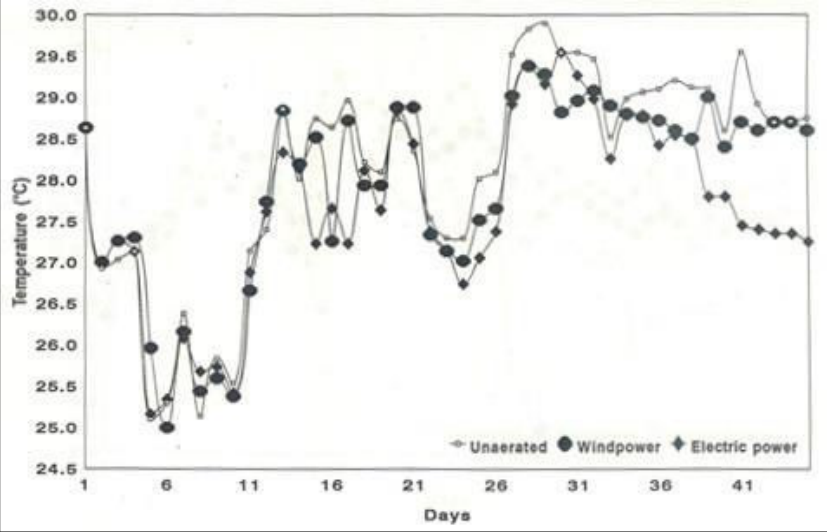 Figure 1
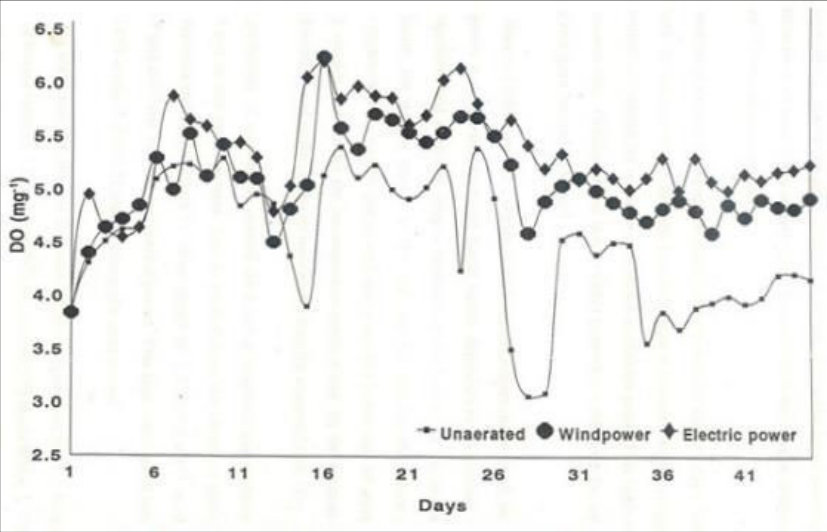 Figure 2
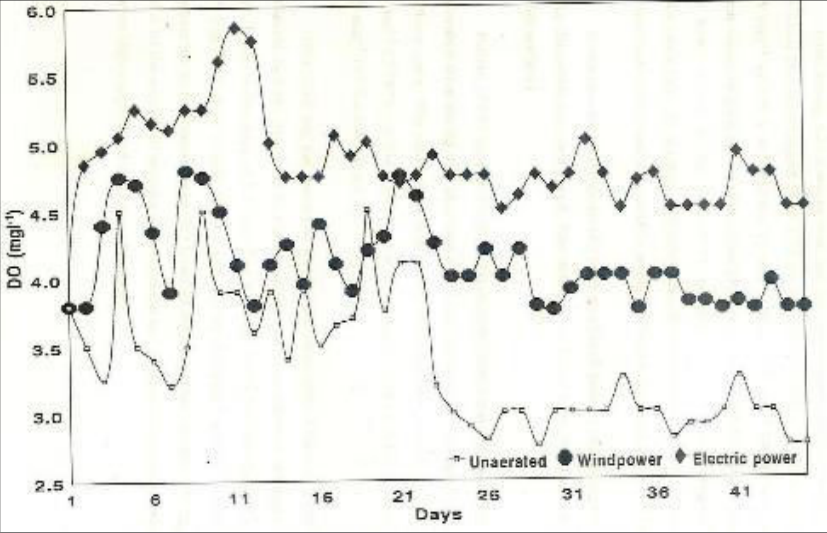 Figure 3
Introduction
India is the largest global producer and exporter of farmed shrimp. India is blessed with long coastline and the estimated brackish water area suitable for undertaking shrimp cultivation. India has around 11.91 lakhs ha area spread over 10 states and union. Shrimp production in India touched 6 lakh tonnes last year during 2017-18. The periodical electrical power cut, grid voltage, fluctuation and cost of electricity make the farmers difficult to operate electric aerators continuously. As most of the brackish water shrimp farms are mostly situated along the coastal line, a wind potential can be utilized for energizing the aerators to overcome the above said problems. Aeration is given to intensify the production of aquatic animals in ponds (Boyd, 1982) [1] , when the Dissolved Oxygen (DO), concentration falls below 2 mg/l (Boyd and Watten, 1989) [2] . Aerators are reported to be useful not only for increasing DO level, but also to enhance water circulation and helps in balancing the temperature throughout the pond (Babu Rao, 1993) [3] . By utilizing the naturally available, pollution free wind power for energizing the aerators the electricity cost can be reduced. The rapid growth of shrimp farms in northwest Mexico and other countries, such as China, India, Indonesia, and Vietnam, is being driven by the increasing demand for fish and seafood proteins worldwide (FAO, 2020; Naylor et al., 2021) [5,6] . Indian shrimp farming sector has undergone transformational shift that has put the country at the top of the list of global farmed shrimp productions (Mohanty, 2023) [7] . This paper presents the analysis of wind powered aerator on water quality in shrimp farming.
Materials and Methods
To study the effect of wind powered aeration on water quality parameters, three tanks of 12m x 4m x 1m each were selected. One tank was kept as a control (T 1 ). In the second tank (T 2 ) windmill operated aerator was installed. In third tank (T 3 ) electric powered paddle wheel aerator (1hp) was installed and the aerator was run between 01.00 and 06.00 hours. Juveniles of white shrimp (Penaus indcus) having an average body weight of 2.1±0.12 g were collected from the wild and stocked in the tanks at the rate of 10 numbers/ m 2 base tank area. The water quality parameters such as DO, Temperature and pH were recorded daily at 06.00, 10.00, 14.00, 18.00 and 22.00 hours [8] . The experiment was conducted for 45 days. A portable anemometer and Oxygen meter (Lutron make, Taiwan) was used to measure wind velocity, temperature and dissolved oxygen (DO).
Results and Discussion
The daily mean values of water quality parameters viz. dissolved oxygen and pH for the three experiments were analyzed.
Effect of aeration on water temperature
The temperature were in the range of 25.10 to 29.90 °C for T 1, 24.96 to 29.54 °C for T 2 and 25.16 to 29.54 °C for T 3 . In general low water temperatures were observed in the aerated tanks (T 2 and T 3 ). However the difference in the temperatures of the three tanks was not appreciable. The relationship between temperature and DO of the tanks are graphically shown in Fig1. The concentrations of DO at saturation decreased as the temperature increased as was observed Colt (1984) [4] . and4.00 to 6.25 mg/l for treatment T 3 . A lowest DO value of 3.1 was observed for treatment T 1 . The highest value of DO 6.21 and 6.25mg/l was observed in treatment 2 and 3 respectively. The DO levels of the three treatments followed a uniform pattern upto 15 days, which is due to the poor demand of DO during the initial period and also the saturation level attained in the aerated tanked beyond which the oxygen content cannot be increased by any external aerators. After 15 days, variations were noticed in DO level due to the growth of shrimps and biological substances accumulating at the bottom. The lowest DO value of 3.1 mg/1 on 28 th day and DO levels below 3.75 mg/1 were observed after 23 rd day. Rise in temperature recorded during that period (i.e) after 26 th day, also might have contributed for reduced oxygen levels as suggested by Colt (1984) [4] . After 26 th day, DO levels of T 2 were between 4.5 and 5.25 mg/l while the values were between 5.0 and 5.67 mg/l for T 3 . The high values of oxygen in T 3 may be due to the high performance of electric aerator than wind powered aerator. Dissolved oxygen in the pond water is reported to go down during dawn (Boyd, 1982) [1] due to the continuous respiration during the night with no production or addition of oxygen by photosynthesis. The dawn DO levels of the three treatments ranged from 2.75 to 4.5 mg/l for T 1 , 3.75 mg/l for T 2 and 3.75 to 5.5 mg/lfor T 3 (Fig 3). Pattern of dawn DO level was not uniform upto 20 days. After 22 nd day, the dawn DO level of the tanks followed similar trend for all the treatments. The low dawn DO level may also be due to the growth of the shrimp and accumulation of organic substances which demand high O 2 level.
Effect of DO at Dawn
Effect of DO at Dawn
Effect on pH
The pH values ranged from 7.8 to 8.5 for T 1 , 7.9 to 8.7 for T 2 and T 3 . As the pH values for the treatments were in the range of 7.8 to 8.7 in all the three treatments, it was clear that there was no effect of aeration of pH level.
Conclusion
The freely available wind power in coastal areas can be used for aeration of aqua ponds, which greatly reduces the consumption of electricity. The highest value of DO obtained was 6.21 and 6.25 mg/l with wind powered aerator aqua tank and electric powered aerator tank respectively. The differences in temperature values of the three experimental tanks were not appreciable. The pH values of the experimental tanks were in the range of 7.8 to 8.7. The dissolved oxygen (DO), dawn DO values in the wind powered aerated tank were within the standard limit of shrimp production.
Figures and tables from the paper
References
6 in the original paper- Boyd CE, Watten JB. Aeration systems in Aquaculture. Aquatic Sciences. 1989;35(1):425-472.
- Babu Rao M. Aquaculture: Prospects and problems. Aqua International. 1993;111:316.
- FAO. The state of world fisheries and aquaculture 2020, in Sustainability in action(Roma: FAO (Food and Agriculture Organization)); c2020.
- Naylor RL, Hardy RW, Buschmann AH, Bush SR, Cao L, Klinger DH, et al. A 20-year retrospective review of global aquaculture. Nature. 2021;591:551-563.
- Mohanty, Surya. Indian Shrimp Farming Industry: A Fact Sheet. Newsletter, Jalaja-2022 (Orissa Retired Fisheries Technical Officer's Association); c2023. p. 11-16.
- Hollerman, William & Boyd, Claude. Nightly Aeration to Increase Production of Channel Catfish. Transactions of the American Fisheries Society. 1980;109:446-452.