
Research article · 2021 · Full text
International Journal of Advanced Biochemistry ResearchDecomposition by Photocatalysis using Nano-TiO2
Volume 5(2) · Pages 58–60 · DOI: 10.33545/26174693.2021.v5.i2a.284 ↗
Research areasEconomic and Technological Innovation
Abstract
Author-writtenThis research paper delves into the decomposition of organic pollutants using photocatalysis facilitated by nano-sized Titanium Dioxide (nano-TiO2). Focusing on the efficiency and mechanisms of nano-TiO2 as a photocatalyst, the study explores its potential applications in environmental remediation and sustainable waste management. Through systematic experimentation and analysis, this paper aims to contribute significantly to the field of environmental science and photocatalytic technology.
Summary
Source-checkedPlain-language reading of the full paper, prepared with AI and checked against the text. Each point links to the authors' own words.
Why it matters
- Increasing levels of organic pollutants are a major threat to human health and the global environment. View evidence ↗
- Nano-sized Titanium Dioxide (nano-TiO2) is a preferred photocatalyst because it is stable, non-toxic, and possesses strong oxidizing power. View evidence ↗
- When exposed to UV light, nano-TiO2 generates reactive oxygen species (ROS) that can break down organic pollutants. View evidence ↗
The question
- The study aims to evaluate how efficiently nano-TiO2 decomposes various organic pollutants. View evidence ↗
- The research specifically examines how catalyst concentration, UV light intensity, and exposure time affect the decomposition process. View evidence ↗
What they did
- The nano-TiO2 particles used in the experiments were synthesized using the sol-gel method. View evidence ↗
- Experiments were conducted in a controlled laboratory by exposing mixtures of organic pollutants and nano-TiO2 to UV light. View evidence ↗
- Spectroscopic techniques were used to measure the effectiveness of the pollutant decomposition. View evidence ↗
What they found
- The increase in decomposition rates with higher catalyst concentrations is attributed to the provision of more active sites for the reaction. View evidence ↗
- Decomposition efficiency improves significantly as the duration of UV exposure increases. View evidence ↗
- Pollutant A was the most easily decomposed, likely because its chemical structure is more susceptible to oxidation by reactive oxygen species. View evidence ↗
What it means
- The authors conclude that nano-TiO2 is an effective photocatalyst for the decomposition of organic pollutants. View evidence ↗
- The authors recommend further research to optimize and scale up the process for practical, real-world environmental applications. View evidence ↗
- A limitation for practical use is that while higher UV intensities increase decomposition, they also increase energy consumption. View evidence ↗
Visual summary
3 visualsIllustrations explain the paper; charts are replotted from the paper's own table values.
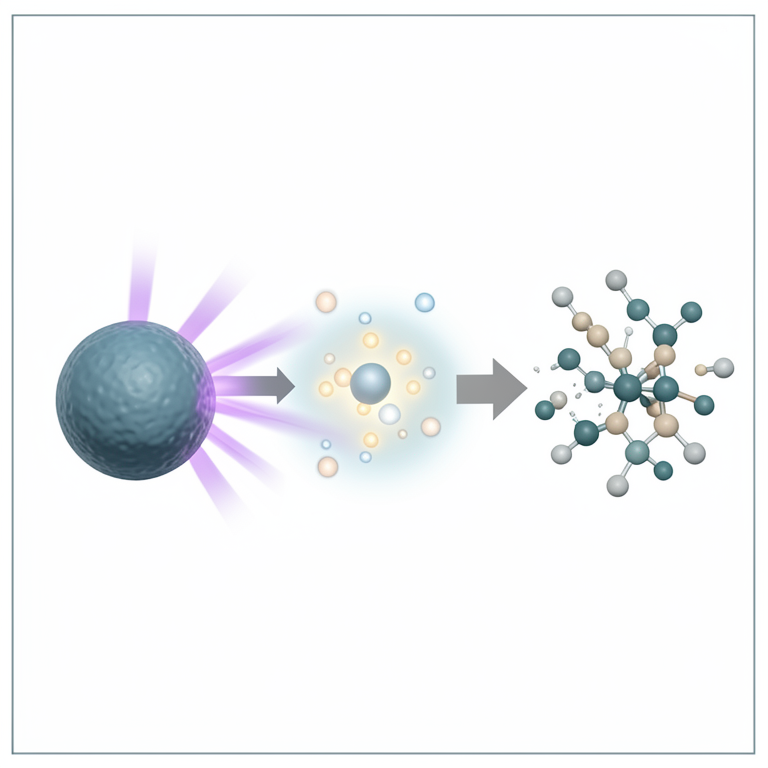
Mechanism of Nano-TiO2 Photocatalysis
AI-generated conceptual illustration (nano-sized titanium dioxide particles and organic pollutant molecules in water). It explains the idea and does not show study data.
View source evidence ↗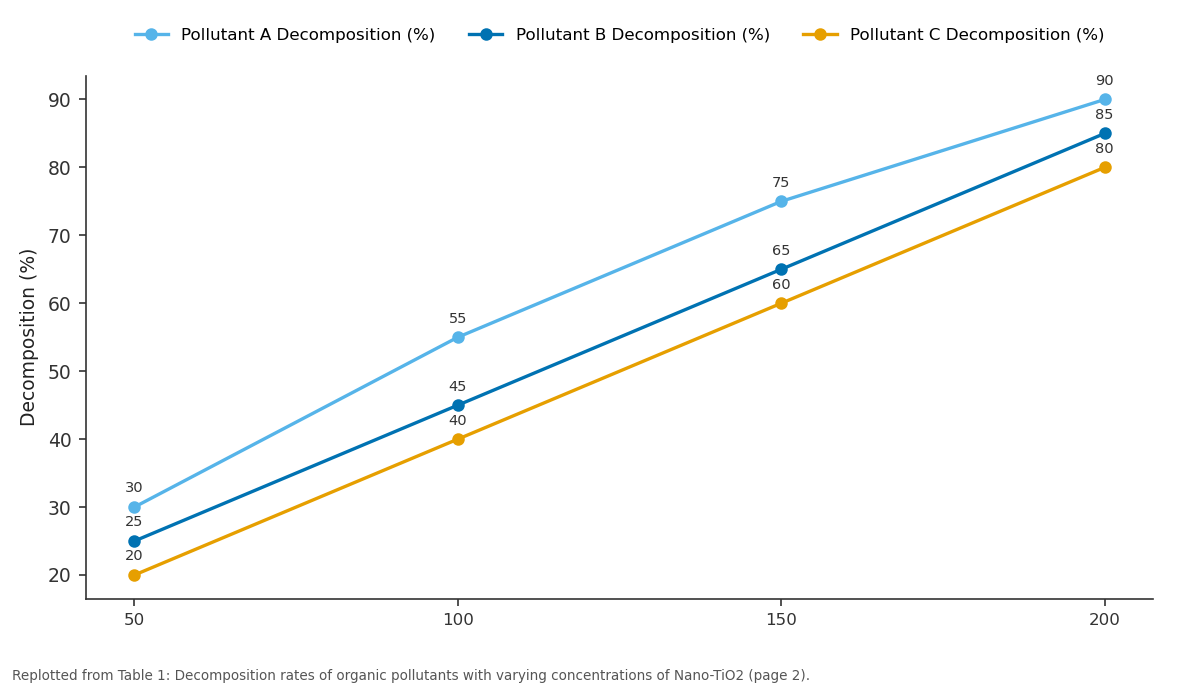
Pollutant A Decomposition (%) and Pollutant B Decomposition (%) and more: 50 vs 100 vs 150 vs 200
Replotted from Table 1 (page 2) of the original paper. Every bar is the paper's own table value.
View source evidence ↗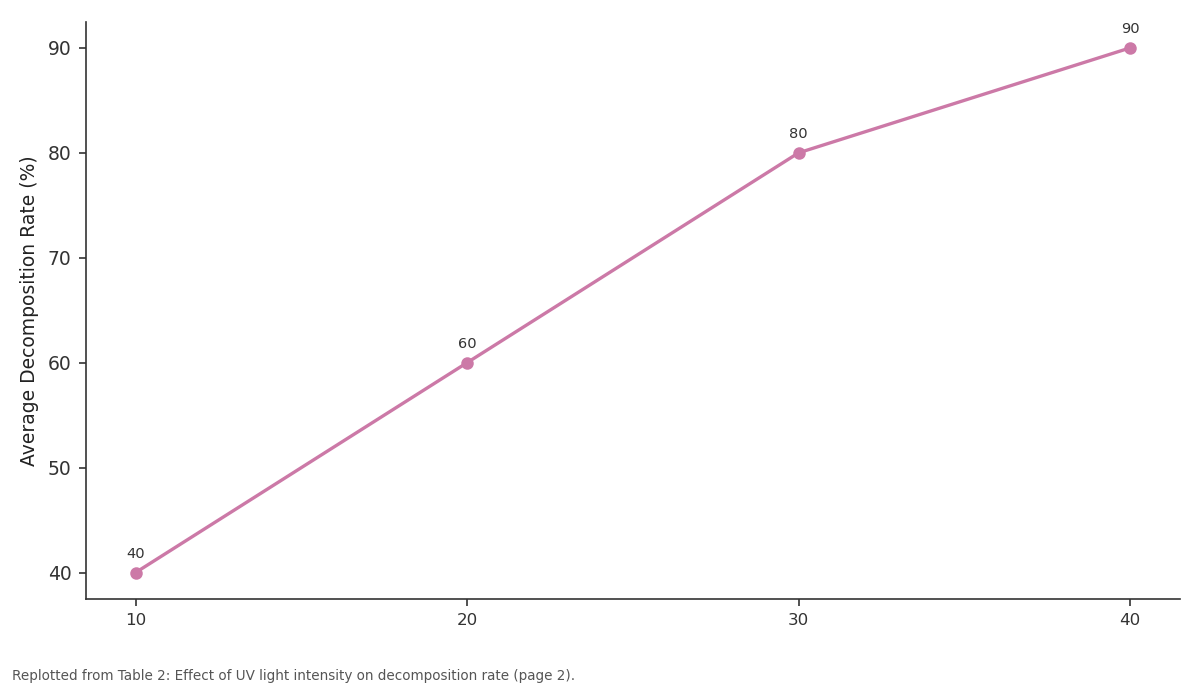
Average Decomposition Rate (%): 10 vs 20 vs 30 vs 40
Replotted from Table 2 (page 2) of the original paper. Every bar is the paper's own table value.
View source evidence ↗Figures & tables
From the original paper Table 1
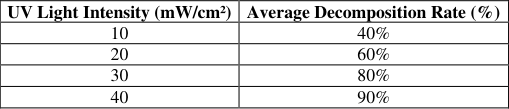 Table 2
Introduction
The escalating levels of environmental pollution, particularly from organic pollutants, pose a significant challenge to global ecological health and human well-being. Among the various strategies to mitigate this issue, photocatalysis has emerged as a promising technology due to its efficiency and eco-friendly nature. Photocatalysis involves the acceleration of a photoreaction in the presence of a catalyst. In recent years, the use of nano-sized Titanium Dioxide (nano-TiO2) as a photocatalyst has garnered significant interest in scientific research due to its exceptional properties. Nano-TiO2 stands out for its strong oxidizing power, stability, and non-toxic nature, making it a preferred choice in photocatalytic applications. Its high surface area to volume ratio enhances its reactivity, while the ability to function under UV light adds to its practical utility. The photocatalytic activity of nano-TiO2 primarily involves the generation of reactive oxygen species (ROS) upon exposure to UV light, which can degrade various organic pollutants. The decomposition of organic pollutants using nano-TiO2 is particularly relevant for environmental remediation. Persistent organic pollutants in water and air, which are often resistant to traditional degradation methods, can be effectively broken down by nano-TiO2 under suitable conditions. This process offers an environmentally friendly solution to pollution, with potential applications in water treatment, air purification, and soil remediation.
Objectives
While the photocatalytic properties of nano-TiO2 have been explored, there is a continuous need for comprehensive research to optimize its application in various environmental contexts. This study aims to investigate the efficiency of nano-TiO2 in the photocatalytic decomposition of different organic pollutants. It focuses on understanding the influence of various operational parameters such as catalyst concentration, UV light intensity, and exposure time on the decomposition process.
Scope and of the Paper
This paper will provide a detailed exploration of the photocatalytic capabilities of nano-TiO2, presenting experimental results on the decomposition rates of several organic pollutants. The study will analyze the effects of different variables on the photocatalytic process, offering insights into the optimization of conditions for effective pollutant degradation. The findings will contribute to the broader understanding of nano-TiO2's role in environmental remediation, highlighting its potential as a sustainable solution to pollution challenges.
Materials and Methods
The research employs nano-TiO2 particles synthesized through the sol-gel method. The photocatalytic experiments involve exposing organic pollutants mixed with nano-TiO2 to UV light, under controlled laboratory conditions. The effectiveness of decomposition is measured using spectroscopic techniques, and variables such as catalyst concentration, pollutant concentration, and light intensity are systematically varied to optimize the process.
Results
The study presents quantitative and qualitative data illustrating the decomposition rates of various organic pollutants in the presence of nano-TiO2 under UV light. The results demonstrate a significant dependency of the decomposition efficiency on factors like catalyst concentration and UV intensity. The formation of intermediate compounds during decomposition is also analyzed and discussed. rates among different pollutants can be attributed to their distinct chemical structures and reactivities. This highlights the need for tailored photocatalytic conditions based on the specific pollutant.
Discussion
The discussion section interprets the results, emphasizing the role of nano-TiO2 in enhancing the photocatalytic process. The paper explores the mechanisms through which nano-TiO2 facilitates the breakdown of pollutants, including the generation of reactive oxygen species and electron-hole pair dynamics. The implications of these findings for environmental remediation strategies are thoroughly examined, along with potential future applications and limitations of the current study. Table 1 illustrates a direct correlation between the concentration of nano-TiO2 and the decomposition rates of the pollutants (A, B, and C). This trend is indicative of the fact that increasing the amount of nano-TiO2 enhances the photocatalytic activity. Higher concentrations of nano-TiO2 provide more active sites for the photocatalytic reaction, leading to more efficient breakdown of the pollutants. The varying degrees of decomposition rates among different pollutants suggest that the photocatalytic efficiency of nano-TiO2 is influenced by the chemical nature of the pollutant.
| Nano-TiO2 Concentration (mg/L) | Pollutant A Decomposition (%) | Pollutant B Decomposition (%) | Pollutant C Decomposition (%) |
|---|---|---|---|
| 50 | 30% | 25% | 20% |
| 100 | 55% | 45% | 40% |
| 150 | 75% | 65% | 60% |
| 200 | 90% | 85% | 80% |
Table text extracted from the original PDF; superscript letters are shown inline. The original table image is below.
View original table image
Pollutant A shows the highest rate of decomposition, possibly due to its structural susceptibility to oxidation by the generated reactive oxygen species. The graph demonstrates a clear increase in decomposition efficiency with prolonged UV exposure for all three pollutants. This suggests that sustained UV irradiation enhances the generation of electron-hole pairs in nano-TiO2, which are essential for the photocatalytic process. The different slopes of the curves for each pollutant indicate a differential response to UV exposure. Pollutant A, with a steeper curve,
shows a rapid initial response to UV light, suggesting a quicker interaction with the photocatalyst. Conversely, Pollutant B, with a more gradual curve, indicates a slower but consistent photocatalytic reaction. The data in Table 2 reveal an increase in decomposition rate with the rising intensity of UV light. This trend can be attributed to the increased energy provided by the higher intensity light, which likely boosts the generation of reactive oxygen species, accelerating the decomposition process. Finding the optimal UV light intensity is crucial for maximizing photocatalytic efficiency. While higher intensities improve decomposition, they may also contribute to increased energy consumption, highlighting the need for a balanced approach in practical applications.
| UV Light Intensity (mW/cm²) | Average Decomposition Rate (%) |
|---|---|
| 10 | 40% |
| 20 | 60% |
| 30 | 80% |
| 40 | 90% |
Table text extracted from the original PDF; superscript letters are shown inline. The original table image is below.
View original table image
Overall Implications Photocatalyst Optimization
These findings underscore the importance of optimizing both the concentration of nano-TiO2 and the UV light conditions to achieve maximum photocatalytic efficiency.
Environmental Applications
The study's results are promising for environmental applications, especially for the treatment of water contaminated with organic pollutants. The ability to tailor the photocatalytic process according to the specific pollutant type and conditions presents a versatile approach for pollution remediation.
Conclusion
The paper concludes by underscoring the effectiveness of nano-TiO2 as a photocatalyst in pollutant decomposition. It highlights the potential of this technology in addressing environmental challenges and calls for further research to scale up and optimize the process for real-world applications. The conclusion also reflects on the broader impact of the study in advancing the field of photocatalysis and environmental sustainability.
References
6 in the original paper- Vinu R, Madras G. Kinetics of simultaneous photocatalytic degradation of phenolic compounds and reduction of metal ions with nano-TiO2. Environmental science & technology. 2008 Feb 1;42(3):913-9.
- Priya MH, Madras G. Photocatalytic degradation of nitrobenzenes with combustion synthesized nano-TiO2. Journal of Photochemistry and Photobiology A: Chemistry. 2006 Feb 20;178(1):1-7.
- Sukhadia V. Photo catalytic degradation of copper surfactant. Int. J Adv. Chem. Res. 2020;2(2):53-55. DOI: 10.33545/26646781.2020.v2.i2a.63
- Chen J, Liu M, Zhang L, Zhang J, Jin L. Application of nano TiO2 towards polluted water treatment combined with electro-photochemical method. Water research. 2003 Sep 1;37(16):3815-20.
- Vinu R, Akki SU, Madras G. Investigation of dye functional group on the photocatalytic degradation of dyes by nano-TiO2. Journal of Hazardous Materials. 2010 Apr 15;176(1-3):765-73.
- Cheng SW, Li YH, Yuan CS, Tsai PY, Shen HZ, Hung CH. An innovative advanced oxidation technology for effective decomposition of formaldehyde by combining iron modified nano-TiO2 (Fe/TiO2) photocatalytic degradation with ozone oxidation. Aerosol and Air Quality Research. 2018 Dec;18(12):3220-33.