
Research article · 2024 · Full text
International Journal of Advanced Biochemistry ResearchResidual effect of enriched organics with iron and zinc on growth, yield and quality of summer groundnut in loamy sand
Volume 8(1S) · Pages 07–09 · DOI: 10.33545/26174693.2024.v8.i1sa.278 ↗
Research areasEngineering and Agricultural Innovations
Abstract
Author-writtenStudy the residual effect of Fe and Zn enriched organics on growth, yield and quality of summer groundnut in loamy sand (Typic Ustipsamments) during the summer seasons of 2016-17 and 2017-18 at SDAU, Sardarkrushinagar. The residual effect of organics enriched 6 kg Fe and 4 kg Zn registered significantly higher plant height, number of pods per plant, pod and haulm yield as well as oil yield over no Fe and Zn (control). The soil of this area is loamy sand and low in Fe and Zn content.
Summary
Source-checkedPlain-language reading of the full paper, prepared with AI and checked against the text. Each point links to the authors' own words.
Why it matters
- Groundnut is a critical crop in India, serving as a source of food, fodder, and cash income for farmers. View evidence ↗
- While farmers typically apply NPK nutrients, the lack of sufficient micronutrients can harm soil health, reduce crop productivity, and lower the quality of the produce. View evidence ↗
- The loamy sand soil in the study area is characterized by low levels of iron (Fe) and zinc (Zn). View evidence ↗
The question
- The study aimed to evaluate how organics enriched with iron (Fe) and zinc (Zn) residually affect the growth, yield, and quality of summer groundnut in loamy sand. View evidence ↗
What they did
- The experiment was carried out over two summer seasons, 2016-17 and 2017-18. View evidence ↗
- The study used a Randomized Block Design (RRBD) with four replications, testing two organic bases (FYM at 20 t ha-1 and vermicompost at 5 t ha-1) and six Fe/Zn supplementation levels, including inorganic and organic-enriched options. View evidence ↗
- Groundnut cultivar GG 2 was used, with nitrogen (25 kg ha-1) and phosphorus (50 kg ha-1) applied as urea and diammonium phosphate. View evidence ↗
What they found
- The different types of organic materials used did not have a significant residual effect on growth, yield, or quality parameters. View evidence ↗
- The highest number of pods per plant was achieved with N5, recording 42.72 (2016-17), 44.73 (2017-18), and 43.58 (pooled), which was statistically similar to N6. View evidence ↗
- Pod yield was significantly higher under the residual effect of N5 compared to the control (N1) and inorganic application (N2). View evidence ↗
- The highest oil yield was recorded for N5, significantly exceeding the control (N1) and inorganic application (N2). View evidence ↗
- The treatments did not significantly influence the seed index or the shelling percentage of the groundnut crop. View evidence ↗
What it means
- The authors conclude that Fe and Zn enriched organics improved growth and yield likely by enhancing soil properties and increasing the availability of native nutrients in the deficient soil. View evidence ↗
Visual summary
3 visualsIllustrations explain the paper; charts are replotted from the paper's own table values.
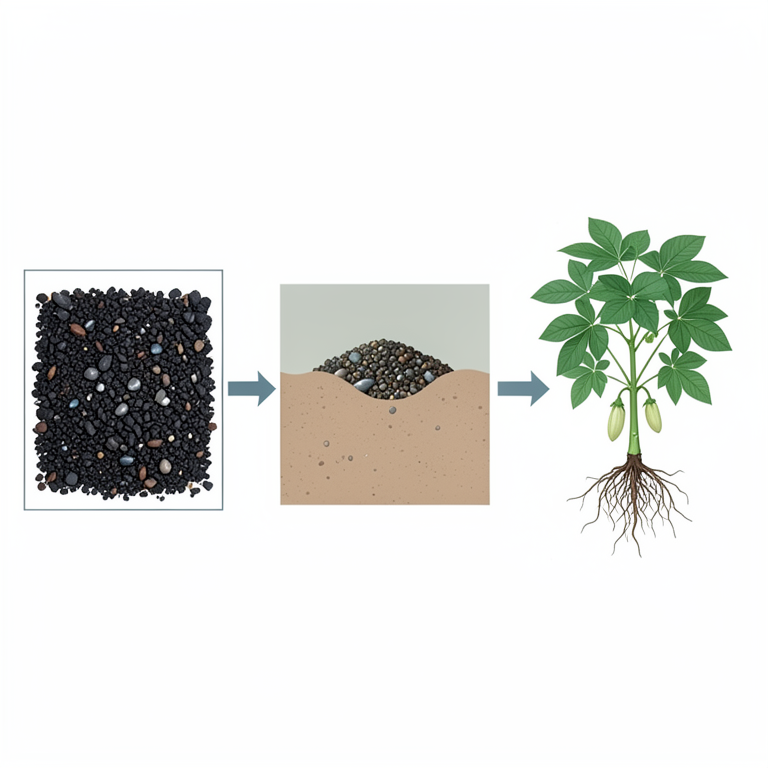
Nutrient Enrichment Cycle
AI-generated conceptual illustration (groundnut plants in loamy sand soil). It explains the idea and does not show study data.
View source evidence ↗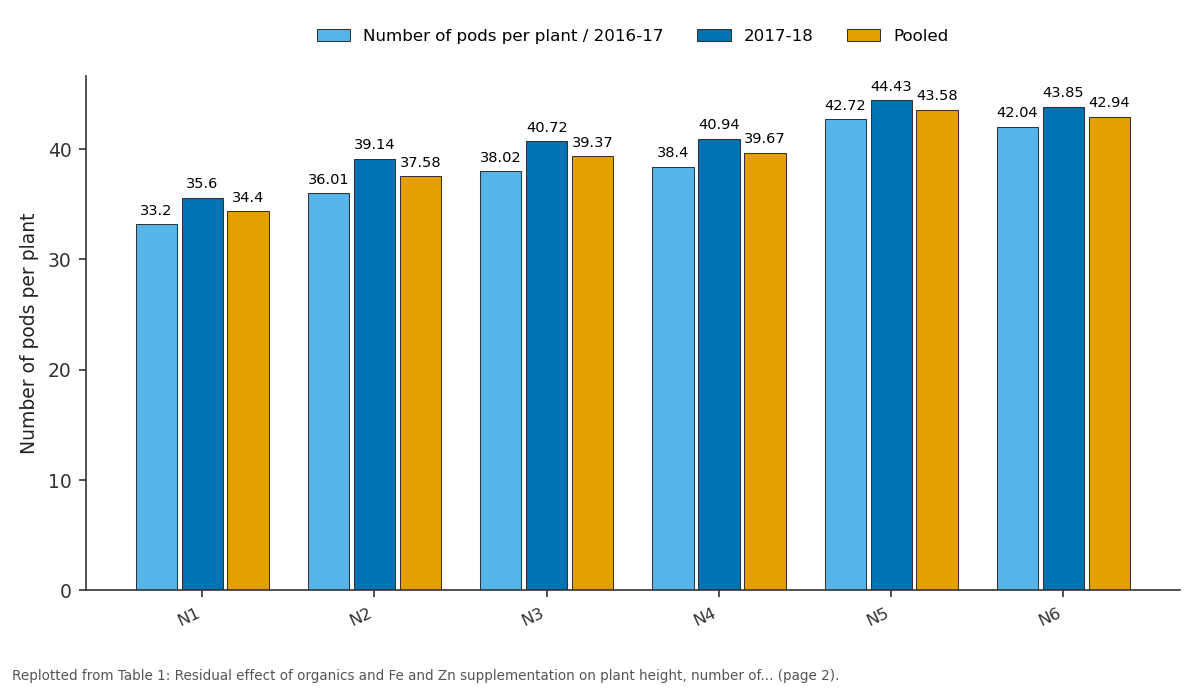
Number of pods per plant / 2016-17 and 2017-18 and more: N1 vs N2 vs N3 vs N4 vs N5
Replotted from Table 1 (page 2) of the original paper. Every bar is the paper's own table value.
View source evidence ↗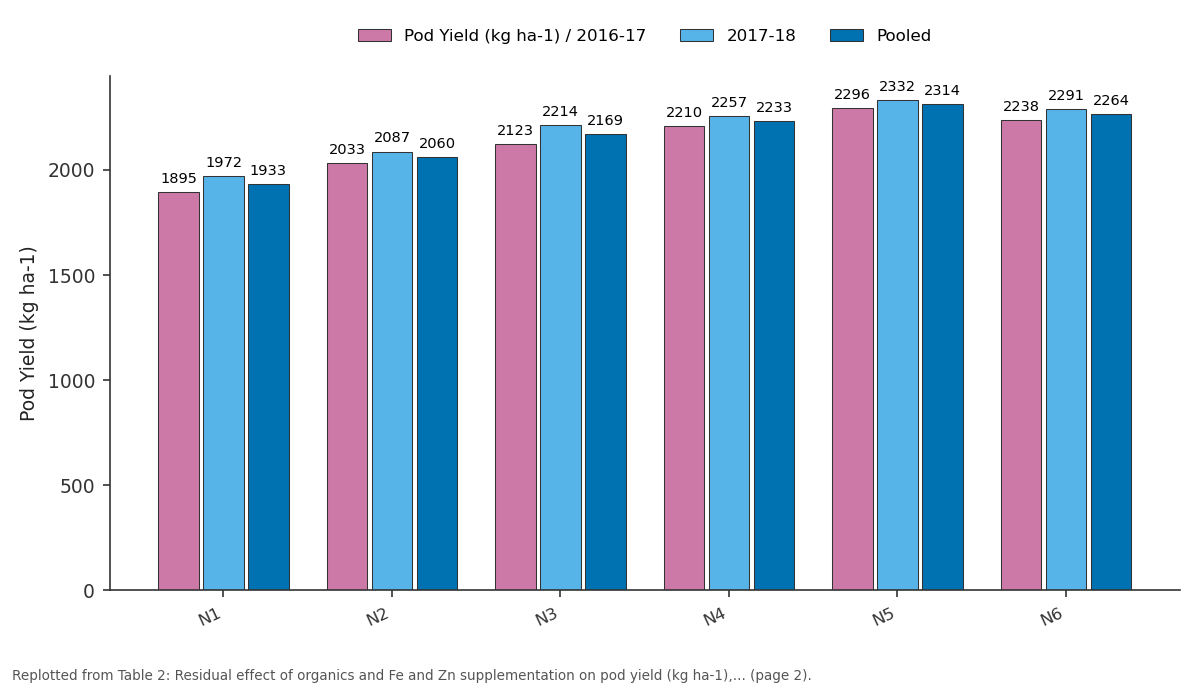
Pod Yield (kg ha-1) / 2016-17 and 2017-18 and more: N1 vs N2 vs N3 vs N4 vs N5
Replotted from Table 2 (page 2) of the original paper. Every bar is the paper's own table value.
View source evidence ↗Figures & tables
From the original paper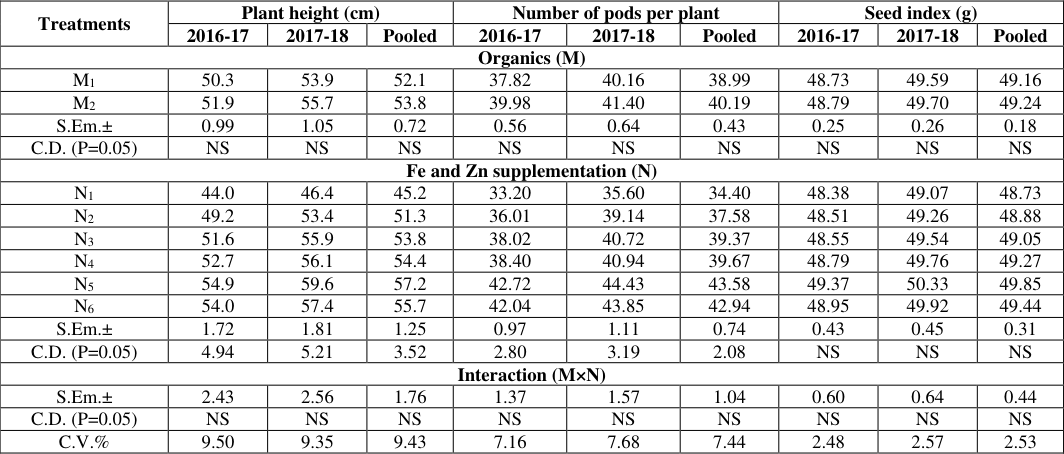 Table 1
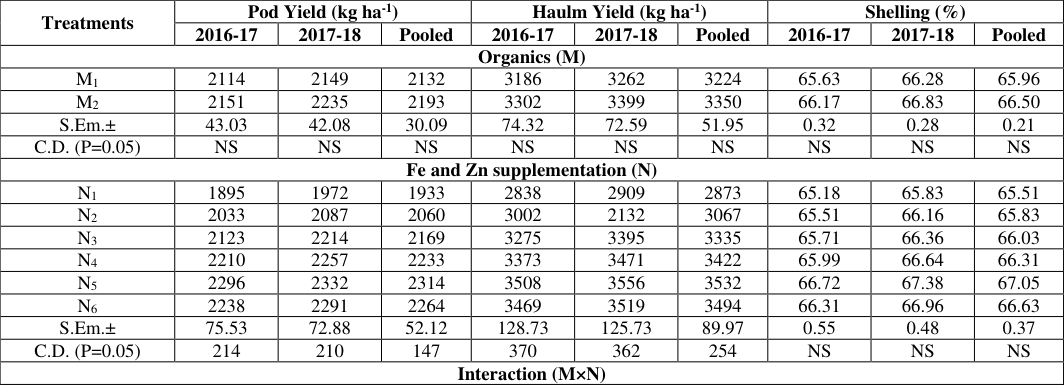 Table 2
 Table 3
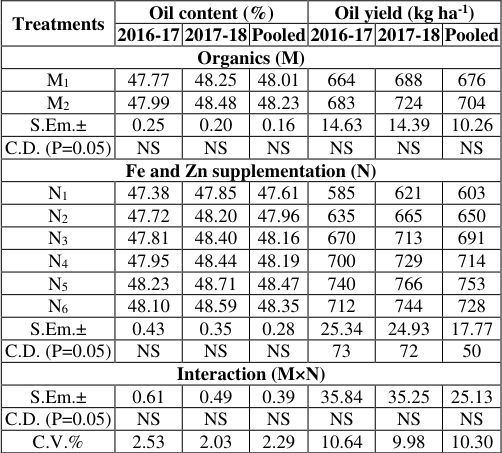 Table 3
Introduction
Groundnut (Arachis hypogaea L.) is an important food, fodder and cash crop for the farmers of India. In India, groundnut is principal oil seed crop has a vital role in Indian agriculture, industry and export trade with economy of country. Groundnut is rich source of energy, as its kernel content about 50.00 per cent edible oil, high quality of protein (21.4-36.4%), carbohydrates (6.0-24.9%), minerals and vitamins (DAS, 1997) [2] . In India, groundnut is grown on 4.56 million hectares and production of 6.77 million tonnes with an average productivity of 1486 kg ha -1 (DAC and FW, 2016). In North Gujarat region, mainly potato-summer groundnut crop rotations commonly followed by the farmers. The farmers often apply NPK nutrients, whereas the application of micronutrients is either absent or insufficient which further affects to soil health that is not only hampering the crop productivity, but also deteriorating produce quality.
Materials and Methods
Experiment was conducted in summer seasons of 2016-17 and 2017-18 to study the residual effect of Fe and Zn enriched organics. The soil was loamy sand, low in OC, available N and DTPA-extractable Fe and Zn. Treatment was FYM 20 t ha -1 (M 1 ) and vermicompost 5 t ha -1 (M 2 ) and six treatments of Fe and Zn viz., No Fe and Zn (N 1 ), 6 kg Fe and 4 kg Zn ha -1 (Inorganic) (N 2 ), 3 kg Fe enriched by organics 2 t ha -1 (N 3 ), 2 kg Zn enriched by organics 2 t ha -1 (N 4 ), 6 kg Fe and 4 kg Zn enriched by organics 2 t ha -1 (N 5 ) and 3 kg Fe and 2 kg Zn enriched by organics 2 t ha -1 (N 6 ) were laid out under RRBD with 4 replications. The graded and healthy seeds of groundnut cv. GG 2 was sown. The entire quantity of nitrogen (25 kg ha -1 ) and phosphorus (50 kg ha -1 ) in form of urea and diammonium phosphate,
Results and Discussion
Results and Discussion
Growth, Yield attributes and quality Effect of organics
The plant height, number of pods per plant and seed index, pod yield, haulm yield, shelling percentage, oil content and oil yield in kernel of summer groundnut crop did not gave significantly result due to residual effect of different organics during both the years as well as on pooled basis.
Fe and Zn supplementation
The plant height and number of pods per plant of summer groundnut measured at harvest was significantly influenced due to residual effect of Fe and Zn fertilization during both the years of study as well as on pooled analysis (Table 1). Among different treatments, the residual effect of N 5 produced significantly higher plant height of summer groundnut which remained statistically on par with N 6 , N 4 and N 3 treatments, but significantly superior to N 2 and N 1 treatments during both the years as well as in pooled. The residual effect of N 5 produced significantly maximum number of pods per plant of 42.72, 44.73 and 43.58 during 2016-17, 2017-18 and in pooled data, respectively, but it was remained at par with treatment of organics 2 t ha -1 enriched with 3 kg Fe and 2 kg Zn (N 6 ) during individual year as well as in pooled analysis. No significant influence on seed index and shelling percentage (Table 2) of summer groundnut crop during both the years and in pooled analysis. The significantly higher pod yield (Table 2) of summer groundnut was recorded due to residual effect of N 5 than that of straight application of 6 kg Fe and 4 kg Zn ha -1 (N 2 ) and N 1 treatment, but it was at par with N 6 , N 4 and N 3 treatments during both the years as well as in pooled analysis. Though the highest haulm yield of summer groundnut was recorded due to residual effect of organics 2 t ha -1 enriched with 6 kg Fe and 4 kg Zn (N 5 ) in both year as well as in pooled result, respectively over no application of Fe and Zn (N 1 ) and straight application of 6 kg Fe and 4 kg Zn ha -1 (N 2 but it was on par with treatments of N 6 , N 4 and N 3 . The maximum oil yield of kernel (Table 3) of summer groundnut was recorded due to residual effect of N 5 over no application of Fe and Zn (N 1 ) and straight application of 6 kg Fe and 4 kg Zn ha -1 (N 2 ), but it was remained on par with enrichment of organics 2 t ha -1 with either Fe and Zn alone or its combinations (N 6 , N 4 and N 3 ) during both year and N 6 and N 4 during pooled data. The better performance in treatments of Fe and Zn enriched organics as residual effect on plant height, number of pods per plant, pod yield, haulm yield and oil yield (Table 1,2,3) of summer groundnut might be due to its influence on soil properties to increase the availability of native nutrients in the soil as the soil was deficient in Fe as well as Zn initially. Besides, the organics enriched with Fe and Zn itself contained appraisable quantity of major and micronutrients which might have resulted into higher nutrients availability due to incorporation in the soil and thereby increased in parameters. Such finding also reported by by Meena et al., (2006) [3] , Patel et al., (2007) [4] , Rahevar (2015) [5] and Shivran (2016) [6] .
| Treatments | Oil content (%) | — | — | Oil yield (kg ha-1) | — | — |
|---|---|---|---|---|---|---|
| 2016-17 | 2017-18 | Pooled | 2016-17 | 2017-18 | Pooled | |
| Organics (M) | ||||||
| M1 | 47.77 | 48.25 | 48.01 | 664 | 688 | 676 |
| M2 | 47.99 | 48.48 | 48.23 | 683 | 724 | 704 |
| S.Em.± | 0.25 | 0.20 | 0.16 | 14.63 | 14.39 | 10.26 |
| C.D. (P=0.05) | NS | NS | NS | NS | NS | NS |
| Fe and Zn supplementation (N) | ||||||
| N1 | 47.38 | 47.85 | 47.61 | 585 | 621 | 603 |
| N2 | 47.72 | 48.20 | 47.96 | 635 | 665 | 650 |
| N3 | 47.81 | 48.40 | 48.16 | 670 | 713 | 691 |
| N4 | 47.95 | 48.44 | 48.19 | 700 | 729 | 714 |
| N5 | 48.23 | 48.71 | 48.47 | 740 | 766 | 753 |
| N6 | 48.10 | 48.59 | 48.35 | 712 | 744 | 728 |
| S.Em.± | 0.43 | 0.35 | 0.28 | 25.34 | 24.93 | 17.77 |
| C.D. (P=0.05) | NS | NS | NS | 73 | 72 | 50 |
| Interaction (M×N) | ||||||
| S.Em.± | 0.61 | 0.49 | 0.39 | 35.84 | 35.25 | 25.13 |
| C.D. (P=0.05) | NS | NS | NS | NS | NS | NS |
| C.V.% | 2.53 | 2.03 | 2.29 | 10.64 | 9.98 | 10.30 |
Table text extracted from the original PDF; superscript letters are shown inline. The original table image is below.
View original table image
| S.Em.± | 105.40 | 103.06 | 73.71 | 182.05 | 177.81 | 127.24 | 0.78 | 0.68 | 0.52 |
|---|---|---|---|---|---|---|---|---|---|
| C.D. (P=0.05) | NS | NS | NS | NS | NS | NS | NS | NS | NS |
| C.V.% | 9.88 | 9.40 | 9.64 | 11.22 | 10.68 | 10.95 | 2.37 | 2.04 | 2.21 |
Table text extracted from the original PDF; superscript letters are shown inline. The original table image is below.
View original table image
| Treatments | Pod Yield (kg ha-1) | — | — | Haulm Yield (kg ha-1) | — | — | Shelling (%) | — | — |
|---|---|---|---|---|---|---|---|---|---|
| 2016-17 | 2017-18 | Pooled | 2016-17 | 2017-18 | Pooled | 2016-17 | 2017-18 | Pooled | |
| Organics (M) | |||||||||
| M1 | 2114 | 2149 | 2132 | 3186 | 3262 | 3224 | 65.63 | 66.28 | 65.96 |
| M2 | 2151 | 2235 | 2193 | 3302 | 3399 | 3350 | 66.17 | 66.83 | 66.50 |
| S.Em.± | 43.03 | 42.08 | 30.09 | 74.32 | 72.59 | 51.95 | 0.32 | 0.28 | 0.21 |
| C.D. (P=0.05) | NS | NS | NS | NS | NS | NS | NS | NS | NS |
| Fe and Zn supplementation (N) | |||||||||
| N1 | 1895 | 1972 | 1933 | 2838 | 2909 | 2873 | 65.18 | 65.83 | 65.51 |
| N2 | 2033 | 2087 | 2060 | 3002 | 2132 | 3067 | 65.51 | 66.16 | 65.83 |
| N3 | 2123 | 2214 | 2169 | 3275 | 3395 | 3335 | 65.71 | 66.36 | 66.03 |
| N4 | 2210 | 2257 | 2233 | 3373 | 3471 | 3422 | 65.99 | 66.64 | 66.31 |
| N5 | 2296 | 2332 | 2314 | 3508 | 3556 | 3532 | 66.72 | 67.38 | 67.05 |
| N6 | 2238 | 2291 | 2264 | 3469 | 3519 | 3494 | 66.31 | 66.96 | 66.63 |
| S.Em.± | 75.53 | 72.88 | 52.12 | 128.73 | 125.73 | 89.97 | 0.55 | 0.48 | 0.37 |
| C.D. (P=0.05) | 214 | 210 | 147 | 370 | 362 | 254 | NS | NS | NS |
| Interaction (M×N) |
Table text extracted from the original PDF; superscript letters are shown inline. The original table image is below.
View original table image
| Treatments | Plant height (cm) | — | — | Number of pods per plant | — | — | Seed index (g) | — | — |
|---|---|---|---|---|---|---|---|---|---|
| 2016-17 | 2017-18 | Pooled | 2016-17 | 2017-18 | Pooled | 2016-17 | 2017-18 | Pooled | |
| Organics (M) | |||||||||
| M1 | 50.3 | 53.9 | 52.1 | 37.82 | 40.16 | 38.99 | 48.73 | 49.59 | 49.16 |
| M2 | 51.9 | 55.7 | 53.8 | 39.98 | 41.40 | 40.19 | 48.79 | 49.70 | 49.24 |
| S.Em.± | 0.99 | 1.05 | 0.72 | 0.56 | 0.64 | 0.43 | 0.25 | 0.26 | 0.18 |
| C.D. (P=0.05) | NS | NS | NS | NS | NS | NS | NS | NS | NS |
| Fe and Zn supplementation (N) | |||||||||
| N1 | 44.0 | 46.4 | 45.2 | 33.20 | 35.60 | 34.40 | 48.38 | 49.07 | 48.73 |
| N2 | 49.2 | 53.4 | 51.3 | 36.01 | 39.14 | 37.58 | 48.51 | 49.26 | 48.88 |
| N3 | 51.6 | 55.9 | 53.8 | 38.02 | 40.72 | 39.37 | 48.55 | 49.54 | 49.05 |
| N4 | 52.7 | 56.1 | 54.4 | 38.40 | 40.94 | 39.67 | 48.79 | 49.76 | 49.27 |
| N5 | 54.9 | 59.6 | 57.2 | 42.72 | 44.43 | 43.58 | 49.37 | 50.33 | 49.85 |
| N6 | 54.0 | 57.4 | 55.7 | 42.04 | 43.85 | 42.94 | 48.95 | 49.92 | 49.44 |
| S.Em.± | 1.72 | 1.81 | 1.25 | 0.97 | 1.11 | 0.74 | 0.43 | 0.45 | 0.31 |
| C.D. (P=0.05) | 4.94 | 5.21 | 3.52 | 2.80 | 3.19 | 2.08 | NS | NS | NS |
| Interaction (M×N) | |||||||||
| S.Em.± | 2.43 | 2.56 | 1.76 | 1.37 | 1.57 | 1.04 | 0.60 | 0.64 | 0.44 |
| C.D. (P=0.05) | NS | NS | NS | NS | NS | NS | NS | NS | NS |
| C.V.% | 9.50 | 9.35 | 9.43 | 7.16 | 7.68 | 7.44 | 2.48 | 2.57 | 2.53 |
Table text extracted from the original PDF; superscript letters are shown inline. The original table image is below.
View original table image
References
4 in the original paper- Meena MC, Patel KP, Rathod DD. Effect of Zn and Fe enriched FYM on mustard yield and micronutrient availability in loamy sand soil (Typic Haplustert) of Anand. J Indian Soc Soil Sci. 2006;54(4):495-499.
- Patel BT, Patel JJ, Patel MM. Response of groundnut (Arachis hypogaea) to FYM, sulphur and micronutrients and their residual effect on wheat (Triticum aestivum). J Soils Crops. 2007;17(1):18-23.
- Rahevar HD, Patel PP, Patel BT, Joshi SK, Vaghela SJ. Effect of FYM, iron and zinc on growth and yield of summer groundnut (Arachis hypogaea L.) under North Gujarat Agro-climatic Conditions. Indian J Agric Res. 2015;49(3):294-296.
- Shivran AC. Growth, Yield and nutrient uptake of isabgol (Plantago ovata Forsk) with phosphorus, PSB and zinc fertilization. Indian J Seed Spices. 2016;6(1):66-73.