
Research article · 2024 · Full text
International Journal of Agriculture Extension and Social DevelopmentStudent’s perception towards curricular and co- curricular activities organized by university of agriculture sciences, Raichur, Karnataka
Volume 7(1) · Pages 172–175 · DOI: 10.33545/26180723.2024.v7.i1c.203 ↗
Research areasLivestock Management and Performance ImprovementDiverse Educational Innovations Studies
Abstract
Author-writtenThe purpose of this study was to determine the perception of students towards curricular & co-curricular activities organized by University of Agricultural Sciences, Raichur. The present study was a descriptive study and has been conducted in Agriculture College, Raichur during the academic year 2017-18. The findings of the study revealed that, 72.00 and 68.00 per cent of the students perceived the curricular and co- curricular activities organized in college were average respectively and 58.00 and 56.00 per cent student were fully satisfied with study tour and rural agricultural work experience (RAWE). While, 62.00 and 56.00 per cent just satisfied with the NSS, NCC activities and sports & cultural facilities. Regarding importance of co-curricular activities, 68.00 per cent of the students of agree that co-curricular activities develop new abilities, positive attitude, increase self-confidence and practical knowledge. 54.00 per cent of them felt that these activities are also important for value inculcation and all round development of the student respectively. The major problem faced by the student during their degree were “accommodation in hostel and hygienic conditions,” (62.00%), “Lack recreation facilities at college campus (TV, Internet, etc,)” and “no regular career oriented & personality development workshops for students” (54.00%), “Shortage of human resources (Teachers, Lab assistants etc)” and Lack of exposure visits to progressive farmers’ field and industrial visits were the major problem faced by the students.
Summary
Source-checkedPlain-language reading of the full paper, prepared with AI and checked against the text. Each point links to the authors' own words.
Why it matters
- Education aims for broad development, including intellectual, social, moral, and cultural growth. View evidence ↗
- Curricular activities alone are insufficient for full educational goals; extra-curricular activities are needed to strengthen learning beyond the formal academic curriculum. View evidence ↗
- Co-curricular activities are believed to foster new abilities, positive attitudes, self-confidence, practical knowledge, and social skills. View evidence ↗
The question
- The study aimed to understand how agriculture students perceive the curricular and co-curricular activities organized at the University of Agricultural Sciences, Raichur. View evidence ↗
- The research sought to determine if university facilities are efficient and identify areas for improvement. View evidence ↗
What they did
- Data was gathered using a pre-tested questionnaire developed with expert assistance. View evidence ↗
- Student perceptions were measured using a five-point Likert scale ranging from 'fully satisfied' (5) to 'very dissatisfied' (1). View evidence ↗
What they found
- High levels of full satisfaction were reported for study tours (58.00%) and the Rural Agricultural Work Experience (RAWE) or field stay programme (56.00%). View evidence ↗
- 68.00% of students agreed that co-curricular activities help develop new abilities, positive attitudes, self-confidence, and practical knowledge. View evidence ↗
- 54.00% of students believed these activities are important for value inculcation and overall student development. View evidence ↗
- The most significant constraint reported by students was hostel accommodation and hygienic conditions (62.00%). View evidence ↗
- Lack of campus recreation facilities and a lack of regular career/personality development workshops were cited as major problems by 54.00% of students. View evidence ↗
- A shortage of human resources, including teachers and lab assistants, was identified as a problem by 52.00% of students. View evidence ↗
What it means
- The authors concluded that students are generally satisfied with most curricular and co-curricular activities, especially RAWE, field visits, experiential learning, and study tours. View evidence ↗
- The authors recommend improving the quality of programs and providing a more comprehensive educational environment to increase student satisfaction. View evidence ↗
Visual summary
2 visualsIllustrations explain the paper; charts are replotted from the paper's own table values.
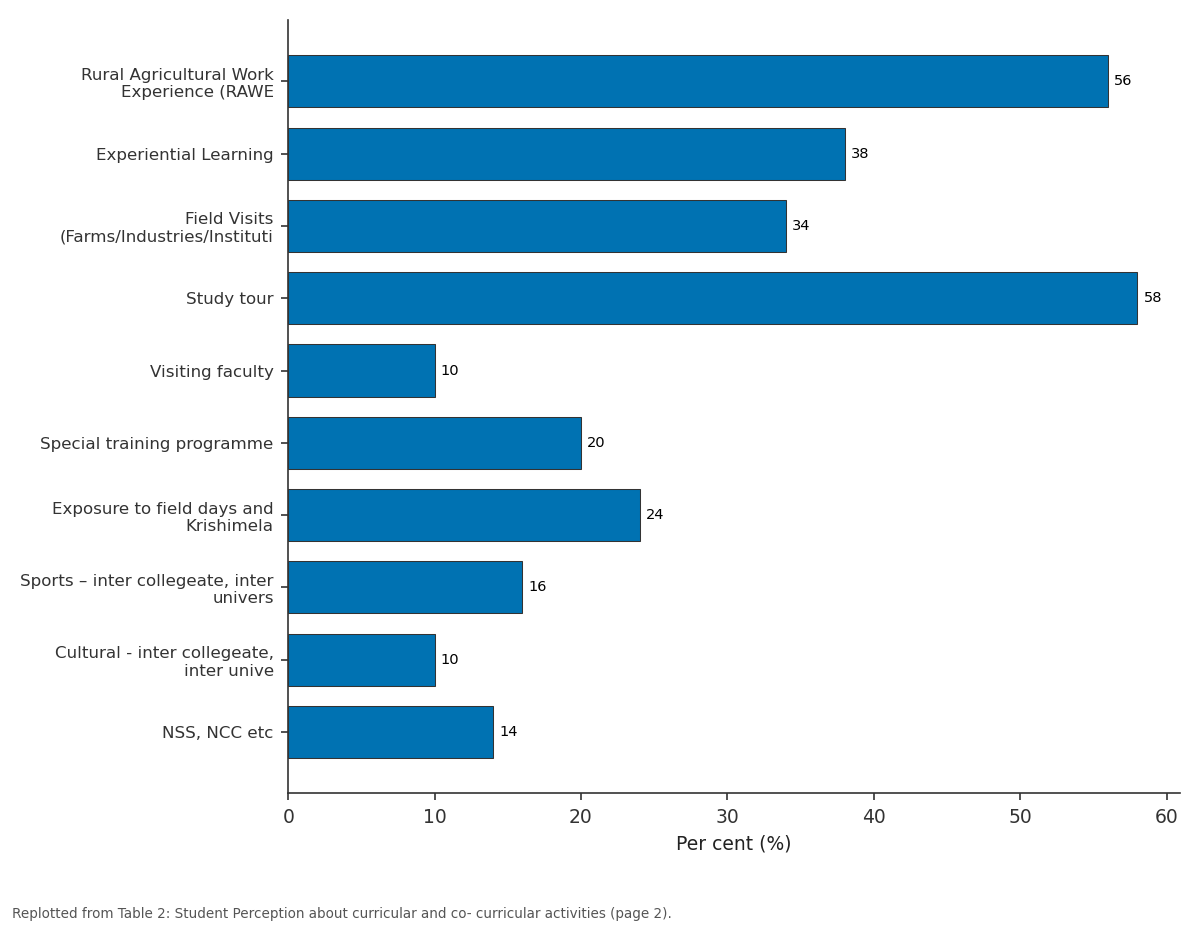
%: Rural Agricultural Work... vs Experiential Learning vs Field Visits... vs Study tour vs Visiting faculty
Replotted from Table 2 (page 2) of the original paper. Every bar is the paper's own table value.
View source evidence ↗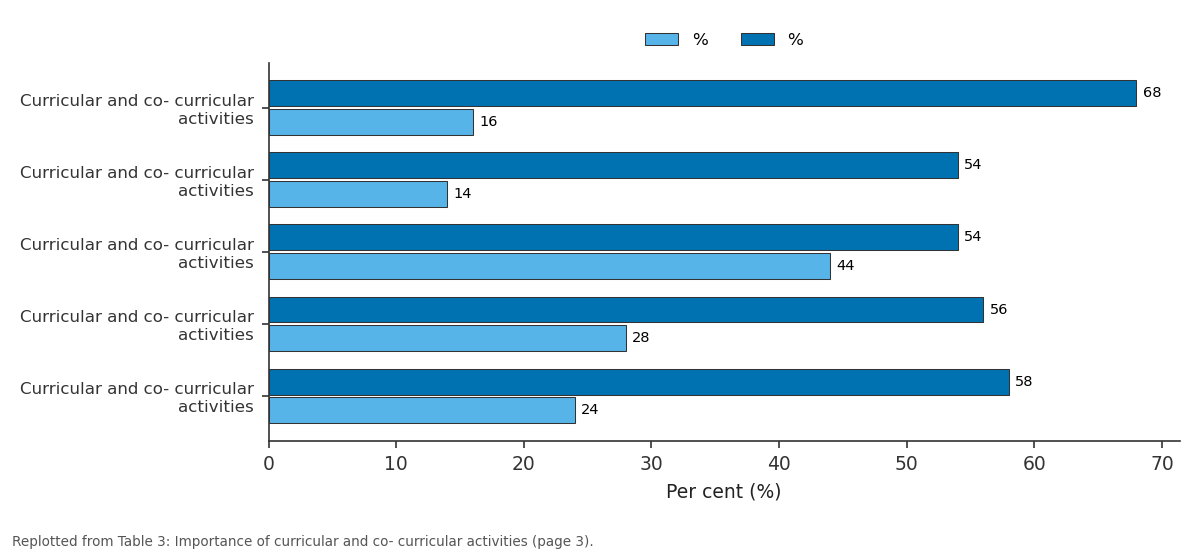
% and %: Curricular and co-... vs Curricular and co-... vs Curricular and co-... vs Curricular and co-... vs Curricular and co-...
Replotted from Table 3 (page 3) of the original paper. Every bar is the paper's own table value.
View source evidence ↗Figures & tables
From the original paper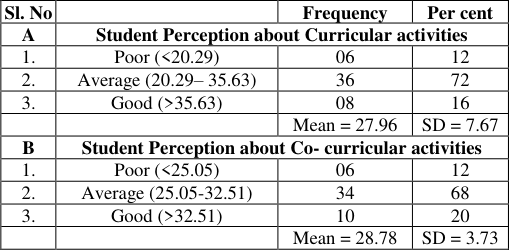 Table 1
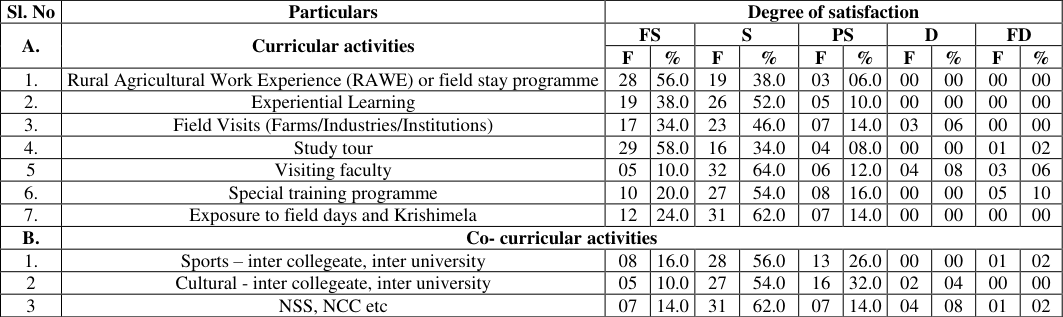 Table 2
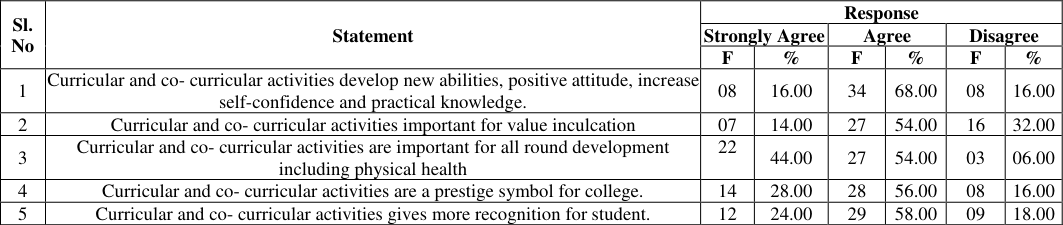 Table 3
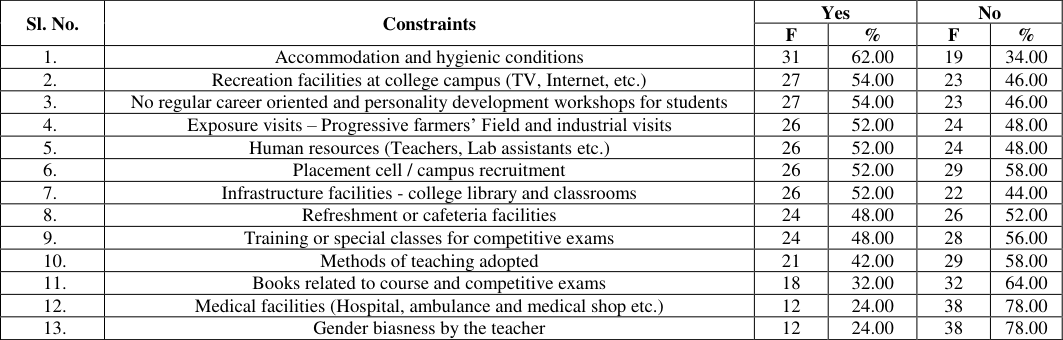 Table 4
Introduction
The aim of education is very wide. Education is related to various aspects of the mind and personality of the person like intellectual development, social development, moral development, cultural development etc. To achieve this aim curricular activities are not sufficient, there is the need of extra-curricular activities. These activities strengthen our learning beyond academic curriculum. The co-curricular activities means a variety of activities outside the formal curriculum. i.e. education through practical or learning by doing. The aim of education can be achieved only when curricular and co-curricular activities co-exist. The blend of the two is very essential in order to produce a complete person. Co-curricular activities develop new abilities, interests, positive attitude, increase self-confidence, practical knowledge and strengthen social and organizational skills of the students. Students acquire practical expertise by taking part in co-curricular activities related to their topic. Participation in such activities provides students with a competitive advantage on their resumes. Academic and cocurricular accomplishments are the sole determinants of students' placement performance (Ramalingam and Ilakkiya, 2021) [6] . Learning and personal development has been achieved through engagement in both academic and non-academic activities which occur inside and outside the classroom (Astin, 1993; Kuh, Douglas, Lund, & Ramin-Gyurnek, 1994; Terenzini & Pascarella, 1991) [10,5,9] . In this sense, colleges should consider the ineffectiveness of having solely classroom learning and encourage students to devote meaningful time outside the classroom for educationally purposeful activities (Kuh, Kinzie, Schuh, & Whitt, 2011) [11] . Most studies reveal that participation in extracurricular activities such as collaboration on research projects, involvement in clubs and organizations, interacting with faculty and peers and voluntarism have all been positively related to persistence and satisfaction (Astin, 1977; Pascarella, Terenzini, & Feldman, 2005) [1,7] and gains in such areas as social competence, confidence, self-esteem, self-awareness and appreciation for human diversity (Kuh, 1995) [4] . These activities play an important role in a student's college life and career development. In addition students also learn how to apply the knowledge learned in www.extensionjournal.com the classroom to real world scenarios by participating in extracurricular activities (Shamsudin, Ismail, Al-Mamun, & Nordin, 2014) [8] . Hence, the purpose of this study was to understand the perception of agriculture students towards various curricular and co-curricular activities orgained in Agriculture University, Raichur. It is to understand whether the facilities provided inside university are efficient and to know whether the facilities can be improved.
Methodology
The purpose of study was to understand the perception of agriculture students towards curricular and co-curricular activities organized in UAS, Raichur. The study was conducted in the College of Agricultural Sciences, Raichur during the academic year 2017-2018. Fifty students of final B.Sc (Agri.) were selected by random sampling method. The data was collected from the students by using the wellconstructed questionnaire. Questionnaire was prepared with the help of concerned experts and was pre-tested. The collected data then scored analyzed and interpreted. Students' perception towards curricular and cocurricular activities was studied by using the Likert type scale in which the responses of students were calculated on a five point quantum scale as fully satisfied, satisfied, partially satisfied, dissatisfied and very dissatisfied with the weightage of 5, 4, 3, 2 and 1 respectively.
Results and Discussion
The results are presented with various heads such as overall perception of the students towards various curricular and cocurricular activities, importance of curricular and cocurricular activities, constraints faced by the students during degree programme and conclusion.
Overall perception of student about curricular and cocurricular activities
Pertaining to overall perception of students towards curricular and co-curricular activities, the data presented in Table 1 indicates that, 72.00 and 68.00 per cent of the students perceived the curricular and co-curricular activities organized in college were average respectively.
| Sl. No | — | Frequency | Per cent |
|---|---|---|---|
| A | Student Perception about Curricular activities | ||
| 1. | Poor (<20.29) | 06 | 12 |
| 2. | Average (20.29– 35.63) | 36 | 72 |
| 3. | Good (>35.63) | 08 | 16 |
| Mean = 27.96 | SD = 7.67 | ||
| B | Student Perception about Co- curricular activities | ||
| 1. | Poor (<25.05) | 06 | 12 |
| 2. | Average (25.05-32.51) | 34 | 68 |
| 3. | Good (>32.51) | 10 | 20 |
| Mean = 28.78 | SD = 3.73 |
Table text extracted from the original PDF; superscript letters are shown inline. The original table image is below.
View original table image
Student perception about curricular and co-curricular activities A. Curricular activities
The Table 2A, exhibited the student's views about components of curricular and co-curricular activities indicated that the 58.00 and 56.00 per cent student were fully satisfied with study tour and rural agricultural work experience (RAWE) or field stay programme respectively followed by 38.00 and 34.00 per cent highly satisfied with experiential learning (Hands on Traininig) and exposure to field days and field visits (Farms/Industries/Institutions), while, 64.00 per cent of them just satisfied with exposure to field days and krishimela.
B. Co-curricular activities
With respect to co-curricular activities (Table 4B), 62.00 and 56.00 per cent just satisfied with the NSS, NCC activities, and sportsinter collegiate & inter university followed by cultural -inter collegiate (54.00%). Further, 32, 26 and14 per cent of them partially satisfied about respect to cultural, sports and NSS activities respectively.
Importance of curricular and co-curricular activities
Table 3 indicates the importance of co-curricular activities. The table shows, 68.00 per cent of the students of agree that co-curricular activities develop develop new abilities, positive attitude, increase self-confidence and practical knowledge in the student, 54.00 per cent of them felt that these activities are also important for value inculcation and all round development of the student respectively. While, 44.00 per cent strongly agreed that students these activities import for all round development of the student, 58.00 and 56.00 per cent of the student mentioned that these activities gives more recognition for student and a prestige symbol for www.extensionjournal.com college respectively. But a small percentage of students do not agree with the statements. They are of the opinion that studies are important for a student. So they should pay more attention towards their studies than to participate in these activities.
| Sl. No | Statement | Response | — | — | — | — | — |
|---|---|---|---|---|---|---|---|
| Strongly Agree | Agree | Disagree | |||||
| F | % | F | % | F | % | ||
| 1 | Curricular and co- curricular activities develop new abilities, positive attitude, increase self-confidence and practical knowledge. | 08 | 16.00 | 34 | 68.00 | 08 | 16.00 |
| 2 | Curricular and co- curricular activities important for value inculcation | 07 | 14.00 | 27 | 54.00 | 16 | 32.00 |
| 3 | Curricular and co- curricular activities are important for all round development including physical health | 22 | 44.00 | 27 | 54.00 | 03 | 06.00 |
| 4 | Curricular and co- curricular activities are a prestige symbol for college. | 14 | 28.00 | 28 | 56.00 | 08 | 16.00 |
| 5 | Curricular and co- curricular activities gives more recognition for student. | 12 | 24.00 | 29 | 58.00 | 09 | 18.00 |
Table text extracted from the original PDF; superscript letters are shown inline. The original table image is below.
View original table image
Constraints faced by students in academic performance
Table 4 indicates the constraints faced by students in academic performance. It was depicted from Table 4 that, majority (62.00%) of the students opined that that "accommodation in hostel and hygienic conditions" was the main problems faced by them followed by "lack recreation facilities at college campus (TV, Internet, etc,)" and "no regular career oriented and personality development workshops for students" were also other major problem expressed by 54.00 per cent of the students. it was also observed that "Shortage of human resources (Teachers, Lab assistants etc.)" in colleges" was expressed by 52.00 percent of the students which needs to be taken care of by the university and college authorities by recruiting sufficient teachers and lab assistants in colleges. The others problems were: poor infrastructure facilities -college library and classrooms", "Placement cell / campus recruitment" and "lack of exposure visits to progressive farmers' field and industrial visits" were also expressed by 52.00 per cent of the students. This might be due to the non-availability of transport facilities at the college level or non-availability funds for the purpose. These problems can be solved by the colleges so that students will perform better in their academic performance. (Govindagowda, et al., 2012) [2] .
| Sl. No. | Constraints | Yes | — | No | — |
|---|---|---|---|---|---|
| F | % | F | % | ||
| 1. | Accommodation and hygienic conditions | 31 | 62.00 | 19 | 34.00 |
| 2. | Recreation facilities at college campus (TV, Internet, etc.) | 27 | 54.00 | 23 | 46.00 |
| 3. | No regular career oriented and personality development workshops for students | 27 | 54.00 | 23 | 46.00 |
| 4. | Exposure visits – Progressive farmers’ Field and industrial visits | 26 | 52.00 | 24 | 48.00 |
| 5. | Human resources (Teachers, Lab assistants etc.) | 26 | 52.00 | 24 | 48.00 |
| 6. | Placement cell / campus recruitment | 26 | 52.00 | 29 | 58.00 |
| 7. | Infrastructure facilities - college library and classrooms | 26 | 52.00 | 22 | 44.00 |
| 8. | Refreshment or cafeteria facilities | 24 | 48.00 | 26 | 52.00 |
| 9. | Training or special classes for competitive exams | 24 | 48.00 | 28 | 56.00 |
| 10. | Methods of teaching adopted | 21 | 42.00 | 29 | 58.00 |
| 11. | Books related to course and competitive exams | 18 | 32.00 | 32 | 64.00 |
| 12. | Medical facilities (Hospital, ambulance and medical shop etc.) | 12 | 24.00 | 38 | 78.00 |
| 13. | Gender biasness by the teacher | 12 | 24.00 | 38 | 78.00 |
Table text extracted from the original PDF; superscript letters are shown inline. The original table image is below.
View original table image
Conclusion
Based on the findings of this study, it was concluded that the students were generally satisfied with most of curricular and co-curricular activities particularly rural agricultural work experience (RAWE) or field stay programme, field visits (Farms/Industries/Institutions), experiential learning (Hand on training) and study tour etc. However, students are partially satisfied with various co-curricular activities and facilities provided by university like sports, cultural and NSS, NCC etc. Hence, to enhance their level of satisfaction, there is need to improve quality of curricular and cocurricular programs and universities should provide students with an ample educational environment, the most important of which is the experience of both curriculum and extracurricular activities.
Figures and tables from the paper
| Sl. No | Particulars | Degree of satisfaction | — | — | — | — | — | — | — | — | — |
|---|---|---|---|---|---|---|---|---|---|---|---|
| A. | Curricular activities | FS | S | PS | D | FD | |||||
| F | % | F | % | F | % | F | % | F | % | ||
| 1. | Rural Agricultural Work Experience (RAWE) or field stay programme | 28 | 56.0 | 19 | 38.0 | 03 | 06.0 | 00 | 00 | 00 | 00 |
| 2. | Experiential Learning | 19 | 38.0 | 26 | 52.0 | 05 | 10.0 | 00 | 00 | 00 | 00 |
| 3. | Field Visits (Farms/Industries/Institutions) | 17 | 34.0 | 23 | 46.0 | 07 | 14.0 | 03 | 06 | 00 | 00 |
| 4. | Study tour | 29 | 58.0 | 16 | 34.0 | 04 | 08.0 | 00 | 00 | 01 | 02 |
| 5 | Visiting faculty | 05 | 10.0 | 32 | 64.0 | 06 | 12.0 | 04 | 08 | 03 | 06 |
| 6. | Special training programme | 10 | 20.0 | 27 | 54.0 | 08 | 16.0 | 00 | 00 | 05 | 10 |
| 7. | Exposure to field days and Krishimela | 12 | 24.0 | 31 | 62.0 | 07 | 14.0 | 00 | 00 | 00 | 00 |
| B. | Co- curricular activities | ||||||||||
| 1. | Sports – inter collegeate, inter university | 08 | 16.0 | 28 | 56.0 | 13 | 26.0 | 00 | 00 | 01 | 02 |
| 2 | Cultural - inter collegeate, inter university | 05 | 10.0 | 27 | 54.0 | 16 | 32.0 | 02 | 04 | 00 | 00 |
| 3 | NSS, NCC etc | 07 | 14.0 | 31 | 62.0 | 07 | 14.0 | 04 | 08 | 01 | 02 |
Table text extracted from the original PDF; superscript letters are shown inline. The original table image is below.
View original table image
References
5 in the original paper- Govindagowda V, Thimmegowda MN, Doddamani A. Attitude of students towards agricultural education and their perceived organizational atmosphere. Adv Res J Soc Sci. 2012 Jun;3(1):77-80.
- Ramalingam M, Ilakkiya R. Data mining algorithms (KNN & DT) based predictive analysis on selected candidates in academic performance. In: 2021 11 th International Conference on Cloud Computing, Data Science & Engineering (Confluence). IEEE; c2021. p. 332-337.
- Shamsudin S, Ismail SF, Al-Mamun A, Nordin SKBS. Examining the effect of extracurricular activities on academic achievements among the Public University Students in Malaysia. Asian Soc Sci. 2014;10(9):171. DOI:10.5539/ass.v10n9p171.
- Terenzini PT, Pascarella ET. Twenty years of research on college students: Lessons for future research. Res Higher Educ. 1991;32(1):83-92. DOI:10.1007/bf00992835.
- Kuh GD, Kinzie J, Schuh JH, Whitt EJ. Fostering student success in hard times. Change: The magazine of higher learning. 2011 Jun 30;43(4):13-9.