
Research article · 2024 · Full text
International Journal of Advanced Biochemistry ResearchNutrient content of chilli (Capsicum annuum L.) as influenced by soil application of vermicompost and foliar spray of liquid organic sources
Volume 8(1S) · Pages 13–15 · DOI: 10.33545/26174693.2024.v8.i1sa.280 ↗
Research areasPlant Growth and Agriculture Techniques
Abstract
Author-writtenThe field experiment was conducted during rabi season 2022 at Department of Agronomy, College of Agriculture, Dapoli, to evaluate the effectiveness of vermicompost and identify suitable organic sources for foliar application to chilli (Capsicum annuum L.) crops using various plant leaf extracts in organic farming practices on nutrient content of chilli. The field experiment was laid out in Randomized Block Design (RBD) comprising thirteen treatments replicated thrice. The result revealed that vermicompost and foliar application of liquid organic sources improved nitrogen, phosphorus, potassium and micronutrient (iron, copper, manganese, zinc) content of chilli with soil application of 100% vermicompost on N equivalent basis alongwith foliar spray of vermiwash @ 0.06% N content.
Summary
Source-checkedPlain-language reading of the full paper, prepared with AI and checked against the text. Each point links to the authors' own words.
Why it matters
- Chilli is a globally popular spice and one of India's most significant commercial vegetable crops. View evidence ↗
- The heavy use of chemical fertilizers and pesticides in farming leaves residues in the soil, which can harm human and animal health and pollute the environment. View evidence ↗
- There is a need to find eco-friendly and cost-effective alternatives to chemical fertilizers. View evidence ↗
The question
- The study aimed to evaluate how vermicompost and various organic foliar sprays, including plant leaf extracts, affect the nutrient content of chilli crops. View evidence ↗
What they did
- The research was conducted during the 2022-2023 rabi season at the College of Agriculture, Dapoli, Maharashtra. View evidence ↗
- The experiment used a Randomized Block Design with thirteen different treatments, each replicated three times. View evidence ↗
- Treatments included 100% recommended nitrogen dose via soil-applied vermicompost, combined with foliar sprays of cow urine, vermiwash, moringa leaf extract, or glyricidia leaf extract (at 0.04% or 0.06% N) applied at 30, 60, and 90 days after transplanting. View evidence ↗
- Data were analyzed using Analysis of Variance (ANOVA) with an 'F' test, and treatment means were compared using Critical Difference (CD) at a 5% probability level. View evidence ↗
What they found
- The highest nitrogen content in green chilli pods (1.25%) was achieved using 100% recommended nitrogen dose via vermicompost and a 0.06% N vermiwash foliar spray (T5). View evidence ↗
- The combination of 100% RDN vermicompost and 0.06% N vermiwash foliar spray resulted in a significantly higher total phosphorus content of 0.327% in the pods. View evidence ↗
- Treatment T5 resulted in a significantly higher total zinc content of 24.08 mg kg-1 in the chilli pods. View evidence ↗
- The maximum total manganese content (39.76 mg kg-1) in the pods was documented in treatment T5. View evidence ↗
- Treatment T5 recorded the significantly highest total copper content of 16.13 mg kg-1. View evidence ↗
- Animal-origin organic sources (vermiwash and cow urine) at 0.06% N generally provided higher nutritional content than plant leaf extracts when combined with 100% RDN vermicompost. View evidence ↗
What it means
- The authors conclude that the optimal combination for plant nutrition is 100% recommended nitrogen dose via vermicompost and a 0.06% N vermiwash foliar spray. View evidence ↗
- This specific organic farming method is recommended for enhancing the nutrient content of green chilli pods in the Konkan region's lateritic soils during the Rabi season. View evidence ↗
Visual summary
2 visualsIllustrations explain the paper; charts are replotted from the paper's own table values.
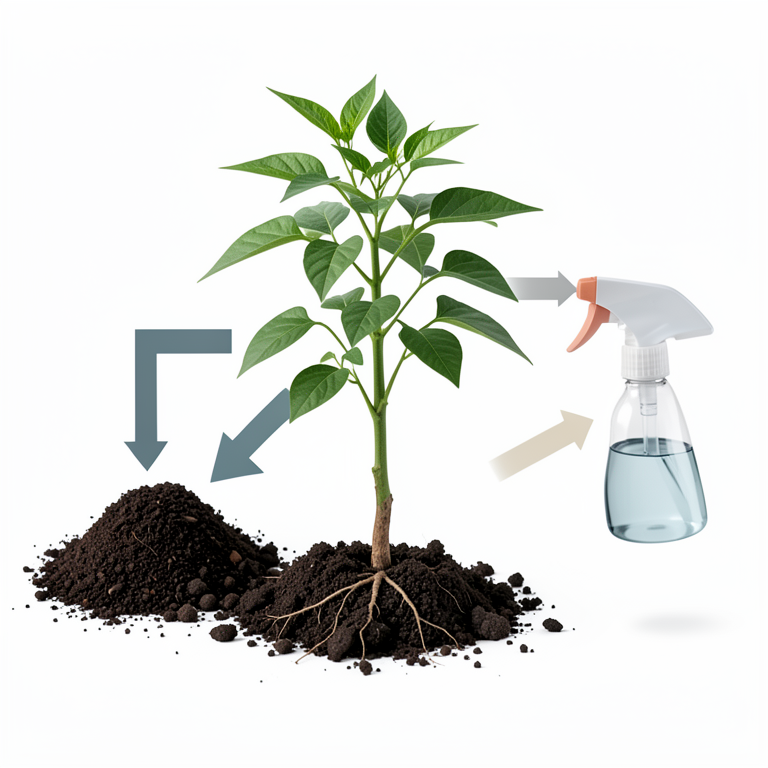
Experimental Treatment Workflow
AI-generated conceptual illustration (chilli plants (Capsicum annuum L.)). It explains the idea and does not show study data.
View source evidence ↗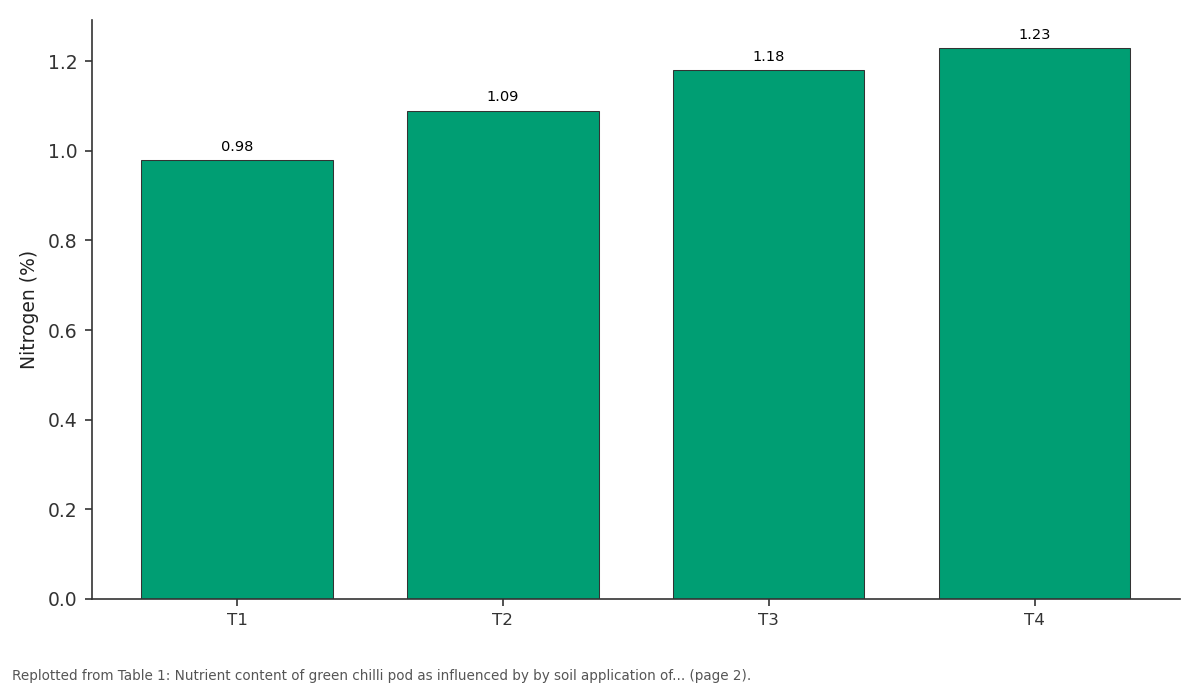
Nitrogen (%): T1 vs T2 vs T3 vs T4
Replotted from Table 1 (page 2) of the original paper. Every bar is the paper's own table value.
View source evidence ↗Figures & tables
From the original paper Table 1
Introduction
Chilli (Capsicum annuum L.) is a unique and popular spice in the majority of the countries of the world and it is one of the most important commercial vegetable crops in the India. Due to heavy dose of chemical fertilizers, pesticides and plant growth regulators, the chemical residue remains in the soil and effect human and animal health also causing environmental pollution. In this regard there is a need to identify the suitable substitute in place of chemical fertilizers which are economically cheaper and ecofriendly. Vermicompost is product obtained from composting of organic waste into high quality manure with help the of the earthworms. Vermicompost has potential in crop nutrition because presence of plant growth regulators such as auxins, gibberellins and cytokinins of microbial origin and humic acid in appreciable quantities (Atiyeh et al. 2002) [3] . Liquid organic manures efficiently meet crop nutrient requirements and correct deficiencies in organic production systems having greater nutrient use efficiency (Shwetha, 2009) [16] . The liquid organic sources and plant leaf extract helps to maintain environmental health by reducing the level of pollution. Cow urine is one of the ingredients of "Panchagavya" (urine, dung, milk, curd, and ghee) which control many diseases as it has many medicinal properties and it has ability to control fungal and bacterial diseases. Vermiwash is brownish-red liquid extract collected water pass through the vermiculture. Vermiwash is combination of earthworm mucous discharge, nutrients, micro-organisms and plant growth promoting material. Various experiments shown application of vermiwash improves plant health, yield and nutritional quality (Naidu et al. 2013) [10] . Moringa oleifera is a highly valued plant, seen in many countries of the tropics and subtropics. It has not only an impressive range of medicinal uses but also high nutritional value. (Abdalla, 2014) [1] . The moringa leaf extract (MLE) applied in the form of foliar application is more beneficial than soil applicatiom (Narang et al. 1997) [11] . Glyricidia sepium is multipurpose tree grown in humid and sub-humid areas and soil conditions, including acid and infertile soils. Glyricidia sepium is a promising green biomass producer for organic fertilizer production. Waste decomposer culture had developed by National Centre of Organic Farming (NCOF) which is used to quick decomposition of organic waste, soil health improvement and as plant protection agent. It is an association of micro-organism extracted from desi cow dung. Decomposer plays an important role in the flow of energy through an ecosystem. By releasing enzymes as well as organic acids, decomposer decomposes plant or crop residues in the field. Additionally, liquid organic fertilizer can actively provide you with the following advantages in addition to many others. Keeping all these views in mind, it was decided to assess the efficacy of organics in chilli crop nutrition. Therefore, the present investigation entitled Nutrient content of chilli (Capsicum annuum L.) as influenced by soil application of vermicompost and foliar spray of liquid organic sources.
Materials and Methods
The present study was carried out at Department of Agronomy, College of Agriculture, Dr. BSKKV., Dapoli (MH) during rabi season of 2022-2023. The field experiment was laid out in Randomized Block Design (RBD) comprising thirteen treatments replicated thrice. The treatment T1-100% RDN through Vermicompost (VC), T2-T1 + Foliar Spray of Cow urine @ 0.04% N content, T3-T1 + Foliar Spray of Cow urine @ 0.06% N content, T4-T1 + Foliar Spray of Vermiwash @ 0.04% N content, T5-T1 + Foliar Spray of Vermiwash @ 0.06% N content, T6-T1 + Foliar Spray of Moringa leaf extract (MLE) @ 0.04% N content (Silicone), T7-T1 + Foliar Spray of Moringa leaf extract (MLE) @ 0.06% N content (Silicone), T8-T1 + Foliar Spray of Glyricidia leaf extract (GLE) @ 0.04% N content (Silicone), T9-T1 + Foliar Spray of Glyricidia leaf extract (GLE) @ 0.06% N content (Silicone), T10-T1 + Foliar Spray of Moringa leaf extract (MLE) @ 0.04% N content (Waste decomposer), T11-T1 + Foliar Spray of Moringa leaf extract (MLE) @ 0.04% N content (Waste decomposer), T12-T1 + Foliar Spray of Glyricidia leaf extract (GLE) @ 0.04% N content (Waste decomposer) and T13-T1 + Foliar Spray of Glyricidia leaf extract (GLE) @ 0.04% N content (Waste decomposer). The vermicompost was applied to soil on the basis of 100% recommended dose of nitrogen along with the foliar application of two levels of cow urine, vermiwash, moringa leaf extract and glyricidia leaf extract @ 0.04 and 0.06% N content was applied as foliar application at the 30, 60 and 90 days after transplanting of seedlings.
Statistical analysis
The experimental data was analyzed statistically by the technique of Analysis of Variance as applicable to Randomized block design. The significance of treatment difference was tested by 'F' (Variance ratio) test. Critical difference (CD) at 5% level of probability was worked out for comparison and statistical interpretation of the treatment means as outlined by Panse and Sukhatme (1967) [13] .
Results and Discussion
Results and Discussion
Nutrient content
The results pertaining to nutrient content of the green chilli pod is presented in table 1. From the table it was observed that soil and foliar application of liquid organic sources had significant influence on nutrient content of green chilli pod. Among different liquid organic sources, maximum N content of green chilli pod (1.25%) was recorded in treatment T5 consisting 100% RDN through vermicompost alongwith foliar spray vermiwash @0.06% N content. The maximum total nitrogen content of chilli pod was found when 100% vermicompost applied on a N equivalent basis and 0.06% N content vermiwash was applied topically to the leaves. Similar findings were also made known by Tripathi and Bharadwaj (2004) [18] , who showed that nitrogen present in the form of mucus, nitrogenous excretory chemicals, growth-stimulating hormones, and enzyme in vermiwash all contribute significantly to raising the N concentration of crops. The significantly higher total phosphorus content (0.327%) in pod was recorded due to application of 100% RDN through vermicompost and foliar application of vermiwash @ 0.06% N content. The reason for this could be because during the vermicomposting process, the insoluble high molecular weight organic forms of phosphorus present in feed material that was used for vermicomposting, such as phospholipids, phytin, and phytic acid, were converted into low molecular weight inorganic forms, such as orthophosphate ions, when it goes through the earthworm gut and also by microbial decomposition, which leaches out from vegetables. The significantly maximum total potassium content (1.22%) of chilli was documented due to the treatment T5. The treatment T5 followed by T3, T4, T6, T7, T8, and T9 treatments. Further, the lower total potassium content (1.09%) of chilli was found in the T1 treatment. The significantly maximum total iron content (12.42 mg kg - 1 ) of chilli was noted due to the treatment T5. The significantly higher total zinc content (24.08 mg kg -1 ) pod of chilli was proved in the treatment T5. The similar results were also stated by Hernandez et al. (2010) [6] and Yassen et al. (2020) [19] , who recorded an increased in the zinc content of lettuce due to combined application of vermicompost and vermiwash. It is obvious from the data that the treatment T5 documented the significantly maximum total manganese content (39.76 mg kg -1 ) in pod and it was at par with the treatments T7, T3, T4, and T2. The treatment T5 recorded the significantly higher total copper content (16.13 mg kg -1 ) of chilli and it was statistically at par with the treatments T3, T2 and T7. In general, as compared to plant leaf extracts, the application of 100% RDN through vermicompost and foliar application of animal-origin organic sources, namely vermiwash and cow urine at greater concentrations (0.06% N content), recorded the maximum nutritional content of chilli. However, when compared to other plant leaf extracts, the foliar application of moringa leaf extract at a greater concentration (0.06% N content) recorded the highest level of nutritional content for chilli. The findings are consistent with those of Nogales et al. (2005) [12] and Hernandez et al. (2010) [6] , who demonstrated an increase in total copper concentration as a result of foliar vermiwash treatment.
| Treat. No. | Nitrogen (%) | Phosphorus (%) | Potassium (%) | Iron (mg kg-1) | Zinc (mg kg-1) | Mangnese (mg kg-1) | Copper (mg kg-1) |
|---|---|---|---|---|---|---|---|
| T1 | 0.98 | 0.234 | 1.09 | 8.44 | 17.93 | 27.96 | 11.86 |
| T2 | 1.09 | 0.269 | 1.12 | 10.49 | 20.50 | 33.93 | 15.23 |
| T3 | 1.18 | 0.270 | 1.19 | 11.14 | 21.43 | 35.81 | 15.26 |
| T4 | 1.23 | 0.321 | 1.17 | 11.09 | 21.50 | 35.06 | 13.96 |
Table text extracted from the original PDF; superscript letters are shown inline. The original table image is below.
View original table image
Conclusion
The treatment T5 comprising 100% RDN through vermicompost and foliar spray of vermiwash @ 0.06% N content significantly improved nutrient content of green chilli pod. Thus, the study revealed that the optimal combination for proper plant nutrition is the application of 100% recommended nitrogen dose through vermicompost and foliar spray of vermiwash @ 0.06 percent nitrogen content. This method enhances nutrient content of green chilli pod under organic farming practices in Rabi season on lateritic soils in the Konkan region.
References
15 in the original paper- Abdalla MM. Boosting the growth of rocket plants in response to the application of Moringa oleifera extracts as a bio stimulant. Life Science Journal. 2014;11(11):1113-1121.
- Arthur GD, Aremu OA, Kulkarni MG, Van Staden J. Vermicompost leachate alleviates deficiency of phosphorus and potassium in tomato seedlings. Hortic Science. 2012;47:1304-1307.
- Atiyeh RM, Lee SS, Edwards CA, Arancon NQ, Metzger J. The influence of humic acid derived earthworm processing organic waste on plant growth. Bioresources Technology. 2002;84:7-14.
- Deva Kumar N, Shubha S, Gowder SB, Rao GE. Microbial analytical studies of traditional organic preparations beejamrutha and jeevamrutha. Building Organic Bridges. 2014;2:639-642.
- Gopal M, Gupta A, Palaniswami C, Dhanapal R, Thomas GV. Coconut leaf vermiwash: a bio-liquid from coconut leaf vermicompost for improving the crop production capacities of soil. Curr Sci. India. 2010;98:1202-1210.
- Hernandez Adriana HC, Damaris O, Ana A, Lopez J, Sanchez E. Effect of Vermicompost and Compost on Lettuce Production. Chilean Journal of Agricultural Research. 2010;70(4):583-589.
- Kumar A, Dahiya T. Effect of vermicompost on growth and yield of chilli (Capsicum annuum). Bioinfolet. 2013;10(4C):1542-1543.
- Lindsay WL, Norvell WA. Development of DTPA soil test for Fe, Mn, Zn and Cu. Proceedings of Soil Science Society America. 1978;42:421-428.
- Naidu Y, Meon S, Siddiqui Y. Foliar application of microbial-enriched compost tea enhances growth, yield and quality of muskmelon (Cucumis melo L.) cultivated under fertigation system. Sci. Hort. 2013;159:33-40.
- Narang RS, Mahal SS, Bedi S, Gosaland KS, Bedi S. Response of wheat to potassium fertilization under maximum yield research strategies. J Environ Ecol. 1997;15(2):474-477.
- Nogales R, Cifuentes C, Benitez E. Vermicomposting of winery wastes: A laboratory study. J Environ Sci. Health Part B. 2005;1234:659-573.
- Pathak ML, Kumar A. Cow praising and importance of Panchyagavya as medicine. Sachitra Ayurveda. 2013;5:56-59.
- Shwetha BN, Babalad HB, Patil RK. Effect of combined use of organics in soybean-wheat cropping system. J Soil Crops. 2009;9(1):8-13.
- Tripathi G, Bhardwaj P. Comparative studies on biomass production, life cycles and composting efficiency of Eisenia foetida (Savigny) and Lampito mauritii (Kinberg). Bioresources Technology. 2004;92(3):275-283.
- Yassen AA, Entsar ME, Marzouk NM, Zaghloul SM. Impact of vermicompost and foliar spray of vermiwash on growth, yield and nutritional status of lettuce plants. Plant Archives. 2020;20(1):449-455.