
Research article · 2024 · Full text
International Journal of Agriculture Extension and Social DevelopmentEntrepreneurship development and start up Manipur: The present scenario
Volume 7(1) · Pages 101–104 · DOI: 10.33545/26180723.2024.v7.i1b.192 ↗
Research areasIndian Economic and Social Development
Abstract
Author-writtenAs the economic development of any nation is dependent upon the purposeful human activity, i.e., entrepreneurial function, it is sometimes referred to as the fourth factor of production. Individual entrepreneurs whose creativity has led to the industrialisation of many nations which enables to bring social transformation through social equality in higher levels of employment, more equitable distribution of income and well-balanced regional development. Due to the potentiality and need of industrialisation in bringing technological revolution through innovation in attaining higher rate of return on social investment and to generate dynamism in social and political life, developing countries like India has to go for quick industrial development and especially for a state like Manipur. Again, industrial growth and economic development of a developing county is deterred by a number issue. In order to fasten the pace of development by removing the hindrances to the economy of India Government of India has initiated a scheme known as ‘Startup India’ scheme from the year 2016. Accordingly in Manipur, the Government of Manipur has also initiated ‘Startup Manipur’ from the year 2018. So, the Startup Scheme who has enjoyed the financial assistance under this scheme since it started giving financial assistance through banks in Manipur. In-spite of giving the opportunities, entrepreneurs are facing problems. For successful venture, appropriate support and mentoring is required. Considering the need for industrialisation, this paper discussed the performance, significance and challenge of Start up in Manipur.
Summary
Source-checkedPlain-language reading of the full paper, prepared with AI and checked against the text. Each point links to the authors' own words.
Why it matters
- Entrepreneurial activity is considered a critical driver of national economic development, often described as the fourth factor of production. View evidence ↗
- Developing regions like Manipur in India require rapid industrial development to foster technological innovation and social dynamism. View evidence ↗
- Manipur is a North Eastern Indian state with approximately 27 lakh inhabitants that relies primarily on the agriculture sector. View evidence ↗
The question
- The study aims to examine the performance, significance, and challenges associated with start-ups in Manipur. View evidence ↗
What they did
- The research methodology relies on a review of secondary sources, including planning department reports, academic papers, and websites. View evidence ↗
What they found
- In 2018, the Start-up Manipur Scheme provided financial assistance to 475 out of 3,966 applicants. View evidence ↗
- In 2019, 145 applicants received financial assistance out of 563 who applied under the 'Stand-up stage'. View evidence ↗
- Between 2020 and 2021, 4,755 out of 17,388 applicants benefited, with 4,540 at the Idea stage, 126 at the Revenue stage, and 89 at the Stand-up stage. View evidence ↗
- Start-ups often fail due to several operational challenges, including poor market access, lack of resources, team conflicts, and low compensation. View evidence ↗
- The risk of failure is high for new ventures, with most start-ups failing within their first year of operation. View evidence ↗
- The lack of defined business processes in flat start-up organizations can lead to financial losses, legal liabilities, and poor customer service. View evidence ↗
What it means
- The authors conclude that appropriate mentoring and support are essential for the success of businesses throughout the entrepreneurial process. View evidence ↗
Visual summary
2 visualsIllustrations explain the paper; charts are replotted from the paper's own table values.
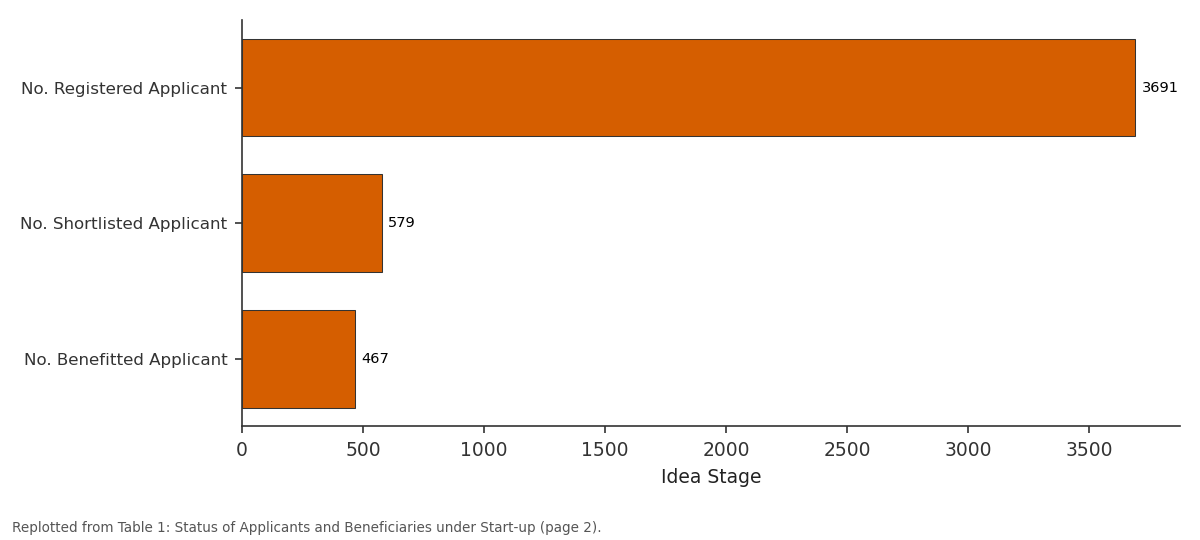
Idea Stage: No. Registered Applicant vs No. Shortlisted... vs No. Benefitted Applicant
Replotted from Table 1 (page 2) of the original paper. Every bar is the paper's own table value.
View source evidence ↗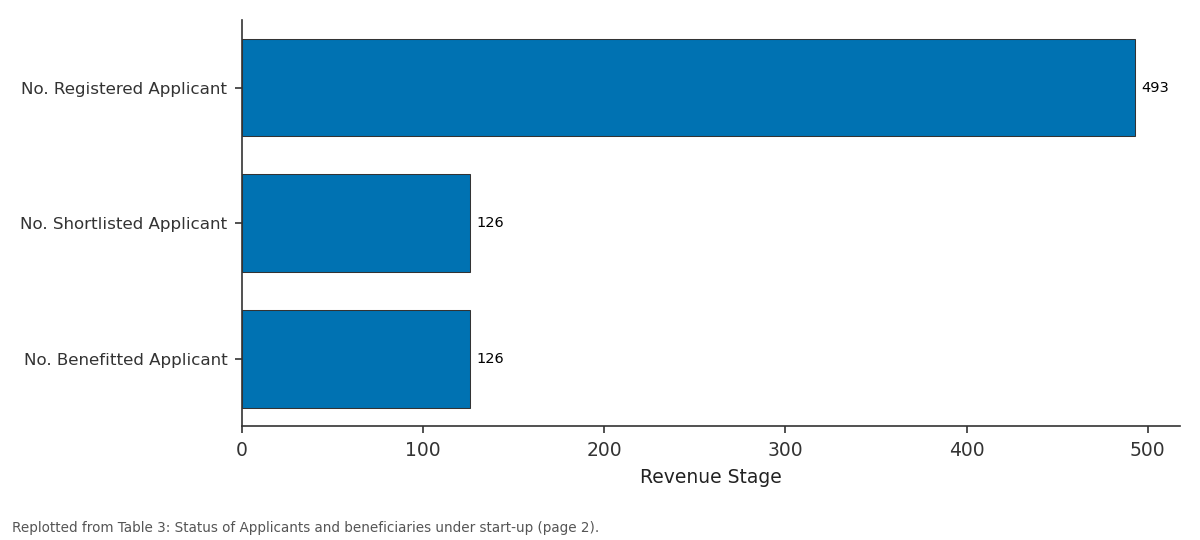
Revenue Stage: No. Registered Applicant vs No. Shortlisted... vs No. Benefitted Applicant
Replotted from Table 3 (page 2) of the original paper. Every bar is the paper's own table value.
View source evidence ↗Figures & tables
From the original paper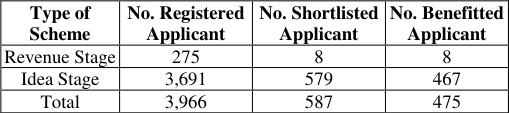 Table 1
 Table 2
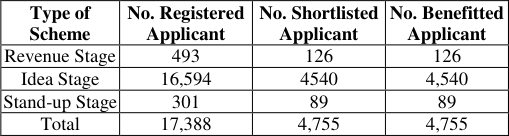 Table 3
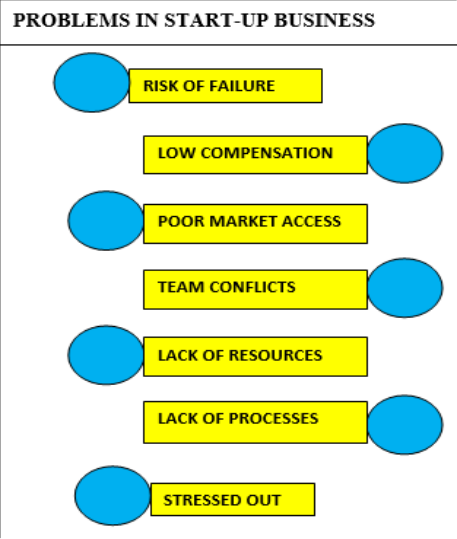 Figure 1
Introduction
Growth and development of entrepreneurship in any society is considered as the most important factor for the development of that society (Michael et al. 2015) [25] . No country in the world can be highly developed without the contributions to the economy from the side of private entrepreneurs (ACS, et al. 2008) [1] . In order to fasten the pace of development of the Indian economy, Government of India has initiated a scheme known as 'Start-Up India Scheme' from the year 2016 with the aim to bring development and innovation of products and services and to increase the employment rate in the country (Adhana et al. 2020) [2] . Start-up India is a flagship initiative of the Government of India, intended to build a strong ecosystem that is conducive for the growth of start-up businesses, to drive sustainable economic growth and generate large scale employment opportunities (Adhana, 2016) [3] . These programs have catalysed the start-up culture, with start-ups getting recognized through the Start-up India initiative and many entrepreneurs availing the benefits of starting their own business in India (Sternberg and Wennekers, 2005) [24] . A Start-up Company is a young company that is just beginning to develop. Start-ups are usually small and initially financed and operated by a handful of founders or individuals (Carree et al. 2007) [6] . The challenges that startups confront in their early stages were illustrated by Sharifi and Hossain (2015) [21] . The main conclusions are that investors are now expecting more due diligence from entrepreneurs before they even pitch their firms, owing to significant advancements in technology. According to Chandiok (2016) [7] , substantial finance, consolidation efforts, developing technology, and a growing local market have all contributed to the Indian start-up ecosystem's recent rise to prominence. The research findings indicate that the success of Start-up India as a developing economy can be attributed to various factors such as lower capital costs, simpler patent filing procedures, research and development credits, and easier entry. According to Babu and Sridevi (2019) [5] , India's start-up ecosystem has gained international attention. Since hundreds of bright young people have opted to follow their entrepreneurial dreams rather than work for large corporations or government agencies, the business community has seen a boom in innovative start-ups offering widespread solutions to pressing issues in recent years. There are several obstacles facing start-ups, from funding to hiring staff to launching and persistently maintaining growth. The government's many action plans and schemes that it has launched through the start-up India schemes are discussed in a paper by Chatterjee (2020) [8] titled "Started-up India: A Step towards Prosperity". Some significant statistics on Indian start-ups are clarified in this report. Even although the government has already started to support innovation, it is still necessary to modify people's mind-sets to encourage creativity, especially the younger generation, in order to produce original ideas rather than merely rehashing pre-existing www.extensionjournal.com ones. In Manipur (A state in the extreme corner of North Eastern part of India having with "No Industry Category") also the start-up Manipur has launched to generate large scale employment opportunities for the youth and women and also to promote sustainable economic growth of the region (Singh and Singh, 2022) [23] . This article examined the performance, relevance, and challenges of Start up in Manipur, taking into account the imperative for industrialization.
Methodology
The current overall structure of the study conducted here is based on the literature gathered from a variety of secondary sources, including papers, department of planning reports, research and prior studies, blogs, and websites, among others (Bryman, 1989, Stewart, 1984, Neuman, 1997 and Pallant, 2007) [28,26,20,27] .
Start-up India Mission and start-up Manipur
The Government of India's flagship program, Start-up India, aims to create a robust environment for fostering innovation and start-ups in the nation, which would propel long-term economic growth and provide a significant number of job opportunities. The Prime Minister outlined 19-point action plans for start-ups in the nation on January 16, 2016. Every facet of the start-up ecosystem is included in the action plan. According to Start-Up India Scheme, an entity shall be considered as a Start-up: Up to a period of ten years from the date of incorporation/ registration, if it is incorporated as a private limited company (As defined in the Companies Act, 2013) or registered as a partnership firm (registered under section 59 of the Partnership Act, 1932) or a limited liability partnership (Under the Limited Liability Partnership Act, 2008) in India. Turnover of the entity for any of the financial years since incorporation/ registration has not exceeded Rs 100 crore. Entity is working towards innovation, development or improvement of products or processes or services, or if it is a scalable business model with a high potential of employment generation or wealth creation. Provided that an entity formed by splitting up or reconstruction of an existing business shall not be considered a 'Start-up'. The benefits provided to recognised start-ups under the Start-up India initiative are: 1. Self-Certification: Self-certify and comply under 3
Environmental and 6 Labour Laws. In the year 2020-2021, out of the total 17,388 applicants under the scheme, 4,755 applicants have been given benefitted under different stages -126 beneficiary under Revenue stage, 4,540 beneficiaries under Idea stage and 89 beneficiaries under Stand-up stage (GOM, 2022) [10] .
Opportunities and challenges of start-up Manipur scheme Opportunities of start-up scheme in Manipur
The following benefits have been realized as a result of Start-up Manipur's promotion of bank funding for start-ups www.extensionjournal.com and incentives to encourage entrepreneurship and job development in the state of Manipur. This scheme and initiative taken up by the Govt. helps to nurture for those young and women who are having bright and talented who can lift up the nation growth through their innovative ideas and invention (Jayanthi, 2019) [12] . Decision taken up by the youth and women would be based on the ability to initiate the new ideas and capability to run the enterprises. Here, What the decision is and what's the effect responsibility is own, Thus, right decisions boost up the energy and wrong decisions make people learn the lessons from the failure to improve their works. This scheme encourages the youth and women to lift up them for those who can make their dreams come true by their own abilities to take right and wrong decision (Jayanthi, 2019) [12] . Establishment of own enterprises and new starts-up business are free from bondage and dictatorship under the one boss to run the business institutions, thus leading to owned the right to manage the works and finances activities. This scheme helps to improve the income exponentially growth and can put into the position of economic independent for all who wish to run the business by their own (Jayanthi, 2019) [12] . Every human on earth wishes to have Job security and we cannot work with full zeal if our jobs are not well sound. Thus, zeal and enthusiasm comes automatically if we established our own empire of business ultimately leading to the path of security of jobs (Jayanthi, 2019) [12] . Instead of running after the jobs, and when any entrepreneurship is started people tend to new jobs own and jobs for others also, thus making an opportunity to create jobs for youth and women (Sharma, 2013, Jayanthi, 2019) [22,12] . We human wish to live a life with joyous and recognition. Thus, by the venture of establishment of our own business empire, fame and recognition comes to us by the natural phenomenon (Sharma, 2013, Jayanthi, 2019) [22,12] . Every human on globe wants to be at comfortably and desires to the best standard and value of life due to the impact of urbanization and new coming trend of e-commerce. Thus, being as an empire of own enterprises, one has possessed the freedom to choose the life of quality by their own (Sharma, 2013, Jayanthi, 2019) [22,12] . Possessing of own brand and naming and putting their names and legacies on the brand gives us immense pleasure to introduce you as an owner of the enterprises (Sharma, 2013, Jayanthi, 2019) [22,12] . We human had own vision and dreams but these dreams turn it into reality are not an easy task. So, by occupying the ownership of one's brand can convert your vision into reality (Sharma, 2013, Jayanthi, 2019) [22,12] . Saying is easier than the doing, thus also saying an old proverb, empty vessels make many noises. But people who take the initiative to create their own empire of business can change the world according to them, if not the world till they make a difference (Sharma, 2013, Jayanthi, 2019) [22,12] . Successful entrepreneurs have the vision of change the social injustice and underdeveloped situation. And by virtue, the role of entrepreneur is also to do jobs for the social. Thus, any successful business is always tended to generous people and readily happy to do their work for socially responsible person. They are very much socially involved and try to love making friends and networking and such activities help in the promotion of any start-up and even can link to start a new business (Sharma, 2013, Jayanthi, 2019) [22,12] . Showing our talent and the creativity to the world can only be possible by doing and establishment of own business (Sharma, 2013, Jayanthi, 2019) [22,12] . Having said and all above mentioned, by the grace of all such entrepreneurship journey, we should create our own legacy for the future generation in this era of global rat races and competitive world for the bitterness' of the society (Sharma, 2013, Jayanthi, 2019) [22,12] . [14] .
Challenges of start-up Manipur Scheme
Challenges of start-up Manipur Scheme
Fig 1: Showing the challenges of start-up business
Most Start-ups fail within their first year of operations so the risk of failure is high. Working under such high risk can blur a start-up's strategic vision. It takes blood, sweat and tears to build a company and long working hours are the norm for start-ups. The rewards are low since it takes time to generate revenue and make profits. Some start-ups give up since its demotivating to work in through proper compensation. Many customers prefer a business that they have worked with over a new start-up. Besides, it is more expensive to acquire new customers than to retain old one. Without a customer base, understanding market needs also becomes a real struggle. Some start-ups are base out desperation since the founder could not find or hold on to a job. Such founders often struggle to build a team that the business needs to succeed. A successful start-up requires funders / co-directors with complimentary personalities and competencies. Even then disagreements can escape in between the going gets tough. Growth hacking, cloud computing and venture capitalism allow start-ups to gain market entry. Most start-ups operate on a short-listing www.extensionjournal.com budget, against competitors that are well-resourced. It gives the competitors an edge in product development sales and marketing. They use that edge to push start-ups. Start-ups are flat organisations that lack defined business processes and operational procedures. This exposes then to poor customer service, legal liability and financial losses. Startups become very stressful as there are a number of problems such as low compensation, many responsibilities and long working hours etc. ( [14,4,9]
Conclusion
With the help of financing organizations, the government, and talent and innovation incubators, startups aim to instill an entrepreneurial culture in the minds of young people and women, as well as to contribute to the new, evolving paradigms of society. Once again, it is evident that the entirety of our current Prime Minister Narendra Modi's action plan provides youth with a variety of opportunities in all forms of start-up in India, with the goal of assisting unemployed youth and women in large to establish businesses in order to provide a small push to new, innovative ventures. Despite the aforementioned prospects, entrepreneurs still face challenges, but they have the ability to overcome them head-on. In conclusion, proper mentoring and assistance are necessary for a successful business in every aspect of the entrepreneurship journey.
Figures and tables from the paper
References
26 in the original paper- Acs ZJ, Desai S, Hessels J. Entrepreneurship, economic development and institutions. Small Bus Econ. 2008;31:219-234. https://doi.org/10.1007/s11187-008-9135-9
- Adhana D. Start-up ecosystem in India: A Study with focus on entrepreneurship and University Business Incubators. SSRN. 2020. Available at: https://ssrn.com/abstract=3702510 or http://dx.doi.org/10.2139/ssrn.3702510
- Adhana DK. Start-up India, Stand-up India: India turning into a start-up hub by prospering entrepreneurial culture. Int J Manag Soc Sci. 2016;4(2):368-384.
- Alawamleh M, Francis YH, Alawamleh KJ. Entrepreneurship challenges: the case of Jordanian start-ups. J Innov Entrep. 2023;12:21. https://doi.org/10.1186/s13731-023-00286-z
- Babu GS, Sridevi K. A Study on Issues and Challenges of Start-ups in India. Int J Financ Manag Econ. 2019;2(1):44-48.
- Carree M, van Stel A, Thurik R, Wennekers S. The relationship between economic development and business ownership revisited. Entrepreneurship and Regional Development. 2007;19(3):281-291.
- Chandiok S. India the world's fastest growing start-up ecosystem: A Study. Amity Res J Tour Aviation Hosp. 2016;1(2):84-93.
- Chatterjee D. Start-up India: A step towards prosperity. Int J Res Analytical Rev. 2020, 108-116.
- Foris T, Tecău AS, Dragomir C-C, Foris D. The StartUp Manager in Times of Crisis: Challenges and Solutions for increasing the resilience of companies and sustainable reconstruction. Sustainability. 2022;14(15): 9140. https://doi.org/10.3390/su14159140
- GOM. Start-up Manipur, Accessed 2022. https://cmdashboard.mn.gov.in/departments/cmflagships/start-up-manipur
- Jayanthi R. A study about Entrepreneurship in India and Its promotion under 'Start-up India' Scheme. Iconic Res Eng J. 2019;2(1):118-126.
- Jitender, Pravesh. Start UP India stand-up India: The Current Scenario. Int J Res Culture Soc. 2017;p.240.
- Kurode T, Kurode AV, Moitra K. A Study of Critical Challenges in Startup Management. SSRN, 2016. Available at: https://ssrn.com/abstract=3348534 or http://dx.doi.org/10.2139/ssrn.3348534
- Caliendo M, Kunn S, Wiebner F, Hogenacker J. Subsidized start-ups out of unemployment: A comparison of regular business start-ups. IZA discussion Papers, 2015, 8817.
- Goyal M, Prakash J. Women entrepreneurship in India - problems and prospects. Zenith Int J Multidiscipline Res, 2011, 1(5).
- Ensley MD, Hmieleski KM, Pearce CL. The importance of vertical and shared leadership within new venture top management teams: Implications for the performance of the start-ups. 2006.
- Fortunato MWP, Alter T. Community entrepreneurship development: An introduction. Community Dev. 2015;46(5):444-455. https://doi.org/10.1080/15575330.2015.1080742
- Bosma N, Praag MV, Thurik R, Wit GD. The value of human and social capital investment for the business performance of start-ups, 2002.
- Sharifi O, Karbalaei Hossein B. Understanding the Financial Challenges Faced by Start-ups in India, 2015 November.
- Sharma Y. Women entrepreneur in India. IOSR J Bus Manag, 2013, 15(2).
- Singh K, Singh D. MSMEs: An analysis on Problem faced by the Employees in Manipur. Int J Humanit Soc Sci. 2022.
- Sternberg R, Wennekers S. The determinants and effects of new business creation using global entrepreneurship monitor data. Small Bus Econ. 2005;24(3):193-203.
- Kordatou MI, Michael C, Duan X, He X, Dionysiou DD, Mills MA, et al. Dissolved effluent organic matter: characteristics and potential implications in wastewater treatment and reuse applications. Water Research. 2015 Jun 15;77:213-48.
- Stewart J, De Wit H, Eikelboom R. Role of unconditioned and conditioned drug effects in the selfadministration of opiates and stimulants. Psychological review. 1984 Apr;91(2):251.
- Pallant JF, Tennant A. An introduction to the Rasch measurement model: an example using the Hospital Anxiety and Depression Scale (HADS). British Journal of Clinical Psychology. 2007 Mar;46(1):1-8.
- Bryman A. June 1989 and beyond: Julia Brannen's contribution to mixed methods research. International Journal of Social Research Methodology. 2014 Mar 4;17(2):121-31.