
Research article · 2023 · Full text
International Journal of Statistics and Applied MathematicsEffect of silicon application on population of green leaf hopper, Nephotettix virescens (Distant) (Hemiptera: Cicadellidae) in Rice
Volume 8(6S) · Pages 1137–1139 · DOI: 10.22271/maths.2023.v8.i6so.1515 ↗
Research areasSilicon Effects in AgricultureAgricultural Science and FertilizationAgronomic Practices and Intercropping Systems
Abstract
Author-writtenThe green leaf hopper, Nephotettix virescens (Distant) (Hemiptera: Cicadellidae) is one of the major pests of rice in India. An experiment was conducted at Agricultural Research Station, Anand Agricultural University, Derol, Dist. Panchmahal, Gujarat, India during kharif (rainy) season in 2011 and 2012 to know the effect of soil and foliar application of silicon on the population of green leaf hopper, N. virescens in rice. Four doses of calcium silicate (500, 1000, 1500 and 2000 kg/ha) applied as soil application and three concentrations of potassium silicate (0.5, 1.0 and 2.0 per cent) applied as foliar sprays were evaluated along with control. All four doses of calcium silicate recorded significantly lower population of green leaf hopper, N. virescens, as compared to control, during both the years of study. The highest dose of calcium silicate i.e. 2000 kg/ha recorded significantly lowest the population of green leaf hopper, N. virescens and it differed significantly from the rest of the treatments.
Summary
Source-checkedPlain-language reading of the full paper, prepared with AI and checked against the text. Each point links to the authors' own words.
Why it matters
- The green leaf hopper (Nephotettix virescens) is a significant pest affecting rice crops in India. View evidence ↗
- Beyond direct feeding, these pests cause major yield losses by acting as vectors for the rice tungro virus. View evidence ↗
- Due to the adverse effects of continuous insecticide use, there is a need for alternative methods of insect control. View evidence ↗
The question
- The study aimed to determine how soil and foliar applications of silicon affect the population of the green leaf hopper in rice. View evidence ↗
What they did
- The research was conducted over two rainy seasons (2011 and 2012) at the Agricultural Research Station in Gujarat, India. View evidence ↗
- The study used a Randomized Block Design with eight treatments and three replications on rice variety GR-11. View evidence ↗
- Treatments included four doses of soil-applied calcium silicate (500, 1000, 1500, and 2000 kg/ha) and three concentrations of foliar-applied potassium silicate (0.5%, 1.0%, and 2.0%), plus a control group. View evidence ↗
- Pest populations were measured by counting nymphs and adults on ten randomly selected hills per plot at weekly intervals from 30 days after transplanting until harvest. View evidence ↗
What they found
- All four soil-applied doses of calcium silicate significantly reduced the green leaf hopper population compared to the control in both study years. View evidence ↗
- The highest dose of soil-applied calcium silicate (2000 kg/ha) was the most effective, resulting in the lowest populations of 3.30 GLH/hill in the first year and 3.26 GLH/hill in the second year. View evidence ↗
- Foliar applications of potassium silicate at 0.5%, 1.0%, and 2.0% provided no significant protection, with populations remaining similar to the control (5.93 GLH/hill in the first year). View evidence ↗
- Pooled data across two years showed that the 2000 kg/ha soil application of calcium silicate was significantly more effective than all other treatments, with a population of 3.28 GLH/hill. View evidence ↗
- Soil application of silicon was significantly more effective at controlling the pest than foliar application. View evidence ↗
What it means
- The authors conclude that applying calcium silicate to the soil during transplanting significantly reduces the population of the green leaf hopper. View evidence ↗
- While all tested doses of calcium silicate were effective, the 2000 kg/ha dose is recommended as the most effective. View evidence ↗
Visual summary
1 visualsIllustrations explain the paper; they do not show study data.
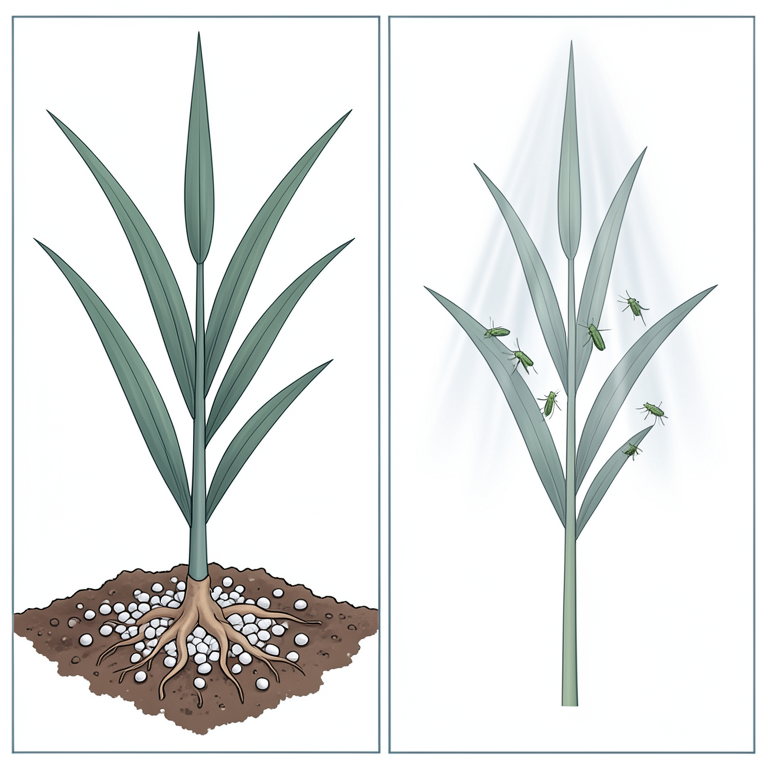
Comparison of Silicon Application Methods
AI-generated conceptual illustration (Rice plants (Oryza sativa) and green leaf hoppers (Nephotettix virescens)). It explains the idea and does not show study data.
View source evidence ↗Figures & tables
From the original paper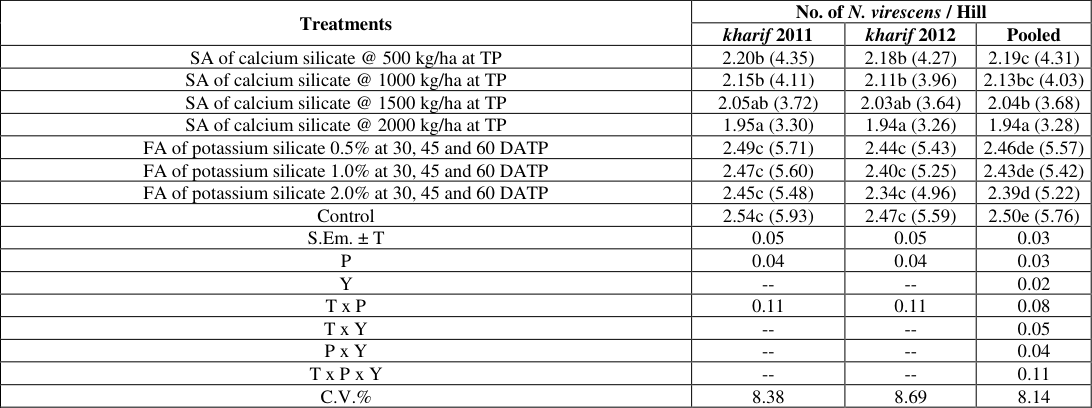 Table 1
Introduction
Rice (Oryza sativa Linnaeus) is a staple food for more than half of the world's population. Asia is considered to be a "Rice Bowl" of the world occupying 90 per cent of the world's rice area. China and India are the two largest rice-producing countries. Rice is attacked by more than 100 species of insects, of which about 20 are major pests (Pathak and Saxena, 1980) [6] . Green leaf hoppers (GLH) feed on the leaves or upper parts of the rice plant (Viswanathan and Kalode, 1984) [10] . Frequently they occur in large number causing significant crop losses (Viswanathan and Kalode, 1984) [10] . They also indirectly damage rice plants by acting as the vector for rice tungro virus, a serious disease in the crop causing major yield losses (Cabauatan and Hibino, 1985) [2] . Tungro epidemics were reported from India (Raichaudhuri et al., 1970). [7] It was estimated that GLH cause 50 to 80 per cent loss in rice (Alam and Islam 1959) [2] . Insecticides are widely used to manage rice pests, including N. virescens. However, the continuous use of a wide range of insecticides has caused many adverse effects. Hence, there is a need to find a suitable alternative to the chemical method of insect control. Insect pest damage may also be reduced through careful management of nutrient requirements of the crop or amendments with mineral nutrients, such as silicon (Si), that reduce crop susceptibility to pests (Meyer and Keeping, 2005) [5] . Silicon application suppressed green leaf hoppers in rice (Maxwell et al., 1972) [4] . Very few workers have studied the effect of silicon application on the incidence of N. virescens in rice in India and such studies have not been reported from Gujarat. Hence, it was thought worthwhile to investigate on the impact of soil and foliar application of silicon on the population of N. virescens in rice.
Materials and Methods
The present study was conducted at Agricultural Research Station, Anand Agricultural University, Derol, Dist. Panchmahal (Gujarat) during kharif (rainy) season for two successive years i.e., 2011 and 2012.
Geographically, Derol is situated on 22 0 36' N latitude and 73 0 27' E longitude and has elevation of 85.36 m above the mean sea level. It falls under middle Gujarat Agro-climatic Zone. The soil of the experimental plot was sandy loam. The experiment was laid out in Randomized Block Design with eight treatments and three replications using rice cv. GR-11. Initially, rice seedlings were raised in the nursery for 25 to 30 days. Later on, seedlings were transplanted at a spacing of 20 x 15 cm in the experimental plot. The gross plot and net plot size were 3.90 x 3.20 m and 3.00 and 2.40 m, respectively. Four doses (500, 1000, 1500 and 2000 kg/ha) of soil application (SA) of calcium silicate (CaSiO3) and three concentrations (0.5, 1.0 and 2.0%) of foliar application (FA) of potassium silicate (K2SiO3) along with control were evaluated for their impact on the population of green leaf hopper, N. virescens. Calcium silicate was applied into soil at the time of transplanting, whereas potassium silicate was applied as a foliar spray at 30, 45 and 60 days after transplanting. Spray application was carried out with knapsack sprayer fitted with a hollow cone nozzle. The volume of the spray solution used was 500 litres per ha. All recommended agronomical practices were followed to raise the rice crop. Calcium silicate (CaSiO3) contains 24 per cent silicon, whereas potassium silicate (K2SiO3) contains 18 per cent silicon. For recording observations on the population of green leaf hopper, N. Virescens, ten hills were randomly selected from each net plot area and total number of nymphs as well as adults were counted at weekly interval starting from 30 DAT to harvest.
Statistical analysis of data
Data were statistically analysed as per the procedure given by Steel and Torrie (1980) [8] . Treatments means were compared using Duncan's New Multiple Range Test (DNMRT).
Results and Discussions
The population of green leaf hopper, N. virescens was observed only at 30, 37, 45, 52 and 60 DAT during both years of study. Periodical data on population of N. virescens were pooled to judge the effectiveness of different treatments.
First year
The data on the population of N. virescens, pooled over periods, revealed significant differences among the treatments (Table 1). The lowest (3.30 GLH/hill) population of N. virescens was observed in the treatment of SA of calcium silicate @ 2000 kg/ha and it differed significantly from all the treatments except calcium silicate @ 1500 kg/ha (3.72 GLH/hill). Treatments of SA of calcium silicate @ 1000 and 500 kg/ha exhibited 4.11 and 4.35 N. virescens per hill, respectively and they were at par with calcium silicate @ 1500 kg/ha. All four doses of calcium silicate were significantly more effective than all three concentrations of potassium silicate. Foliar application of silicon in the form of potassium silicate did not provide protection against N. virescens in rice as all three concentrations (0.5, 1.0 and 2.0%) were at par with control plots (5.93 GLH/hill).
| Treatments | No. of N. virescens / Hill | — | — |
|---|---|---|---|
| kharif 2011 | kharif 2012 | Pooled | |
| SA of calcium silicate @ 500 kg/ha at TP | 2.20b (4.35) | 2.18b (4.27) | 2.19c (4.31) |
| SA of calcium silicate @ 1000 kg/ha at TP | 2.15b (4.11) | 2.11b (3.96) | 2.13bc (4.03) |
| SA of calcium silicate @ 1500 kg/ha at TP | 2.05ab (3.72) | 2.03ab (3.64) | 2.04b (3.68) |
| SA of calcium silicate @ 2000 kg/ha at TP | 1.95a (3.30) | 1.94a (3.26) | 1.94a (3.28) |
| FA of potassium silicate 0.5% at 30, 45 and 60 DATP | 2.49c (5.71) | 2.44c (5.43) | 2.46de (5.57) |
| FA of potassium silicate 1.0% at 30, 45 and 60 DATP | 2.47c (5.60) | 2.40c (5.25) | 2.43de (5.42) |
| FA of potassium silicate 2.0% at 30, 45 and 60 DATP | 2.45c (5.48) | 2.34c (4.96) | 2.39d (5.22) |
| Control | 2.54c (5.93) | 2.47c (5.59) | 2.50e (5.76) |
| S.Em. ± T | 0.05 | 0.05 | 0.03 |
| P | 0.04 | 0.04 | 0.03 |
| Y | -- | -- | 0.02 |
| T x P | 0.11 | 0.11 | 0.08 |
| T x Y | -- | -- | 0.05 |
| P x Y | -- | -- | 0.04 |
| T x P x Y | -- | -- | 0.11 |
| C.V.% | 8.38 | 8.69 | 8.14 |
Table text extracted from the original PDF; superscript letters are shown inline. The original table image is below.
View original table image
Second year
The data on population of N. virescens, pooled over periods, indicated that the differences among the treatments were significant (Table 1). SA of calcium silicate @ 2000 kg/ha was found to be most effective with 3.26 N. virescens per hill. Furthermore, it differed significantly from the remaining treatments, except calcium silicate @ 1500 kg/ha (3.64 GLH/hill). SA of calcium silicate @ 1500, 1000 and 500 kg/ha recorded 3.64, 3.96, and 4.27 N. virescens per hill, respectively and they were at par with one another. FA of potassium silicate (0.5 to 2.0%) supported the population of 4.96 to 5.43 N. virescens per hill, but they were at par with control (5.59 GLH/hill). (2) Within the column, treatment means followed by same letter within the column do not differ significantly by DNMRT at 5 per cent level of significance.
(3) TP: Transplanting, SA: Soil Application, FA: Foliar Application, DATP: Days After Transplanting
Pooled Results
The data on N. virescens population, pooled over 5 periods and 2 years, indicated that all four doses of SA of calcium silicate (500, 1000, 1500 and 2000 kg/ha) were effective against N. virescens in rice as they recorded significantly lower population of N. virescens as compared to control plots (Table 1). Among four doses of SA of calcium silicate the dose 2000 kg/ha (3.28 GLH/hill) was the most effective treatment and it differed significantly from the rest of the treatments. Calcium silicate @ 1500 kg/ha (3.68 GLH/hill) and 1000 kg/ha (4.03 GLH/hill) were found to be equally effective in reducing N. virescens population in rice. All four doses of SA of calcium silicate were significantly more effective then all three concentrations of FA of potassium silicate in controlling the N. virescens in rice. Foliar application of silicon in the form of potassium silicate @ 1.0 and 0.5 per cent recorded 5.42 and 5.57 N. virescens per hill, respectively and they were at par with control (5.76 GLH/hill). Similar result was reported by Maxwell et al. (1972) [4] , who observed that silicon suppressed green leaf hoppers in rice. Hou et al. (2018) [3] also reported reduction in plant hopper population due to soil application of silicon to rice plants. Honeydew excretion by brown plant hopper was reduced due to soil application of silicon in rice, indicating reduced feeding by the pest (Tenguri et al., 2023) [9] . Furthermore, Yang et al. (2017) [11] found that silicon application significantly decreased brown plant hopper population growth rates while increased population doubling time and enhanced rice plant resistance to brown plant hopper through impairment of feeding.
Conclusion
Soil application of silicon in the form of calcium silicate at the time of transplanting of rice significantly reduced the population of green leaf hopper, N. virescens. All four doses of calcium silicate (500, 1000, 1500 and 2000 kg/ha) were effective against N. virescens, but the dose of 2000 kg/ha was significantly the most effective.
Acknowledgement
AcknowledgementThe first author sincerely acknowledges the support provided by the Director of Research and Dean, Post Graduate Studies, Anand Agricultural University, Anand, Gujarat. The author is also thankful to the Unit Head, Agricultural Research Station, Anand Agricultural University, Derol, Dist. Panchmahal, Gujarat for providing all the necessary facilities during study.
References
10 in the original paper- Alam Z, Islam A. Biology of the rice leafhopper, Nephotettix bipunctatus Fab. in East Pakistan. Pak J Sci Res. 1959;2:20-28.
- Cabauatan PQ, Hibino H. Transmission of rice tungro bacilliform and spherical viruses by Nephotettix virescens distant. Phytopathology. 1985;2:103-109.
- Hou YQ, Wen JH, Peng ZP, Zhang DY, Hou ML. Effects of silicon amendment on the occurrence of rice insect pests and diseases in a field test. J Integr. Agric. 2018;17(10):2172-2181.
- Maxwell FG, Jenkons JN, Parrott WL. Resistance of plants to insects. Adv Agron. 1972;24:187-265.
- Meyer JH, Keeping MG. Nitrogen and silicon impact on the resistance of sugarcane to Eldana saccharina stalk borer (Lepidoptera: Pyralidae). In: III Silicon in Agriculture Conference, Uberlandia, 22-26 October 2005, Brazil.
- Pathak MD, Saxena RC. Breeding approaches in rice. In: Smith H, editor. Breeding plants resistant to insects. Oxford: Pergamon; 1980. p. 61-81.
- Raichaudhuri SP, Mitra DK, Everett TR. of rice green leafhoppers -vectors of rice Tungro virus and yellow dwarf in India. Proceedings of VII Congress International de la protection des plants Paris, 1970, Boulevard Lannes, Paris; (Mimeo.); c1970.p. 5.
- Tenguri P, Chander S, Ellur RK, Yele Y, Sundaram AP, Nagaraju MT. Effect of silicon application to the rice plants on feeding behaviour of the brown planthopper, Nilaparvata lugens (Stål) under elevated CO2. Silicon. 2023;15:5811-5820. https://doi.org/10.1007/s12633-02302480-w
- Viswanathan K, Kalode MB. Comparative study on varietal resistance to rice green leafhoppers Nephotettix virescens (Distant) and N. nigropictus (Stal). Proc Indian Acad Sci (Anim Sci). 1984;93(1):55-63.
- Yang L, Han Y, Li P, Wen L, Hou M. Silicon amendment to rice plants impairs sucking behaviors and population growth in the phloem feeder Nilaparvata lugens (Hemiptera: Delphacidae). Sci Rep. 2017;7:1101. https://doi.org/10.1038/s41598-017-01060-4