
Research article · 2023 · Full text
International Journal of Statistics and Applied MathematicsPopulation dynamics of Jassid Amrasca biguttula biguttula (Ishida) infesting okra and its relationship with weather parameters
Volume 8(6S) · Pages 1044–1048 · DOI: 10.22271/maths.2023.v8.i6sn.1500 ↗
Research areasAgricultural Practices and Plant GeneticsAgricultural pest management studiesAgricultural Science and Fertilization
Abstract
Author-writtenAn investigation to study the population dynamics of jassid (nymph/leaf), Amrasca biguttula biguttula (Ishida) (Cicadellidae) infesting okra and its relationship with weather parameters was carried out at Anand Agricultural University, Anand, Gujarat during summer 2021. The incidence of jassid commenced after two weeks of germination (10th SMW) and continued up to removal of crop in the 20th SMW. A higher incidence of jassid was observed during the 13th to 17th SMW. Jassid population exhibited significant positive correlation with maximum temperature and vapour pressure deficit, whereas it showed non-significant positive correlation with minimum temperature, bright sunshine hours, morning and evening vapour pressure. The morning as well as evening relative humidity, rainfall and wind speed showed non-significant negative correlation with jassid population. Population of coccinellids had significant positive correlation whereas spider population had highly significant positive correlation with jassid population.
Summary
Source-checkedPlain-language reading of the full paper, prepared with AI and checked against the text. Each point links to the authors' own words.
Why it matters
- The jassid pest Amrasca biguttula biguttula can cause a 54-66% reduction in the vegetative growth and yield of okra crops if they are not protected. View evidence ↗
- Jassid nymphs and adults damage okra by sucking sap from the underside of leaves and injecting a toxin that causes leaf browning, cupping, and necrosis. View evidence ↗
- Understanding the peak periods of jassid infestation is essential for managing the pest to reduce yield losses and increase okra productivity in India. View evidence ↗
The question
- The study aimed to investigate the population dynamics of jassids in okra and how these populations relate to various weather parameters. View evidence ↗
What they did
- The research was conducted in summer 2021 at Anand Agricultural University in Gujarat, using okra variety GAO 5 planted with 45 cm row spacing and 30 cm plant spacing. View evidence ↗
- Jassid populations were monitored weekly from one week after germination until crop removal by counting insects on top, middle, and lower canopy leaves of five randomly selected plants per sector. View evidence ↗
- The researchers used simple correlation coefficients to analyze the relationship between the populations of jassids, coccinellids, and spiders and various environmental factors. View evidence ↗
What they found
- Jassid infestation began in the second week after germination (10th Standard Meteorological Week) and lasted until harvest (20th SMW). View evidence ↗
- Jassid populations ranged from 0.50 to 3.55 per leaf, peaking at 3.55 jassids/leaf in the third week of April (15th SMW). View evidence ↗
- Jassid populations showed a significant positive correlation with maximum temperature (r = 0.684) and vapor pressure deficit (r = 0.698). View evidence ↗
- Morning relative humidity, evening relative humidity, rainfall, and wind speed all showed non-significant negative correlations with the jassid population. View evidence ↗
- Coccinellid activity began in the second week of April (14th SMW) at 0.25 per plant and peaked at 0.35 per plant in the third week of April (15th SMW). View evidence ↗
- Spider populations were first observed in the first week of April (13th SMW) at 0.15 per plant, reaching a peak of 0.35 per plant in the third week of April (15th SMW). View evidence ↗
- There was a significant positive correlation (r = 0.684) between the population of coccinellids and the population of jassids. View evidence ↗
- Spider populations showed a highly significant positive correlation (r = 0.795) with jassid populations. View evidence ↗
What it means
- The authors concluded that jassid activity in summer okra is highest during April, specifically from the 13th to the 17th Standard Meteorological Week. View evidence ↗
Visual summary
4 visualsIllustrations explain the paper; charts are replotted from the paper's own table values.
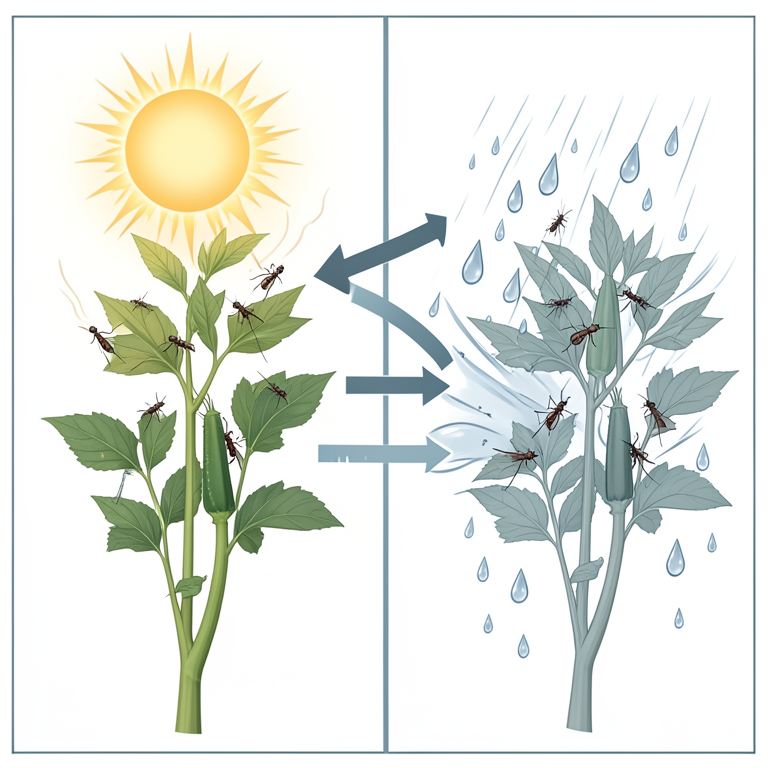
Weather Influence on Jassids
AI-generated conceptual illustration (Amrasca biguttula biguttula jassids on okra plants). It explains the idea and does not show study data.
View source evidence ↗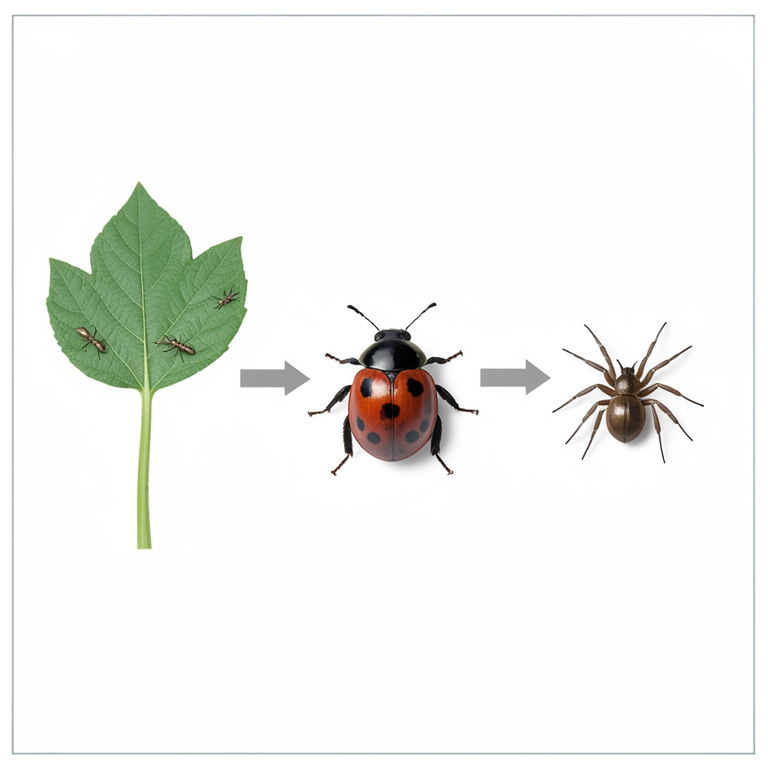
Trophic Relationship
AI-generated conceptual illustration (Okra plants infested with Amrasca biguttula biguttula jassids, coccinellid beetles, and spiders). It explains the idea and does not show study data.
View source evidence ↗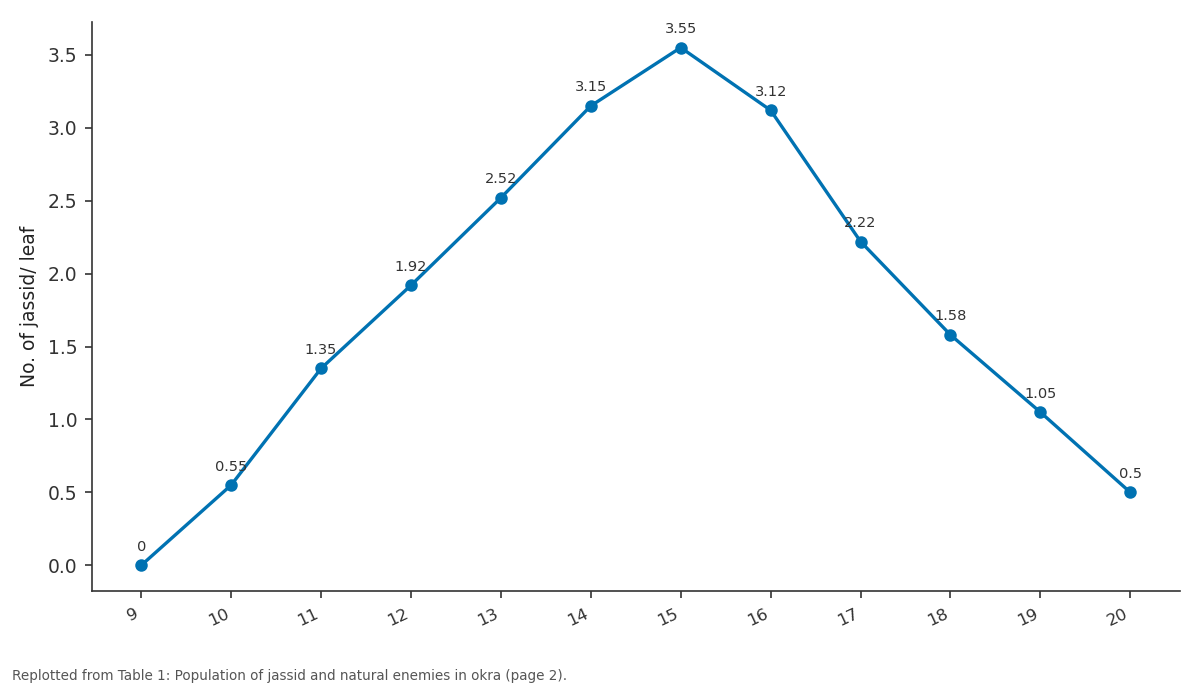
No. of jassid/ leaf: 9 vs 10 vs 11 vs 12 vs 13
Replotted from Table 1 (page 2) of the original paper. Every bar is the paper's own table value.
View source evidence ↗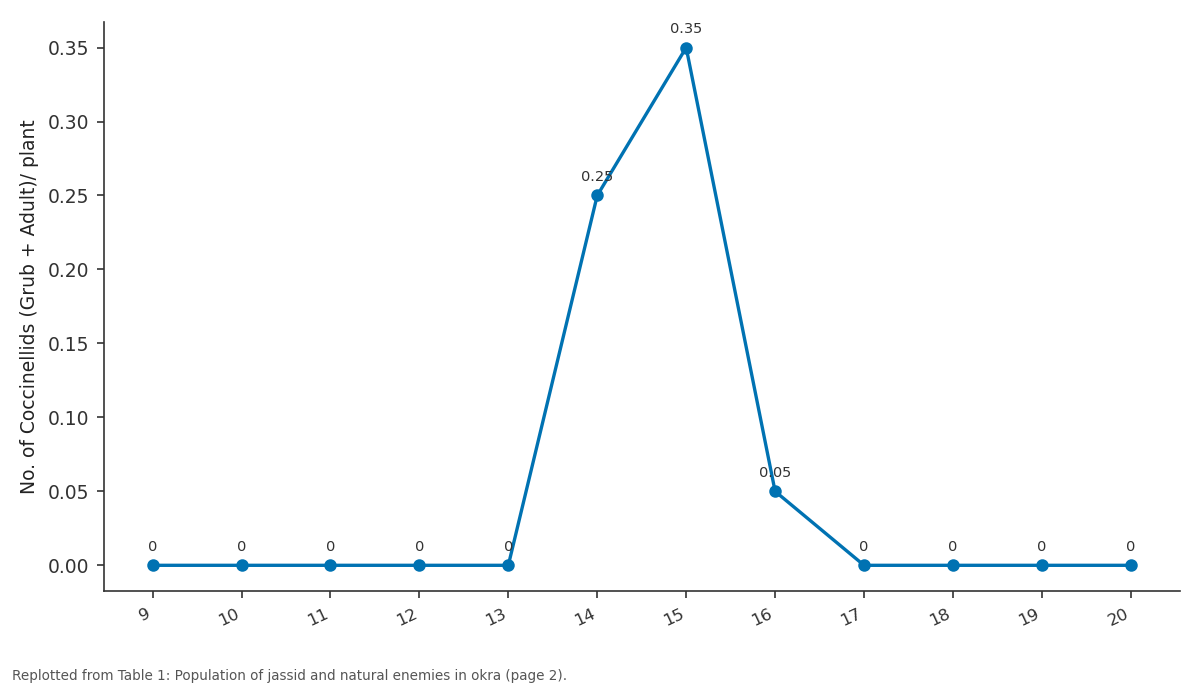
No. of natural enemies/ plant / Coccinellids...: 9 vs 10 vs 11 vs 12 vs 13
Replotted from Table 1 (page 2) of the original paper. Every bar is the paper's own table value.
View source evidence ↗Figures & tables
From the original paper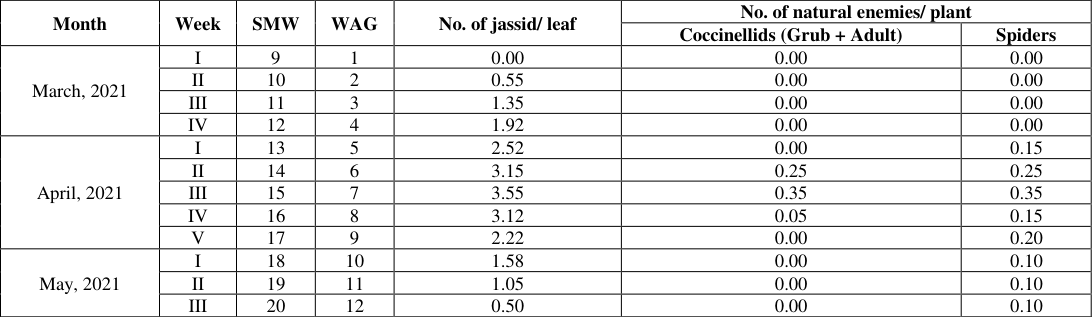 Table 1
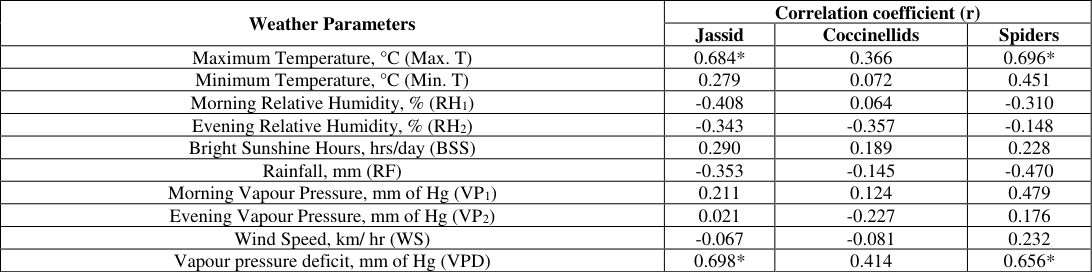 Table 2
 Table 3
Introduction
Okra [Abelmoschus esculentus (L.) Moench] is also known as Lady's finger, belongs to the family Malvaceae. Okra crop is heavily infested by several insect pests which cause quantitative as well as qualitative loss to the crop. Among various pests jassid Amrasca biguttula biguttula (Hemiptera: Cicadellidae) causes 54-66 per cent vegetative growth and yield reduction, if the okra crop remains unprotected (Singh et al., 2013) [10] . Nymph and adult are very active with a characteristic way of moving diagonally in relation to their body, but quick to hopping (Singh et al., 2018) [9] . Apart from feeding on okra, the jassid has a very wide range of host plants, including herbaceous cultivated plants and weeds. Jassid is a polyphagous insect infesting okra, cotton, brinjal, beans, castor, cucurbits etc. (Devi et al., 2018) [4] . The nymphal population build-up occurs from the second week of seedling emergence to the harvesting stage that causes considerable loss in yield. Okra is the most suitable host for the survival and feeding of jassid. Both nymphs and adults of jassid suck plant sap from the lower surface of leaves and inject necrotic toxin thereby reducing the assimilation of photosynthate, which leads to browning, bronzing, cupping, withering and necrosis of leaves. Population dynamics of the insect pest provides not only the information of initiation of the pest but also provides the peak activity of the particular pest as well as effect of biotic and abiotic parameters on pest. Correlation study helps in to provide either positive or negative association of pest population with biotic or abiotic factors. It gives direct influence of particular parameter on pest population build-up as well as its indirect effect through other parameters. Knowledge about peak period of infestation helps to tackles these major pests and reduces the yield losses as well as increase production and productivity of okra in Gujarat as well as in India. Therefore, a field experiment was carried out to study the population dynamics of jassid in okra and its relationship with weather parameters.
Materials and Methods
The experiment was conducted during summer 2021 at Agronomy Farm, B. A. College of Agriculture, Anand Agricultural University, Anand, Gujarat. Okra variety GAO 5 was sown with row to row spacing of 45 cm and plant to plant spacing of 30 cm. The sowing was done on 17 th February, 2021. The plot size was 9 X 12 m. All standard agronomical practices were followed. The whole experimental plot was kept free from the application of any insecticides. For recording observations on jassid population, the plot was divided into four equal size sectors. From each sector, five plants were randomly selected. From each selected plant, one leaf from the top, middle and lower canopy was observed and the number of jassids (nymphs & adults) was counted at weekly intervals starting from one week after germination and continued till the removal of the crop. Observations on population of coccinellids (grub + adult) and spiders were also recorded from the randomly selected five plants in each sector.
Statistical analysis
In order to study the effect of weather parameters on the population of the jassid, coccinellids and spiders, the weekly data on different physical factors of environment viz., maximum (MaxT) and minimum (MinT) temperature, morning (RH1) and evening (RH2) relative humidity, bright sunshine hours (BSS), rainfall (RF), wind speed (WS), morning (VP1) and evening (VP2) vapour pressure, vapour pressure deficit (VPD) were obtained from the Meteorological Observatory of Anand Agricultural University, Anand. Simple correlation coefficient was calculated to find possible relationship between population of jassid, coccinellids and spiders with physical factors of environment by adopting a standard statistical procedure (Steel and Torrie, 1980) [11] .
Results and Discussions Population dynamics of jassid in okra
The data on population of jassid and natural enemies are presented in Table 1. The incidence of jassid in okra crop commenced in the second week after germination i.e. second week of March (10 th SMW) and persisted up to the harvest (20 th SMW). The jassid population ranged from 0.50 to 3.55 jassid/leaf. Initially, the population was low (0.55 jassid/leaf), which gradually increased and attained a peak (3.55 jassid/leaf) during the third week of April i.e. 7 weeks after germination (15 th SMW). After that, the population was declined and it was recorded up to harvest in the third week of May (20 th SMW). A higher incidence of jassid (> 2.00 jassid/leaf) was observed during the month of April (13 th to 17 th SMW, 5 th to 9 th WAG). In past, Das et al. (2011) [3] reported that the jassid first appeared in the third week after sowing, its population gradually increased and the maximum population was observed during 5 to 7 weeks after sowing of okra. Jadhav et al. (2015) [6] also reported that the jassid infestation in okra commenced in the 10 th SMW and the maximum population was recorded during the 18 th SMW. According to Pathan and Bharpoda (2016) [8] , jassid infestation in okra initiated in the first week of March (10 th SMW). The jassid populations gradually increased and reached the first peak during the fourth week of March and the second peak during the fourth week of April. Further, Dhandge et al. (2018) [5] noticed that the jassid incidence in summer okra commenced in the third WAG (11 th SMW) and first as well as second peaks of jassid population were observed in 17 th and 19 th SMW, respectively. As per the report of Jat and Singh (2019) [7] , the infestation of leafhopper in okra commenced in the first week of March (12 th SMW) and reached its peak in the fourth week of March. Thus, the present findings are more or less in conformity with earlier reports.
| Month | Week | SMW | WAG | No. of jassid/ leaf | No. of natural enemies/ plant | — |
|---|---|---|---|---|---|---|
| Coccinellids (Grub + Adult) | Spiders | |||||
| March, 2021 | I | 9 | 1 | 0.00 | 0.00 | 0.00 |
| II | 10 | 2 | 0.55 | 0.00 | 0.00 | |
| III | 11 | 3 | 1.35 | 0.00 | 0.00 | |
| IV | 12 | 4 | 1.92 | 0.00 | 0.00 | |
| April, 2021 | I | 13 | 5 | 2.52 | 0.00 | 0.15 |
| II | 14 | 6 | 3.15 | 0.25 | 0.25 | |
| III | 15 | 7 | 3.55 | 0.35 | 0.35 | |
| IV | 16 | 8 | 3.12 | 0.05 | 0.15 | |
| V | 17 | 9 | 2.22 | 0.00 | 0.20 | |
| May, 2021 | I | 18 | 10 | 1.58 | 0.00 | 0.10 |
| II | 19 | 11 | 1.05 | 0.00 | 0.10 | |
| III | 20 | 12 | 0.50 | 0.00 | 0.10 |
Table text extracted from the original PDF; superscript letters are shown inline. The original table image is below.
View original table image
Correlation between weather parameters and jassid population
The correlation coefficient data (Table 2) indicated that maximum temperature (r = 0.684) and vapor pressure deficit (r = 0.698) had significant positive correlation with jassid population. However, minimum temperature (r = 0.279), bright sunshine hours (r = 0.290), morning (r = 0.211) as well as evening (r = 0.021) vapour pressure showed nonsignificant positive correlation with jassid population. The morning (r = -0.408) as well as evening (r = -0.343) relative humidity and rainfall (r = -0.353), wind speed (r = -0.067) were non-significantly negatively correlated with jassid population.
| Weather Parameters | Correlation coefficient (r) | — | — |
|---|---|---|---|
| Jassid | Coccinellids | Spiders | |
| Maximum Temperature, °C (Max. T) | 0.684* | 0.366 | 0.696* |
| Minimum Temperature, °C (Min. T) | 0.279 | 0.072 | 0.451 |
| Morning Relative Humidity, % (RH1) | -0.408 | 0.064 | -0.310 |
| Evening Relative Humidity, % (RH2) | -0.343 | -0.357 | -0.148 |
| Bright Sunshine Hours, hrs/day (BSS) | 0.290 | 0.189 | 0.228 |
| Rainfall, mm (RF) | -0.353 | -0.145 | -0.470 |
| Morning Vapour Pressure, mm of Hg (VP1) | 0.211 | 0.124 | 0.479 |
| Evening Vapour Pressure, mm of Hg (VP2) | 0.021 | -0.227 | 0.176 |
| Wind Speed, km/ hr (WS) | -0.067 | -0.081 | 0.232 |
| Vapour pressure deficit, mm of Hg (VPD) | 0.698* | 0.414 | 0.656* |
Table text extracted from the original PDF; superscript letters are shown inline. The original table image is below.
View original table image
Earlier Das et al. (2011) [3] recorded that the jassid population in okra had a significant positive correlation with maximum temperature and non-significant positive correlations with minimum temperature, bright sunshine, evaporation and vapour pressure. Jadhav et al. (2015) [6] also reported that leafhopper population in okra had a significant positive correlation with maximum temperature and a significant negative correlation with relative humidity. Aarwe et al. (2016) [1] reported that maximum temperature, average sunshine hours and wind speed had a significant positive correlation, whereas total rainfall had a negative correlation with the jassid population in okra. According to Chouhan et al. (2016) [2] , the jassid population in okra had a significant positive correlation with maximum temperature, positive but non-significant correlation with minimum temperature and negative correlation with morning and evening relative humidity. Pathan and Bharpoda (2016) [8] reported that bright sunshine, rainfall, wind speed, morning relative humidity and evening relative humidity showed a negative correlation, whereas maximum temperature and minimum temperature had a positive impact on the fluctuation of leafhopper population in okra. The leafhopper population showed a positive significant correlation with maximum and minimum temperature in the okra (Jat and Singh, 2019) [7] . Thus, the present findings are more or less in conformity of earlier reports.
Population dynamics of natural enemies Coccinellids
The activity of coccinellids (grub and adult) commenced in the second week of April (14 th SMW) with a population of 0.25 coccinellid/plant (Table 1). The population increased up to 0.35 coccinellid/plant in the third week of April (15 th SMW) and the least population was recorded in the fourth week of April (16 th SMW). Thereafter, it disappeared from crop. Overall, the population of coccinellids in okra crop was low and it was observed during 14 th to 16 th SMW.
Spiders
The population of spider in experimental plot was initially observed in the first week of April (13 th SMW) with 0.15 spider per plant (Table 1). Thereafter, it increased gradually and reached the first peak in the third week of April (15 th SMW) with 0.35 spider/plant. In the following week (16 th SMW) there was decline in spider population (0.15 spider/plant). Spider population exhibited the second peak in last week of April (17 th SMW) with the population of 0.20 spider/plant. During 18 th to 20 th SMW the spider population remained static and low (0.10 spider/plant).
Correlation between coccinellids population and weather parameters as well as jassid population
The coccinellid population showed non-significant positive correlation with maximum temperature (r = 0.366), minimum temperature (r = 0.072), morning relative humidity (r = 0.064), bright sunshine hours (r = 0.189), morning vapour pressure (r = 0.124) and vapor pressure deficit (r = 0.414). Whereas, it showed non-significantly negative correlation with evening relative humidity (r = -0.357), rainfall (r = -0.145), evening vapour pressure (r = -0.227) as well as wind speed (r = -0.081). Coccinellid population exhibited significantly positive correlation (r = 0.684) with jassid population (Table 3).
| Natural enemies | Correlation coefficient (r) |
|---|---|
| Coccinellids | 0.684* |
| Spiders | 0.795** |
Table text extracted from the original PDF; superscript letters are shown inline. The original table image is below.
View original table image
In past, Jat and Singh (2019) [7] reported that coccinellid population had a significant positive correlation with temperature and leafhopper population. They also reported that coccinellids population exhibited significant negative correlation with relative humidity. The variation might be due to difference in locality or season.
Correlation between spider population and weather parameters as well as jassid population
Correlation coefficient values between weather parameters and spider population are presented in Table 2. Maximum temperature (r = 0.696) and vapor pressure deficit (r = 0.656) had significantly positive correlation with spider population. Whereas, minimum temperature (r = 0.451), bright sunshine hours (r = 0.228), wind speed (r = 0.232), morning (r = 0.479) as well as evening (r = 0.176) vapour pressure exhibited nonsignificant positive correlation with spider population. The morning (r = -0.310) as well as evening (r = -0.148) relative humidity and rainfall (r = -0.470) were non-significantly negatively correlated with spider population. Population of spiders showed highly significant positive correlation (r = 0.795) with jassid population (Table 3). Present finding are supported by the findings of Pathan and Bharpoda (2016) [8] , who reported that spider population had a significantly positive correlation with maximum temperature and non-significant positive correlation with bright sunshine hours and wind speed. They further reported that morning and evening relative humidity showed non-significant negative correlation with spider population.
Jassid nymph Jassid Adult
Coccinellid grub Coccinellid Adult
Spiders
Spiders
Conclusion
Overall, it can be concluded that the activity of jassid, A. biguttula biguttula in summer okra was higher during the month of April (13 th to 17 th SMW). Jassid population exhibited significant positive correlation with maximum temperature and vapour pressure deficit, whereas it showed non-significant positive correlation with minimum temperature, bright sunshine, morning and evening vapour pressure. The morning as well as evening relative humidity, rainfall and wind speed showed non-significant negative correlation with the jassid population. Population of coccinellids had significant positive correlation with jassid population whereas spider population showed highly significant positive correlation with jassid population.
Acknowledgement
AcknowledgmentsThe authors are thankful to the Director of Research and Dean Post Graduate Studies, Anand Agricultural University, Anand for providing all the necessary facilities and encouragement during the present investigation.
References
10 in the original paper- Aarwe R, Pachori R, Sharma AK, Thakur AS, Mandloi R. Impact of weather factors on the incidence of major insect pests of okra (Abelmoschus esculentus L. Moench). Int J Agric Sci. 2016;8(3):981-983.
- Chouhan S, Chandrakar G, Nirala YS, Rana N. Studies on seasonal incidence of major sucking insect pests of okra and their correlation with weather parameters. Adv Life Sci. 2016;5(2):348-387.
- Das S, Pandey V, Patel HR, Patel KI. Effect of weather parameters on pest-disease of okra during summer season in middle Gujarat. J Agrometeorol. 2011;13(1):38.
- Devi YK, Pal S, Seram D. Okra jassid, Amrasca biguttula biguttula (Ishida) (Hemiptera: Cicadellidae) biology, ecology and management in okra cultivation. J Emerg Technol Innov Res. 2018;5(10):333-343.
- Dhandge SR, Bangale SA, Vaja AS, Virani VR. Seasonal incidence of sucking pest of okra and its relationship with weather parameters in summer season. Int. J Curr. Microbiol Appl. Sci. 2018;7(11):2697-2704.
- Jadhav YT, Waghmare UM, Barkade DP. Seasonal incidence, correlation and regression of leafhopper on summer okra in relation to weather parameters. Trends Biosci. 2015;8(23):6662-6665.
- Jat SL, Singh S. Seasonal abundance of major sucking insect pests of okra and their natural enemies in relation to abiotic factors. Int J Chem Stud. 2019;7(3):2173-2178.
- Pathan NP, Bhapoda TM. Succession of major insect pests in okra, Abelmoschus esculentus (L.) Moench grown in summer. Int. J Agric. Sci. Res. 2016;6(4):111118.
- Singh A, Singh J, Singh K, Rani P. Host range and biology of Amrasca biguttula biguttula (Hemiptera: Cicadellidae). Int. J Environ Ecol. Fam. Urban Stud. 2018;8(2):19-24.
- Singh Y, Jha A, Verma S, Mishra VK, Singh SS. Population dynamics of sucking insect pests and its natural enemies on okra agro-ecosystem in Chitrakoot region. Afr. J Agric. Res. 2013;8(28):3814-3819.