
Research article · 2023 · Full text
International Journal of Statistics and Applied MathematicsDesign and development of animal lifting device
Volume 8(6S) · Pages 823–831 · DOI: 10.22271/maths.2023.v8.i6sk.1472 ↗
Research areasLivestock Management and Performance ImprovementAgriculture and Farm Safety
Abstract
Author-writtenOne of the most challenging problem for veterinarians, Gaushala and small dairy farmers is management and treatment of recumbent/downer animal, prolong recumbency due to inadequately treated and unresponsive and may be due to illness, aging, during calving, slippery floor and so on. So to medically treat this condition we need to lift the animal by physical support and also to give the confident for sick animal. Considering all these things we have designed an animal lifting device which is suitable for all the Gaushala people, veterinary hospitals and small dairy farmers. It is designed in such a way that it should be simple, easy to transport and operate, less people required, comfortable, lift weight up to 600 kg, weight of the animal is equally distributed on supporting frame, less injury to animal, adjustable according to size of animal and cost effective compare to other method. Animal responding well to the treatment and physiotherapy and able to standup without the help of slings after complete recovery and almost 62% of cases were recovered till now from the trial taken. Out of 31 cases treated 20 animals were saved by using this device. Total cost of the device is Rs. 35,000/-. And life span of the device is 20 years.
Summary
Source-checkedPlain-language reading of the full paper, prepared with AI and checked against the text. Each point links to the authors' own words.
Why it matters
- Managing and treating recumbent or 'downer' animals is a significant challenge for veterinarians, Gaushalas, and small dairy farmers. View evidence ↗
- Traditional manual lifting methods are labor-intensive, requiring 6-8 people, and often cause discomfort to the animal. View evidence ↗
- Physical support is necessary to help recumbent animals regain the confidence to stand and to prevent secondary complications such as wounds and maggots. View evidence ↗
The question
- The study aimed to design a low-cost, portable, and easy-to-handle animal lifting device that prioritizes animal comfort and safety and can be manufactured locally. View evidence ↗
What they did
- The researchers used ANSYS software to design and analyze the animal lifting device. View evidence ↗
- The developed device is made of cast iron, weighs 82 kg, and has a lifting capacity of 800 kg. View evidence ↗
- The supporting sac was constructed from nylon, tarpaulin, and nomex, featuring a sandwiched foam layer for cushioning to improve animal comfort. View evidence ↗
What they found
- Out of 31 treated cases, 20 animals recovered using the lifting device. View evidence ↗
- The actual recovery rate was 65%, representing a 35% increase over the 25% expected recovery rate from traditional practices. View evidence ↗
- Physiological parameters, including respiration rate, pulse rate, and body temperature, returned to normal conditions following the use of the device and therapeutic treatment. View evidence ↗
- The device reduced the required manpower for lifting cattle from 6-8 people in traditional methods to only 2-3 people. View evidence ↗
- The total cost of the animal lifting device is reported between Rs. 35,000 and Rs. 36,000. View evidence ↗
What it means
- The authors conclude that the device is highly useful for dairy farmers, veterinarians, and Gaushala owners in providing primary physical support and therapeutic treatment to sick animals. View evidence ↗
Visual summary
2 visualsIllustrations explain the paper; charts are replotted from the paper's own table values.
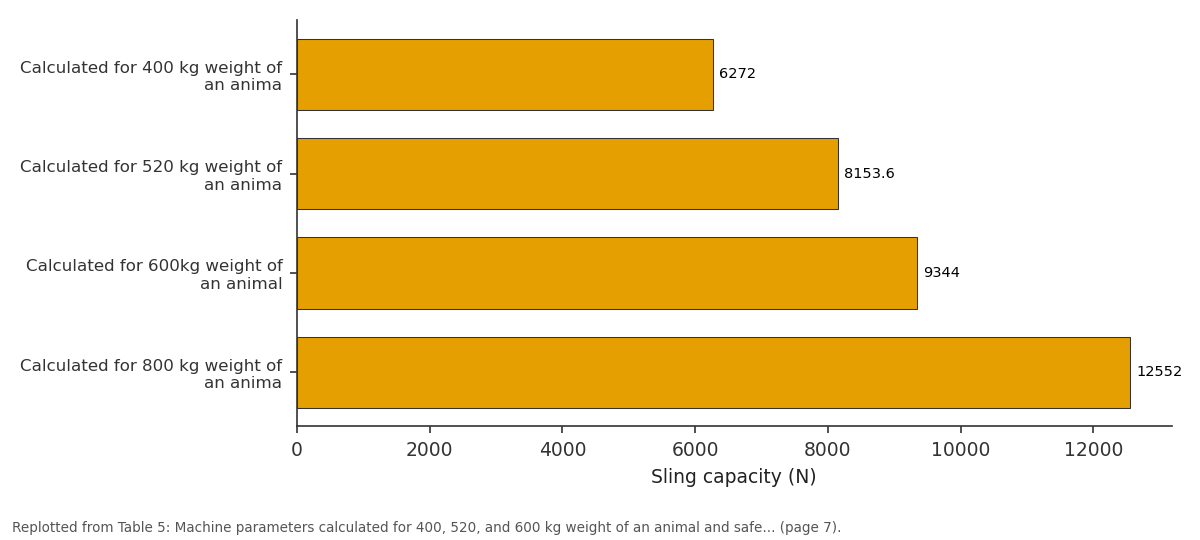
Sling capacity (N): Calculated for 400 kg... vs Calculated for 520 kg... vs Calculated for 600kg... vs Calculated for 800 kg...
Replotted from Table 5 (page 7) of the original paper. Every bar is the paper's own table value.
View source evidence ↗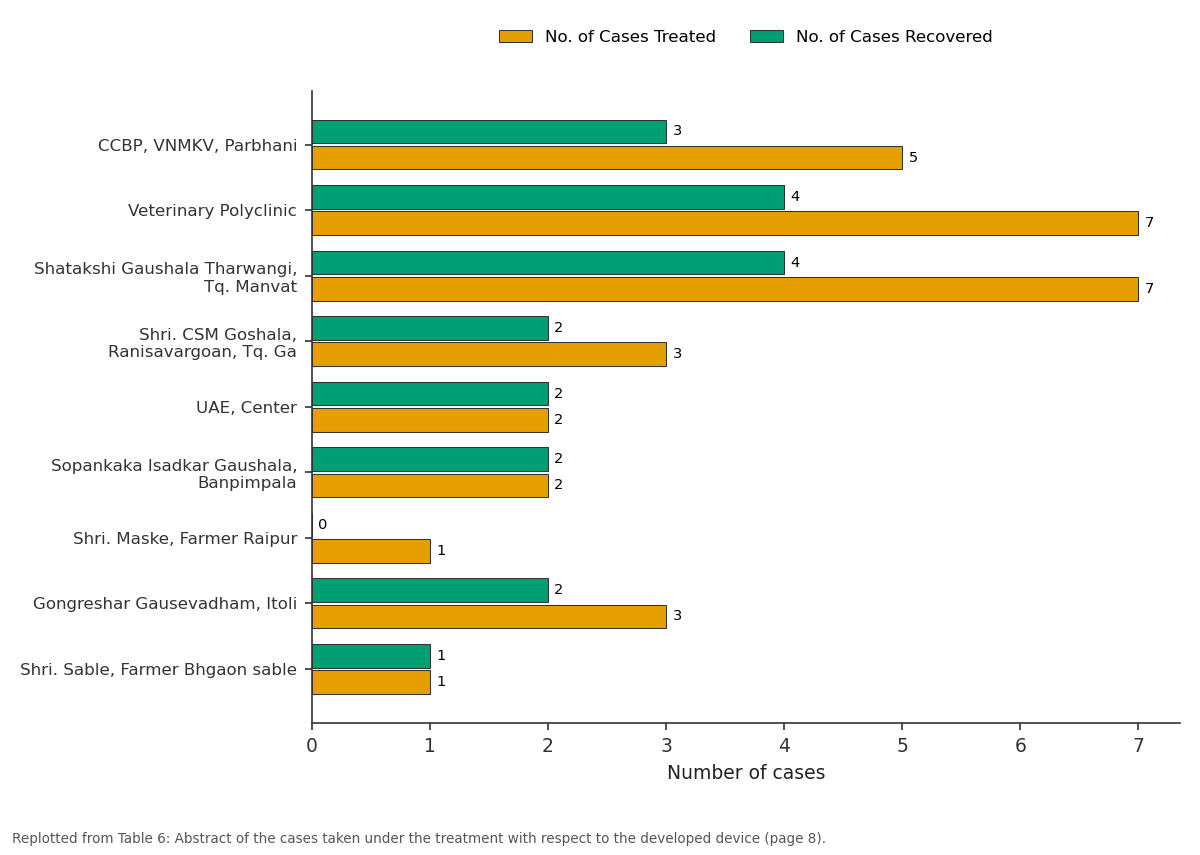
No. of Cases Treated and No. of Cases Recovered: CCBP, VNMKV, Parbhani vs Veterinary Polyclinic vs Shatakshi Gaushala... vs Shri. CSM Goshala... vs UAE, Center
Replotted from Table 6 (page 8) of the original paper. Every bar is the paper's own table value.
View source evidence ↗Figures & tables
From the original paper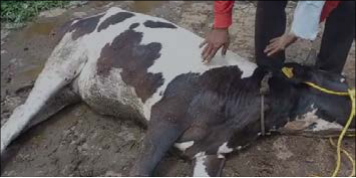 Plate 1
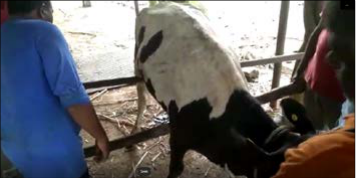 Plate 1
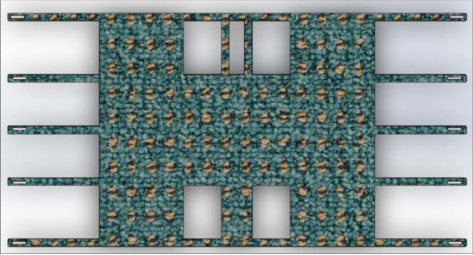 Figure 1
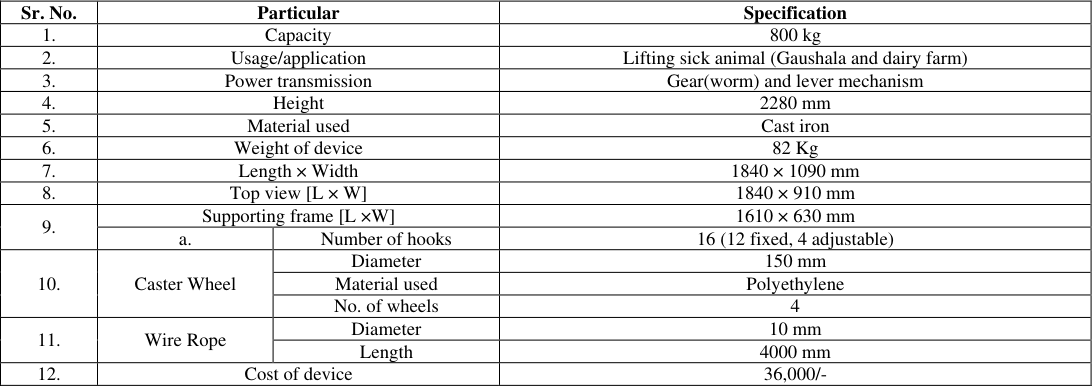 Table 1
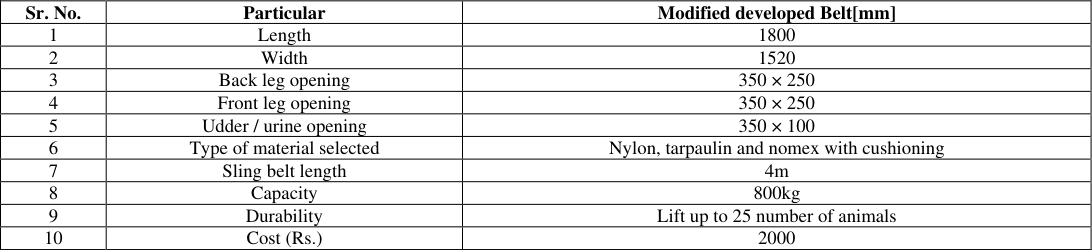 Table 2
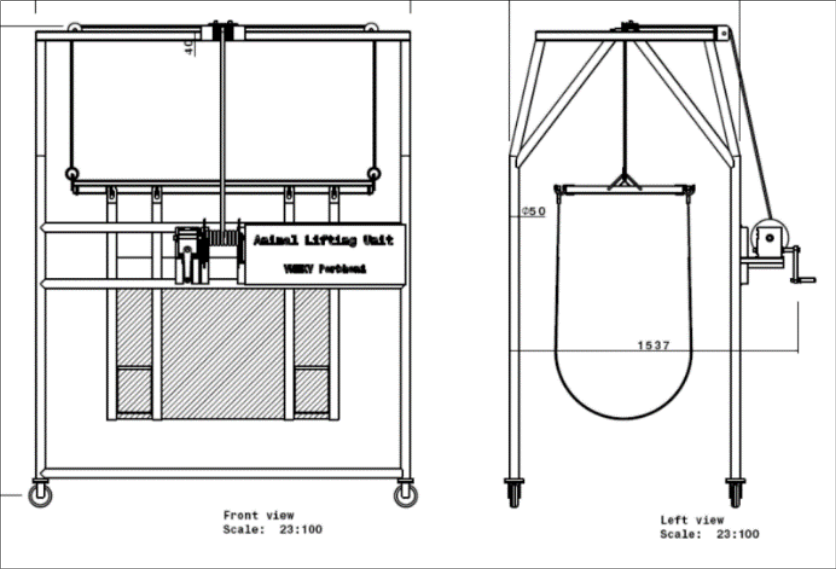 Figure 2
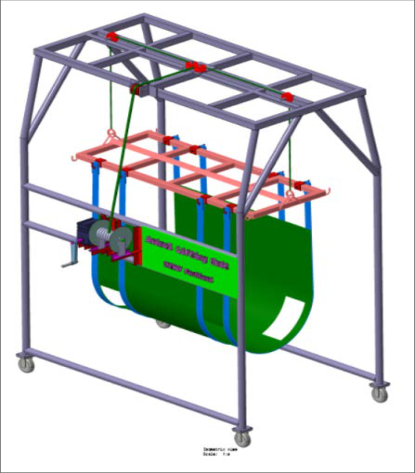 Figure 3
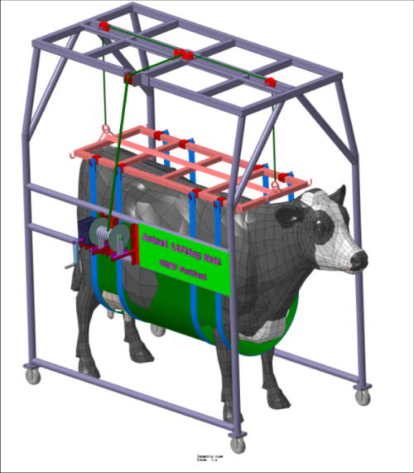 Figure 3
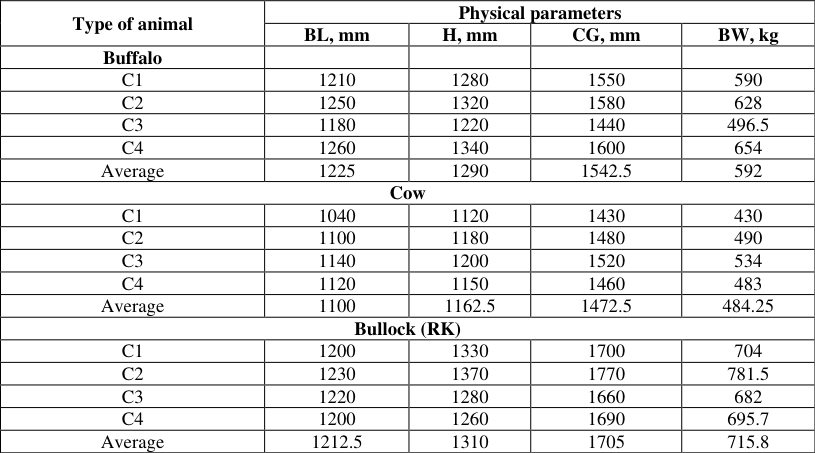 Table 3
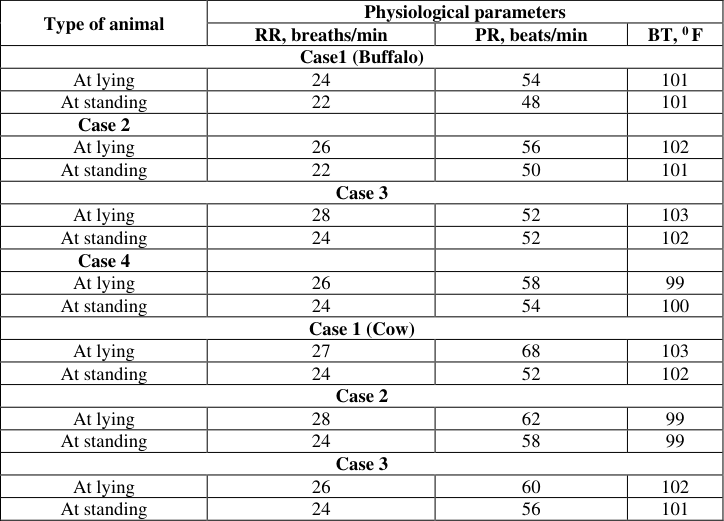 Table 4
 Table 5
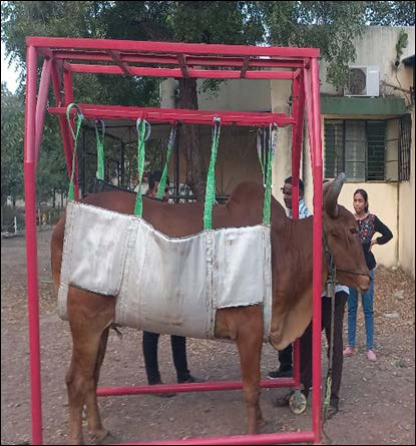 Plate 2
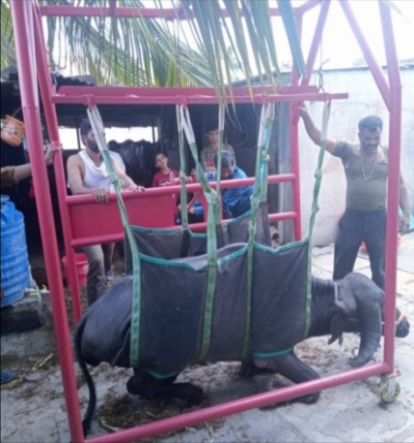 Plate 2
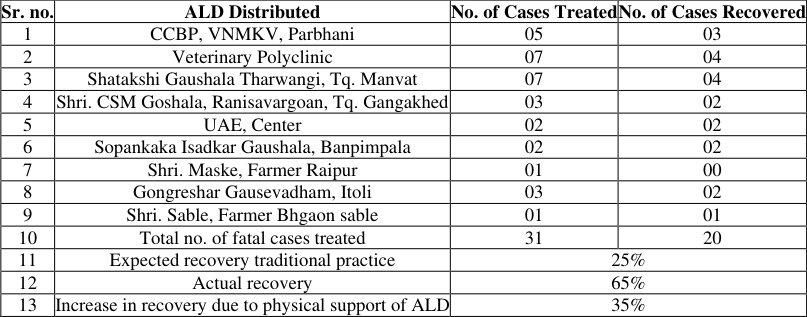 Table 6
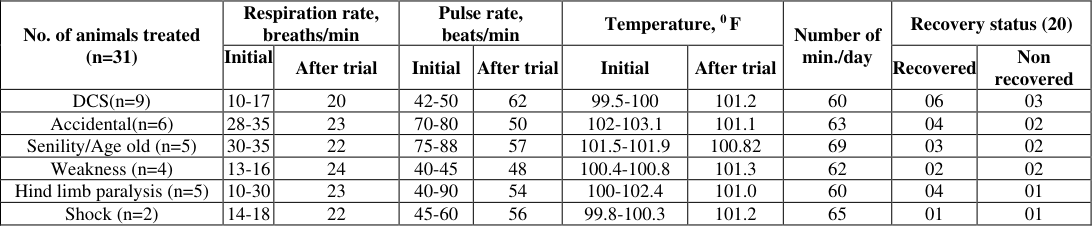 Table 7
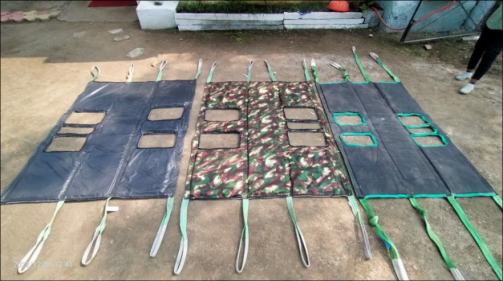 Plate 3
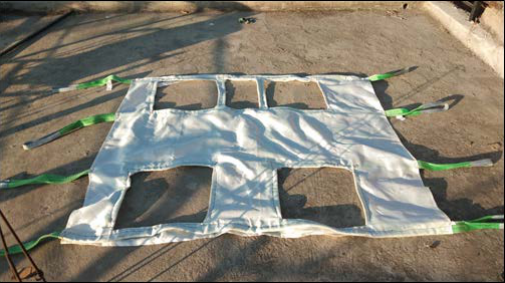 Plate 3
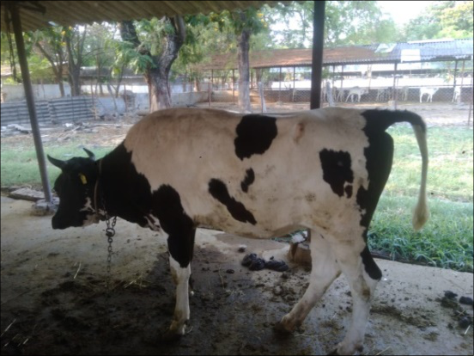 Plate 4
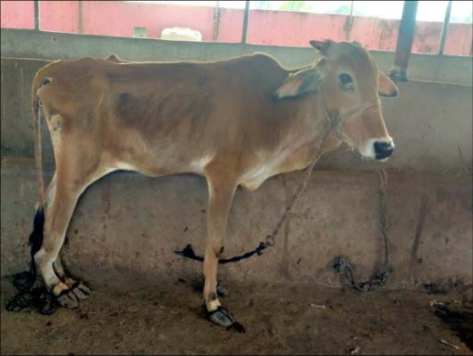 Plate 4
Introduction
Assistive devices for the elderly animals with disabilities are extremely common place in modern society. Many of these devices provide excellent support in the completions of daily tasks, but often more specific tasks can still be very difficult. The area of interest is the transportation of animals, in particular, the act of lifting a cow/buffalo (animals) crate into a vehicle for the transportation of a downer cow. Sick animals of all quadruped species often become recumbent, but the recumbency of the downer cow seems to have some unique features (Victor s cox, 1988) [13] . 'Downer cow' or 'Post parturient recumbency' is to describe a cow that is so injured, weak sick to stand or walk (Carolyn et al., 2007) [2] . The affected animals are usually bright and alert but are unable to stand. The downer cow is also be defined as a post-parturient recumbent cow does not get up even after two successive treatments with calcium (Geetha and Gnanraj, 2017) [4] . There are many other causes for a lying down animals like pre-calving, post calving conditions, back leg dislocation, hind limb paralysis, shock, age old, weakness, disability to stand and fracture of leg due to slippery floor etc. To medically treat such animals and under this condition the animal has to be in standing position for 4-5 h/day and treatment usually lasts for 7-10 days. Hence the physical support is much necessary. The weight of cows/buffaloes usually ranges between 200-800 kg. In traditional approach nearly 6-8 people required to lift the animal to chase the task full of drudgery. Also, the most important point to consider here is the manual lift can cause a lot of discomfort to the yielding animal. Hence there is a need of physical support for the lying down animal to give self-confidence to stand by its own and also to reduce secondary complications like development of wounds, maggots etc. which has been observed in continuous lay down position. A complete evaluation of the circumstances and a physical exam are critical for determining the most likely cause of a dairy animal going "down".
Care should be taken for the animal which is in lying condition when caring for down animal, the focus should be to correct the primary reason for being down so the animal can rise. Animal suffered from lying down condition is treated with medicine for its initial cause, then with help of manual operation or machine animal is assisted to back onto its feet. Helping animal to stand regularizes the blood circulation. Lifting help lying down animal to stand and may help with an initial assessment of injury. However, it carries the risk of further injury to the animal and can be dangerous for people. Animal was assisted to stand for 30 minutes four to six times a day using supportive slings. The sling was designed in such way that the weight of the animals is equally distributed massage of hind limbs with vegetable oil to increase muscular activities was carried out and hot water fomentation was performed. Animal responded well with treatment and physiotherapy. Cow was able to stand up without help of slings after complete recovery (Nirmala Kumara and B L Kaswan 2015) [10] . When an animal lies down for an extended period due to various reasons, it may lose its confidence and will to live. This is because it cannot bear its own weight during this condition, which can make it harder for the animal to recover and to get confidence, even if it receives the right treatment. In some cases, the animal may die due to this. Therefore, physical support of lifting device is much required to increase its confidence and help to stand on its own. Various lifting systems are on the market, such as cow lift with a supporting harness sore hip clamp, pelvic lift method. Lifting with air bags is popular in England and with the people who are concerned about the humane aspects or are worried about damage due to misuse of hip clamps. The problem with lifting from below is that the belly is soft. Before the body is lifted, the abdominal contents are forced against the diaphragm making respiration difficult, and hence cow quits trying to stand on her own. We have had three cases where the air bag worked well, but all of these would have done well if lifted with other methods (V S Cox and J S Onapito 1986) [14] . However, these techniques can cause secondary injuries and ischemic pressure damage (Zanolari Patrik et al 2019) [17] . These technologies are costly and most of the time not readily available in the rural areas of India. In Maharashtra the bovine population is around 19.5 million as 20 th livestock census. There are about 550-560 Gaushala in Maharashtra state. In Parbhani district about 17-18 Gaushala are available. From survey and feedback of veterinary hospitals, Gaushala and small dairy farmers it is observed that animal become serious in fatal condition and unable to stand properly, needs intensive care and treatment. In the field conditions it is very difficult to lift and transport the large animals to the hospital. In such cases animal owner become helpless and heavy economic losses occur. In traditional practices ropes and M. S pipes or wooden Bali were used for lifting of animal with which is very crude method. During transportation for lifting of animal in a bullock cart or tractor it needs about 7 to 8 labors and availability of labor is again a constraint. During lifting animal patients can harm handlers and themselves also. In Maharashtra availability of animal lifting devices is very negligible and that only in commercial dairy farms, and they are costly too. Considering the feedback from the different animal farms and Gaushala this study is undertaken. Hence, it is necessary to design a device which is easy to handle, low-cost portable animal lift, comfort and safety of animal is an important aspect considered while developing this technology which can be easily manufactured at the local level. This portable animal lift is suitable for lifting animal in and around 500-800 kg. While designing the supportive sac the top most priority is given to comfort of the animal. Therefore, the supportive sac is used is strong, waterproof but at the same time it is soft. To make it extra comfortable for the animal safety of the udder is taken into account. Wheels on the unit we get convenient to move or utterance including on off roads. It was designed in such a way that it may need 2-3 people to lift the cattle instead of 6-8 people which has needed in traditional method.
Material and Methods
The project entitled design and development of animal lifting device is started with the review and feedback that to understand problems, find out the solutions and need of gadget related to lying down condition of sick animals and need of physical support with therapeutic treatment to bring confidence of sick animal. It is found that the available literature mainly focused on the causes of lying down animals and to design and develop the lifting device. Comparatively, very limited literature concerning machines to lift the animal suffering from lying down condition of sick animal is available. There are different other methods used to lift an animal which are rarely available and costly. In traditional method there is drudgery and discomfort for both animal and humans and it is not safe for both and manual power required is more. Hip clamp, tractor lift and pelvic lift can be dangerous and risky as weight transferred to tuber coxae region (V. S. Cox, 1992) [15] . If only the body slings are used there is discomfort for animals and chance of injury is more. Air bag method is causing pressure damage and it leads to compression of the internal organs and the diaphragm, having a negative effect on the respiration (V. S. Cox et al., 1982) [16] . Difficult to get the animal into the tank in floatation tank method, large amount of warm water that is needed and the risk of creating hyperthermia in the animal and not widely available (J. Stojkov et al., 2016) [7] . To maintain public trust in dairy farmers and veterinarians must continue to adopt a strong culture of animal care using poor and unplanned procedures when dealing with animals which are in lying condition or down animals can cause an animal welfare issue. This reflects negatively on all dairy industry stakeholders and will cause serious reputational harm. However, it carries the risk of further injury to the animal and can be dangerous for people also. Hence to overcome these disadvantages animal lifting device is designed.
Plate 1: Animals suffering from lying down condition and traditional method used for lifting by using Balli
Design consideration of animal lifting device
As per the objective research work started with the study of existing methods of animal lifting devices from the study we came to know that need to consider the machine parameters and animal parameters to ensure the safety and wellbeing of both the animals and the operators involved.
Design and Development of Animal Lifting Device
Designing and developing of an animal lifting device is a challenging task that requires careful consideration of various factors like machine parameters, animal parameters and operator parameters. The animal lifting device is designed by using ANSYS software and required analysis is done. Views are automatically generated from the solid model and notes, dimensions and tolerances can then be easily added to the drawing as needed. The drawing module includes most paper sizes and standards. The main components are discussed below; Superstructure By considering width, length and height of animal the structure is designed. The structure is sturdier and more stable than existing system. The material used is cast iron and supporting structure is appropriate and no difficulty faced while lifting the animal during trials. The overall dimension is 1840 × 1090 mm (L×W). Diameter of the pipe is 50 mm and height of the structure is 2280 mm. the structure also has two diagonal braces each side at top level to provide stability.
Supporting frame
The frame is designed in such a way that it has to hold the animal without any instability and drudgery. The rectangular frame is made up of cast iron; it is used for connecting the supporting sac and rope pulley and helps in maintaining the shape of the animal. The supporting frame is wider in the middle confirming to the contour of the animal. Additionally it has four adjustable hooks on both sides so that according to the animal size it may be adjusted and balancing is easy while lifting an animal. Dimensions of supporting frame are 1600x625 mm (L×W) and thickness of 40×40 mm. Frame has three supporting beams in between to provide stability.
Supporting sac
It is used to steadily lift the animal with the help of supporting frame which is connected to pulley with rope. The sac is made up of different type of material/cloth and is 1800 mm long and 1520 mm wide with the thickness of 2.5 mm. The tensile strength is of 120 kg/cm 2 . The sac has four straps of belt which is sewn on the corners and 2 straps in between to provide strength to the sac. The type of sling is webbing sling (flat eye) which is connected to the frame and are 370 mm apart. In order to improve the comfort level of the animal, an extra layer of foam is sandwiched between two layer of fabric stitched at the inner side of the sac thus act as a cushioning. Four holes are given to insert the legs of the animal into it and hole in the back centre is given for udder as well as for the animal to pee to go out without spoiling the sac. It is designed in such a way that it should not remove the legs by itself and should cover the chest girth of an animal for safety purpose. It is designed by using ANSYS software provided with dimensions in fig. 3.4
Pulley
The pulleys are used to transmit power from one point to another by means of ropes. Since the velocity ratio is the inverse ratio of the diameter of the driving and driven pulleys, therefore the pulley diameter should be careful ly selected in order to have a desired velocity ratio. The pulley must be in perfect alignment in order to allow the rope to travel in a line normal to the pulley faces. In our model we used cast iron pulleys and number of pulley are 6. The diameter selected is 16mm for inner and 75mm for outer pulley.
Worm gear
A worm gear system consists of worm and worm wheel positioned as a cross axis and is the most compact type of winch gear system. Due to compact design, worm gear reducers are able to place in relatively small spaces and provide high-ratio speed reduction. The diameter of gear is 87mm. It is used to transmit the power at high velocity ratios 300:1; Worm is made up of phosphorous bronze or cast iron because of high thermal conductivity. And worm wheel is made up of alloy steel due to low conductivity. The winch is a manual device that can be used to raise or lower the sling by winding or unwinding a rope. The winch has a capacity of 800 kg and a gear ratio of 50:1. The winch is mounted on the top cross member of the frame and has a handle that can be rotated by hand.
Caster wheel
A movement of the device should be carried out after treatment the animal has to keep at certain place so, interlocking system is much needed to avoid any accidents. A caster wheel is an un-driven wheel that is designed to be attached to the bottom cross member of the superstructure to enable the device to be moved. The diameter of the wheel is 0.15m and 0.1m thickness. It is made up of polyethylene and has an axle that can be fixed to the frame with nuts and bolts.
It is a wonderful mobility enabler, with properties such as strength, corrosion resistance, water resistance, weather resistance and shock absorption. These wheels are used for both on and off road applications. It also reduces physical strain while pushing the device and can rotate 360⁰ rotations promotes easy motion. Considering all the formulae, problems, methodology parameters the device has been designed fig. 2 shows animal lifting device. Specification of animal lifting device has been given below table 1. The supporting sac which has been used for lifting the animal to give physical support and studied by considering the physical parameters of an animal and strength, capacity, durability of slings. The specification of supporting sac has been given in table 2. Lifting procedure for animal lifting device Following process is carried out during the trials of device at AICRP on Utilization of Animal Energy, CAET, VNMKV, Parbhani. Follow the instructions for assembling the part as a superstructure and make sure all the bolts are secure to avoid it falling apart or breaking. To install the rope pulley, you need to attach it to the hook that is on the highest horizontal pipe of the superstructure. Make sure that the pulley's outer end is pointing down, so that you can connect it to the supporting frame. Make sure the holes are on the top side when you insert the supporting sac into the animal legs. Then, gently pull the superstructure over the animal without disturbing it. Connect the strap holes of the sac belt with the hooks of the supporting frame. To help the animal stand on its leg, pull the rope of the pulley block using the handle lever after the hooks are securely attached to the supporting frame. The animal may need some assistance to remove its leg from the sac, so gently guide its leg through the holes on the belt. Let the animal stand for 10-15 minutes and then lower the rope pulley to place the animal in a clean and dry area. And repeat the procedure if needed. Insufficient heart is a high indicator of structural defects, allows front feet to toe out, hooked toe, more susceptible to stress and is a high maintenance animal. Body weight of the animal is calculated by Shaffer's formula with the help of animal chest girth and length of an animal. Calculation of body weight of the selected animals with respect to physical parameters of animal is provided in table 3. The rate of respiration is measured by counting the number of times an animal exhales for a period of 15 seconds and then multiply that
| Type of animal | Physical parameters | — | — | — |
|---|---|---|---|---|
| BL, mm | H, mm | CG, mm | BW, kg | |
| Buffalo | ||||
| C1 | 1210 | 1280 | 1550 | 590 |
| C2 | 1250 | 1320 | 1580 | 628 |
| C3 | 1180 | 1220 | 1440 | 496.5 |
| C4 | 1260 | 1340 | 1600 | 654 |
| Average | 1225 | 1290 | 1542.5 | 592 |
| Cow | ||||
| C1 | 1040 | 1120 | 1430 | 430 |
| C2 | 1100 | 1180 | 1480 | 490 |
| C3 | 1140 | 1200 | 1520 | 534 |
| C4 | 1120 | 1150 | 1460 | 483 |
| Average | 1100 | 1162.5 | 1472.5 | 484.25 |
| Bullock (RK) | ||||
| C1 | 1200 | 1330 | 1700 | 704 |
| C2 | 1230 | 1370 | 1770 | 781.5 |
| C3 | 1220 | 1280 | 1660 | 682 |
| C4 | 1200 | 1260 | 1690 | 695.7 |
| Average | 1212.5 | 1310 | 1705 | 715.8 |
Table text extracted from the original PDF; superscript letters are shown inline. The original table image is below.
View original table image
| Sr. No. | Particular | Modified developed Belt[mm] |
|---|---|---|
| 1 | Length | 1800 |
| 2 | Width | 1520 |
| 3 | Back leg opening | 350 × 250 |
| 4 | Front leg opening | 350 × 250 |
| 5 | Udder / urine opening | 350 × 100 |
| 6 | Type of material selected | Nylon, tarpaulin and nomex with cushioning |
| 7 | Sling belt length | 4m |
| 8 | Capacity | 800kg |
| 9 | Durability | Lift up to 25 number of animals |
| 10 | Cost (Rs.) | 2000 |
Table text extracted from the original PDF; superscript letters are shown inline. The original table image is below.
View original table image
| Sr. No. | Particular | — | Specification |
|---|---|---|---|
| 1. | Capacity | 800 kg | |
| 2. | Usage/application | Lifting sick animal (Gaushala and dairy farm) | |
| 3. | Power transmission | Gear(worm) and lever mechanism | |
| 4. | Height | 2280 mm | |
| 5. | Material used | Cast iron | |
| 6. | Weight of device | 82 Kg | |
| 7. | Length × Width | 1840 × 1090 mm | |
| 8. | Top view [L × W] | 1840 × 910 mm | |
| 9. | Supporting frame [L ×W] | 1610 × 630 mm | |
| a. | Number of hooks | 16 (12 fixed, 4 adjustable) | |
| 10. | Caster Wheel | Diameter | 150 mm |
| Material used | Polyethylene | ||
| No. of wheels | 4 | ||
| 11. | Wire Rope | Diameter | 10 mm |
| Length | 4000 mm | ||
| 12. | Cost of device | 36,000/- |
Table text extracted from the original PDF; superscript letters are shown inline. The original table image is below.
View original table image
Results and Discussion
The study of animal lifting device is conducted on the sick animals of different age group, disease conditions, breed, species and sizes of animal. Thirty one cases are recorded. The physical, physiological and visual parameters of animals and engineering parameters of animal lifting device is recorded and presented in this chapter.
Physiological parameters of animal with respect to device
The mean value of physiological parameters of buffalo, bullock and cow before and after the trials are recorded the same is given in below table no. 3.1 and we observed that after several trials the respiration rate, pulse rate and temperature of an animal becomes normal condition due to physical support of the device. The pulse rate of animals varied during the trials depend on a situation in which animal is suffering. The temperature did not show appreciable effect on physiological reaction. In some cases since there is an increase in environmental temperature there is slight increase in respiration rate. Machine parameters of device: The calculation of sling capacity, rated capacity, sling load angle, forces on each sling, and breaking strength during trial on lifting device was recorded. The same is given in table 5. From the above table sling capacity of animal lifting supporting with sac nylon material which is lifting about 12,552 N of weight of an animal. So, the belt can safely lift the weight up to 19,620N; considering the material strength, rated capacity and load factor. Sling angle is 90⁰-100⁰, if it exceeds it loses its stability. The force on each sling when using a brisket hitch to lift 800 kg of weight with 8 slings is approximately 1000N/sling. This assumes that the load is evenly distributed among the slings, which is a common practice to ensure balance lifting and minimize stress on individual slings. The sling tension in each sling is 102.04kg when lifting 800 kg of load with 100 degree angle between sling leg and vertical line. This means that each leg of the sling should be able to safely support 102.04 kg of the load.
As the load increases the resistive force increases hence the speed of lifting decreases and rotation per minute of handle decreases. The supporting sac showed in plate 3. The field treatment and testing has been carried out, where there is need to lift the animal and having the cases of lying down animal like downer animal, shock, hind limb paralysis, fracture, weakness etc. the detail of the location and number of cases treated with respect to the device is given in table 6 and 7. Table 7. shows in the cases of downer cow syndrome, shock, weakness in lying down condition the temperature of animal goes down where as in the disease condition, fracture, hind limb paralysis temperature of lying down animal rises by 2 to 3 °F but after physical support of animal lifting device for half an hour it is observed that the temperature may reaches to normal. Similar results were observed for the respiration rate and pulse rate that is the respiration rate and pulse rate goes down in downer cow syndrome, shock, weakness but it is important after physical support of animal lifting device. That might be due to comfort to the animal. So out of 31 different cases treated by physical support with an animal lifting device in different location 20 cases was recovered, expected recovery in traditional practice was 25%, and actual recovery was 65%. Hence there was an increase in recovery due to physical support of animal lifting device was 35%. Hence, 20 animals were saved due to the support given by the device.
| No. of animals treated (n=31) | Respiration rate, breaths/min | — | Pulse rate, beats/min | — | Temperature, 0 F | — | Number of min./day | Recovery status (20) | — |
|---|---|---|---|---|---|---|---|---|---|
| Initial | After trial | Initial | After trial | Initial | After trial | Recovered | Non recovered | ||
| DCS(n=9) | 10-17 | 20 | 42-50 | 62 | 99.5-100 | 101.2 | 60 | 06 | 03 |
| Accidental(n=6) | 28-35 | 23 | 70-80 | 50 | 102-103.1 | 101.1 | 63 | 04 | 02 |
| Senility/Age old (n=5) | 30-35 | 22 | 75-88 | 57 | 101.5-101.9 | 100.82 | 69 | 03 | 02 |
| Weakness (n=4) | 13-16 | 24 | 40-45 | 48 | 100.4-100.8 | 101.3 | 62 | 02 | 02 |
| Hind limb paralysis (n=5) | 10-30 | 23 | 40-90 | 54 | 100-102.4 | 101.0 | 60 | 04 | 01 |
| Shock (n=2) | 14-18 | 22 | 45-60 | 56 | 99.8-100.3 | 101.2 | 65 | 01 | 01 |
Table text extracted from the original PDF; superscript letters are shown inline. The original table image is below.
View original table image
| Sr. no. | ALD Distributed | No. of Cases Treated | No. of Cases Recovered |
|---|---|---|---|
| 1 | CCBP, VNMKV, Parbhani | 05 | 03 |
| 2 | Veterinary Polyclinic | 07 | 04 |
| 3 | Shatakshi Gaushala Tharwangi, Tq. Manvat | 07 | 04 |
| 4 | Shri. CSM Goshala, Ranisavargoan, Tq. Gangakhed | 03 | 02 |
| 5 | UAE, Center | 02 | 02 |
| 6 | Sopankaka Isadkar Gaushala, Banpimpala | 02 | 02 |
| 7 | Shri. Maske, Farmer Raipur | 01 | 00 |
| 8 | Gongreshar Gausevadham, Itoli | 03 | 02 |
| 9 | Shri. Sable, Farmer Bhgaon sable | 01 | 01 |
| 10 | Total no. of fatal cases treated | 31 | 20 |
| 11 | Expected recovery traditional practice | 25% | |
| 12 | Actual recovery | 65% | |
| 13 | Increase in recovery due to physical support of ALD | 35% |
Table text extracted from the original PDF; superscript letters are shown inline. The original table image is below.
View original table image
Figures and tables from the paper
| Type of animal | Physiological parameters | — | — |
|---|---|---|---|
| RR, breaths/min | PR, beats/min | BT, 0 F | |
| Case1 (Buffalo) | |||
| At lying | 24 | 54 | 101 |
| At standing | 22 | 48 | 101 |
| Case 2 | |||
| At lying | 26 | 56 | 102 |
| At standing | 22 | 50 | 101 |
| Case 3 | |||
| At lying | 28 | 52 | 103 |
| At standing | 24 | 52 | 102 |
| Case 4 | |||
| At lying | 26 | 58 | 99 |
| At standing | 24 | 54 | 100 |
| Case 1 (Cow) | |||
| At lying | 27 | 68 | 103 |
| At standing | 24 | 52 | 102 |
| Case 2 | |||
| At lying | 28 | 62 | 99 |
| At standing | 24 | 58 | 99 |
| Case 3 | |||
| At lying | 26 | 60 | 102 |
| At standing | 24 | 56 | 101 |
Table text extracted from the original PDF; superscript letters are shown inline. The original table image is below.
View original table image
References
9 in the original paper- Stull CL, Payne MA, Berry SL, Reynolds JP. A review of the causes, prevention, and welfare of nonambulatory cattle. J Am Vet Med Assoc. 2007;231(2):227-234. https://doi.org/10.2460/javma.231.2.227.
- Geetha T, Gnanaraj T. Successful Therapeutic Management of a Downer Cow. Indian Vet J 2017;94(05):58-59. Retrieved from https://pdfs.semanticscholar.org.
- Stojkov J, Weary DM, Von Keyserlingk MAG. Nonambulatory cows: Duration of recumbency and quality of nursing care affect outcome of flotation therapy. J Dairy Sci. 2016;99(3):2076-2085.
- Wangchuka K, Wangdia J, Mindu M. Comparison and reliability of techniques to estimate live cattle body weight. J Appl Anim Res. 2018;46(1):349-352. http://dx.doi.org/10.1080/09712119.2017.1302876.
- Kumari N, Kaswan BL. Successful Management of Downer Syndrome in Cow by Medicinal Treatment Along with Physiotherapy. Int. J Sci Res. 2015;4(6):828829.
- Riaz R, Tahir MN, Waseem M, Asif M, Khan MA. Accuracy of Estimates for Live Body Weight Using Schaeffer's Formula in Non-Descript Cattle (Bos Indicus), Nili Ravi Buffaloes (Bubalus Bubalis) And Their Calves Using Linear Body Measurements. Pak J Sci. 2018;70(3):255-232.
- Cox VS. Theory and Management Of The Downer Cow. University of Minnesota. 1988;7464:99-101.
- Cox VS, Onapito JS. An update on the downer cow syndrome. Bov Pract. 1986;21:195. DOI: https://doi.org/10.21423/bovine-vol0no21p195-199.
- Zanolari P, Monnard R, Hirsbrunner G. Lifting Techniques in Bovine Recumbency. Schweiz Arch Tierheilkd. 2019;161(10):619-62.