
Research article · 2023 · Full text
International Journal of Horticulture and Food ScienceApple orchards infected by Tetranychus urticae (Acari: tetranychidae) are being monitored for acaricide resistance
Volume 5(2) · Pages 45–47 · DOI: 10.33545/26631067.2023.v5.i2a.177 ↗
Research areasInsect-Plant Interactions and ControlPlant Virus Research StudiesInsect Resistance and Genetics
Abstract
Author-writtenSpider mites are significant crop pests in various crops, often becoming a management concern when pesticides are used to eradicate other pests. They disrupt biological control due to non-target effects on natural enemies, particularly phytoseiid mites. Some studies suggest that pesticides can stimulate reproduction in spider mites at levels below fatal dosages, leading to increased population growth and fecundity. Spider mites are more prone to becoming resistant to pesticides due to their haplodiploid reproduction, which has reduced food resource constraints and high polyphagy. Tetranychus urticae Koch, a two-spotted spider mite, is a significant pest of over 150 fruit, ornamental, vegetable, and agricultural crops worldwide. It causes reduced plant growth, yield, leaf bronzing, necrosis, deformation, and plant mortality. This damage can also result in aesthetic damages, such as scars on clementine mandarin fruits and gold flecking on tomatoes, which impair the marketability and commercial worth of fruit. Apples are severely harmed by Tetranychus urticae Koch, and acaricides are frequently used to manage them. However, the presence of resistant populations limits the consequences. The shelf life of acaricides is getting shorter, and monitoring local population resistance is crucial for efficient management. A deeper understanding of resistance development is needed to limit the evolution of resistance and postpone the dissemination of resistant populations.
Summary
Source-checkedPlain-language reading of the full paper, prepared with AI and checked against the text. Each point links to the authors' own words.
Why it matters
- The two-spotted spider mite, Tetranychus urticae, is a major global pest affecting more than 150 different types of agricultural, vegetable, ornamental, and fruit crops. View evidence ↗
- Infestations of T. urticae can lead to severe plant damage, including necrosis, leaf bronzing, deformation, reduced growth and yield, and even the death of the plant. View evidence ↗
- T. urticae is particularly susceptible to developing pesticide resistance because of its high polyphagy, reduced food resource constraints, and haplodiploid reproduction. View evidence ↗
The question
- The research aimed to describe the levels of acaricide resistance, as well as multiple and cross-resistance, in T. urticae populations collected from major apple-growing regions in Korea. View evidence ↗
What they did
- The study selected one commercial apple orchard from each of ten sample locations across the primary apple-producing regions of Korea. View evidence ↗
- Mites were collected from the apple tree canopy at heights between 1.5 and 3.0 meters from June to October 2002. View evidence ↗
- At least 40 infested leaves were collected from each orchard and transported to a laboratory for analysis. View evidence ↗
- Mature female mites were transferred using a fine brush under a microscope onto two-week-old kidney bean plants. View evidence ↗
What they found
- The investigation found that most of the local mite populations exhibited minimal resistance to the majority of commonly used acaricides. View evidence ↗
- These findings contrast with previous reports that indicated moderate to high resistance levels in apple orchard T. urticae to fenbutatin-oxides, pyridaben, fenpyroximate, and dicofol. View evidence ↗
- Over a ten-year period in Korea, the use of conventional acaricides decreased as Integrated Pest Management (IPM) grew, with IPM orchards showing higher densities of predatory mites compared to conventional orchards. View evidence ↗
What it means
- The authors conclude that because the effectiveness of acaricides is decreasing over time, monitoring the resistance of local populations is essential for efficient pest management. View evidence ↗
- The authors state that a more profound understanding of how resistance develops is necessary to slow its evolution and delay the spread of resistant populations. View evidence ↗
Visual summary
1 visualsIllustrations explain the paper; they do not show study data.
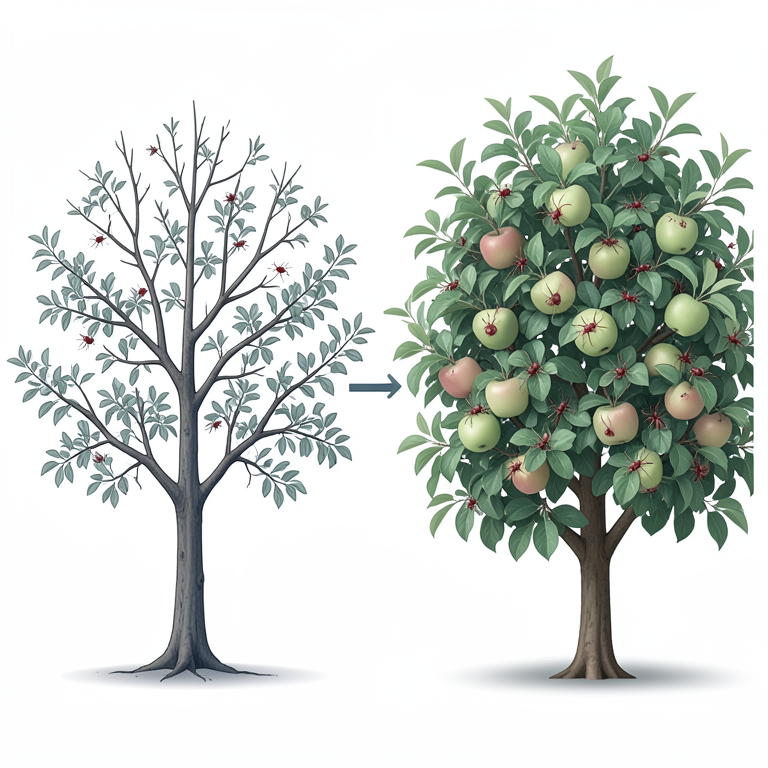
IPM vs Conventional Management
AI-generated conceptual illustration (Apple trees in an orchard). It explains the idea and does not show study data.
View source evidence ↗Figures & tables
From the original paper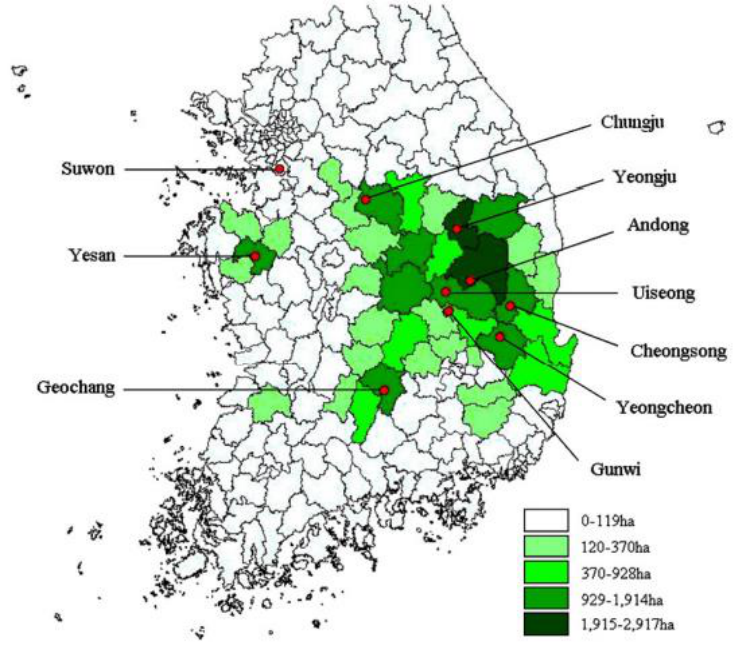 Figure 1
Introduction
Spider mites are significant crop pests in many different crops. Spider mites are secondary pests in many cropping systems, such as those that produce tree fruits, and only become a management concern when pesticides are used to eradicate other pests. This is often linked to the disruption of biological control caused by many pesticides' non-target effects on spider mite natural enemies, particularly phytoseiid mites. However, some studies have suggested that pesticides can also stimulate reproduction in spider mites at levels below fatal dosages (A process known as hormoligosis), leading to an increase in the pest's population growth and fecundity. It is crucial to ascertain how regularly used pesticides affect both spider mites and their predatory animals. A substance is likely to impair biological control if it is more destructive to the predatory mites than the pests. Spider mites are more prone than phytoseiidae to become resistant to a pesticide even if they are originally vulnerable to it. Due of the haplodiploid reproduction, this has occurred. This is related to some species of spider mites (Tetranychus urticae Koch) having haplodiploid reproduction, which has a reduced food resource constraint and a high degree of polyphagy. Tetranychus urticae Koch (Acari: Tetranychidae), a two-spotted spider mite, is a significant pest of more than 150 fruit, ornamental, vegetable, and agricultural crops worldwide. Larvae, protonymphs, and deutonymphs are active early life stages that feed by inserting their stylet into mesophyll and epidermal cells. As a result of this feeding activity, the amount of chlorophyll is effectively diminished, and the epidermal and stomatal guard cells' functions are changed. This causes a drop in photosynthesis and transpiration rates as well as an increase in water stress. Reduced plant growth and yield, leaf bronzing, necrosis, and deformation, and in rare cases plant mortality is all possible effects of T. urticae damage.
Additionally, this may result in aesthetic damages that impair the marketability and commercial worth of fruit, flowers, or leaves. For instance, aesthetic damage manifests as scars on clementine mandarin fruits (Citrus clementina Hort. ex. Tan.) and gold flecking on tomatoes (Solanum lycopersicum L.), making such fruit unsuitable for fresh market retail. Fruit with visual flaws is degraded or culled by producers and merchants because they have a low tolerance for it, which causes growers to suffer large financial losses (Julian R 2020) [6] . Apples are severely harmed by Tetranychus urticae Koch around the world. Acaricides are frequently used by farmers to manage T. urticae in apple orchards. However, the presence of resistant populations limits the consequences. Due to its short life cycle, strong reproductive capacity, and haplo-diploid parthenogenesis, T. urticae has a relatively high risk of developing pesticide resistance.
Fig 1:
Location map of collection sites of T. urticae populations from major apple growing regions (Sang-Hyun Koh 2009) [3] There are several reports on the emergence of T. urticae strains that are resistant to acaricides as well as the failure of these compounds to control T. urticae. The shelf life of acaricides is getting shorter. The monitoring of local population resistance is the first step in the efficient management of T. urticae. To limit the evolution of resistance in T. urticae and postpone the dissemination of resistant populations, a deeper comprehension of resistance development is needed. There aren't many research projects in Korea that look at T. urticae' s acaricide resistance, and there aren't any that track it all. The resistance levels of T. urticae populations that were gathered from significant apple producing regions, as well as the cross-resistance and multiple-resistance of T. urticae to acaricides in Korea, are described in this research (Sang-Hyun Koh 2009) [3] . From the main apple-producing regions in Korea, ten sample locations were chosen (Fig. 1). From each region, one commercial apple orchard was selected. From June through October of 2002, T. urticae were gathered from the apple tree canopy at a height of 1.5 to 3.0 m. From each orchard, at least 40 leaves that were T. urticae-infested were taken and transported to the lab. Under a microscope, mature female T. urticae were applied with a fine brush to kidney bean plants that were two weeks old. In order to control T. urticae resistance in apple orchards, the first step is to monitor local populations for acaricide susceptibility. We discovered during this investigation that the majority of the local mite population had minimal resistance to the majority of the widely used acaricides. This is remarkably different from earlier results that claimed T. urticae in apple orchards had moderate to high levels of resistance to dicofol, fenpyroximate, pyridaben, and fenbutatin-oxides. The use of conventional pesticides, particularly acaricides, has decreased in Korea during the past ten years while apple IPM has grown. IPM-managed orchards had larger densities of predatory mites than conventionally-managed orchards.
References
5 in the original paper- Schmidt-Jeffris RA, Beers EH. Potential impacts of orchard pesticides on Tetranychus urticae: A predatorprey perspective. Crop Protection. 2018;103:56-64.
- Golec JR, Hoge B, Walgenbach JF. Effect of biopesticides on different Tetranychus urticae Koch (Acari: Tetranychidae) life stages. Crop Protection. 2020;128:105015.
- Koh SH, Ahn J, Im JS, Jung C, Lee SH, Lee JH. Monitoring of acaricide resistance of Tetranychus urticae (Acari: Tetranychidae) from Korean apple orchards. Journal of Asia-Pacific Entomology. 2009;12(1):15-21.
- Van Leeuwen T, Vontas J, Tsagkarakou A, Dermauw W, Tirry L. Acaricide resistance mechanisms in the two-spotted spider mite Tetranychus urticae and other important Acari: A review. Insect biochemistry and molecular biology. 2010;40(8):563-572.
- Devine GJ, Barber M, Denholm I. Incidence and inheritance of resistance to METI-acaricides in European strains of the two-spotted spider mite (Tetranychus urticae) (Acari: Tetranychidae). Pest Management Science: formerly Pesticide Science. 2001;57(5):443-448.