
Research article · 2023 · Full text
International Journal of Statistics and Applied MathematicsStudy on the market integration between the major markets of pearl millet in Karnataka
Volume 8(6S) · Pages 658–661 · DOI: 10.22271/maths.2023.v8.i6si.1448 ↗
Research areasAgricultural Economics and Practices
Abstract
Author-writtenIndian millets, including pearl millet, finger millet, foxtail millet, and little millet, contribute significantly to the country's agriculture. With diverse climates supporting their growth, India is a major producer. The marketing of millets is essential, and co-integration analyses, such as those conducted in this study, help understand price relationships, ensuring a holistic view of the market dynamics for effective agricultural policies. The study conducted a comprehensive co-integration analysis to explore the inter-market price relationships among major pearl millet markets in Karnataka, specifically focusing on Gangavathi, Kushtagi, Manvi, and Sindhanur markets over a ten-year period (2011-12 to 2021-22). The first step involved Augmented Dickey-Fuller Unit Root Tests to check for data stationarity. Subsequently, Johansen co-integration tests were applied, revealing significant long-term integration among the markets. The study inferred that price changes in one market had a substantial impact on others. Granger causality tests further affirmed the existence of co-integration, identifying both unidirectional and bidirectional relationships among the markets. Factors such as transportation costs and demand were suggested as potential contributors to the observed unidirectional relationships. The Vector Error Correction Mechanism was employed to estimate co-integration coefficients, with results indicating structurally significant cointegration between Gangavathi and Sindhanur markets. This suggested that these markets corrected about 29.62% and 48.09% of price losses over a one-month period. The study demonstrated bidirectional market integration for pearl millet prices between Manvi and Gangavathi, as well as Manvi and Kushtagi markets, signifying mutual influence. Unidirectional relationships were observed for Kushtagi and Gangavathi, Gangavathi and Manvi, Kushtagi and Manvi, and Manvi and Sindhanur markets, indicating a one-way impact on prices. The overall findings implied that these markets were influenced by each other's price changes, providing valuable insights into the dynamics of pearl millet markets in Karnataka.
Summary
Source-checkedPlain-language reading of the full paper, prepared with AI and checked against the text. Each point links to the authors' own words.
Why it matters
- Millets are essential to India's agricultural landscape because they contribute significantly to sustainable farming and food security. View evidence ↗
- Pearl millet is a major staple crop grown extensively in the Karnataka regions of Gangavathi, Kushtagi, Manvi, and Sindhanur. View evidence ↗
- Analyzing the inter-relationships between price movements in different markets is useful for understanding the efficiency of marketing systems. View evidence ↗
The question
- The objective of this study was to determine the pricing integration among selected pearl millet markets in Karnataka. View evidence ↗
What they did
- The study focused on four major pearl millet markets: Gangavathi, Kushtagi, Manvi, and Sindhanur. View evidence ↗
- The researchers used secondary data on monthly arrivals and modal prices collected from APMC registers for the period from 2011-12 to 2021-22. View evidence ↗
- The Augmented Dickey-Fuller (ADF) Unit Root Test was used to determine the stationarity of the price data for each market. View evidence ↗
- Vector Auto Regression (VAR) estimates were calculated to determine short-term co-integration within and between markets, expressed as percentages. View evidence ↗
What they found
- The ADF tests showed that price data for all four markets became stationary after taking the first difference. View evidence ↗
- Johansen co-integration tests revealed that the markets were highly cointegrated, with p-values ≤ 5% for three of the markets. View evidence ↗
- Bidirectional market integration was found between Manvi and Gangavathi, as well as Manvi and Kushtagi, meaning price changes in one market mutually influence the other. View evidence ↗
- Unidirectional price relationships were observed for the pairs of Kushtagi and Gangavathi, Gangavathi and Sindhanur, Kushtagi and Sindhanur, and Manvi and Sindhanur. View evidence ↗
- Vector Error Correction Mechanism results showed that Gangavathi and Sindhanur markets corrected approximately 29.62% and 48.09% of price losses, respectively, over a one-month period. View evidence ↗
- A one-month lagged price in the Gangavathi market negatively influenced its own current price by 51.42%. View evidence ↗
- The one-month lagged price of the Gangavathi market positively influenced the current price of the Sindhanur market by 33.43%. View evidence ↗
What it means
- The authors suggest that the observed unidirectional price relationships may be caused by factors such as product demand and transportation costs. View evidence ↗
Visual summary
2 visualsIllustrations explain the paper; charts are replotted from the paper's own table values.
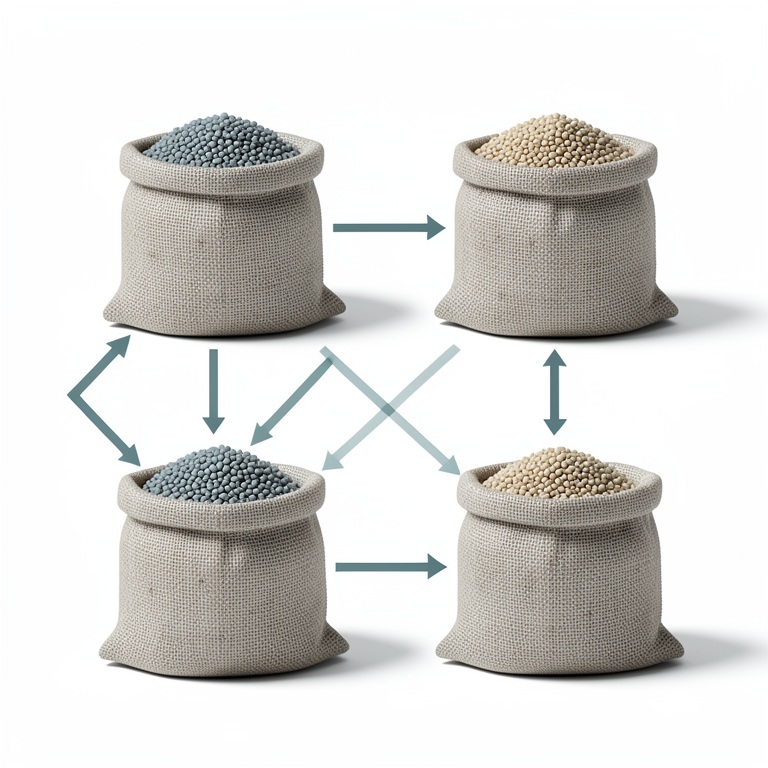
Market Influence Map
AI-generated conceptual illustration (pearl millet grains in sacks at open-air regional markets). It explains the idea and does not show study data.
View source evidence ↗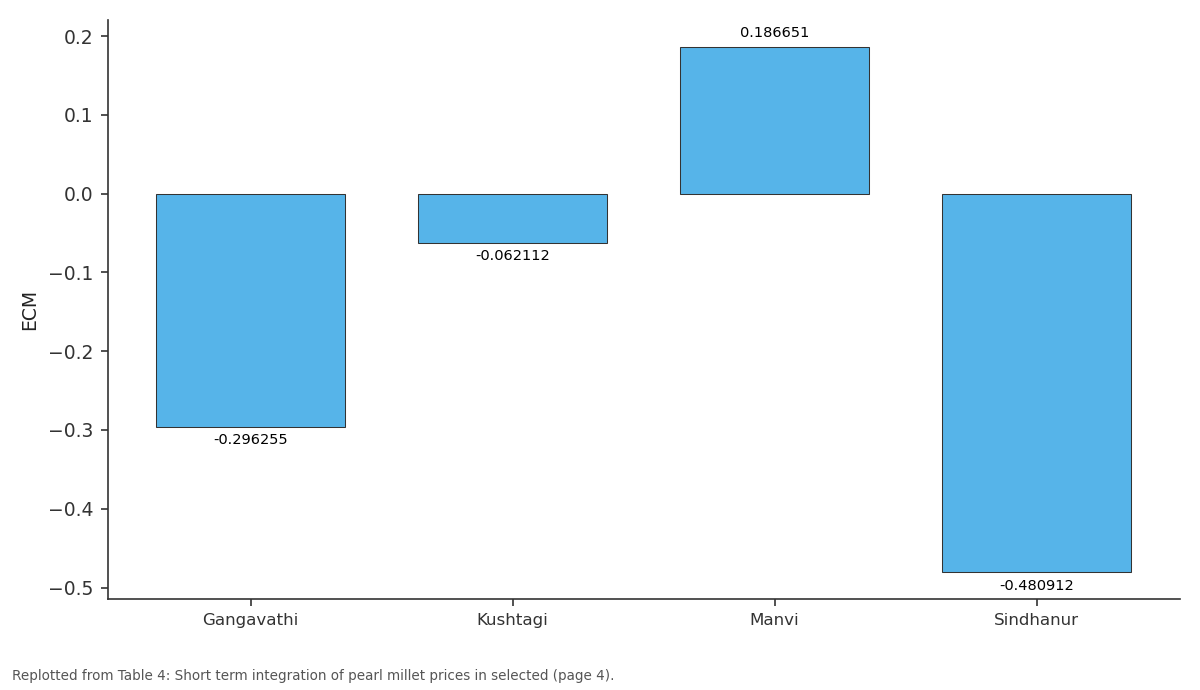
ECM: Gangavathi vs Kushtagi vs Manvi vs Sindhanur
Replotted from Table 4 (page 4) of the original paper. Every bar is the paper's own table value.
View source evidence ↗Figures & tables
From the original paper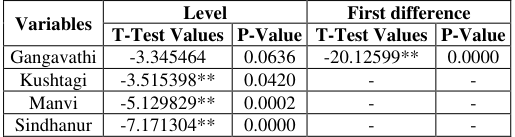 Table 1
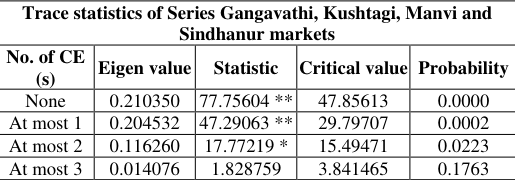 Table 2
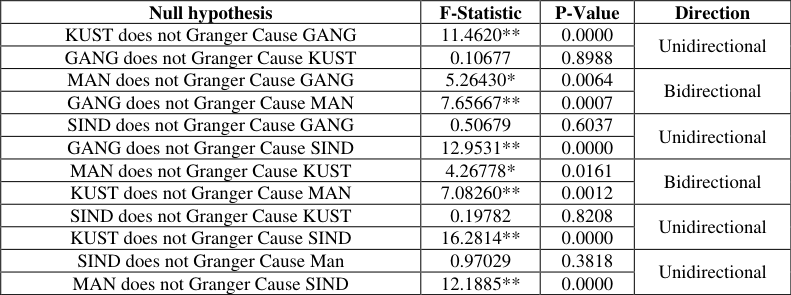 Table 3
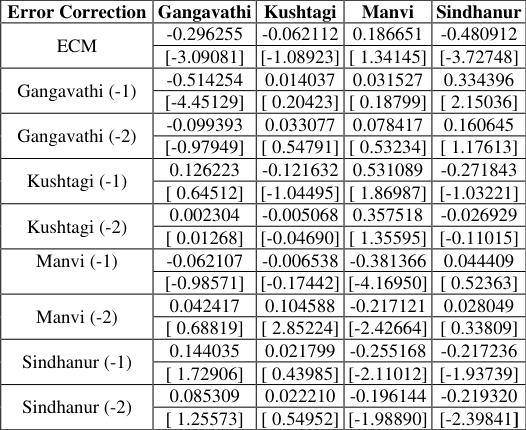 Table 4
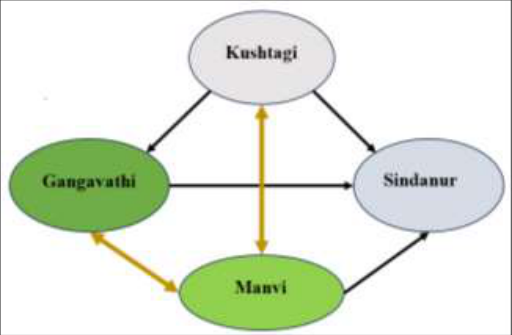 Figure 1
Introduction
Millets, often referred to as coarse grains, play a crucial role in the Indian agricultural landscape, contributing significantly to food security and sustainable farming practices. In Karnataka, a state in southern India known for its diverse agriculture, the production and marketing of millets, including pearl millet, finger millet, foxtail millet, and little millet, have gained prominence due to their nutritional value, climate resilience, and cultural significance. Karnataka boasts a favourable agro-climatic environment for millet cultivation, with diverse soil types and rainfall patterns. Pearl millet, a major staple, is grown extensively in regions like Gangavathi, Kushtagi, Manvi, and Sindhanur. Finger millet, known as 'ragi,' holds cultural importance and is a staple in many households. Foxtail millet and little millet are also cultivated, contributing to the state's agricultural diversity. The cultivation of millets in Karnataka involves both rainfed and irrigated practices. Rainfed areas, particularly in the northern regions, rely on the monsoon for cultivation. In contrast, certain districts with access to irrigation facilities enable year-round millet farming. These millets are well-suited to Karnataka's climate, requiring less water compared to other crops, making them resilient to erratic rainfall patterns and droughts. The marketing of millets in Karnataka involves a complex interplay of factors, including supply chains, pricing mechanisms, and consumer preferences.
Traditionally, millets were consumed locally, but changing dietary patterns and increased awareness of their nutritional benefits have expanded their market reach. Markets in cities like Bengaluru, Mysuru, and Hubballi witness a growing demand for millet-based products. The surge in healthconscious consumers has led to an increased interest in milletbased snacks, flour, and ready-to-eat products. This shift presents an opportunity for farmers to explore diverse market channels and value addition. Millets hold immense potential in Karnataka's agricultural landscape. Their nutritional benefits, climate resilience, and cultural significance position them as essential crops for sustainable and diversified farming. With concerted efforts from farmers, government agencies, and the private sector, millets can not only contribute to food security but also emerge as a lucrative sector in Karnataka's agricultural economy. The interrelation between the price movements in different markets mostly depends upon the nature and extent of competition. An analysis of such inter-relationships helps us in understanding the efficiency of the marketing systems. The current study is to find out the pricing integration among the selected markets of pearl millet in Karnataka.
Methodology
In view of specific objectives of the study, four major markets of pearl millet in Karnataka state were selected. The selection of markets was done on the basis of maximum quantity of arrivals of pearl millet in the selected markets. The markets thus selected were Gangavathi, Kushtagi, Manvi and Sindanur. This study was based on the secondary data. The time series data on monthly arrivals and price of pearl millet required for the study were collected from the registers maintained in the respective APMCs. These markets maintain data on daily, monthly and yearly arrivals and prices of agricultural commodities. The data on arrivals refer to the total arrivals during the month in quintals in the market. The data on prices refers to modal prices in a month. Modal price was considered superior to the monthly average price as it represented the major proportion of the commodity marketed during the month in a particular market. For the prices of pearl millet, monthly secondary data were collected from the selected markets for a period of 11 years depending upon data availability. Information on arrivals and price was collected for the period 2011-12 to 2021-22.
Co-integration in Eviews
Co-integration is an analytic technique for common trends in multivariate time series and modeling long-run and short-run dynamics. Two or more predictive variables in a time-series model are co-integrated when they share a common stochastic drift. Variables are considered co-integrated if a linear combination of them produces a stationary time series. This analysis was carried out to ascertain the response of price change in one market that is transmitted to other markets. The Co-integration analysis was carried out for this purpose to know the inter market price relationship between the major pearl millet, finger millet, foxtail millet and little millet markets in India Price relations are widely used to indicate the overall market performances; the usual definition is that integrated markets are those whose prices are determined interdependently i.e., the changes in one market will be fully transmitted to the other markets.
In the present study co-integration method has been adapted with the use of Eviews 12 software to study the market integration for modal prices of the selected markets. To carry out the analysis data has been made stationary mean that the process of generating the data is in equilibrium around a constant value and that the variance around the mean remains constant over a time. If mean changes over time and variance is not reasonably constant, then the series is non-stationary. To decide the stationarity of the data, for each the market ADF test (Augmented Dickey -Fuller Unit root test) has been conducted. If calculated probability value of respective market in ADF test is less than 0.09 then that market's price data is already stationary. But if the ADF values are greater than 0.09, data is subjected to 1 st order differencing or 2 nd order differencing until it becomes stationary. Finally, vector Auto regression Estimates are calculated for all the markets. The VER estimates will provide the shortterm Co-integration with in the markets and between the markets which will be expressed in percentage. The t-Statistics are calculated to know the significance of the markets within them and also between markets, which will be greater than 1.96 then the integration values are considered as significant otherwise they are non-significant and will not be considered for drawing the inferences.
Results and Discussion
Extent of market integration among the selected pearl millet markets of Karnataka Co-integration is an analytic technique used to model long run and short run dynamics in multivariate time series. When two or more predictive variables in a time series model have a common stochastic drift, they are co-integrated. Cointegration occurs when a linear combination of variables creates a stationary time series. Co-integration was used to examine the integration of selected main pearl millet, finger millet, foxtail millet and little millet markets in Karnataka during a ten-year period (2011-12 to 2021-22). The first step in Co-integration analysis is performing the Augmented Ducky Fuller Unit Root Test (ADF test) which was conducted to check the data for stationary. On conducting ADF test for all the pearl millet markets i.e. Gangavathi, Kushtagi, Sindanu and Manvi, data were made stationary by taking First Difference. Table 1 presents the unit root results of pearl millet prices in selected markets of Karnataka. The markets of pearl millet that was considered for the study were Ganagavathi, Kushtagi, Manvi and Sindhanur market. For the Ganagavthi market the level t test values obtained were -3.34 with the probability value to be 0.0636. The first difference observed to be with t test values of -20.12 with 0.00 of p value which was found significant at one per cent probability level. With respect to Kushtagi market the t test values obtained to be -3.51 with p value of 0.0420, Manvi market -5.12 with the p value of 0.002 and Sindhanur market to be -7.17 with 0.00 p value. All the markets were found to be statistically significant at one per cent probability level. As observed in the results, the unit root test results analysed to check the stationarity of time series data of markets that are selected for the study. It was evidenced from the t-test value in the first only three markets that is Kushtagi, Manvi and Sindanur markets were found to be stationary indicating the data that was obtained for the study had no differences. In the first difference the linearity in the data was observed for the market of Gangavathi as indicated by the P-value of Gangavathi market.
| Variables | Level | — | First difference | — |
|---|---|---|---|---|
| T-Test Values | P-Value | T-Test Values | P-Value | |
| Gangavathi | -3.345464 | 0.0636 | -20.12599** | 0.0000 |
| Kushtagi | -3.515398** | 0.0420 | - | - |
| Manvi | -5.129829** | 0.0002 | - | - |
| Sindhanur | -7.171304** | 0.0000 | - | - |
Table text extracted from the original PDF; superscript letters are shown inline. The original table image is below.
View original table image
Since all the price series are non-stationary at level form and stationery at first difference level, Johansen co integration test can be applied to analyze the long run equilibrium among the pearl millet markets. Table 2 presents the long-term integration of the pearl millet prices in selected markets of Karnataka. It is observed from the table the trace statistic at none, at most 1, at most 2 and at most 3 was 77.75, 47.29, 17.77 and 1.82 while critical value to be 47.85, 29.79, 15.49 and 3.84. The probability level registered at 0.00 for none, 0.0002 for at most 1, 0.0223 at most 2 and 0.1763 at most 3. The values of trace statistic for none, at most 1 were found to be statistically significant at one per cent probability level while at most 2 results were registered at statistically significant at five per cent probability level. The results depicted that the markets were highly cointegrated between three markets as the P-value obtained was less than or equal to 5 per cent for three markets. The overall results inferred that the prices of one market have an effect on the other market. As a part of co-integration analysis, Granger causality Test was used to know if co integration exists between two markets or not. The causal relationship among the markets price of major pearl millet markets in Karnataka were approached through above technique. The results of pairwise causality test for pearl millet prices in selected markets of Karnataka is presented in table 3. From the table its can be observed that some of the selected markets were highly co integrated with each other which was inferred with the probability value is equal or less than 0.05 for the selected markets (Fig. 52). The change in the prices of pearl millet in the Kushtagi market has an effect on the Ganagavathi market. At the same time and change in the Gangavathi market had not affect in change in the prices of Kushtagi market which was evidenced with the unidirectional in nature. The other markets with unidirectional situation were Sindhanur and Ganagavathi market, Sindhnaur and Kushtagi market, Sindhanur and Manvi markets. The bidirectional relationship was observed for the markets of Manvi and Ganavatahi as the change in prices will affect both the markets. The same situation was also observed for Manvi and Kushtagi markets. Among 12 pairs of markets four pair of markets were found to be unidirectional in nature. The unidirectional nature indication maybe mainly due to many factors such as cost of transportation, demand for the product etc. Thus, a unidirectional situation was found among the markets such as Kushtagi and Gangavathi, Gangavathi and Sindanur, Kushtagi and Sindanur, Manvi and Sindanur. At the same time, it can be observed from the table that there was existence of bidirectional of market integration indicating the influence of the prices in the pair of markets. Thus, indicating that these markets were price takers. Bidirectional causality was observed between Manvi and Gangavathi, Manvi and Kustagi markets, indicating the change in these pair markets will influence on each other. In order to know the Co-integration between the major pearl millet markets considered under study, the Vector Error Correction Mechanism was conducted. The results of vector error correction mechanism estimation are presented in the table 4. The cointegration coefficient of Gangavathi and Sindhanur markets is (-0.296255) and (-0.480912) were structurally significant. The cointegration coefficient indicated that Gangavathi market and Sindanur markets corrected about 29.62 per cent and 48.09 percent of the price losses over a time of one month. The cointegration coefficient of Kushtagi and Manvi markets were found to be statistically not significant. One month lagged price of Gangavathi market would influence the existing market price of the same market to the tune of 51.42 per cent in a negative direction. The same one month lagged price will affect the present price of sindanur market to the extent of 33.43 per cent in a positive direction. One month lagged price of Manvi market would influence the existing price in same market to the extent of 38.13 per cent in a negative direction. Two month lagged price at Manvi market influence the impact of present market price at Kushtagi market to the tune of 10.45 per cent and present price at Manvi market to the extent of 21,71 per cent in negative direction. Further as depicted from table, one month lagged price of Sindanur market would influence on the present price of Manvi market to the extent of 25.51 per cent in a negative direction. Tow month lagged prices will influence on the present price of its own market in the negative direction to the extent of 21.93 per cent. In all other markets that was considered for the study the existence of cointegration was found to between the price but they were non-significant in manner. The cointegration equation indicated that prices of earl millet in Gangavathi and Sindanur markets were statistically significant indicating the prices which get disturbed by other markets will get corrected within one month. The other two markets that is Kushtagi and Manvi markets were found to be statistically non-significant. One month lagged prices had a negative influence on the present prices of Gangavathi and positive influence on the Sindanur market. Similar situation was observed for Manvi market as the one month lagged price would influence negatively on the present prices of pearl millet in the Manvi market. Two month lagged prices in Manvi market would influence positively on present prices of Kushtagi market. Similarly, the Sindnur market exhibited, one month lagged price had influence on the prices of Manvi market in a negative way and two month lagged prices influence negatively on its own market. The overall results indicated that the pearl millet prices at Gangavathi, Manvi and Sindanur markets would influence on the prices of other markets.
| Error Correction | Gangavathi | Kushtagi | Manvi | Sindhanur |
|---|---|---|---|---|
| ECM | -0.296255 | -0.062112 | 0.186651 | -0.480912 |
| [-3.09081] | [-1.08923] | [ 1.34145] | [-3.72748] | |
| Gangavathi (-1) | -0.514254 | 0.014037 | 0.031527 | 0.334396 |
| [-4.45129] | [ 0.20423] | [ 0.18799] | [ 2.15036] | |
| Gangavathi (-2) | -0.099393 | 0.033077 | 0.078417 | 0.160645 |
| [-0.97949] | [ 0.54791] | [ 0.53234] | [ 1.17613] | |
| Kushtagi (-1) | 0.126223 | -0.121632 | 0.531089 | -0.271843 |
| [ 0.64512] | [-1.04495] | [ 1.86987] | [-1.03221] | |
| Kushtagi (-2) | 0.002304 | -0.005068 | 0.357518 | -0.026929 |
| [ 0.01268] | [-0.04690] | [ 1.35595] | [-0.11015] | |
| Manvi (-1) | -0.062107 | -0.006538 | -0.381366 | 0.044409 |
| [-0.98571] | [-0.17442] | [-4.16950] | [ 0.52363] | |
| Manvi (-2) | 0.042417 | 0.104588 | -0.217121 | 0.028049 |
| [ 0.68819] | [ 2.85224] | [-2.42664] | [ 0.33809] | |
| Sindhanur (-1) | 0.144035 | 0.021799 | -0.255168 | -0.217236 |
| [ 1.72906] | [ 0.43985] | [-2.11012] | [-1.93739] | |
| Sindhanur (-2) | 0.085309 | 0.022210 | -0.196144 | -0.219320 |
| [ 1.25573] | [ 0.54952] | [-1.98890] | [-2.39841] |
Table text extracted from the original PDF; superscript letters are shown inline. The original table image is below.
View original table image
| Null hypothesis | F-Statistic | P-Value | Direction |
|---|---|---|---|
| KUST does not Granger Cause GANG | 11.4620** | 0.0000 | Unidirectional |
| GANG does not Granger Cause KUST | 0.10677 | 0.8988 | |
| MAN does not Granger Cause GANG | 5.26430* | 0.0064 | Bidirectional |
| GANG does not Granger Cause MAN | 7.65667** | 0.0007 | |
| SIND does not Granger Cause GANG | 0.50679 | 0.6037 | Unidirectional |
| GANG does not Granger Cause SIND | 12.9531** | 0.0000 | |
| MAN does not Granger Cause KUST | 4.26778* | 0.0161 | Bidirectional |
| KUST does not Granger Cause MAN | 7.08260** | 0.0012 | |
| SIND does not Granger Cause KUST | 0.19782 | 0.8208 | Unidirectional |
| KUST does not Granger Cause SIND | 16.2814** | 0.0000 | |
| SIND does not Granger Cause Man | 0.97029 | 0.3818 | Unidirectional |
| MAN does not Granger Cause SIND | 12.1885** | 0.0000 |
Table text extracted from the original PDF; superscript letters are shown inline. The original table image is below.
View original table image
| Trace statistics of Series Gangavathi, Kushtagi, Manvi and Sindhanur markets | — | — | — | — |
|---|---|---|---|---|
| No. of CE (s) | Eigen value | Statistic | Critical value | Probability |
| None | 0.210350 | 77.75604 ** | 47.85613 | 0.0000 |
| At most 1 | 0.204532 | 47.29063 ** | 29.79707 | 0.0002 |
| At most 2 | 0.116260 | 17.77219 * | 15.49471 | 0.0223 |
| At most 3 | 0.014076 | 1.828759 | 3.841465 | 0.1763 |
Table text extracted from the original PDF; superscript letters are shown inline. The original table image is below.
View original table image
Conclusion
The market integration study indicated that there was cointegration of the markets with bidirectional for pearl millet prices for Manavi and Ganavathi market, Manvi and Kusghtagi market. Which evidenced that the prices of both markets will affect the prices in the other market. While unidirectional prices were observed for Kushtagi and Ganagavathi market, Gangavathi and Manvi market, Kushtgai and Manvi markets, Manvi and Sindhanur market. Here, the market price of one market will affect only the other market price.
Figures and tables from the paper
References
10 in the original paper- Agarwal NL, Dhaka JM. Relationship between arrivals and prices of spice crops in Rajasthan, Indian J Agric. Mktg. 1998;12(3):152-153.
- Anil Kolur RA, Yeledalli PB, Gamanagatti, Choudhary K, Patil C. Study on the market integration between the major markets of wheat, Internat. J Com. & Bus. Manage. 2012;5(2):152-154.
- Arya A. Spatial integration of regulated markets in Kheda district of Gujarat. Indian J Agric. Mktg. 1991;5(2):207209.
- Awasthi PK, Atkare P, Gupta SK. Market integration and its impact on groundnut price in western region of M.P. Indian J Agric. Econ. 1985;40(3):420-427.
- Debdutt B, Durga P, Charan. Cointegration and market integration: An application to the marine fish markets in Orissa. Indian J Agric. Econ. 1998;53(3):344-349.
- Madhusudhan G. Cointegration tests and spatial integration of rice markets in India. Indian J Agric. Econ. 2000;55(4):616-625.
- Jyotish PB, Dinda S. Market integration: An application for error correlation model to potato market in Hooghly district, West Bengal. Indian J Agric. Econ. 2003;58(4):742-751.
- Patel A. Market integration and pattern of market arrivals of rapeseed-mustard in Mehasana district of Gujarat. Agric. Mktg. 2000;42(4):24-29.
- Saran S, Gangwar LS. Analysis of spatial cointegration amongst major wholesale egg markets in India. Agric. Econ. Res. Review. 2008;21(2):259-264.
- Yogisha GM, Karnool NN, Kumar VHS, Basavaraja H. Market integration for major agricultural commodities in Kolar District. Karnataka J Agric. Sci. 2007;19(3):857861.