
Research article · 2023 · Full text
International Journal of Advanced Biochemistry ResearchLumpy skin disease: Its emergence and impact on Indian farmer
Volume 7(2S) · Pages 507–509 · DOI: 10.33545/26174693.2023.v7.i2sg.260 ↗
Research areasPoxvirus research and outbreaksHerpesvirus Infections and TreatmentsBacillus and Francisella bacterial research
Abstract
Author-writtenLumpy skin disease (LSD) is a viral disease caused by lumpy skin disease virus (LSDV), a member of Capri poxvirus genus of Poxviridae family. It is a transboundary disease of the economic importance affecting cattle and water buffaloes. The disease is transmitted by arthropod vectors and causes high morbidity and low mortality. LSD has recently been reported first time in India with 7.1% morbidity among cattle. Generally, fever, anorexia, and characteristic nodules on the skin mucous membrane of mouth, nostrils, udder, genital, rectum, drop in milk production, abortion, infertility and sometimes death are the clinical manifestations of the disease. The disease is endemic in African and has started spreading to India and other Asian countries. In India, currently epidemiological status of the disease is unknown. Vaccination along with strict quarantine measures and vector control could be effective for preventing the spread of the disease. This article aims to summarise the latest developments in the transmission, clinical presentations, diagnostics and management of the disease.
Summary
Source-checkedPlain-language reading of the full paper, prepared with AI and checked against the text. Each point links to the authors' own words.
Why it matters
- Lumpy skin disease (LSD) is caused by the lumpy skin disease virus (LSDV), which belongs to the Capripoxvirus genus of the Poxviridae family. View evidence ↗
- LSD is a transboundary disease that significantly impacts the economy by affecting water buffaloes and cattle. View evidence ↗
- Due to its capacity to spread from Africa globally, LSD is classified as an agro-terrorism agent. View evidence ↗
The question
- The authors aim to summarize current knowledge regarding the transmission, clinical signs, diagnosis, and management of Lumpy skin disease. View evidence ↗
What they did
- The paper notes that LSD was recently reported in India for the first time, showing a 7.1% morbidity rate among cattle. View evidence ↗
- The current epidemiological status of the disease in India is described as massive, affecting almost all states. View evidence ↗
What they found
- The incubation period for LSD varies by environment, lasting 2 to 5 weeks in natural conditions and 7 to 14 days in experimental settings. View evidence ↗
- Cutaneous lesions typically become necrotic and harder after 2 to 3 weeks, which impairs the animal's mobility. View evidence ↗
- LSD causes infertility in both sexes, with females remaining in anoestrus for long periods and bulls with genital lesions remaining infertile for months. View evidence ↗
- The high economic impact of LSD is driven by morbidity (disease prevalence) rather than mortality, as death rates are generally low. View evidence ↗
- Polymerase chain reaction (PCR) is identified as the most rapid and efficient method for diagnosing the disease. View evidence ↗
- No effective cure for LSD exists; treatment is limited to managing symptoms using antibiotics and anti-inflammatory drugs. View evidence ↗
What it means
- The authors conclude that the spread of LSD can be effectively prevented through a combination of vector control, strict quarantine, and vaccination. View evidence ↗
- The authors recommend investigating how LSD was introduced into India and conducting random epidemiological screenings to determine actual prevalence. View evidence ↗
Visual summary
1 visualsIllustrations explain the paper; they do not show study data.
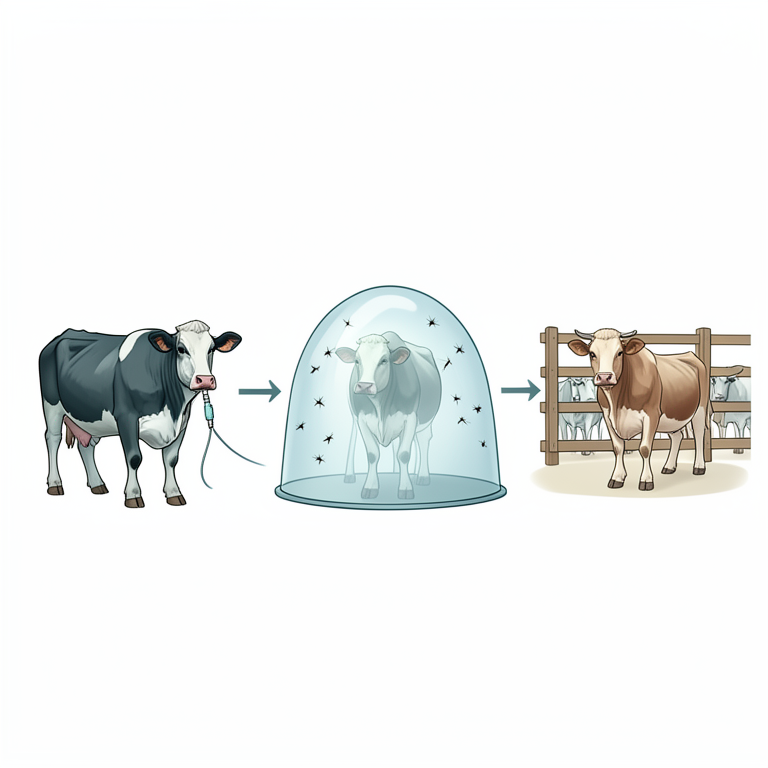
LSD Prevention Strategy
AI-generated conceptual illustration (cattle). It explains the idea and does not show study data.
View source evidence ↗Figures & tables
From the original paper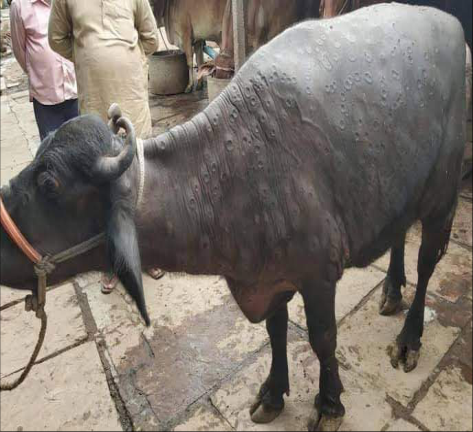 Figure 1
Introduction
Lumpy skin disease (LSD) is a severe cattle infection caused by the lumpy skin disease virus (type strain, Neethling), which, along with sheep and goat poxviruses, is part of the Poxviridae family's Capripoxvirus genus. The disease is distinguished by large skin nodules that cover the entire body, fever, enlarged lymph nodes, nasal discharge, and lachrymation, but the consequences of clinical signs varies greatly. Due to permanent hide damage, LSD causes significant economic losses. Cows and bulls may face temporary or permanent infertility (Tuppurainen and Oura 2011) [11] . It causes decreased milk yield and, in some cases, death due to secondary bacterial infections (Chihota et al. 2003) [6] . Furthermore, it disrupts the trade in cattle and their products. In India, the disease's epidemiological status is currently massive, with all parts of the country affected (almost all states). Vaccination, strict quarantine measures, and slaughter policies were successful in eradicating the disease in such outbreaks (Brenner et al. 2006) [5] . In 1989, LSD was also suspected in Arabian oryx in Saudi Arabia. It was recognised by the appearance of numerous skin nodules covering the entire body, as well as a persistent high fever and depression.
Clinical signs and lesions
In natural conditions, disease incubation last for between 2 and 5 weeks, but in experimental conditions, it lasts between 7 and 14 days. LSD comes in three varieties: acute, subacute, and chronic. Biphasic fever is the first symptom of the illness. Clinical manifestations of mild infection include one or two lumps of nodules within 2 to 3 days of fever onset, emaciation, ocular discharge, and agalactia. Later on, painful and hyperemic nodular lesions may appear on the animal's body, particularly in the skin of the muzzle, nares, back, legs, scrotum, perineum, eyelids, lower ear, nasal and oral mucosa, and tail. More than a hundred nodules formed on skin all over the body in serious conditions, and this stage lasted 7 to 12 days. The nodules are firm and slightly raised from the surrounding skin, with a narrow haemorrhagic ring separating them. Dermis, epidermis, adjacent subcutis, and musculature are all involved in the nodules. The lesions then develop into papules, vesicles, pustules with exudation, and finally scabs. The lesions heal very slowly. Lesions form on the mucous membranes of the nostrils, respiratory tract, mouth, and vulva over time. The cutaneous lesions become harder and necrotic after 2-3 weeks, causing discomfort and making the animals reluctant to move. Sloughing of the lesions may result in the formation of a hole in the "sitfast," the characteristic lesion, allowing screwworm fly and bacterial invasion, which can lead to septicaemia (Abutarbush et al. 2013) [2] . LSD's common symptom is pneumonia, which is caused by the animal inhaling necrotic material. Abortion occurs during the acute stage of infection. Infertility is another complication of the disease that affects both male and female. The female remains in anoestrus for an extended period of time. Infected bulls with genital lesions are also infertile for months. Due to secondary bacterial infection, pneumonia, mastitis, and fly strike in necrotic lesions that leave deep holes in the body, recovery is extremely slow (Al-Salihi 2014) [3] .
Economic importance
Because of its economic impact, the World Organization for Animal Health (OIE) classifies LSD as a notifiable disease. Because of its ability to spread from Africa to other parts of the world, LSD has been classified as an agro-terrorism agent (Abutarbush 2017) [1] . The disease's economic implications are high due to morbidity rather than mortality, as mortality rates are typically low. Significant losses are caused by severe emaciation, hide damage, mastitis, male and female infertility, a drop in milk production, and abortions. The effect of the reduction in animal quality can be seen in the overall trade of live animals and animal products. This could result in massive financial losses for the meat, milk, leather, and other industries associated with livestock and its by-products. Not only industries, but also poor farmers who keep livestock, are affected by the disease.
Diagnosis
Because of lack of familiarity and logistics, diagnosing exotic diseases can be difficult. Clinical signs of LSD can be mistaken for those of other diseases such as foot and mouth disease (FMD), insect bite, demodicosis, and hypersensitivity. Skin nodules on the face, eyelids, neck, muzzle, nostrils, udder, and limbs can be used to make a tentative diagnosis. A skin biopsy sample can be obtained to confirm the disease. Samples should be transported in phosphate buffered saline transport medium containing 20 to 50% glycerol. Electron microscopy can be used to identify viruses in skin samples (Davies et al. 1971) [7] . Virus isolation can be used to confirm a diagnosis in new niches. The primary and secondary cultures of bovine testes and pre-pubertal lamb are the most sensitive for virus isolation. Molecular diagnosis with PCR is the most efficient and rapid test for disease diagnosis. For rapid diagnosis, both conventional and real-time PCR have been developed (Heine et al. 1999 [8,9,10,13,4] . Real-time PCR has been used to distinguish LSDV from other Capripoxviruses.
Prevention and control
There is currently no effective LSD treatment available. Symptoms are treated with anti-inflammatory and antibiotic medicines. To control the disease, effective control and preventive measures must be implemented, including 1. Restrict movement: To prevent the spread of transboundary disease, movement of infected animals with LSD should be strictly prohibited. If such lesions are found on animals within a country, they should be quarantined for inspection to prevent disease spread.
Limit vector movement: Movement of vectors caused
by prevailing winds may result in disease transmission.
Vector control methods, such as the use of vector traps and insecticides, can also be used to prevent the disease.
Vaccination
Vaccination
Conclusion
Cattle and buffaloes are important livestock that contribute significantly to the global economy. Lumpy skin disease is a serious condition that affects cattle and buffalo. Previously, the disease was limited to African countries and a few other countries, but the disease's recent spread to India and other Asian countries, a previously disease-free region, is cause for concern in the livestock rearing sector, as most of these countries have agriculture-based economies. Because this disease is economically significant, spreading it to larger geographical areas of the Indian subcontinent will undoubtedly harm the rural economy in particular. LSD may also reduce the export of livestock and livestock products.
To determine the true disease prevalence, the reasons for the introduction of LSD into India must be investigated, as well as epidemiological random screening in various regions.
Aside from effective quarantine and vector control methods, vaccination is the only method of disease prevention.
Figures and tables from the paper
References
12 in the original paper- Abutarbush SM, Ababneh MM, Zoubil IG, Sheyab OM, Zoubi MG, Alekish MO, et al. Lumpy skin disease in Jordan: Disease emergence, clinical signs, complications and preliminary-associated economic losses. Transbound Emerg Dis. 2013;62(5):549-554.
- Al-Salihi K. Lumpy skin disease: Review of the literature. Mirror Res Vet Sci Ani. 2014;3(3):6-23.
- Bowden TR, Babiuk SL, Parkyn GR, Copps JS, Boyle DB. Capripoxvirus tissue tropism and shedding: a quantitative study in experimentally infected sheep and goats. Virology. 2008;371(2):380-393.
- Brenner J, Haimovitz M, Oron E, Stram Y, Fridgut O, Bumbarov V, et al. Lumpy skin disease (LSD) in a large dairy herd in Israel, June 2006. Israel Journal of Veterinary Medicine. 2006;6173-77.
- Chihota CM, Rennie LF, Kitching RP, Mellor PS. Attempted mechanical transmission of lumpy skin disease virus by biting insects. Medical Veterinary Entomology. 2003;17:294-300.
- Davies FG, Krauss H, Lund LJ, Taylor M. The laboratory diagnosis of lumpy skin disease. Res Vet Sci. 1971;12:123-127.
- Heine HG, Stevens MP, Foord AJ, Boyle DB. A Capri poxvirus detection PCR and antibody ELISA based on the major antigen P32, the homolog of the vaccinia virus H3L gene. Journal of Immunol Methods. 1999;227(1/2):187-196.
- Mangana-Vougiouka O, Markoulatos P, Koptopoulos G, Nomikou K, Bakandritsos N, Papadopoulos O, et al. Sheep poxvirus identification by PCR in cell cultures. J Virol Methods. 1999;77(1):75-79.
- Orlova ES, Shcherbakov AV, Diev VI, Zakharov VM. Differentiation of capripoxvirus species and strains by polymerase chain reaction. Application of Molecular Biology. 2006;40(1):139-145.
- Tuppurainen ES, Stoltsz WH, Troskie M, Wallace DB, Oura CA, Mellor PS, et al. A potential role for ixodid (Hard) tick vectors in the transmission of lumpy skin disease virus in cattle. Transbound Emerg Dis. 2011;58:93-104.
- Tuppurainen ESM, Oura CAL. Review: Lumpy Skin Disease: An Emerging Threat to Europe, the Middle East and Asia. Transboundary and Emerging Diseases. 2011;59:40-48.
- Zheng M, Liu Q, Jin NY, Guo JG, Huang X, Li HM, et al. A duplex PCR assay for simultaneous detection and differentiation of Capripoxvirus and Orf virus. Mol Cell Probes. 2007;21:276-281.