
Research article · 2023 · Full text
International Journal of Statistics and Applied MathematicsTo chronicle the challenges encountered by stakeholders during the installation and operation of the agri clinic and agri business centers scheme in Madhya Pradesh state
Volume 8(6S) · Pages 561–563 · DOI: 10.22271/maths.2023.v8.i6sh.1428 ↗
Research areasAgricultural Economics and Practices
Abstract
Author-writtenThe Agribusiness and Agri Clinics Centres Scheme is expanding as an important forum for agricultural candidates with a background in agriculture from an employment standpoint, with government assistance to accomplish goals such as educating extension agents on farmer entrepreneurship development to improve their financial situation. In terms of employment, the Agri Clinics and Agribusiness Centres Scheme is growing into an important venue for Agribusiness graduates in the agricultural industry. For the purpose of this study randomly select the 100 candidates in 4 different batches the most recent (2021-22), middle (2017-18) (2019-20), and the initial batch (2014-15) each training facility which has been chosen were all contained in the random selection of five percent of the whole number of Agri-Preneurs to different Nodal Training Institute in Madhya Pradesh State of India. According to the finding of the study there are 13 different problem listed but the major problem to start their own business is lack of money for the particular person who wants to start their own business mainly the lack of own money shared the 88 percentage like 100 out of 88 candidate faced the problem. Heavy competition from exciting market players is the major problem for running their business in market place 53 respondents face this problem for running their business.
Summary
Source-checkedPlain-language reading of the full paper, prepared with AI and checked against the text. Each point links to the authors' own words.
Why it matters
- The Agribusiness and Agri Clinics Centres Scheme serves as a key employment forum for agriculture graduates, using government support to develop farmer entrepreneurship and improve financial outcomes. View evidence ↗
- The program aims to utilize the skills of agribusiness graduates to provide high-quality agricultural skills to farmers across the country. View evidence ↗
What they did
- The researchers randomly selected 100 candidates from four different training batches spanning from 2014-15 to 2021-22. View evidence ↗
- Data was collected from two groups: agripreneurs who had not yet started their venture (to study establishment challenges) and those who had already started (to study operational challenges). View evidence ↗
- The study used percentages, frequencies, scores, and averages to analyze trainee profiles and institutional facilities. View evidence ↗
What they found
- A lack of handholding support from Nodal Training Institutes (NTIs) was the second most common establishment challenge, affecting 85% of respondents. View evidence ↗
- Insufficient family support was cited as a major obstacle by 82% of the agripreneurs attempting to start their ventures. View evidence ↗
- Financial barriers during establishment included high margin money (72%), bank reluctance to lend (70%), fear of business failure (69%), and lack of collateral security. View evidence ↗
- For those already operating, the primary challenge was heavy competition from established market players, reported by 53% of respondents. View evidence ↗
- Marketing and infrastructure issues were the second most prevalent operational challenge, affecting 50% of the agripreneurs. View evidence ↗
- The perishable and seasonal nature of agricultural products was a significant operational hurdle for 45% of the respondents. View evidence ↗
- Operational difficulties also included farmers requesting credit sales (51.72%), mediocre family support (48.27%), and a lack of direct company dealerships (43.10%). View evidence ↗
What it means
- The authors conclude that there is an immediate need for loans with lower interest rates and reduced margin money requirements to support graduates. View evidence ↗
- The authors state that a 44% subsidy is an encouraging incentive for agricultural graduates wishing to launch enterprises. View evidence ↗
Visual summary
2 visualsIllustrations explain the paper; charts are replotted from the paper's own table values.
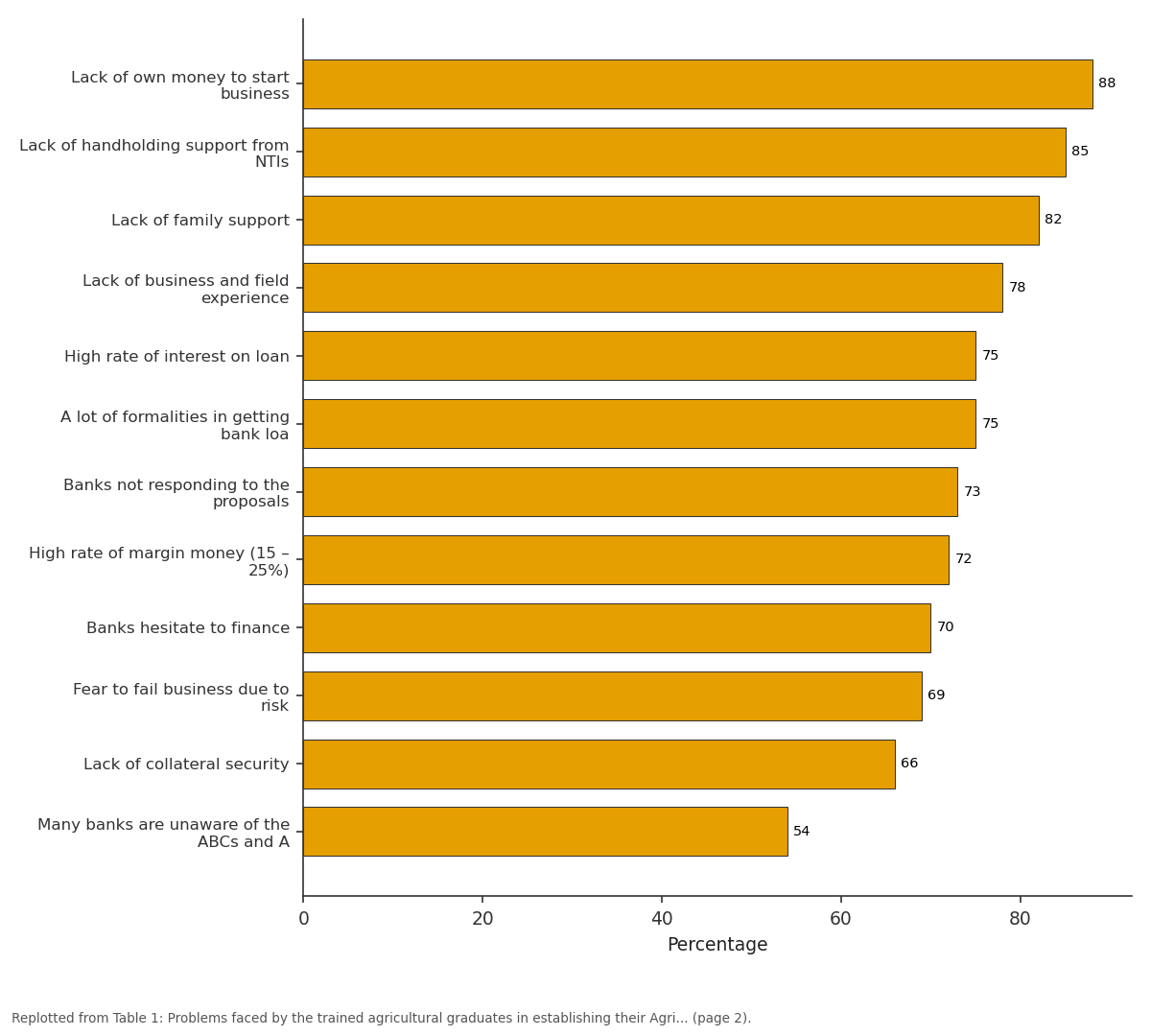
Percentage: Lack of own money to... vs Lack of handholding... vs Lack of family support vs Lack of business and... vs High rate of interest...
Replotted from Table 1 (page 2) of the original paper. Every bar is the paper's own table value.
View source evidence ↗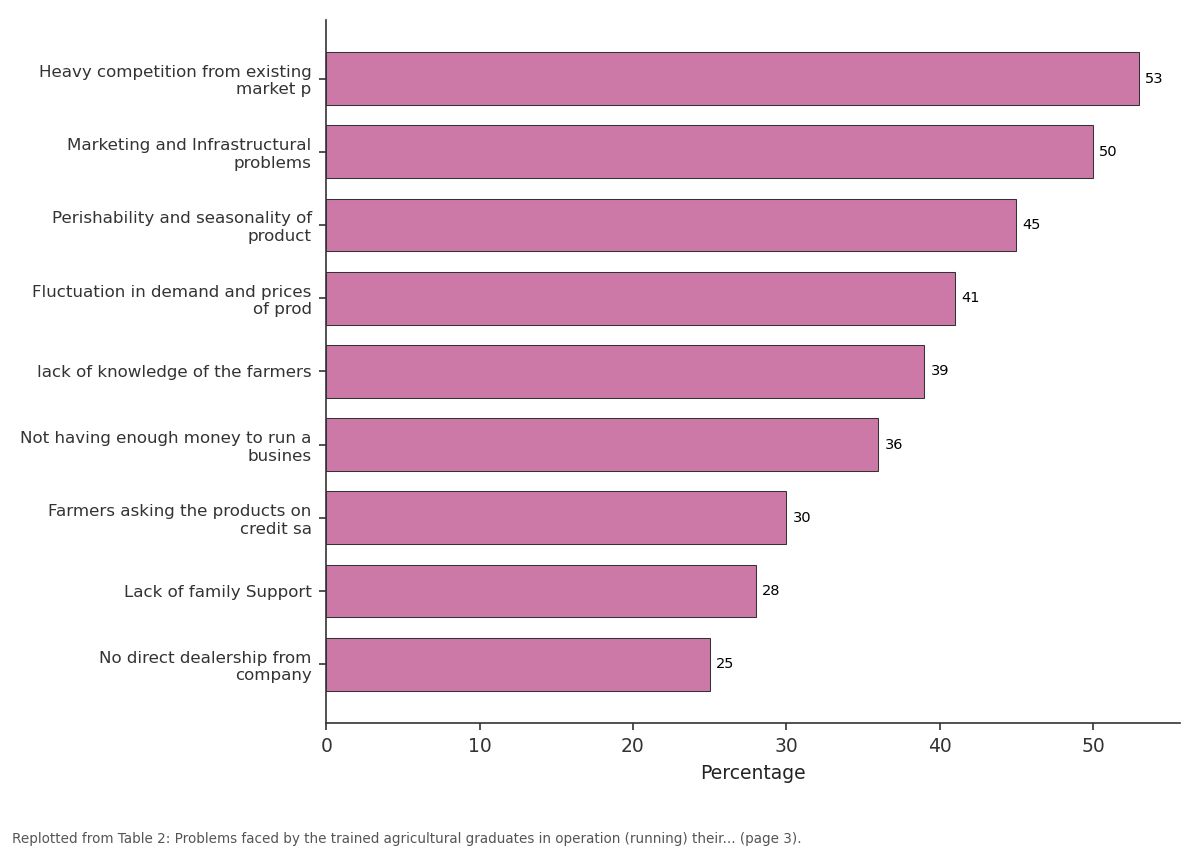
Percentage: Heavy competition from... vs Marketing and... vs Perishability and... vs Fluctuation in demand... vs lack of knowledge of...
Replotted from Table 2 (page 3) of the original paper. Every bar is the paper's own table value.
View source evidence ↗Figures & tables
From the original paper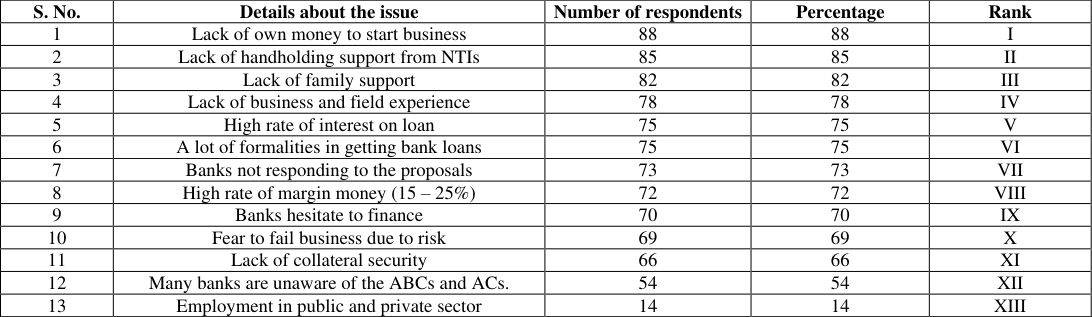 Table 1
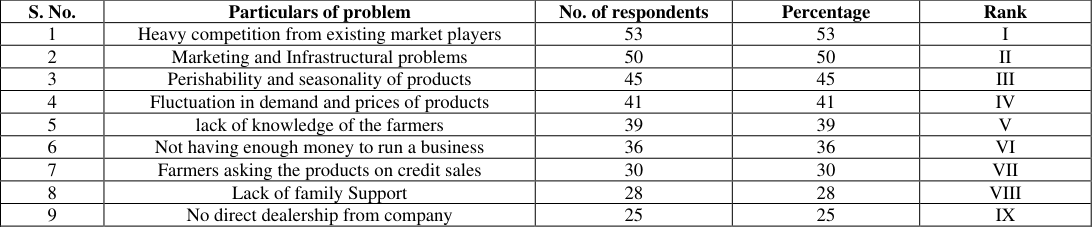 Table 2
Introduction
In conjunction with NABARD, the Government of India has launched a specific project for agribusiness and agriculturist welfare. Finally, the goal of this plan is to provide superior agricultural skills to every agriculturist in the country. The goal of this programme is to put to use the abilities available among the large pool of agribusiness graduates. Whether you are a fresh graduate or currently employed, you can open your own Agri-Clinic or Agri-Business Centre and provide professional development services to a limitless number of farmers. The Agribusiness and Agri Clinics Centres Scheme is expanding as an important forum for agricultural candidates with a background in agriculture from an employment standpoint, with government assistance to accomplish goals such as educating extension agents on farmer entrepreneurship development to improve their financial situation. In terms of employment, the Agri Clinics and Agribusiness Centres Scheme is growing into an important venue for Agribusiness graduates in the agricultural industry.
Research Methodology Sampling Design
A multistage purposive sampling procedure utilize to choose the Agri Graduate and Agri Preneur (Person who started the Business).
Selection of AC & ABC
Selection of AC & ABC
Analytical Methods and Tools Percentage
In regards to training requirements, trainee and trained agriculture graduate profiles, programme enrolment elements, and training institute facilities, scores, percentages, frequencies, and averages will be employed. Additionally, the trainees' profile will be taken into account. Once the percentages are determined, the following formula will be used to give ranks:
No.of respondents (frequency) Total no.of respondents X 100
In a similar manner, proportional weights for every element (including infrastructure and instruction) were employed in order to conduc0t research on the comments made by trainees on the training institutes. The proportion of weights determined by applying the formula that follows Percentage Weight = Scores obtained Total no.of scores X 100
Result and Discussion
Result and Discussion
Study of the problem faced by stakeholders in implementations and operations of the scheme
The information was gathered from agripreneurs who either (a) have not yet begun their agri venture aiming to research the challenges that are presented throughout the establishment procedure an agri venture or (b) have already begun their agri venture aiming to research the challenges that are presented during the course of successfully operating an agri venture. The purpose of this was to examine the issues that the beneficiary farmers face. The list of these is as follows: the general headings that were used to convey the specific issues that the agripreneurs were dealing with:
Obstacles Skilled Agribusiness Owners confront while launching their own Farm
To carry out study on the difficulties that trained agripreneurs encounter when attempting to launch their own agricultural businesses, information was obtained from one hundred agripreneurs who haven't started their own agricultural businesses. According to Table 1, the most significant challenges that agripreneurs face are a lack of their own money to start a business, a lack of handholding support from NTIs, a lack of family support, a lack of business and field experience, a high rate of interest on loans, and a lot of formalities in obtaining bank loans. These challenges affect 88, 85, 82, 78, 75, and 75 percent of agripreneurs, respectively. Table 4. It's possible that difficult family circumstances are to blame for the lack of personal funds necessary to launch the business. It's possible that the high level of risk involved in the agriculture business contributed to the lack of support from the family. Agriculture is dependent on the environment, and agribusiness in turn is dependent on agricultural pursuits; additionally, agribusiness can only be conducted during certain times of the year and in dry land regions. These are some of the potential causes of the problems that have arisen. A large percentage of margin money (72%), banks' reluctance to lend money (70%), apprehension about a business collapsing from risk (69%), and a deficiency of collateral security were the order problems that these agripreneurs faced when establishing their agri venture. Seventy-three percent of the banks did not respond to the proposals of these agripreneurs when they attempted to establish their agri venture (66 percent). In addition, the majority of financial institutions, such as banks (54 percent), as well as employers both in the public and commercial domains (54 percent), are unaware of the AC and ABCs (14 percent). It may be difficult to respond to the ideas because of inadequate preparation or the project's unviability, or considering that the project site that is indicated in the proposal does not be subject to the authority of the banks. Any of these could be the case for the problem. Their difficulty with high margin money was principally caused by the fact that they had a problem with a shortage of owned funds. Twenty-five proportion of the project's total the price ought to have been based on the agripreneurs. However, they did not have enough cash to cover this amount. It's possible that the reluctance of financial institutions to give money for agricultural cooperatives and agricultural business start-ups is caused by the difficulty of agricultural entrepreneurs to persuade and win over the trust of bank authorities. However, because of their involvement and commitment to their jobs, some trained graduates who have already entered the workforce in the private or public sector have difficulty launching their own agricultural businesses. This results from the fact that their jobs require a lot of their time and attention. These findings are comparable to those that were discovered by According to Karjagi (2006) [2] and Karjagi et al. (2007) [1] , excessive loan interest rates, a dearth of handholding support, a dearth of subsidies, and a high rate of margin money were the most significant challenges when it came to launching agricultural businesses in south India under the AC and ABCs scheme.
| S. No. | Details about the issue | Number of respondents | Percentage | Rank |
|---|---|---|---|---|
| 1 | Lack of own money to start business | 88 | 88 | I |
| 2 | Lack of handholding support from NTIs | 85 | 85 | II |
| 3 | Lack of family support | 82 | 82 | III |
| 4 | Lack of business and field experience | 78 | 78 | IV |
| 5 | High rate of interest on loan | 75 | 75 | V |
| 6 | A lot of formalities in getting bank loans | 75 | 75 | VI |
| 7 | Banks not responding to the proposals | 73 | 73 | VII |
| 8 | High rate of margin money (15 – 25%) | 72 | 72 | VIII |
| 9 | Banks hesitate to finance | 70 | 70 | IX |
| 10 | Fear to fail business due to risk | 69 | 69 | X |
| 11 | Lack of collateral security | 66 | 66 | XI |
| 12 | Many banks are unaware of the ABCs and ACs. | 54 | 54 | XII |
| 13 | Employment in public and private sector | 14 | 14 | XIII |
Table text extracted from the original PDF; superscript letters are shown inline. The original table image is below.
View original table image
Problems Faced by the Trained Agri preneurs in Operating their Agri venture
To carry out investigations on the challenges that trained agri preneurs encounter when launching their own agricultural businesses, data were collected from 58 agripreneurs who have already launched their own agricultural businesses. Table 2 demonstrated that the fierce rivalry among the market's current participants was the most significant obstacle confronted by the 53 agripreneurs (53 percent). This was followed by problems with marketing and infrastructure, the perishability and season ability of products, fluctuations in demand and prices of products, illiteracy and an ignorance on the side of the farmers, and an insufficient amount of cash on hand to run the business. These issues were cited by 50, 45, 41, 39, and 36 agripren. The intense competition from existing players because of the well-established businesses they run, their greater experience, and their in-depth understanding of the current market situation. The advertising, promotion, roads, storage, and warehousing facilities, and the electricity facilities at the business location are all a part of the issue regarding the marketing and infrastructure. The easily perishable and seasonal nature of agricultural products is the primary obstacle or challenge to the efficient operation of agricultural businesses. Considering that the majority of agricultural graduates come from farming communities, trained agripreneurs often not possess sufficient cash on hand to run their businesses. Additional difficulties that were faced by agribusiness owners included farmers requesting credit sales of their products (51.72 percent), average support from family members (48.27 percent), and absence of direct dealership from company representatives (43.10 percent). Farmers often ask for goods that will be sold to them on a credit base consequent to their low income and the mediocre assistance from their family. This results from the farmers' risk-taking in the company because they are afraid of losing money. There will not be a direct dealership offered by the company; instead, they will utilise sub dealerships. Because of this, they must establish a connection with private businesses such as Mahindra Shubha-Lah, ITC-e-Choupal, Rallis India Limited, etc. and they can accomplish this by purchasing a franchise from one of these businesses. These the results align with what Rao and Rup Kumar found in their investigation (2005). According to what they found, the most significant pre-start challenges that the sample of agricultural business owners in Maharashtra face are a lack of funds and aversion to risk. Both Karjagi (2006) [2] and Karjagi et al. (2007) [1] came to the conclusion that the most significant challenges in operating agricultural businesses in south India as part of the AC and ABCs scheme were fierce rivalry between reputable merchants, a lack of cooperation from nearby farms, and a deficiency of cash on hand.
| S. No. | Particulars of problem | No. of respondents | Percentage | Rank |
|---|---|---|---|---|
| 1 | Heavy competition from existing market players | 53 | 53 | I |
| 2 | Marketing and Infrastructural problems | 50 | 50 | II |
| 3 | Perishability and seasonality of products | 45 | 45 | III |
| 4 | Fluctuation in demand and prices of products | 41 | 41 | IV |
| 5 | lack of knowledge of the farmers | 39 | 39 | V |
| 6 | Not having enough money to run a business | 36 | 36 | VI |
| 7 | Farmers asking the products on credit sales | 30 | 30 | VII |
| 8 | Lack of family Support | 28 | 28 | VIII |
| 9 | No direct dealership from company | 25 | 25 | IX |
Table text extracted from the original PDF; superscript letters are shown inline. The original table image is below.
View original table image
Conclusion
Most of these young, ambitious grads have degrees, but they don't have the money to invest. because they don't get enough subsidies and there isn't enough collateral security. As a result, the provision requiring loans with a lower interest rate and margin money need must be included immediately. For those who have finished their education in agricultural programmes and want to launch agricultural enterprises, a 44% subsidy is encouraging.
References
2 in the original paper- Karjagi R, Khan HSS, Vijaykumar HS. Factors affecting participation in Agriclinic and agribusiness centres programme in South India, Karnataka Journal of Agricultural Sciences. 2007;20(4):873-875.
- Kumari MV, Durga PK, Bhanusree MR, Chandrika M. Major Constraints faced by the trained agripreneurs in successfully running their agriventures under the scheme of ACABC in Andhra Pradesh. International Journal of Agricultural Science and Research. 2016;6(3):241-244.