
Research article · 2023 · Full text
International Journal of Horticulture and Food ScienceTraditional flowers used by the Meiteis as food and medicine
Volume 5(2) · Pages 30–34 · DOI: 10.33545/26631067.2023.v5.i2a.175 ↗
Research areasAgricultural Economics and PracticesSouth Asian Studies and ConflictsIndian History and Philosophy
Abstract
Author-writtenThe relationship of the plants and human beings was known since time immemorial. Nowadays there is scientific study of the relationship that exist between people and plants. Manipur was a small princely state in the North-East India, having a history of about 2000 years. Manipur is under Indo - Burma Biodiversity Hot Spot of Northeast region and many endemic diverse rich flora and fauna are available. Meiteis are the dominant community of this state which have its own traditional food, culture, spiritual (offered to God) and social (Religious purposes, as decoration in marriage ceremony and other events of life) value and the other 35 ethnic schedule tribes of Manipur also have traditional foods. Out of the total area of Manipur 22327 Km2, 82% is hilly region and only 8% is plain area. So the percentage of forest area is bigger than plain area and edible traditional flowers with medicinal value are available in nature. Flowers are the most beautiful creation of God and has an aesthetic value for decoration in wedding parties which keep our mind peaceful and in happy mood. In addition the flowers have medicinal value as well as food like Curcuma angustifolia, Hedychium flavum, Parkia roxburghi, Punica granatum, Curcuma longa, Weldlandia glabra, Phlogacanthus thyrsiflorus, Musa paradisiaca, Leucus aspera, Nelumbo nucifera etc.
Summary
Source-checkedPlain-language reading of the full paper, prepared with AI and checked against the text. Each point links to the authors' own words.
Why it matters
- Manipur is part of the Indo-Burma Biodiversity Hot Spot, which means it has a high concentration of endemic plant species. View evidence ↗
- The traditional knowledge of using flowers for food and medicine is still maintained by both rural and urban populations in the region. View evidence ↗
The question
- The study aims to document the traditional flowers used by the Meitei people for food and for treating various ailments. View evidence ↗
What they did
- The researchers conducted extensive fieldwork across different seasons throughout the year and consulted related literature. View evidence ↗
- Data was collected via oral questioning and discussions with key informants, including vegetable sellers, elderly locals, herbal practitioners (Maibas), religious astrologers (Panji), priests, and ritual attendants. View evidence ↗
- The study used a mixed-method approach consisting of plant species inventory, scientific observation, photography, and in-depth interviews. View evidence ↗
What they found
- The study documented 47 plant species: 19 are edible, 18 have medicinal value, and 10 serve both purposes. View evidence ↗
- The 47 documented species belong to 26 families, with Lamiaceae being the most represented (6 species), followed by Nymphaeaceae (4), and Zingiberaceae and Asteraceae (3 each). View evidence ↗
- Flowers are consumed raw or cooked, often paired with other vegetables, meat, or fish, with a preference for fish among the Meiteis. View evidence ↗
- Certain plants, such as Bauhinia variegata and Ficus glomereta, are used traditionally to treat diabetes. View evidence ↗
- Toothache is treated using various floral parts, including crushed powder or oil from Eugenia caryophyllata and chewing fresh Spilenthes inflorescence. View evidence ↗
- Gastrointestinal issues like diarrhea and dysentery are treated with Euphorbia hirta and Nelumbo nucifera. View evidence ↗
- Nymphoides indica and Nymphaea nouchali are used as aphrodisiacs and to treat excess menstrual discharge. View evidence ↗
What it means
- The authors conclude that utilizing the nutritional value of wild plants can help address global food scarcity caused by population growth. View evidence ↗
- The authors suggest that collecting and selling these documented plants could improve the socioeconomic conditions of local people. View evidence ↗
- The authors state that further phytochemical analysis of the edible flowers is needed to better understand their consumption and medicinal use. View evidence ↗
Visual summary
1 visualsIllustrations explain the paper; they do not show study data.
Classification of Documented Flowers
AI-generated conceptual illustration (Various flowering plants including Lamiaceae, Nymphaeaceae, Zingiberaceae, and Asteraceae species). It explains the idea and does not show study data.
View source evidence ↗Figures & tables
From the original paper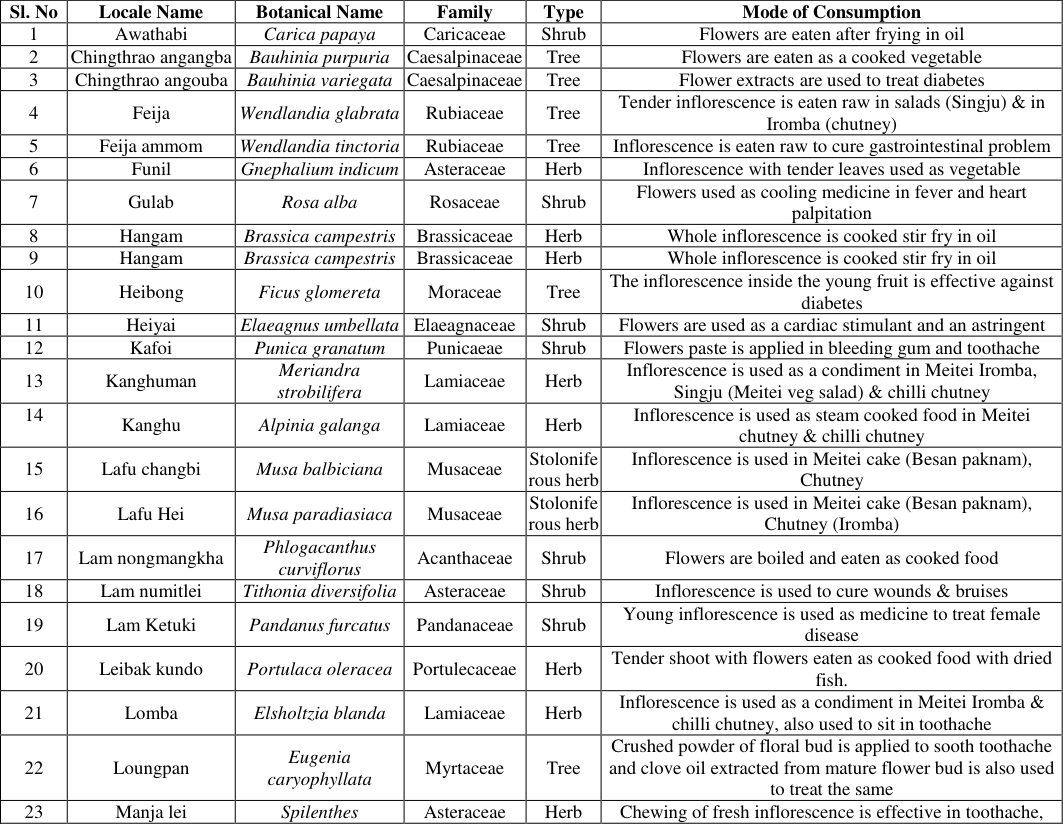 Table 1
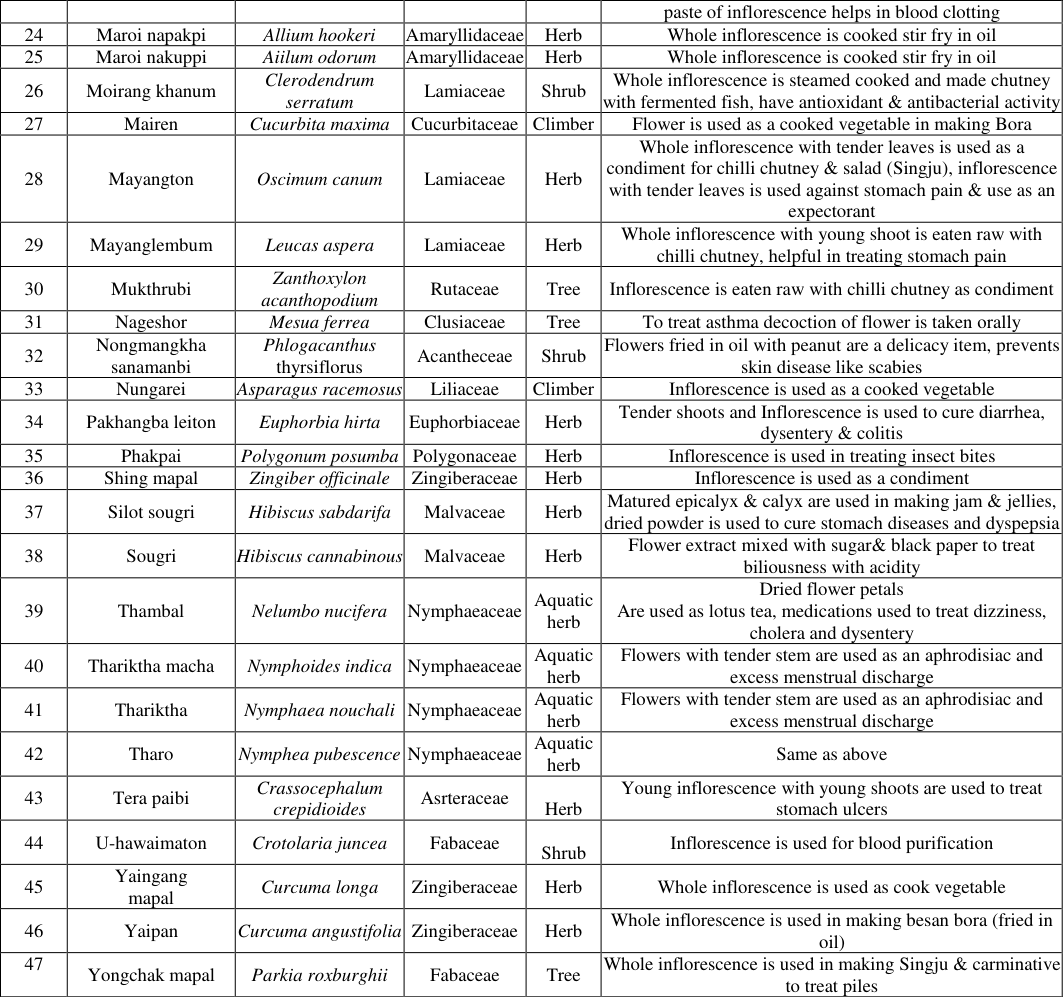 Table 2
Introduction
Manipur was one of the oldest Monarchical Kingdom of the world, situated in the North-East India, having a written history of about 2000 years since Nongda Lairen Pakhangba, the first King of Manipur from the Ningthouja Dynasty. The majority indigenous people are the Meiteis and other 35 schedule tribes have many traditional foods and medicinal plants. The current study will present the traditional flowers used by the Meiteis as food and as medicinal value to treat different ailments. There is documentation by A. Nirmala Devi et al. [1] of 58 traditional food plants, 61 plant species which have medicinal value and 17 plants are used in religious rituals of Meiteis of Manipur. Manipur is included under the Indo -Burma Biodiversity Hot Spot of Northeast region out of the 36 selected Biodiversity Hot Spot of the World indicating high concentration of endemic species of plants (H. Tombi Singh, 2009) [20] and rich in biodiversity consisting of a large number of non-conventional food plants and medicinal plants. The total geographical area of Manipur is 22327 Km 2 located between 23 0 51' North to 25 0 41' N Latitude and 93 0 3'E to 94 0 6'E Longitude. Manipur in its distinctive geographical features and varied agro climatic condition inhabited by different people of multicultural society, has a very rich resource of plants with vast potential for uplifting the socioeconomic condition of the people by growing various economic plants, Singh S. Sukumar [7] . North American Botanist John Willium Harshburger [5] (1895) while he was teaching at the University of Pensylvania to describe the studies of Ethnomedicinal plants which are also described by Ballic and Cox [2] (1996) as "Plants used by primitive and aboriginal people". Since time immemorial, there is knowledge of using plant parts like bark, leaves, roots, and flowers as medicine and food to get the nutrient supplement in their daily diet, Singh H. B., Singh R. S. and Sandhu J. S. ( 2003) [14] . The present studies highlight the useful botanical information about the use flowers by Meiteies as traditional food and plants which have medicinal value in treating different diseases. According to Rocky [10] , T. Amita H, S. Zimisai T. Chanu Anel et al. this traditional system of health care and treatment of ailments through herbal medicine has been very popular and significant in the state, so much that the herbal medicines have become essential ingredients in food items of the Meiteis. Meiteis of Manipur extensively used plants in the treatment of various ailments since time immemorial. Sporadic mention on the uses of plants as medicine could be found in the folklore of Manipur. The Royal Chronicle of Manipur (locally known as Cheitharol Kumbaba) do have records of uses of few plants as medicines of Meitei community, Sharma, H.M., A. Radhapyari & B. Manihar Sharma [13] . This knowledge of herbal medicine of flower as well as food is still continuing by urban people and rural people.
Methodology
An extensive field work has been carried out at different seasons round the year. Related litterateurs were also used for reference to this subject. From key informants collected the data through oral questioning and discussion. Vegetable sellers in the local marketplaces were also key informants.
Other key informants are elderly locale people, experience herbal practitioners (Maibas), Panji (religious astrologers), Arangfam (attendants of rites and rituals), Brahman (Hindu priests) and authorized attendants (Amaiba and Amaibis) of the ancestral deities (Umanglai). The present study was conducted by adopting a mixed method approach of scientific observation, photography, plant species inventory and in-depth interview of key informants.
Results and Discussion
About forty-seven (47) plants documented in this study, nineteen (19) plants are found edible as food and about eighteen (18) plants are found to have medicinal values which are used to treat many ailments of human being. Ten (10) plants are both edible as food and have medicinal value. Altogether, there are a documentation of forty-seven (47) plant species belonging to twenty-six (26) different families. Maximum number of plants six (6) is found in the family Lamiaceae. Second maximum four (4) is found in the family Nymphaeaceae. Third maximum three (3 each) is found in the families Zingiberaceae and Asteraceae. The flowers are consumed as raw or cooked wholly or partly according to species. The flowers may be cooked with other conventional vegetables and with meat or fish. Meiteis are more inclined to eat with fish. In the local vegetable market different wild vegetable flowers are sold in different season. This will also solve the problem of scarcity of food due to population explosion. The wild flowers are mostly collected from the forest. They are low cost and have great socioeconomic significance for most of the indigenous people as they are food for survival, to add nutrition and some are used as medicine to treat a different ailment. The Plants and flowers are tabulated with their local names, botanical names, families, habitat, plant part used and their uses in table 1. In table 2 pictures of edible flowers and prepared food.
| — | — | — | — | — | paste of inflorescence helps in blood clotting |
|---|---|---|---|---|---|
| 24 | Maroi napakpi | Allium hookeri | Amaryllidaceae | Herb | Whole inflorescence is cooked stir fry in oil |
| 25 | Maroi nakuppi | Aiilum odorum | Amaryllidaceae | Herb | Whole inflorescence is cooked stir fry in oil |
| 26 | Moirang khanum | Clerodendrum serratum | Lamiaceae | Shrub | Whole inflorescence is steamed cooked and made chutney with fermented fish, have antioxidant & antibacterial activity |
| 27 | Mairen | Cucurbita maxima | Cucurbitaceae | Climber | Flower is used as a cooked vegetable in making Bora |
| 28 | Mayangton | Oscimum canum | Lamiaceae | Herb | Whole inflorescence with tender leaves is used as a condiment for chilli chutney & salad (Singju), inflorescence with tender leaves is used against stomach pain & use as an expectorant |
| 29 | Mayanglembum | Leucas aspera | Lamiaceae | Herb | Whole inflorescence with young shoot is eaten raw with chilli chutney, helpful in treating stomach pain |
| 30 | Mukthrubi | Zanthoxylon acanthopodium | Rutaceae | Tree | Inflorescence is eaten raw with chilli chutney as condiment |
| 31 | Nageshor | Mesua ferrea | Clusiaceae | Tree | To treat asthma decoction of flower is taken orally |
| 32 | Nongmangkha sanamanbi | Phlogacanthus thyrsiflorus | Acantheceae | Shrub | Flowers fried in oil with peanut are a delicacy item, prevents skin disease like scabies |
| 33 | Nungarei | Asparagus racemosus | Liliaceae | Climber | Inflorescence is used as a cooked vegetable |
| 34 | Pakhangba leiton | Euphorbia hirta | Euphorbiaceae | Herb | Tender shoots and Inflorescence is used to cure diarrhea, dysentery & colitis |
| 35 | Phakpai | Polygonum posumba | Polygonaceae | Herb | Inflorescence is used in treating insect bites |
| 36 | Shing mapal | Zingiber officinale | Zingiberaceae | Herb | Inflorescence is used as a condiment |
| 37 | Silot sougri | Hibiscus sabdarifa | Malvaceae | Herb | Matured epicalyx & calyx are used in making jam & jellies, dried powder is used to cure stomach diseases and dyspepsia |
| 38 | Sougri | Hibiscus cannabinous | Malvaceae | Herb | Flower extract mixed with sugar& black paper to treat biliousness with acidity |
| 39 | Thambal | Nelumbo nucifera | Nymphaeaceae | Aquatic herb | Dried flower petals Are used as lotus tea, medications used to treat dizziness, cholera and dysentery |
| 40 | Thariktha macha | Nymphoides indica | Nymphaeaceae | Aquatic herb | Flowers with tender stem are used as an aphrodisiac and excess menstrual discharge |
| 41 | Thariktha | Nymphaea nouchali | Nymphaeaceae | Aquatic herb | Flowers with tender stem are used as an aphrodisiac and excess menstrual discharge |
| 42 | Tharo | Nymphea pubescence | Nymphaeaceae | Aquatic herb | Same as above |
| 43 | Tera paibi | Crassocephalum crepidioides | Asrteraceae | Herb | Young inflorescence with young shoots are used to treat stomach ulcers |
| 44 | U-hawaimaton | Crotolaria juncea | Fabaceae | Shrub | Inflorescence is used for blood purification |
| 45 | Yaingang mapal | Curcuma longa | Zingiberaceae | Herb | Whole inflorescence is used as cook vegetable |
| 46 | Yaipan | Curcuma angustifolia | Zingiberaceae | Herb | Whole inflorescence is used in making besan bora (fried in oil) |
| 47 | Yongchak mapal | Parkia roxburghii | Fabaceae | Tree | Whole inflorescence is used in making Singju & carminative to treat piles |
Table text extracted from the original PDF; superscript letters are shown inline. The original table image is below.
View original table image
| Sl. No | Locale Name | Botanical Name | Family | Type | Mode of Consumption |
|---|---|---|---|---|---|
| 1 | Awathabi | Carica papaya | Caricaceae | Shrub | Flowers are eaten after frying in oil |
| 2 | Chingthrao angangba | Bauhinia purpuria | Caesalpinaceae | Tree | Flowers are eaten as a cooked vegetable |
| 3 | Chingthrao angouba | Bauhinia variegata | Caesalpinaceae | Tree | Flower extracts are used to treat diabetes |
| 4 | Feija | Wendlandia glabrata | Rubiaceae | Tree | Tender inflorescence is eaten raw in salads (Singju) & in Iromba (chutney) |
| 5 | Feija ammom | Wendlandia tinctoria | Rubiaceae | Tree | Inflorescence is eaten raw to cure gastrointestinal problem |
| 6 | Funil | Gnephalium indicum | Asteraceae | Herb | Inflorescence with tender leaves used as vegetable |
| 7 | Gulab | Rosa alba | Rosaceae | Shrub | Flowers used as cooling medicine in fever and heart palpitation |
| 8 | Hangam | Brassica campestris | Brassicaceae | Herb | Whole inflorescence is cooked stir fry in oil |
| 9 | Hangam | Brassica campestris | Brassicaceae | Herb | Whole inflorescence is cooked stir fry in oil |
| 10 | Heibong | Ficus glomereta | Moraceae | Tree | The inflorescence inside the young fruit is effective against diabetes |
| 11 | Heiyai | Elaeagnus umbellata | Elaeagnaceae | Shrub | Flowers are used as a cardiac stimulant and an astringent |
| 12 | Kafoi | Punica granatum | Punicaeae | Shrub | Flowers paste is applied in bleeding gum and toothache |
| 13 | Kanghuman | Meriandra strobilifera | Lamiaceae | Herb | Inflorescence is used as a condiment in Meitei Iromba, Singju (Meitei veg salad) & chilli chutney |
| 14 | Kanghu | Alpinia galanga | Lamiaceae | Herb | Inflorescence is used as steam cooked food in Meitei chutney & chilli chutney |
| 15 | Lafu changbi | Musa balbiciana | Musaceae | Stolonife rous herb | Inflorescence is used in Meitei cake (Besan paknam), Chutney |
| 16 | Lafu Hei | Musa paradiasiaca | Musaceae | Stolonife rous herb | Inflorescence is used in Meitei cake (Besan paknam), Chutney (Iromba) |
| 17 | Lam nongmangkha | Phlogacanthus curviflorus | Acanthaceae | Shrub | Flowers are boiled and eaten as cooked food |
| 18 | Lam numitlei | Tithonia diversifolia | Asteraceae | Shrub | Inflorescence is used to cure wounds & bruises |
| 19 | Lam Ketuki | Pandanus furcatus | Pandanaceae | Shrub | Young inflorescence is used as medicine to treat female disease |
| 20 | Leibak kundo | Portulaca oleracea | Portulecaceae | Herb | Tender shoot with flowers eaten as cooked food with dried fish. |
| 21 | Lomba | Elsholtzia blanda | Lamiaceae | Herb | Inflorescence is used as a condiment in Meitei Iromba & chilli chutney, also used to sit in toothache |
| 22 | Loungpan | Eugenia caryophyllata | Myrtaceae | Tree | Crushed powder of floral bud is applied to sooth toothache and clove oil extracted from mature flower bud is also used to treat the same |
| 23 | Manja lei | Spilenthes | Asteraceae | Herb | Chewing of fresh inflorescence is effective in toothache, |
Table text extracted from the original PDF; superscript letters are shown inline. The original table image is below.
View original table image
Conclusion
From the above studies and discussion, it can be concluded that the flowers of many plants mainly wild plants are found edible in many forms of preparation by the indigenous people Meiteis. The knowledge of availability of wild plants and with the nutritious values will help to solve the scarcity of food which is one of the major problems throughout the globe due to population explosion. Some plants are also found to have medicinal value to treat different ailments. Nowadays, herbal medicines are regarded as safer for health than the allopathic medicines. With these knowledges about the edible and medicinal flowers need to be disseminated among more people around the world. Collecting and selling of the above documented plants there will be upgrade of socioeconomic condition among folk. Further investigation about the phytochemical analysis of the edible flowers will throw more light in the consumption and use as medicine to many people.
Acknowledgement
First of all, I would like to express my heartiest gratitude sincere thanks to S. Samungou Singh, a local medical practitioner who helped me with documentation of flowers which have medicinal value. Secondly, I would like to thank some imma (mother) vegetable sellers of Ima Market, the market run only by women, Panji (Religious astrologers), Arangfam (Attendants of rites and rituals), Brahman (Hindu priests) and authorized attendants (Amaiba and Amaibis) of the ancestral deities (Umanglai).
References
7 in the original paper- Devi AN, Geetabali L, Bijaya N. The traditional food of meiteis from the aspects of medicine, cultural, spiritual and social value. Journal of Agriculture and Ecology. 2023;16S:55-63.
- Harshberger JW. The Purposes of Ethno-hotany' In. Botanical Gazette. 1896;21(3):146-154.
- Hedge GT, Bhat DM. Wild plant species used in Hindu Festivals: A case study from Uttarakhand District, Western Ghats, South India. Center for Ecological Sciences, Indian Institute of Sciences, Bengaluru, India. Life Sciences Leaflets. 2012;3:1-6.
- Tiwari AK, Choudhary IJ, Pandey. Indian Traditional Trees and Their Scientific Relevance, Journal of Medicinal Plant Studies. 2019;7(3):29-32.
- Niroula G, Singh NB. Religion and Conservation: A Review of Use and Protection of Sacred Plants and Animals in Nepal, Journal of Institute of Science and Technolog. 2015;20(2):61-66.
- Sharma HM, Devi AR, amp Sharma BM. Ethnomedicinal use of Monocotyledonous Plants of Meiteies of Manipur, in: Ethnobotany and Medicinal Plants of India and Nepal, Eds V. Singh, A.P. Jain. 2003;1:473-484.
- Singh KI, Singh PK, Singh SS. An Ethnobiological approach to the indigenous soaps and detergents of Meitei community of Manipur. Journal Economic Taxonomy of Botany. 2002;25(3):547-552.