
Research article · 2023 · Full text
International Journal of Biology SciencesAqueous extract of Strychnos pseudoquina exhibits no mutagenicity but shows increased mutagenicity upon interaction with sodium azide
Volume 5(2) · Pages 47–50 · DOI: 10.33545/26649926.2023.v5.i2a.170 ↗
Research areasPlant-based Medicinal ResearchPlant Pathogenic Bacteria StudiesPhytochemistry and biological activities of Ficus species
Abstract
Author-writtenThe infusion of Strychnos pseudoquina leaves and bark has been used in folk medicine to treat fevers, malaria, liver and stomach conditions, and anemia. Despite its popular use, the mutagenic effects of S. pseudoqunia are unclear. It is important to note that species of this same genus are generally classified as both toxic and mutagenic. The present study evaluated the mutagenic and antimutagenic potential of an aqueous extract of S. pseudoquina bark using the Ames test in Salmonella typhimurium. The concentrations of 0.62, 1.25, 2.5, 5, and 10 mg/plate of S. pseudoquina were evaluated. The results revealed the absence of mutagenicity and antimutagenicity for all tested concentrations of S. pseudoquina, suggesting the potential medicinal value for this plant. Importantly, S. pseudoquina solution can interact with other drugs. We observed that the aqueous extract of S. pseudoquina bark increased the mutagenicity of sodium azide in S. typhimurium by as-yet unknown components and mechanisms. Thus, despite not having mutagenic or antimutagenic actions, the use in association with other drugs may bring unwanted effects. Further scientific data are required to guide clinical practice and safeguard the welfare of users.
Summary
Source-checkedPlain-language reading of the full paper, prepared with AI and checked against the text. Each point links to the authors' own words.
Why it matters
- Strychnos pseudoquina is a plant native to the Brazilian Cerrado used in traditional medicine to treat conditions such as malaria, anemia, and fevers. View evidence ↗
- While used medicinally, other species within the Strychnos genus are typically considered toxic and mutagenic, raising safety concerns. View evidence ↗
- The use of S. pseudoquina preparations currently lacks a scientific basis regarding their safety and efficacy. View evidence ↗
The question
- The study aimed to evaluate whether an aqueous extract of S. pseudoquina bark possesses mutagenic or antimutagenic properties using the Ames test. View evidence ↗
What they did
- The aqueous extract was prepared by heating 60 g of macerated bark in 1 liter of water, following popular usage recommendations. View evidence ↗
- The researchers used the Salmonella typhimurium TA-100 bacterial strain as the indicator species for the bioassay. View evidence ↗
- The experiment tested five different concentrations of the extract: 0.62, 1.25, 2.5, 5, and 10 mg/ml. View evidence ↗
- The study utilized distilled water as a negative control and sodium azide as a positive control. View evidence ↗
What they found
- None of the tested doses of S. pseudoquina showed significant mutagenic activity when compared to the negative control. View evidence ↗
- The aqueous extract of S. pseudoquina potentiated the mutagenic effect of sodium azide, with negative percent inhibition (PI) indicating increased mutagenicity at higher doses. View evidence ↗
- When combined with the positive control, the 1.25 mg/plate dose of S. pseudoquina resulted in a percent inhibition of -28%, indicating an increase in revertant colonies. View evidence ↗
- The 5 mg/plate dose combined with the positive control also showed a percent inhibition of -28%, further demonstrating the potentiating effect on mutagenicity. View evidence ↗
What it means
- The authors conclude that the lack of inherent mutagenicity or antimutagenicity suggests the plant may have medicinal value. View evidence ↗
- The authors warn that using S. pseudoquina in association with other drugs may lead to unwanted effects due to its ability to potentiate other mutagens. View evidence ↗
- The study is limited by its use of bacterial cells; the authors state that research on eukaryotic cells and mammalian models is necessary. View evidence ↗
- The specific components and mechanisms responsible for the potentiating effect on sodium azide remain unknown and require further study. View evidence ↗
Visual summary
2 visualsIllustrations explain the paper; charts are replotted from the paper's own table values.
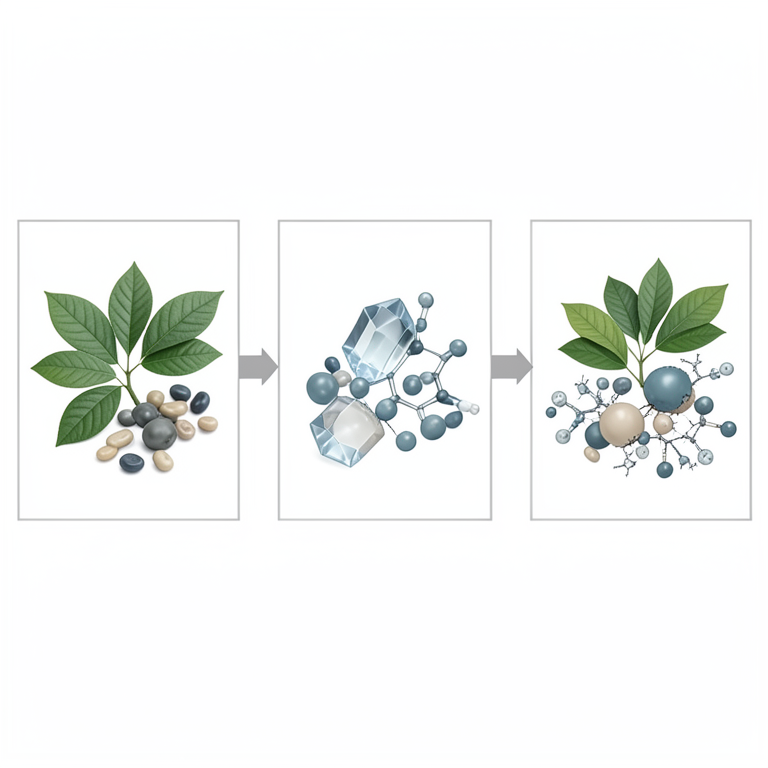
Synergistic Mutagenicity Concept
AI-generated conceptual illustration (Strychnos pseudoquina plant leaves and Salmonella typhimurium bacteria). It explains the idea and does not show study data.
View source evidence ↗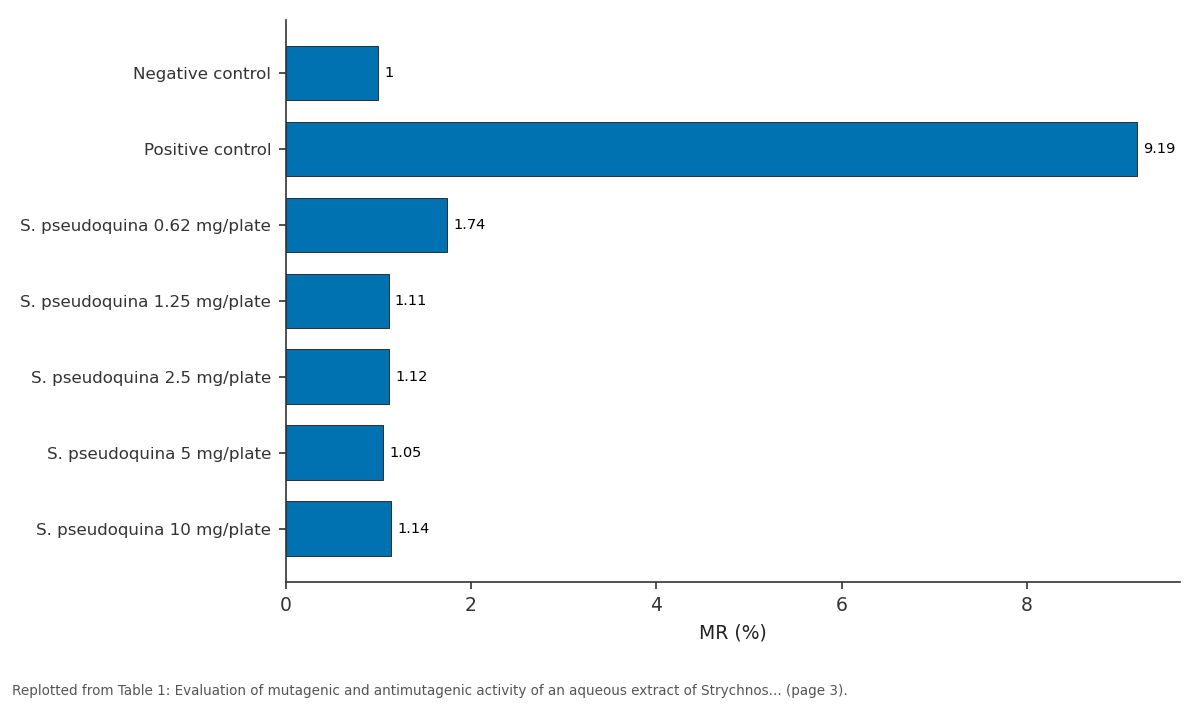
MR (%): Negative control vs Positive control vs S. pseudoquina 0.62... vs S. pseudoquina 1.25... vs S. pseudoquina 2.5...
Replotted from Table 1 (page 3) of the original paper. Every bar is the paper's own table value.
View source evidence ↗Figures & tables
From the original paper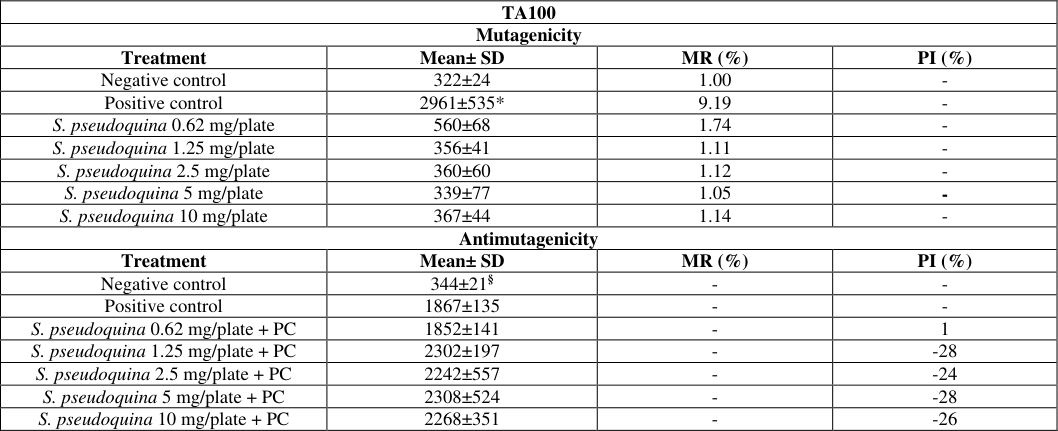 Table 1
Introduction
Many plant species have been used in folk medicine for the treatment and prevention of various human diseases (Al-Asmari et al. 2014) [1] . Despite their therapeutic advantages, the toxic potential of medicinal plants and their dosages are not always recognized by the general public or by many professional groups in traditional medicine (Soetan and Aiyelaagbe 2009) [23] . Thus, mismanagement during therapy could be harmful to health. The genotoxic, mutagenic, and carcinogenic potential of medicinal plants has been a subject of great concern in the scientific community, especially regarding bioactive components found in natural products. In contrast, many plant extracts also have antimutagenic activity against the mutagenic influences of endogenous or exogenous agents and guarantee the integrity of DNA (Burcham 1999; Ribeiro and Salvadori 2003) [6,19] . This process takes place through DNA repair mechanisms, damage tolerance, cell cycle checkpoints, and cell death pathways (Jackson and Bartek 2009) [13] . A widely used species in folk medicine is Strychnos pseudoquina A. St.-Hil., popularly known as falsa-quina, quina-branca, and/or Quina-do-cerrado. The plant is native to the Brazilian Cerrado. Ethnobotanical evidence has indicated the use of S. pseudoquina to treat intermittent fevers, malaria, liver and stomach conditions, and anemia (Brandão and Rapini 2018). The leaves and stem bark are main plant parts used in traditional medicine, either through infusions or as powder (De Saint-Hilaire 2009) [8] . However, their use is based only on popular knowledge and traditions, with no scientific basis on the efficacy and safety of the preparations (De Saint-Hilaire 2009) [8] .
The genus Strychnos, to which S. pseudoquina belongs, has phytocompounds with powerful toxicity and mutagenicity (Bonamin et al. 2011) [4] . This toxicity is mainly due to the presence of some alkaloids. However, despite their genotoxic properties, antioxidant and antimutagenic substances, such as flavonoids, are also present (Jurado et al. 1991) [14] , and, even though rare, their toxicity and mutagenic capacity are also reported in the literature (Moreira et al. 2002) [16] . Most species of the genus Strychnos are genotoxic and data on their biological properties and chemical compositions is limited. Thus, data are needed to ensure efficacy and safety when using S. pseudoquina (Silva et al. 2005) [3,4,22,24] . This study evaluates the mutagenic and antimutagenic potential of an aqueous extract of S. pseudoquina by using the indicator species Salmonella typhimurium in the Ames test bioassay. The main advantages of this bioassay are its simplicity, cost-effectiveness, flexibility, and large database of validated data. The test also allows the evaluation of various concentrations and determination of the doseresponse relationship (Mortelmans and Zeiger 2000) [17,26] . This assay is used to provide safety data in the use of medicinal plants (Sturbelle et al. 2010) [25] . This is important, since the use of mutagenic substances can increase or accelerate the mutation rate, leading to the development of neoplasms (Ribeiro et al. 2003) [19] .
Materials and Methods
Materials and Methods
S. pseudoquina
The S. pseudoquina barks were purchased from Chá e Cia -Ervas Medicinais (Jacareí, Brazil). The product is, produced and distributed by J T F Produtos Naturais (São José dos Campos, Brazil; batch: 022021). An aqueous extract of the barks of Quina-do-cerrado (S. pseudoquina) was prepared according to the manufacturer's directions for popular use. To prepare the aqueous extract, 60 g of macerated bark was added to 1 l of water, which is equivalent to the manufacturer's recommended dose of two tablespoons in 1 l of water. The mixture was placed in a container and heated to the boiling point. The container was then covered for 10 min. The mixture was then ready for use. For the tests, five concentrations were used: 0.62, 1.25, 2.5, 5, and 10 mg/ml.
Bacterial strain
S. typhimurium TA-100 was the bacterial strain used. The strain was provided by the Laboratory of Radiobiology and Mutagenesis, Federal University of Goiás, Campus Samambaia, Goiânia-Goiás, Brazil.
Experimental procedure
Evaluation of mutagenic and antimutagenic activities S. typhimurium TA100 was inoculated in sterile nutrient broth and incubated for 12 h at 37 °C in a water bath under constant agitation until reaching the stationary phase of growth. To evaluate the mutagenic activity, aliquots of 100 µl of the bacterial strain cultures were incubated with 0.62, 1.25, 2.5, 5, and 10 mg/plate of S. pseudoquina for 25 min at 37 °C in triplicate test tubes under constant agitation. Negative (20 µl autoclaved distilled water) and positive (20 µl sodium azide) controls were also included in the experiments. To evaluate the antimutagenic activity, the positive control was co-administered with the different doses of S. pseudoquina. After incubation, liquid glucose agar (top-agar) containing a histidine/biotin solution (0.5 mM) was added at a temperature of 45 °C. The content was vortexed and then poured into petri dishes containing solid medium (minimal glucose agar). Triplicate preparations of each sample and control were incubated at 37 °C for 48 h in a biochemical oxygen demand incubator. After this period, revertant colonies were enumerated using an electronic counter. The mean of the triplicate values was reported (Maron and Ames 1983; Mortelmans and Zeiger 2000) [15,17,26] .
Evaluation parameters Mutagenesis and antimutagenesis
For evaluating the mutagenicity of S. pseudoquina, the mutagenicity ratio (MR) was calculated for all tested doses, using the following equation:
MR = number of revertants/test sample plate number of revertants/negative control plate
The test is considered positive for mutagenicity when the number of revertant colonies on the test plates is equal to or greater than twice the number of spontaneous revertant colonies of the negative control (Maron and Ames 1983) [15] . The percent inhibition (PI) was calculated using the following equation:
number of revertants on test plate -RE number of revertants on positive control plate -RE )] × 100
Where test plate refers to plates incubated with mutagen and compound, number of revertants of test plate refers to histidine positive revertants, number of revertants on positive control plate refers to plates incubated with mutagen only, and RE: spontaneous revertants refer to test strains incubated in the absence of compound and mutagen.
Statistical analyses
Statistical analyses of the data from the Ames test were performed using BioEstat version 5.3 software (Ayres et al.
2007) [2] . The Shapiro-Wilk normality test was used to determine the best statistical analysis method to be applied, considering p>0.05 and samples with a normal distribution. Analysis of variance (ANOVA) test was then used to determine possible significant differences between means. Finally, the Tukey's post-hoc test was performed to identify groups with significant differences (p<0.05). For the Ames test, after counting the number of revertants and calculating the MR for each dose and PI, the mutagenicity and antimutagenicity parameters were considered (p<0.05 compared to the negative and positive control, respectively).
Results
Table 1 presents the results of the evaluation of mutagenic and antimutagenic activity of S. pseudoquina by the Ames test.
| TA100 | — | — | — |
|---|---|---|---|
| Mutagenicity | |||
| Treatment | Mean± SD | MR (%) | PI (%) |
| Negative control | 322±24 | 1.00 | - |
| Positive control | 2961±535* | 9.19 | - |
| S. pseudoquina 0.62 mg/plate | 560±68 | 1.74 | - |
| S. pseudoquina 1.25 mg/plate | 356±41 | 1.11 | - |
| S. pseudoquina 2.5 mg/plate | 360±60 | 1.12 | - |
| S. pseudoquina 5 mg/plate | 339±77 | 1.05 | - |
| S. pseudoquina 10 mg/plate | 367±44 | 1.14 | - |
| Antimutagenicity | |||
| Treatment | Mean± SD | MR (%) | PI (%) |
| Negative control | 344±21§ | - | - |
| Positive control | 1867±135 | - | - |
| S. pseudoquina 0.62 mg/plate + PC | 1852±141 | - | 1 |
| S. pseudoquina 1.25 mg/plate + PC | 2302±197 | - | -28 |
| S. pseudoquina 2.5 mg/plate + PC | 2242±557 | - | -24 |
| S. pseudoquina 5 mg/plate + PC | 2308±524 | - | -28 |
| S. pseudoquina 10 mg/plate + PC | 2268±351 | - | -26 |
Table text extracted from the original PDF; superscript letters are shown inline. The original table image is below.
View original table image
The different doses of S. pseudoquina showed no significant difference (p>0.05) compared to the negative control in mutagenic activity. The result indicated the lack of mutagenic potential of S. pseudoquina aqueous extract at doses of 0.62, 1.25, 2.5, 5, and 10 mg/plate. In the antimutagenic evaluation, S. pseudoquina did not significantly reduce (p>0.05) the number of S. typhimurium colonies when compared to the positive control (20 µg/plate of sodium azide) in any of the tested doses. The result indicating that aqueous extract of S. pseudoquina bark does not provide protection to bacterial DNA.
Discussion and Conclusion
The x`present study evaluated the mutagenic and antimutagenic activity of S. pseudoquina. Our results reveal the lack of mutagenic activity for S. typhimurium TA100. Corroborating this data, Nunes (2008) [11,18] tested the ethanolic extract of the bark in the Ames mutagenicity test using S. typhimurium TA98 and TA100, and reported no mutagenic activity at the tested doses. In contrast, Gontijo et al. (2020) [10,11] evaluated the mutagenicity of leaves and bark of S. pseudoquina by the Ames test, and found that both displayed mutagenic potential. The absence of S. pseudoquina mutagenic activity and toxicity on S. typhimurium at the tested doses provide evidence of the potential medicinal value of aqueous extracts for humans. However, knowledge of the effect of S. pseudoquina on eukaryotic cells is still unknown. Studies with models that more closely mimic mammals, especially humans, are needed. Before being indicated for use, it is also necessary to determine the mechanisms of action of the bioactive compounds present in the aqueous extract of S. pseudoquina and the appropriate dosage for safe and effective use in humans. Another concern regarding the use of natural products is their drug interactions. Many potentially non-harmful substances can increase or decrease the activity of other drugs. Our results showed a potentiation of the action of the sodium azide mutagen in the presence of S. pseudoquina. The negative PI indicated increased mutagenic activity at the highest doses. Although the aqueous extract of S. pseudoquina barks lacked mutagenic and antimutagenic actions, the mutagenicity of sodium azide for S. typhimurium was increased. Similar results have been described for Vernonanthura polyanthes, Piper cubeba, Lycopersicon esculentum, and Tabebuia impetiginosa in Different experimental models (Dutra et al. 2009 [9] ; Sousa et al. 2009 [12,24] ; Rezende et al. 2011 [24] ; Barbosa et al. 2012 [3] ; Guerra-Santos et al. 2016) [12] . Plant extracts have multiple components that can exert mutagenic or antimutagenic effects alone or synergistically (Cai et al. 2004; Romero-Jiménez et al. 2005) [7,20] . Thus, the co-administration of herbal medicines and therapeutic drugs may pose clinical risks to patients and needs to be further investigated (Barbosa et al. 2012) [3] . The components and mechanisms used by plant species to potentiate the effect of mutagens have been poorly investigated. This study shows that the aqueous extract of S. pseudoquina bark can potentiate the mutagenic action of sodium azide by as-yet unknown components and mechanisms. Further studies are required to determine the substance(s) involved in this potentiating effect. These data are important, since understanding the components and mechanisms involved in herbal-drug interactions is essential for clinical risk assessment (Barbosa et al. 2012) [3] . Further studies are also needed to confirm the efficacy and/or risks of the use of this medicinal plant by humans and to discover alternatives for the rational use of this natural resource.
Acknowledgement
AcknowledgmentsThe authors thank Dr. Lee Chen and the Department of General Biology at the Institute of Biological Sciences at the Federal University of Goiás, Goiânia, Brazil, for providing the laboratory facilities to conduct the experiment. The authors have no conflicts of interest to declare.
References
21 in the original paper- Al-Asmari AK, Al-Elaiwi AM, Athar MT, Tariq M, Al Eid A, Al-Asmary SM. A review of hepatoprotective plants used in Saudi traditional medicine. Evidence-Based Complementary and Alternative Medicine. 2014;2014(1):890842.
- Barbosa LC, Dias de Morais M, De Paula CA, Da Silva Ferreira MC, Jordao AA, Andrade e Silva ML, et al. Mikania glomerata Sprengel (Asteraceae) influences the mutagenicity induced by doxorubicin without altering liver lipid peroxidation or antioxidant levels. Journal of Toxicology and Environmental Health. 2012;75(1617):1102-1109. http://dx.DOI.org/10.1080/152 87394.2012.697842.
- Bonamin F, Moraes TM, Kushima H, Silva MA, Rozza AL, Pellizzon CH, et al. Can a Strychnos species be used as antiulcer agent? Ulcer healing action from alkaloid fraction of Strychnos pseudoquina St. Hil. (Loganiaceae). Journal of Ethnopharmacology. 2011;138(1):47-52. DOI:10.1016/j.jep. 2011.08.020.
- Burcham PC. Internal hazards: baseline DNA damage by endogenous products of normal metabolism. Mutat Res. 1999;443(1-2):11-36. DOI:10.1016/s1383-5742(99)000083.
- Cai Z, Tsung EF, Marinescu VD, Ramoni MF, Riva A, Kohane IS. Bayesian approach to discovering pathogenic SNPs in conserved protein domains. Hum Mutat. 2004;24(2):178-84. DOI:10.1002/humu.20063.
- Dutra ES, Dias CD, Araújo BC De, Castro AJS, Nepomuceno JC. Effect of organic tomato (Lycopersicon esculentum) extract on the genotoxicity of doxorubicin in the Drosophila wing spot test. Genetics and Molecular Biology. 2009;32(1):133-137. DOI:10.1590/S1415-47572009005000008.
- Gontijo DC, Brandão GC, Gontijo PC, De Oliveira AB, Diaz MAN, Fietto LG, et al. Identification of phenolic compounds and biologically related activities from Ocotea odorifera aqueous extract leaves. Food Chemistry. 2017;230:618-626. DOI:10.1016/j.foodchem.2017.03.087.
- Gontijo DC, Nunes LG, Farias LM, Duarte MGR, Carvalho AF, Fietto LG, et al. Assessment of the phenolic content, mutagenicity and genotoxicity of ethanolic extracts of stem bark and leaves from Strychnos pseudoquina A. St.-hil. Drug and Chemical Toxicology. 2020;43(5):539-545. DOI:10.1080/01480545.2018.1515218.
- Guerra-Santos IJ, Rocha JD, Vale CR, Sousa WC, Teles AM, Chen-Chen L, et al. Vernonanthura polyanthes leaves aqueous extract enhances doxorubicin genotoxicity in somatic cells of Drosophila melanogaster and presents no antifungal activity against Candida spp. Brazilian Journal of Biology. 2016;76(4):928-936. DOI:10.1590/15196984.04615.
- Jackson SP, Bartek J. The DNA-damage response in human biology and disease. Nature. 2009;461(7267):10711078. DOI:10.1038/nature08467
- Jurado J, Alejandre-Durán E, Alonso-Moraga A, Pueyo C. Study on the mutagenic activity of 13 bioflavonoids with the Salmonella Ara test. Mutagenesis. 1991;6(4):289-95. DOI:10.1093/mutage/6.4.289.
- Maron DM, Ames BN. Revised methods for the Salmonella mutagenicity test. Mutation Research. 1983;113(3-4):173-215. DOI:10.1016/0165-1161(83)90010-9.
- Moreira RRD, Santos LE, Varella SD, Varanda EA, Vilegas W. Avaliação da atividade mutagênica do extrato etanólico bruto de Paepalanthus latipes (Eriocaulaceae) e dos compostos flavonoídicos 7-metoxilados relacionados. Rev bras farmacogn. 2002;12(1):11-19. https://DOI.org/10.1590/S0102-695X2002000100002.
- Mortelmans K, Zeiger E. The Ames Salmonella/microsome mutagenicity assay. Mutation Research. 2000;455:29-60. DOI:10.1016/s0027-5107(00)00064-6.
- Romero-Jiménez M, Campos-Sánchez J, Analla M, Muñoz-Serrano A, Alonso-Moraga A. Genotoxicity and anti-genotoxicity of some traditional medicinal herbs. Mutation Research. 2005;585(1-2):147-155. https://DOI.org/10.1016/j.mrgentox.2005.05.004.
- Shilkin ES, Boldinova EO, Stolyarenko AD, Goncharova RI, Chuprov-Netochin RN, Khairullin RF, et al. Translesion DNA Synthesis and Carcinogenesis. Biochemistry (Mosc). 2020;85(4):425-435. DOI: 10.1134/S0006297920040033.
- Silva MAD, Rafacho BPM, Lima CAH, Rocha LRM, Santos LCSD, Sannomiuya M, et al. Evaluation of Strychnos pseudoquina St. Hil. leaves extract on gastrointestinal activity in mice. Chemical and Pharmaceutical Bulletin. 2005;53(8):881-885. DOI:10.1248/cpb.53.881.
- Soetan KO, Aiyelaagbe OO. The need for bioactivitysafety evaluation and conservation of medicinal plants. A review. Journal of Medicinal Plants Research. 2009;3(5):324-328. Available at: https://academicjournals.org/article/article1380378053_So etan%20and%20Aiyelaagbe.pdf. Accessed on: 08 Mar; c2023.
- Sousa NC De, Rezende AAA De, Silva RMG Da, Guterres ZR, Graf U, Kerr WE, et al. Modulatory effects of Tabebuia impetiginosa (Lamiales, Bignoniaceae) on doxorubicin-induced somatic mutation and recombination in Drosophila melanogaster. Genetics and Molecular Biology. 2009;32(2):382-388. https://DOI.org/10.1590/S1415-47572009005000042.
- Sturbelle RT, Pinho DS De, Restani RG, Oliveira GR De, Garcias G De L, Martino-Roth M Da G. Avaliação da atividade mutagênica e antimutagênica da Aloe vera em teste de Allium cepa e teste de micronúcleo em linfócitos humanos binucleados. Rev bras farmacognosia. 2010;20(03):409-415. https://DOI.org/10.1590/S0102695X2010000300019.
- Zeiger E. The test that changed the world: The Ames test and the regulation of chemicals. Mutat Res Genet Toxicol Environ Mutagen. 2019;841:43-48. DOI:10.1016/j.mrgentox.2019.05.007.