
Research article · 2023 · Full text
International Journal of Agriculture and NutritionExploiting utilization potential of taro for diverse food products and improved farmer livelihood
Volume 5(2) · Pages 21–27 · DOI: 10.33545/26646064.2023.v5.i2a.125 ↗
Research areasPacific and Southeast Asian StudiesAgriculture and Rural Development Research
Abstract
Author-writtenTaro use is limited due to undiversified utilization options. Generating information on diverse household utilization options of improved taro cultivars and their commercially viable processed forms would boost uptake of newly release varieties. The objective was to assess the utilization potential of four improved taro varieties for diverse food products to ultimately increase their demand for increased production, trade and enhanced farmer’s livelihood. Sensory evaluation and corm dry matter content were determined. Flour RVA profiling, starch pasting properties and starch granule morphology were determined using rapid viscosity analysis and light microscopy, respectively. The taro varieties showed diverse food options and pasting properties. Their RVA profiles classification provided a practical guideline for food producers and breeders to select suitable varieties for further product development. These improved taro varieties, when promoted will significantly provide diversified utilization options of taro in Ghana for recovery of the taro industry for food and job security.
Summary
Source-checkedPlain-language reading of the full paper, prepared with AI and checked against the text. Each point links to the authors' own words.
Why it matters
- Taro is an ancient crop grown primarily for its edible corms and serves as a critical food security resource across Africa, Asia, the Pacific, and the Caribbean. View evidence ↗
- In Ghana, taro remains underutilized due to a lack of diverse processing options and the impact of taro leaf blight disease (TLBD). View evidence ↗
- To combat production declines and economic loss, four new taro varieties tolerant to TLBD were released for commercial use in Ghana. View evidence ↗
The question
- The study aimed to evaluate how four improved taro varieties could be used in various food products to increase demand, production, and farmer income. View evidence ↗
What they did
- The researchers tested four improved varieties (CRI-Huogbelor, CRI-Asempa, CRI-Agyenkwa, and CRI-Yen Anyawoa) against a farmer-preferred local variety. View evidence ↗
- Corm dry matter content was measured gravimetrically by drying samples at 60 °C for 72 hours. View evidence ↗
- A rapid viscosity analyzer (RVA) was used to determine the pasting properties of the taro flour and starch. View evidence ↗
What they found
- Dry matter content varied across samples, with the local variety having the highest (38.9%) and CRI-Huogbelor the lowest (33.0%). View evidence ↗
- In sensory tests, CRI-Agyenkwa was rated the best overall, despite some itchiness, while CRI-Huogbelor performed the worst. View evidence ↗
- Starch granule sizes differed by variety, ranging from the smallest in CRI-Yen anya woa (1-2.5 µm) to the largest in CRI-Asempa (3-10 µm). View evidence ↗
- CRI-Huogbelor exhibited the highest peak viscosity at 2970 centipoise, whereas the local variety had the lowest at 945 centipoise. View evidence ↗
- The local variety had the highest stability (0.98) and setback (1.5) ratios, while the lowest stability was in CRI-Huogbelor (0.65) and the lowest setback in CRI-Asempa (1.38). View evidence ↗
- All improved varieties were suitable for the tested food preparations, except CRI-Huogbelor, which was found unsuitable for making crispy chips. View evidence ↗
What it means
- The authors conclude that the improved varieties meet consumer preferences and industrial needs, and promoting them could revitalize the taro industry in Ghana, enhancing food and job security. View evidence ↗
Visual summary
3 visualsIllustrations explain the paper; charts are replotted from the paper's own table values.
Taro Value Chain Improvement
AI-generated conceptual illustration (Taro plants (Colocasia esculenta) and processed taro food products). It explains the idea and does not show study data.
View source evidence ↗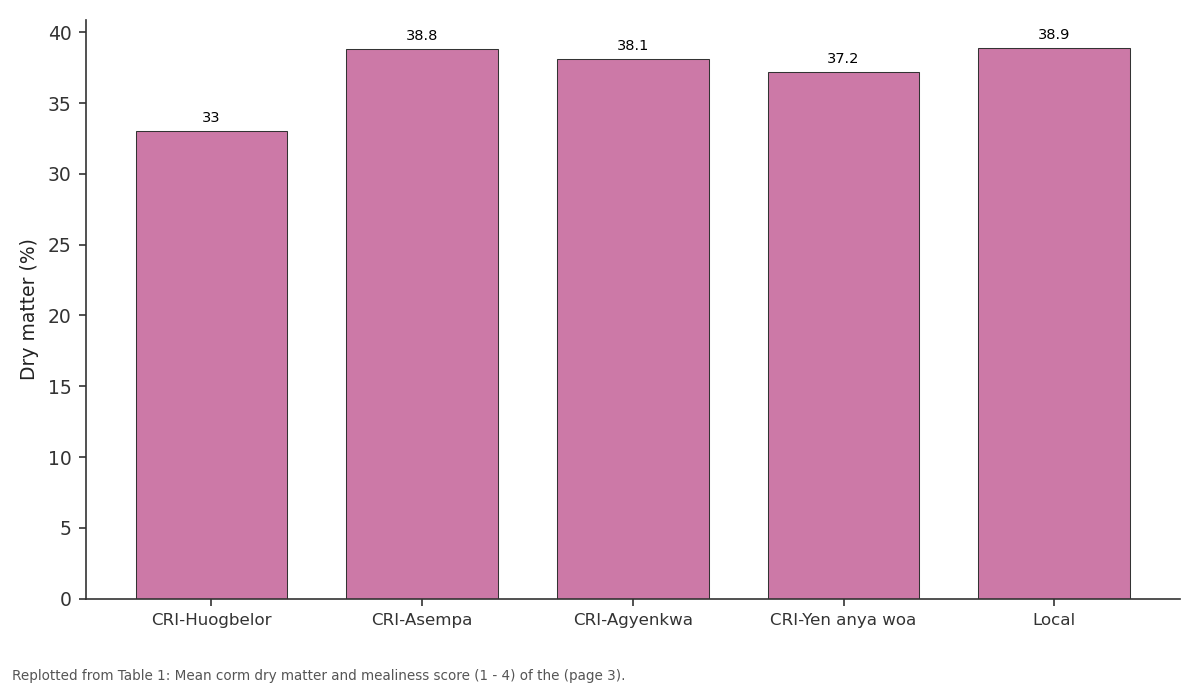
Dry matter (%): CRI-Huogbelor vs CRI-Asempa vs CRI-Agyenkwa vs CRI-Yen anya woa vs Local
Replotted from Table 1 (page 3) of the original paper. Every bar is the paper's own table value.
View source evidence ↗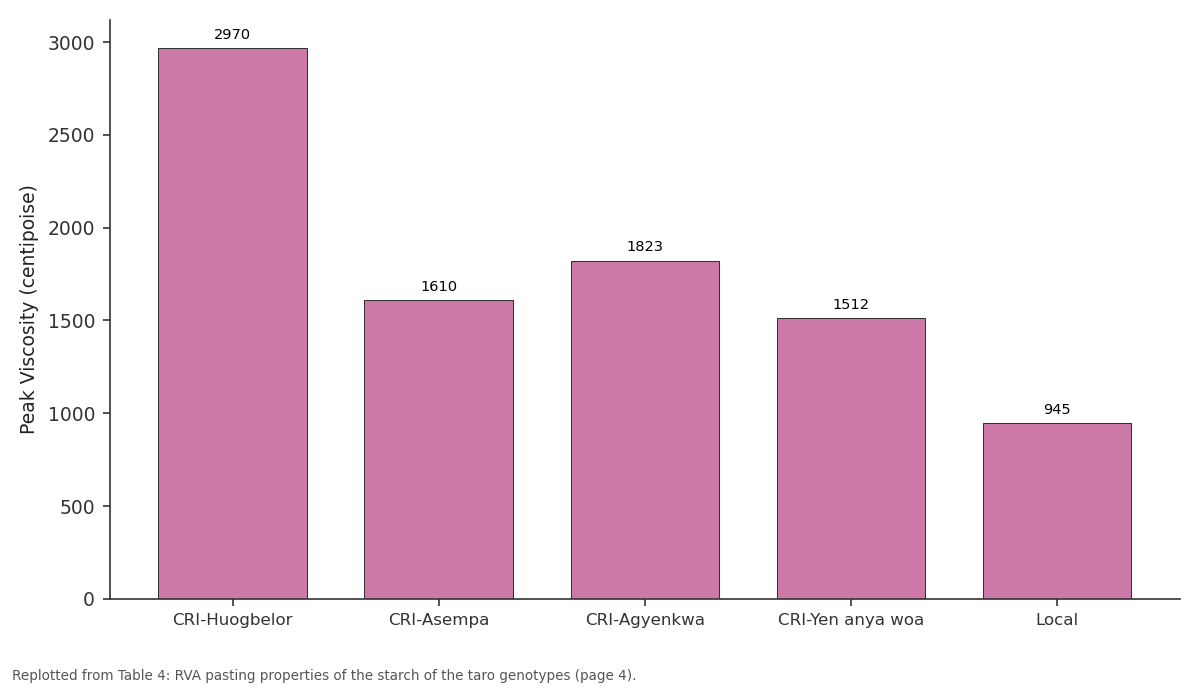
Peak Viscosity (centipoise): CRI-Huogbelor vs CRI-Asempa vs CRI-Agyenkwa vs CRI-Yen anya woa vs Local
Replotted from Table 4 (page 4) of the original paper. Every bar is the paper's own table value.
View source evidence ↗Figures & tables
From the original paper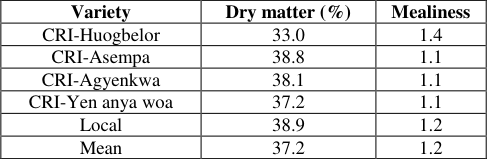 Table 1
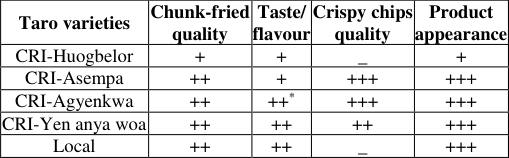 Table 2
 Table 3
 Table 4
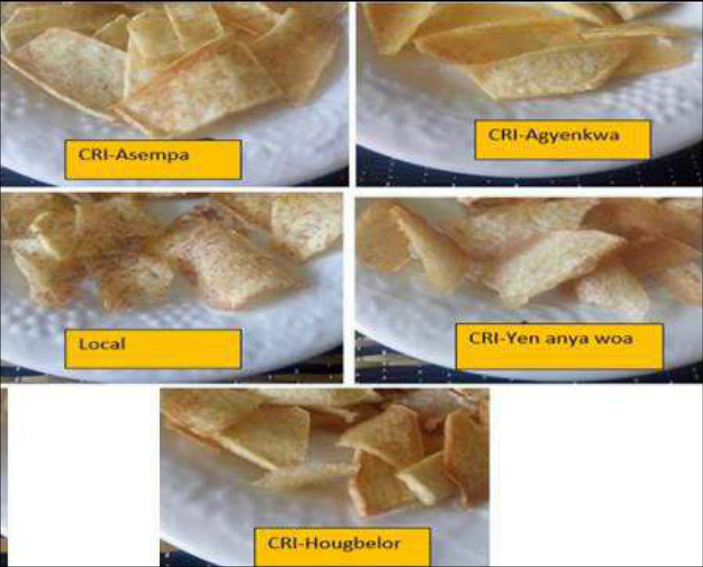 Plate 1
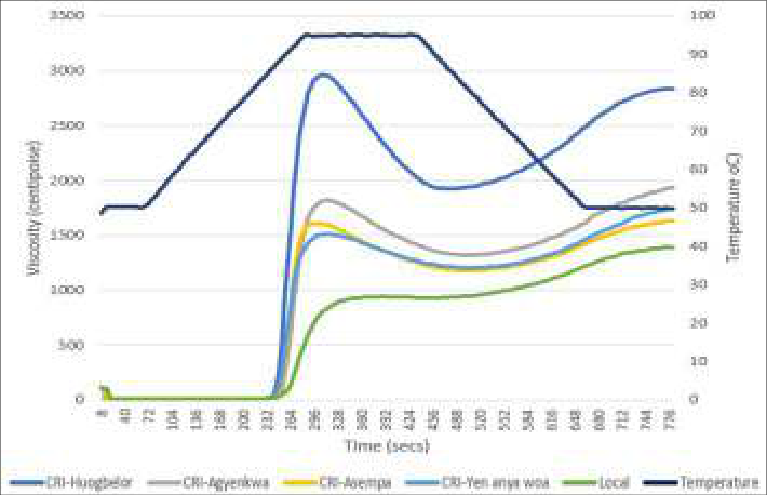 Figure 1
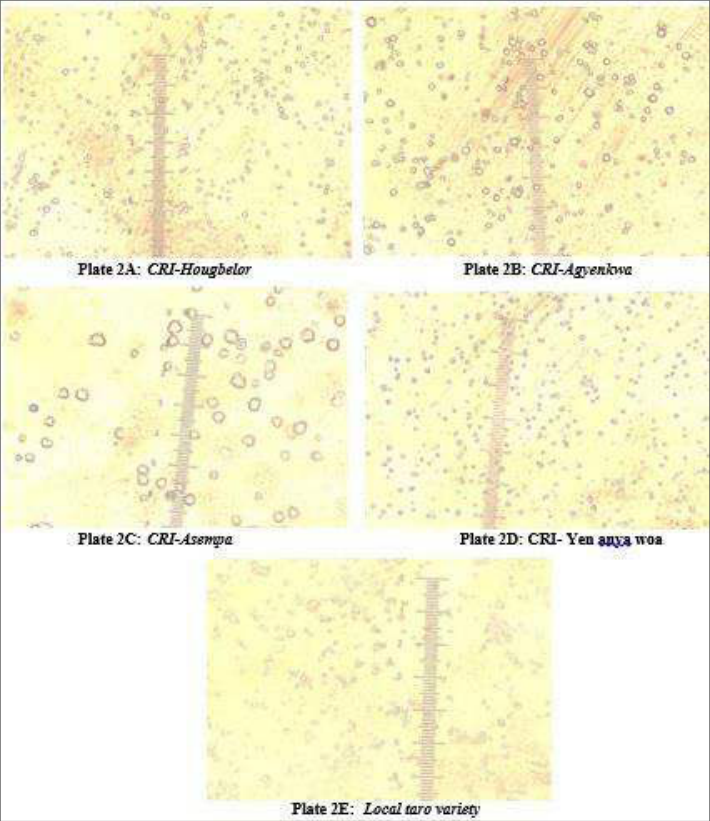 Plate 2
Introduction
Taro [Colocasia esculenta (L.) Schott] is a member of the Araceae family and subfamily Aroideae [1,2] . It is one of the oldest cultivated crops grown mainly for its edible corms [3][4][5][6] . Originating from Southeast Asia, it has spread globally as a significant food security crop in Africa, Asia, the Pacific, and the Caribbean [7,8] . The corms, leaves and petioles are used as a vegetable [9] . In addition to being rich in carbohydrate and proteins, the crop has significant bioactive compounds like riboflavin, thiamine, phosphorus, iron, zinc, potassium, copper, manganese as well as vitamin B6 and vitamin C [10,11] . The corms are widely consumed in most parts of Africa in the form of fried, roasted or cooked products. It has medicinal value in reducing tuberculosis, ulcers, pulmonary congestion and fungal infection [12][13][14][15] . It is also rich in easily digestible starch as well as iron and zinc and is a specialty food for potentially allergic infants and persons suffering from gastro-intestinal disorders. Comparatively, it holds a considerable amount of starch more than potato or sweet potato [16] . The utilization potential of taro has not fully been exploited in Ghana despite its contribution to food and income security [17] . Limited utilization options and the outbreak of the taro leaf blight disease (TLBD) caused by Phytophthora colocasiae are key factors that have caused taro to remain an underutilised crop resource in Ghana. To avert the decline in production and utilization of taro as well as its dwindling contribution to rural and national economies, four improved taro varieties highly tolerant to the TLBD were released for commercial production and utilization in Ghana [18] . However, the utilization of the corms is limited [19] , due to undiversified utilization options as a result of lack of its value-added food forms. Thus, end-users have difficulty determining the most suitable attributes for a particular use. Bridging end-users' knowledge gap on utilization options of improved taro cultivars and their integration in agribusinesses would redeem taro as an underutilised resource for food, job and income security. The objective was to assess the utilization potential of four improved taro varieties for their suitability for diverse food products for increased production, trade and enhancement of farmer's livelihood.
Materials and Methods
This work was carried out at the CSIR-Crops Research Institute Postharvest Laboratory, Fumesua. A representative sample of corms (small, medium and large) of each variety was brought to the laboratory and processed for analysis within 48 h after harvest. The four improved taro varieties used were CRI-Huogbelor, CRI-Asempa, CRI-Agyenkwa, and CRI-Yen Anyawoa. A farmer preferred Local variety was used as check.
Sensory evaluation
Based on the approach of [20] , a representative sample of corms of all the improved varieties and the local variety were washed, peeled and cut into chunks of approximately equal size (9.7 x 4 cm). Ten chunks of each variety were placed in boiling water and cooked. The optimum cooking was determined by piercing through with a fork [21] . Five washed and peeled corms were also sliced and fried into crispy chips. The cooked samples were kept in food warmer containers to maintain a warm temperature to avoid wide variation in temperature during assessment. The assessment was done using focus group discussion consisting of consumers of varied age and educational background. All the samples were presented to the assessors in transparent plastic containers labelled with 3-digit codes. The order of sample presentation was completely randomized for different sets of the assessors, to rule out bias in order of presentation. Thirty trained assessors were involved. Assessment was based on product taste, flavour, overall quality and appearance. Chunk boiled samples (Ampesi) were scored using a scale of 1-4; where 1 -excellent, 2very good, 3good, and 4poor/bad. Processed product samples and their attributes were scored as excellent (+++), very good (++), good (+), and poor/bad (-). Data were analysed using simple means score.
Corm dry matter content determination
Corm dry matter content was determined gravimetrically as the remaining residue after drying [22] . Fresh corm samples of sizes small, medium and large were selected, washed thoroughly with clean tap water, and wiped with hard tissue. Samples were peeled and partitioned into four dimensions for each of the varieties of which the opposite sides were selected as a true representative sample. The representative samples were grated and 50 g each weighed into an already weighed and well labelled perforated envelopes in duplicates using an electronic scale of accuracy 0.1 mg. Samples were dried in a cabinet dryer at 60 °C for 72 h. Dried samples were allow to cool at room temperature for weighing. Dry matter content was determined as:
Determination of flour and starch pasting properties
Representative corm samples were washed with tap water and peeled. Peeled corm samples were grated, air-dried in an air oven at 60 ºC for 72 h, milled through 60-80 mesh screen using Cyclotec 1093 sample mill, and the flour obtained stored in an air-tight polythene bags at room temperature. For the starch, washed and peeled corms were macerated and the starch obtained through filtration, sedimentation and decantation were air-dried for 72 h to 12% moisture content. Both the flour profiling and the starch pasting properties were done using rapid viscosity analyzer (RVA model 4500, Perten Instruments, Australia) in duplicates. Fourteen percent (Dry weight basis) flour slurries were used to run the flour profile while 11.2% (dry weight basis) starch slurries were used to determine the pasting temperature, peak time, peak viscosity, setback ratio, and stability ratio of the starch.
Starch granule size
With the aid of a spatula, about 10 mg starch sample of each taro variety was mixed with 2 drops iodine solution (0.2%), spread thinly on a glass slide, and observations made using a light microscope (Novex, Holland) with an eyepiece calibrated for measuring starch granules size. A digital camera (Canon sx210 IS) was used to take micrographs at 400x magnification.
Results
The dry matter content of the taro varieties ranged from 33.0% for CRI-Huogbelor to 38.9% for the Local variety. The corm mealiness of the varieties also ranged from 1.1 for the other three improved varieties to 1.4 for CRI-Huogbelor. All the taro varieties had higher dry matter content than the overall mean dry matter (37.2%) content except CRI-Huogbelor. The overall mean mealiness was equal to that of the Local variety but slightly higher than all the other improved varieties except CRI-Huogbelor. These results are presented in Table 1. CRI-Huogbelor had the least-best sensory product characteristics score among the taro varieties while CRI-Agyenkwa was top best even though it had a bit of itchiness (Table 2). CRI-Huogbelor had the least product appearance, and together with the local variety was poor in crispy chips preparation (Table 2). Crispy chips prepared from the taro varieties are presented in Plate 1. CRI-Yen anya woa recorded the smallest starch granule size (1-2.5 µm), followed by CRI-Huogbelor (1-5.5 µm) while CRI-Asempa recorded the largest starch granule size (3 -10 µm) (Table 3). 4. The rapid visco-amylograph pasting profiles of the flour of the taro varieties are shown in Figure 1. The taro varieties showed diversity in pasting profile. CRI-Huogbelor the highest viscosity (>2,000 centipoise), followed by CRI-Agyenkwa, CRI-Asempa, and CRI-Yen Anyawoa (>1,000 centipoise) while the Local variety recorded the lowest viscosity (<1,000 centipoise).
| Variety | Starch granule size distribution (μm) |
|---|---|
| CRI-Huogbelor | 1-3.5 |
| CRI-Asempa | 3-10 |
| CRI-Agyenkwa | 2-5 |
| CRI-Yen anya woa | 1-2.5 |
| Local | 2-3 |
Table text extracted from the original PDF; superscript letters are shown inline. The original table image is below.
View original table image
| Taro varieties | Chunk-fried quality | Taste/ flavour | Crispy chips quality | Product appearance |
|---|---|---|---|---|
| CRI-Huogbelor | + | + | _ | + |
| CRI-Asempa | ++ | + | +++ | +++ |
| CRI-Agyenkwa | ++ | ++* | +++ | +++ |
| CRI-Yen anya woa | ++ | ++ | ++ | +++ |
| Local | ++ | ++ | _ | +++ |
Table text extracted from the original PDF; superscript letters are shown inline. The original table image is below.
View original table image
| Variety | Dry matter (%) | Mealiness |
|---|---|---|
| CRI-Huogbelor | 33.0 | 1.4 |
| CRI-Asempa | 38.8 | 1.1 |
| CRI-Agyenkwa | 38.1 | 1.1 |
| CRI-Yen anya woa | 37.2 | 1.1 |
| Local | 38.9 | 1.2 |
| Mean | 37.2 | 1.2 |
Table text extracted from the original PDF; superscript letters are shown inline. The original table image is below.
View original table image
Discussions
All the improved taro varieties had comparable higher corm dry matter content as the Local variety, except for CRI-Huogbelor whose dry matter content was slightly lower. All the improved taro varieties were preferred as the farmers'
Local variety when chunk boiled based on mealiness score
of less than two. Their preference could be attributed to their higher corm dry matter content which is an apt attribute for food preparation preference. This is because, higher dry matter content is an important consumer preferred attribute for root and tuber crops in West Africa, particularly Ghana. Variations in physical, chemical, and sensory features occur when food is cooked [23,24] . Thus, low dry matter varieties lose mealiness when cooked, affecting textural characteristic to deviate from preference. Such varieties also have higher affinity for absorbing more cooking oil when fried, making it wasteful to processors and unhealthy to consumers. Dry matter content correlates positively with cooking quality in root and tuber crops. High dry matter content is highly preferred trait for roots and tubers based food [25][26][27] , and also essential for the starch industries [28] . This means that all the four taro improved varieties except CRI-Huogbelor would be suitable for use in the food products and starch processing industry. This was evident in their product profile as CRI-Huogbelor was the least-best among the taro varieties for product development, and also had poor crunchy chips. Earlier findings identified taro as containing key bioactive components which can be utilized to develop a variety of functional foods and nutraceuticals [16,29] . Taro is also an active ingredient in a variety of foods and pharmaceuticals, demonstrating its commercial viability. For instance, taro meals are good for persons allergic to cereals, newborns and toddlers who are lactose intolerant [30] . The taro genotypes portrayed the "A" type RVA pasting profile, which is an attribute of most roots and tubers [31,32] . Varied viscosities of the taro varieties are an indication of their suitability for various uses. For instance, varieties having viscosity (>2,000 centipoise) are desirable for domestic Fufu and industrial Fufu flour preparation while those with low viscosity (<1,000 centipoise) are ideal for baby food preparation [31] . In this study, CRI-Huogbelor and the Local variety suits Fufu and baby food production, respectively. Taro flour can be utilized in various food products, including bread, cookies, baby food, pasta, and other products. In addition, flour from taro has an exceptional carbohydrates for diabetics and weaning meals for infants and also patients suffering from gastrointestinal disorders [16] . Taro starch has a wide range of applications in the food industry. It is exclusively ingredient as an emulsifier, stabilizer, and prebiotic in the development of a variety of food products [29] . Compared with potato, sweetpotato or cassava, taro starch is small making it easy to digest and providing therapeutic and health care functions [33] . Starch granule distribution, shape and size differ in nature according to origin, and are key attributes for characterizing starch from different sources. The granule size of the taro varieties studied was small (1.0-10.0 μm) and varied among the taro varieties. Similar variation was observed for their shape and distribution. These traits have immense influence on the utilization options for starch products. Taro starch granules are small, irregular in shape and polygonal, and offers smooth-textured starch gel [34] . This explains the mealy nature of the taro varieties when cooked. The granule size of starches of mealy genotypes seems smaller than those of the firm group [35] . Fine granule-starch improved binding and reduced breakage of snack products. Taro starch is relatively less resistant to Pancreatin hydrolysis compared with starches of other root and tuber crops [36] . Furthermore, the shape and the small starch granule size has made taro an excellent potential for use in various industry [37][38][39][40] . Varieties with small granule size range and higher peak viscosity have higher potential for use in the gluten-free noodles industry [41] . CRI-Huogbelor was found to have this combination of traits and could be exploited for the expanding gluten-free market. Small granule size is also generally associated with mealiness which is an important trait for fillers and stabilizers in the ice cream and yogurt industry [31] . Lower setback ratio, higher peak viscosity and larger starch granule size were preferred traits for fried crispy chips [41] . In this study, starch from CRI-Asempa and CRI-Agyenkwa exhibited these attributes, and may be targeted for the fried crispy chips industry. CRI-Agyenkwa, CRI-Asempa and CRI-Yen anya woa had high stability ratio and offer ingredients with good resistance against shearing under hot condition. The texture of these varieties after being cooked could be less sticky due to less starch granule rupture upon heating and shearing [42] . Setback ratio indicates the starch retrogradation tendency after gelatinization and cooling. CRI-Asempa had the lowest setback ratio of 1.38, and could be a good thickener and stabilizer for food processing industries [43] . Minimal retrogradation correlates well with longer shelf life and therefore, CRI-Asempa which had the lowest setback ratio could be a target for the baking industry [31] . Pasting temperature was associated with the gelatinization properties of the starch, and higher temperatures indicate the resistance potential of the starch against swelling in the ingredient. The resistant potential against swelling could be correlated to the amount of amylose and amylopectin in the taro varieties. In this study, all the taro varieties had high pasting temperatures. All the four improved taro varieties had taste and texture similar to the Local taro variety in spite of the relative itchiness of CRI-Agyenkwa. Focus groups have widely been used to assess consumer taste and preferences [31,[44][45][46][47][48] . In this study, the sensory evaluation conducted revealed that all the improved taro varieties were suitable for the preparation all the foods evaluated except for CRI-Huogbelor, which was not suitable for crispy chips. For every food, particular varieties were unique and this could be due to variation in preferred traits.
Conclusion
The improved taro varieties showed a diverse food and pasting properties. Their classification based on RVA profiles enabled quick identification of the taro varieties into their process ability and pasting properties. This classification will provide a practical guideline for food producers and taro breeders to select suitable varieties for further product development. All the improved taro varieties met domestic food preparation preferences and also had potential uses in the food industry. These improved taro varieties, when promoted will significantly provide diversified utilization options of taro in Ghana and beyond for recovery of the taro industry for food and job security.
Acknowledgement
AcknowledgmentThis work was supported by the West African Agricultural Productivity Project (WAAPP). We declare that there is no conflict of interest to this work.
Figures and tables from the paper
| Variety | Peak Viscosity (centipoise) | Peak Time (mins) | Pasting Temperature (°C) | Stability Ratio | Setback Ratio |
|---|---|---|---|---|---|
| CRI-Huogbelor | 2970 | 5.13 | 85.65 | 0.65 | 1.47 |
| CRI-Asempa | 1610 | 5.07 | 87.20 | 0.73 | 1.38 |
| CRI-Agyenkwa | 1823 | 5.20 | 87.30 | 0.72 | 1.46 |
| CRI-Yen anya woa | 1512 | 5.20 | 86.45 | 0.80 | 1.45 |
| Local | 945 | 6.46 | 88.80 | 0.98 | 1.50 |
Table text extracted from the original PDF; superscript letters are shown inline. The original table image is below.
View original table image
References
33 in the original paper- TaroGen. AS Taro genetic resources: Conservation and utilization project, secretariat of the pacific community, noumea, new caledonia, 2000. Annual report; c2000.
- Kuruvilla KM, Singh A. Karyotypic and electrophoretic studies on taro and its origin. Euphytica. 1981;30:405413.
- Coates DJ, Yen DE, Gaffey PM. Chromosome variation in taro, Colocasia esculenta: Implications for the origin in the pacific. Cytologia. 1988;53:551-560.
- Dereje B. Composition, morphology and physicochemical properties of starches derived from indigenous Ethiopian tuber crops: A review. International Journal of Biological Macromolecules. 2021;187:911-921.
- Matthews PJ, Ghanem ME. Perception gaps that may explain the status of taro (Colocasia esculenta) as an orphan crop. Plants, People, Planet. 2001;3(2):99-112.
- Nath VS, Senthil M, Hegde VM, Jeeva ML, Misra RS, Veena SS, et al. Analysis of genetic diversity in Phytophthora colocasiae using rapid markers. The Asian and Australasian Journal of Plant Science and International Journal of Agriculture and Nutrition https://www.agriculturejournal.net Biotechnology. 2012;6(1):38-43. ©2012 Global Science Books.
- Kapoor B, Singh S Kumar P. Taro (Colocasia esculenta) zero wastage orphan food crop for food and nutritional security. South African Journal of Botany. 2022;145:157-169.
- Rashmi DR, Raghu N, Gopenath TS, Palanisamy P, Bakthavatchalam P, Karthikeyan M, et al. Taro (Colocasia esculenta): An overview. Journal of Medicinal Plants Studies. 2018;6:156-161.
- Brown AC, Valiere A. The medicinal uses of poi. Nutrition in Clinical Care. 2004;7(2):69-74.
- Sharma RK, Mani SC. Analysis of gene action and combining ability for yield and its component characters in rice. Oryza. 2008;45(2):94-97.
- Deepika S, Ajay S, Sanju BD, Pradyuman K, Tanu M, Pankaj K. Taro starch: Isolation, morphology, modification and novel applications concern: A review. International Journal of Biological Macromolecules. 2020;163:1283-1290.
- Baafi E, Agyeman A, Omenyo LE Aboagye LM. Farmer participatory evaluation of five taro lines for food security in Ghana. Agricultural and Food Science Journal of Ghana. 2018;11:884-890.
- Amon AS. Effect of boiling time on chemical composition and physico-functional properties of flours from taro (Colocasia esculenta) corm grown in Côte D'ivoire. Journal of Food Science and Technology. 2011;51(5):855-864.
- Adu-Kwarteng E, Otoo JA, Oduro I. Screening of sweetpotato for poundability into 'Fufu'. Eighth triennial conference of ISTRC-AB, 2001; International Institute of Tropical Agriculture, Nigeria, West Africa; c2001.
- Vitrac O, Trystam G, Raoult-Wack AL. Deep-fat frying of food: Heat and mass transfer, transformations and reactions inside the frying material. The European Journal of Lipid Science and Technology. 2000;102(89):529-538.
- Fontes LCB, Oliverira FG, Collares-Queiroz FP. Optimization of the deep fat frying processes of sweet potato chips in palm Olein or stearin. American Journal of Food Technology. 2011;6(5):348-361.
- Yasir AS, Farhan S, Muhammad A, Numra W, Shabana A, Noman S, et al. Industrial applications of taro (Colocasia esculenta) as a novel food ingredient: A review. Journal of Food Processing and Preservation, 2022;46(11):e16951.
- Darkwa S, Darkwa AA. Taro (Colocasia esculenta): It's utilization in food products in Ghana. Journal Food Process Technology. 2013;4(5):1-7.
- Adu-Kwarteng E, Baafi E, Amoa-Owusu A, Okyere F, Carey E. Expanding industrial uses of sweetpotato for food security and poverty alleviation. Open Agriculture. 2021;6(1):382-391.
- Collado LS, Corke H. Accurate estimation of sweetpotato amylase activity by flour viscosity analysis. Journal of Agricultural and Food Chemistry. 1999;47(3):832-835.
- Zhang E, Shen W, Jiang W, Li W, Wan X, Yu X, et al. Research progress on the bulb expansion and starch enrichment in taro (Colocasia esculenta (L). Schott). Peer Journal. 2023;11:e15400. http://doi.org/10.7717/peerj.15400.
- Asavasaksakul S, Tattiyakul J, Pradipasena P. Chemical and physical properties of taro starch Colocasia esculenta (L.). Schott grown in Thailand. The 3 rd Conference on Starch Technology. P-STARCH. 2005;1:191-197.
- Nongnuch C, Dudsadee U, Worayudh P, Yasuhito T. Physicochemical characteristics of starches and flours from cassava varieties having different cooked root textures. LWT-Food Science and Technology. 2011;44(8):1774-1781.
- Sugimoto Y, Ohnishi K, Takaya T, Fuwa H. Comparative susceptibility to Pancreatin of starch granules from different plant species. Journal of the Japanese Society of Starch Science. 1979;26:182.
- Alfaro-Galarza O, López-Villegas EO, Rivero-Perez N, Tapia-Maruri D, Jiménez-Aparicio AR, PalmaRodríguez HM, et al. Protective effects of the use of taro and rice starch as wall material on the viability of encapsulated Lacticaseibacillus paracasei subsp. Paracasei. Lwt. 2020;117:108686.
- Shao P, Zhang H, Niu B, Jin W. Physical stabilities of taro starch nanoparticles stabilized Pickering emulsions and the potential application of encapsulated International Journal of Agriculture and Nutrition https://www.agriculturejournal.net teapolyphenols. International Journal of Biological Macromolecules. 2018;118(Part B):2032-2039.
- Liu C, An F, He H, He D, Wang Y, Song H. Pickering emulsions stabilized by compound modified areca taro (Colocasia esculenta (l.) schott) starch with ball-milling and osa. Colloids and surfaces a: Physicochemical and Engineering Aspects. 2018;556:185-194.
- Singla D, Singh A, Dhull SB, Kumar P, Malik T, Kumar P. Taro starch: Isolation, morphology, modification and novel applications concern -a review. International Journal of Biological Macromolecules. 2020;163:1283-1290.
- Shafie B, Cheng SC, Lee HH, Lu PH. Characterization and classification of whole-grain rice based on rapid visco analyzer (RVA) pasting profile. International Food Research Journal 2016;23(5):2138-2143.
- Lee CM, Lee SY. Consumer insights on healthy breakfast cereal, a focus group research. Journal of Sensory Studies. 2007;22(4):417-432.
- Boquin MM, Moskowitz HR, Donovan SM, Lee SY. Defining perceptions of picky eating obtained through focus groups and conjoint analysis. Journal of Sensory Studies. 2014;29(2):126-138.
- Barlagne C, Cornet D, Blazy J, Diman J, OzierLafontaine H. Consumers' preferences for fresh yam: A focus group study. Food Science and Nutrition. 2017;5(1):54-66.
- Baafi E, Manu-Aduening J, Carey EE, Ofori K, Blay ET, Gracen VE. Constraints and breeding priorities for increased sweetpotato utilization in Ghana. Sustainable Agriculture Research. 2015;4(4):1-16. ISSN 1927050X E-ISSN 1927-0518. DOI:10.5539/sar.v4n4p1. URL: http://dx.doi.org/10.5539/sar.v4n4p1.
Cited by 1
From OpenAlex, OpenCitations and reference lists read by Scinovex
- Nutrition, processing, value addition, and health benefit of taro (Colocasia esculenta L.) ↗
Solomon Worku Kidane, Gidmwork Abera, Geremew Bultosa · Elsevier eBooks · 2026
❝ 0