
Research article · 2023 · Full text
International Journal of Agriculture Extension and Social DevelopmentAwareness, access and utilization of migrant Laboure’s for agricultural activities among farming households in Kogi state, Nigeria
Volume 6(2) · Pages 01–07 · DOI: 10.33545/26180723.2023.v6.i2a.185 ↗
Research areasMigration and Labor DynamicsAgricultural Innovations and PracticesCOVID-19 Pandemic Impacts
Abstract
Author-writtenThe study investigated awareness, access, and utilization of migrant labourers for agricultural activities among farming households in selected Local Government Areas of Kogi State, Nigeria. Primary data were obtained from respondents using an interview schedule. A multi-stage sampling procedure was employed in sampling one hundred and fifty households in the study area. The principal results of the study show that use of migrant labour was pervasive with land clearing, ridging/mounding, weeding/hoeing and harvesting among the dominant activities they were employed to carry out. Findings indicate a high level of awareness and access to migrant labourers. The major constraints to migrant labour utilization were inadequate capital, wage rate and seasonal migration of the labourers. It is concluded that migrant labour utilization is pervasive among farming households and there is preference of use of migrant labour for land clearing, ridging/mounding, weeding/hoeing and harvesting with the major constraints to migrant labour utilization among farming households in the study area being inadequate capital, wage rate and seasonal migration of the labourers. Age (ðœ’2 = 16.05, P = 0.003), Gender (ðœ’2 = 30.325, P=0.000), Educational status (ðœ’2 = 15.345, P=0.012) and farm size (ðœ’2 = 13.143, P = 0.0011) were found to have a significant relationship with the constraints to migrant labour utilization. It is recommended that farming households embrace the use of migrant labourers given their availability and the perception that they are better skilled.
Summary
Source-checkedPlain-language reading of the full paper, prepared with AI and checked against the text. Each point links to the authors' own words.
Why it matters
- In rural Nigeria, agricultural production is primarily dependent on human labor and rain-fed systems, making labor a critical asset for smallholder households. View evidence ↗
- The inability to access sufficient labor is one of the primary constraints affecting agricultural production within Nigeria. View evidence ↗
- Emigration can shrink the available labor force, leading to less cultivated land and increasing the risk of food insecurity. View evidence ↗
What they did
- The research was conducted in the Mopamuro, Yagba West, and Yagba East Local Government Areas of Kogi State, Nigeria. View evidence ↗
- Due to the low education levels of the respondents, data was gathered using an interview schedule. View evidence ↗
- Analysis involved descriptive statistics (frequencies, charts, means, ranks, and percentages) and Chi-square tests for hypothesis testing. View evidence ↗
What they found
- Awareness of migrant labor was high: 100% were aware of male and old migrant laborers, 96% were aware of youth laborers, and 56% were aware of female laborers. View evidence ↗
- Migrant labor was most frequently used for land clearing (80%), ridging/mounding (79.33%), harvesting (71.33%), weeding/hoeing (70.67%), and planting/sowing (60%). View evidence ↗
- The primary reason for employing migrant labor was the perception of a better work ethic, cited by 72.67% of respondents. View evidence ↗
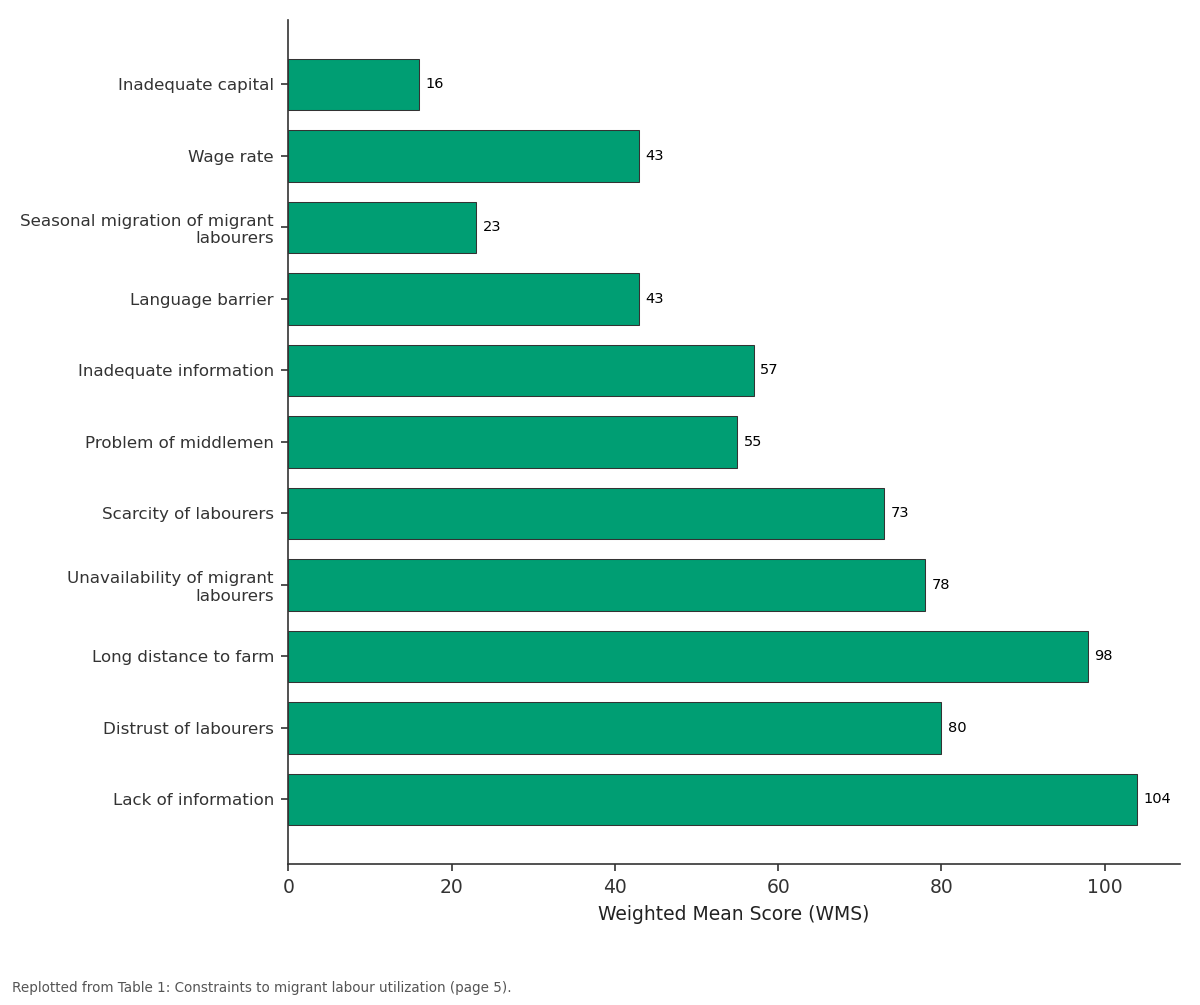
- The top three constraints to utilizing migrant labor were inadequate capital, wage rates, and the seasonal migration of the laborers. View evidence ↗
- Age, educational status, and farm size were significantly related to the constraints farmers faced when using migrant labor. View evidence ↗
What it means
- The authors recommend that farming households embrace the use of migrant laborers because they are available and perceived to be better skilled. View evidence ↗
Visual summary
1 visualsIllustrations explain the paper; charts are replotted from the paper's own table values.
NS: Inadequate capital vs Wage rate vs Seasonal migration of... vs Language barrier vs Inadequate information
Replotted from Table 1 (page 5) of the original paper. Every bar is the paper's own table value.
View source evidence ↗Figures & tables
From the original paper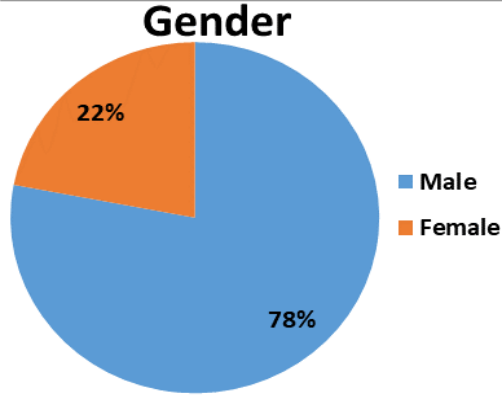 Figure 1
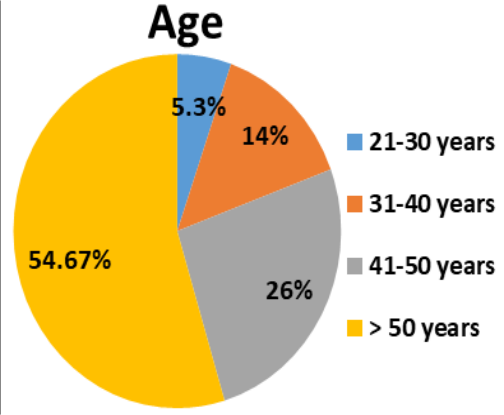 Figure 2
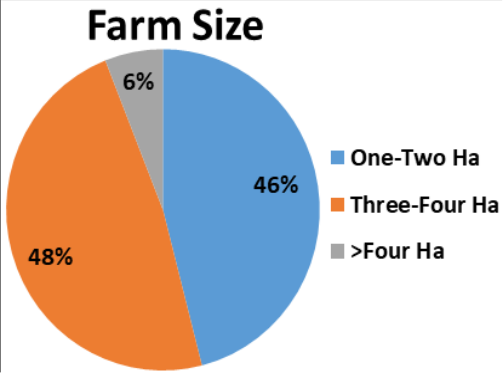 Figure 3
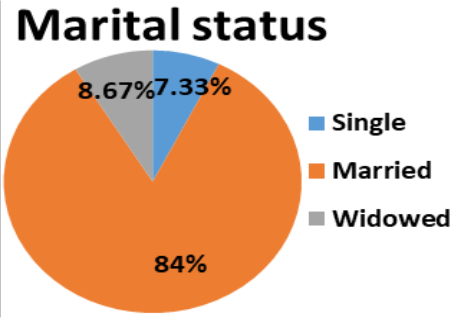 Figure 4
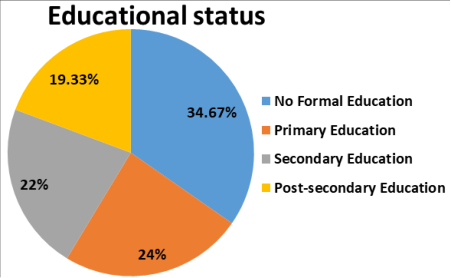 Figure 5
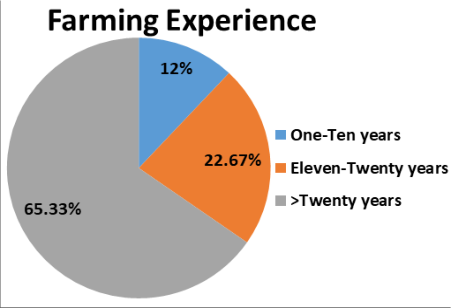 Figure 6
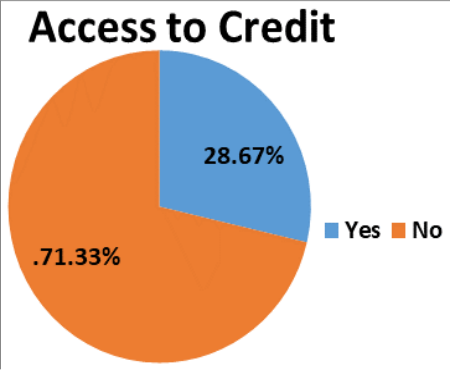 Figure 7
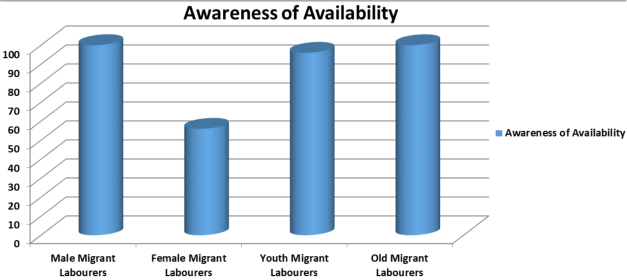 Figure 8
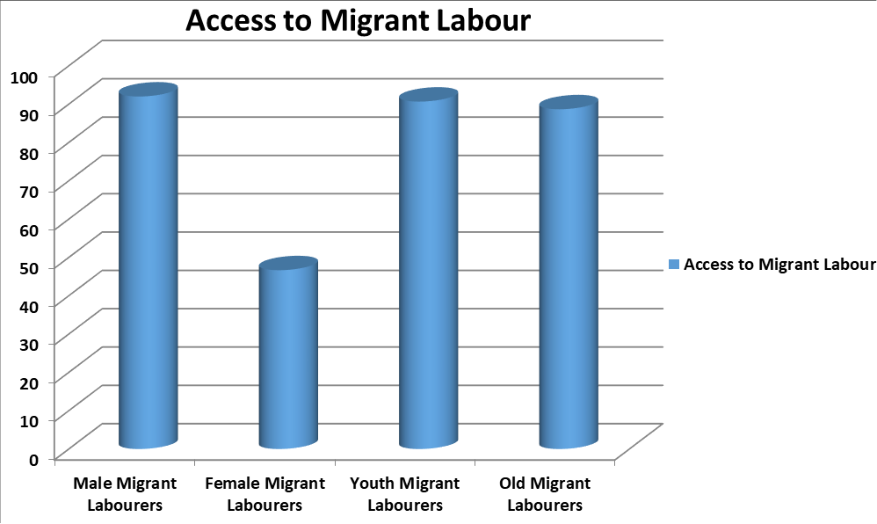 Figure 9
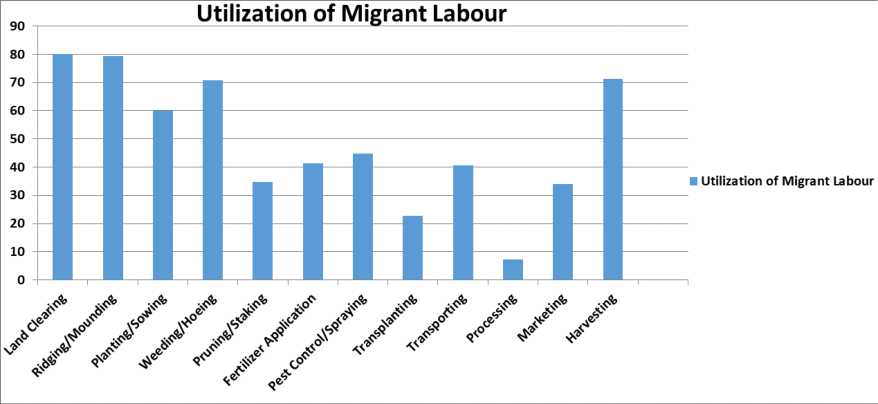 Figure 10
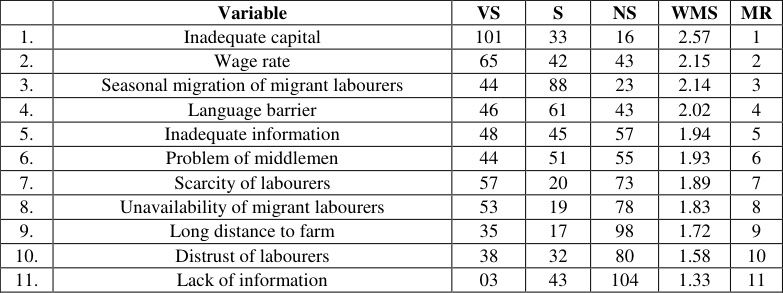 Table 1
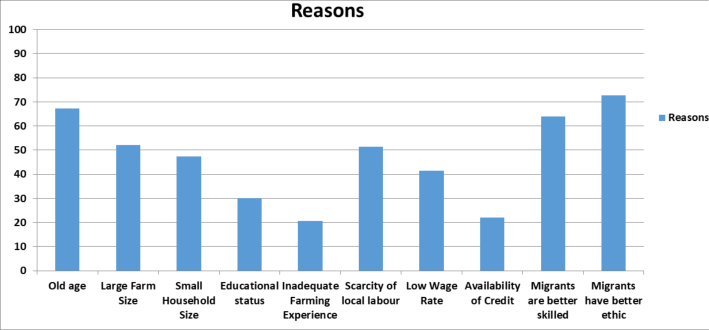 Figure 11
 Table 2
Introduction
Labour is a significant asset for smallholder households in the rural areas of Nigeria where agricultural production is majorly rain-fed and human labour-dependent. Olayide (2002) [16] asserted that about 90% of non-mechanized agricultural systems rely on human labour while in mechanized agricultural systems, an estimated 60% of farm duties is dependent on human effort. Hence, labour accessible to households in terms of capacity, education, expertise, and vigor make up the social capital that becomes the footing for the construction of household income and livelihood (Takane, 2008) [21] . Further, accessibility to labour influences timeliness of planting, effective weed and insect control, well-timed harvesting actions and general crop handling operations (Oluyole et al., 2007) [17] . Farm tasks constitute a most important source of work for the rural population and while industrial change has been a key force causing modifications in occupations and productivity, these changes have not reached the resource-poor farmers who cannot afford, for example, farm machinery and therefore continue to rely on human labour. Ergo, inaccessibility of labour is a chief limitation in agricultural production in Nigeria (Gocowski & Oduwole, 2003) [8] . The migration of humans is a significant component of population structure which can have substantial imports on both the source and destination. Migration has shaped the composition of receiving centres and places of origin. Ofuoku & Emerhi (2014) [13] and Afolabi (2007) [2] affirmed that rural-urban drift has untoward impacts on agrarian productivity and household livelihood via loss of active people in rural populations. The process of rural-urban or rural-rural migration creates empty spaces i.e. a labour vacuum in the sending area while creating abundance in the receiving areas. The effect of these vacuum in agrarian economies cannot be exaggerated, specifically with respect to interference in rural incomes. Emigration leads to radically constricted labour force, which leads to reduced lands under cultivation with the final consequence being limited availability of food, amplified vulnerability, and food insecurity (FAO, 2017) [6] . Conversely, urban-rural or rural-rural drift has largely upped farm outputs whereas the number of economically active people in agriculture has also increased (Majid, 2004) [10] . In the same vein, migrants may move to areas where their skills and abilities are needed and can be drivers of innovation making key impacts on the agricultural activities of such areas. The importance of a steady supply of human labour to Nigerian agriculture where smallholder stakeholders generate more than 85% of local production in Nigeria (Akanni & Dada, 2012) [3] cannot be overstressed and since hired labour contributes 88% of the total labouruse on farms (Okuneye, 2002) [15] , a study of migrant labour use among farm household is at the same time timely as it is expedient. In the light of this, the study therefore assessed utilization of migrant labour for agricultural activities among farming households as well as the constraints to its www.extensionjournal.com use among farming households.
Materials and Methods
The investigation was carried out in Kogi State. Specifically, it was carried out in Mopamuro, Yagba West and Yagba East Local Government Areas (LGAs) of the state. The three local governments are a part of the 21 LGAs in Kogi state. Geopolitically, they constitute the Yagba Federal constituency. The study area was selected because of the great number of migrant settlements along the belt and consequently abundance of migrant labourers. A threestage sampling procedure was used in selecting respondents. The first stage was a purposive selection of three LGAs due to the abundance of migrant labourers. The second stage involved a random selection of five communities each from the three local governments selected making a total of fifteen communities from a list of the communities. The final stage involved a random selection of ten farm household heads each from the fifteen (15) selected communities making a total of one hundred and fifty (150) farmers. Data was collected with the use of an interview schedule due to low level of education among respondents. The data collected was analyzed using descriptive and inferential analytical tools. Employing descriptive statistics entailed the use of frequency counts, bar charts, pie charts, means, ranks and percentages while Chi square was used in testing the hypothesis of the study.
Results and Discussion Distribution of respondents based on socioeconomic characteristics
Source: Field survey, 2021 Results show that majority (78%) of the respondents were male while females constitute 22%. This could be attributed to the patriarchal nature of Nigerian societies. This finding corroborates that of Ibitoye, (2013) [9] who reported that more men were found in farming than women in Kogi state. As indicated in the figure above, more than half (54.67%) of the respondents were above fifty years, 26% were between the age of 41-50 while only a total of 19.33% were between the age of 21-40. This result suggests that the study area is dominated by the aged which may necessitate the need for hired labour. This agrees with finding of Owojaiye et al. (2019) [20] that the majority of household heads are advanced in age. Findings reveal that 46% of the total respondents had farm size between 1-2 hectares with another 48% of respondents having between 3-4 hectares. This situation is typical of farming in sub-Sahara Africa which is characterized by small land holding (Giller et al, 2021) [7] . Only a paltry 6% have more than four hectares of farmland. The smallholdings continue to ensure that farmers do not enjoy the economies of scale and limit their rise from poverty. www.extensionjournal.com Source: Field survey, 2021 As shown in figure 4, 84% of the respondents were married while only 7.33% were single. The large percentage of married respondents suggests that marriage is highly valued in the study area and could lead to increased household sizes with possible consequences on the supply of labour for agricultural activities (Oluyole et al., 2013) [18] . Source: Field survey, 2021 The distribution according to educational levels show that 34.67% had no formal education. About 24% of them had primary education, while about 22% others had received some form of secondary school education. About 19.33% had one form of post-secondary education or the other. The education index has consequences on farm decision-making in allocation of resources, supply of commodities and adoption of innovation (Ojoko, 2001) [14] .
Source: Field survey, 2021
Source: Field survey, 2021
Source: Field survey, 2021
Source: Field survey, 2021 [4] . The result demonstrates that reasonable farming experience among household heads in the study area. Less than one-quarter of respondents (28.67%) had access to credit while majority (71.33%) of them did not have access to credit. This is in tandem with findings by Aderinoye-Abdulwahab, et al. (2015) [1] that access to credit constitutes a most important constraint for farmers.
Source: Field survey, 2021
Source: Field survey, 2021
Utilization for agricultural activities
Results presented in the figure above shows that all (100.0%) of the respondents were aware of the availability of male migrant labourers while only a little more than half (56.0%) of the respondents were aware of the availability of female migrant labourers. 96.0% and 100% of the respondents were aware of the availability of youth migrant labourers and old migrant labourers respectively. This connotes a high level of awareness of availability of migrant labour among respondents. Aromolaran et al. (2017) [5] described awareness as the first stage in adoption process.
The figure above reveals that majority (92.0%) of respondents had access to the male migrant labourers while less than half (46.67%) of the respondents had access to female migrant labourers for use on their farms. This suggests that the male migrant labourers are more abundant than female migrant labourers. Also, 90.67% and 88.67% of the respondents had access to youth migrant labourers and older migrant labourers respectively. This is similar to the study by Akanni & Dada (2012) [3] which showed that among hired labourers, male labourers made up the majority of overall labour-use portfolio. This finding shows that majority (80%) of respondents had used migrant labourers for land clearing while 79.33% used them for ridging/mounding, 70.67% for weeding/hoeing, 60% for planting/sowing and 71.33% for harvesting. There was however, a low usage of migrant labourers for pruning/staking (34.67%), fertilizer application (41.33%), and pest control/spraying (44.67%). Others included transplanting (22.67%), processing (7.33%), marketing (34%) and transporting (40.67%). It implies that majority of the respondents had employed migrant labourers for one www.extensionjournal.com agricultural operation or the other. The findings also substantiate those of Oluyole et al. (2013) [18] that hired labourers were majorly used for land clearing; seed planting/sowing weeding/hoeing and harvesting.
Distribution of respondents according to their reasons behind migrant labour use
Source: Field survey, 2021 [4] . This absence of young men and women in rural areas is not unconnected to meagre incomes, inadequate economic, health and social infrastructure. (Oluyole et al., 2013) [18] . About 64% of respondents employ migrant labourers on their farms because they hold them to be better skilled. 1 shows constraints to migrant labour utilization among respondents. Chief among the constraints are inadequate capital (ranked 1 st ), wage rate (ranked 2 nd ) and seasonal migration of migrant labourers (ranked 3 rd ). According to Nsikak-Abasi & Glory (2013) [12] , smallholders are incapable of securing credit facilities from formal institutions because of stringent terms, prolonged processes and bottlenecks, along with exorbitant charges including interests and other associated charges. The barrier posed by language often necessitates a middleman and maybe a source of discouragement from taking on migrant labourers on season contracts. Annually, during the year-end festive period or during the Ramadan fast, many migrant labourers return to their local areas to stay with their people returning after such landmark events may have passed. Others include language (ranked 4th) and the problem of middlemen (ranked 6th). Those not considered to be major constraints are unavailability of migrant labourers (ranked 8th) Long distance to farm (ranked 9th) and distrust of migrant labourers (ranked 10th). The findings are in similitude with Uwagboe et al. (2010) [22] and Musa, et al. (2013) [112] that inadequate capital and inadequate credit facility are the biggest problems of agricultural production.
Test of Hypothesis
As revealed in Table 2, among personal characteristics, age (𝜒 2 = 16.05%, P = 0.003), Educational status (𝜒 2 = 15.345, P=0.012) and farm size (𝜒 2 = 13.143, P = 0.0011) were found to be significantly related to constraints to migrant labour utilization. This implies that the aforementioned selected characteristics influence the intensity of the constraints to migrant labour use; the null hypothesis is therefore rejected. Age influences degree to which www.extensionjournal.com constraints affect the farmers in that older farmers are more susceptible to the vagaries of life, this aligns with findings by Anyiro et al. (2013) [4] that increase in age might lead to reduction in labour use efficiency. Educational status is significant because the more educated farmers may have access to higher incomes, which might influence their ability to hire and utilize labour efficiently than the lesser educated ones, which is in agreement with (Sofoluwe, et al., 2011) [20] that education improves the aptitude of stakeholders to allocate their resources proficiently. The significant relationship between socio-economic characteristics and constraints suggests that farmers are still plagued with a lot of labour related challenges in their farming activities.
| Characteristics | Chi-Square Value | Degree of Freedom | P-Value | Remarks |
|---|---|---|---|---|
| Age | 16.045 | 3 | 0.003 | Significant |
| Educational status | 15.345 | 3 | 0.012 | Significant |
| Farm Size | 13.143 | 2 | 0.011 | Significant |
Table text extracted from the original PDF; superscript letters are shown inline. The original table image is below.
View original table image
Conclusion
There is high level of awareness of availability and access to migrant labourers among farming households. Similarly, the use of migrant labourers for farming activities is pervasive with land clearing ridging/mounding, weeding, planting and harvesting being the major operations for which they are employed. The foremost reason for migrant labour utilization is perceived better work ethic while the major constraints to their utilization among farming households are inadequate capital, wage rate and seasonal migration of the labourers. Age, educational status, and farm size were found to be significantly related to constraints to migrant labour utilization. It is therefore recommended that farming households adopt the use of migrant labourers given their availability and the perception that they are better skilled. This will engender employment and increase food availability, a key pillar of food security.
Figures and tables from the paper
| — | Variable | VS | S | NS | WMS | MR |
|---|---|---|---|---|---|---|
| 1. | Inadequate capital | 101 | 33 | 16 | 2.57 | 1 |
| 2. | Wage rate | 65 | 42 | 43 | 2.15 | 2 |
| 3. | Seasonal migration of migrant labourers | 44 | 88 | 23 | 2.14 | 3 |
| 4. | Language barrier | 46 | 61 | 43 | 2.02 | 4 |
| 5. | Inadequate information | 48 | 45 | 57 | 1.94 | 5 |
| 6. | Problem of middlemen | 44 | 51 | 55 | 1.93 | 6 |
| 7. | Scarcity of labourers | 57 | 20 | 73 | 1.89 | 7 |
| 8. | Unavailability of migrant labourers | 53 | 19 | 78 | 1.83 | 8 |
| 9. | Long distance to farm | 35 | 17 | 98 | 1.72 | 9 |
| 10. | Distrust of labourers | 38 | 32 | 80 | 1.58 | 10 |
| 11. | Lack of information | 03 | 43 | 104 | 1.33 | 11 |
Table text extracted from the original PDF; superscript letters are shown inline. The original table image is below.
View original table image
References
15 in the original paper- Aderinoye-Abdulwahab SA, Nwachukwu SC, Salawu OL Popoola PO. Assessment of Livelihood Activities of Rural Farmers in Kwara State. Ethiopian Journal of Environmental Studies & Management. 2015;8(2):120129. DOI: http://dx.doi.org/10.4314/ejesm.v8i2.2
- Akanni KA, Dada AO Analysis of Labour-Use Patterns among Small-Holder Cocoa Farmers in South Western Nigeria. Journal of Agricultural Science and Technology. 2012;2(1):107-113.
- Anyiro CO, Emerole CO, Osondu CK, Udah SC, Ugorji SE. Labour-use efficiency by smallholder yam farmers in Abia state Nigeria: a labour-use requirement frontier approach. International Journal of Food and Agricultural Economics. 2013;1(1):151-163.
- Aromolaran AK, Akerele D, Oyekunle O, Sotola EA, Taiwo K. Attitudes of Farmers to Extension Trainings in Nigeria: Implications for Adoption of Improved Agricultural Technologies in Ogun State Southwest Region. Journal of agricultural sciences. 2017;62(4):423-443. https://doi.org/10.2298/JAS1704423K
- Ibitoye SJ. Survey of the Performance of Agricultural Cooperative Societies in Kogi State, Nigeria. European Scientific Journal (ESJ). 2013;8(24):98-114.
- Musa YN, Reuben J, Magaji IY. Problems associated with agricultural produce marketing in Nigeria: the experience of milled rice women marketers from southern Taraba State, Nigeria. Research Journal of Agricultural and Environmental Management. 2013;2(1):22-26.
- Nsikak-Abasi AE, Glory EE. Constraints of the Nigerian Agricultural Sector: A Review. British Journal of Science. 2013;10(1):22-32.
- Ofuoku AU, Emerhi EA. Effect of Rural-Urban Labour Migration on Rural Household Livelihoods and Rural Environment in Delta State, Nigeria. Global Journal of Science Frontier Research (D). 2014;14(7):36-51.
- Olayide MC. Technical Efficiency and productivity of maize producers Efficiency and productivity of Maize producers within and outside the Global. 2000 projects. Agricultural Economies. 2002;19(3):341-348.
- Oluyole KA, Adebiyi S, Adejumo MO. An assessment of the adoption of Cocoa rehabilitation techniques among Cocoa farmers in Ijebu East Local Government Area of Ogun State. Journal of Agricultural research and Policies. 2007;2(1):56-60.
- Oluyole KA, Dada OA, Oni OA, Adebiyi S, Oduwole www.extensionjournal.com OO. Farm Labour Structure and Its Determinants among Cocoa Farmers in Nigeria. American Journal of Rural Development. 2013;1(1):1-5.
- Owojaiye OB, Olaitan TR, Atibioke OA, Aina OB, Babatunde O, Akinola-soji B, et al. Rural-Urban Drift and Its Effects on Agricultural Labour in Yagba East Local Government Area of Kogi State, Nigeria. International Journal of Scientific and Research Publications. 2019;9(3):411-418.
- Sofoluwe NA, Tijani AA, Baruwa OI. Farmers' perception and adaptation to climate change in Osun State, Nigeria. African Journal of Agricultural Research. 2011;6(20):4789-4794.
- Takane T. Labor use in smallholder agriculture in Malawi: Six village case studies. African Study Monographs. 2008;29(4):183-200.
- Uwagboe EO, Adeogun SO, Odebode SO. Constraints of farmers in cashew production: a case study of Orire L.G.A. of Oyo state, Nigeria. ARPN Journal of Agricultural and Biological Science. 2010;5(4):27-31.