
Research article · 2023 · Full text
International Journal of Agriculture Extension and Social DevelopmentPerformance and activities of Swachh Bharat Abhiyan in Ayodhya district
Volume 6(2) · Pages 19–20 · DOI: 10.33545/26180723.2023.v6.i2a.188 ↗
Research areasDiverse Scientific Research StudiesSocial and Economic Development in IndiaCOVID-19 Pandemic Impacts
Abstract
Author-writtenAccording to the report of United Nation, it was found that 55% people in India were defecating in the open even after the completion of 60 years of the independence. The government of India took many initiatives but due to irrelevant behaviour in order to address this challenge was responsible for the many risks faced by the respondents. Considering these situations, Swachh Bharat Abhiyan has been introduced by our present Prime Minister Shri Narendra Modi on 2 October 2015 to make dream of clean India a reality by 2019. This mission has led to increase the level of awareness regarding sanitation and hygiene, influence attitude of the people towards cleanliness and promotion of practices such as use of toilets to defecate, hand washing after and before defecation. With a similar aim, the present study was also conducted to evaluate performance and activities of the selected respondents. The study revealed that the extent of performance and activities of the respondents under Swachh Bharat Abhiyan was also found at moderate level.
Summary
Source-checkedPlain-language reading of the full paper, prepared with AI and checked against the text. Each point links to the authors' own words.
Why it matters
- Open defecation has been a significant challenge in India, with United Nations reporting that 55% of the population practiced it even 60 years after independence. View evidence ↗
- The Swachh Bharat Abhiyan was launched on October 2, 2015, with the goal of achieving a clean India by 2019. View evidence ↗
- The mission aims to improve sanitation and hygiene awareness, change attitudes toward cleanliness, and promote the use of toilets and handwashing. View evidence ↗
The question
- The objective of this study was to assess the performance and activities associated with the Swachh Bharat Abhiyan. View evidence ↗
What they did
- The study was conducted in the Ayodhya district of Uttar Pradesh. View evidence ↗
- Data was collected using an interview schedule consisting of 8 'Yes/No' questions. View evidence ↗
- Respondents were scored based on their answers, with one point given for positive responses and zero for negative ones (and vice versa for negatively phrased questions). View evidence ↗
What they found
- The majority of the respondents (56%) were categorized as having a medium level of performance and activity. View evidence ↗
- Among the respondents, 27% were in the high category and 17% were in the low category. View evidence ↗
- The overall mean score for performance and activities was 4.50, with a standard deviation of 2.35. View evidence ↗
What it means
- The authors concluded that the performance and activities of the respondents under the Swachh Bharat Abhiyan were at a moderate level. View evidence ↗
- The study was limited by its small sample size and its focus on only one district (Ayodhya) in Uttar Pradesh. View evidence ↗
- The authors suggest that future research should include a larger number of samples and cover more districts within Uttar Pradesh. View evidence ↗
Visual summary
1 visualsIllustrations explain the paper; charts are replotted from the paper's own table values.
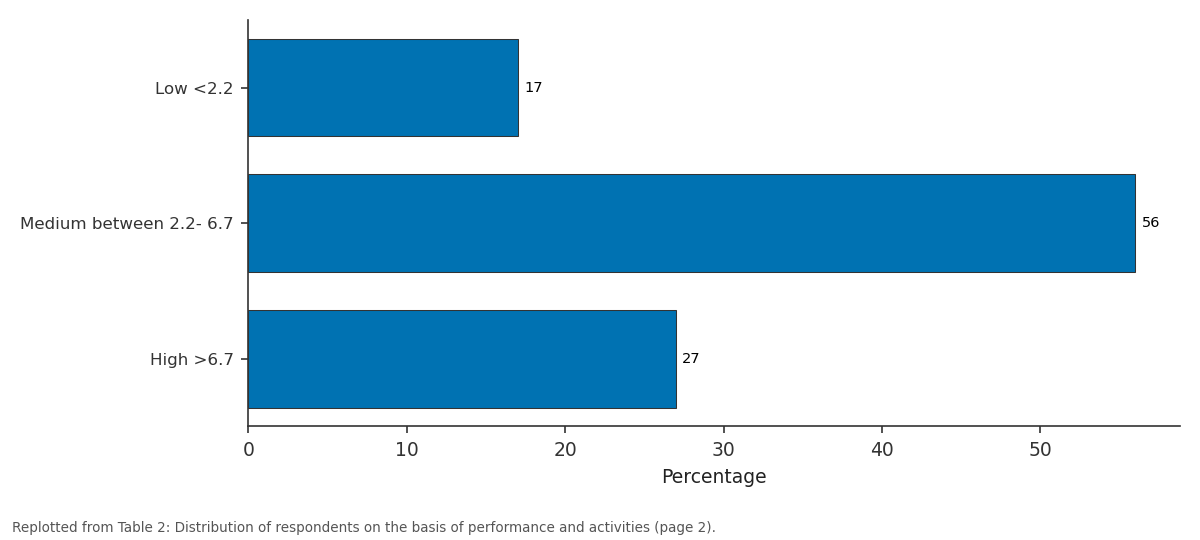
Percentage: Low <2.2 vs Medium between 2.2- 6.7 vs High >6.7
Replotted from Table 2 (page 2) of the original paper. Every bar is the paper's own table value.
View source evidence ↗Figures & tables
From the original paper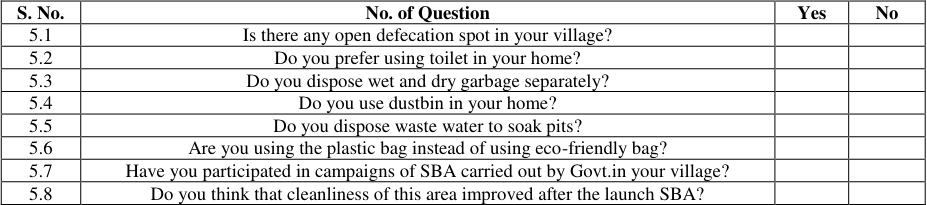 Table 1
 Table 2
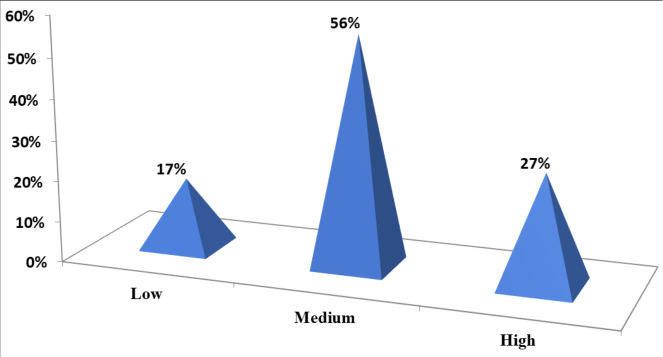 Figure 1
Introduction
Swachh Bharat Abhiyan is a community-based program. They tried to build up a community-based mass movement which termed as Jan-andolan and also community-based leadership. These are two hallmarks of the movement which differentiate it from the preceding initiatives of the government on sanitation or cleanliness. Ministry of drinking water and sanitation 2018 recently reported that there were 3,23,560 no. of villages, 1,42,757 no. of gram panchayats, 2893 no. of blocks, 314 no. of districts and 11 state of India became open defecation free.
The report showed that Arunanchal Pradesh, Chandigarh, Chhattisgarh, Daman and Diu and Gujarat had been reported with highest coverage (100%) of open defecation free where Bihar, Odisha And Uttar Pradesh had been reported lowest coverage. There have been a large number of people who were living below the poverty line which affected the status of education, health, sanitation and standards of living. So, keeping these facts in mind, the several objectives were framed under this study given below: 1.1 Objectives To assess the performance and activities of the Swachh Bharat Abhiyan.
Methodology
There are 75 districts in Uttar Pradesh in which Ayodhya district was selected for study. Out of 11 blocks of Ayodhya district 2 blocks Sohawal and Tarun were selected randomly. Out of these two blocks 2-2 villages from each blocks were selected and out of these 2-2 villages, 25-25 2. Medium Between (Mean standard deviation) 3.
High Above (Mean + standard deviation)
Results And Discussions
Perusal of table no. -2 reveals that majority of the respondents 56% were in the category of medium. While 27% respondents were in the category of high and 17% respondents were in the category low with mean score 4.50 and standard deviation 2.35. 19 International Journal of Agriculture Extension and Social Development https://www.extensionjournal.com Table 1: Performance and activities of the respondents under Swachh Bharat Mission- S. No. No. of Question Yes No 5.1 Is there any open defecation spot in your village? 5.2 Do you prefer using toilet in your home? 5.3 Do you dispose wet and dry garbage separately? 5.4 Do you use dustbin in your home? 5.5 Do you dispose waste water to soak pits? 5.6 Are you using the plastic bag instead of using eco-friendly bag? 5.7 Have you participated in campaigns of SBA carried out by Govt.in your village? 5.8 Do you think that cleanliness of this area improved after the launch SBA?
Table 2: Distribution of respondents on the basis of performance and activities Sl. No. Category Frequency Percentage Mean Standard deviation 1. Low <2.2 17 17% 4.50 2.35 2 Medium between 2.2- 6.7 56 56% 3 High >6.7 27 27% Fig 1: Distribution of respondents on the basis of performance and activities 6.
| Sl. No. | Category | Frequency | Percentage | Mean | Standard deviation |
|---|---|---|---|---|---|
| 1. | Low <2.2 | 17 | 17% | 4.50 | 2.35 |
| 2 | Medium between 2.2- 6.7 | 56 | 56% | ||
| 3 | High >6.7 | 27 | 27% |
Table text extracted from the original PDF; superscript letters are shown inline. The original table image is below.
View original table image
Kumar A, Das KC. drinking water and sanitation facility in India and its linkage with diarrhoea among children under 5; Evidence from recent data. International Journal h\Human Social Science Invent. 2014;3(4):50-60. 4. Suggestions The present study was limited to only one district of Uttar Pradesh namely Ayodhya with confined number of selected respondents. The suggestion is to conduct research study also in other districts of Uttar Pradesh with greater area and large number of samples.
References
5 in the original paper- Sharma, Singh SP. Job satisfaction among the extension person of Rajasthan; Indian journal Ext. Edu. 2001;37(3-4):206-208.
- Jain P, Malaiya S, Jain SA. Impacts of Swachh Bharat Abhiyan in India. International Journal of Humanities and Social Science Research. 2016;2(10):18-20.
- Kumar SK, Akoijam BS. Knowledge of personal hygiene and water borne diseases and practice of personal hygiene among student of central agricultural university Manipur, India. International Journal communication Medical public health. 2016;2(4):592- 595.
- Sankaran V. Water, sanitation, hygiene and Swachh Bharat: An anthropological analysis. Int. J Adv. Chem. Res. 2020;2(1):13-16. DOI: 10.33545/26646781.2020.v2.i1a.17
- Kuberan A, Singh AK, Kesav JB. Water and sanitation hygiene knowledge, attitude and practices among household members living in rural setting of India; natural science biological medical. 2015;6(3):69-75. 20